The Boys In Blue

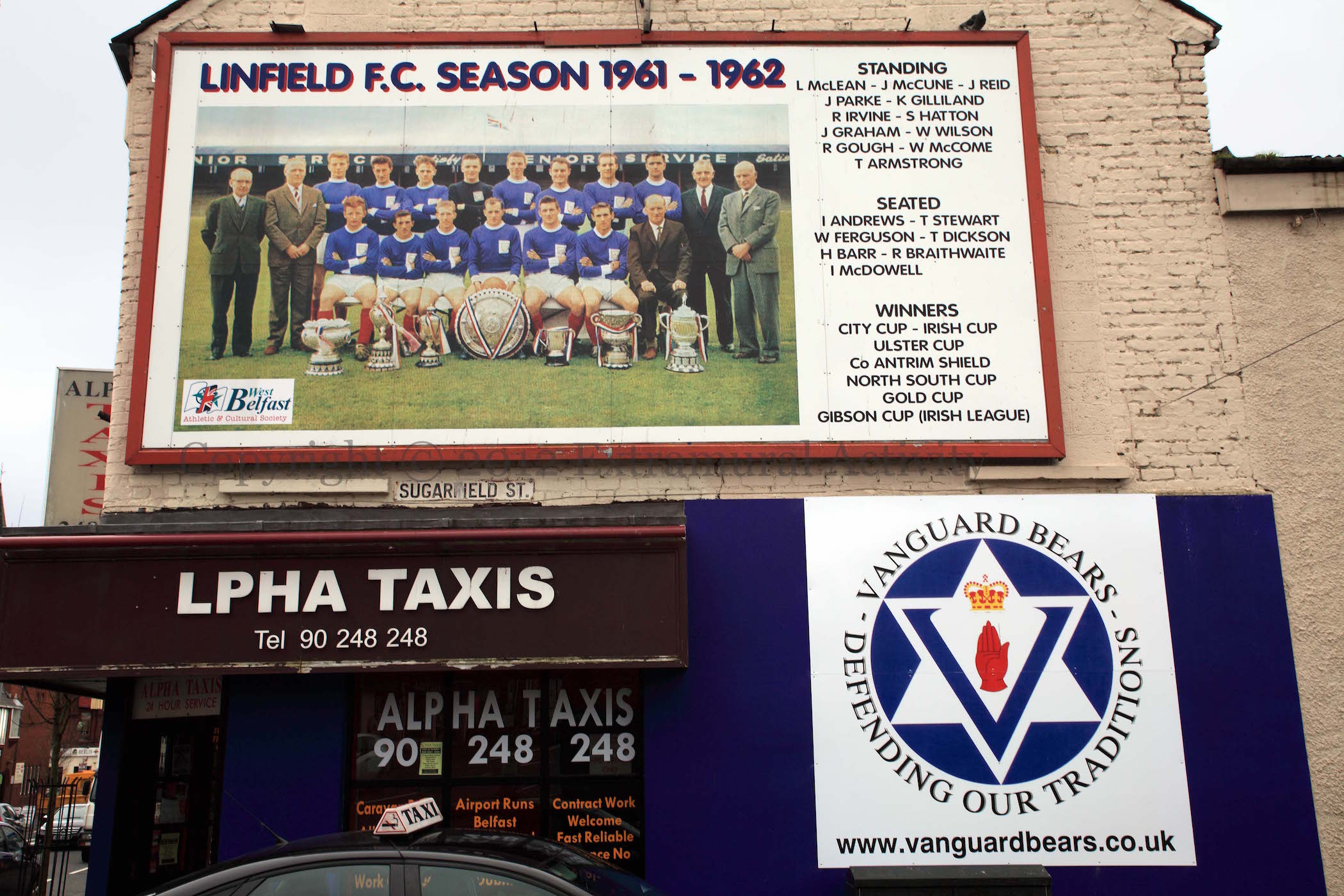
Linfield FC is a south-Belfast soccer club. The 1961-1962 season is one of two seven-trophy seasons in the club’s history, the first being 40 years previously in 1921-1922 (WP).

Vanguard Bears is a Rangers supporters club.

Click image to enlarge
Copyright © 2012 Seosamh Mac Coılle
X00856 Sugarfield St

Maghaberry Concentration Camp

“End forced strip searches, end internment [at] Maghaberry concentration camp”. Republican prisoners are held in the Roe House at Maghaberry. Several republican prisoners (as many as five) are conducting a “dirty protest” in response to conditions and treatment, including integration with loyalist prisoners (Irish Echo | BBC). The green ribbon as an emblem goes back to the campaign after the ceasefire to release POWs – here is a mural from 1995.

International Wall, Divis St.

Click image to enlarge
Copyright © 2012 Seosamh Mac Coılle
X05221

One Love

Jesus Of Nazareth with a crown of thorns – a stencil of unknown provenance at the shops next to the Andersonstown Iceland (long ago the Busy Bee).

Click image to enlarge
Copyright © 2012 Seosamh Mac Coılle
X00827

Hang Out Our Banners

“Hang out our banners … The cry is still “They come!”” – Shakespeare, Macbeth Act V, Scene V

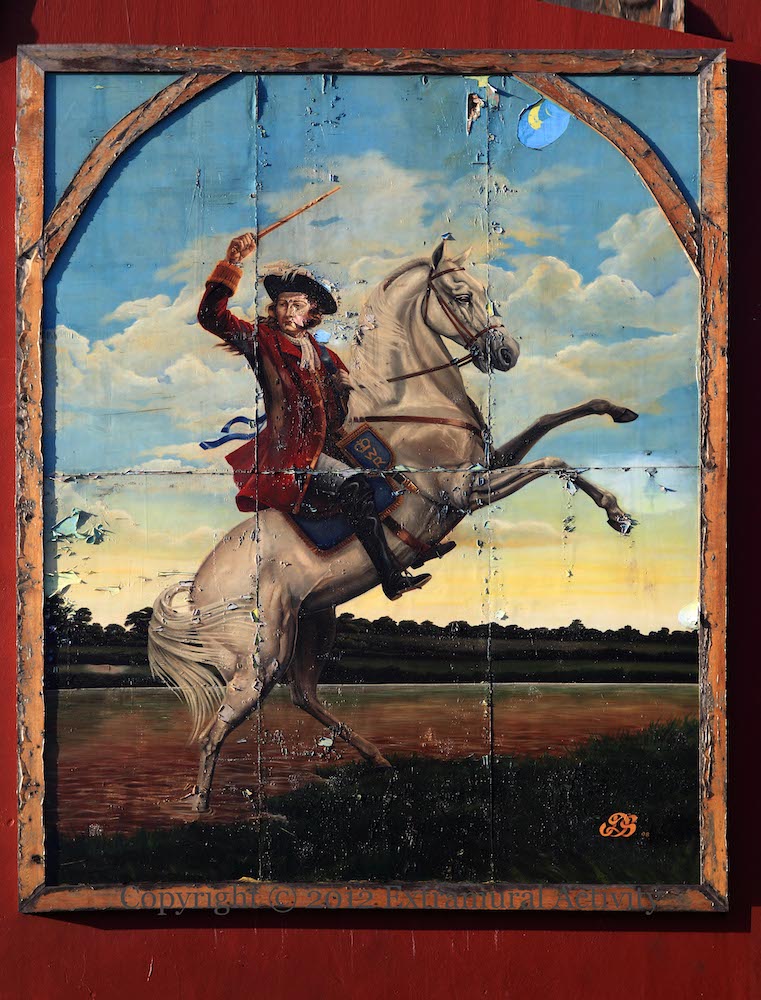
King Billy crossing the Boyne replaces a UFF ‘Eddie’ mural (see M02487) as part of the re-imaging of loyalist murals in 2008. Rolston (2012 p. 455) reports that the Arts Council thought King Billy was too divisive an image to replace the Village Eddie, but lost this particular battle (though Billy does not carry a sword but a stick/crop).

The info board, shown below, places the painting in the history of loyalist muraling as a return to traditional images after a period of paramilitary control.

By John Darren Sutton in Tavanagh Street, Belfast.
Click image to enlarge
Copyright © 2012 and 2017 Seosamh Mac Coılle
X00552 X04465 the info board would later (on/after 2019) be moved to Maldon St
“The first unionist mural was painted in 1908 on the Beersbridge Road in East Belfast by shipyard worker John McLean. It depicted King William at the Battle of the Boyne. This was the start of mural painting becoming a key element in the annual unionist celebration of the Battle of the Boyne, culminating in the Orange Order parades of July 12th. Murals, bunting, arches, painted flagstones, marked out the route of marches as well as adorning countless local areas. Between 1908 and the 1970s the vast bulk of unionist murals depicted King William at the Boyne. Other murals depicted the sinking of the Titanic, the 36th Ulster [sic] Division at the Battle of the Somme, and various royal weddings and anniversaries. Each unionist working class area vied with the neighbouring areas to have the best decorations for the Twelfth. As part of this rivalry, King William murals were painted and repainted year after year, with some surviving through six or more decades. The longest-surviving mural in the South Belfast area was in Rockland Street. It depicted King William on his white horse at the Battle of the Boyne. Painted first in the mid-1920s, it survived until the mid-1990s, when it became a victim first of the heat from an adjacent bonfire, and then of redevelopment. The King William murals began to fade from the walls in the 1970s, to be replaced with murals depicting flags and other inanimate emblems. Overall, the number of murals declined significantly in this decade. In the mid-1980s mural painting in unionist areas came under the control of loyalist paramilitary groups. From that point, the vast majority of murals in unionist areas depicted armed and hooded men. In recent years, the debate on mural painting inside and outside loyalist paramilitary organisations has led to the decline of the military iconography. This debate has led to many positive changes taking place throughout Northern Ireland and in January 2008 Greater Village Regeneration Trust secured funding through the Re-imaging Communities Programme to transform a number of areas within the village. This programme was established to help communities in both rural and urban areas to focus on positive ways of expressing  their culture and identity and to encourage the creation of vibrant and attractive shared spaces. Thanks to the overwhelming support and participation of the local community in the Re-imaging process. Local organisations, community leaders, residents and young people have worked closely with artists to tackle the displays of redundant sectarian imagery and replacing these with positive expressions of wider cultural celebration.