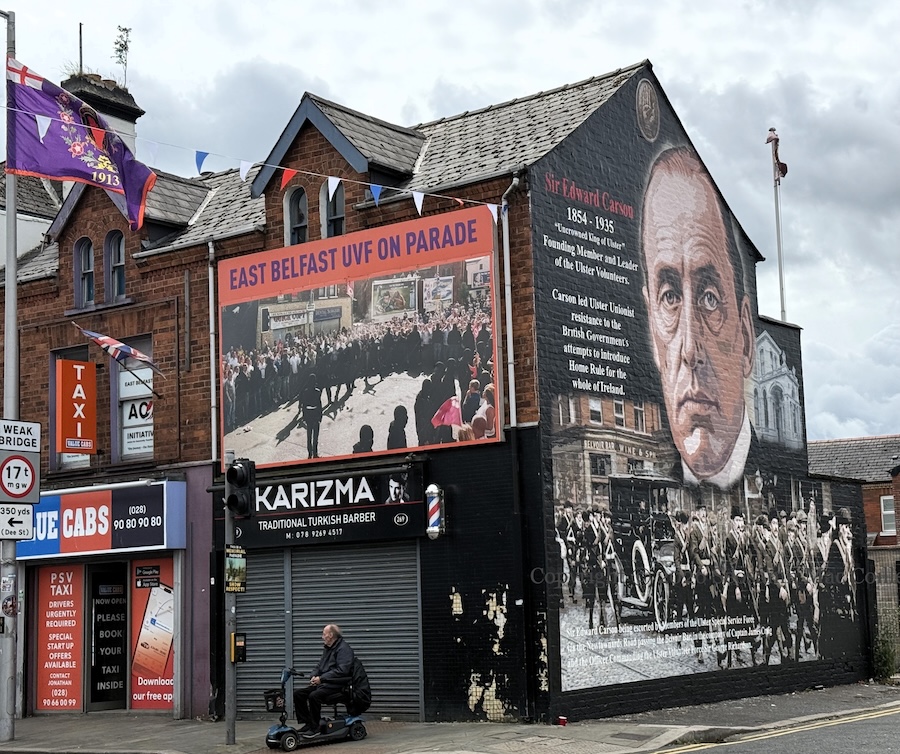
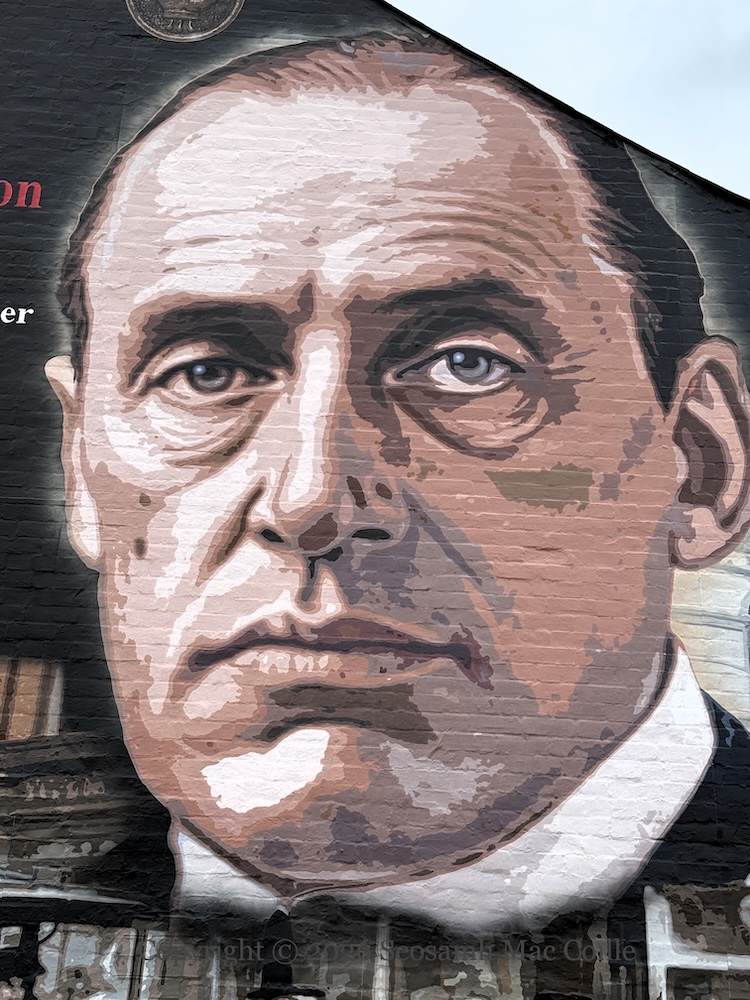
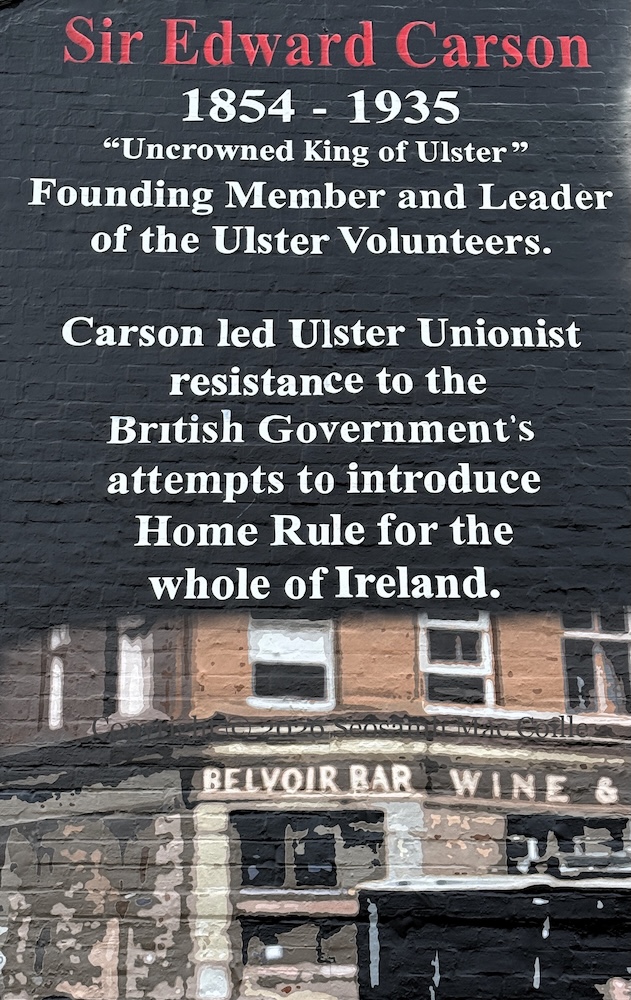
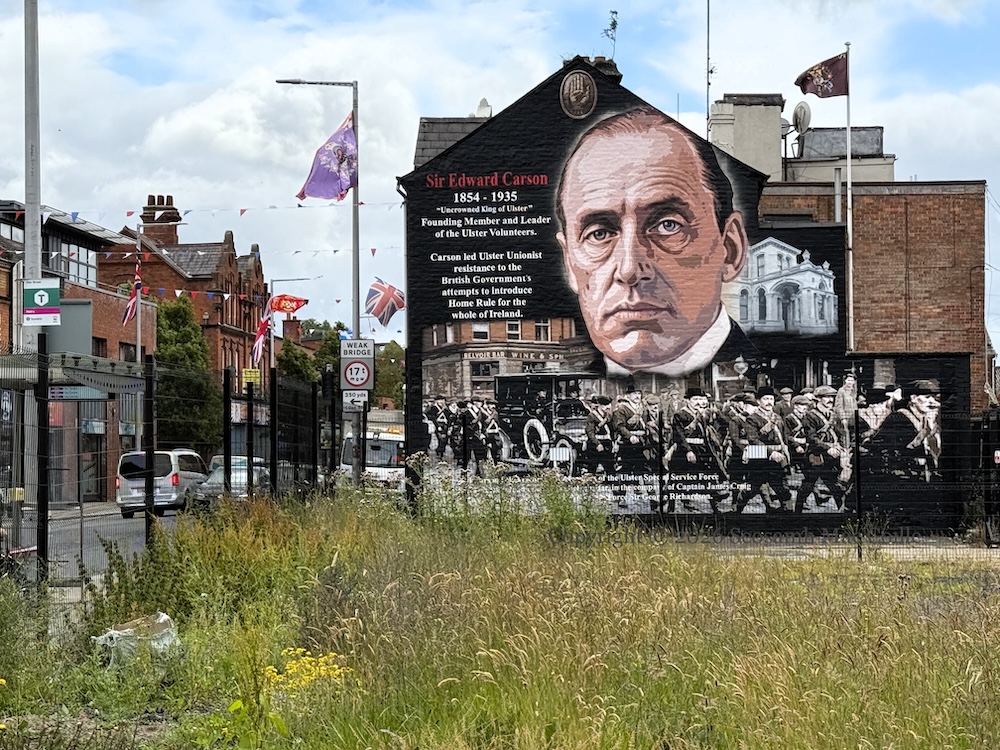
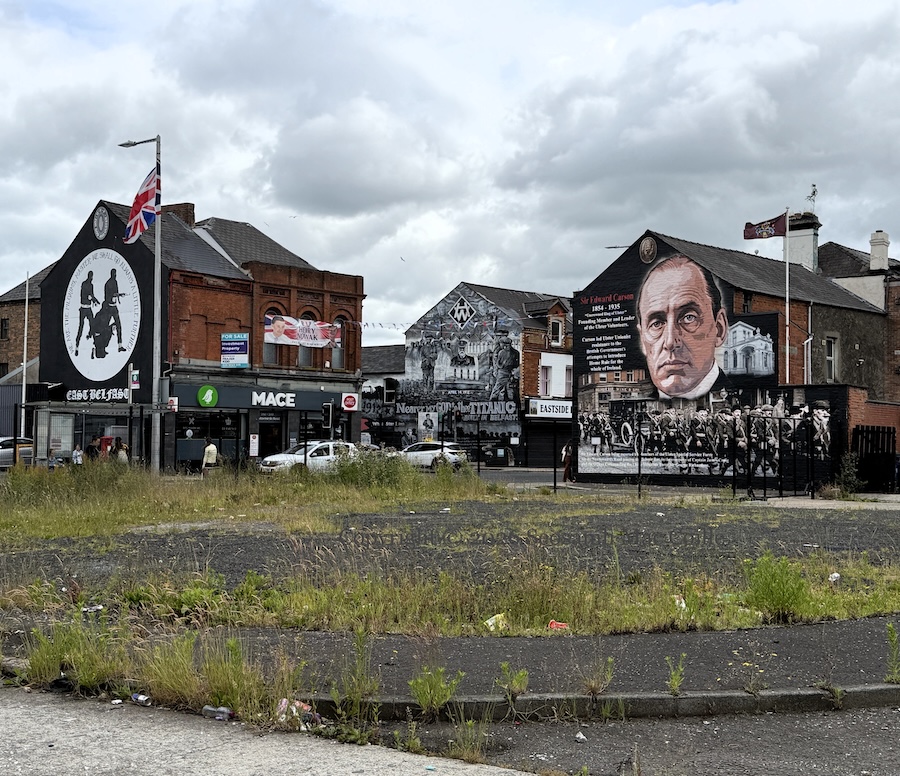
Text above: “Sir Edward Carson 1854 – 1935 “Uncrowned King of Ulster” Founding member and leader of the Ulster Volunteers. Carson led Ulster Unionist resistance to the British Government’s attempts to introduce Home Rule for the whole of Ireland.”
The epithet “uncrowned King” seems to be generally used of Carson and not attributable to any one source. Here is a September 1912 newspaper article that calls Carson the “uncrowned King of the North” and relays criticisms of a Carson reception in Portadown as “a parody upon a royal reception” and “an insult to the King”. A May 1914 review of (the book) The Reign Of Edward Carson refers to “King Carson”. (Here is a postcard depicting Carson as a king upon a throne – Postcards Ireland. And a cartoon showing “The Ulster King-At-Arms“.)
The phrase is an echo of and response to the phrase “uncrowned king of Ireland”, which was used of both O’Connell and Parnell. Here is an 1847 article describing both O’Connell and the Napoleonic Governor-General of Algeria (WP) as “uncrowned monarch[s]”. According to WP, the epithet was first applied to Parnell in 1880, because he was so popular during a tour of the United States and Canada. At the end of James Joyce’s story ‘Ivy Day In The Committee Room’ a character recites a poem about Parnell, beginning “He is dead. Our uncrowned king is dead” (archive.com).
The wording “the British government’s attempts to introduce Home Rule” is more forthright than we are used to. Typically the resistance is simply to “Home Rule”. This wording makes clear that the Ulster Volunteers were a private militia preparing for the possibility of fighting the regular British Army and Navy. By being so explicit, this wording suggests that we are currently living through a time in which loyalists consider the “British government” to be insufficiently British, just as was the case in 1912.
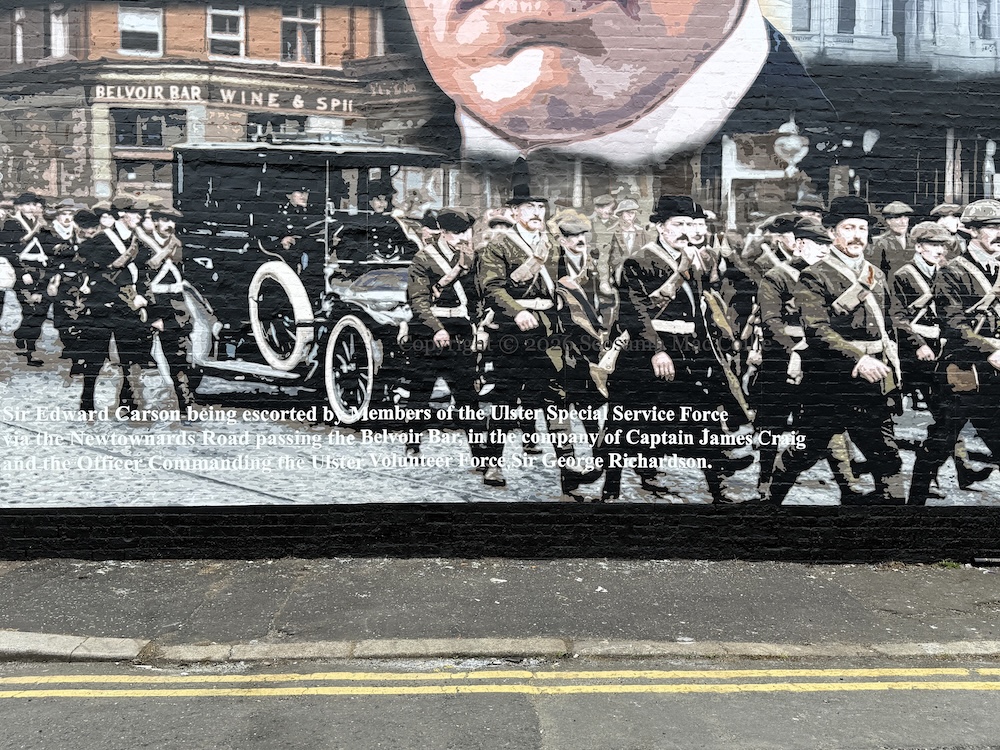
Text below: “Sir Edward Carson being escorted by members of the Ulster Special Service Force on the Newtownards Road passing the Belvoir Bar in the company of Captain James Craig and the Officer Commanding of the Ulster Volunteer Force Sir George Richardson.”
According to a Regimental Band Fb post, “Sir Edward Carson was speaking at the Reform Club in Royal Avenue. There was an opinion that the British Government were going to try and arrest him so he was escorted to the safety of Craigavon House [shown on the right of the mural]. This photo was taken on the 20th March, 1914.” This October 1913 article, in addition to calling Carson “Ulster’s Uncrowned King”, notes that he travelled with a detective and carried a revolver.
By Dee Craig (Fb), presumably, replacing his hooded gunmen mural The Right To Defend Yourself, on the Newtownards Road at (the former) Bright Street.
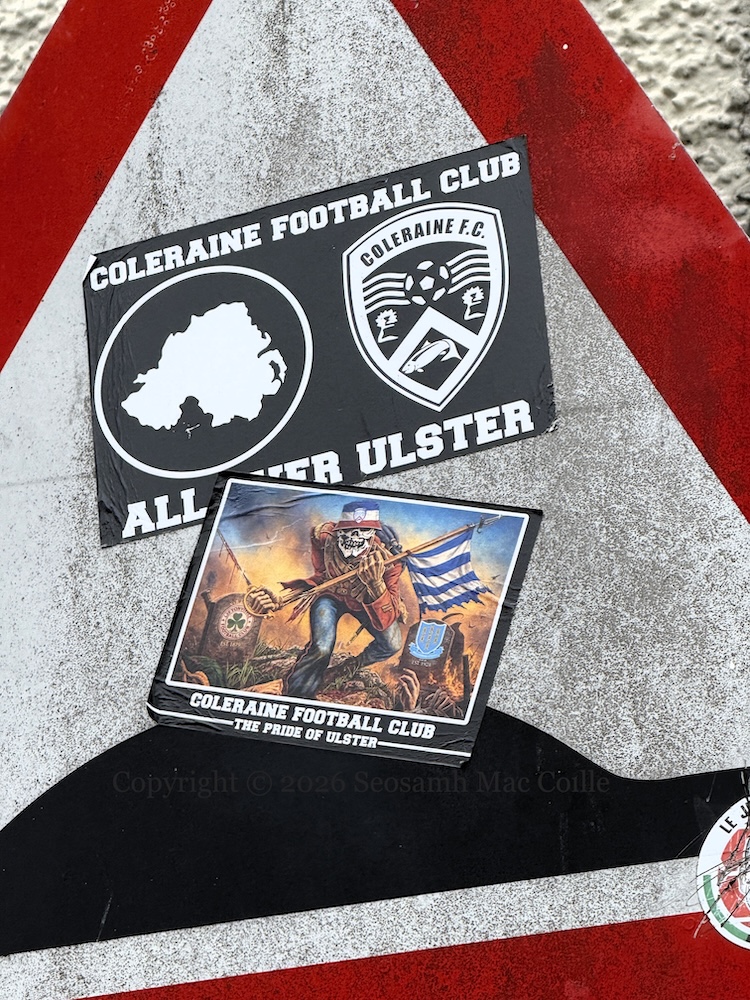
Eddie The Trooper makes an appearance as a Coleraine FC (“the pride of Ulster”) supporter, stomping on the grave of rival clubs Cliftonville (left) and Ballymena (right).
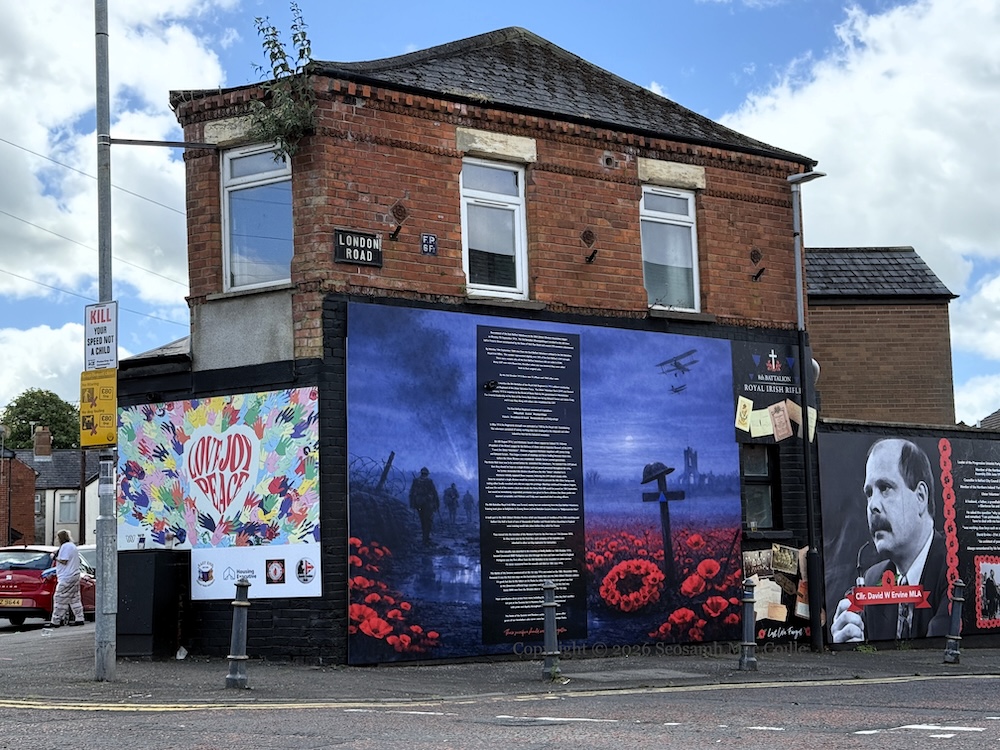
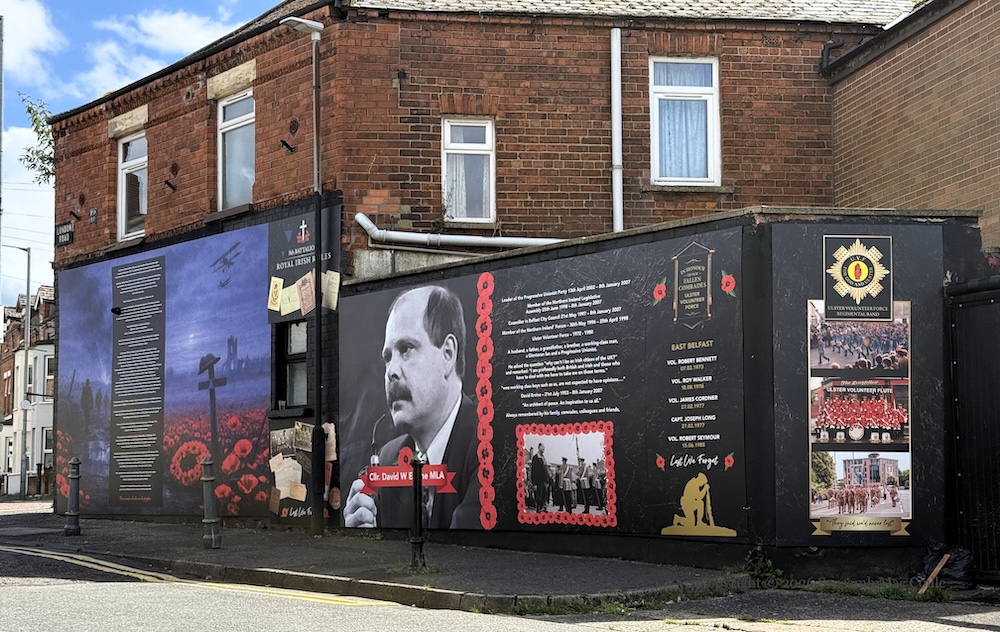
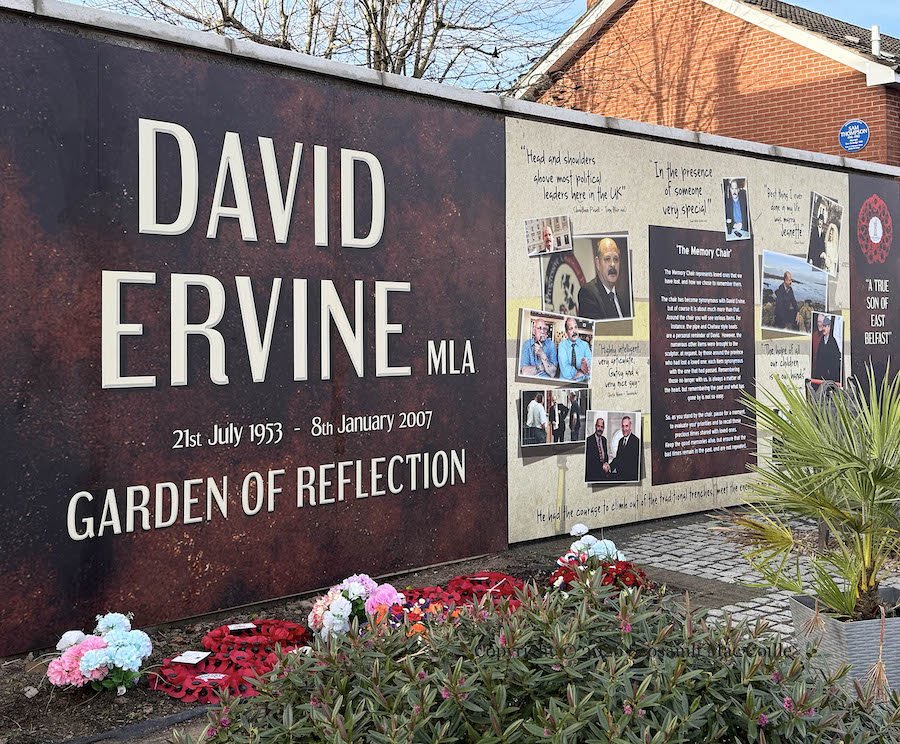
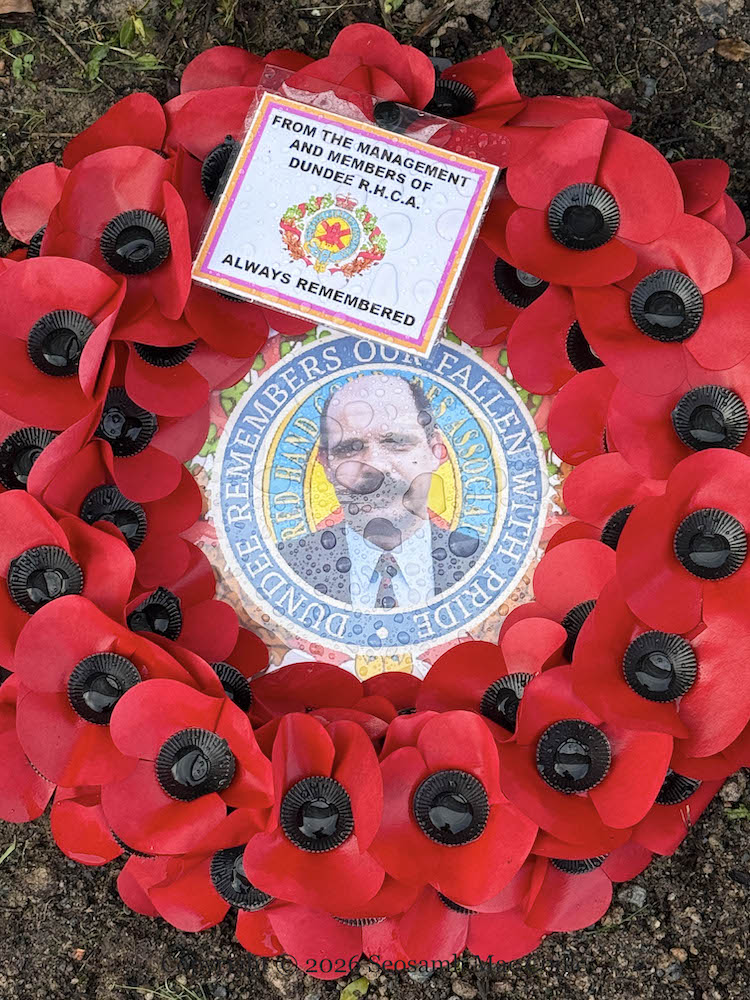
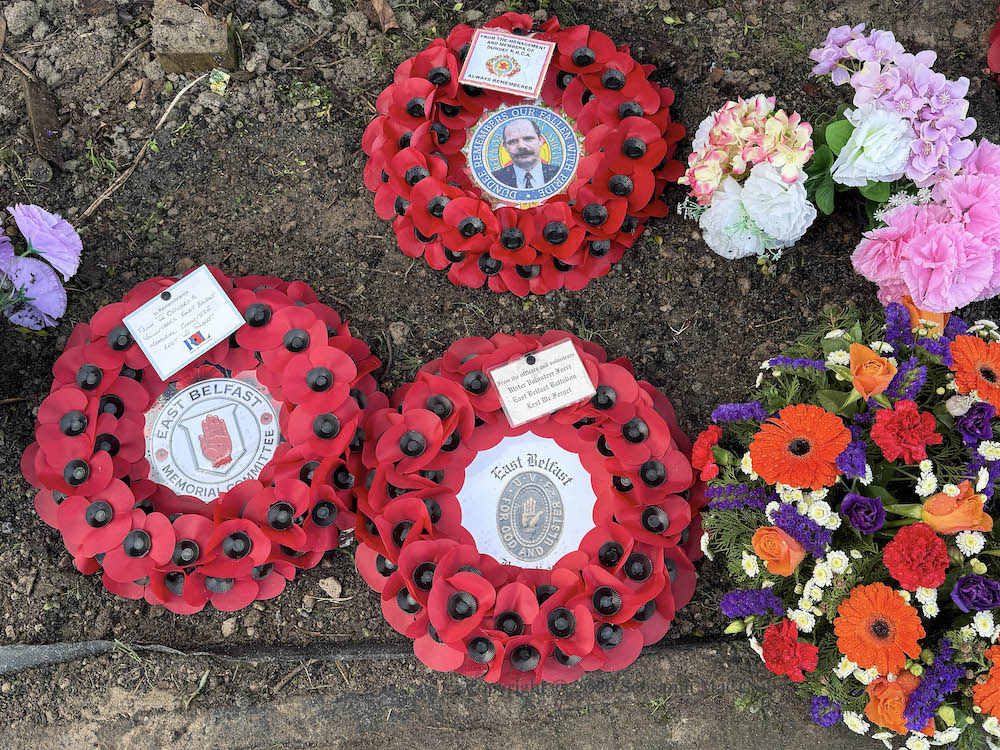
The UVF boards at the junction of London and My Lady’s roads in east Belfast have been completely replaced (compared to 2022). The hooded gunmen on the short side have been replaced by “Joy, peace, love” while a tribute to David Ervine now replaces the lettering reading “East Belfast Ulster Volunteer Force”. (For more about Ervine, and the UVF roll of honour, see the parallel entry in the Paddy Duffy Collection.)
The largest panel remains a tribute to the dead of WWI, specifically now the “3rd battalion (Mountpottinger)” of the East Belfast regiment of the Ulster Volunteers who “marched to the old town hall in Victoria Street accompanied by the Duke Of York Pipe Band and around 270 members volunteered”. The long text explains the negotiation between Kitchener and Craig over the formation of the 36th Division, that the East Belfast volunteers joined the 8th Battalion of the Royal Irish Rifles, and that “training took place at Ballykinlar in County Down and the Battalion became known as “Ballymacarret’s Own”.”
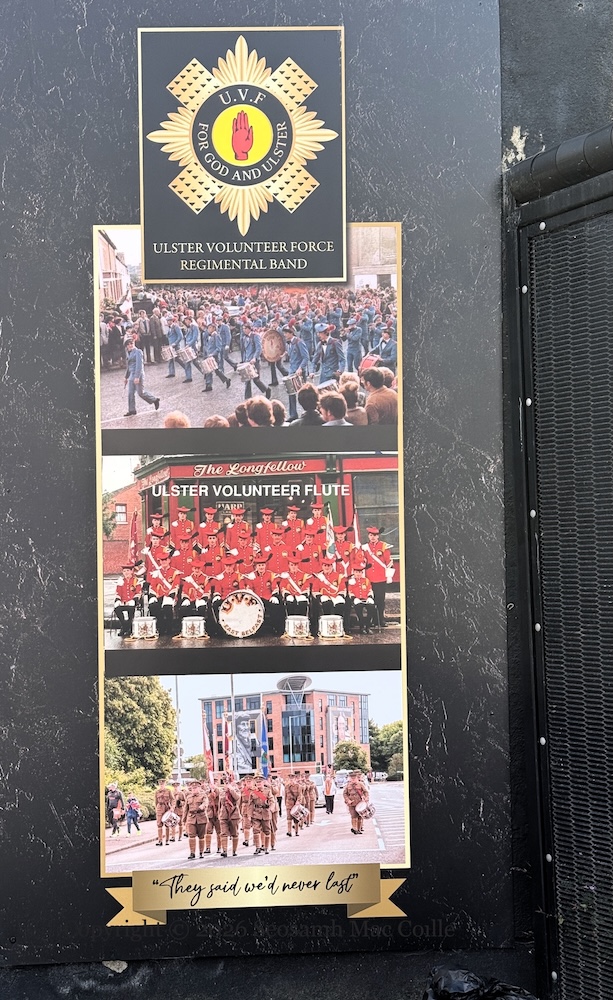
The final image shows the trio of photographs of the UVF flute band. The middle photograph has been changed since the launch, as it was of the band marching past the site of the 1992 Sean Graham bookies massacre to which family-members of the victims objected (Crime World) – again, see the parallel entry in the Paddy Duffy Collection. The photograph now in its place is of the band outside the Longfellow bar, which still stands in My Lady’s Road, facing these boards.
The full (and uncorrected) text of the central information board reads as follows: “Recruitment of the East Belfast Volunteers to the 36th (Ulster) Division Association began on Monday 7th September 1914. The 3rd Battalion (Mountpottinger) marched to the old town hall in Victoria Street accompanied by the Duke of York Pipe Band and around 270 members volunteered. By Monday 14th September 1044 men from the East Belfast Volunteers enlisted in the 8th Battalion, Royal Irish Rifles. This number represented slightly over 10% of the East Belfast’s UVF strength. There were reasons why all the East Belfast Volunteers did not enlist in 8 RIR. Many UVF men were Reservists, therefore when war was declared they were called back to their original units. By the 3rd October there was 15 officers and 1065 other ranks. [We] cannot mention the 8th Battalion of the Royal Irish Regiment in 1914 without mentioning th[e East] Belfast Regiment of the Ulster Volunteer Force. The Ulster Volunteer Force (UVF) was formed in January 1913 in response to the threat of Home Rule by the government in Westminster. The Unionist leadership at the time of the Home Rule Crises was led by Edward Carson and James Craig and it was they along with others who established the UVF. The East Belfast Regiment consisted of 6 battalions:– Willowfield, Avoniel, Mountpottinger, Victoria, Strandtown & Knock, Newtownbreda and Ballynafeigh. In May 1914 the Regiments strength as 7100 by the Royal Irish Constabulary. The volunteers consisted of mainly working-class men employed in the shipyards and other industries that fed the industrial revolution. On 6th August 1914, Lord Kitchener, issued a blunt request to Colonel T.E. Hickman (President of the British League for the Defence of Ulster and an Inspector General of the UVF): “I want the Ulster Volunteers”. Hickman suggested Kitchener negotiate with James Craig and Edward Carson. Thus began a month of meetings and horse trading between these men, before the Ulster Division was established. Initially Carson wanted guarantees. The Home Rule issue was to be sorted before he committed the volunteers. He insisted if the UVF joined, then they should be kept as a single division and not spread piecemeal throughout the army. He further demanded this division should have the title “Ulster” attached to it. Kitchener initially opposed these requests, believing the UVF should simply enlist. Once he accepted a single division would be created, he tried to prevent the title Ulster being used, noting other locally recruited units did not enjoy this privilege. Meetings continued throughout August, and near the end of the month a deal was struck: the Home Rule Bill would be passed on 18th September, but would be immediately suspended; permission was given to form a division; the Ulster prefix was deemed acceptable; and Hickman and Craig were appointed chief recruiting officers. The 8th Battalion Royal Irish Rifled was formed, mainly but not exclusively from the East Belfast Volunteers. Training took place at Ballykinlar in County Down and the Battalion became know as “Ballymacarrets Own”. It took part in the 36th (Ulster) Division Review which saw thousands of members of the 36th marching past Belfast City Hall in front of tens of thousands of families and friends before departing to England were training would take place before they sailed for France. They moved into the trenches of the Western Front for the first time on 11 October 1915. As they were new to the fron line, each company of the battalion was attached to other serving regiments for instruction. The first casualty was recorded in the trenches at Mailly-Maillet on 15th October 1915. Second Lieutenant RME Pettigrew was shot through the face later sent back to England. Pettigrew was the first officer from the 8th Battalion to be wounded on active service. He never recovered from his wounds and died on 10th June 1916. The Battle of the Somme commenced on the 1st July 1916 and ended on the 18th November 1916. However it was the first two days on the horrendous battle that saw the 36th (Ulster) Division achieve it’s goals but due to the failure on it’s flanks by other Divisions the land gained was lost as the Ulstermen suffered huge casualties and left the frontline on the 2nd July. Some 5000 men from the Division died or where injured on the 1st July. Their contribution drew priase from many including the King and to this day their sacrifice not just at the Somme but in Flanders Fields, Belgium is remembered with pride and dignity throughout the province of Ulster. The fields of the Somme and Flanders contain grave after grave after grave of our forefathers who never came home and lie in foreign fields. Their sacrifice should never be forgotten.”
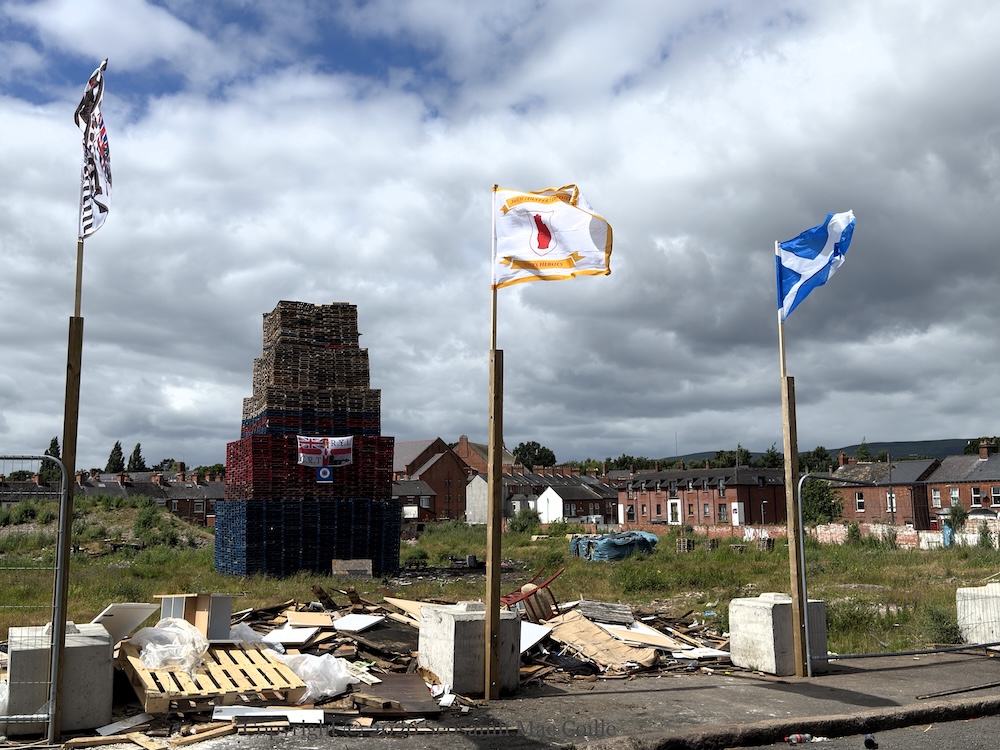
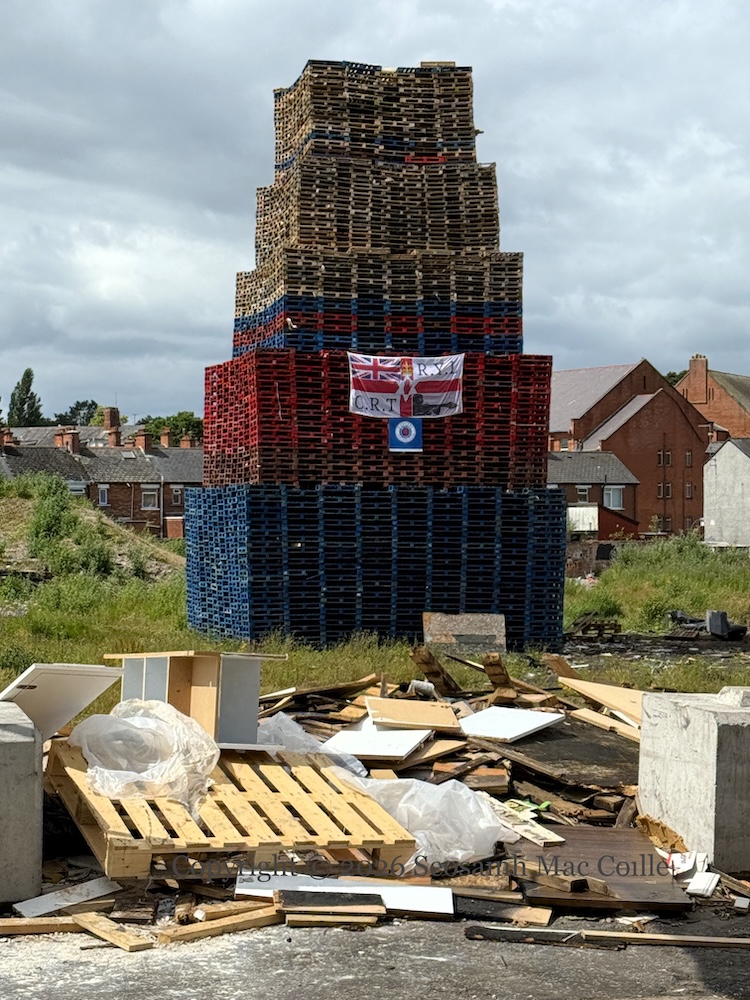
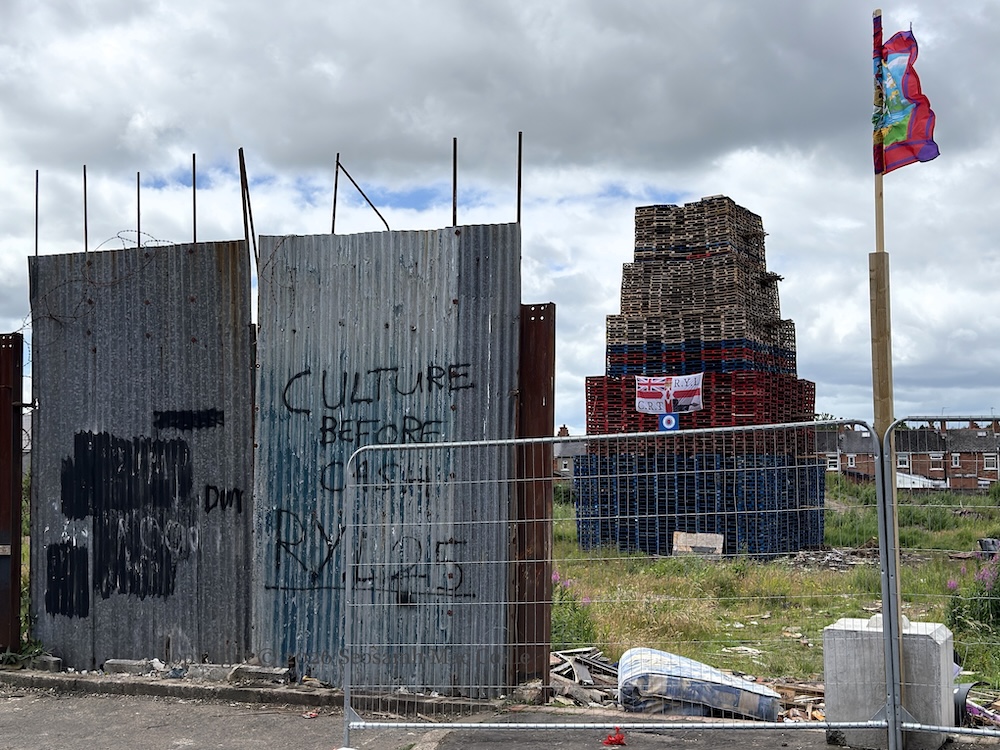
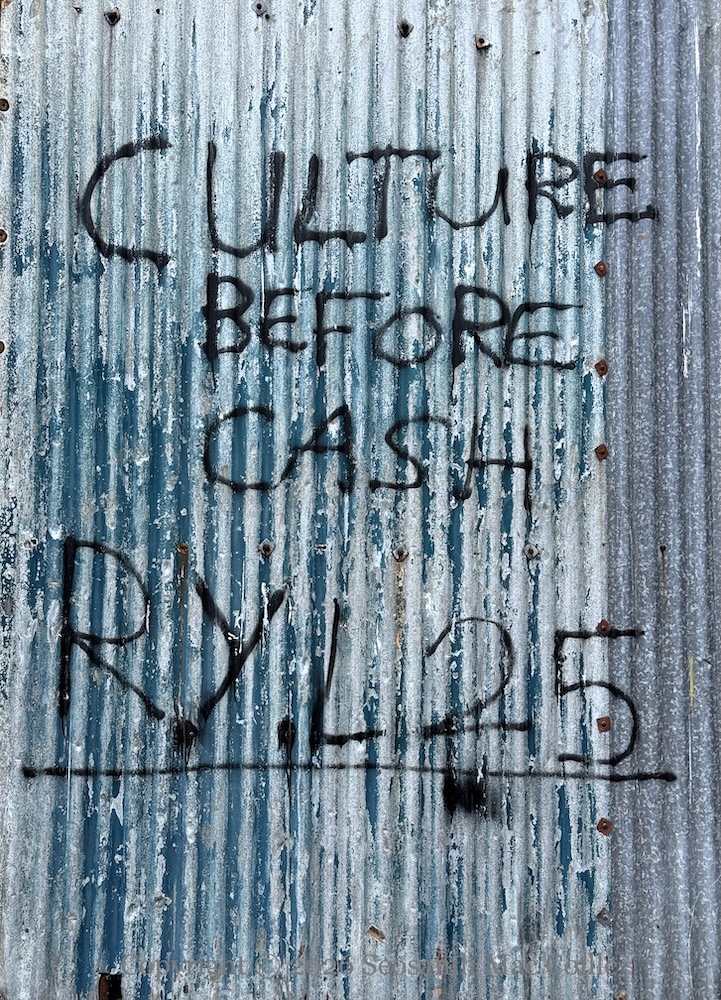
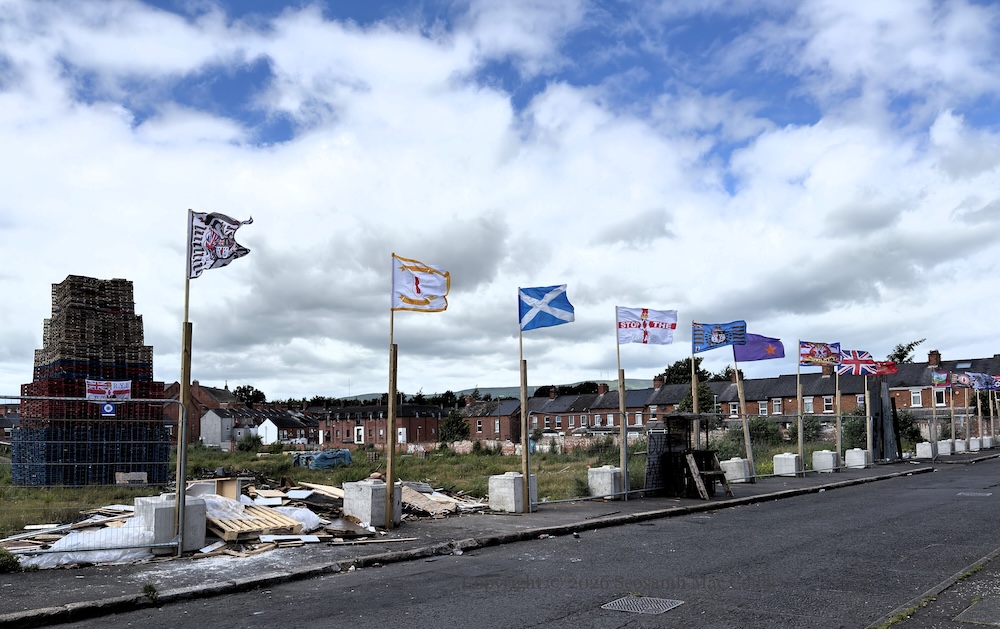
Bonfires will be lit across Northern Ireland on “Eleventh Night” (July 11th) and builders will be working until then in order to build the pyres high. The one shown here is in the Ravenhill Road area of east Belfast, constructed out of shipping palettes (see Commonwealth Handling Equipment). As an alternative, Belfast City Council will fund the construction of much smaller beacons. (The programme was previously called the “Bonfire Management” programme and is now the “Bonfire And Cultural Expression” programme.) The Ravenhill builders, both this year and last, consider this a sell-out. (See previously, Culture Before Cash (2014) | Real Loyalists Will Never Be Bought).
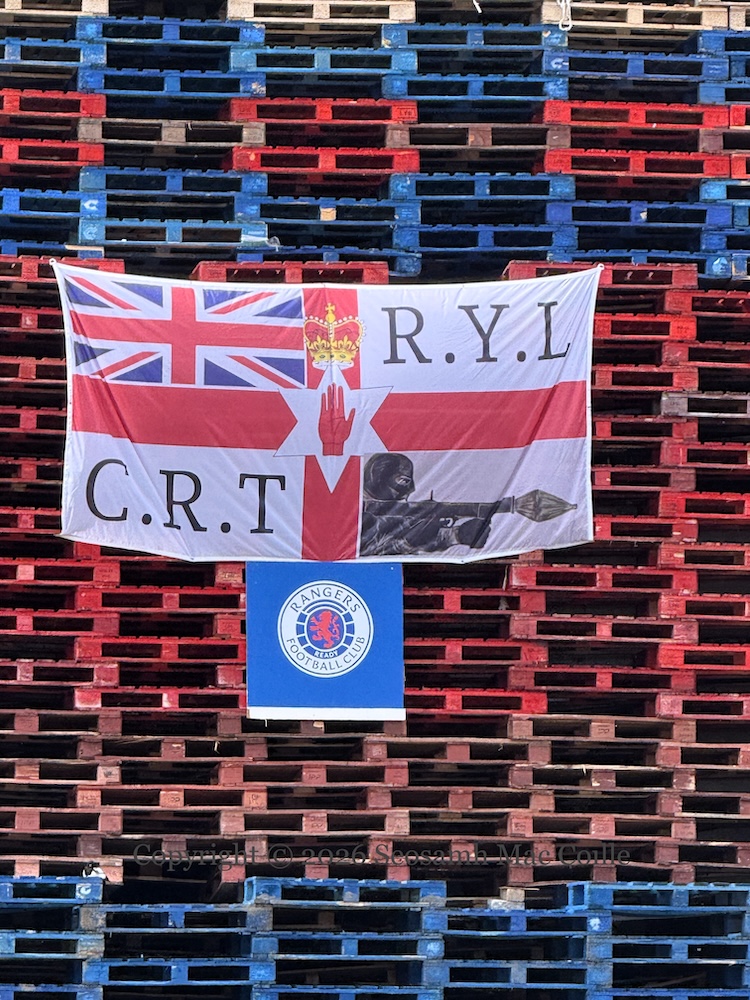
The flag on the bonfire shows a hooded volunteer with an RPG (taken from an old mural in the Shankill), with the lettering “RYL” (“Ravenhill Young Loyalists”) and “CRT” (“Clonduff Rocket Team”).
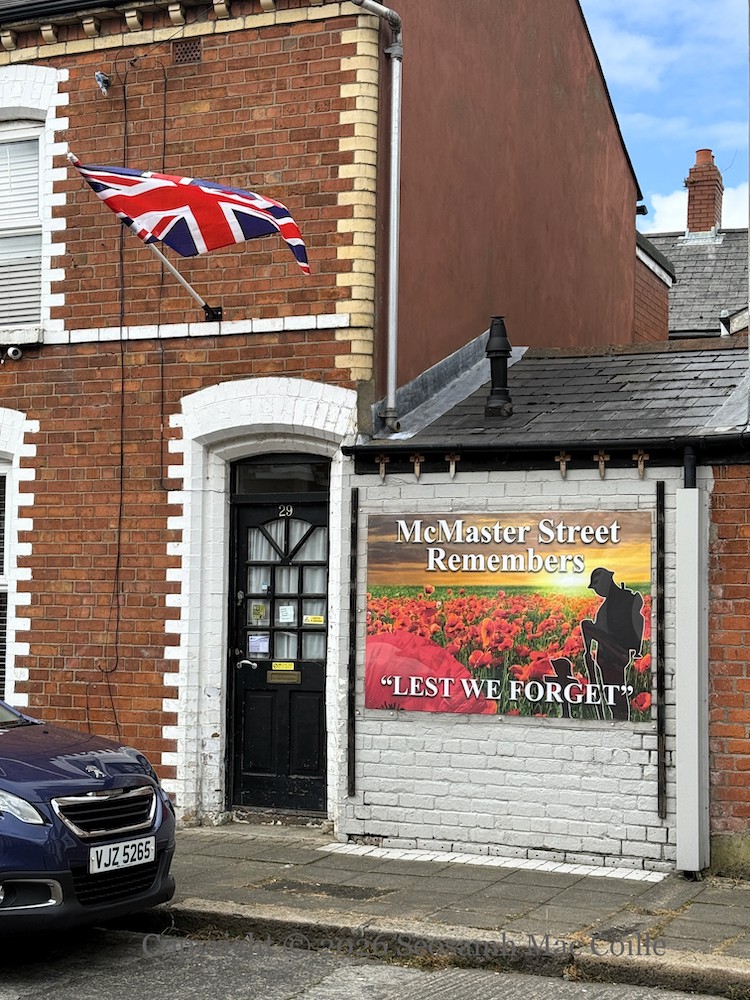
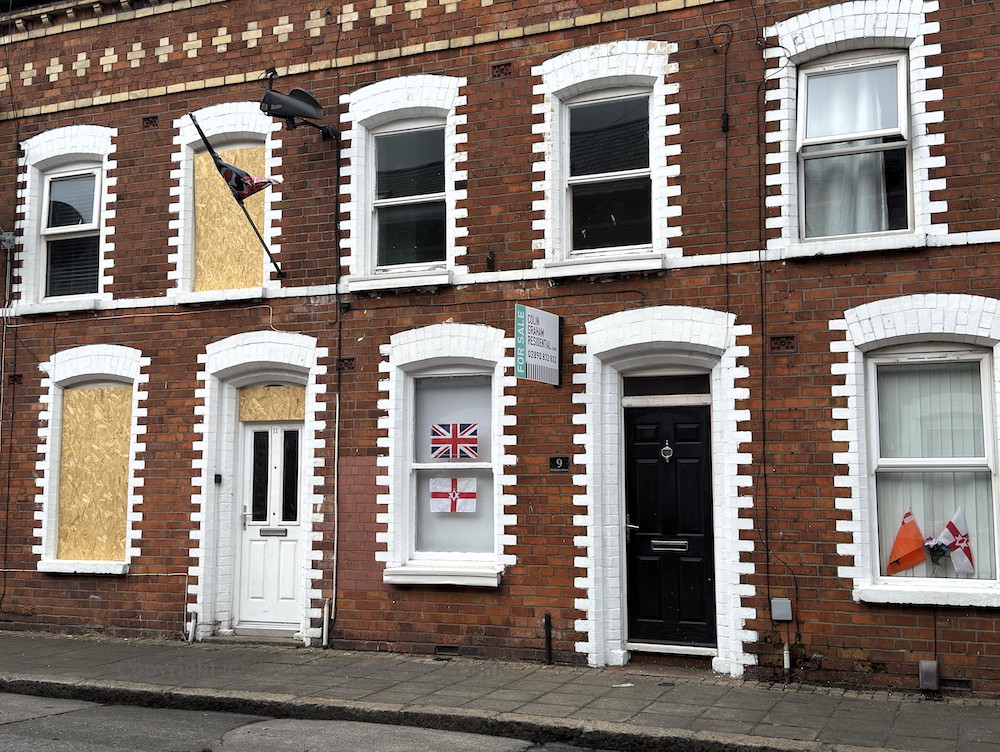
McMaster and Lendrick streets – part of a conservation site of Victorian terraced houses (Dept For Communities) – were the epicentre of last week’s anti-immigration riots, with cars and houses in the street set ablaze and families evacuated to safety by the security forces (BBC video). The image below shows the boarded-up windows of number 11 McMaster Street, with a melted satellite dish above the door, while the Union Flag and Ulster Banner in the window of number 9 are unscathed.
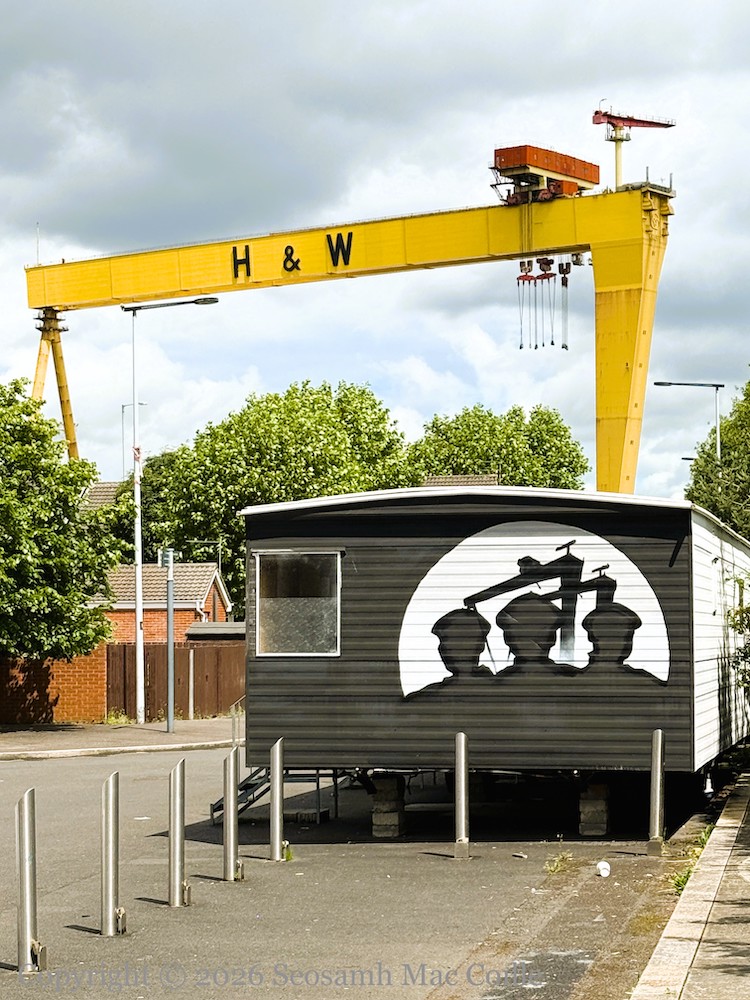
At its peak, the Harland & Wolff shipyard employed 35,000 people (IndustriAll) and the flat-capped worker became a symbol of east Belfast, along – much later – with Samson and Goliath, the two gantry cranes at the shipyard that were raised in 1974 and 1969 (WP) and which have become the symbol of Belfast.
The silhouetted workers and cranes are on a mobile office in Fraser Pass, Newtownards Road, Belfast, at the end of the Pitt Stop next to the Belfast Bikes racks.
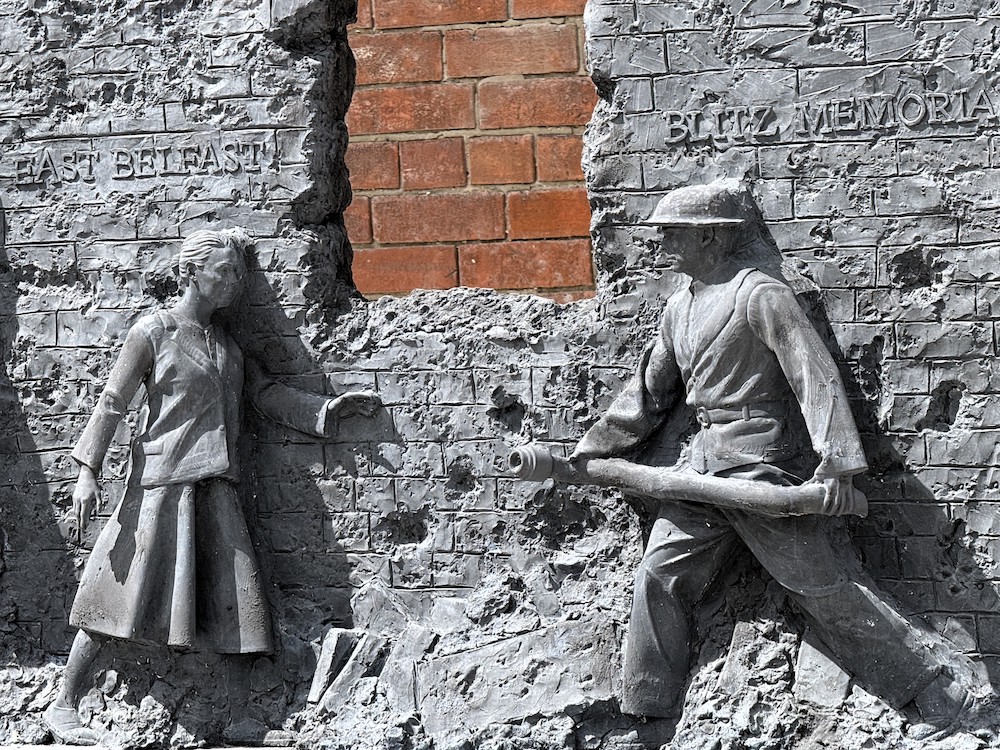
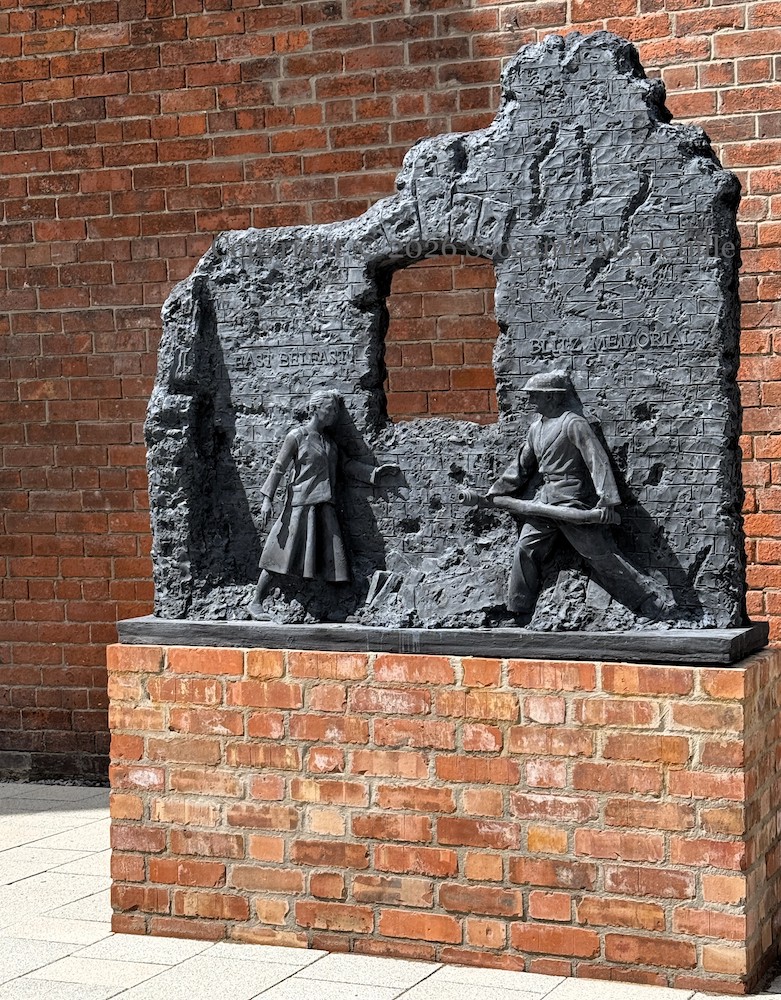
The German Luftwaffe blitzed Belfast on four occasions in April and May of 1941, targeting especially the industrial yards of east Belfast, including H&W shipbuilding and Short Brothers. Nearby streets were hit in the attacks (see Belfast Blitz), and some suffered very heavy damage, including Thistle, Tower, and Westbourne streets. This new memorial (City Council planning application) is in the grounds of Westbourne Presbyterian church, which was built in 1877 (Stone Database), was hit during the war, but survived.
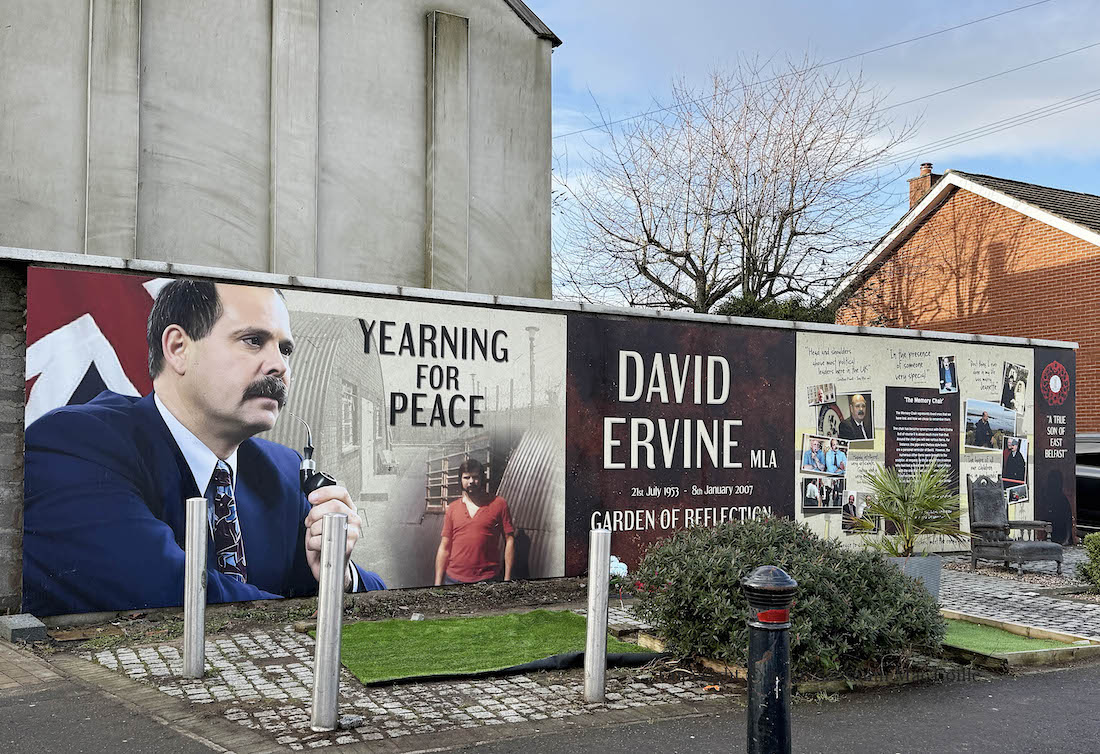
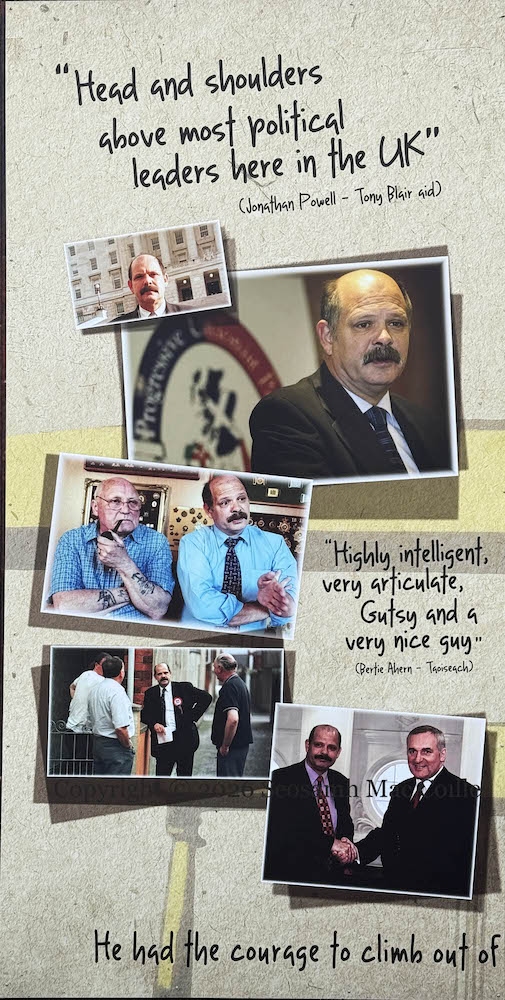
On the anniversary of David Ervine’s death, January 8th, a new board was launched in his memory, with images of Ervine “yearning for peace” in the cages of Long Kesh, where he met Gusty Spence (the pair can be seen together in the middle of the first column of photographs).
After his release, Ervine turned to politics, running unsuccessfully as a PUP candidate for Pottinger in the Belfast City Council elections of 1985 (WP); he would eventually be successful in 1997. In 1998 he was returned by Belfast East in the Assembly election (ARK). He helped bring about the loyalist ceasefire in 1994 – which was read aloud by Spence (youtube) – and was pro-Agreement in 1998 (DIB | Guardian | Slugger).
The information about the Memory Chair sculpture makes mention of Ervine’s boots but it seems they have not survived the mothballing of the sculpture which was last seen on site – boots included – in 2014.
This is a new tarp on Dee Street, east Belfast, in which a child asks a sleeping lion to “wake up”. Both are wrapped in the Union Flag. The (probable) context for the image is the idea that foreigners – and in particular, non-white, non-Christian, foreigners – have been moving to the UK and that over time their numbers have increased, without much notice, to such a level that English (or more broadly, the UK) people need to rouse themselves in order to notice and counter this.
We have a working principle that the level of investment in a piece’s production is an indicator of the extent to which the producer(s) believes it will be accepted (or at least countenanced) by the community in which it appears. This printed tarp is, as far as we know, the most sophisticated expression of anti-immigrant feeling so far (or at least, the most expensive to produce). Prior to this, there have been placards (One Big Clean-Up | Not A Dumping Ground | If Necessary We Must Shed Blood), a simple stencil (I Was A Stranger), a short-lived printed paste-up (Multiculturalism Is Genocide), and various appearances of “locals only” graffiti (2025 | 2024 | 2014 | 2014). According to a 2023 study from KCL, 32% of UK residents think the “Great Replacement” conspiracy theory is “definitely” or “probably” true, while 22% of Irish people (in 2024) think so (Gript/Electoral Commission).
At the heart of this east Belfast homage to the healing power of soccer are German and British soldiers shaking hands over a ball in ‘no man’s land’ on the Western Front, on Christmas Day, 1914. The image is not from a contemporary photograph but a modern one of a 2014 sculpture depicting such an even by Andy Edwards (TruceStatue) (who also did the Pat Jennings sculpture in Newry – seen in Pat Jennings). For more images of the WWI soccer statue, see WWI Cemeteries.
It’s not clear that matches between opposing forces – rather than simple fraternisation – were actually played; see Wikipedia for a review of the evidence.









 Extramural Activity