Maghaberry Prison’s Roe House, home to about 50 republican prisoners, was this past week the scene of a stand-off with prison guards, as 30 (BelTel) or 40 (BBC) inmates refused to enter their cells. There was also a protest outside the jail and a bomb-threat on Tuesday (U.tv).
The final spot on Northumberland Street (see previously: Reserved) was taken in September by this mural for Youth In Motion’s ‘Bytes’ project, which seeks to build basic skills and assist job-seekers (Fb | Web (YIM) | Web (Bytes)).
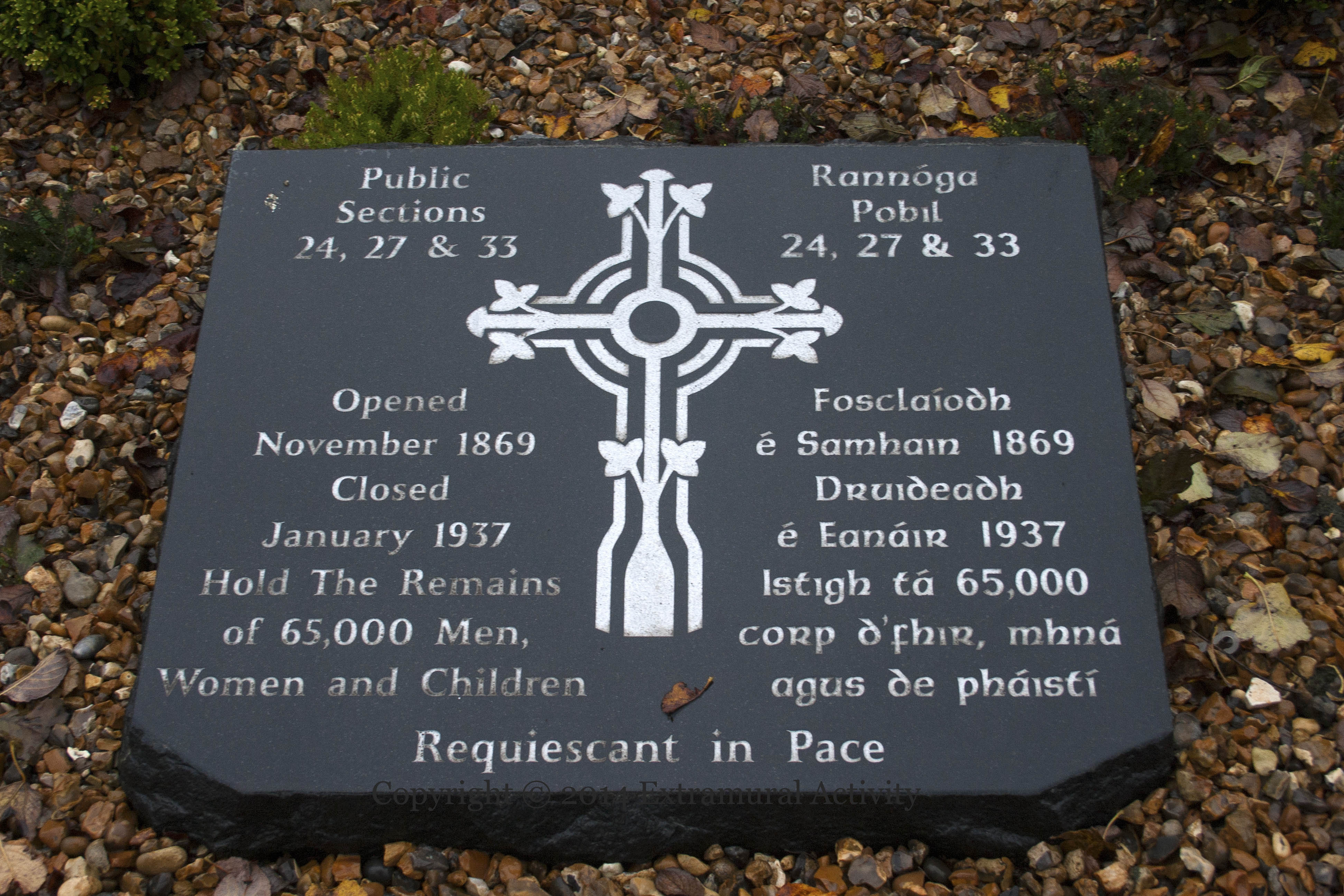
Milltown Cemetery contains what appear to be three large, unused, spaces (see the second and third images, below). They are in fact the Poor Grounds, mass graves of those unable to afford an individual grave. The plaque shown above puts their number at 65,000; WP puts it at 80,000. (The total number buried is about 200,000.) They include victims of typhus in the 1870s, and of the great influenza pandemic of 1918-1919. There is more information at CultureNI and Milltown Cemetery.Tom Hartley’s book on Milltown was released by Blackstaff Press last year (2014).
“Public Sections 24, 27 & 33, opened November 1869, closed January 1937, hold the remains of 65,000 men, women and children. Rannóga pobıl 24, 27 & 33 fosclaíodh é Samhaın 1869, druıdeadh é Eanáır 1937. Istıgh tá 65,000 corp d’fhır, mhná agus de pháıstí. Requiescant in pace.”
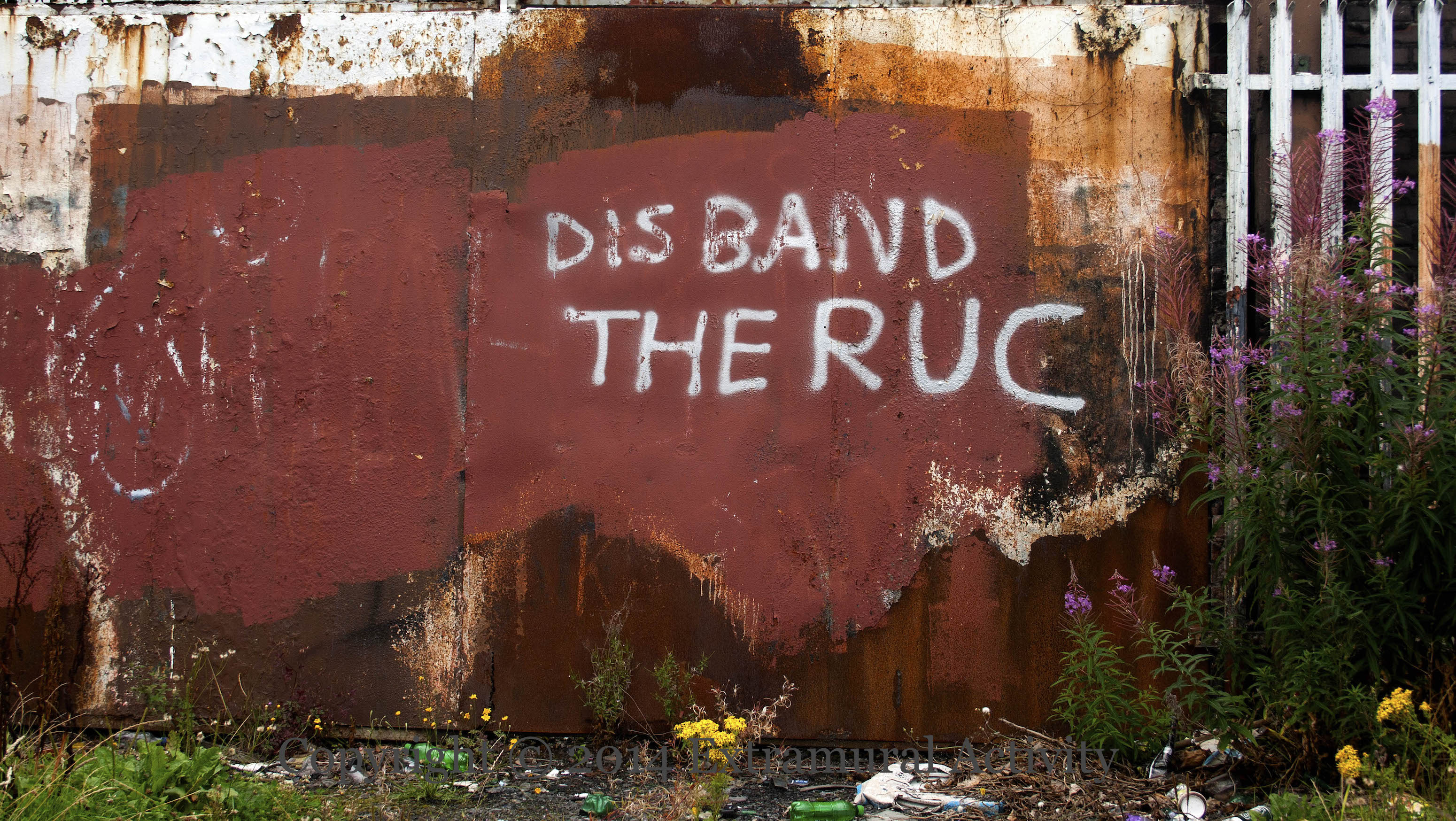
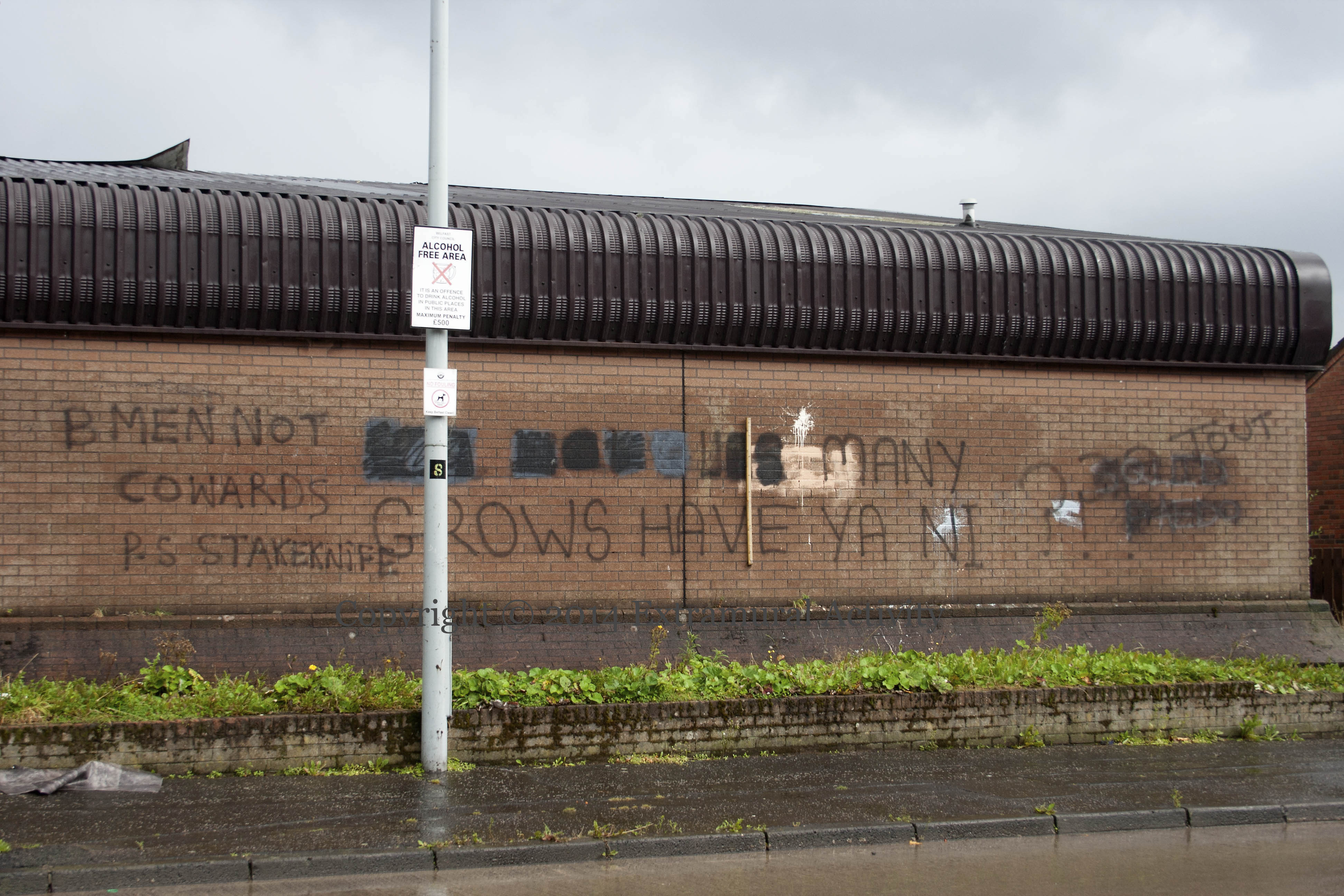
Old graffiti doesn’t go away. It persists, witness to the aspirations and angers of years past.
Above, “Disband the RUC” in Bóthar Chaıtríona/St. Katharine’s, republican west Belfast. Below, “If the leaders are impotent… only the people can rise” – anarchist graffiti in Melrose Street and “B-Men not cowards” in Agnes St, Loyalist west Belfast. These are all late-2014 pictures of graffiti that are at least three years old.
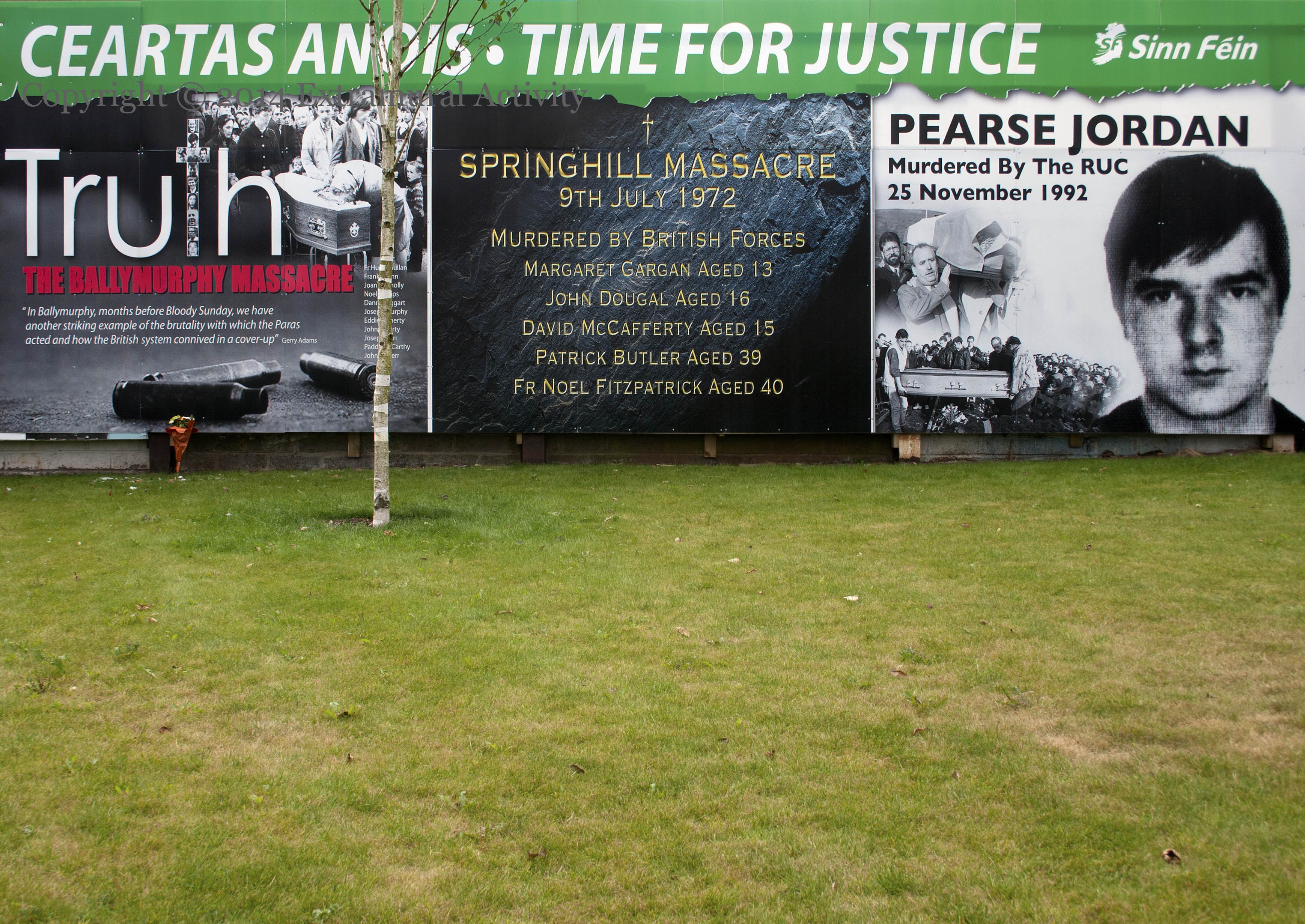
Three different campaigns for inquiries into deaths at the hands of British paratroopers are brought together into a single board on the site of the former Andersonstown RUC station: the Ballymurphy Massacre of August, 1971, in which 11 were killed; the Springhill Massacre of July 1972, in which 5 were killed, and the killing of IRA volunteer Pearse Jordan, who, like the others, lived in the greater Ballymurphy area.
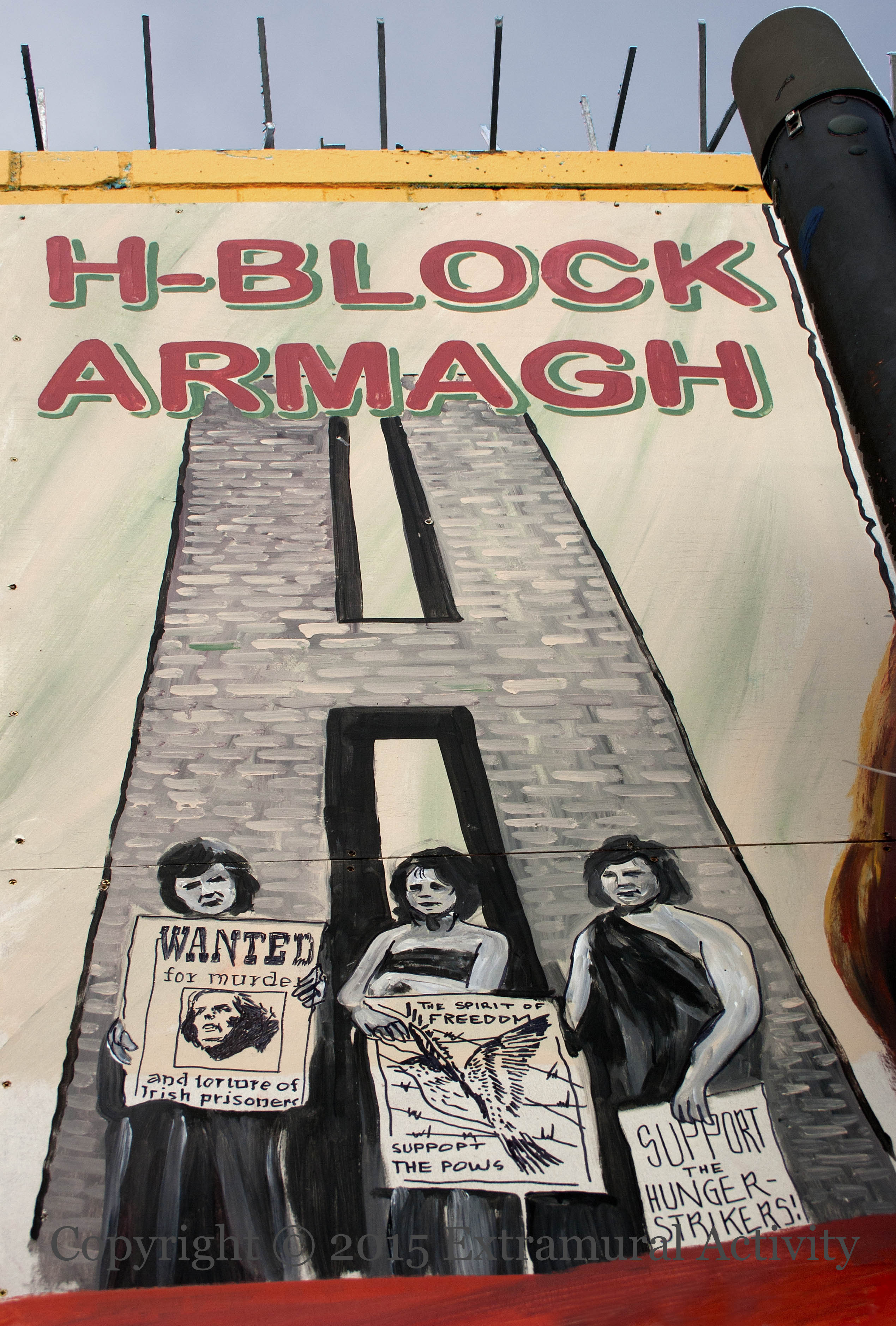
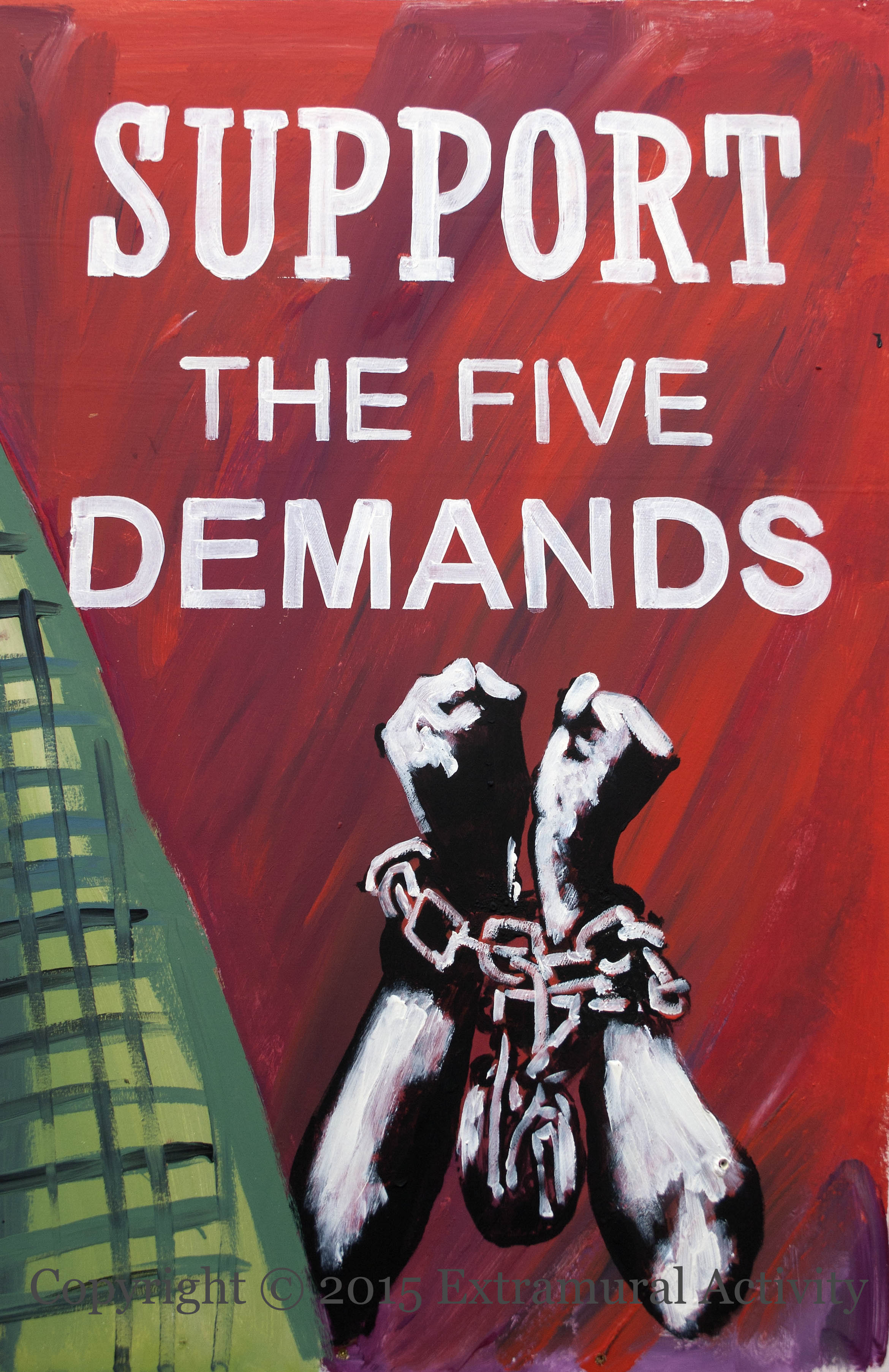
Here are two details from the new Kieran Nugent board along with the “Slí Na Gaeltachta‘ (The Gaeltacht Trail) plaque at its side. The image above shows prisoners “on the blanket” (that is, refusing to wear prison uniforms) in front of a giant brick “H” (for the H-Blocks) which perspective also shapes into an “A” (for Armagh Women’s Prison). They hold placards from the time: Wanted for murder [Margaret Thatcher] and torture of Irish prisoners”; “The spirit of freedom; support the POWs”; “Support the hunger-strikers”. The image below reads “Support the five demands”. These were (1) the right not to wear a prison uniform; (2) the right not to do prison work; (3) the right of free association with other prisoners, and to organise educational and recreational pursuits; (4) the right to one visit, one letter and one parcel per week; (5) restoration of remission lost through the protest.
The text of the Slí Na Gaeltachta plaque can be found at the bottom of this page.
“Slí na Gaeltachta – Abhaınn na Feırste. Cé go bhfuıl sí cludaıthe faoı choıncréıt anoıs agus gan a bheıth le feıceáıl, ıs ag an láthaır seo ar Shráıd Northumberland a chéadtrasnaıonn Abhaınn na Feırste Bóthar na bhFál. Aınmníodh an abhaınn as an fhearsaıd a bhí ag béal na habhann san áıt a dtéann sí ısteach sa Lagán. Baısteadh Béal Feırste ar an lonnaíocht a d’fhás thart ar áth cosanta ag cumar an dá abhaınn. Ba as an lonnaíocht ársa sın a d’eascaır cathaır an lae ınnıu. Here at Northumberland Street the now culverted Farset River first crosses the Falls Road. The river is named from the sandbank (fearsaıd) which was at the mouth (béal) of the river where it joins the Lagan. The settlement that grew up around a defended river ford at this confluence of the two rivers was named Béal Feırste, ‘mouth of the sandbank ford’. It was from this ancient settlement that the present-day city grew.”
Keiran Nugent (and Brendan Hughes) has been returned to the left-most spot on the International Wall.
This new board is closely based on the mural (shown in Belfast’s Infamous Prison) which was painted over in October in advance of the November 9th non-binding referendum in Catalonia (see Votes About Votes; the yellow background and some of the lettering from the Catalonia mural can still be seen in the image above). Nugent and Maıréad Farrell were then included in the hunger-strikers mural further down the wall: see I’ll Wear No Convict’s Uniform and Peace With Justice.
New in this version is the inclusion of a reference to the women’s protest in Armagh prison; one of the figures standing in front of the H/A holds the ‘Thatcher – Wanted for murder and torture of Irish prisoners’ poster that previously filled the top-left corner.
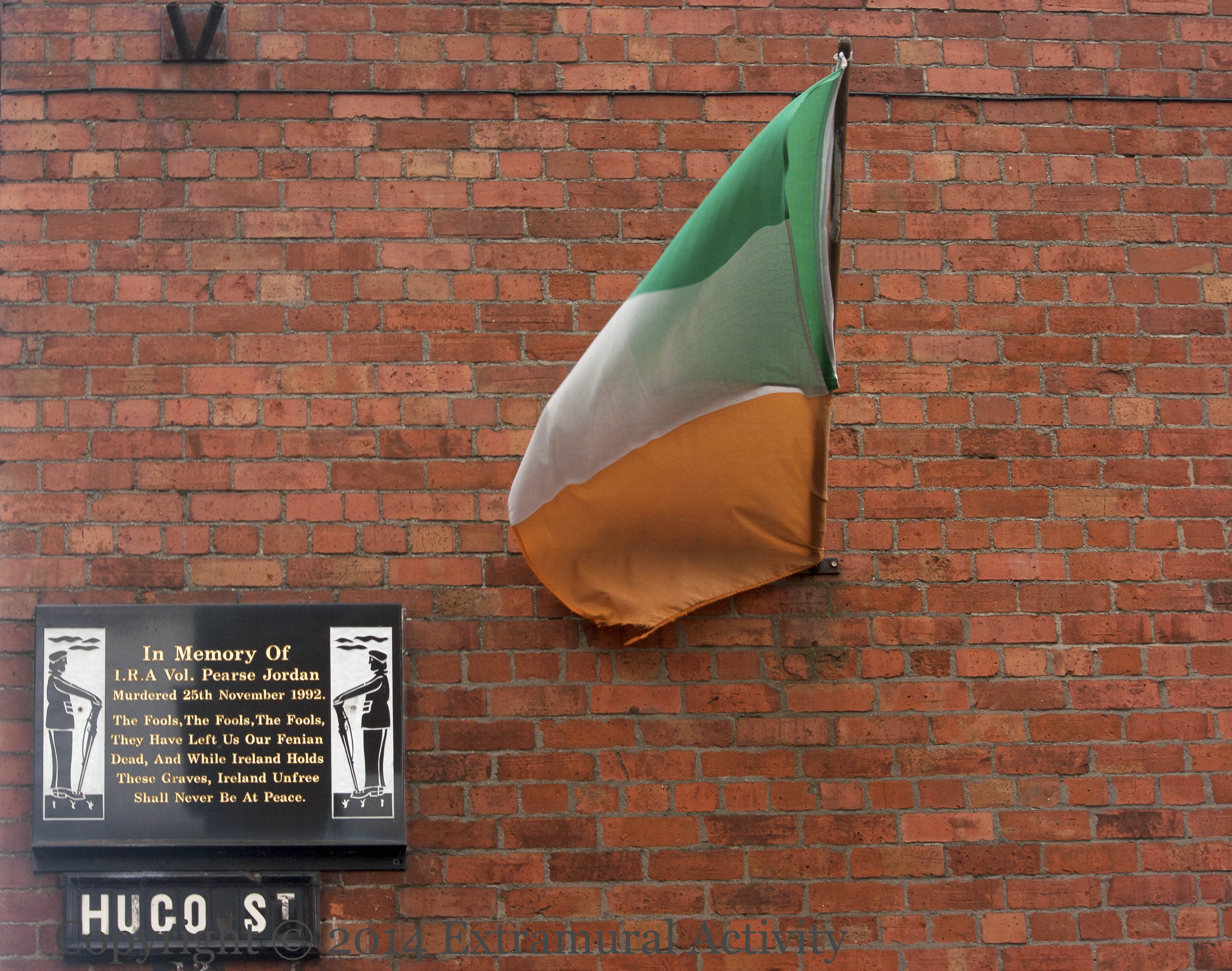
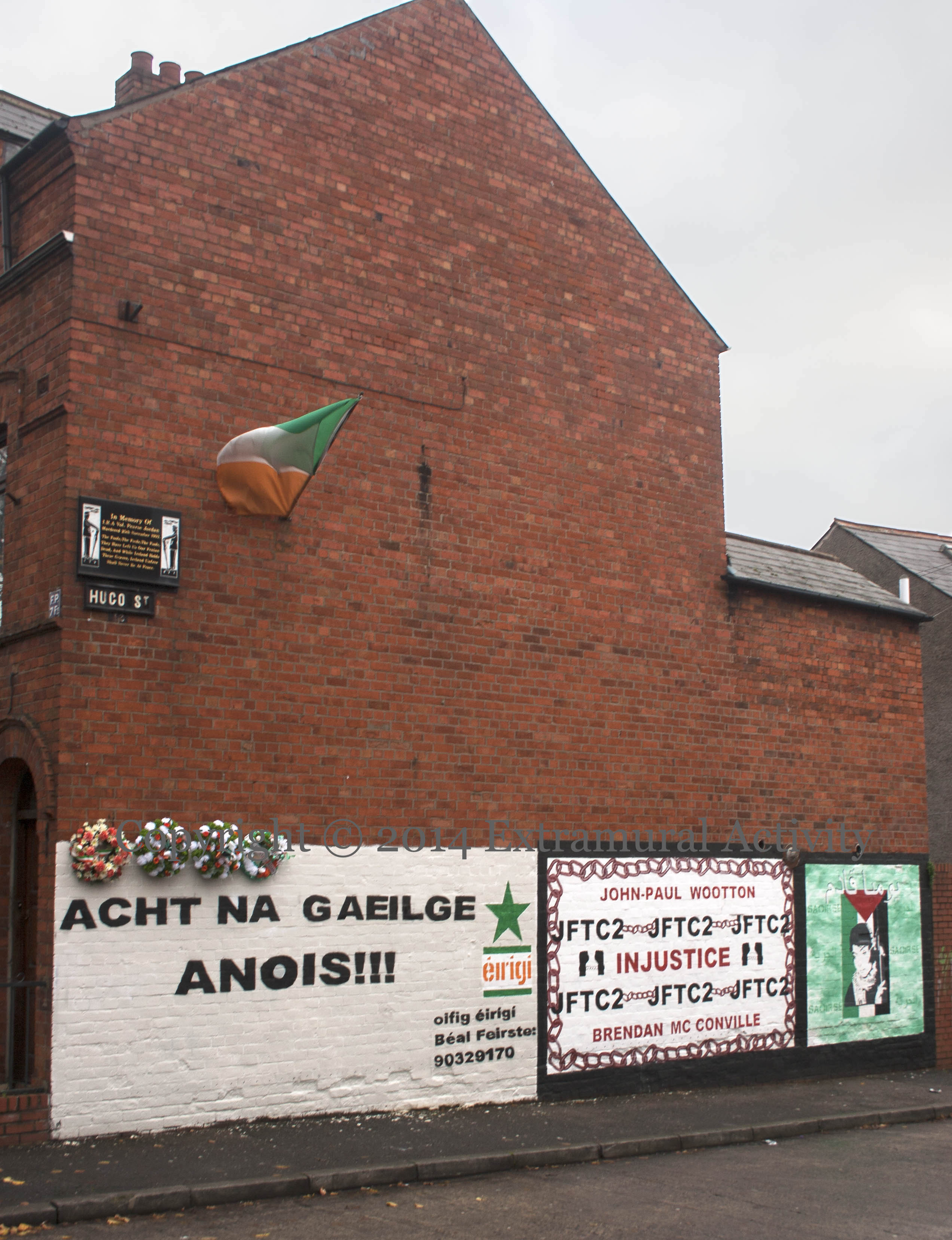
The Belfast Telegraph reports that an Irish language bill will be published in the near future, though the DUP have already rejected such an Act. (For more background and discussion see Brian Walker’s post a few days ago on Slugger.) The éırígí stencil above, calling for “Acht Na Gaeılge Anoıs!!!” – “An Irish Language Act Now!!!”, is in Hugo Street below a tricolour and a plaque in the memory of Pearse Jordan (see the second image, below). The wide shot shows the two other pieces on this side of the street, a ‘Justice For The Craigavon 2’ stencil (featured previously in Justice) and Palestinian skyjacker Leila Khaled.
Under a tricolour flying from the roof of the Rock Bar on the Falls, in green, white, and orange: “Rebel Sunday – The Rock Bar – Every Sunday – From 6 PM”









 Extramural Activity