Black taxis were first brought from England to Belfast in 1970 by locals who wanted to provide an alternative, and locally-based, transport system to augment the Citybuses which were sometimes cancelled and sometimes burned out. The board above commemorates eight drivers who were killed during the troubles: Michael Duggan, Jim Green, Harry Muldoon, Paddy McAllister, Caoimhín Mac Brádaigh, Thomas Hughes, Hugh Magee, and Paddy Clarke.
Calls for “truth” and “justice” concerning the killing in August, 1971, of 11 people from Ballymurphy, by the 1st Parachute Regiment during Operation Demetrius, the beginning of internment.
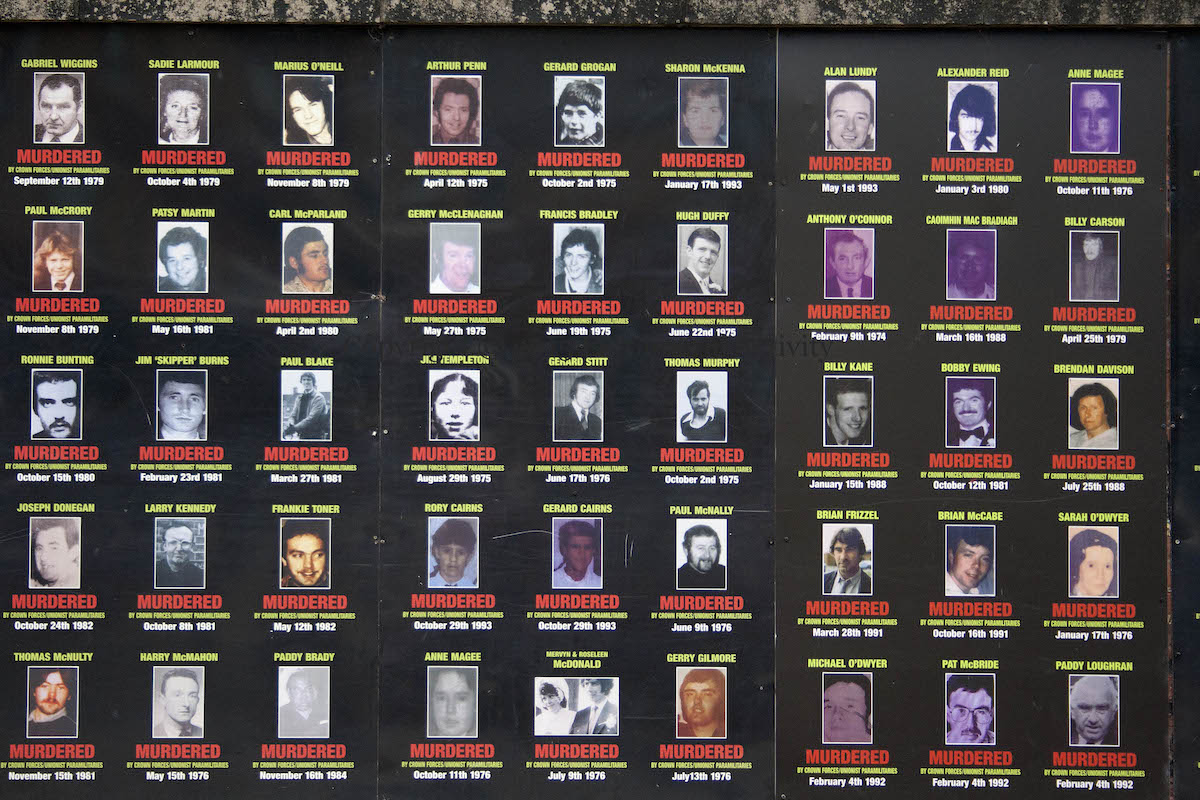
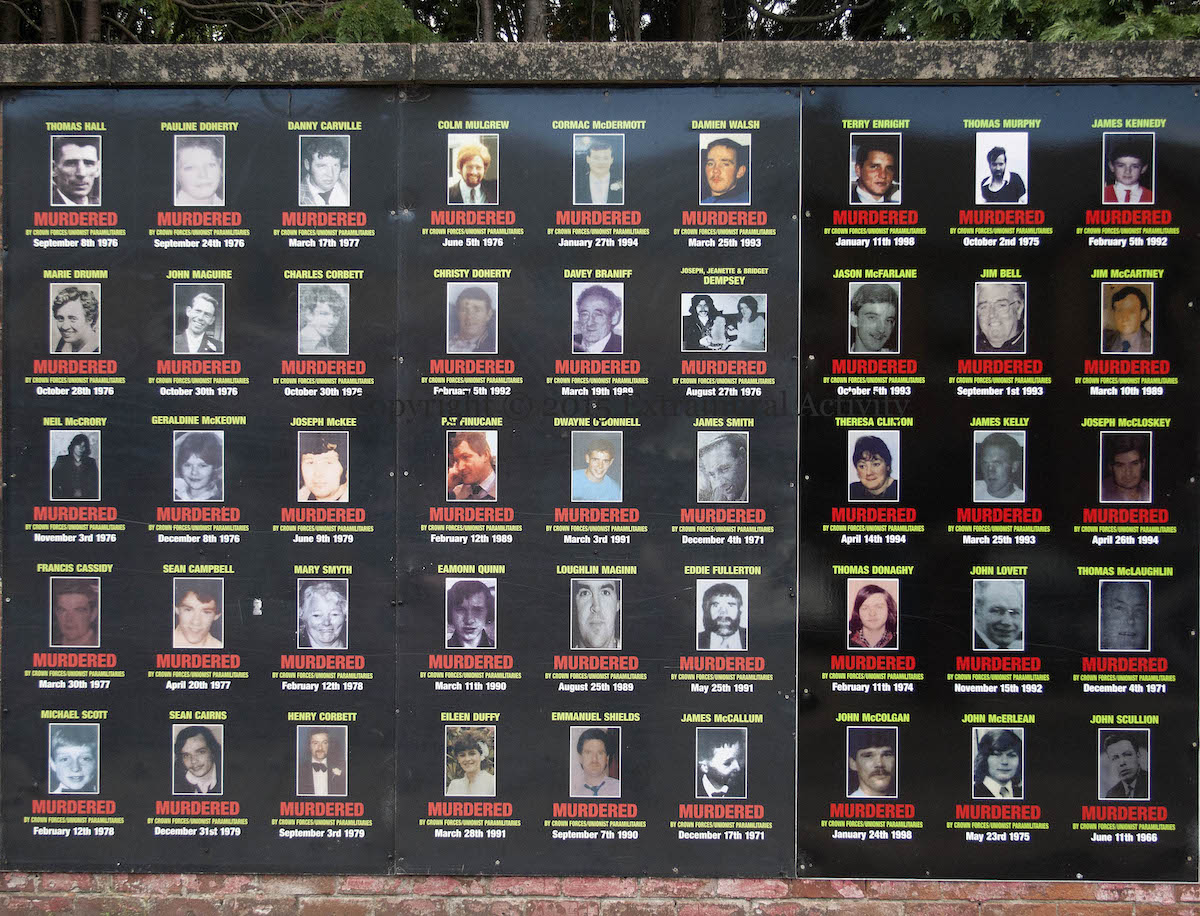
The final three panels (panels 16-18) of the ‘murdered’ follows to the right of the Ballymurphy board. (These are new additions, as compared with 2011.) They are then followed by the final board, to the WBTA.
“11 people in west Belfast from the Greater Ballymurphy neighbourhood were murdered by the British Army as internment without trial was violently carried out on August 9th, 1971. Proper police investigations were never undertaken and one has served a day in prison for causing these deaths. The familys of those murdered deserve and demand the truth be told by the state about its policies and actions of those who carried them out.”
Two boards about collusion in Beechmount Avenue. The first chronicles (both in words and images) alleged instances of collusion between the RUC and loyalist paramilitaries, citing John Stevens, Peter Cory, and Nuala O’Loan – pages from the 2007 O’Loan report are shown in the second, below.
The British soldiers on the right of the board above are given red berets to indicate the Paratroop Regiment, which was the regiment involved in Derry’s Bloody Sunday.
“Springhill–Westrock massacre. Belfast’s Bloody Sunday. Time for truth! On the 9th July 1972 a team of British Army snipers took up firing positions in Corry’s timber yard overlooking the nationalist Springhill/Westrock estates. Within less than an hour five civilians lay dead and two critically wounded. Among the dead were three teenagers, a father of six and a priest on his way to administer the last rites to the dead and injured. There has never been a proper police investigation, and not one solider has spent a single day in prison in connection with their deaths. The families deserve, and demand the comprehensive facts be told by the British establishment. The truth costs nothing.”
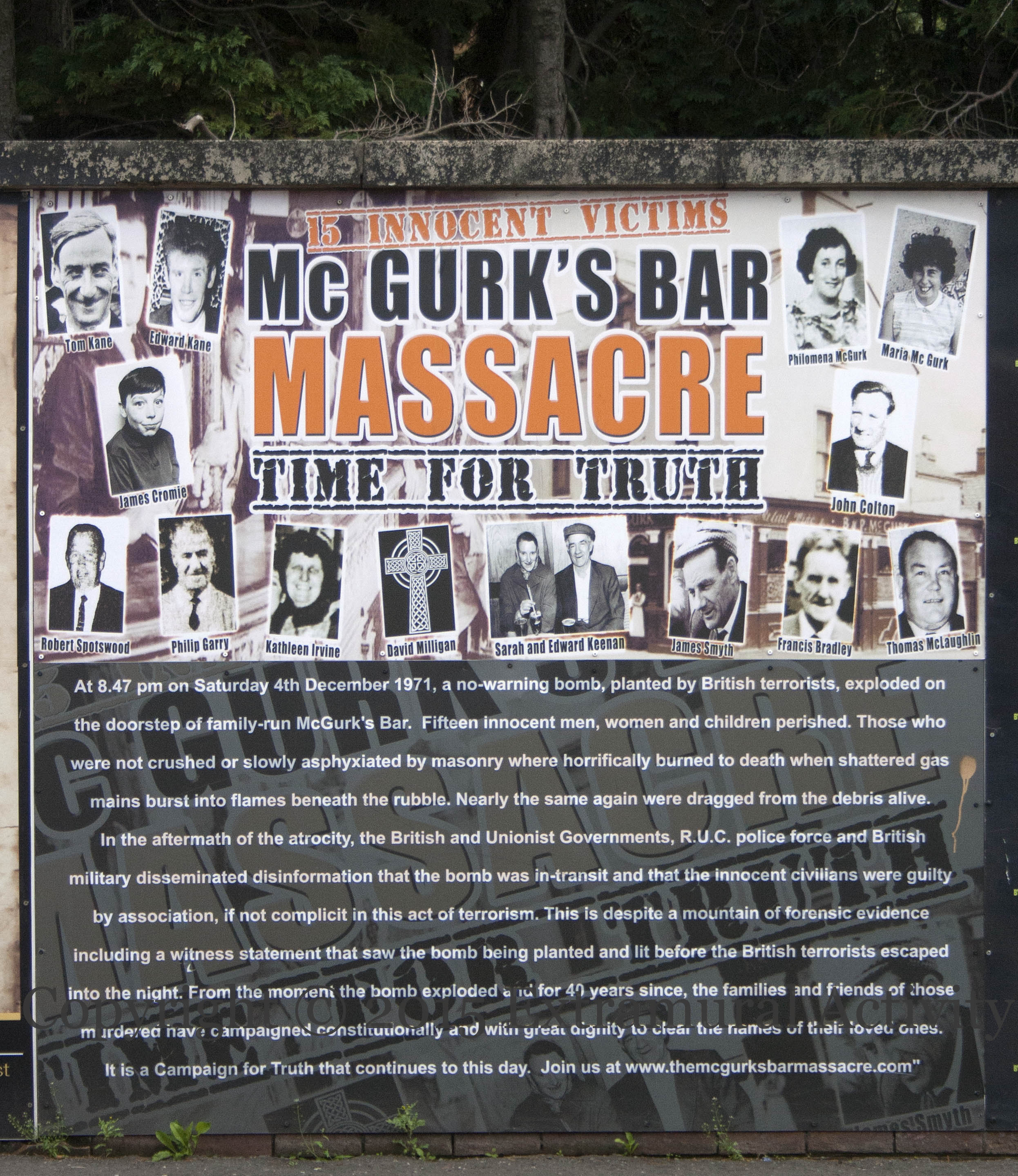
The McGurk’s Bar bombing of December, 1971 killed fifteen people – the most in a single incident during the troubles – capping what had already been a bloody year, including the “Ballymurphy Massacre” of July, in which 11 died, and starting another round of killings that would spread into the new year. Campaigners for an inquiry were busy this week in both Dublin and Belfast (Irish News).
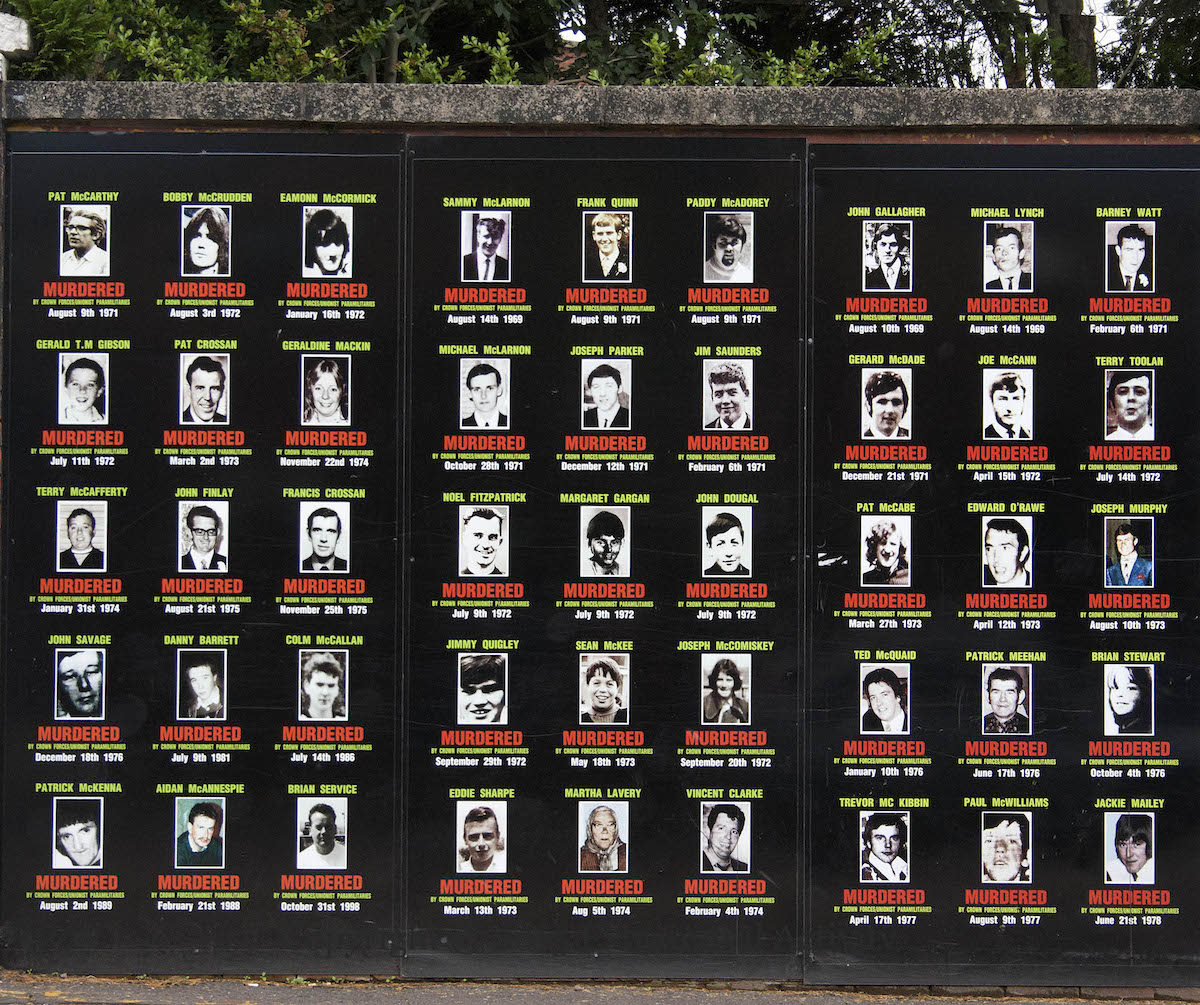
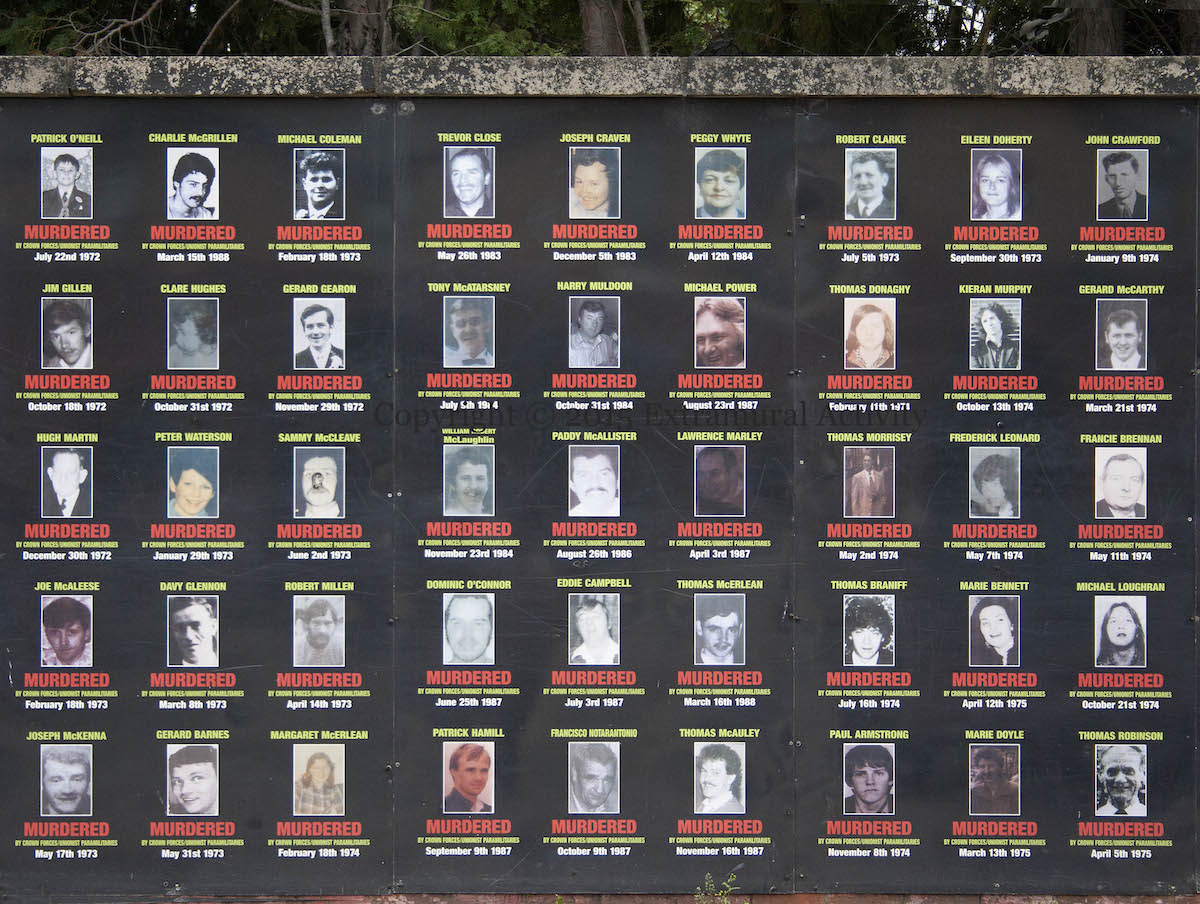
The first nine panels of the ‘murdered’ follow to the right of the McGurk’s Bar board, presented here three-at-a-time. Note that the ninth panel (with Terry Enright in the top left) was previously the 11th panel; it is not clear why it has been moved left.
This is a new mural from the 32 County Sovereignty Movement (web) on the international wall, Divis Street, (Visual History) with symbols of nationalism (the crests of the four provinces, the harp, the tricolour), socialism (the plough in the stars) and support for republican POWs (the barbed wire).
For images of the mural being worked upon, see the Peter Moloney Collection; for an earlier version see 100% British.
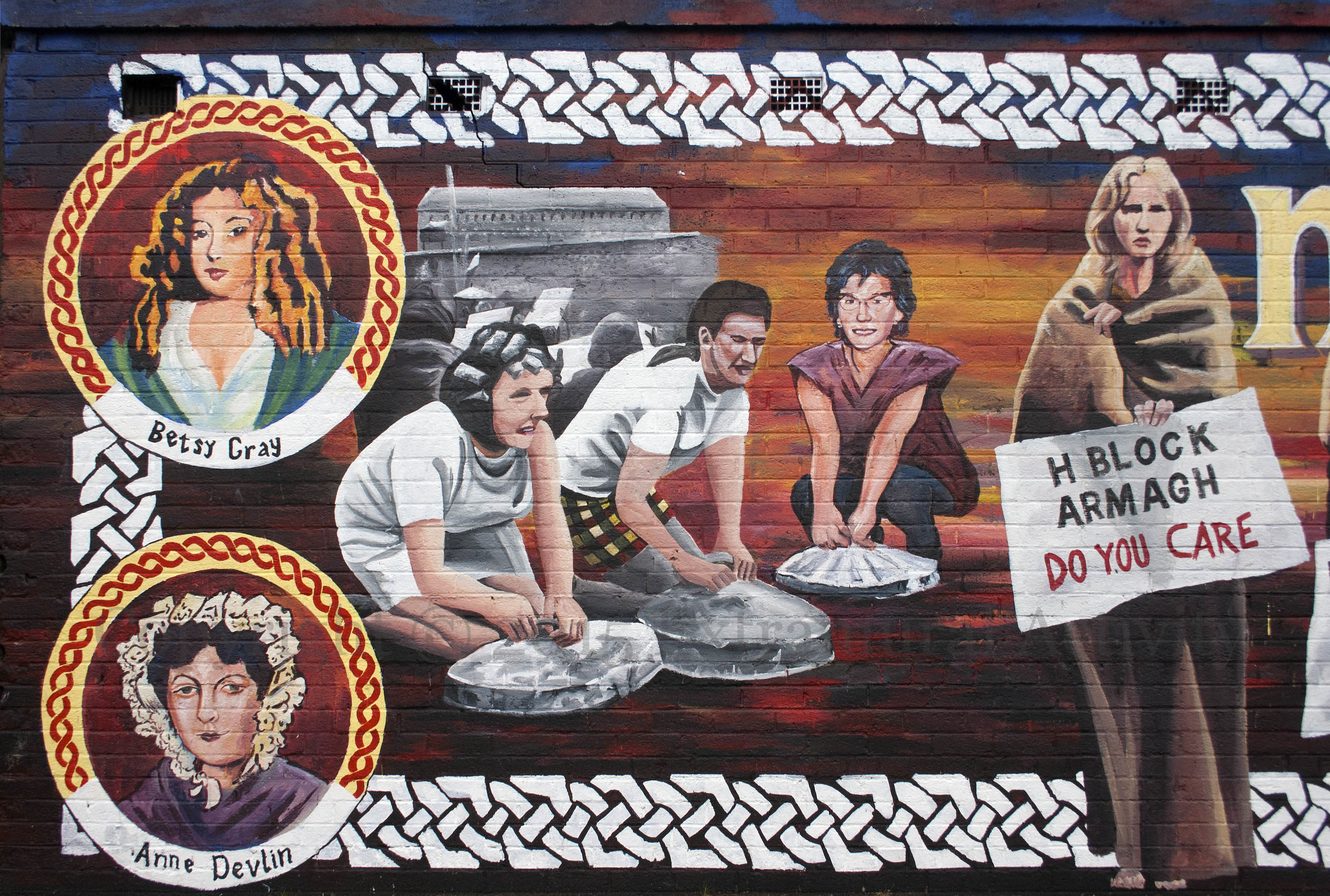
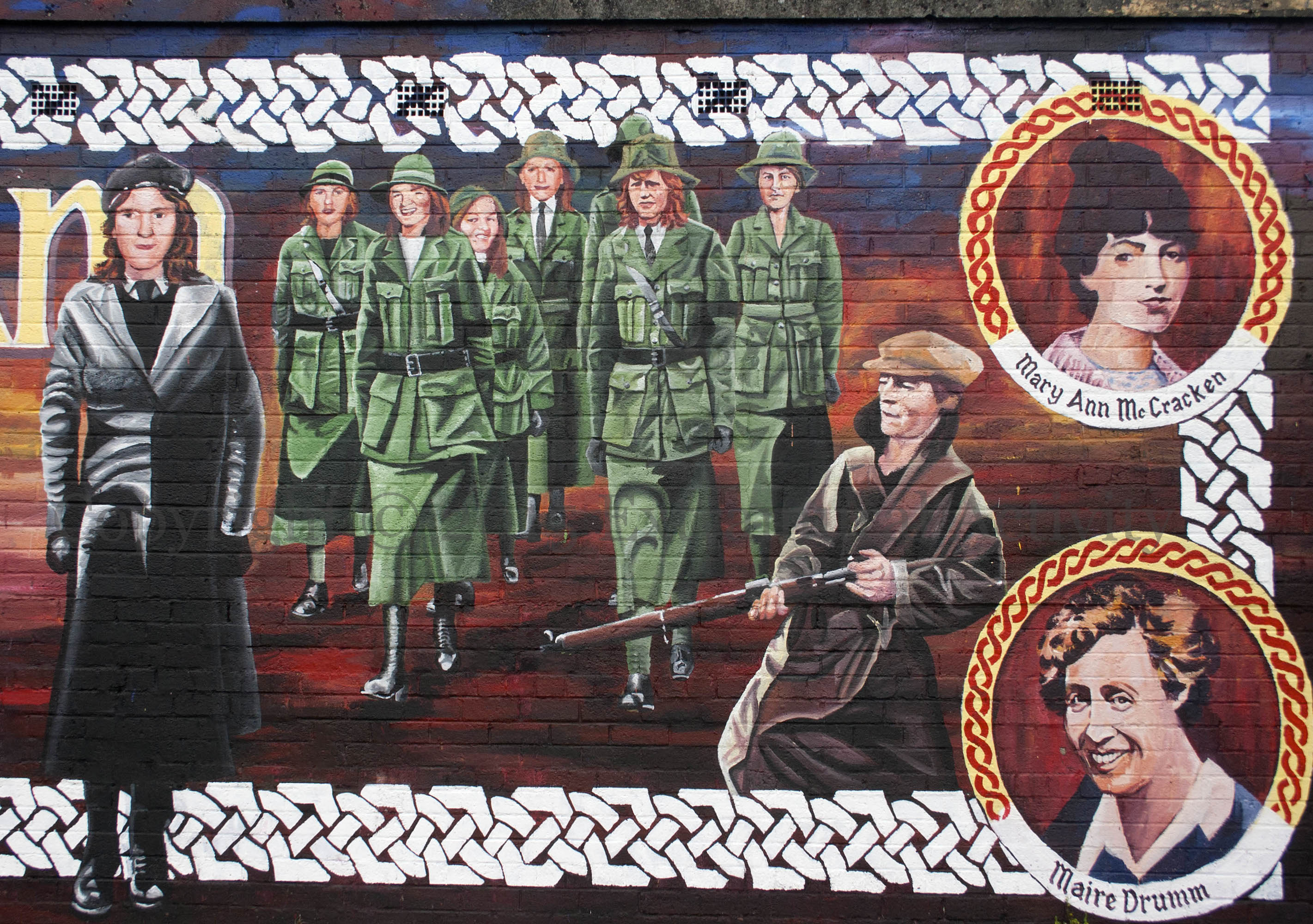
Here are two images of the extremes of the Mná Na hÉıreann mural.
In the four corners are circles of Betsy Gray, Anne Devlin, Mary Ann McCracken, and Máıre Drumm. Gray and McCracken were Presbyterians; Gray fought (or at least, was killed) in the 1798 rebellion, as did McCracken’s brother Henry Joy; Mary Ann went on to work for the poor of Belfast and lobby against slavery. Anne Devlin assisted in Robert Emmet’s 1803 rising. (National Graves Assoc) Máıre Drumm was vice-president of Sınn Féın and commander of Cumann Na mBan, who are shown marching on the right-hand side.
In the cloth cap and holding a rifle is Eithne Coyle, a leader and later president of Cumann Na mBan, imprisoned both by the Black and Tans before the treaty and after it by the Provisional Irish government (WP). For the photograph on which her pose here is based, see An Phoblacht‘s History Of Cumann na mBan, which also includes the photo of marching women (discussed previously in Mothering Sunday In Beechmount) though the faces have been changed here, presumably to those of more contemporary volunteers. The same is probably true of the third woman with a bin lids on the left – leave a comment or send an e-mail if you can put a name to any of these faces.
Here are two details from the Mná Na hÉıreann mural. This one shows three Derry women protesting the conditions in Armagh Women’s Prison and in the H-Blocks. This article on Mary Nelis (the protester on the right, with Kathleen Deeny and Theresa Deery) describes the photograph on which this part of the mural is based. The women in Armagh prison were allowed to wear their own clothes and so were not ‘on the blanket’ as their male counterparts in the H-Blocks of Long Kesh were. However, they did engage in a “no wash” protest, which lasted from February 1980 until March 1981, and three of them – Maıréad Farrell, Mary Doyle, and Margaret Nugent – joined the 1980 hunger strike.
In the second image, below, grieving mothers, wives, and sisters stand over a coffin draped in the Irish tricolour with paramilitary gloves and beret on top.
Countess Markievicz, carrying a flag of Cumann Na mBan, and Ethel Lynch, carrying a flag of the Derry IRA, take centre stage in the Mná Na hÉıreann mural in London-/Derry/Doıre’s bogside. Markievicz is famous for her role in the Easter Rising of 1916 (WP); Lynch died in December 1974 of injuries sustained when a bomb exploded prematurely. (Derry Journal – also contains the photo on which the painting above is based.) Between them, “Liberty leads the people” waving an Irish tricolour.








 Extramural Activity