
New territorial markings at the top of Cambrai Street, Belfast, next to the “Amy Carmichael” installation.
Click image to enlarge
Copyright © 2023 Seosamh Mac Coılle
X12837
New territorial markings at the top of Cambrai Street, Belfast, next to the “Amy Carmichael” installation.
Click image to enlarge
Copyright © 2023 Seosamh Mac Coılle
X12837

“Billy was Wright – no Irish Sea border.” Billy Wright broke with the UVF in 1996 over loyalist concessions made during the peace-process that ultimately led to the Agreement in 1998. He soon formed the LVF but was killed in prison in 1997 by members of the INLA, which, like the LVF, had not joined the ceasefire.
These posters are in Cambrai Street and Conway Street; attempts to remove them have proven unsuccessful. The Sunday World reports that a similar banner has appeared in Ballymena (Sunday World) and that the same poster was also spotted in the lower Shankill (Sunday World).
Wright is shown standing in front of a small mural in Old Rectory Park, Portadown – see D01068.


Click image to enlarge
Copyright © 2023 Seosamh Mac Coılle
X12835 [X12836] X12851
Copyright © 2021 Pat Dorrian
X15337

This climbing vine joins Blue Tit, Half Human, Not Today, Satan. Not Today, and the much older (2009) Loyalist Or Racist at the Spectrum Centre on the Shankill.
Click image to enlarge
Copyright © 2023 Seosamh Mac Coılle
X12844
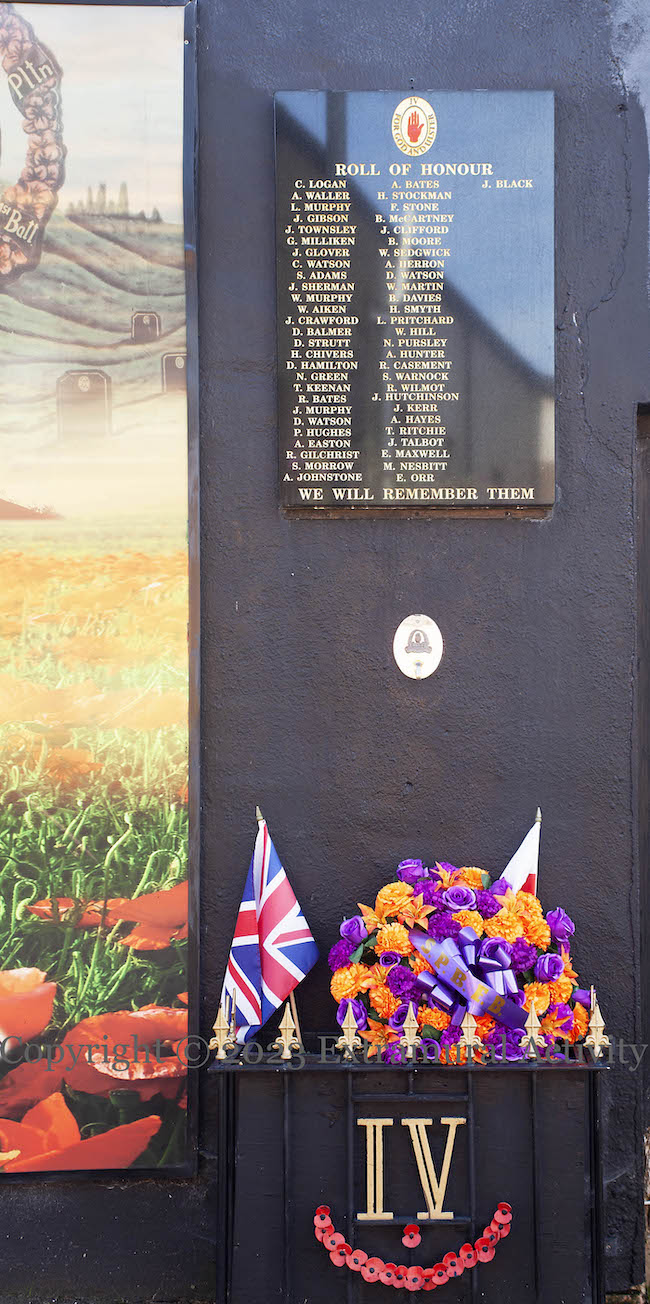
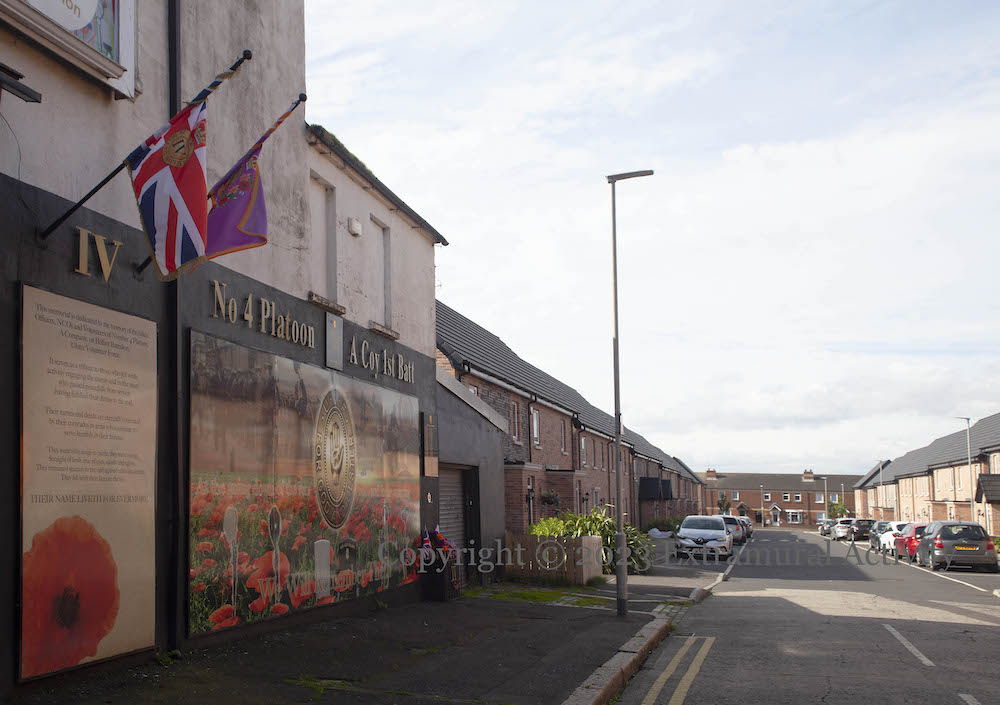
The UVF (A company, 1st battalion, platoon 4) mural in Glenwood Street was in the news last week after Jude Whyte of the Victims And Survivors Forum (web) drew attention to it because of its inclusion of some members of the Shankill Butchers (Irish News). The gang-members included in the plaque are given in a previous post – Platoon IV.
Some outlets (e.g. Sunday World) are reporting that the plaque is new but, while a few names of platoon have volunteers been recently added – Nesbitt, Orr, and Black – the plaque, including the names of various members of the gang, has been on the wall since 2017.


Click image to enlarge
Copyright © 2023 Seosamh Mac Coılle
X12860 X12861 X12862 X12863

The application form for a dual-language street sign is completely agnostic as to which language (in addition to English) should go on the street sign. Based on news reports (including, recently, one home-owners complaint that such a sign would lower property values – BelTel) and our impression from tramping the streets, Irish (Gaeilge) is by far the most commonly requested language, but there are a few that include Ulster Scots; previously we featured Heichbrea Airt in Castlereagh, and to that can now be added the sign shown above in the Woodvale: “Oregon Gardens” / “Orkan Gairdens”. (Please get in touch if you know of others.)
Ards & North Down council has just approved its own dual-language policy; like the old Belfast policy, one third of householders must sign the initial petition and two-thirds must respond positively to the subsequent survey of the street (News Letter).
Click image to enlarge
Copyright © 2023 Seosamh Mac Coılle
X12847

“In commemoration of King William III and his victory at the Battle Of The Boyne, 1st July 1690.” King William and images of Carrickfergus and the Boyne are included on the left of the board: in Ireland, William in person travelled from Carrickfergus to Drogheda and – after the victory at the Boyne – to Dublin, from which he left to pursue the war in Europe; his troops, on the other hand, after landing in Groomsport (1689) and Carrickfergus (1690) and fighting at the Boyne, continued on southward, to Cork and then to Limerick, and westward, to Athlone, Aughrim, and (again) Limerick. The campaign ended in October, 1691, with the signing of the Treaty Of Limerick. The information is available in pdf format from the Schomberg House Museum.
King William’s Corner joins Queen’s Corner and King’s Corner (and first of them all, Conor’s Corner –Conor’s ‘The Twelfth In Wellington Place, Belfast 1918’ is included to the left of the map, under a few lines from The Sash – “It is old but it is beautiful, and its colours they are fine/It was worn at Derry, Aughrim, Enniskillen and the Boyne” – and “The Boyne Standard [a.k.a. the flag of the Orange Order] with the heraldic crest of King William”).


Click image to enlarge
Copyright © 2023 Seosamh Mac Coılle
X12764 [X12763] X12762 [X12761] X12765 “This artwork was commissioned by ACT Initiative [web] – Protecting Our Community.”

“Wherever life plants you, bloom with grace.” When the Shankill Women’s Centre was first formed, in 1987, it was located in The Hummingbird on the lower Shankill (SWC). (When the Wellbeing Centre was built on that site, the Women’s Centre moved further up the Shankill to its current location in the Hammer.) A hummingbird features in one of the paintings on the hoarding around the construction site of a new “Shankill Shared Women’s Centre” on Lanark Way, a 6.5 million euro project funded by PEACE IV (Belfast CC).


Click image to enlarge
Copyright © 2023 Seosamh Mac Coılle
X12773 X12772 X12774

The Shankill Area Social History (SASH) (Fb) celebrates the people and events of the Shankill Road with a new mural in Downing Street.
From left to right: girls wrapped in Union Flags watching the parade; boys on pallets; the Shankill Mission; Orange Order parade; the Summer festival in Woodvale Park (The Cabin); the former Belfast Savings Bank, now an undertaker’s; the Winter festival and switching-on of the Christmas tree lights, with Mrs. Claus, the Grinch in Santa jacket and hat, and last year’s (2022) celebrity guest Charlie Lawson (youtube); local band Casual Riots (ig). (SASH Fb Gallery)
For a mural of famous Shankill faces and places, see Save The Shankill.


Click image to enlarge
Copyright © 2023 Seosamh Mac Coılle
X12698 X12700 X12699 X12697

This is a new mural on the Ballysillan Road by MWAK/Pigment Space (ig) close to the Boys’ Model and featuring a student at the centre of symbols of learning – a film camera in the top left; Hokusai’s Great Wave in the top right, for art; Titanic (for engineering?) and a thermometer (for chemistry? or global warming?) on the right; musical notes in the bottom right; sports in the bottom left. The dates on the left are obscure. “1971” is perahps for the year the school won the Schools’ Cup in rugby (News Letter); there is a soccer ball next to “1996” but no similar victory can be found – get in touch if you can supply a meaning.
Replaces the Alternatives mural seen in Our Wee Country and No Alternative.
Click image to enlarge
Copyright © 2023 Seosamh Mac Coılle
X12744
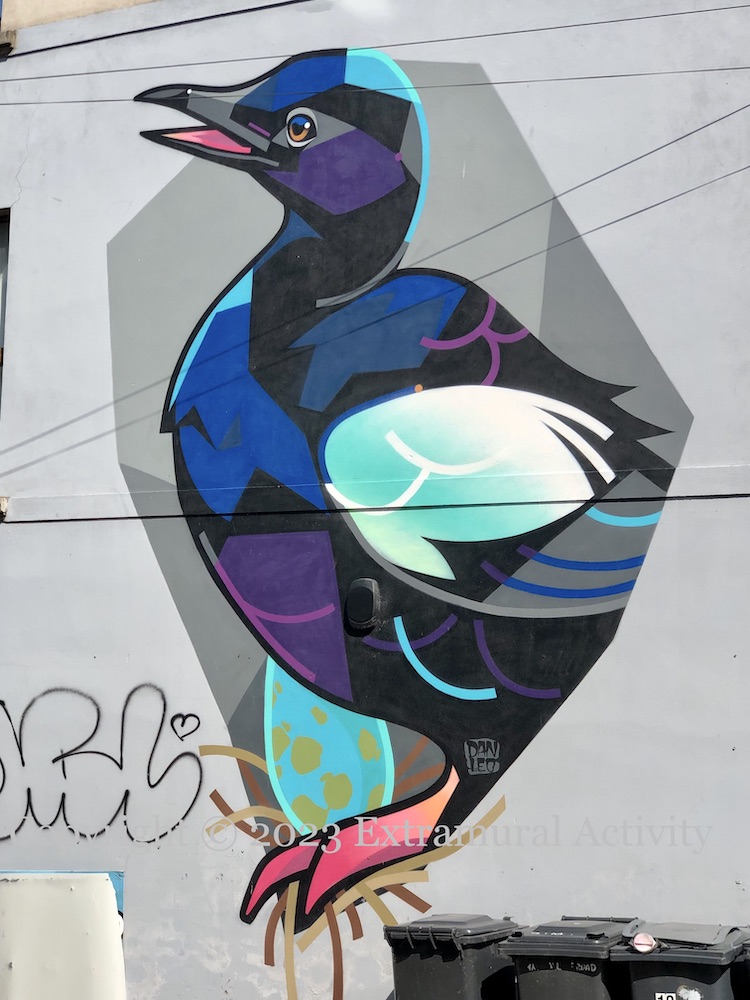
The guillemot is distinctive for its red “gape” (inside of mouth). It spends most of its time on and around water but nests on cliff ledges and other remote spaces in May (BirdWatchIreland). The pointed shape of the egg makes it less likely to fall off cliffs (British Birds). They have been nesting in Bangor since at least 1911 (Geograph). If you can’t spot any at the marina, you can check out this mural by Dan Leo (ig) in nearby Victoria Road.
Click image to enlarge
Copyright © 2023 Seosamh Mac Coılle
X12612
 Extramural Activity