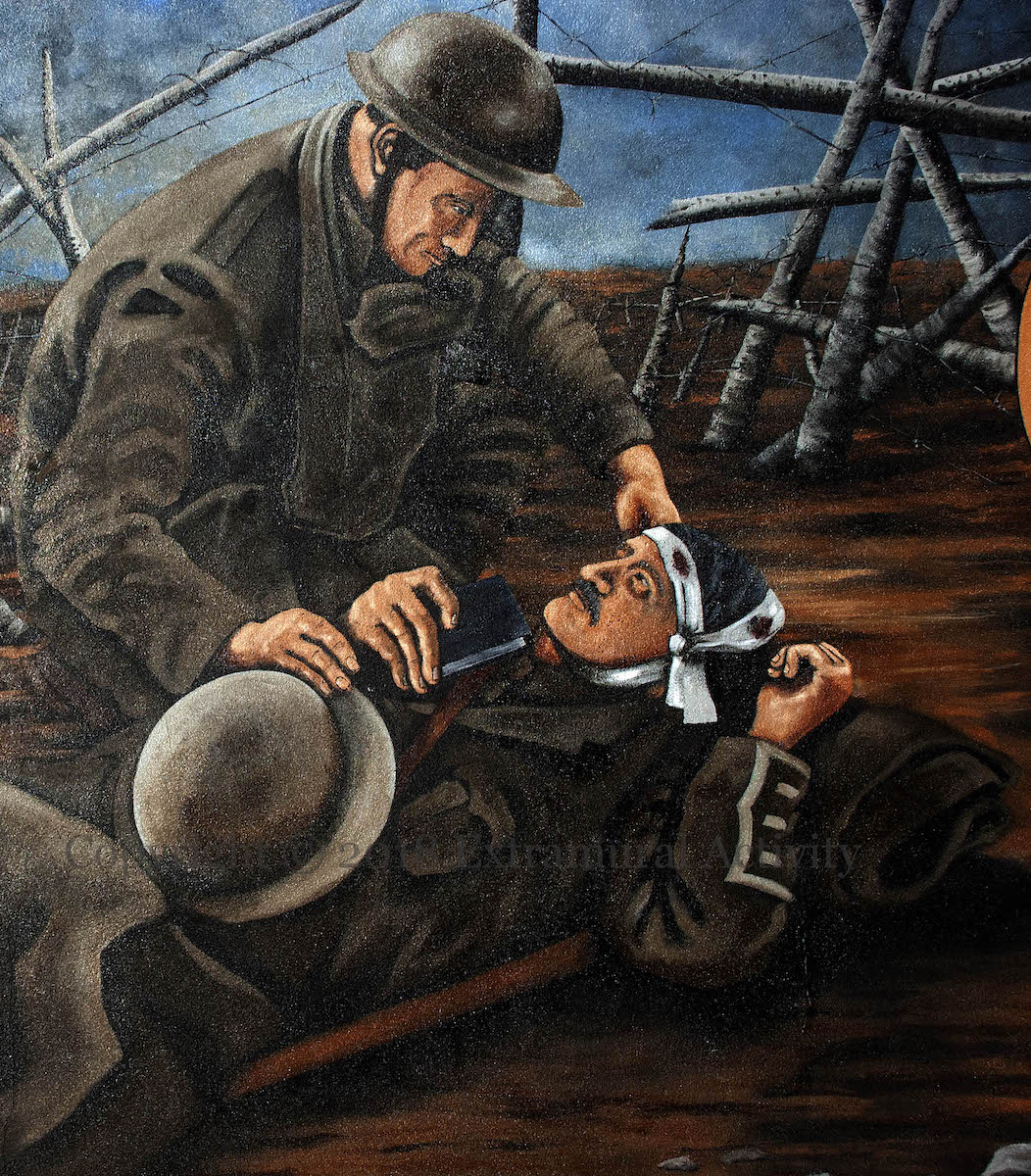
The Union Flag/UVF side-wall is a new addition to the Ulster Volunteers/UVF memorial in London Road, east Belfast. The main panel shows WWI soldiers going over the top (see Between The Crosses) while the four portraits to its right are of deceased UVF volunteers of the 70s and 80s – Seymour, Long, Cordner, and Bennett – (see Ulster’s Brave).
John Meeke signed the Ulster Covenant in Dervock Orange Hall in 1912 and went to war with the Ulster Volunteers. Willie Redmond, brother of John Redmond, had been jailed three times and was a nationalist MP at Westminster when, at age 53, he signed up for service.
Major Redmond went over the top with the 16th (Irish) Division at Messines Ridge and was hit by machine-gun fire. Private Meeke, a stretcher-bearer with the Royal Inniskilling Fusiliers in the 36th (Ulster) Division, found and stayed with Redmond under heavy fire, taking two bullets himself.
Redmond would die that night. He was awarded the Legion Of Honour by the French. His East Clare seat was taken by Éamon de Valera. Meeke survived after several surgeries. He was awarded the Military Medal by the British. After the World War, he joined the Specials and LOL 1001 in Benvarden before dying of TB in 1923 (NALIL | Irish Times | WP | BelTel).
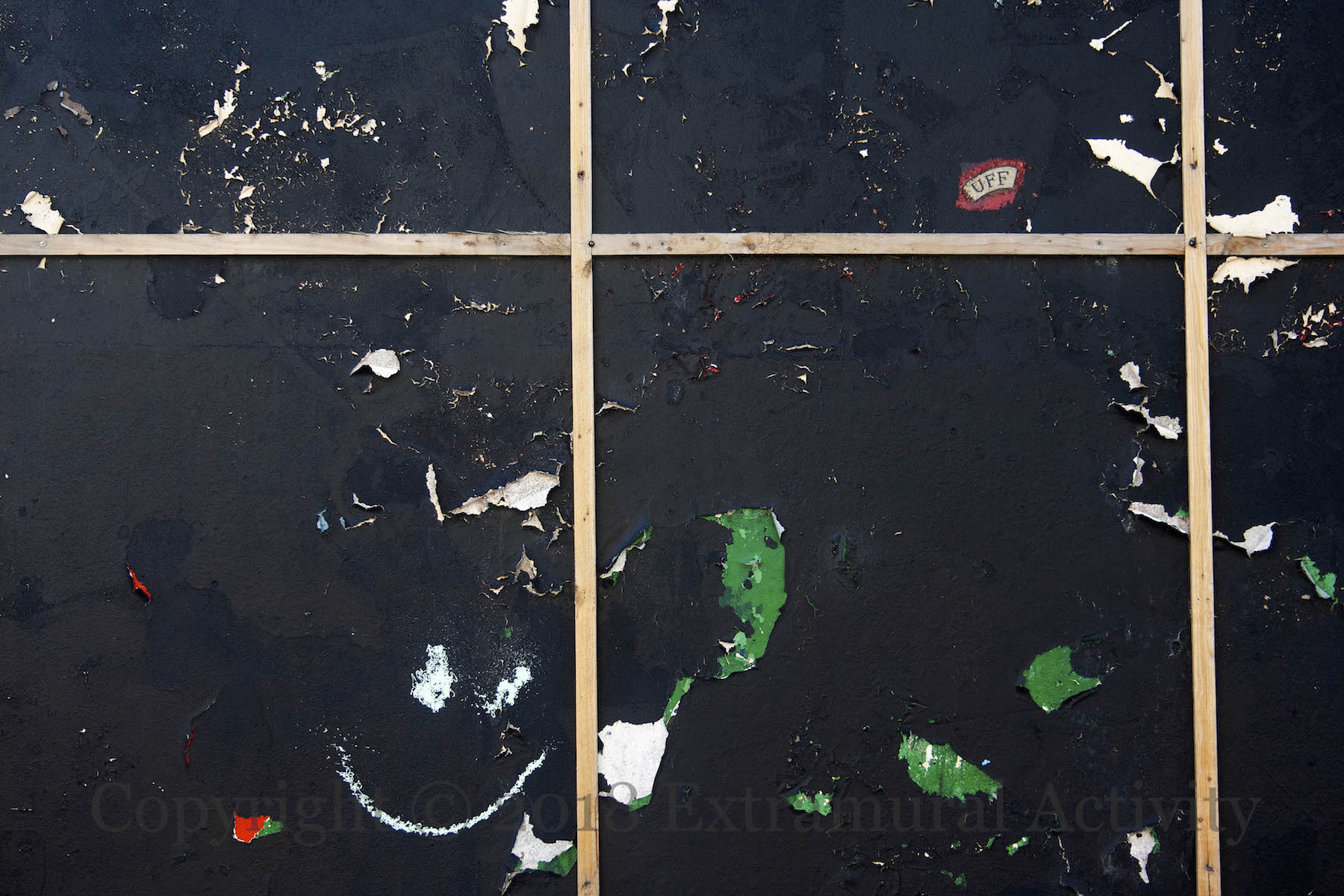
As reported earlier (in Digital Eddie), the 2016 Eddie The Trooper laminate in Ebrington Terrace, Londonderry, began disintegrating as soon as it went up. Today’s images (from late 2018) show that he has completely gone, exposing scraps of the former Eddie. A few Eddies still stalk the land, most notably in Carrickfergus – see the Visual History page for Eddie.
The Apprentice Boys mural in Emerson Street, Londonderry, which was at least fifteen years old, was replaced in 2018 with a version of boards (shown above). The shutting of the city gates in December 1688 began the Siege Of Derry.
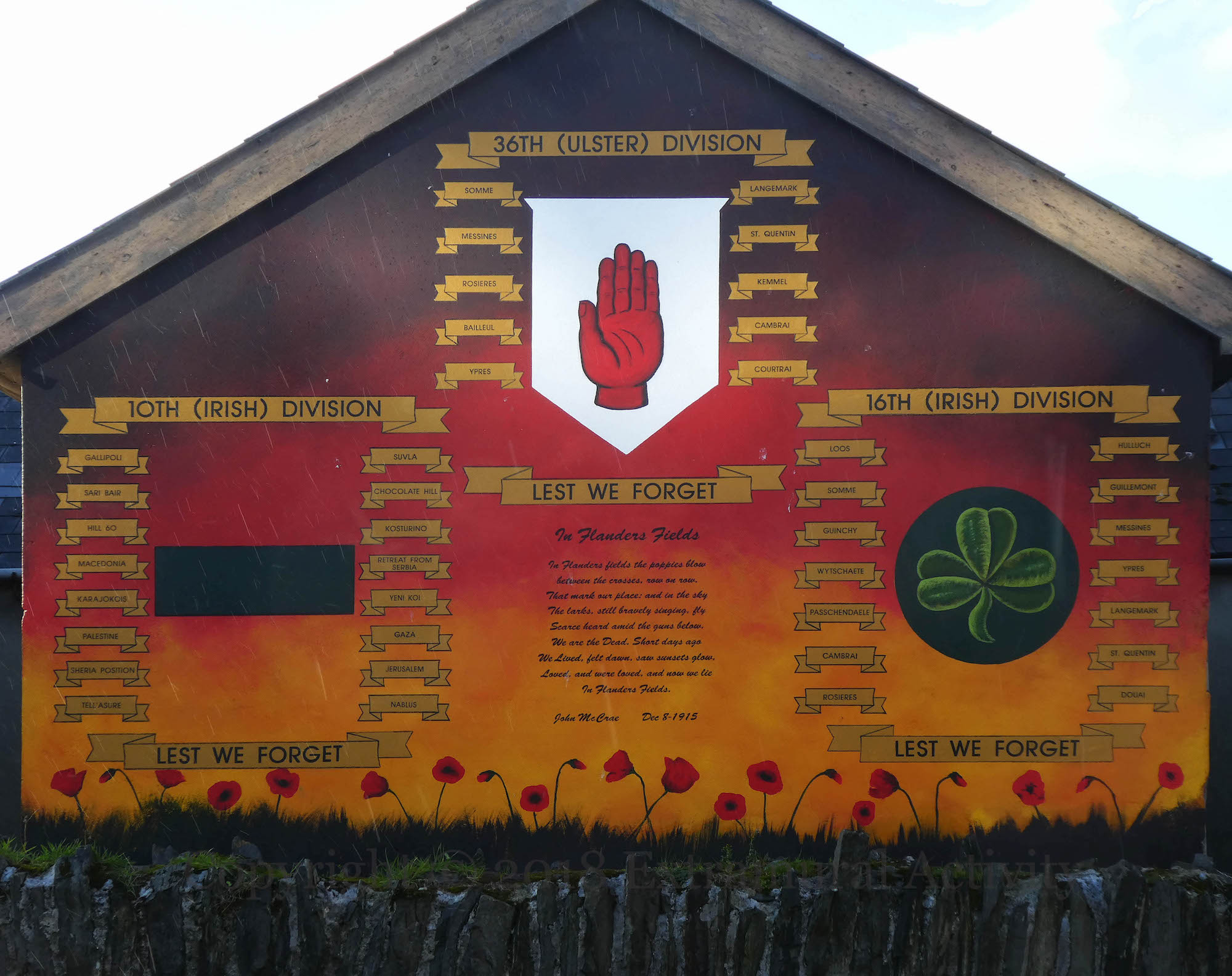
This small mural in the car-park of the Waterside Arts Centre, a companion piece to We Are The Dead which lists their battles, gives casualty totals for the 10th (Irish), 36th (Ulster), and 16th (Irish) divisions of the British Army in WWI .
Between its construction in 1841 and decommissioning in 2003, Ebrington Barracks served as a home to many military units, including those whose emblems are at the bottom of the mural above (from left to right): the Royal Irish Rifles, Royal Inniskilling Fusiliers, Royal Irish Rangers, UDR, and the Royal Irish Regiment.
HMS Ferret and HMS Sea Eagle are not in fact ships but a part of Ebrington barracks given to the navy to serve as a “stone frigate” during (Ferret) and after (Sea Eagle) WWII. HMS Londonderry was an anti-submarine frigate but does not appear to have a particular connection to Ebrington (please comment if you know otherwise).
The Northern Ireland General Service medal – in the middle of the mural – was awarded to any soldier who served at least 30 days during Operation Banner, the deployment of British troops in Northern Ireland from 1969 onwards.
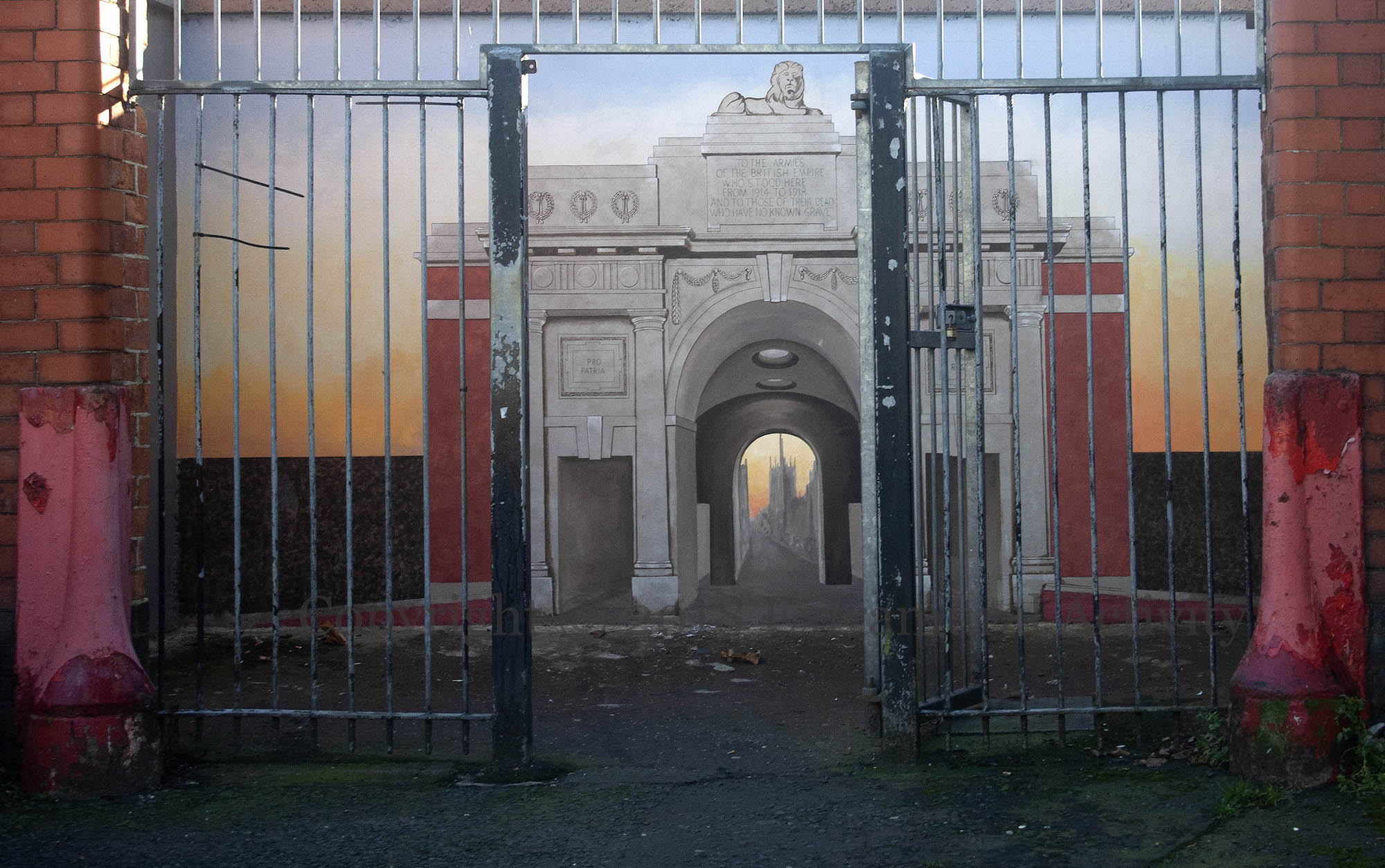
The Menin Gate memorial, at the eastern edge of Ypres, Belgium, commemorates 54,896 Commonwealth soldiers who died in the area during WWI and whose bodies were not recovered. “To the armies of the British Empire who stood here from 1914 to 1918 and to those of their dead who have no known grave.” The gates in the image above are off Bond’s Street, Londonderry, leading to the Ebrington Centre car park.
The 10th (Irish) Division fought only briefly “in Flanders fields”, towards the very end of the war, having spent most of its time in Gallipoli (in the Ottoman Empire), Macedonia, Egypt, and Palestine. The 16th took part in the Somme, especially at “Guinchy” [Ginchy] and Guillemont, while the 36th were deployed on the first day (the Battle Of Albert).
The poem in the middle is the first half of John McCrae’s In Flanders Fields: “In Flanders fields the poppies blow/Between the crosses, row on row/That mark our place, and in the sky/The larks, still bravely singing, fly/Scarce heard amid the guns below.//We are the dead; short days ago/We lived, felt dawn, saw sunset glow/Loved and were loved, and now we lie/In Flanders fields.”







 Extramural Activity