From The Road To The Somme

“1914 West Belfast regiment, Ulster Volunteer Force – 36th (Ulster) division, Royal Irish Rifles.” Men from the West Belfast Ulster Volunteers – which included the Shankill and Woodvale areas – joined the 9th battalion of the Royal Irish Rifles, which became part of the 107th brigade of the 36th division.

The main part of this new gable-sized board places two colourised photographs on top of each other. The first (upper) photo shows shows the first and second battalions of the West Down regiment being presented with their colours in May, 1914 (CyberProd). The second (lower) photo shows the first and second battalions of the West Belfast regiment receiving the Kings colours in May, 1914 (CyberProd).

In the bottom left corner is a poem called “Sons of Ulster” written on a scroll: “Muster round me Sons of Ulster,/And pay heed to what I speak,/Of the war to end all wars,/In the place where hell is deep.//Go and help to save the Empire,/Glorious deeds shall Ulster reap./Go and fight for King and Country,/In the place where hell is deep.//The order goes out – “Fix Bayonets!”/As Zero Hour does creep,/Ulster’s prime stands tall in line,/In the place where hell is deep.//No-Man’s Land hears a whistling band,/From Thiepval Wood they sweep./The crosses grow where the Ancre flows,/In the place where hell is deep.//With bomb and gun they repelled the Hun,/The Redoubt they die to keep./They fought as one did Ulster’s Sons,/In the place where hell is deep.//To the Glory of God on this sacred sod,/Where Ulster’s Blood does seep,/Yours and mine slaughtered like swine,/In the place where hell is deep.//Death patiently waits in this stalemate,/For Ulster’s love will weep,/The poppies grow where the Ancre flows,/In the place where hell is deep.”

In the bottom right, the Ulster Tower is dedicated: “‘Field Marshall Sir Henry Hughes Wilson, 1st Baronet, GCB, DSO, MP, Colonel Commandant, Rifle Brigade, Chief Of The Imperial General Staff. Field Marshall Sir Henry Hughes Wilson of County Longford, was one of the most senior British Staff Officers to serve int he First World War. On 18th November 1921, in the stead of Sir Edward Carson and Sir James Craig, who were both ill at the time, Sir Henry undertook the solemn duty of dedicating the newly constructed Ulster Memorial Tower, on the site of the Somme battlefield. Tragically, on 22nd June 1922, Sir Henry, who also served as a Unionist politician, was assassinated outside his London home.”

Conway Street, Shankill, west Belfast, replacing Ulster Tower.

Click image to enlarge
Copyright © 2026 Seosamh Mac Coılle
X16287 X16290 X16291 X16292
X16288 [X16289]

Royal Irish Rifles

After WWI, the Royal Irish Rifles became the Royal Ulster Rifles (and later became part of the Royal Irish Rangers). This board prioritises WWI as the Rifles were part of the 36th Division. The hero of WWI portrayed in the central panel is William McFadzean, awarded the VC for falling on two live grenades in the trenches on July 1st, 1916. McFadzean is familiar from many previous murals both individually and in the company of other VC winners; for his family home in Cregagh, see Rubicon.

Alongside McFadzean, the hero of WWII is Blair “Paddy” Mayne, who was only briefly in the Ulster Rifles before making his name in the Parachute Unit (later, and better, known as the SAS). His many medals of honour are shown in an old Newtownards mural though he was denied the VC.

Ballysillan Road, north Belfast.

Click image to enlarge
Copyright © 2023 Seosamh Mac Coılle
X14137 [X14133] [X14134] X14136 X14135 X14138 X14131 X14132

What Answer From The North?

These are the boards at the chip shop (formerly a Spar and before that a Mace) in the centre of the Mourneview estate, Lurgan.

Above, in Mourne Road, a gallery of photographs of the Craigavon Protestant Boys (Fb) past and present, with a plaque in memory of Victor Stewart. “Our only crime is loyalty.”

Below are the images from the front of the shop, in Pollock Drive:

First/right: “When injustice becomes law resistance becomes duty.” The same panel was seen in Ballyclare, though for the 1st East Antrim battalion rather than the Mid Ulster brigade.

Next: A company, 1st battalion, Mid Ulster brigade UVF – Lurgan as well as Broxburn (outside Edinburgh) and Thornliebank (near Glasgow).

Next: A tribute to the Ulster Volunteers from the area: the 9th battalion Royal Irish Fusiliers joined the 108th brigade in the 36th (Ulster) Division; the 5th battalion joined the 31st brigade and the 10th (Irish) Division. This board goes back to (at least) 2011.

Next: “Believe, we dare not boast,/Believe, we do not fear/We stand to pay the cost,/In all that men hold dear.//What answer from the North?/One Law, one Land, one Throne/If England drive us forth,/We shall not fall alone!” Kipling’s poem Ulster.

The first stanza also appears in a Belfast RHC mural, and other lines from the poem have been used elsewhere: We Perish If We Yield | The Terror, Threats, And Dread.

All of the preceding pieces are UVF/PAF, but the last, high up on the left, is a UDU board in the top left of the wall, to 1 company, D battalion, South Belfast.

With thanks to Jackie Findon for today’s images.

Click image to enlarge
Copyright © 2023 Jackie Findon
X12356 X12357 X12358 X12359 X12360

Silence Speaks When Words Can Not

There was previously a (painted) mural on this wall – see Passchendaele Court – but this latest display is a large printed board, with photographs blended together and framed by graveside mourners, poppies, and the emblems of the Pride Of Govan flute band and the Govan Somme Association (Fb), which also supported the previous mural.

To the left, as seen in the final images, is a smaller UVF (1st Battalion) A Company 5th Platoon board – like the other new board in the street We Will Always Be Ready (and on the other side of Conway Street – see When Needed We Shall Rise Again).

Conway Walk, Belfast

Click image to enlarge
Copyright © 2023 Seosamh Mac Coılle
X12023 X12024 X12021 X12022

Is Your Home Worth Fighting For?

“… It will be too late to fight when the enemy is at your door.” In 1914, at the time of the Larne gun-running – see the mural in the second image and (previously) Amazing Night At Larne – the enemy was the threat of Home Rule and its enforcement by British Army forces and RIC that would remain under British control for at least three years after the commencement of home rule (Home Rule And Ulster’s Resistance p. 9). A bill to amend home rule by excluding some or all of the Ulster counties was introduced in July, 1914 (WP), but both Home Rule and the amendment were put aside when the Great War began; the enemy of Unionists then became the Central Powers. The contemporary enemy is the NI Protocol and Brexit, with the powers in Westminster again suggesting a separation of Britain and (Northern) Ireland.

Click image to enlarge
Copyright © 2022 Seosamh Mac Coılle
X09336 X09335 X09337 Greenland Drive Larne

The Loyal 36th

“Off to France our boys were sent. All gave some, some gave all – In memory of the loyal 36th.” The first phrase might come from the Rangers’ song ‘We’re Coming Down The Road‘. The second phrase dates not to WWI but the Korean War in the 1950s (Reference). Kitchener Drive, the Village.

Click image to enlarge
Copyright © 2019 Extramural Activity
X06729 X06728 kitchener drive

Comrades In Arms

John Meeke signed the Ulster Covenant in Dervock Orange Hall in 1912 and went to war with the Ulster Volunteers. Willie Redmond, brother of John Redmond, had been jailed three times and was a nationalist MP at Westminster when, at age 53, he signed up for service.

Major Redmond went over the top with the 16th (Irish) Division at Messines Ridge and was hit by machine-gun fire. Private Meeke, a stretcher-bearer with the Royal Inniskilling Fusiliers in the 36th (Ulster) Division, found and stayed with Redmond under heavy fire, taking two bullets himself.

Redmond would die that night. He was awarded the Legion Of Honour by the French. His East Clare seat was taken by Éamon de Valera. Meeke survived after several surgeries. He was awarded the Military Medal by the British. After the World War, he joined the Specials and LOL 1001 in Benvarden before dying of TB in 1923 (NALIL | Irish Times | WP | BelTel).

Click image to enlarge
Copyright © 2018 Seosamh Mac Coılle
X06390 [X06389] X06388 ebrington st

We Are The Dead

The 10th (Irish) Division fought only briefly “in Flanders fields”, towards the very end of the war, having spent most of its time in Gallipoli (in the Ottoman Empire), Macedonia, Egypt, and Palestine. The 16th took part in the Somme, especially at “Guinchy” [Ginchy] and Guillemont, while the 36th were deployed on the first day (the Battle Of Albert).

The poem in the middle is the first half of John McCrae’s In Flanders Fields: “In Flanders fields the poppies blow/Between the crosses, row on row/That mark our place, and in the sky/The larks, still bravely singing, fly/Scarce heard amid the guns below.//We are the dead; short days ago/We lived, felt dawn, saw sunset glow/Loved and were loved, and now we lie/In Flanders fields.”

Click image to enlarge
Copyright © 2018 Seosamh Mac Coılle
X06358 Ebrington Centre, Londonderry

Victoria Crosses Of The 36th (Ulster) Division

Dee Craig has updated the Victoria Crosses mural in Cregagh, honoring G[eoffrey St. George Shillington] CatherW[illiam Frederick] MacFadzeanR[obert] Quigg, and E[ric] N[orman] F[rankland] Bell. Five more were included in a board on the Shankill and another in Willowfield Street. (For the previous Cregagh version, see M03390)

Click image to enlarge
Copyright © 2018 Seosamh Mac Coılle
X06313 [X06314] X06315 cappagh gardens

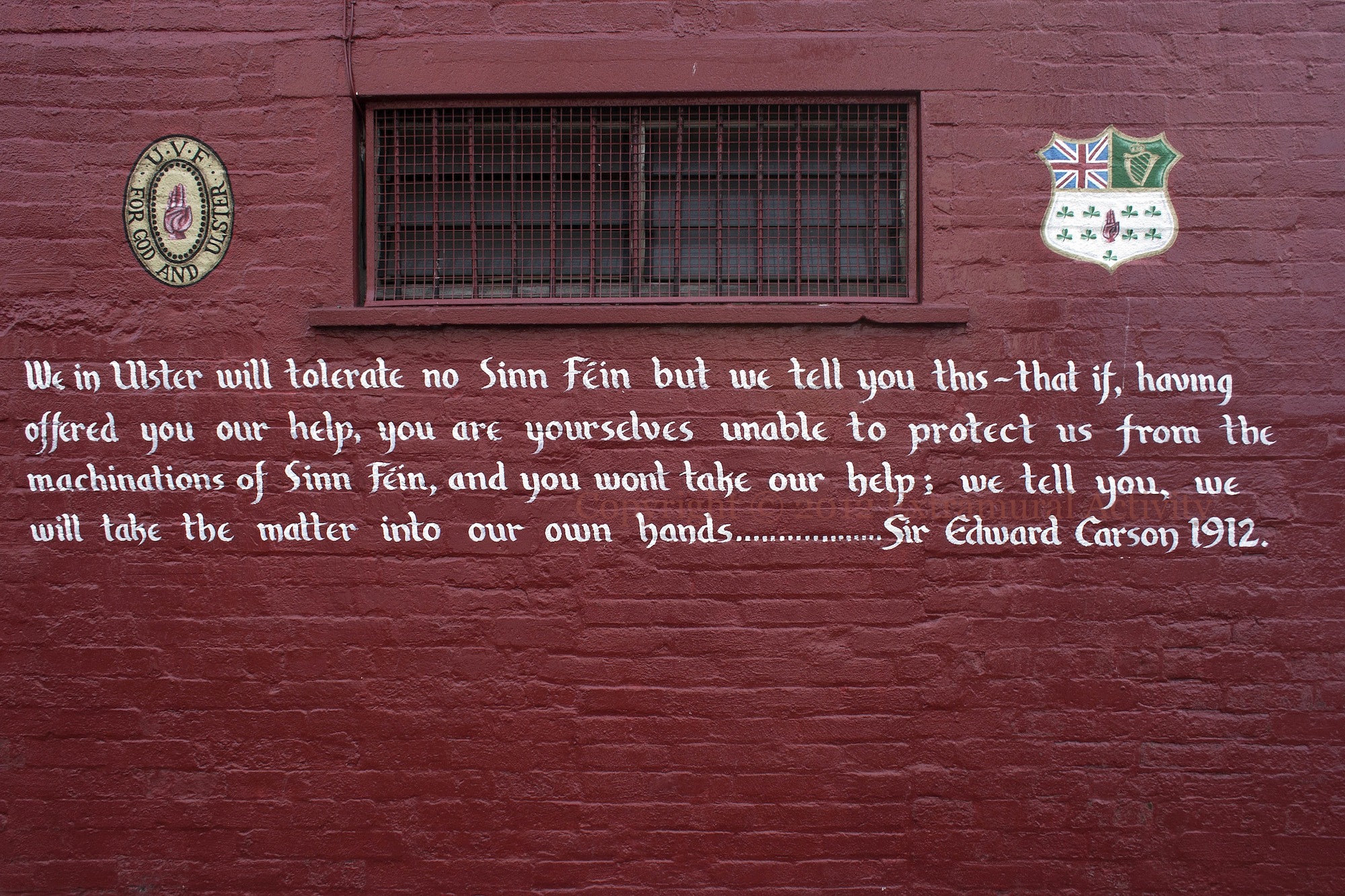
We Will Take The Matter Into Our Own Hands

2012-12-04 CarsonQuote+

“We in Ulster will tolerate no Sinn Féin but we tell you this – that if, having offered you our help, you are yourselves unable to protect us from the machinations of Sinn Féin, and you won’t take our help; we tell you, we will take the matter into our own hands …. ” A quote from Sir Edward Carson (probably, 12th of July, 1920 rather than 1912 – Treason Felony | RTÉ) replaces the previous “free men” quote (see M03378); the poppies between the emblems in the main panel are also new, as is the plinth the hooded gunmen are standing on, which reads “1912 East Belfast Ulster Volunteer Force” (also, “1981 Gareth Keys 2008″). In other words, the mural has been softened (slightly) by adding historical elements.

Castlereagh Road, opposite Ravensdale Street.

Click image to enlarge
Copyright © 2012 Seosamh Mac Coılle
X02970 X00846 u.v.f. for god and ulster