This is another part of a long ‘Bangor Protestant Boys Flute Band’ wall in Kilcooley: the shield of the 36th (Ulster) Division – the Union flag and Irish harp above a red hand on a field of shamrocks – on a garland of orange poppies and WWI battlefields on a purple ribbon – orange and purple being the colours of the Ulster Volunteers.
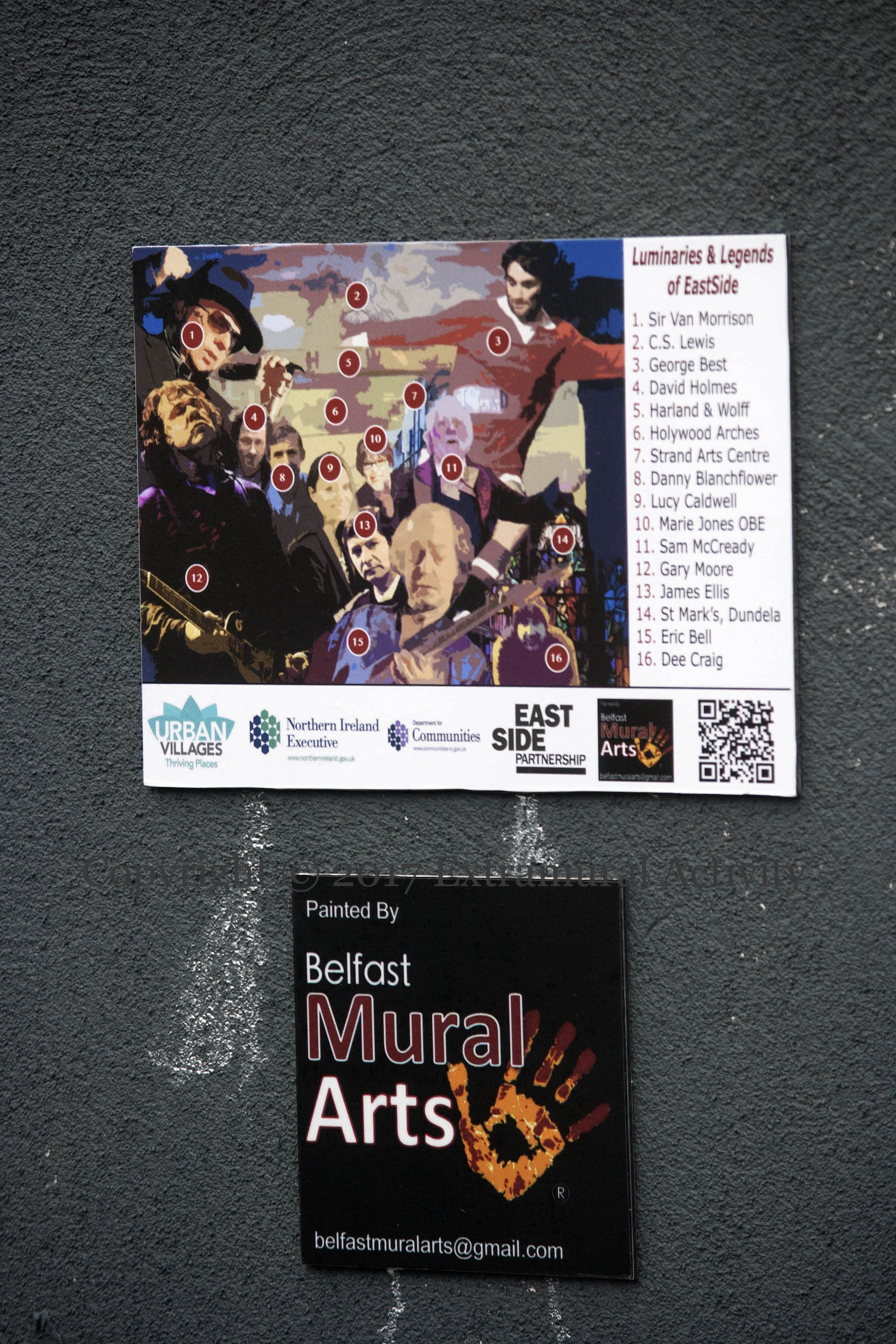
Famous faces and landmarks from east Belfast, including, in the foreground, guitarists Gary Moore and Eric Bell (from Thin Lizzy). Included in the bottom right is the artist himself, Dee Craig. For a complete list, see the info board, below.
Two pieces of local commentary from the Cupar Way “peace” wall in west Belfast. “Fuck the peace process”, “Save the NHS”, and “[Secretary for Health] Jeremy Hunt is a total dick”.
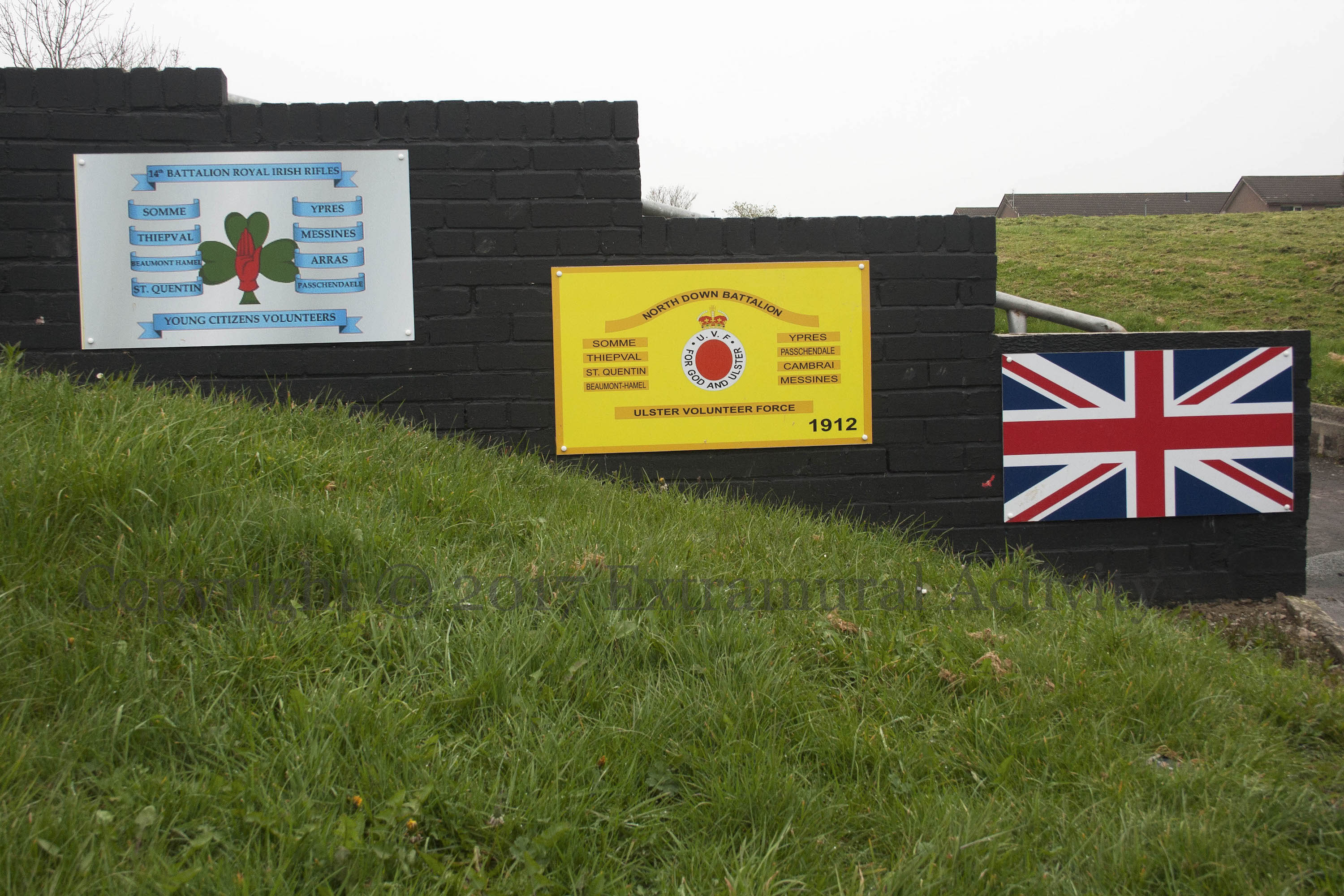
Recruiting for the Ulster Volunteers in Down was so successful that it was divided into four areas (North, South, East, and West), each with a battalion, and the North down battalion comprised 15 companies (History Ireland). The Down battalions became the 13th battalion of the (108th Brigade) Royal Irish Rifles in WWI. The YCV (Young Citizen Volunteers) was formed separately (in 1912) but joined the Volunteers in May 1914, before becoming the (109th Brigade) 14th battalion of the Royal Irish Rifles when the war broke out (WP). Both began their campaigns at Boulogne-Sur-Mer in October, 1915 (WP).
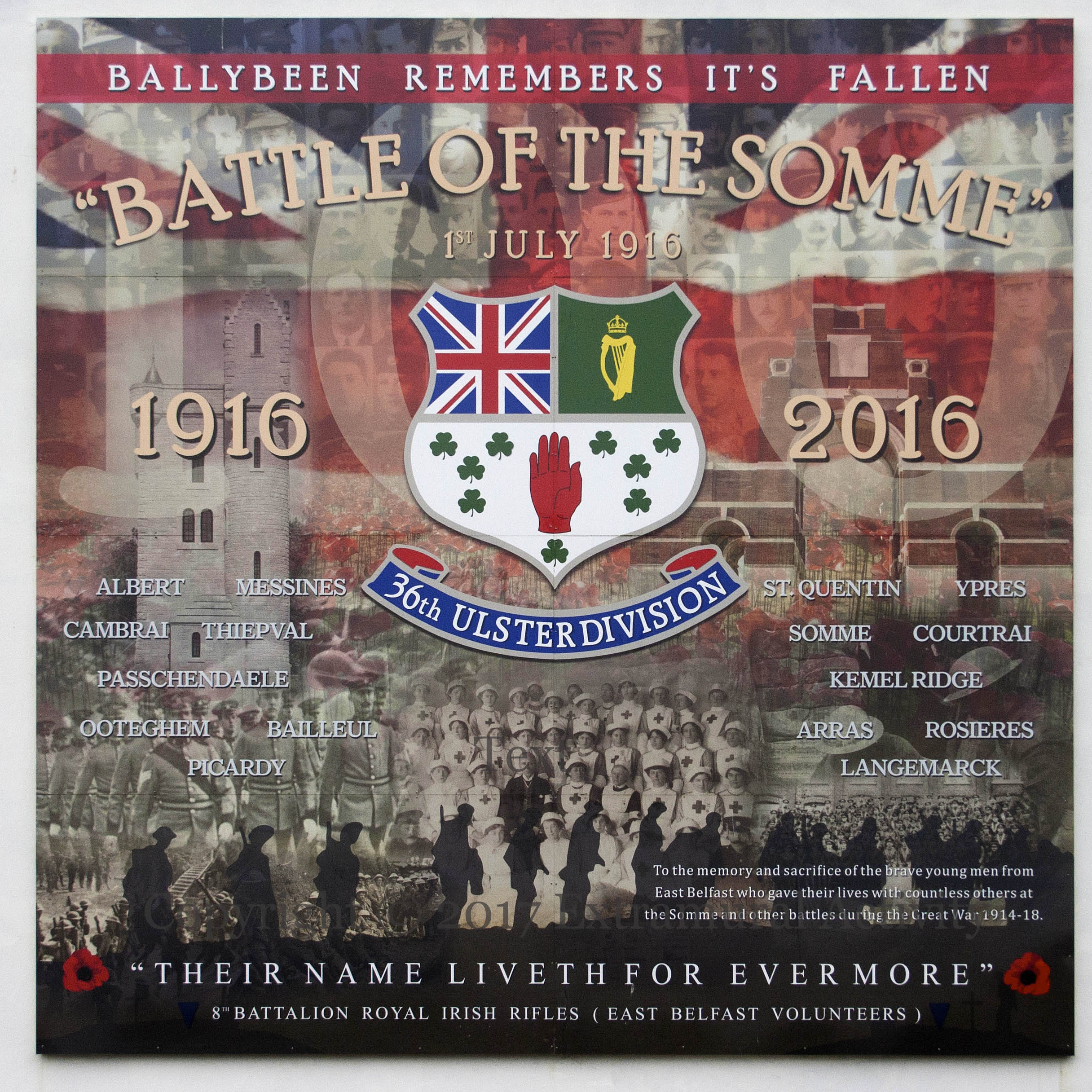
“Ballybeen remembers it’s [sic] fallen – to the memory and sacrifice of the brave young men from East Belfast who gave their lives with countless others at the Somme and other battles during the Great War 1914-18.” The Union flag and the Thiepval memorials serve as a backdrop for images of individual soldier and photographs of soldiers and nurses at work.
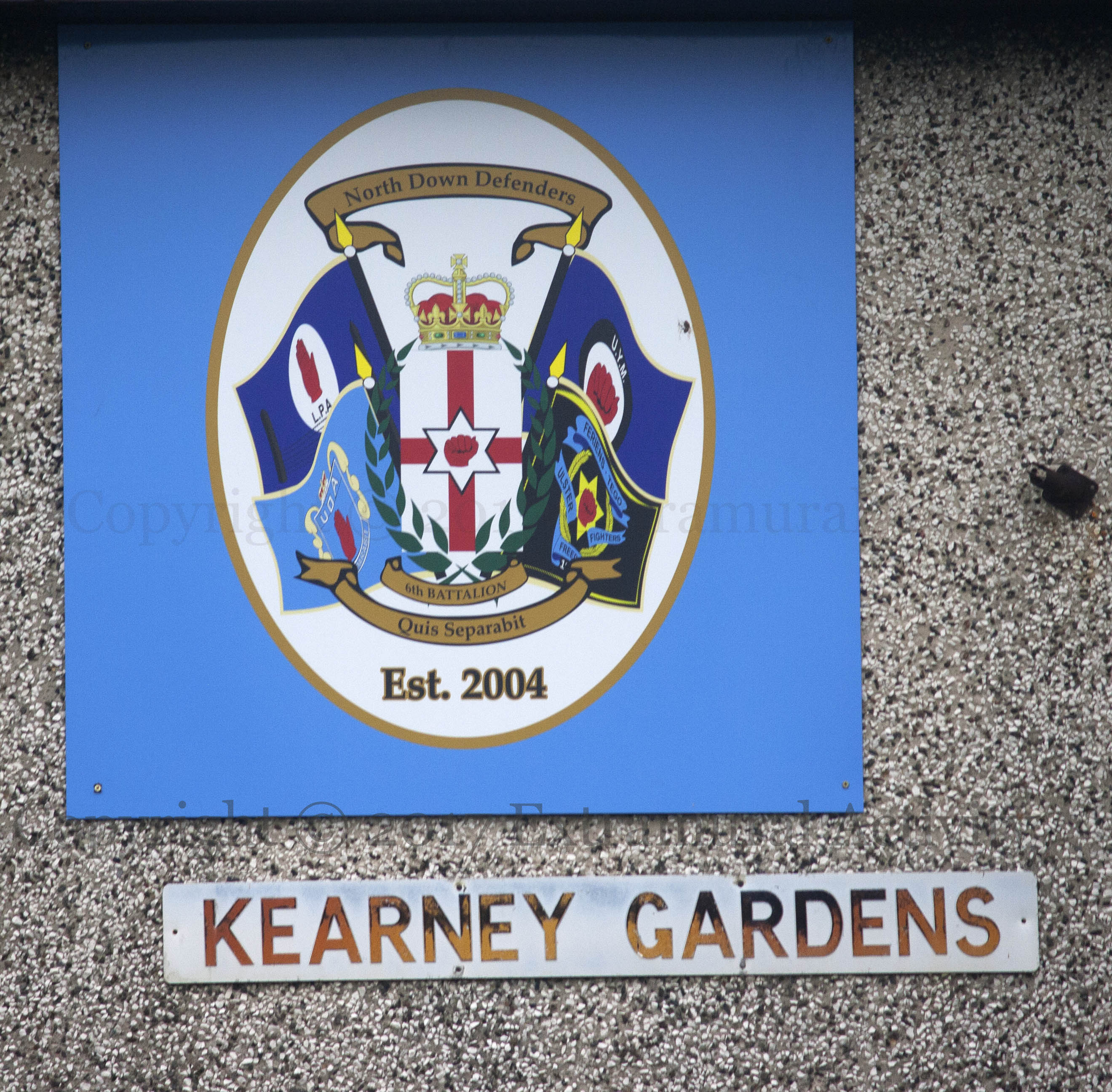
Here is a small board in Bangor from the North Down Defenders flute band (Tw | Fb), unusual due to the modified Ulster banner with clenched red hand in the centre. Surrounding it are the flags of the LPA, UDA, UFF, and UYM.
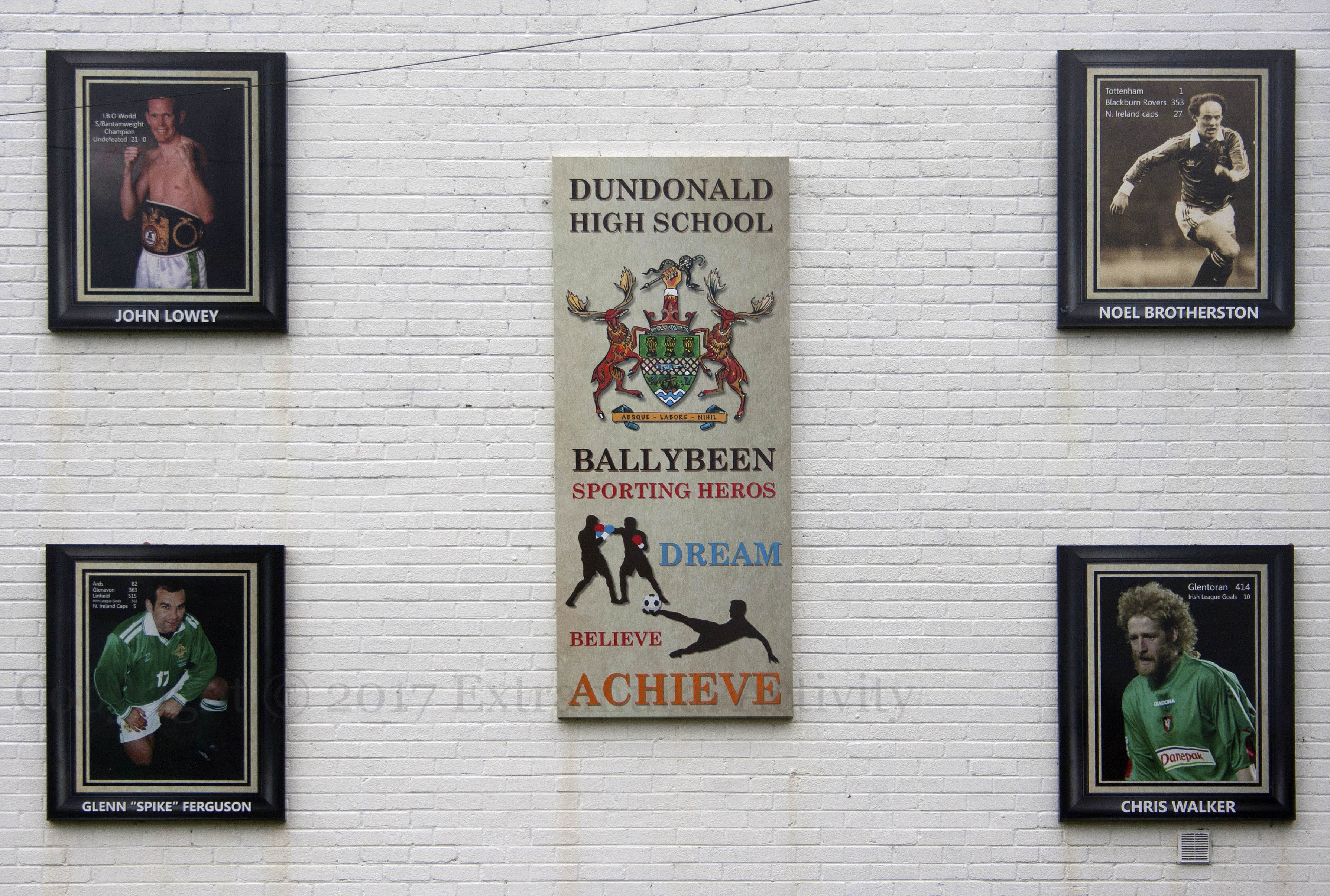
Teenagers at Dundonald High “dream, believe, achieve” success on a par with their “Ballybeen sporting hero[e]s”, such as IBO super bantamweight boxer John Lowey and footballers Noel Brotherson (Blackburn Rovers), Glenn “Spike” Ferguson (Glenavon and Linfield), and Chris Walker (Glentoran).
The boards on the right read: “‘Tis thy flag and my flag;/The best of flags on Earth,/So cherish it my children,/It’s yours by right of birth.//Your fathers fought,/Your fathers died,/To raise it to the skies,/And we like them must never yield,/But keep it flying high.” from The UnionJack, by Edward Shirley, in Little Poems For Little People, and “In memory of the men and women from the Orangefield area, who have made the ultimate sacrifice in the defence of our freedom in all theatres of conflict, both foreign and at home.” These memorial boards are to local men who “stood to the fore to defend the Empire as the 8th Battalion (East Belfast) Royal Irish Rifles” in the 36th division, formed from formed from the “8th Battalion (Avoniel) and the 6th Battalion (Strandtown)” of the Ulster Volunteers.
Privates Fred Starrett and James Cummings died in an IRA bombing on Belfast’s Royal Avenue on February 24th, 1988. Both Orangemen, their deaths are commemorated every year by a parade from east Belfast to the city centre. Shown in today’s post are the panels from a new UDR commemorative wall in east Belfast.
The fourth panel is a collage of UDR activities (on the streets, on base, manning check-points, in boats, helicopters, with dogs) with a few pieces of republican signs as backdrop (Free Derry Corner, “Provies rule”, “Such is British justice – remember 9th August”) and the fifth shows soldiers searching for arms near some outbuildings.
The 100th anniversary plaque and board shown in this entry are on the spot of Bloomfield House (web), where guns from Clyde Valley were held for the East Belfast battalion of the Ulster Volunteers in 1914. See also: John Henry Patterson’s involvement in Operation Lion.
“When the 3rd Home Rule Bill was passed by Parliament in 1912, Ulster Unionists under the leadership of Edward Carson and James Craig realised that armed resistance was the only resort left to them to remain British. The Ulster Volunteer Force was formed in January 1913 and comprised of 100,000 men. East Belfast Regiment was the largest in the UVF with over 10,000 men divided into 6 Battalions: 1st. Ballynafeigh & Newtownbreda, 2nd. Willowfield, 3rd. Mountpottinger, 4th. Victoria, 5th. Avoniel, 6th. Strandtown & Knock. Major Fred Crawford was tasked with procuring weapons and ammunition. On 24/25th April 1914 he did just this when landed 25,000 rifles and 3,000,000 rounds of ammunition from Clyde Valley at Larne and Donaghadee in Operation Lion. These munitions were taken all over the country, and a consignment was sent to East Belfast UVF. Part of this consignment was concealed in the grounds of Bloomfield House, which stood on this location.”
“This plaque marks the occasion in early May 1914 when over 2,000 men of the East Belfast Regiment, Ulster Volunteer Force paraded to the grounds of Orangefield House for an inspection to celebrate the success of Operation Lion when weapons and ammunition were landed at Larne and Donaghadee. For God and Ulster.”
These three are next to (and the same black background) as the Orangefield memorial – see In All Theatres Of Conflict.