Catalan president, Carles Puigdemont, will address the regional parliament today, the first time since the referendum on October 1st and the violence that accompanied it. He threatened to announce an independent Catalonia within 48 hours of the poll, but today might in fact be the day (Irish Times | Guardian).
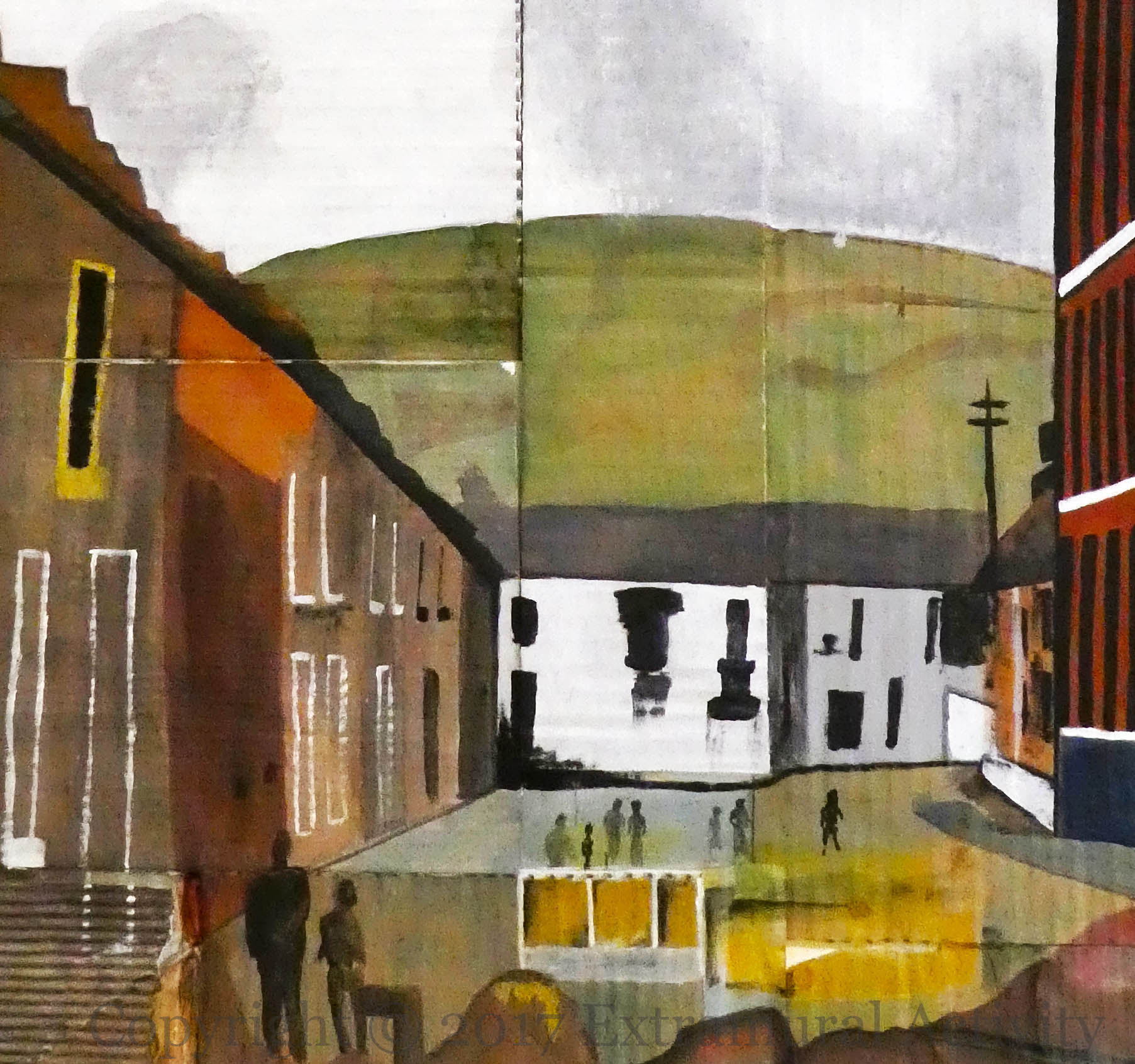
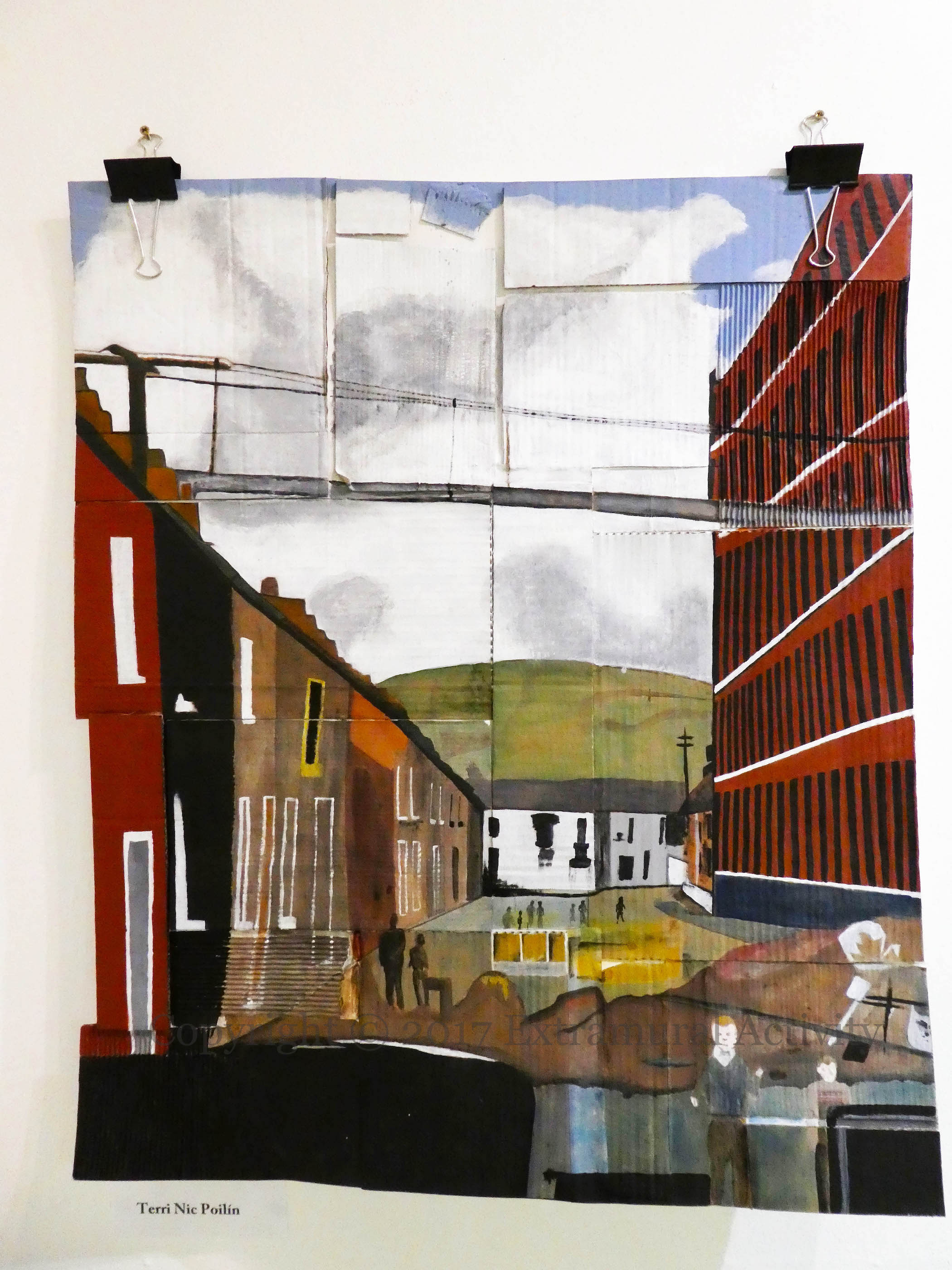
Year 10 GCSE student Terri Nıc Poılín imagines what the view would be like if the “peace wall” were removed, using cardboard as a canvas. The piece was part of the Coláıste Feirste art show in An Chultúrlann.
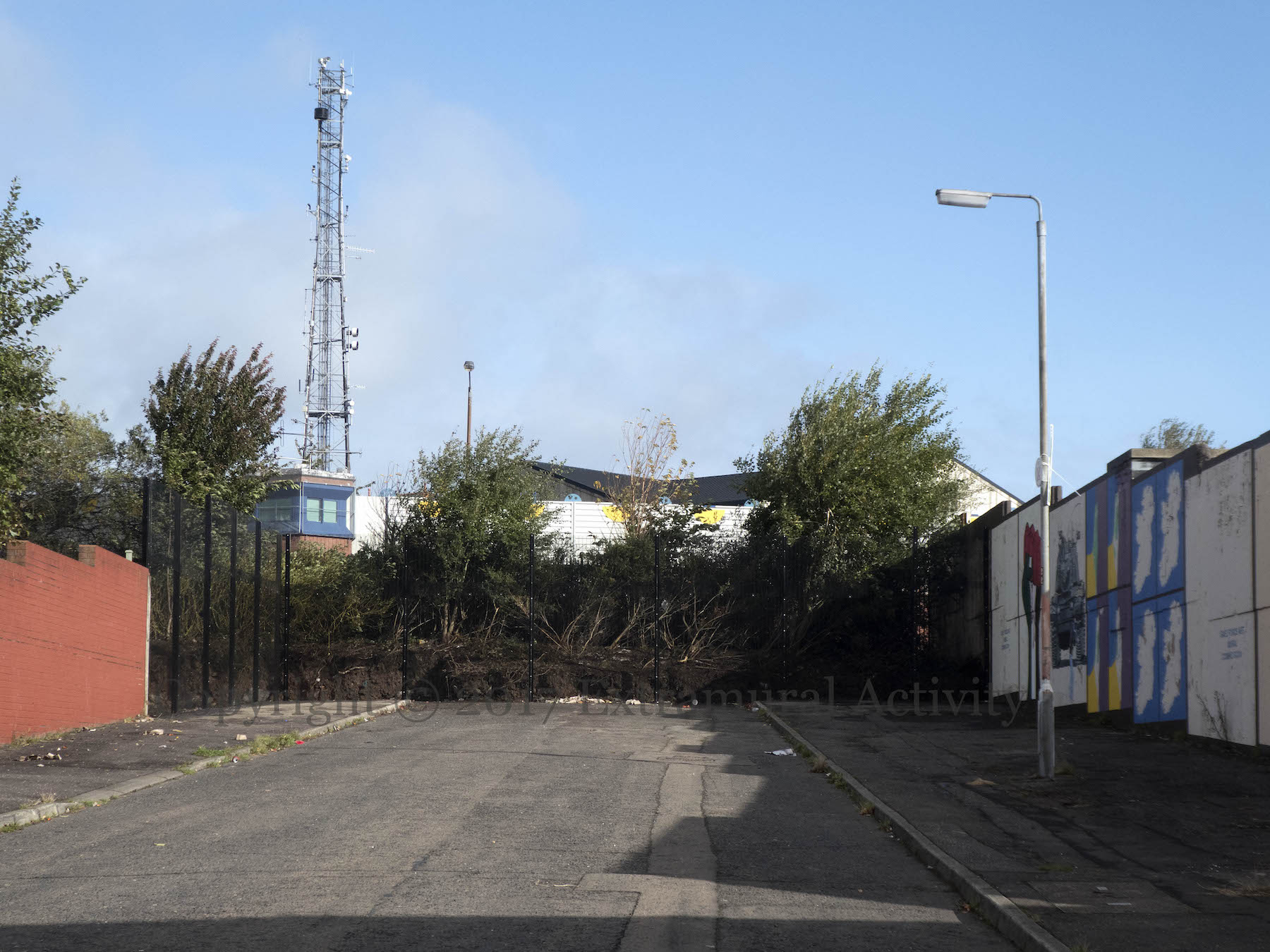
A good deal of attention was recently paid to the removal of a “peace” wall at the top of Springhill Avenue (e.g. Guardian | Irish Times). As can be seen from the image above, however, a high fence has been put in its place and the dense shrubbery left intact, so that it is impossible to enter or exit the area this way. The new “transparency” is similar to the see-through gate in Workman Avenue in 2015 and in Howard Street in 2013. The immediate impact has been to remove a large wall used for muraling: Palestine Abú | Man Against Machine | Apache Hellfire.
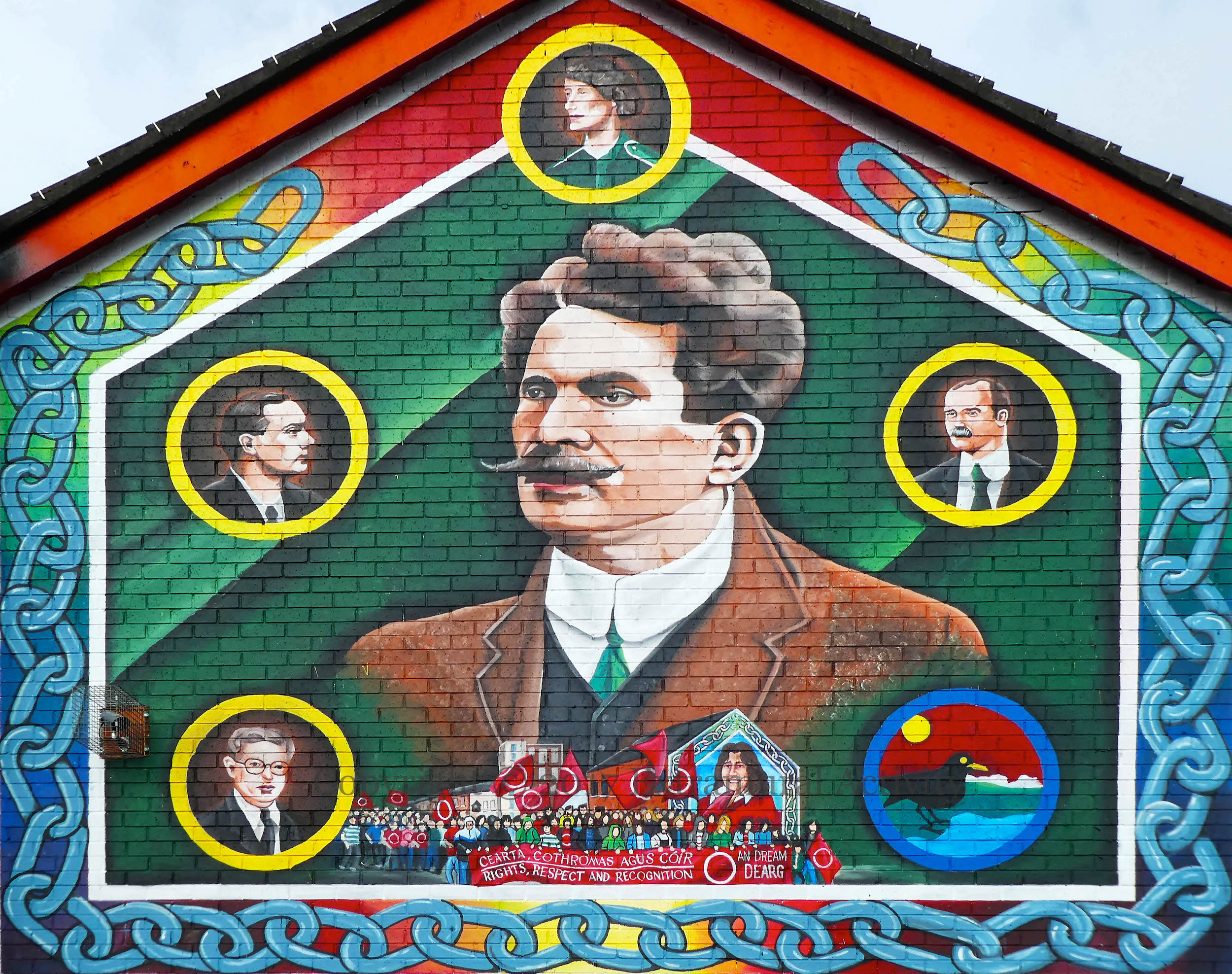
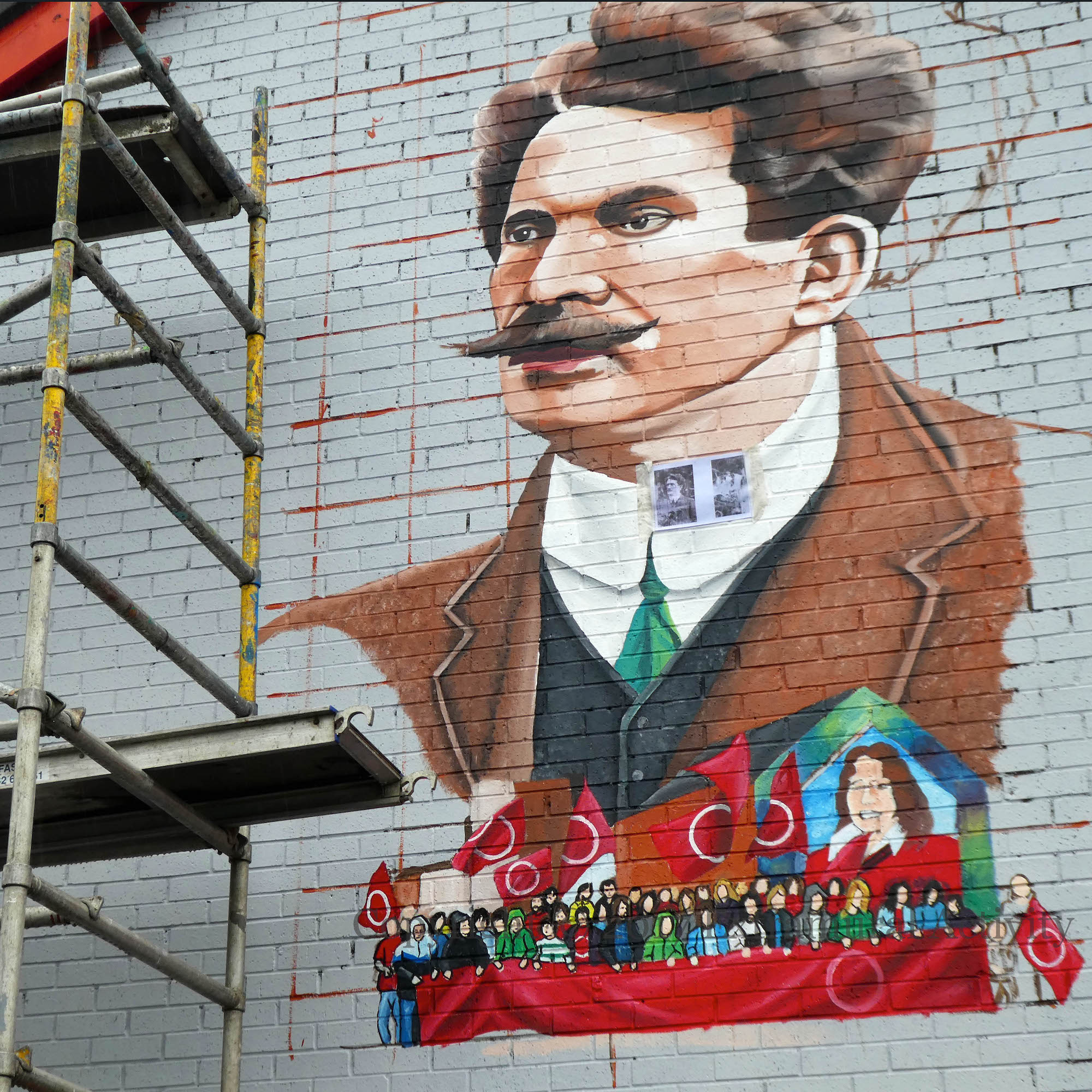
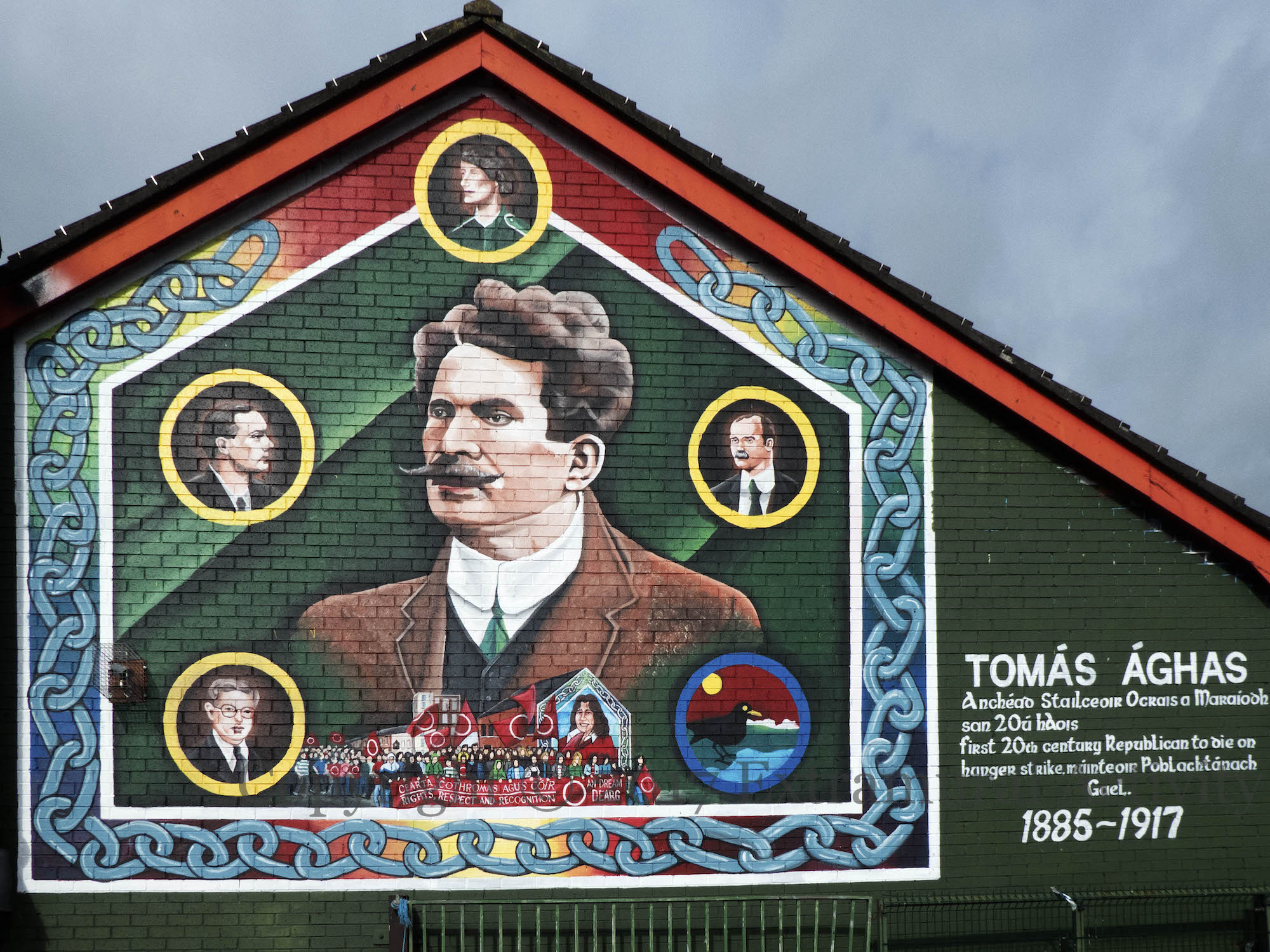
Thomas Ashe was working as an Irish teacher in Dublin when he joined the Irish Volunteers and in 1916 served as a battalion commander in the Easter Rising, for which he was sentenced to penal servitude for life. He went on hunger strike in May 1917 and again in September when he was rearrested by the British authorities for a “seditious” speech. He died on September 25th, one hundred years ago, becoming “an chéad staılceoır ocraıs a maraíodh san 20ú haoıs” (“first hunger striker to die in the 20th century”).
In the five circles around his portrait are Countess Markievicz, Pádraig Pearse, and James Connolly – fellow fighters in the Rising – and Máırtín Ó Cadhaın (author of Cré Na Cılle and IRA member interned during WWII), and the symbol of Laochra Loch Lao and more generally of An Ceathrú Gaeltachta/Gaeltacht Quarter (see previously The Big Plan and Onwards). In the middle (shown in detail below), An Dream Dearg march in support of Acht Na Gaeılge (an Irish language Act) past the Bobby Sands mural on Sevastopol Street.
This is a 32 County Sovereignty Movement (32CSM) poster from west Belfast, asking people to “Dismantle partition – reject British rule”. The organisation describes itself as “a republican pressure group”. The Belfast cumann (Fb | web) is named after Wolfe Tone and Henry Joy McCracken (of the 1798 Rebellion).
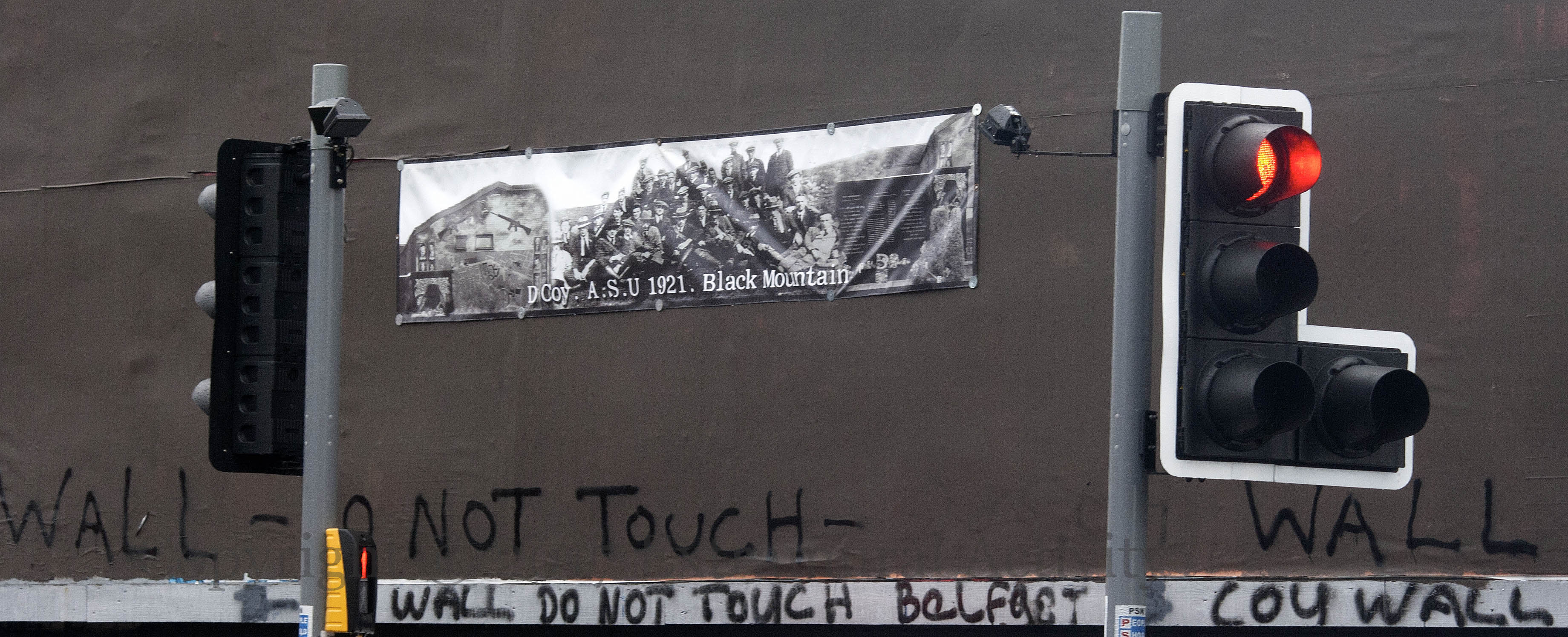
Towards the end of August the advertising hoarding at the corner of Divis and Northumberland Streets was covered with brown paint and a warning scrawled along the bottom rail: “D-Coy wall – Do not touch – Belfast D Coy wall” (though the two “D”s were painted over). (See the second image.)
A few weeks later, the banner above was added, showing the men of the northern IRA’s D Coy “active service unit” (“ASU”), between images of the (Troubles-era) D Coy mural and memorial garden (PMC | Extramural). A direct line between the IRA of and the PIRA unit is possible – some of the Northern Division went with Joe McKelvey, leader of the 3rd Division, to Dublin to support the anti-Treaty forces (WP) though most of the northern IRA accepted the assurance that the six counties would soon join the South. (For some guesstimates at the number of northerners who served pro-Treaty, see treasonfelony.)
But perhaps only an ideological heritage is intended, that the Black Mountain unit of 1921, and the D Coy of the Troubles, and the contemporary D Coy, alike aim at (Northern) Irish independence.
The harp as a symbol of Ireland dates back to the 1500’s, with the ‘winged maiden’ version current by the late 1700s. The United Irishmen replaced the crown typically added above it (used, for example, by the Royal Irish Rifles) with a cap of freedom (for another image see the 2000 Bobby Sands mural). The Irish Republican National Congress (web) is a 2014 group with the goal of a united Ireland.
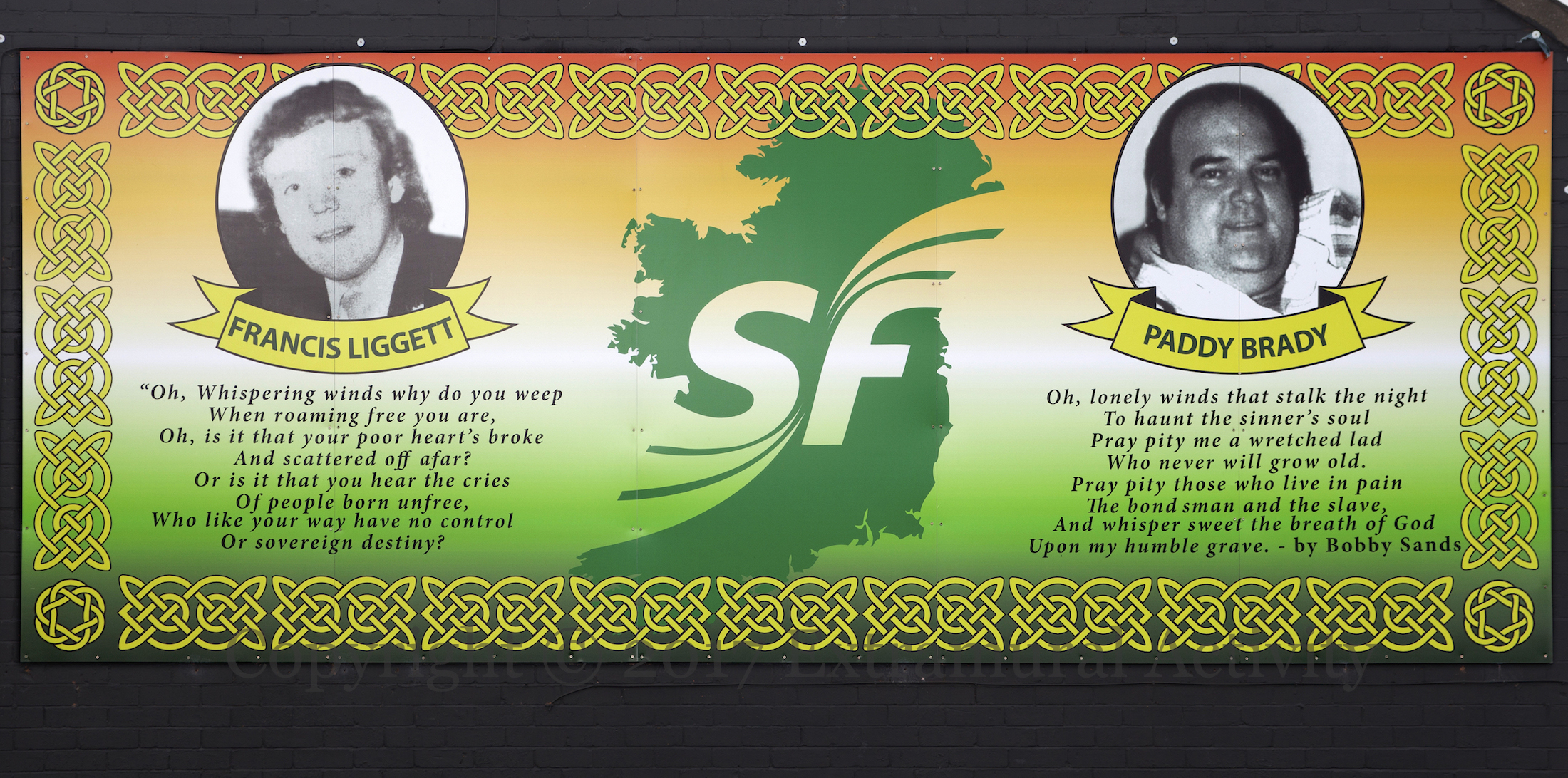
IRA volunteer Francis Liggett was shot dead by the British Army during an attempted armed robbery at Royal Victoria Hospital, Falls Road in 1973 (Sutton) while local Sinn Féin member Paddy Brady was shot by the UFF while at work in 1984 (Sutton | An Phoblacht). They are commemorated in the St James memorial garden with the board shown above, featuring two verses from Bobby Sands’s poem Weeping Winds: Oh, Whispering [Whistling, in the original] winds why do you weep/When roaming free you are, Oh! Is it that your poor heart’s broke/And scattered off afar? Or is it that you bear the cries/Of people born unfree, Who like your way have no control/Or sovereign destiny? Oh! Lonely winds that stalk [walk] the night/To haunt the sinner’s soul/ Pray pity me a wretched lad/Who never will grow old. Pray pity those who lie in pain/The bondsman and the slave And whisper sweet the breath of God/Upon my humble grave.
The board is similar in design to the painted one it replaces, except that Éire was at the centre rather than the “SF” logo.
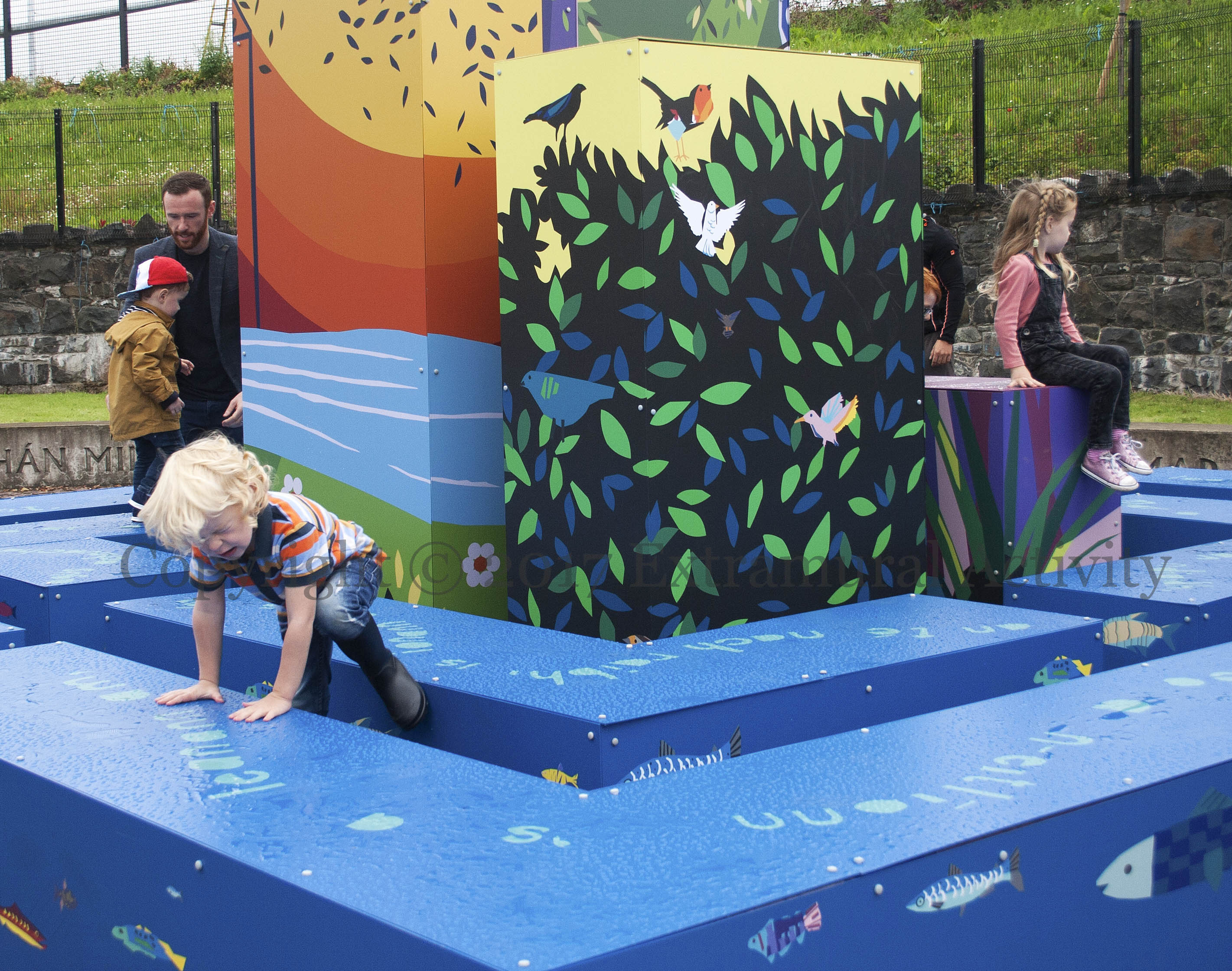
The inspiration for the new installation outside Coláıste Feırste entitled “Athbheochan” (“renewal”) is the area’s previous life as the site of spinning mills, established in the 1800s to take advantage of local rivers (Forbaırt Feırste). The Bog Meadows nature reserve down beside the M1 is the only part of the Blackstaff’s flood plain that remains in an undeveloped state.
The launch was on August 11th during Féıle by Maırtín Ó Muılleoır, but the piece is also part of Irish-language festival Lıú Lúnasa (tw | web) which is going on this week. Artist Aodán Monaghan can be seen on the left in the final image of kids climbing all over the artwork.







 Extramural Activity