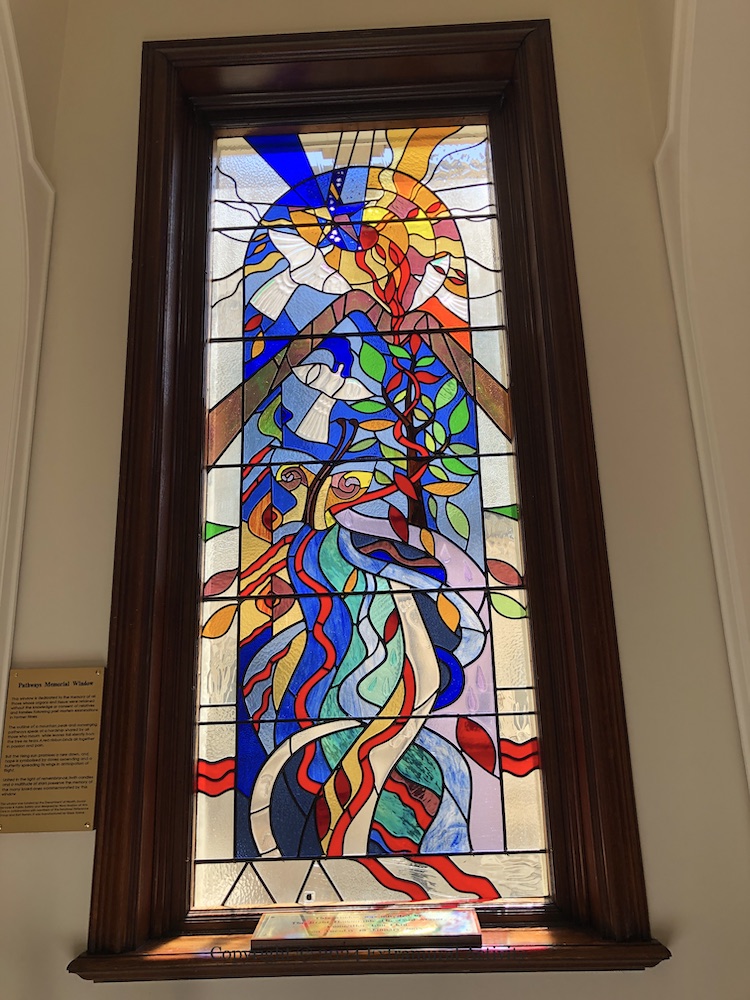
6: The Pathways Window – according to the guide, this window commemorates the pain caused to the relatives of deceased persons from whom organs were taken without consent.
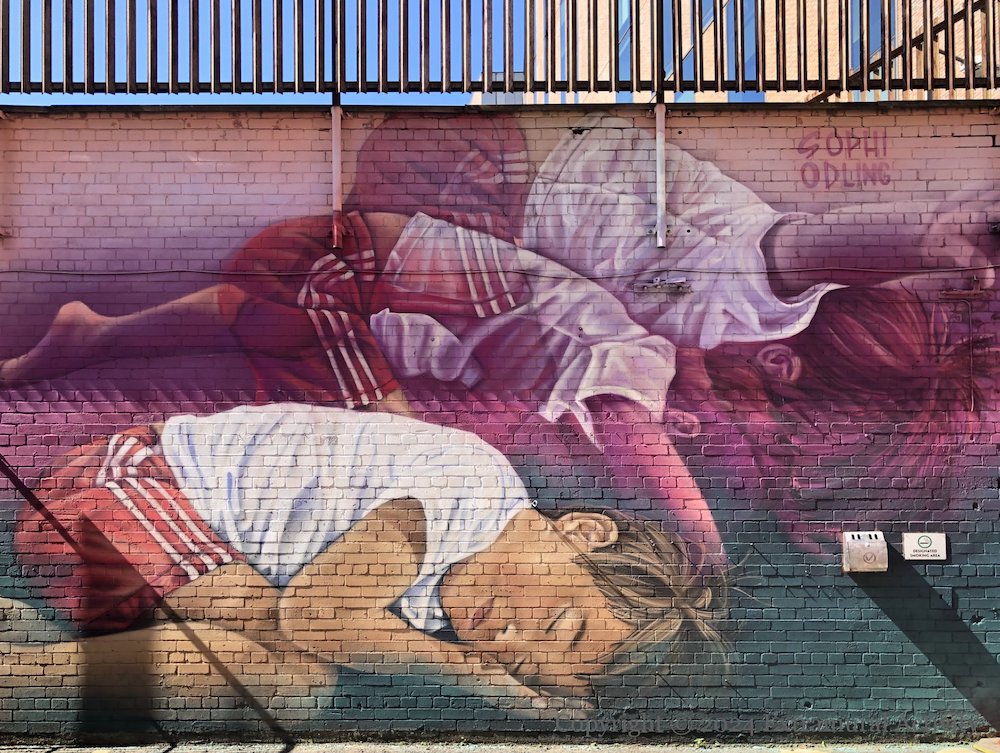
Sydney-based artist Sophi Odling (web | ig) was in town for HTN24, painting this large piece in York Lane (behind the D block of the new UU building), showing a youngster dreaming of what they will get up to ‘tomorrow’.
In this new statue in the grounds of Belfast city hall, Mary Ann McCracken is shown handing out abolitionist leaflets with a pleading enslaved woman above the words “Am I not a woman and a sister?” The same supplicant image is on the medallion (perhaps made by Wedgwood for the Society For The Abolition Of The Slave Trade – WP) worn at her throat. See also: The Blots On The Page Are So Black and The World Affords No Enjoyment Equal To That Of Promoting The Happiness Of Others.
“Mary Ann McCracken’s feminist ideals and commitment to the principles of Equality, Liberty, Fraternity applying equally to the Rights of Woman defined her participation in the United Irish Movement.” For McCracken’s connection to the 1798 Rebellion, see These Are Times That Try Men’s Souls.
“Mary Ann McCracken (1770-1866) Abolitionist, educator, social reformer and businesswoman. Sheas Mary Ann an fód ar son na mbocht, na mban, na bpáıstí agus ar son sıúd a bhí faoi dhaoırse. [Mary Ann stood up for the poor, women, children, and for those who were enslaved.]”
The statue was unveiled together with a statue to Winifred Carney on International Women’s Day (March 8th); they were produced by Ralf and Naomi Sander (BCC).
A statue to Winifred Carney was unveiled, along with another to Mary Ann McCracken, in the grounds of Belfast City Hall on Friday, March 8th (BCC). At her left hand is a typewriter. Carney was a qualified secretary and typist, and became secretary of the Irish Textile Workers’ Union in 1912, in which position she met James Connolly, who was secretary of the Belfast branch of the ITGWU. The 1913 manifesto addressed ‘To The Linen Slaves Of Belfast’ (marxists.org), exhorting “our toiling sisters” in the mills to join the organisation, was signed by Carney, Connolly, and Ellen Gordon.
Her uniform, and the amorphous pistol (or holster?) in her right hand, refer to her membership of Cumann Na mBan and participation in the Easter Rising of 1916. Carney was in the GPO when it was taken over and was among those who surrendered at the end; during the occupation she typed up dispatches from the Moore Street headquarters. A News Letter editorial described the statue as smuggling terrorists onto the grounds of city hall.
“Winifred Carney, born in Bangor, was a suffragist and a committed trade unionist. She was an organiser in the Irish Textile Workers’ Union and became James Connolly’s personal secretary, political confidante and friend. In 1913, She and Connolly wrote the Irish Textile Workers’ Union manifesto entitled ‘To the Linen Slaves of Belfast’. It was a time when Belfast workers, mostly women and children, were working long hours in horrific conditions, barefoot and hungry. “D’oıbrıgh Winnie ar son oıbrıthe Bhéal Feırste, go háırıthe ar son na mban agus na bpáıstí a bhíodh ag obaır sna muılte ar fud na cathrach. “Many Belfast mills are slaughterhouses for the women and penitentiaries for the children.” Chomh maıth leıs an obaır a rınne sí ar son na gceardchumann, ba Phoblachtánach í Winnie a bhí ına ball de Chumann na mBan agus d’Arm Cathartha na hÉıreann. As an officer in the Irish Citizen Army, Winnie was present with Connolly in the Dublin General Post Office during the 1916 Easter Rising and has since become known as ‘the typist with the Webley’. Carney stood as a Sınn Féın candidate in the 1918 elections, but in an ‘unwinnable’ seat. She retained her commitment to socialism and in 1924, Winifred joined the Northern Ireland Labour Party. Here she met her future husband, George McBride, like her a committed socialist. George was a Protestant from Shankill Road who fought at The Battle of the Somme with the 36th (Ulster) Division. Tá Winnie curtha ı Reılıg Bhaıle an Mhuılınn ar Bhóthar na bhFál ın ıarthar Bhéal Feırste.”
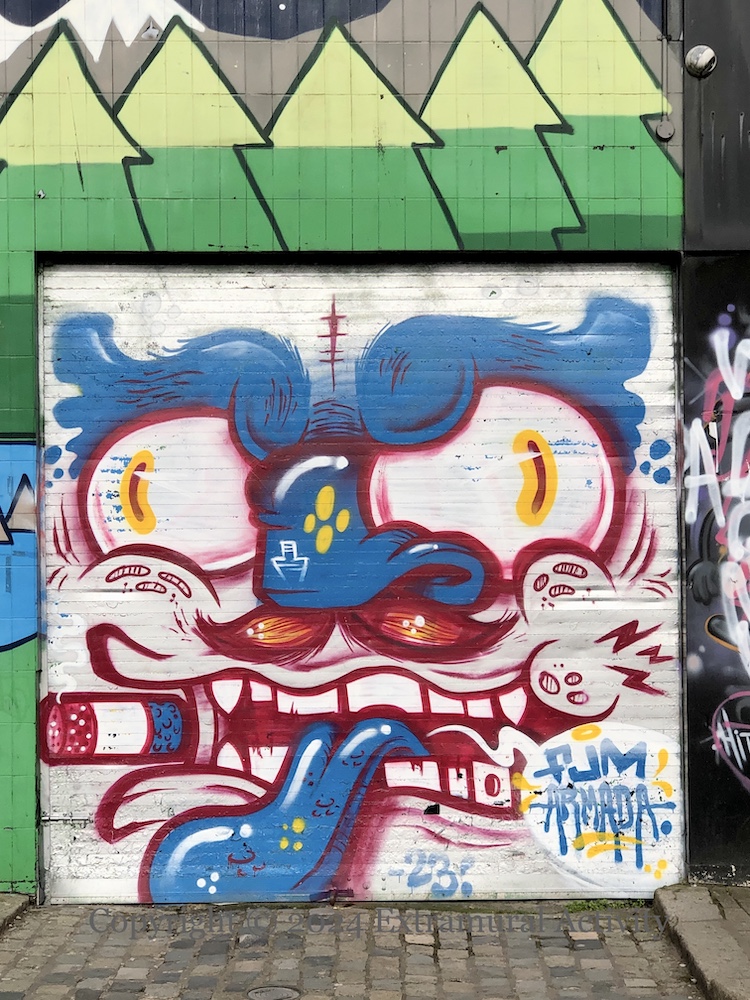
This face is by Birmingham graffiti artist Fum.Armada (ig), in North Street, Belfast. There is another from Union Street in the Paddy Duffy collection.
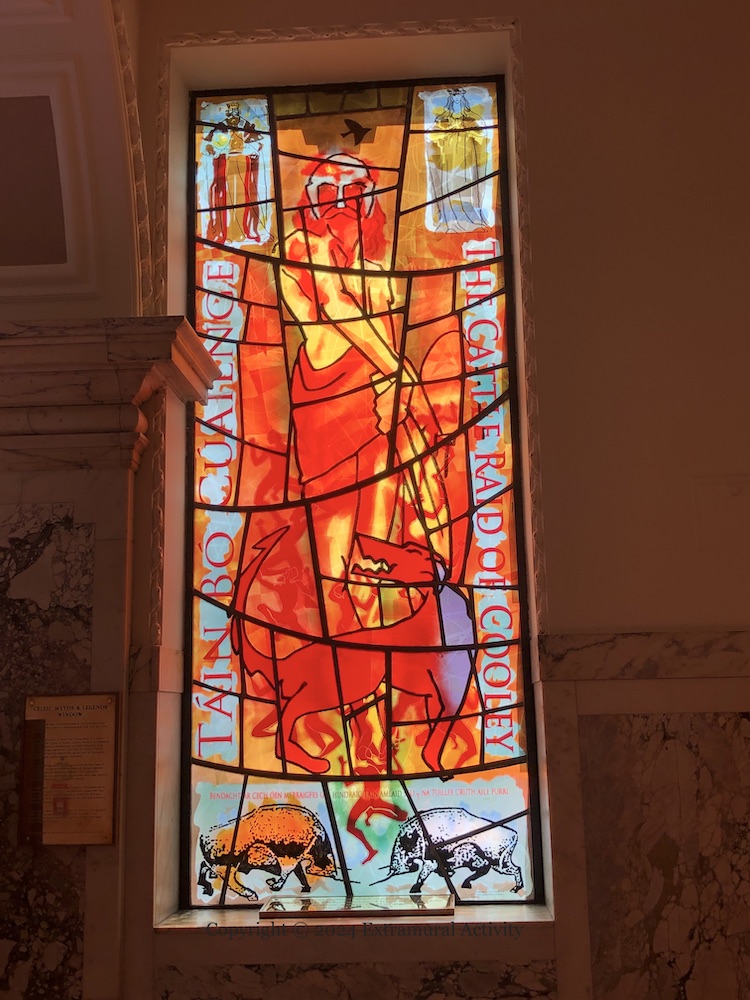
Samuel Ferguson was born in Belfast in 1810 and after studying law at Trinity College settled in Dublin (WP | paywalled 1886 Memoriam). Some of his poems were based on the pre-Celtic myths, such as ‘Tain Quest‘ on the Táın Bó Cúaılgne, and ‘Congal‘ on the Cath Mhaıgh Rátha. (Ian Adamson later (in 1980) published Ferguson’s Congal as The Battle Of Moira, which featured a cover by Jim Fitzpatrick – see the end of the Visual History page on Fitzpatrick).
Words from Ferguson’s poem ‘Conary‘ (one of the Lays Of The Red Branch) are included at the base of the Dalaradia Window, a free-standing piece of stained glass in the Linen Hall Library (web): “Robed in red mantles and with caps of red/No swords had they, nor bore they spear or shield/But each man on his knee a bagpipe held.”
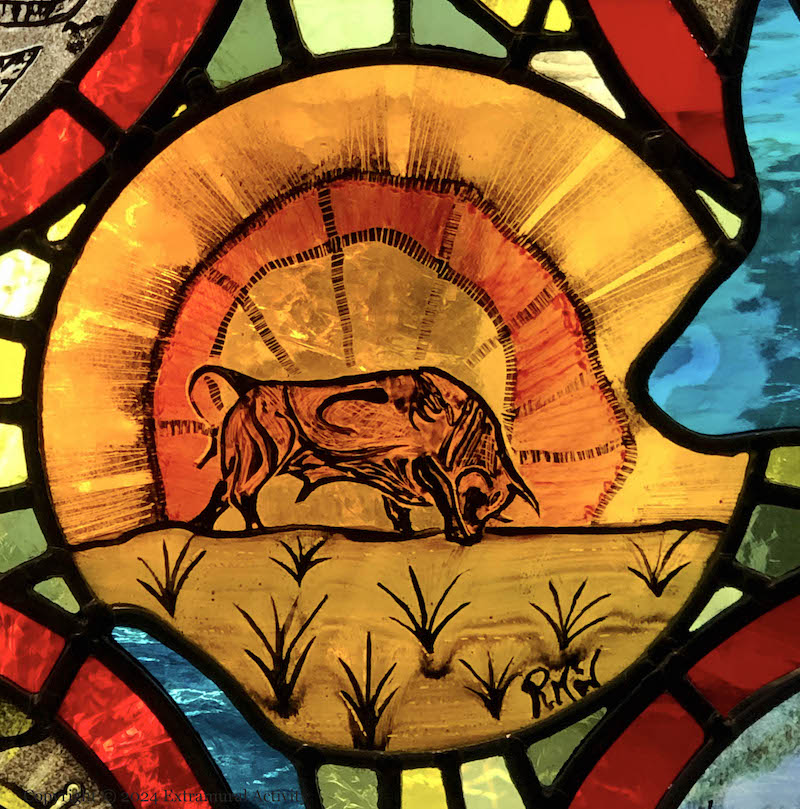
The image above shows the bó at the centre of the Táın, Donn Cúaılgne (the brown bull of Cooley), at the centre of Window, which is shown complete below; the other elements of the Window are detailed in this Dalaradia publication (pdf). A painted version of the Window can be seen in Kragfargus Cultural Corner.
“Since 2012” and lasting until the undetermined year “XXXX”. Protests against the restricted flying of the Union Flag at City Hall were held on a daily basis in the winter of 2012-2013 after the Council’s vote on December 3rd. It became a weekly protest perhaps in the spring and a group of die-hards continues to meet each Saturday. There does not seem to be a functioning public social media channel for “Loyal People’s Protest”; the numbers might be small enough that a private group chat is sufficient. The male in the top right of the placard is unknown; there have previously been media profiles of Billy and Ann Dickson (Belfast Live).
Dundela “ultras” have been told they are not welcome at the team’s future games after “unsavoury chanting” at the NI Championship match against local rivals H&W Welders – “the most cataclysmic derby match in world football” (BelTel).
Thirteen more soccer-related stickers are below, including [Glasgow] Rangers Action Force.







 Extramural Activity