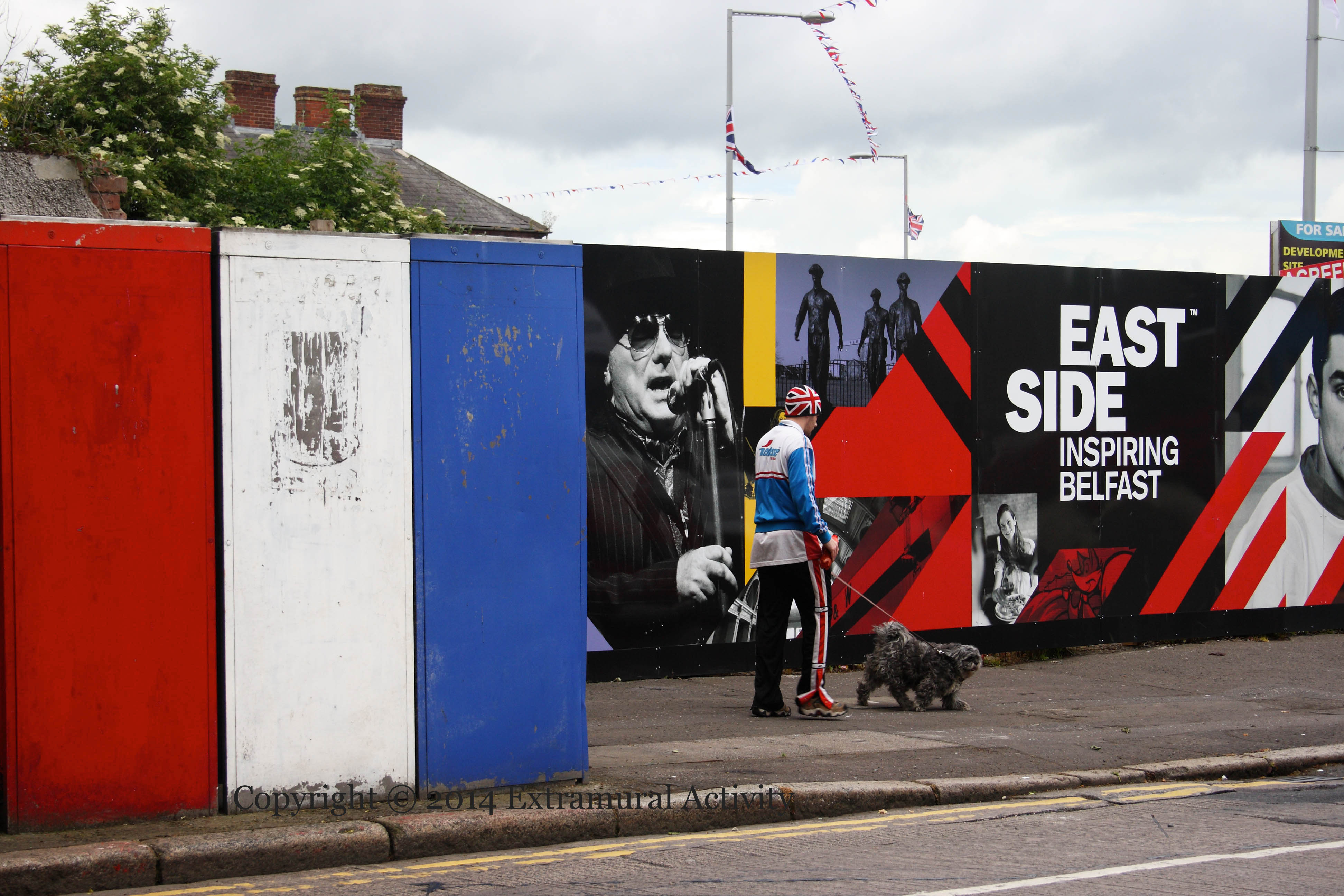
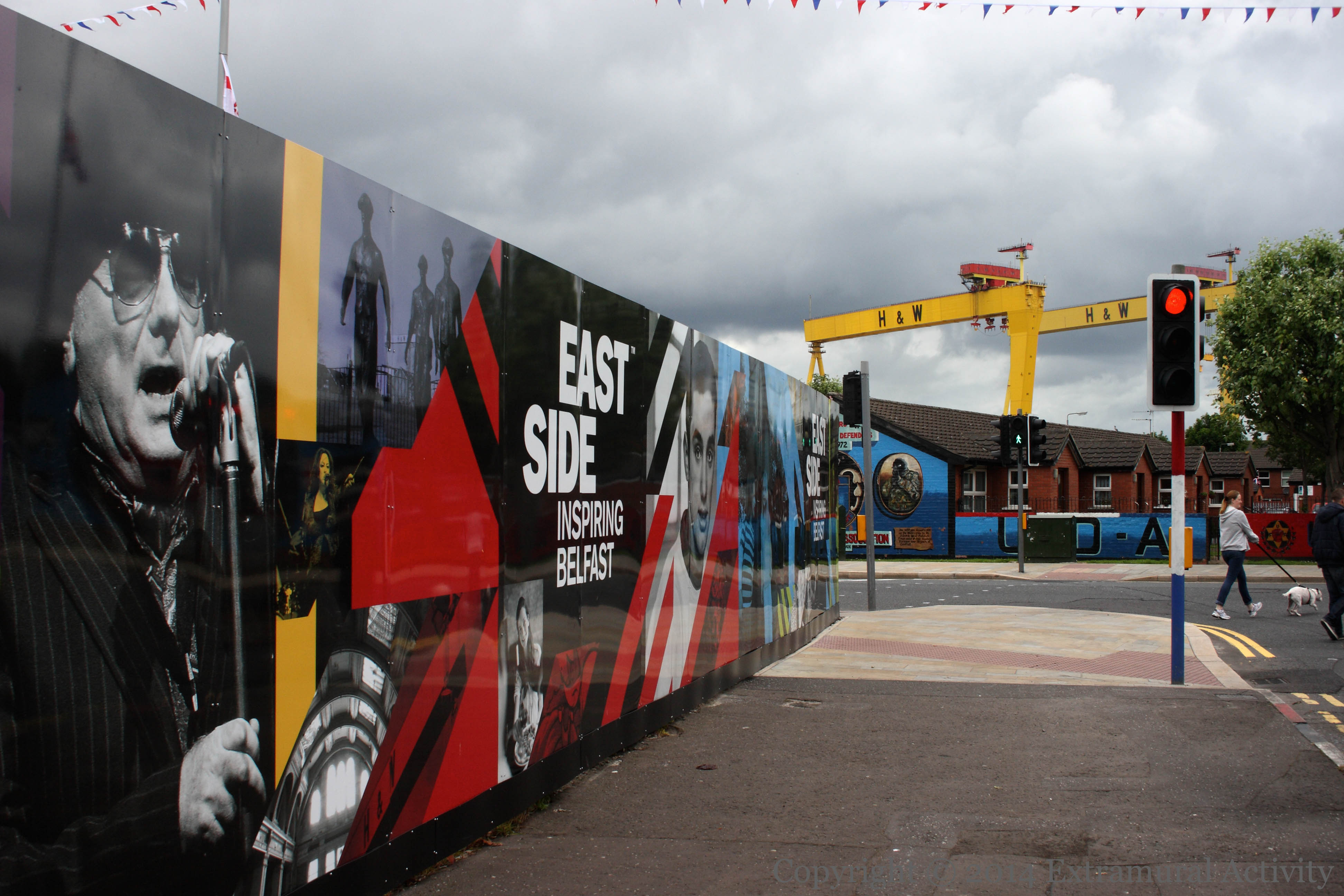
The waste-ground at the corner of Templemore Avenue and Newtownards Road (where the flyers featured in Harland & Why were posted) was given a face-lift with images of east Belfast heroes Van Morrison and George Best and the words “East Side – Inspiring Belfast”. The red-white-and-blue is supplied by the phone-boxes and the passer-by.
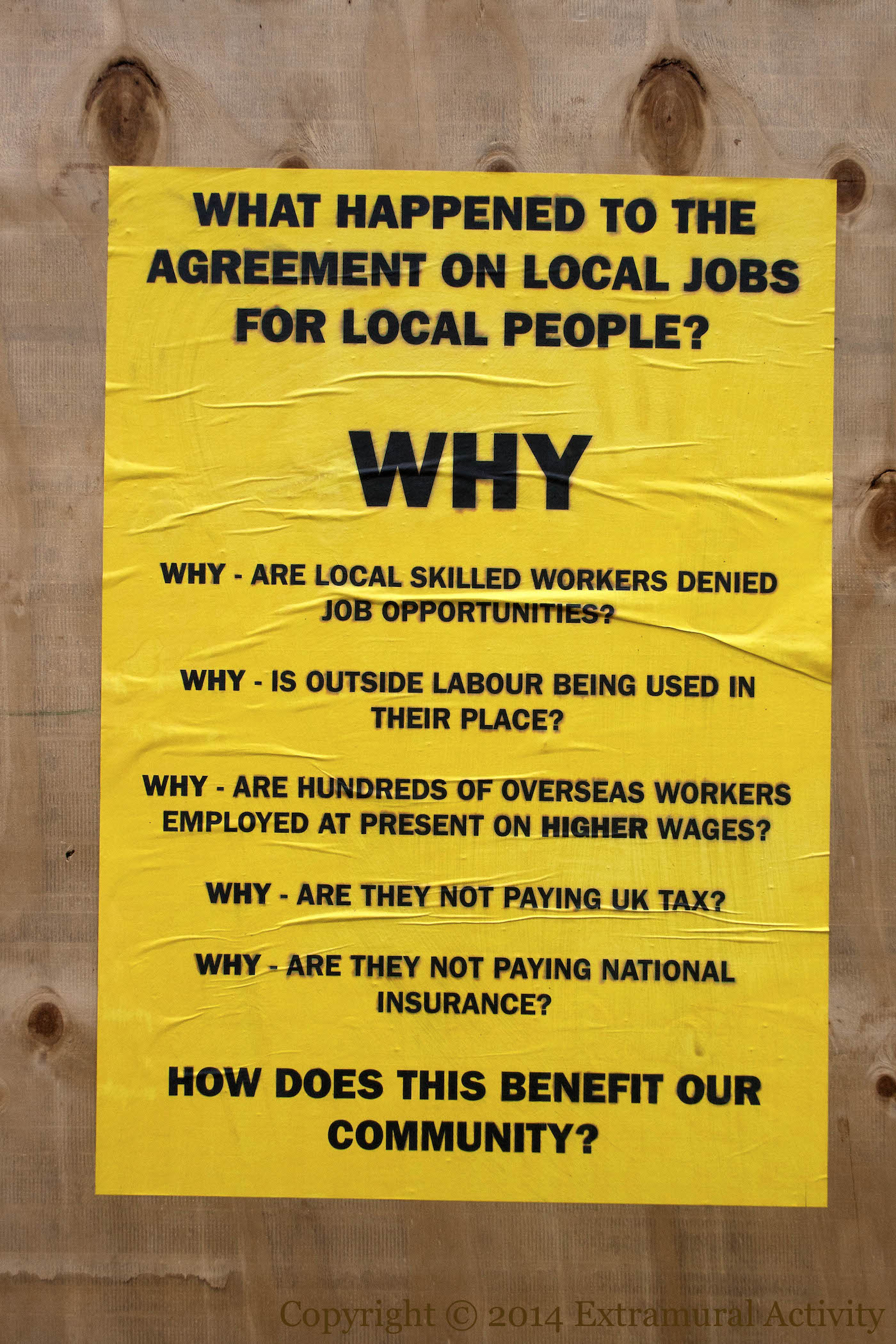
The poster above – seen in east and south Belfast – has been called “racist” by the Alliance party. “What happened to local jobs for local people? Why are local skilled workers denied job opportunities? Why is outside labour being used in their place? Why are hundreds of overseas workers employed at present on higher wages? Why are they not paying UK tax? Why are they not paying national insurance?”
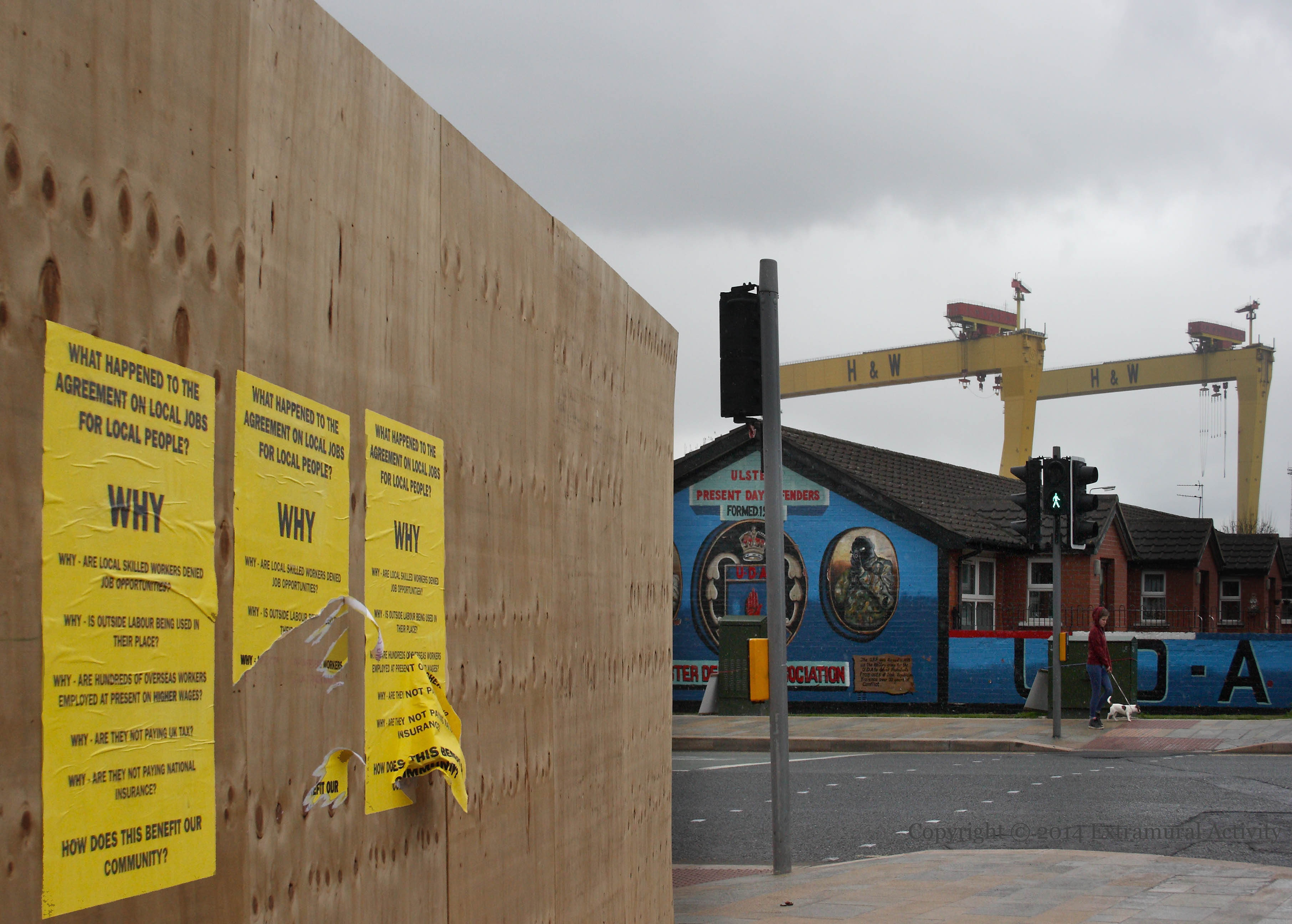
The poster concerns the 600 temporary jobs at H&W refurbishing the oil rig ‘Blackford Dolphin‘. According to the BBC (video) only one third of the jobs could be filled from the Northern Irish workforce. A BelTel article from November 2013 specifies that another third came from Britain and the final third from “Poland and Lithuania”.
Below: Some posters with the H&W cranes in the background, just off the Newtownards Road.
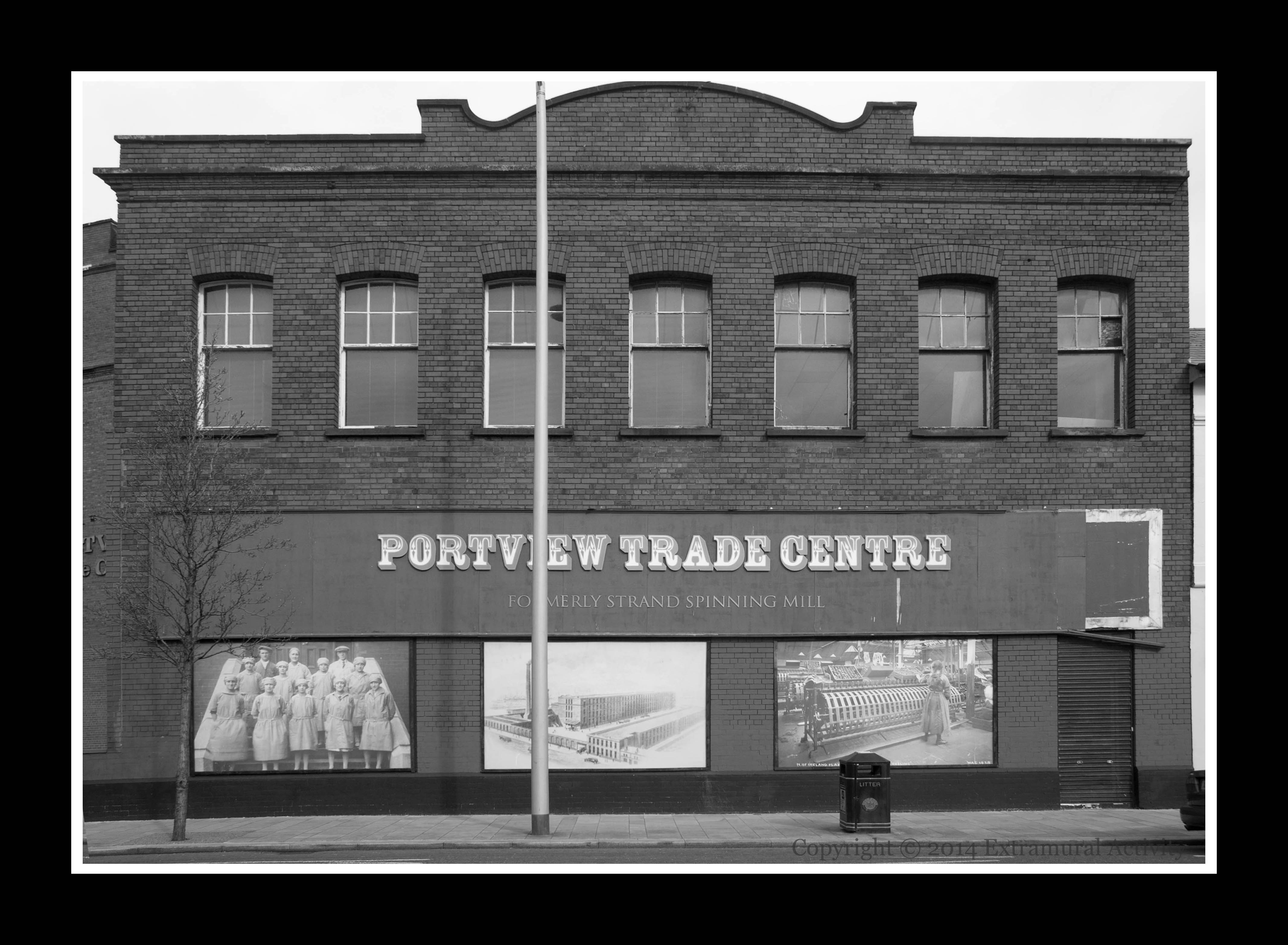
The Strand Spinning Mill on the Newtownards Road in east Belfast began life as the Jaffe Spinning Mill, after Otto Jaffe, a Jewish-German emigrant from Hamburg who became a naturalized citizen, early benefactor of Queen’s University (in 1905 he contributed £3000) and twice Lord Mayor of Belfast. It quickly became the Strand Spinning Mill when he sold it to Mackies in 1912. The mill made munitions during WWI and viscose rayon during WWII. The mill closed in 1983 and now provides space to small businesses as the Portview Trade Centre.
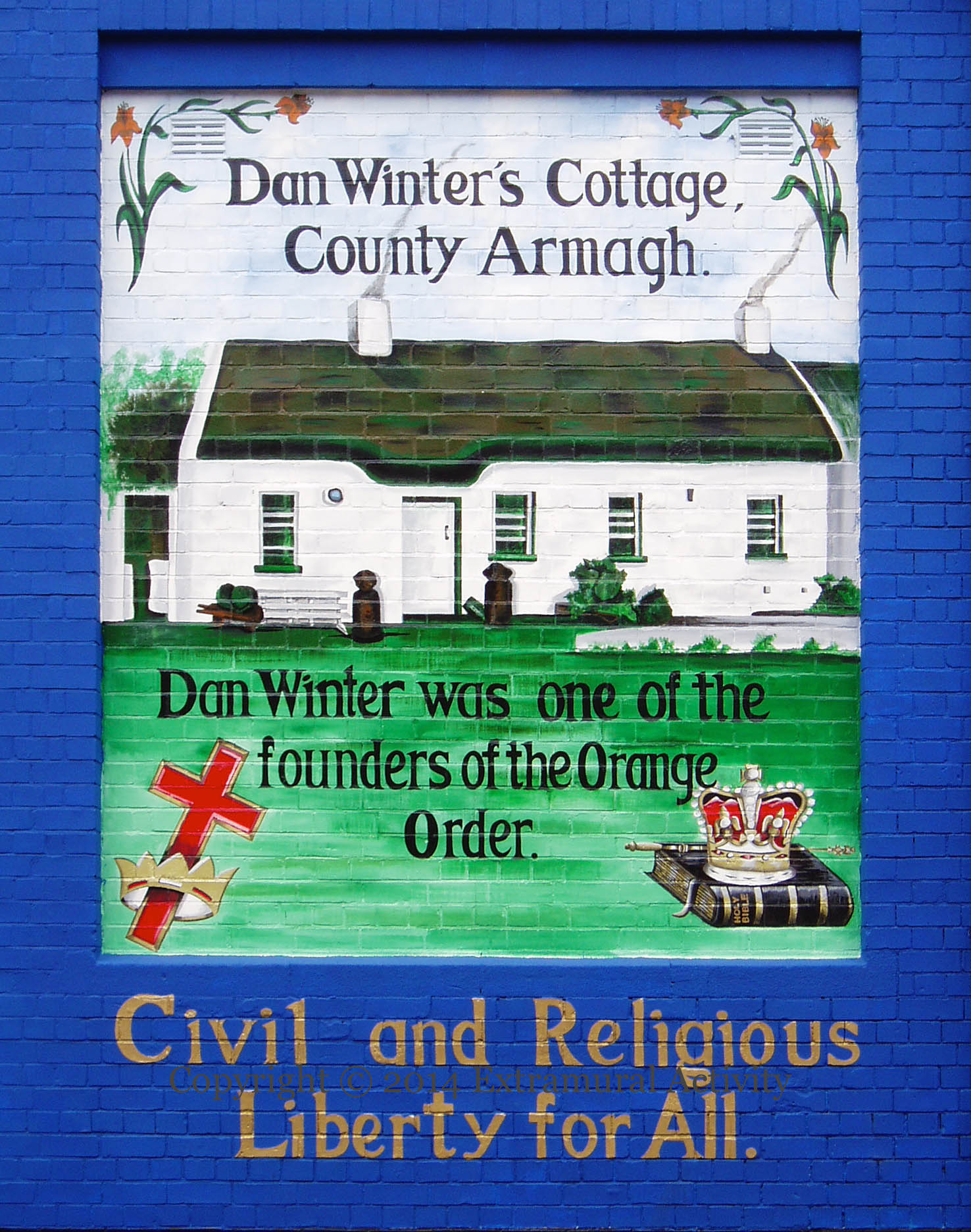
Dan Winter, along with James Wilson and James Sloan, founded the Orange Institution in Loughgall in 1796 in response to sectarian tensions over land. After a decisive victory by the Protestant ‘Peep O’ Day Boys’ over the Catholic ‘Defenders’, the Order was founded and Catholics driven out with the threat ‘to hell or to Connaught’.
Geordie Bell was caretaker at the Short Strand community centre, on the other side of this mural, as well as a trade unionist and republican. A piece of art in the Skainos centre is dedicated to his memory (East Belfast Mission).
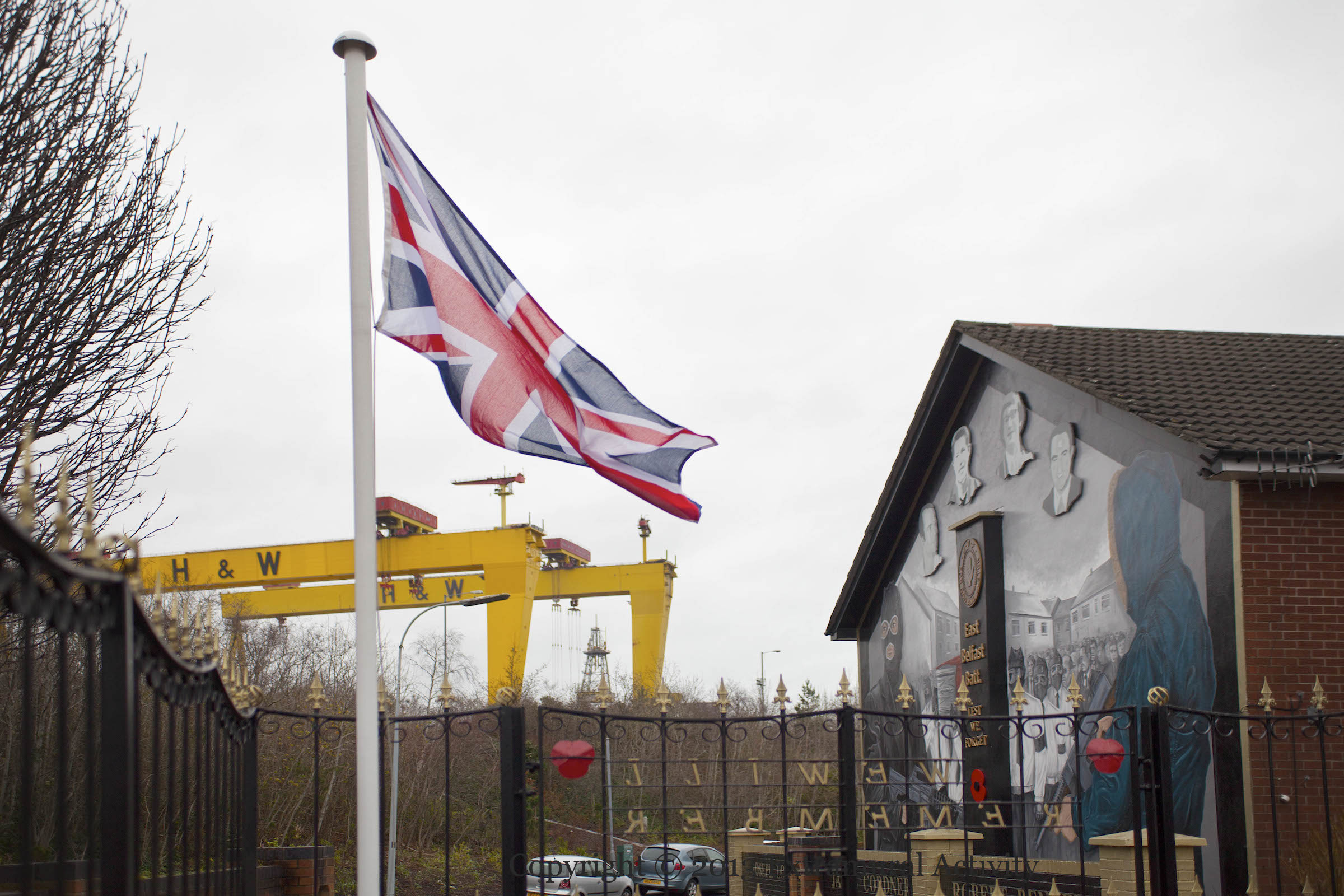
Here are four shots of a late 2011 UVF mural, with memorial wall, on Ballymacarrett Road in east Belfast. The four members named are Robert Seymour, shot dead by the PIRA; James Cordner and Joseph Long, who were killed in a premature explosion, and Robert Bennett, killed by the British Army during a riot. These same four are commemorated in the controversial 2013 mural featured in Years Of Sacrifice.
The nearby memorial (through the railings of which the third image, below, was taken) was constructed in 2003.
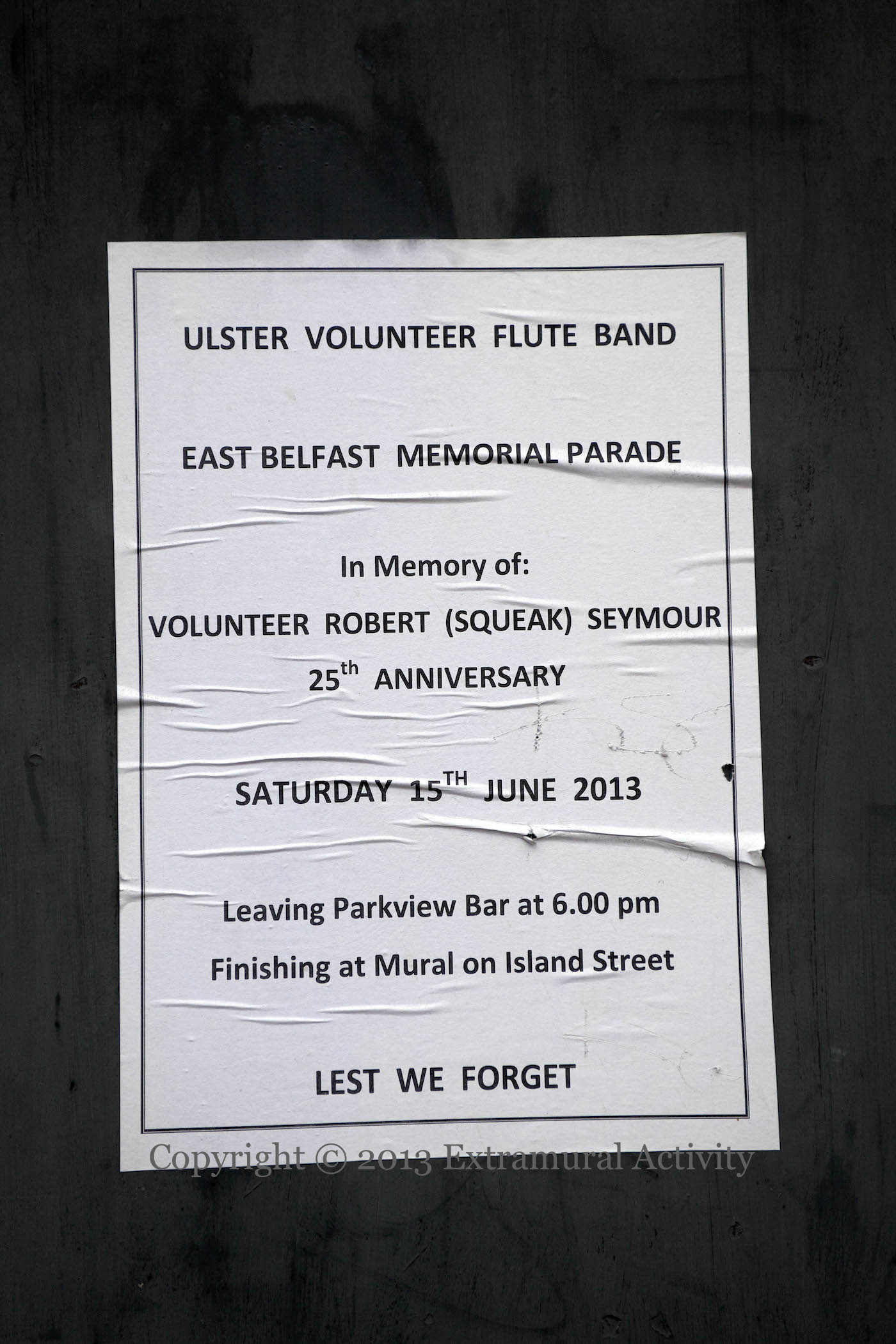
2013 saw the 25th anniversary of Seymour’s death; the final image, below, is of a flyer announcing a commemorative parade.
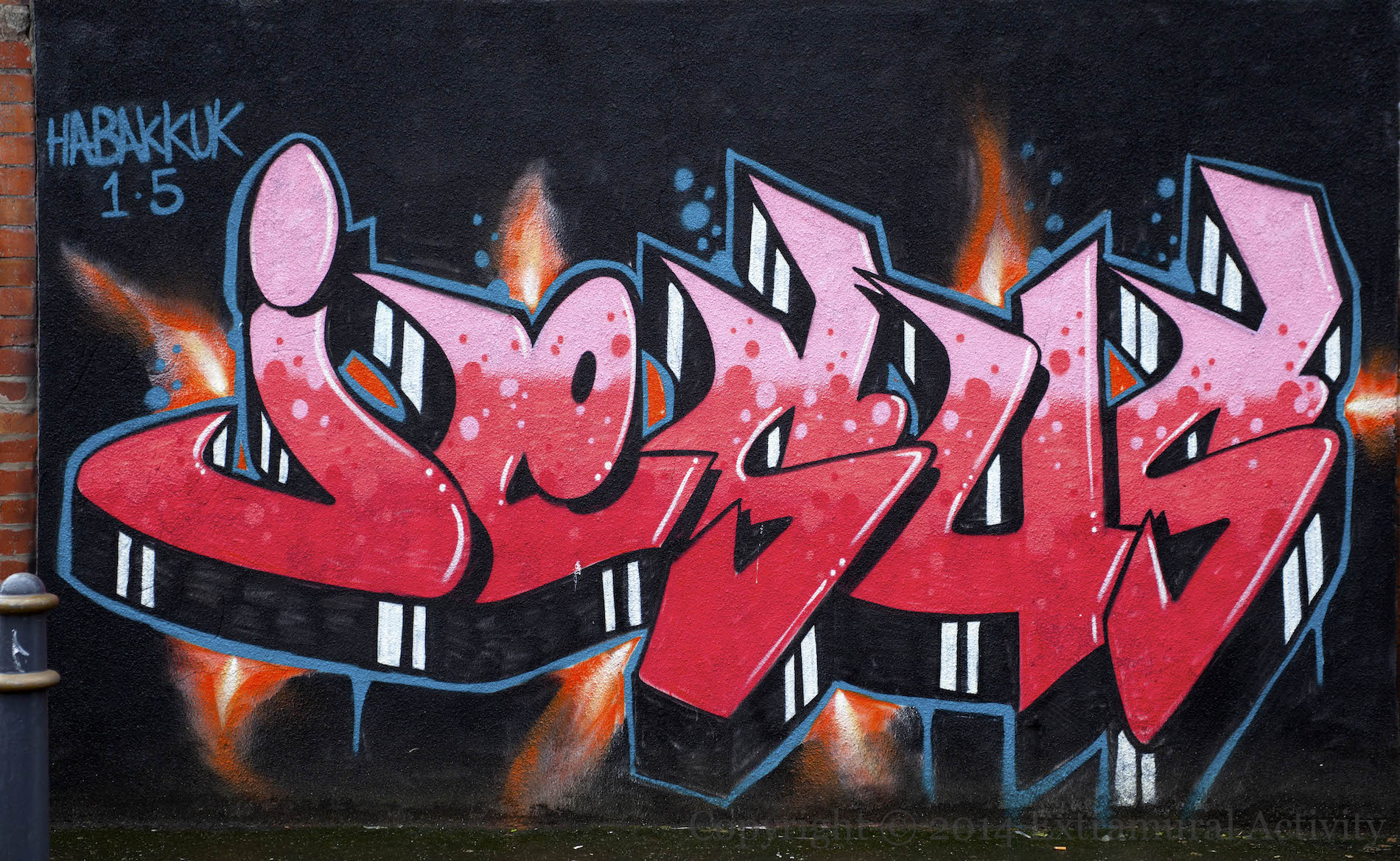
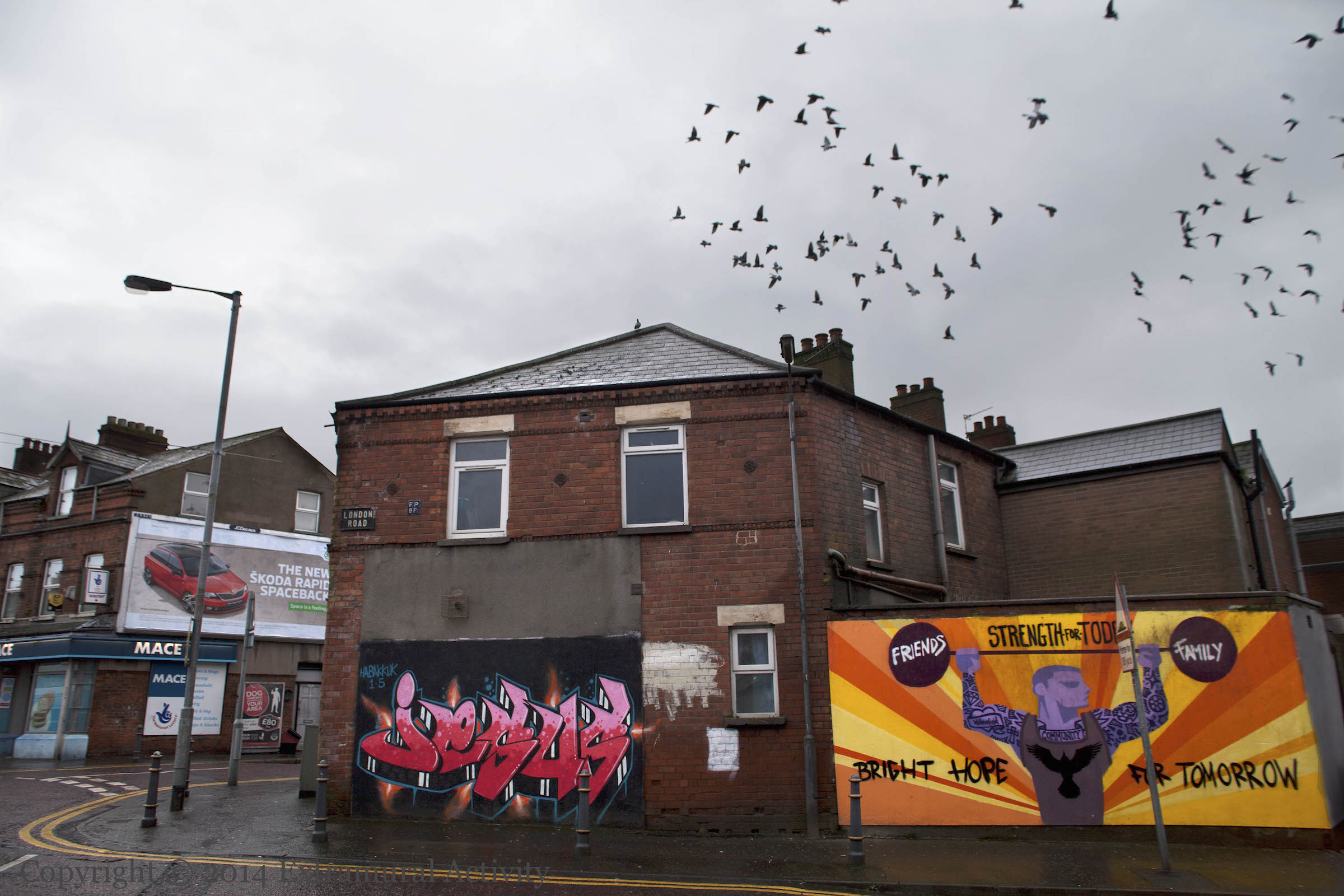
“Strength for today, bright hope for tomorrow.” A “Willowfield community” strong man lifts a barbell of “friends” and “family” as he gets in shape. Below, a “Jesus” tag and a wide shot of both pieces, at the top of London Road.
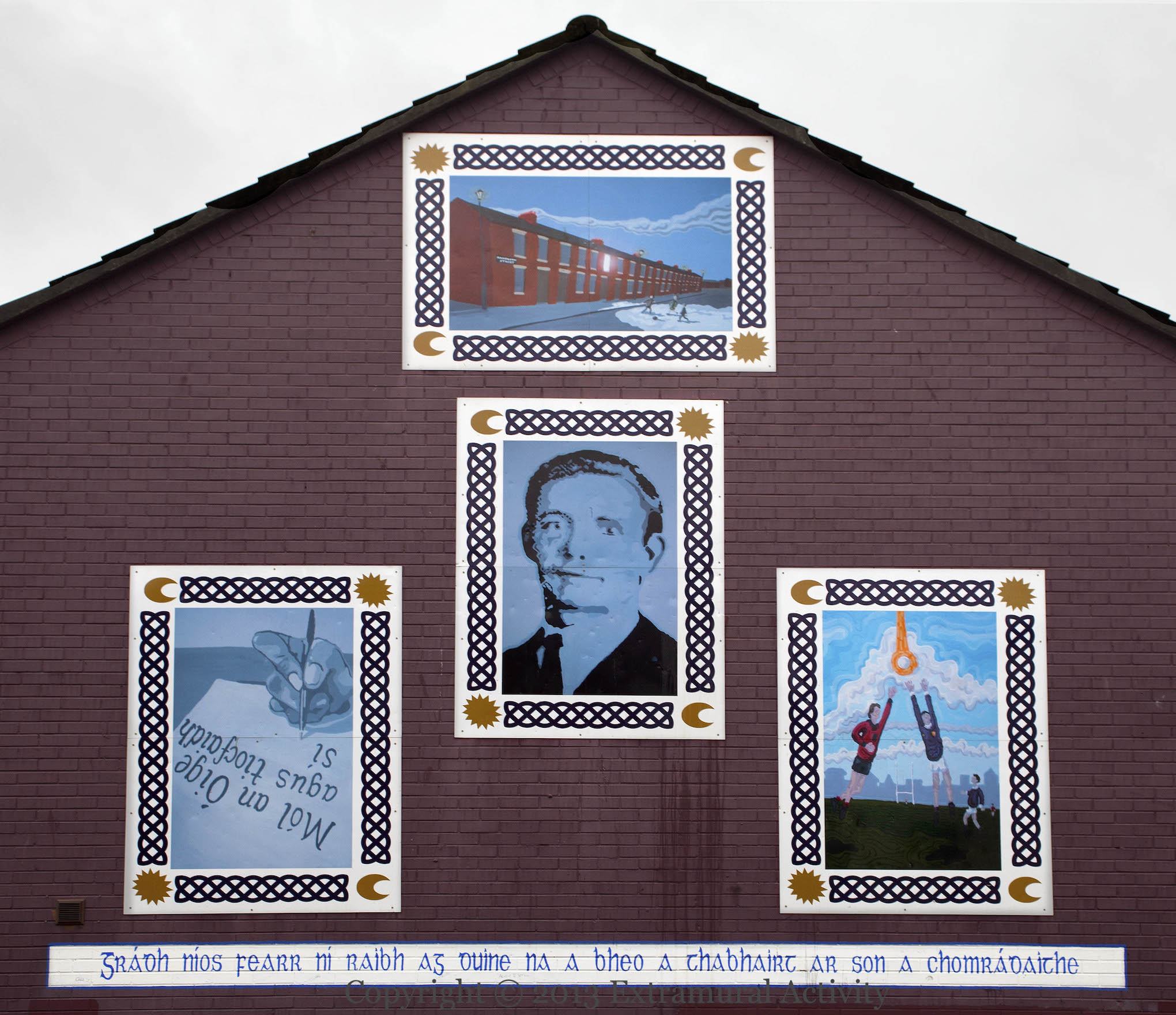
IRA Volunteer Sean Martin is at the centre of these panels in Beechfield Street, in the Short Strand, (CNR) east Belfast. The image in the apex of the house depicts his death in nearby Anderson Street (which no longer exists; roughly where Arran Street is).
milltowncemetery.com (link now dead) reports that Sean Martin “was killed in April 1940 during a lecture on arms and a Millis hand grenade in a small terrace house in Anderson Street. In the course of the lecture Sean, who was giving the instruction, had dismantled the grenade, and was putting it together again. The detonator which he was using was thought to have been a dud one. In demonstrating how to throw the grenade, he pulled out the pin and released the lever. Hearing the hissing sound of the fuse he realised that the detonator was live and that the grenade was about to explode. He rushed to the window with the intention of throwing it out on to the street, but some children were playing outside. In the few seconds left to him, Sean had to make that terrible choice; shouting to the others to get out of the house – he pulled the grenade into himself with his two hands and leaned over the kitchen table with the grenade covered by his whole body. The device exploded and blew him right across the kitchen, killing him instantly. All the others escaped uninjured.”
The Irish at the bottom reads “Grádh níos fearr ní raıbh ag duıne na a bheo a thabhaırt ar son a chomrádaıthe” – “A greater love no person has than to give his life for his comrades” (John 15:13)
Belfast Forum has some pictures of Anderson Street; according to the accompanying conversation, the Martins (might have) lived at no. 29. Sean Martin’s CLG/GAA club was named after Martin.
“As we scrambled over the trench ladders the Y.C.V. flag appeared.” One of the many panels in an extended mural in Thorndyke Street, this one inspired by a drawing by Jim Maultsaid, who joined the YCV in 1914 and kept a diary and sketch-book. More of his sketches can be found as part of the Friends Of The Somme’s account of the war in 1916. His portrait is included below.
The plaque reads: At the outbreak of the Great War in August 1914, when Lord Kitchener, the War Minister, was desperately looking for men, he had asked Sir Edward Carson for a brigade consisting of four battalions. Carson offered him a division consisting of twelve battalions, uniformed and equipped at Ulster’s expense. The UVF was transformed rapidly into the 36th (Ulster) Division. On the 1st July 1916 the 26 (Ulster) Division took part in the Somme Offensive. Nine Victoria Crosses were awarded for acts of valour on that day. Men of the 36th (Ulster) Division won four of these. Of those, three were awarded posthumously. Of the 9,000 men of the Division who took part in the attack, scarcely 2,500 answered roll call on 3 July; while of 400 officers, more than 250 were killed or wounded. The Division lost 5,500 officers and other ranks killed, wounded and missing as a result of the first two days of the Somme offensive. The illustration depicted is derived from a drawing by Jim Maultsaid, an American citizen. He joined the 14th Royal Irish Rifles, which was drawn from members of an organisation called the Young Citizen Volunteers (YCV).








 Extramural Activity