“Some believe it is only high walls that can hold fear in check but that is not what I have found. I have found that it is the small, everyday deeds of ordinary folk that keep the darkness at bay, small acts of kindness and love – Gandalf and me [called_to_create_ (ig)].” The quote is from the movie of ‘The Hobbit – An Unexpected Journey’ (youtube) and not any Tolkein book. Whatever the truth of the quotation, residents generally want the so-called “peace” walls to remain: 2023 BelTel (about Derry) | 2019 Irish Times | 2015 BBC.
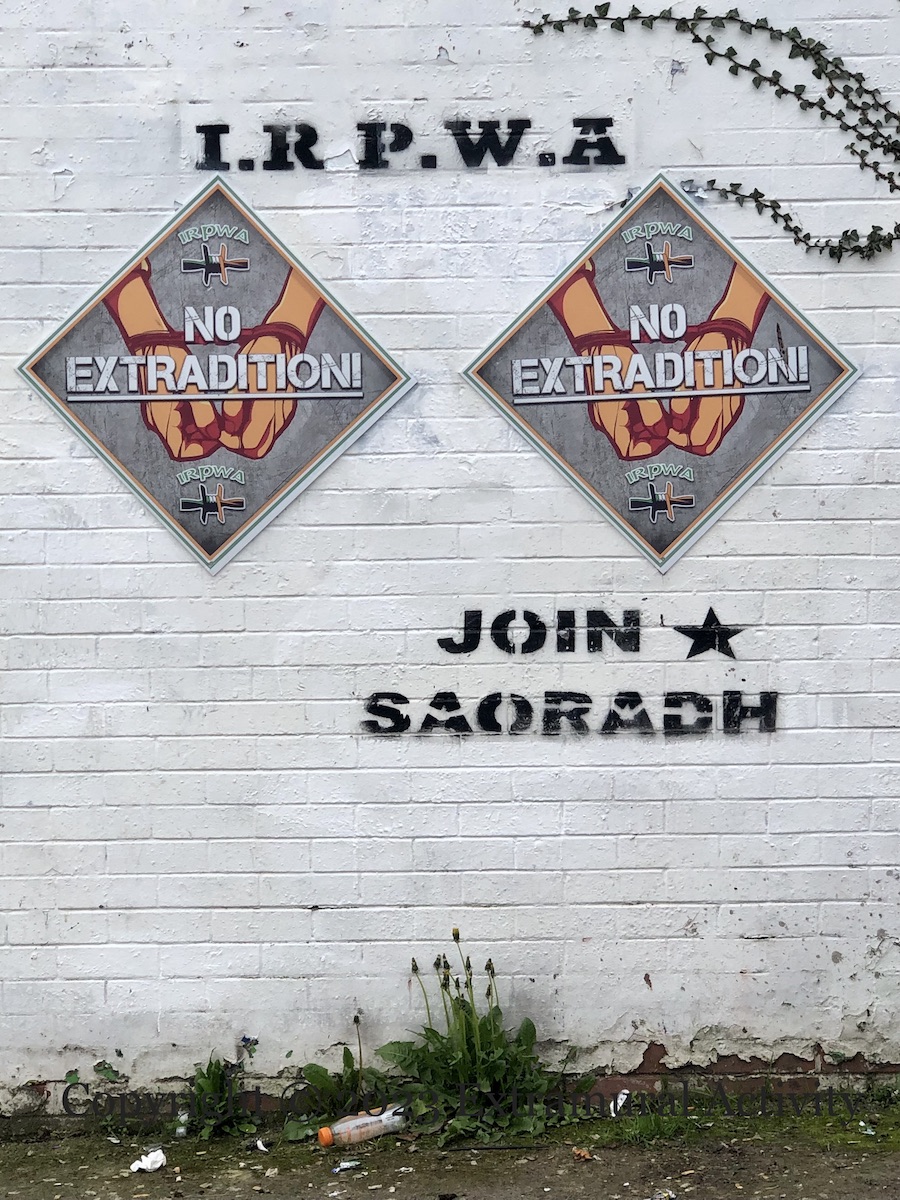
There has been graffiti art of the side wall of what was Vogue Hair & Beauty and is currently the Kurdish barbers since 2008 (see Visual History 11) but in 2018 the wall was claimed by Saoradh (web) with a mural depicting the Palestinian flag (see From The River To The Sea – it has recently been repainted) and a changing message to the right-hand side – currently a pair of IRPWA “No extradition’ boards.
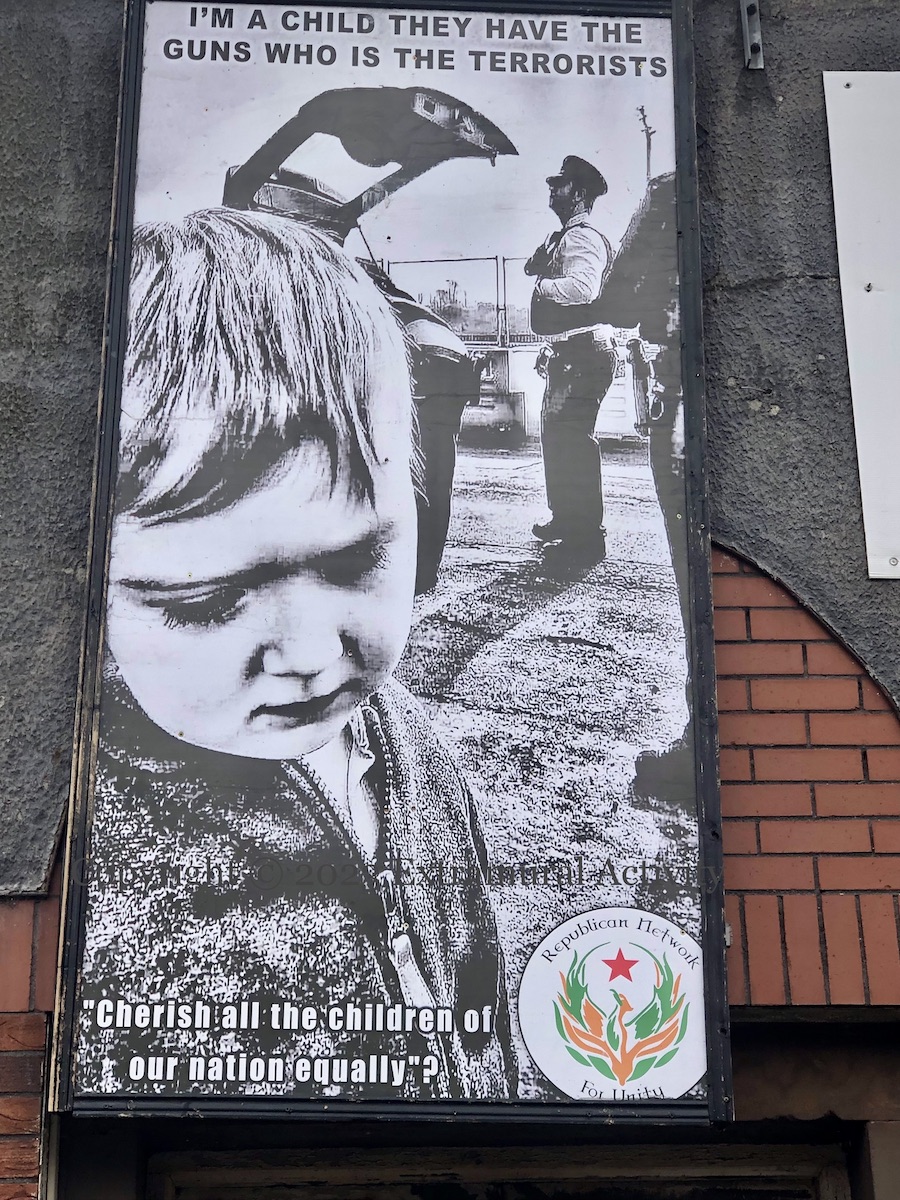
“I’m a child. They have the guns. Who is the terrorists? ‘Cherish all the children of our nation equally’? ” The quote is from the 1916 Proclamation (CAIN); it has been used inclusively for various classes (see Cherish | The Children Of The Nation) but here is applied to children.
Anti-Agreement republicans have complained about being searched in the streets and in their homes, sometimes in front of children. (There is a Facebook group on the issue.)
RNU (ig | Fb) board in Divis Street, west Belfast.
Here are three new pieces above the security gates on Northumberland Street, coving over the “Deserted! Well, We Can Stand Alone” graffiti in the last remaining spot on the wall without a mural. From left to right:
Arthur Guinness: “Black Protestant Porter” as a description of Guinness stems from Arthur Guinness’s opposition to the 1798 rebellion (Indo). The Union Star (newspaper in Belfast – A Planet Of Light And Heat) called Guinness a spy and advised that “United Irishmen will be cautious of dealing with any publican who sells his drink.” (An Phoblacht).
Gusty Spence, a former commander of the UVF, read out the ceasefire statement of the “Combined Loyalist Military Command” (UVF, RHC, and UDA): “Let us firmly resolve to respect our different views of freedom, culture and aspiration and never again permit our political circumstances to degenerate into bloody warfare – Gusty Spence, loyalist ceasefire [statement in full], 13 October, 1994.”
“Welcome To The Shankill Road – we are proud, resilient, welcoming”: The original ‘three hands’ was on Northumberland Street, just above this spot – see Proud, Defiant, Welcoming – which was then reproduced in reduced form in Gardiner Street – see Welcome To The Shankill Road.
This is the most conciliatory statement ever made by loyalism and the decision to put it on Northumberland Street, especially in the context of the internationally famous and associated-with-Ireland Guinness and the “welcome” mural, suggests that the trio is directed at tourists rather than locals.
A trio of international causes aimed at the visiting Joe Biden, president of the United States, from Gael Force Art and People Before Profit. What’s new here is the “No 2 NATO” under the Irish Tricolour. The other two parts have been on the mountain previously: the Cuban flag with “unblock Cuba” reprises the maassive Cuban flag on the mountain in 2021, which was depicted in the La Solidaridad Invariable mural onDivis St, and the Palestinian flag with “BDS” [Boycott, Divestment, Sanctions] in 2018’s #BDS.
“Joe Biden, globalist. Not welcome in Ireland.” Joe Biden landed in Belfast yesterday and was greeted by Prime Minister Rishi Sunak (Bel Tel | Reuters). This morning, he will deliver at the Belfast campus of UU, before heading south to Louth, Dublin, and Mayo (Journal).
This is an Ógra Shinn Féin (ig | web – youth division of Sinn Féin Poblachtach) sticker in Divis Street; they also have a “Joe Biden, warmonger” version (tw).
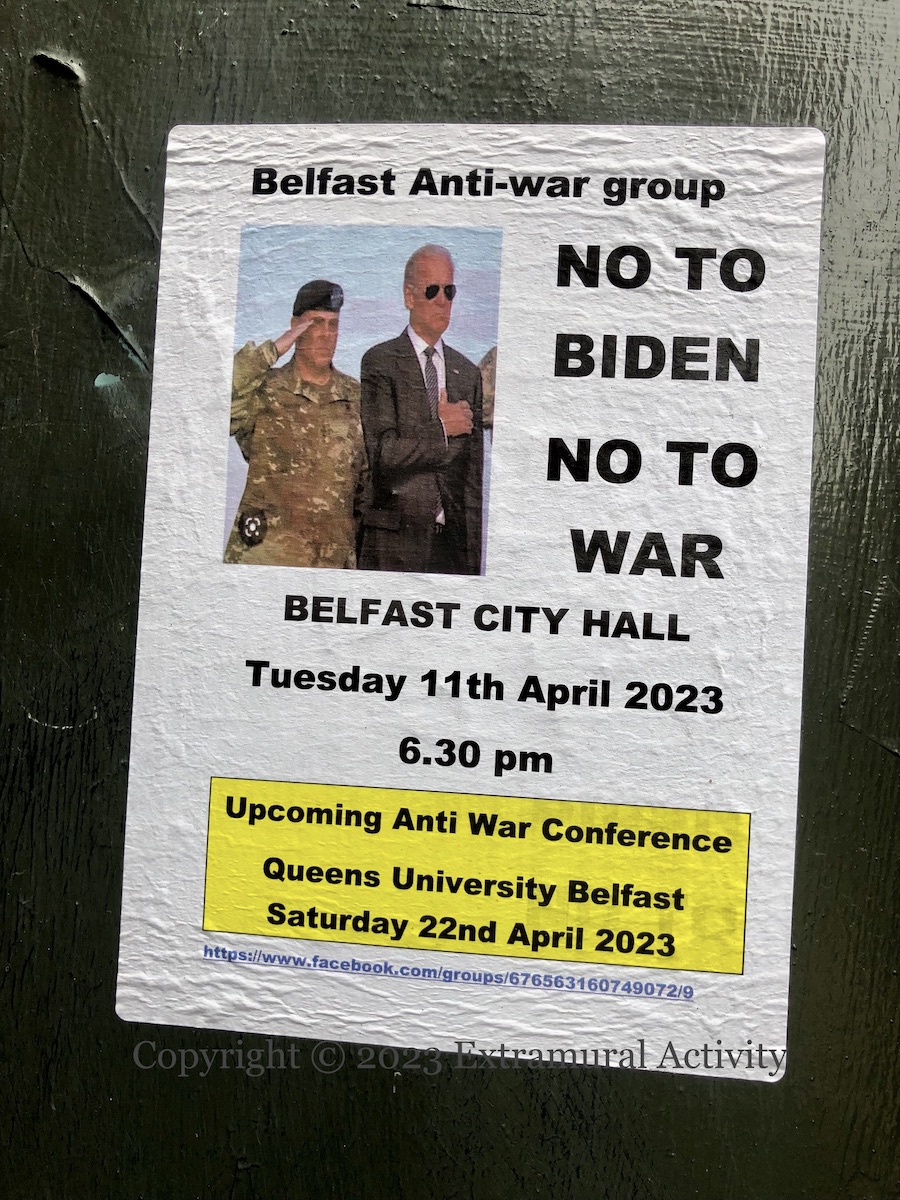
In the same vein is the poster below from the “Belfast Anti-war group” advertising rally outside city hall and an upcoming conference at Queen’s: “No to Biden, no to war”
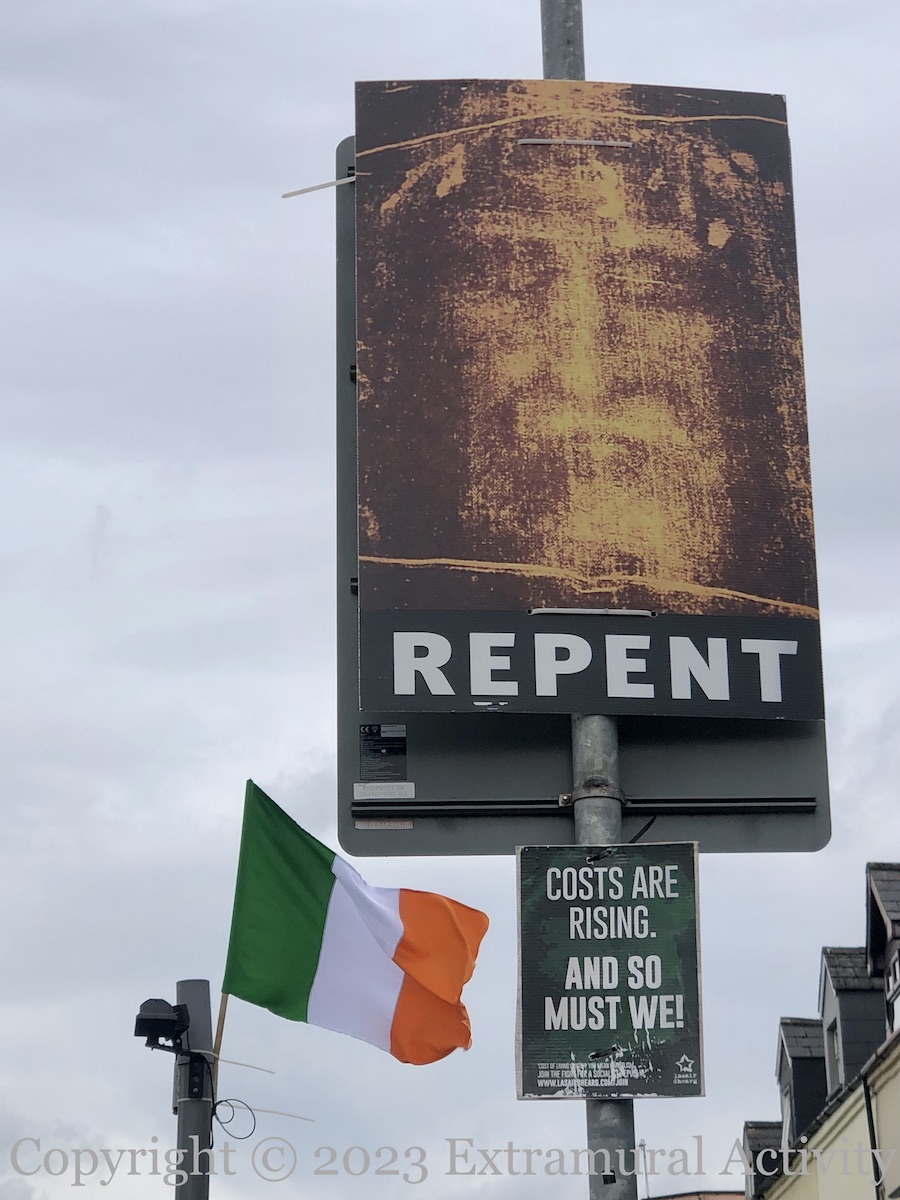
CNR west Belfast, but not that rising. Rather these two placards on the Falls Road encourage reactions to risings of the Christian kind – we should “repent” our sins even as they forgiven; the shroud of Turin dates to roughly 1300 but is a symbol of Jesus of Nazareth in the tomb between crucifixion and resurrection – and of the inflationary kind – Lasaır Dhearg (web) declares “Costs are rising. And so must we!”
An IRSP (web) electoral board joins the Miriam Daly tribute at the end of Oakman Street (see previously History Is Written By The Winners). Dan Murphy took 2.5% of the first-preference votes in the 2022 Assembly elections (WP) on a platform focusing on housing: “Demand better! Housing – Equality – Community. Someone who stands up to landlords in Beechmount (e.g.), fighting for affordable rents, fighting for our community.”
The IRSP first painted on this Oakman Street gable in 1996, with the original Daly mural. Before that, in 1986, there was an IRA anti-touting message (see M00413).
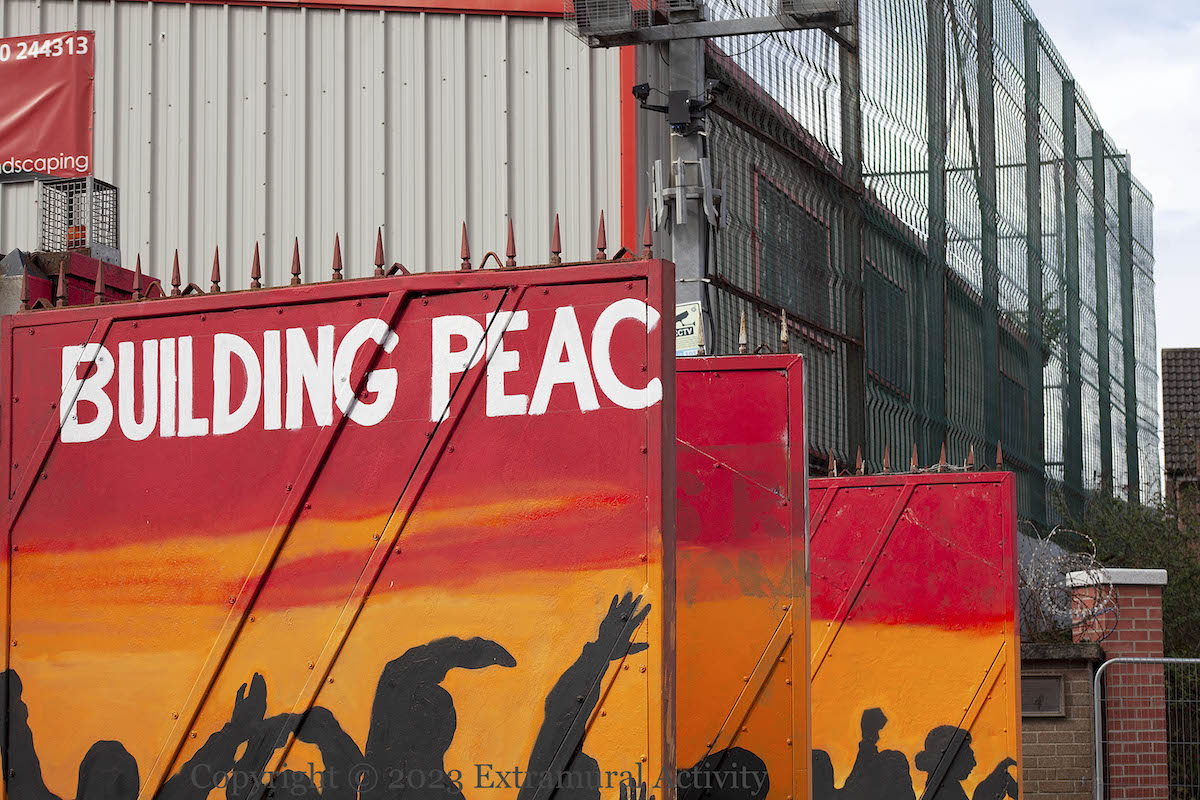
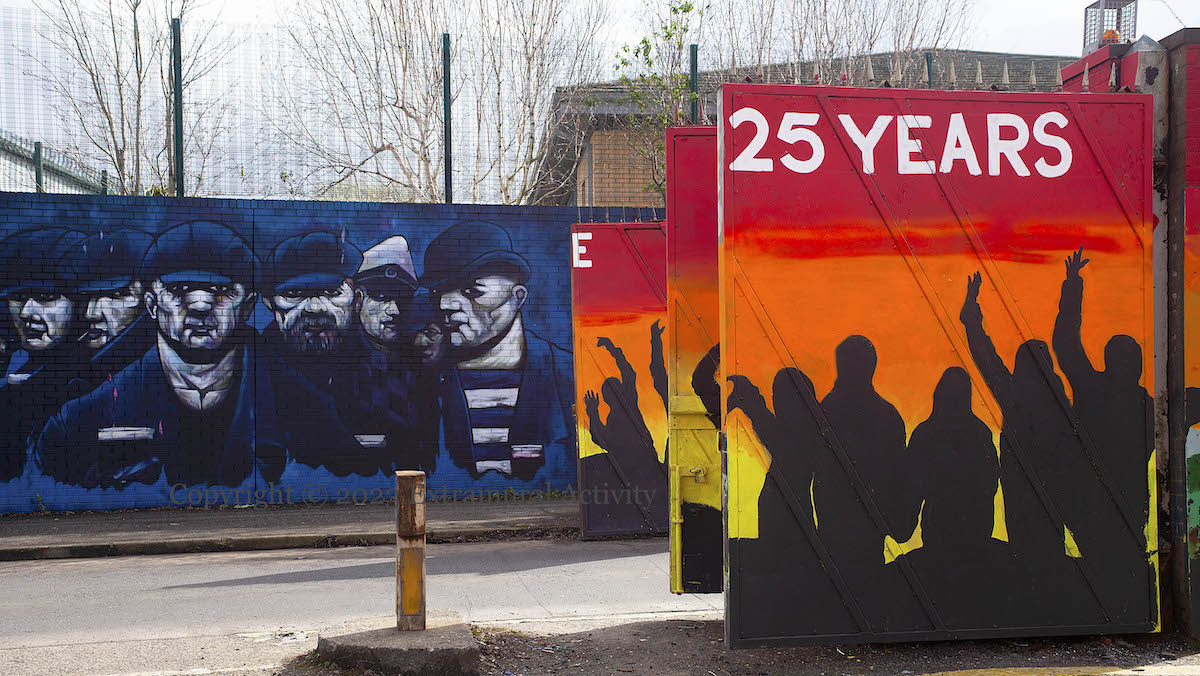
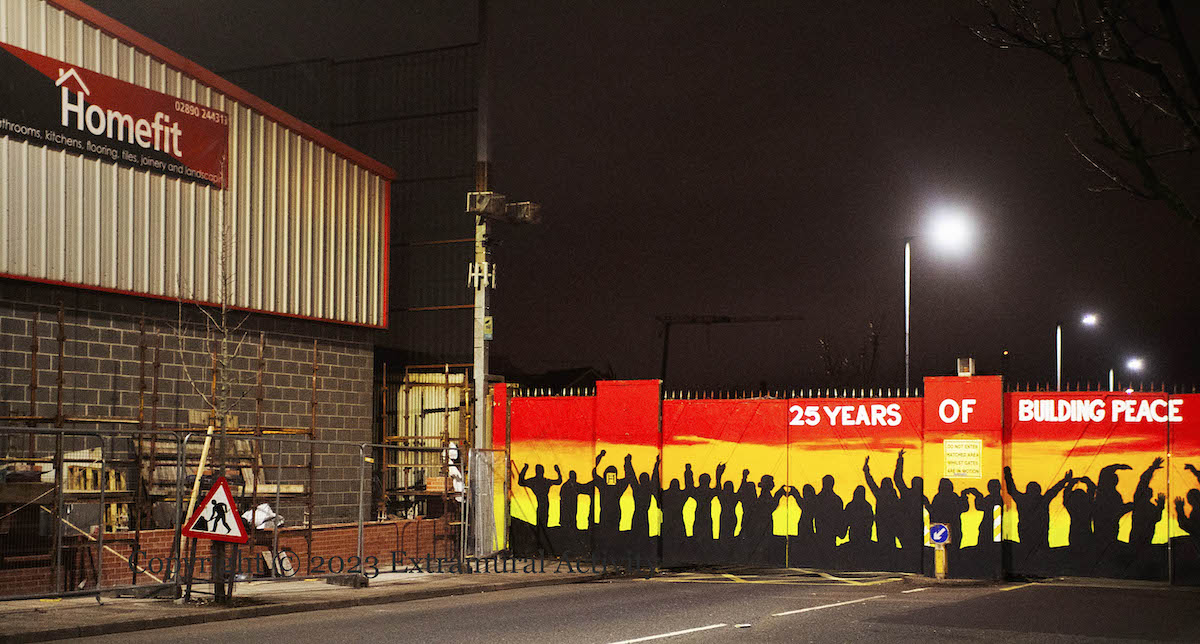
The gates on Lanark Way are part of the west Belfast “peace” wall. On this site we always put the word in scare-quotes to signify that it has a different meaning than it typically does. Without them, “peace wall” might suggest a place where people can go for a few moments of quiet reflection.
Rather, the wall – and the gates and the cages that surround many buildings on either side of the wall (see above) – is a divider meant to keep the peace by separating warring factions. Indeed the reason for the re-painting of the gates is not just the up-coming 25th anniversary of the Belfast or “Good Friday” Agreement (on April 10th) but the fact that they were damaged in the 2021 rioting (BBC). (This Irish News article surveys 150 years of violence at the site.)
The new art on the gates is inspired by the cover of the booklet sent to every household in advance of the May vote to ratify the Agreement (available at CAIN), which was similar in various ways to the television ad shown at the time (Ads On The Frontline). It showed a family of four in silhouette against a red-and-orange sunset; given the rioting associated with Lanark Way, on the gates this sunset could be mistaken for flames, and the rejoicing silhouetted figures for gesticulating and petrol-bomb-throwing rioters. For the previous art on the gates, see the Visual History page on the west Belfast “peace” line. (For the mural in the background, see Sailortown Dockers.)
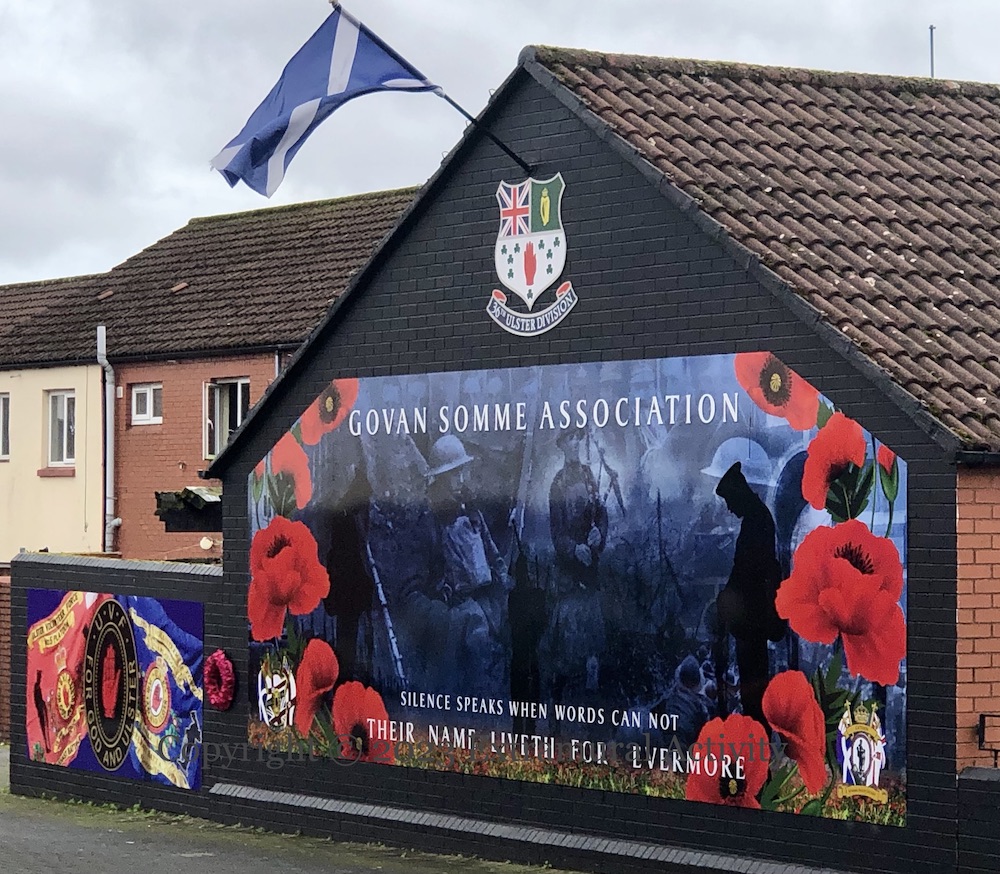
There was previously a (painted) mural on this wall – see Passchendaele Court – but this latest display is a large printed board, with photographs blended together and framed by graveside mourners, poppies, and the emblems of the Pride Of Govan flute band and the Govan Somme Association (Fb), which also supported the previous mural.
To the left, as seen in the final images, is a smaller UVF (1st Battalion) A Company 5th Platoon board – like the other new board in the street We Will Always Be Ready (and on the other side of Conway Street – see When Needed We Shall Rise Again).










 Extramural Activity