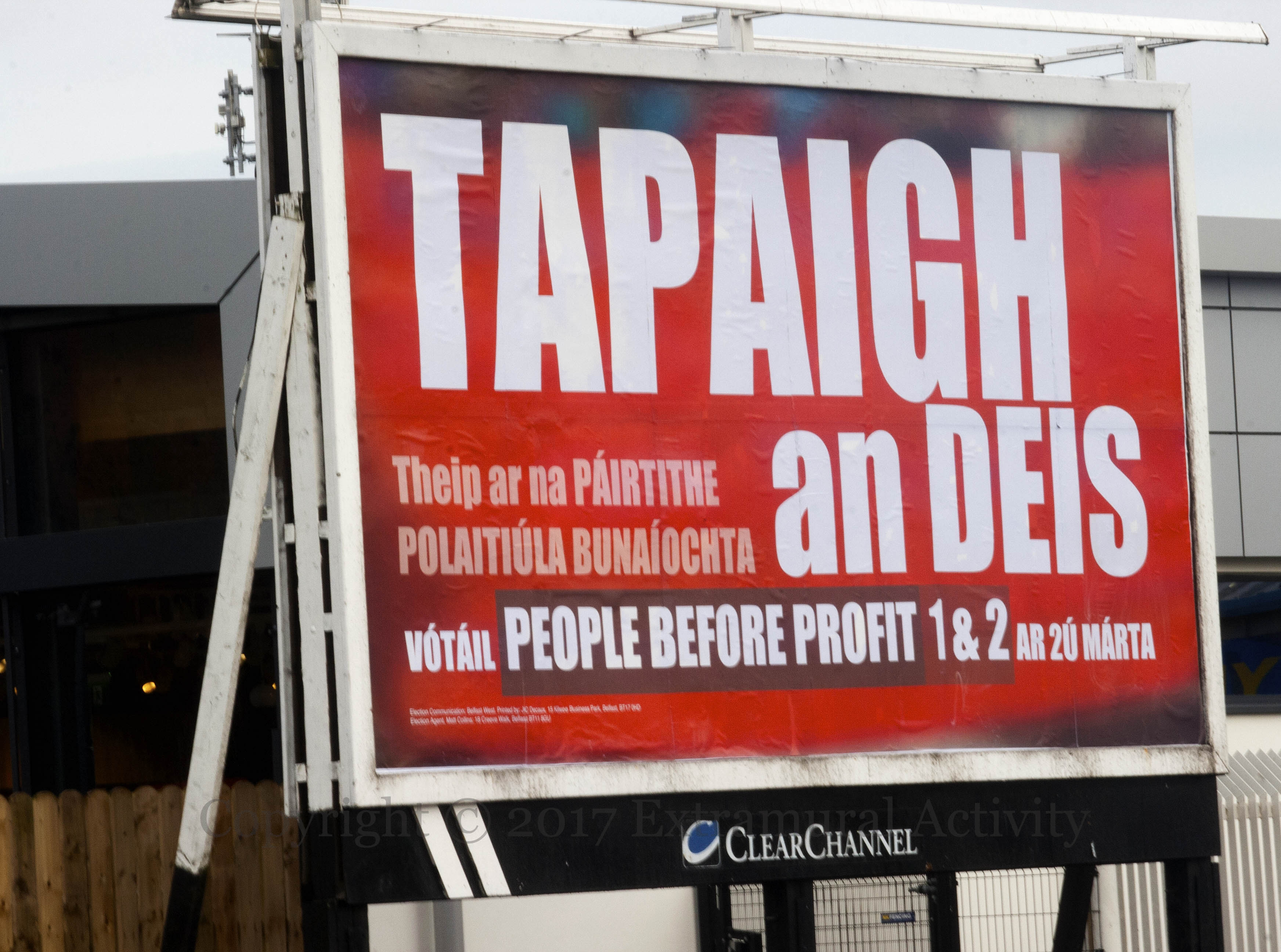
People Before Profit are fielding two candidates (Michael Collins, Gerry Carroll) in west Belfast for the Assembly elections. The hoarding above (on the Andersonstown Road) points to “the failure of established political parties” (“theıp ar na páırtıthe polaıtıúla bunaíochta”) and asks voters to “seize the opportunity” for change.
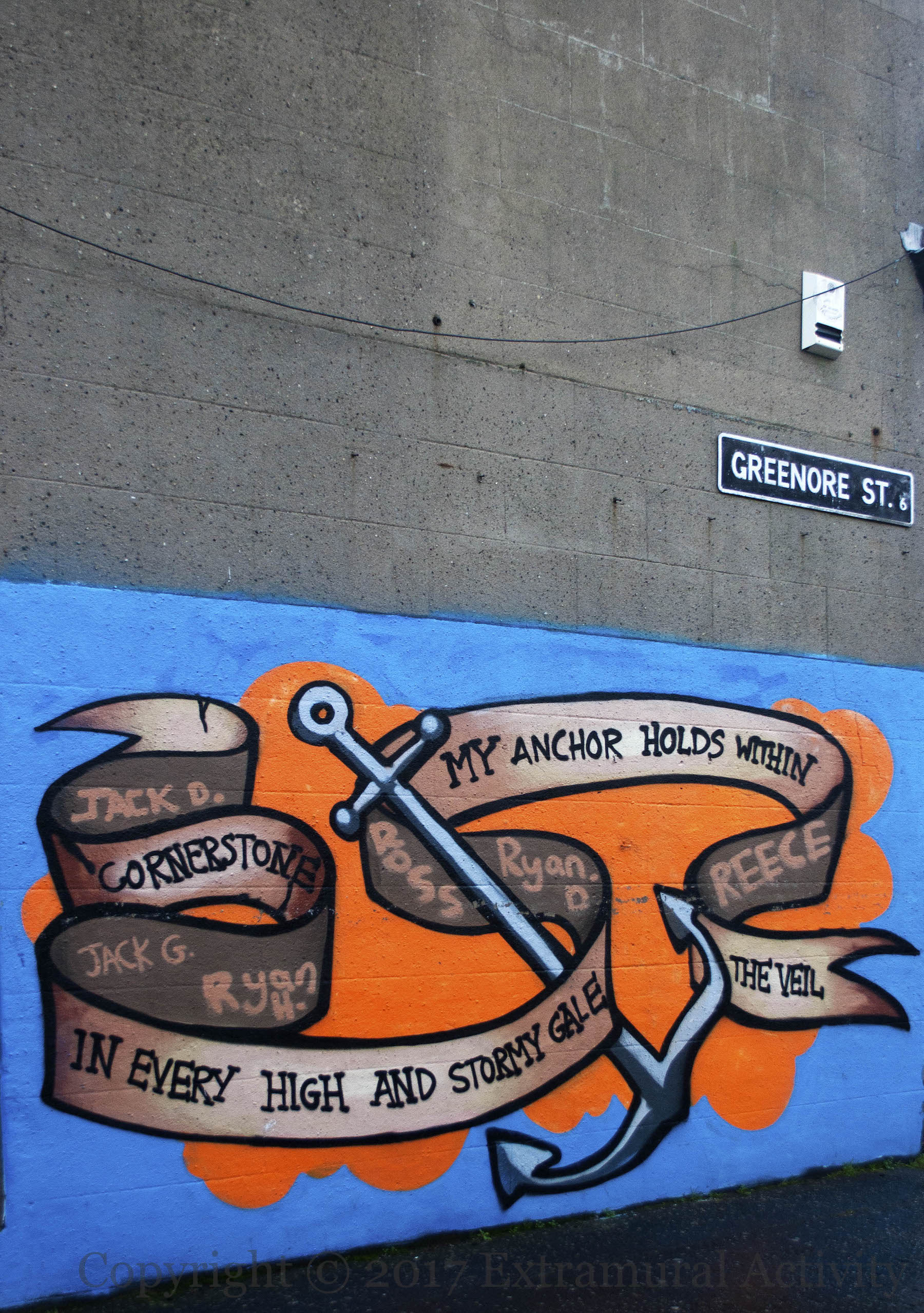
Words (by Edward Mote in 1836) from a Christian hymn ‘My Hope Is Built On Nothing Less’, commonly sung to the 1863 tune by William Bradbury ‘The Solid Rock’ (WP) but also used with a different melody for the song Cornerstone (which is the name of the east Belfast community group) written on a ribbon wrapped around an anchor in east Belfast: “In every high and stormy gale, my anchor holds within the veil.”
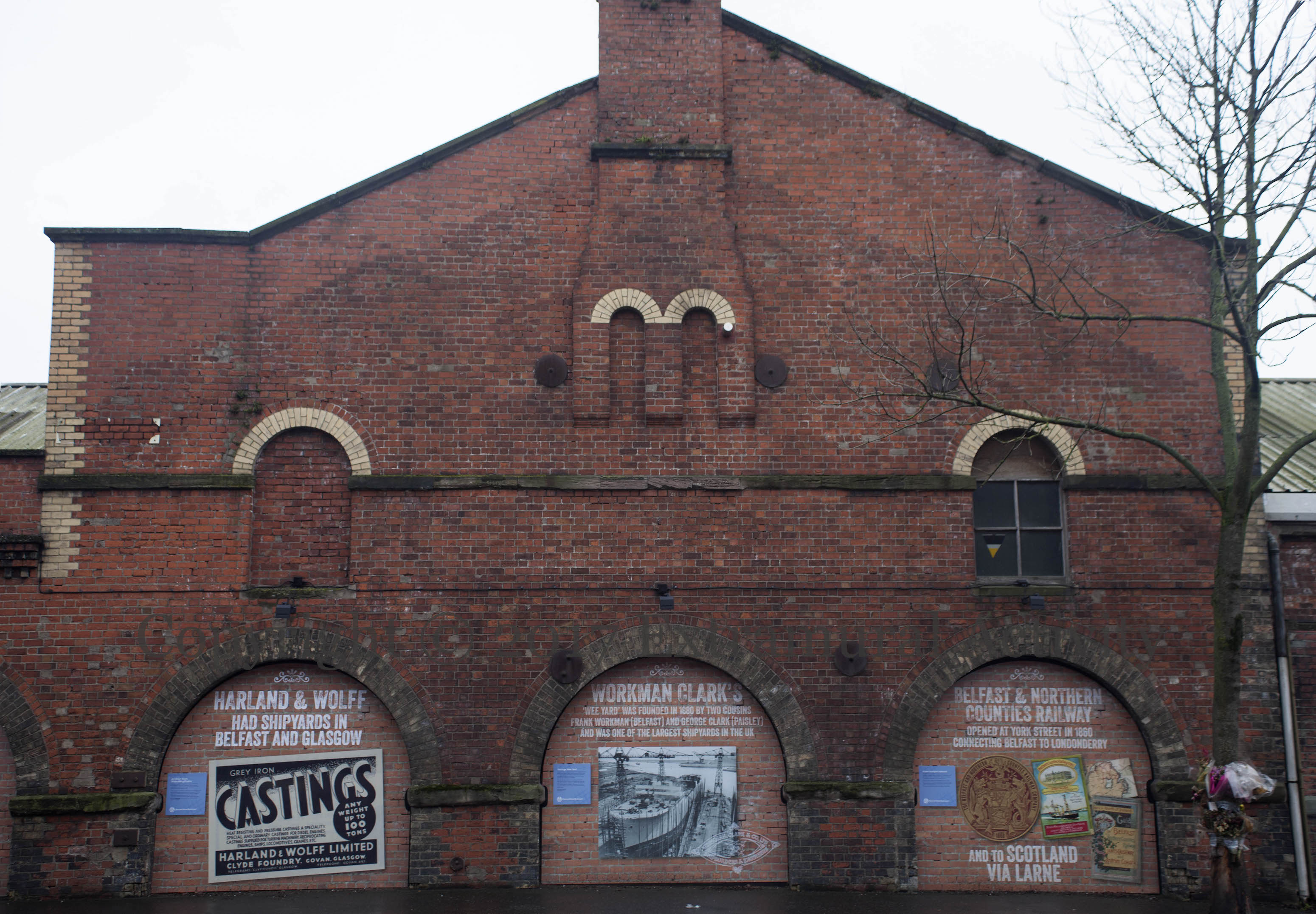
Workman & Clark’s (in the centre panel above) was a Belfast shipyard existing from 1880 to 1935. During the first world war it took over the construction of two monitor ships (specifically, M29 and M31) for the Royal Navy that H&W did not have space to build. For more, see Grace’s Guide | BBC audio on monitor ships and their construction, including a record for number of rivets hammered in by one John Moore at Workman Clark’s.
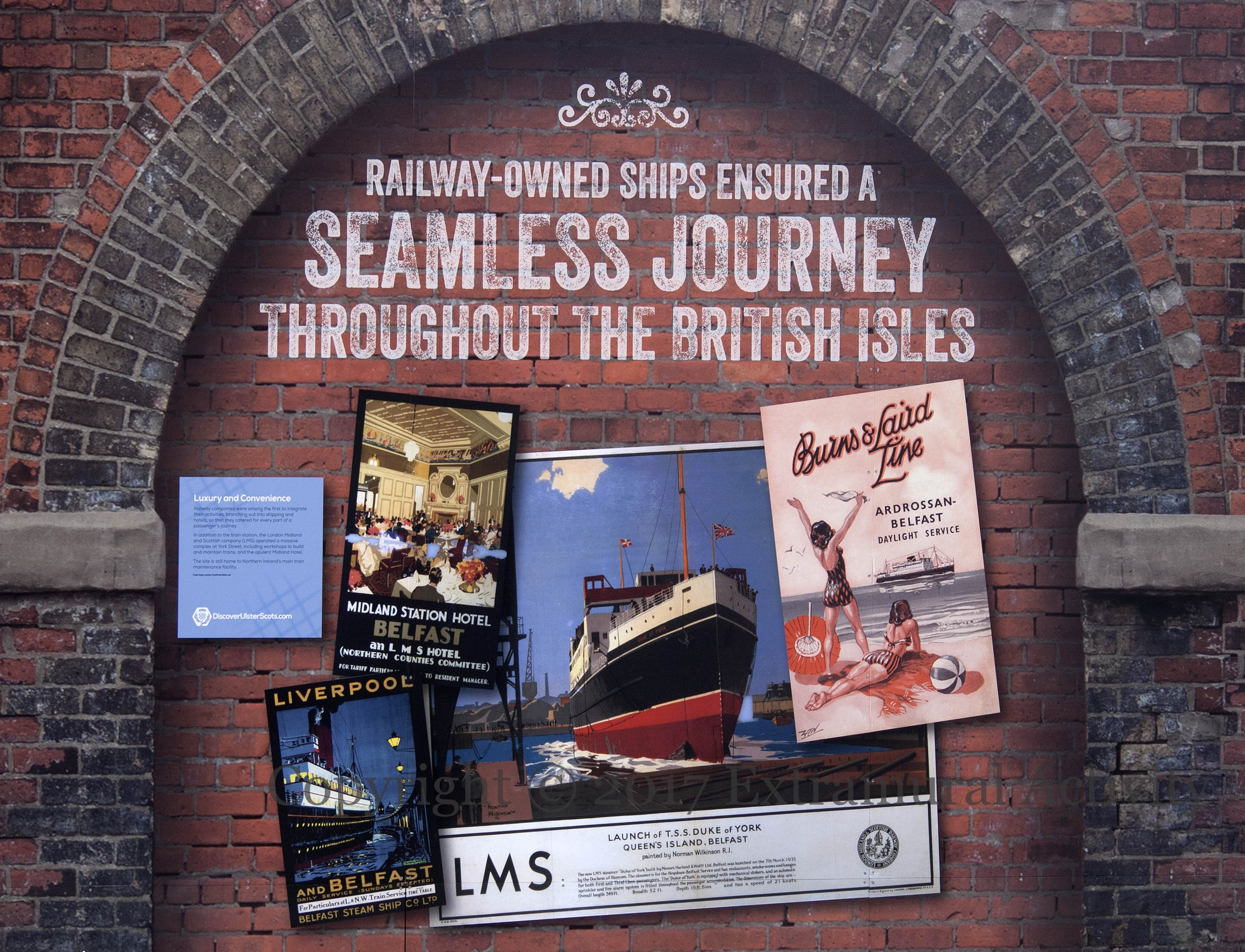
These are panels 6, 7, and 8 from the new boards along York Street on the outer wall of the NI Railways mechanical engineering workshop.
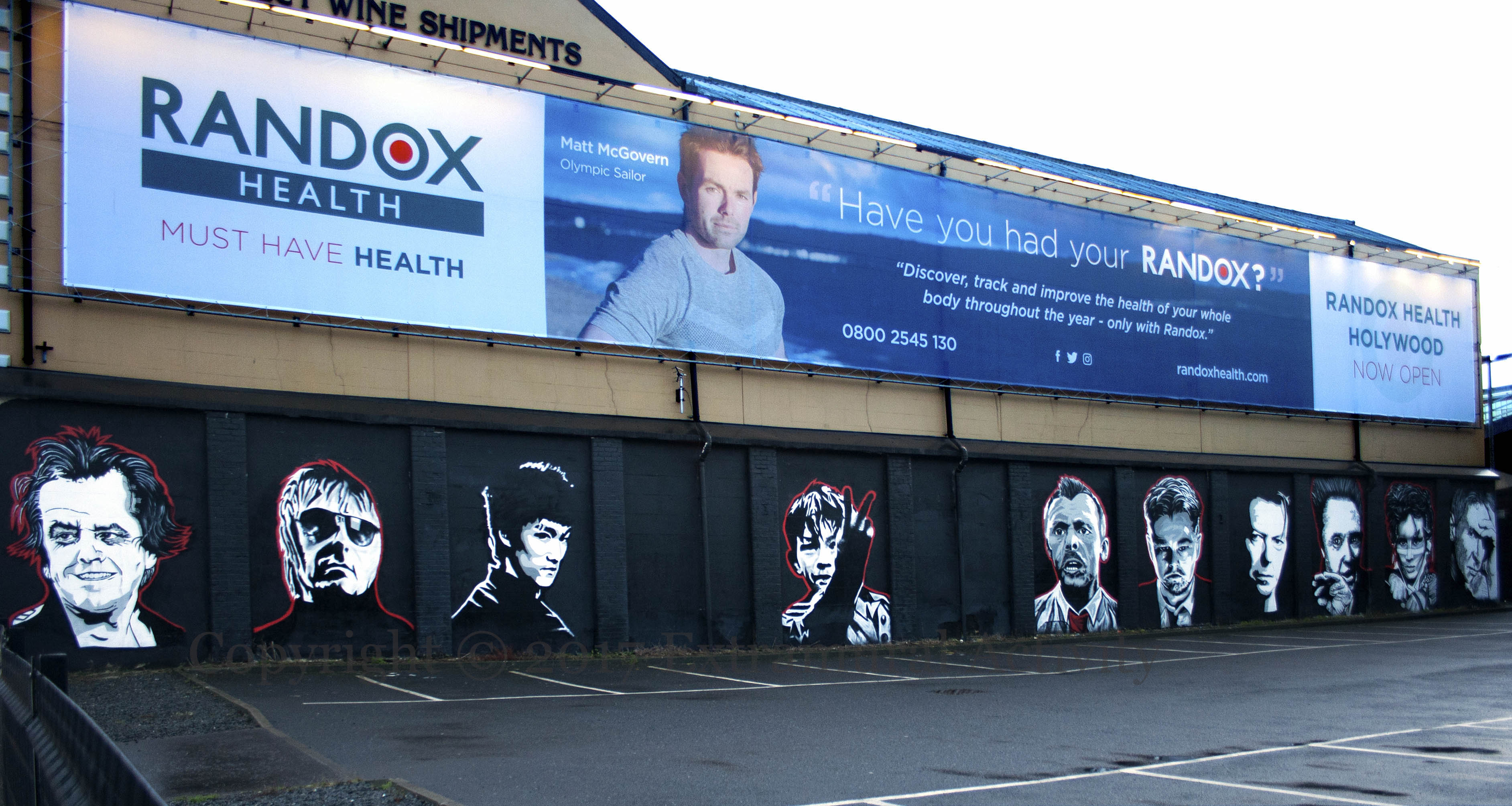
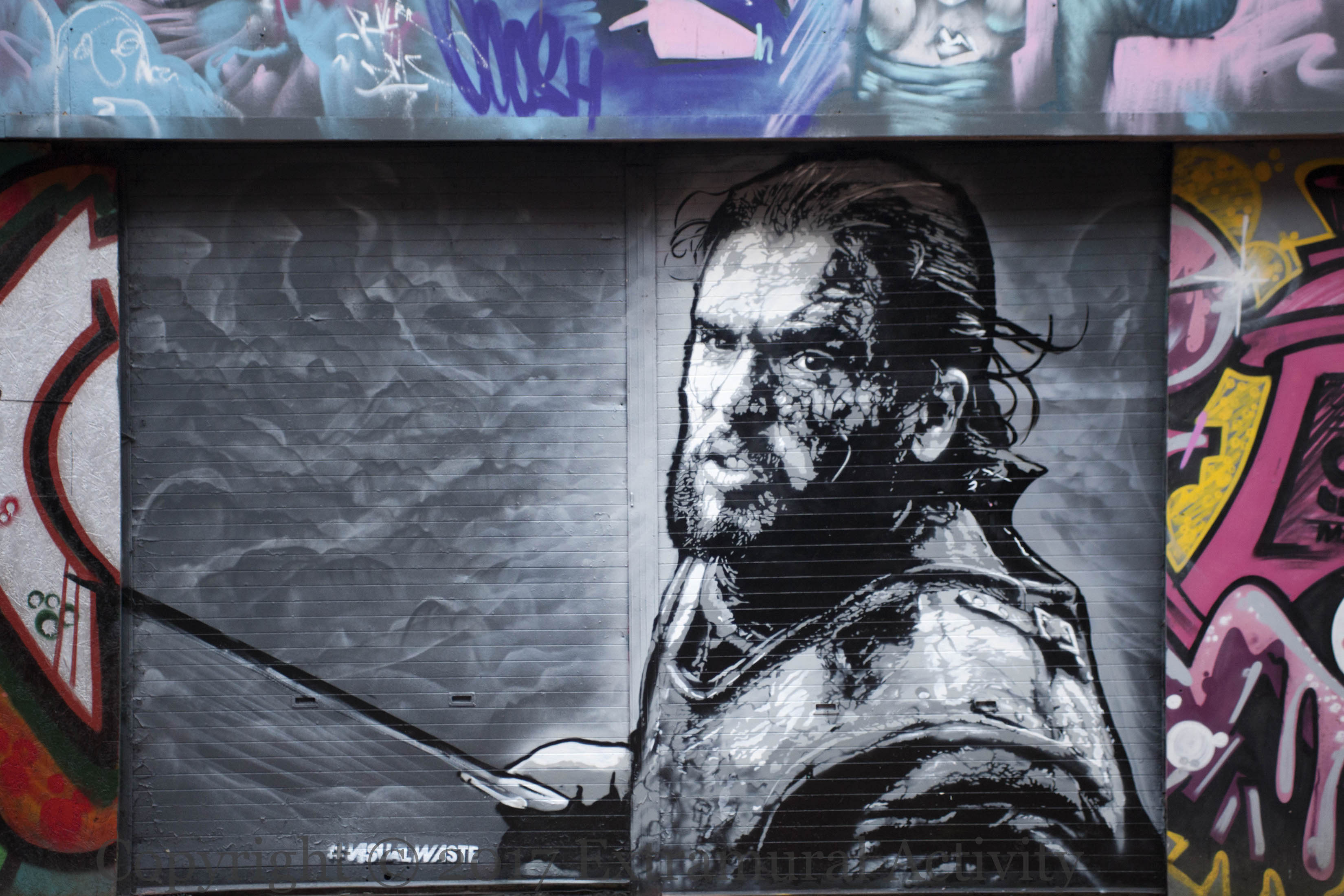
Christopher Walken, Adam Ant, and Harrison Ford are the final three figures from Glen Molloy’s gallery of stars on Corporation Street. The wide shot below also shows Noel Gallagher and Bruce Lee in the second and third spots.
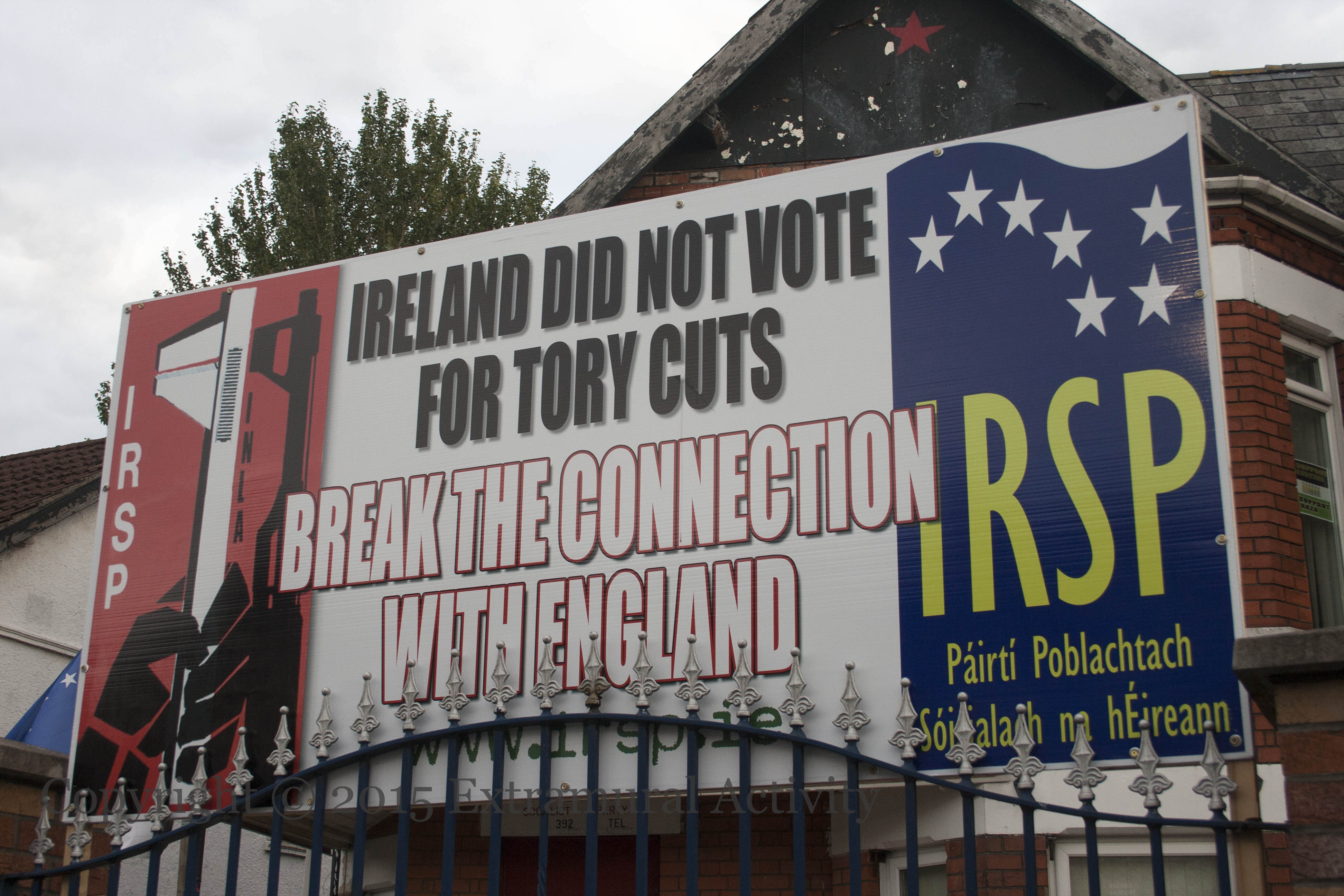
“Ireland did not vote for Tory cuts. Break the connection with England. www.irsp.ie. Páırtí poblachtach sóısıalaıgh na hÉireann.”
This IRSP/INLA board outside the party offices on the Falls Road protests policies coming from the Westminster parliament and specifically the Conservatives. On the left-hand side of the board are an adjustable pipe-wrench (for IRSP) and a rifle (for INLA). The sticker on a post-box is in Cavendish Street.
Jon Snow, the character from Song Of Ice And Fire, as incarnated by Kit Harrington on the TV show Game Of Thrones during the Battle Of The Bastards (s6e9).
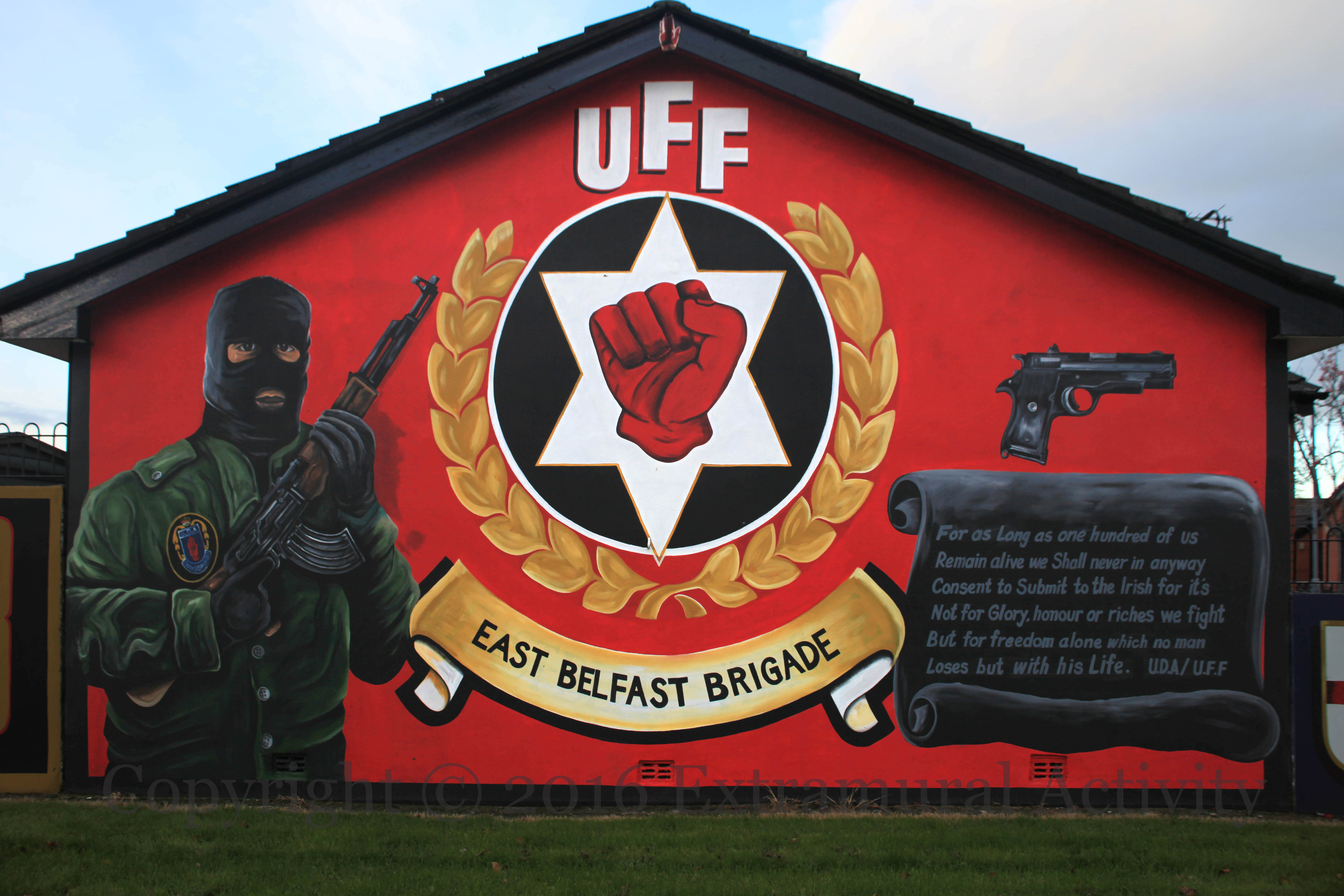
Here is the UDA/UFF mural on the left-hand gable of “Freedom Corner”. The mural is a 2015 repaint of the previous mural, which had to be replaced when it disintegrated. (See Freedom Corner for speculation as to the cause.) At the time, there was some disappointment that it was not repainted in a non-paramilitaristic fashion but defenders described the mural as “historical” (Tele).
The mural shows a UDA-jacketed volunteer with assault rifle and a modified version of the Declaration of Arbroath: “For as long as one hundred of us remain alive we shall never in anyway consent to submit to the Irish for it’s not for glory, honour or riches we fight but for freedom alone which no man loses but with his life – U.D.A./U.F.F”
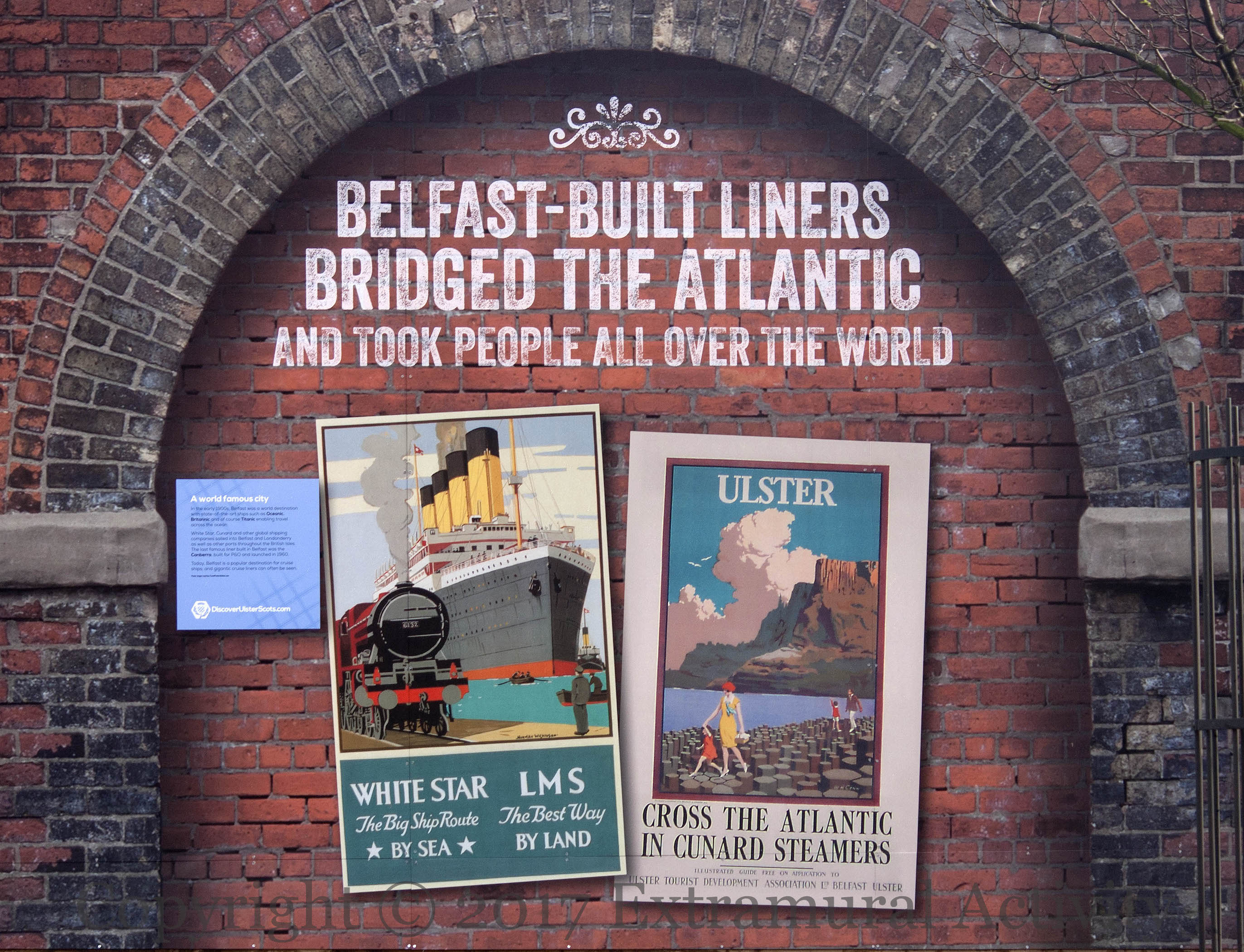
In addition to the famous trans-Atlantic ships (image above), Belfast was part of the travel network in the UK and Ireland (image below). Before there was British Railways, there were the Big 4: the Southern, Great Western, London and Northeastern, and London, Midland, and Scottish (LMS) railways. The latter included the railways in the Northern Counties. In addition to railways, the company owned canals, ships (including the Princess Victoria which sank on the Larne-Stranraer route), and hotels. “Belfast-built liners bridged the Atlantic and took people all over the world.” “Railway-owned ships ensured a seamless journey throughout the British Isles.”
Previously:The history of Shipbuilding in Belfast.




 Extramural Activity