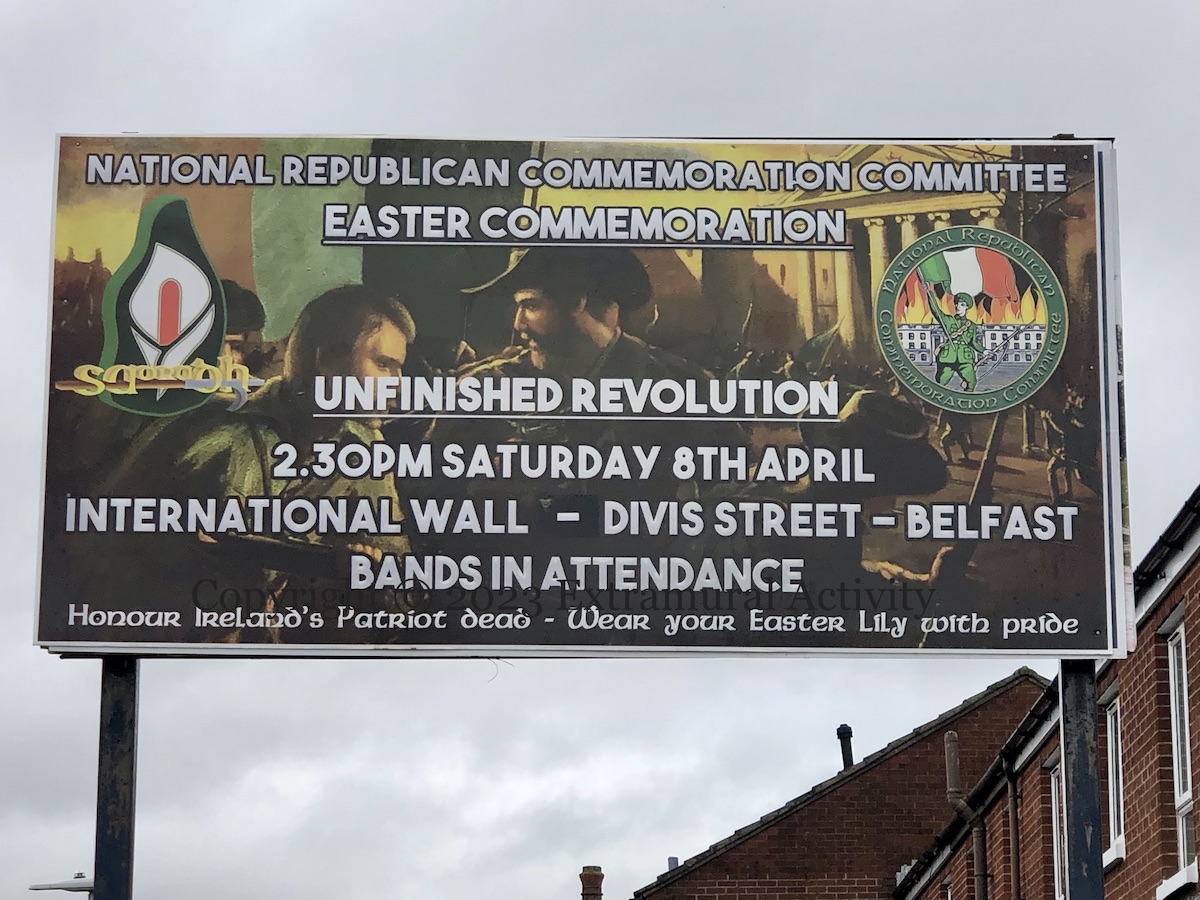
There are dozens of Easter Rising commemorations happening this weekend – see Belfast Media for a full calendar. Above is a board for Saoradh’s (web) Easter parade on Saturday 8th. Below is the Falls/D Company gathering.
“National Republican Commemoration Committee Easter commemoration. Unfinished revolution. 2.30 pm Saturday 8th April. International wall, Divis Street, Belfast. Bands in attendance. Honour Ireland’s patriot dead, wear your Easter lily with pride.”
An IRSP (web) electoral board joins the Miriam Daly tribute at the end of Oakman Street (see previously History Is Written By The Winners). Dan Murphy took 2.5% of the first-preference votes in the 2022 Assembly elections (WP) on a platform focusing on housing: “Demand better! Housing – Equality – Community. Someone who stands up to landlords in Beechmount (e.g.), fighting for affordable rents, fighting for our community.”
The IRSP first painted on this Oakman Street gable in 1996, with the original Daly mural. Before that, in 1986, there was an IRA anti-touting message (see M00413).
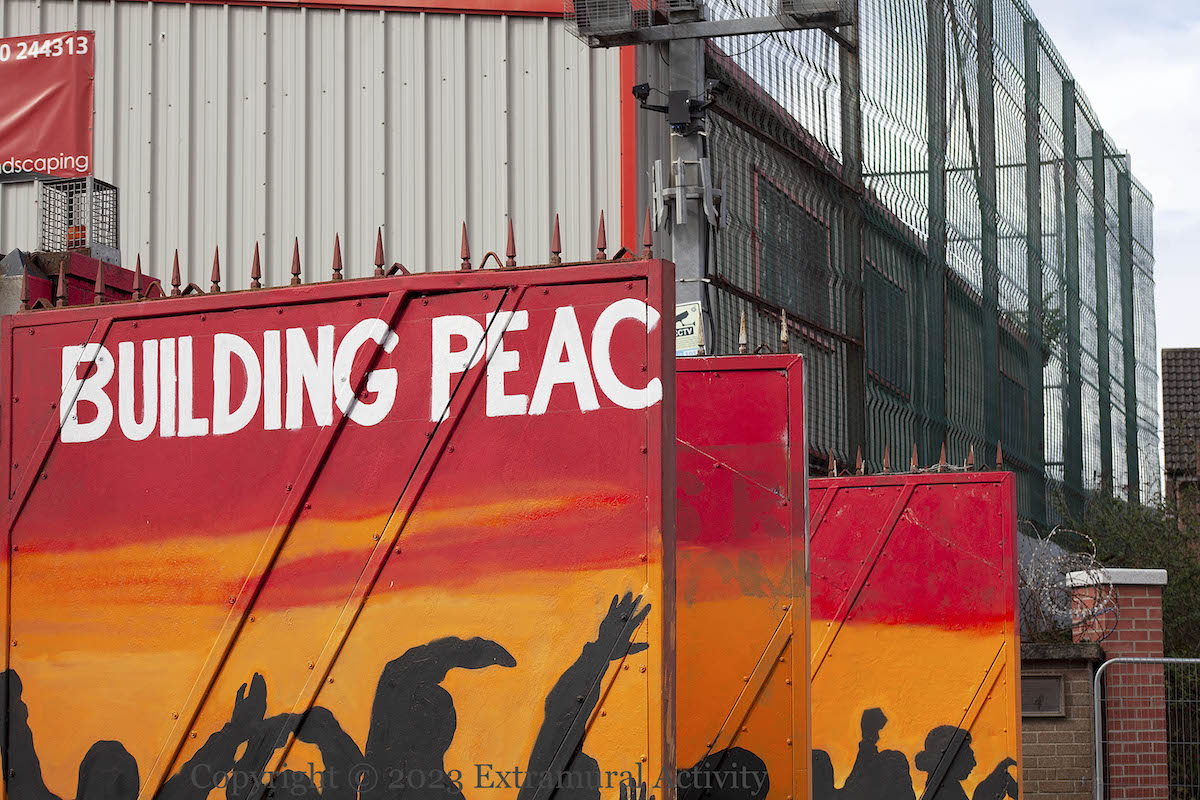
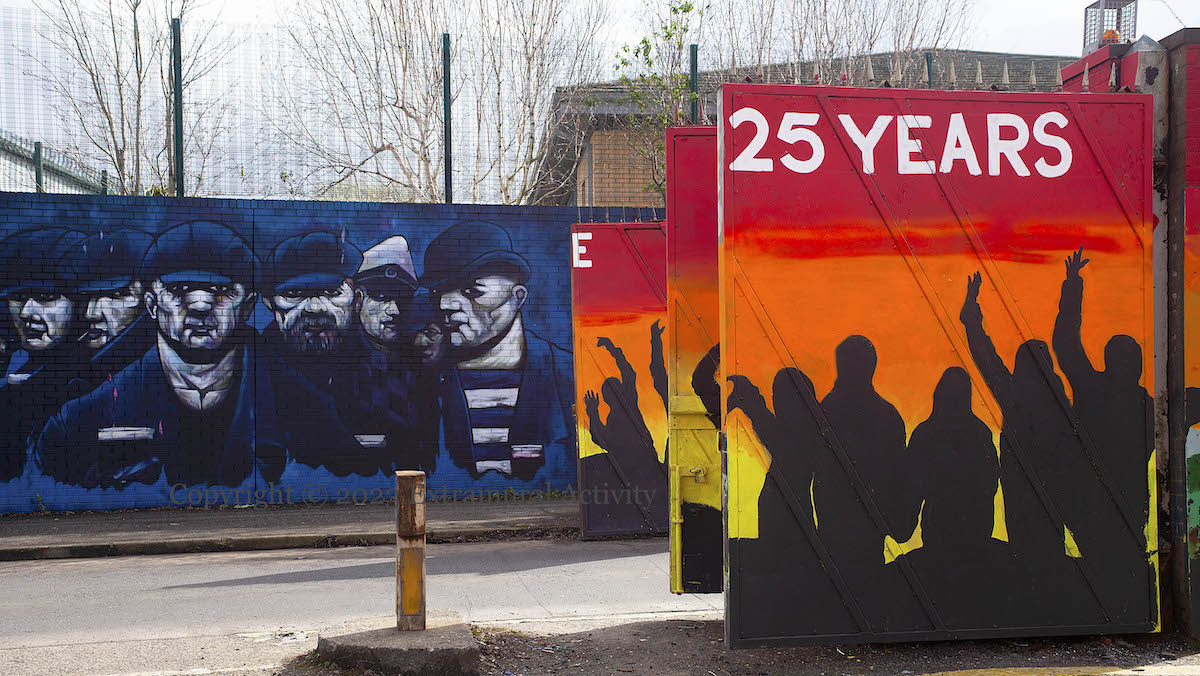
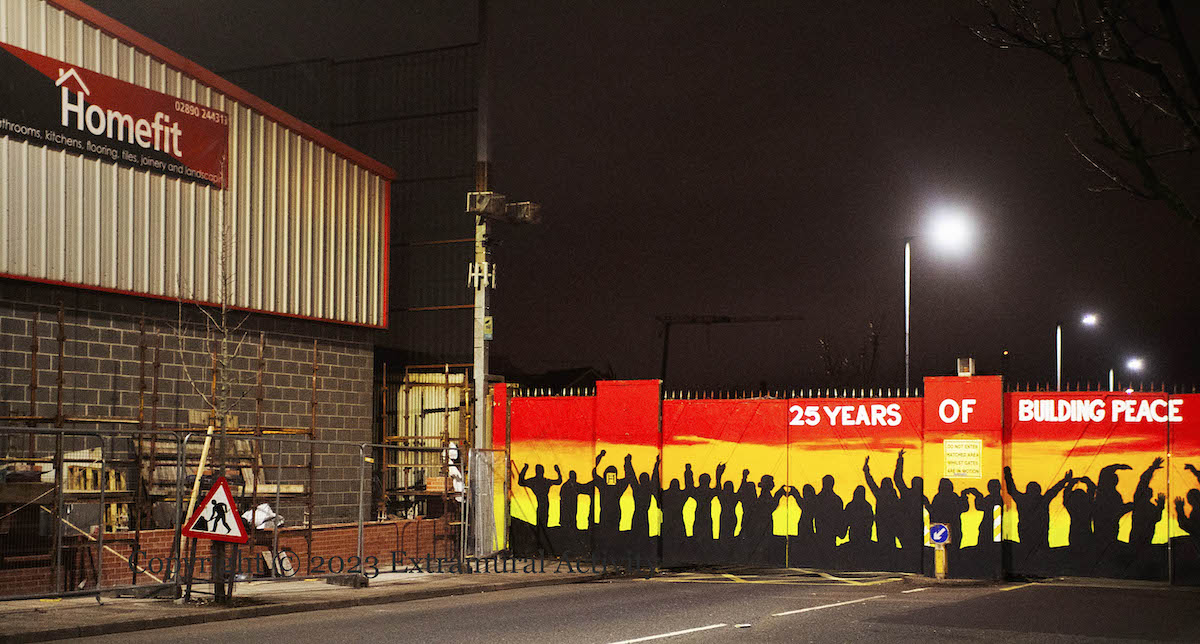
The gates on Lanark Way are part of the west Belfast “peace” wall. On this site we always put the word in scare-quotes to signify that it has a different meaning than it typically does. Without them, “peace wall” might suggest a place where people can go for a few moments of quiet reflection.
Rather, the wall – and the gates and the cages that surround many buildings on either side of the wall (see above) – is a divider meant to keep the peace by separating warring factions. Indeed the reason for the re-painting of the gates is not just the up-coming 25th anniversary of the Belfast or “Good Friday” Agreement (on April 10th) but the fact that they were damaged in the 2021 rioting (BBC). (This Irish News article surveys 150 years of violence at the site.)
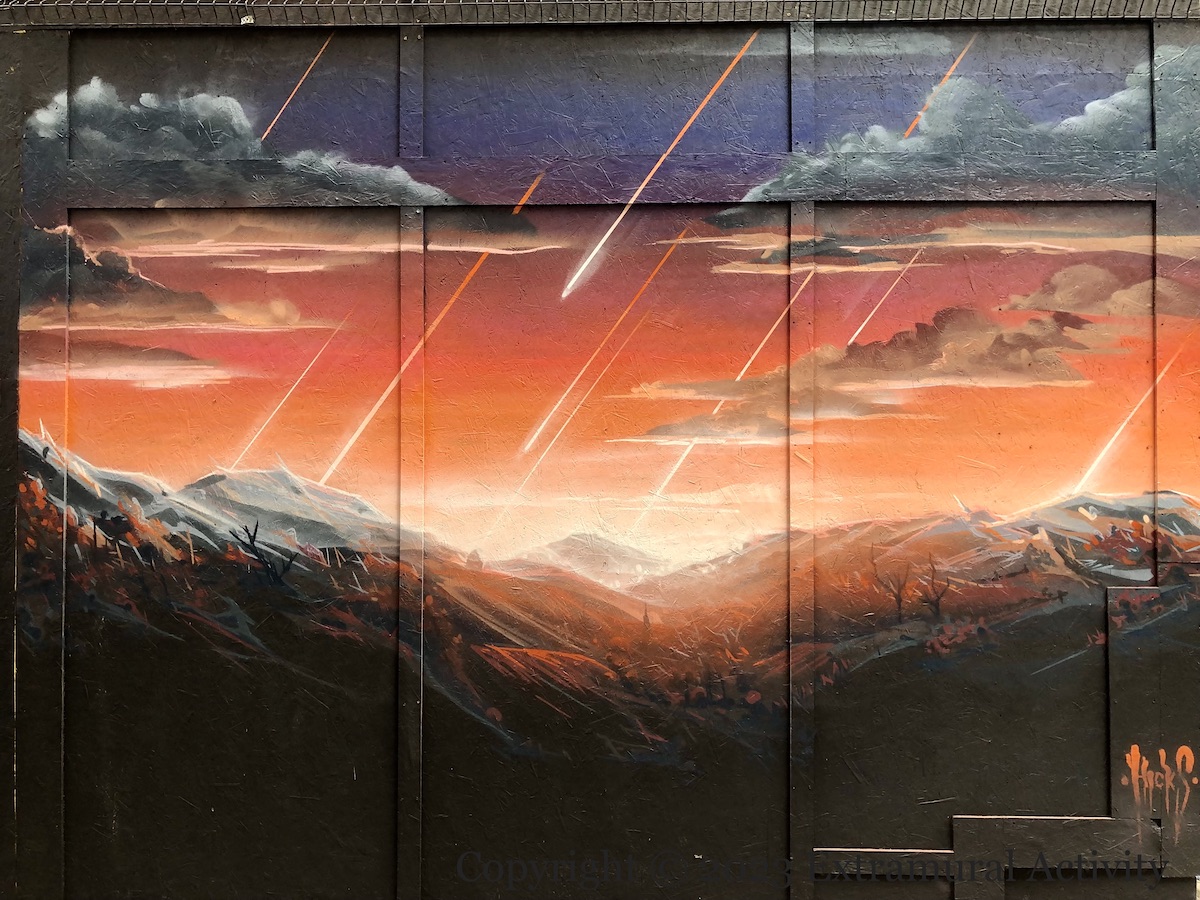
The new art on the gates is inspired by the cover of the booklet sent to every household in advance of the May vote to ratify the Agreement (available at CAIN), which was similar in various ways to the television ad shown at the time (Ads On The Frontline). It showed a family of four in silhouette against a red-and-orange sunset; given the rioting associated with Lanark Way, on the gates this sunset could be mistaken for flames, and the rejoicing silhouetted figures for gesticulating and petrol-bomb-throwing rioters. For the previous art on the gates, see the Visual History page on the west Belfast “peace” line. (For the mural in the background, see Sailortown Dockers.)
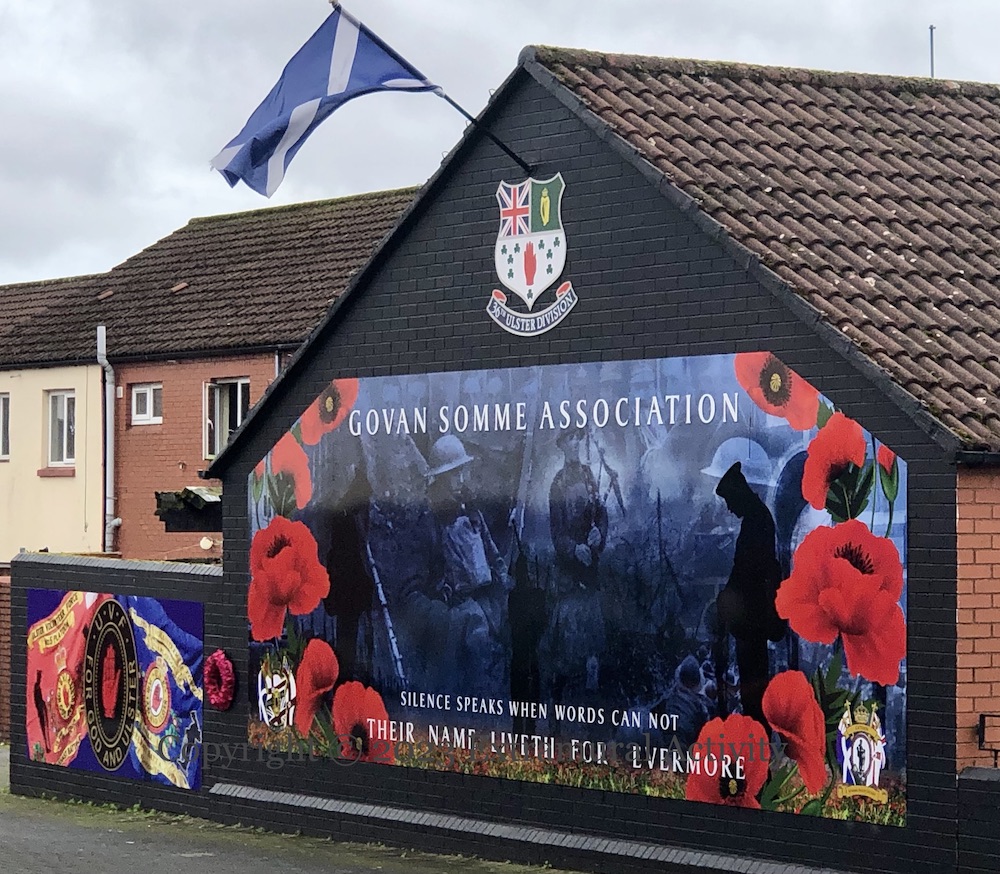
There was previously a (painted) mural on this wall – see Passchendaele Court – but this latest display is a large printed board, with photographs blended together and framed by graveside mourners, poppies, and the emblems of the Pride Of Govan flute band and the Govan Somme Association (Fb), which also supported the previous mural.
To the left, as seen in the final images, is a smaller UVF (1st Battalion) A Company 5th Platoon board – like the other new board in the street We Will Always Be Ready (and on the other side of Conway Street – see When Needed We Shall Rise Again).
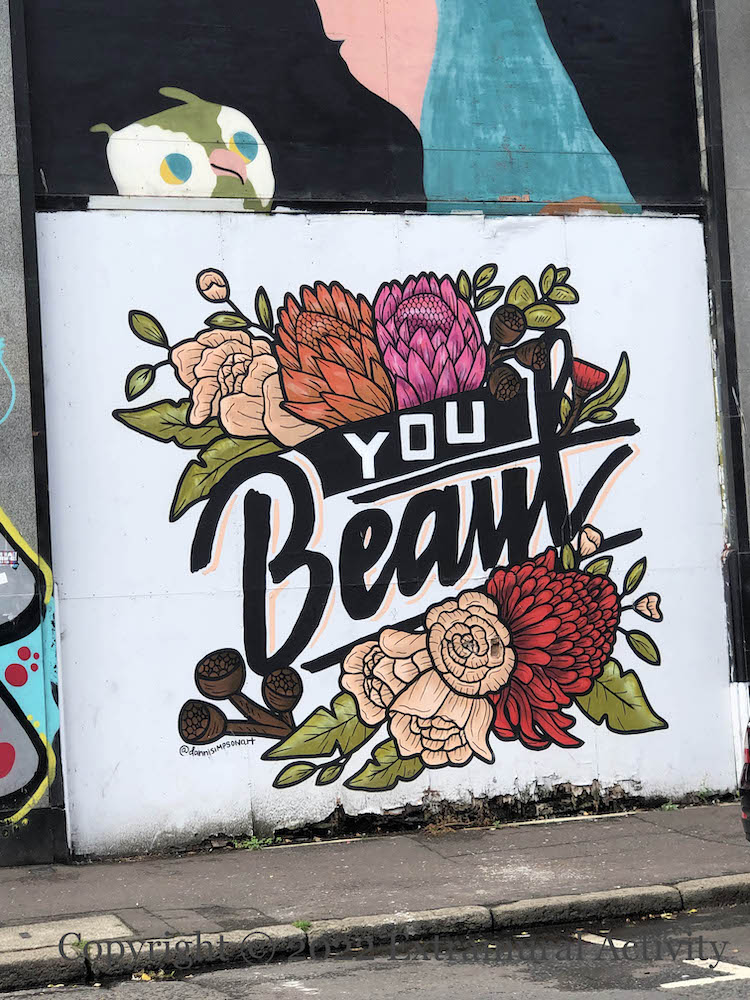
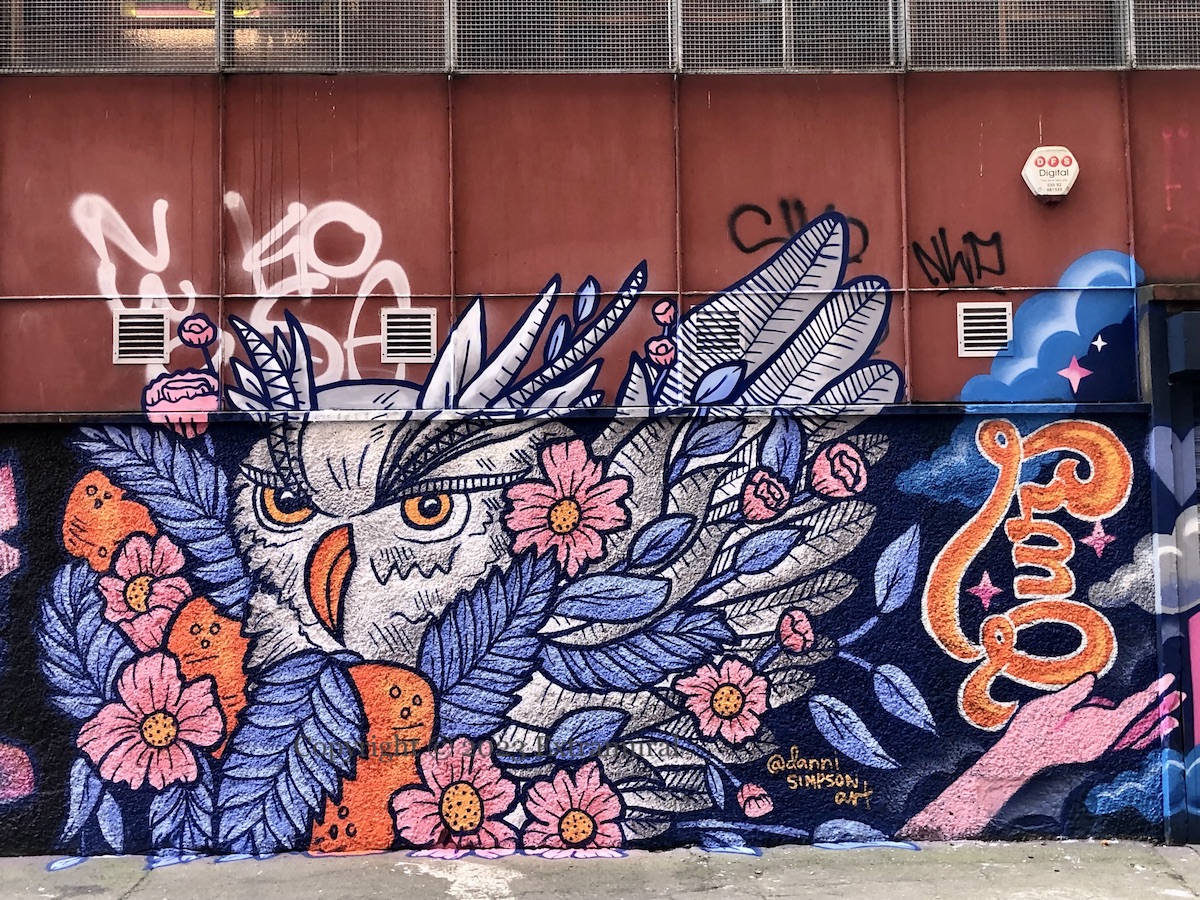
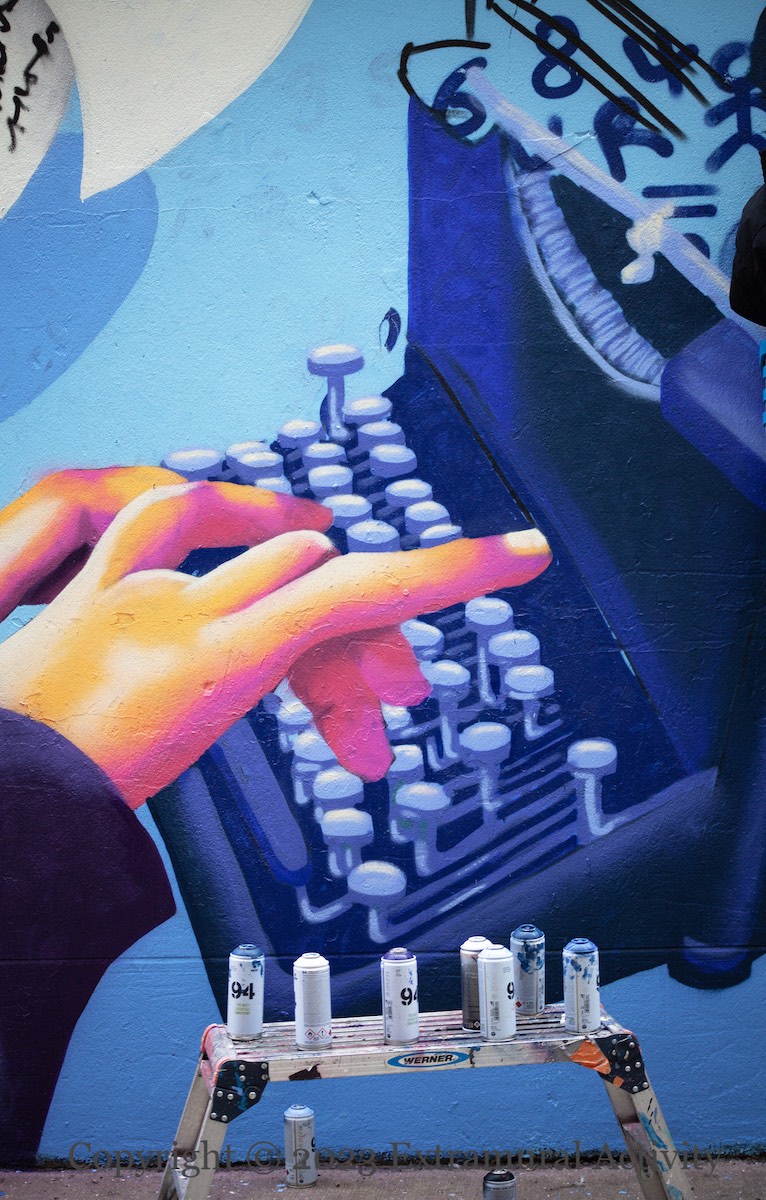
North Street Arcade was burned down in April 2004 – see Who Burnt Us Out?. Since 2012, there has been street art at both its North Street and Donegall Street ends, the latest (from September, 2021) being this piece by Danni Simpson (ig) in Donegall St.
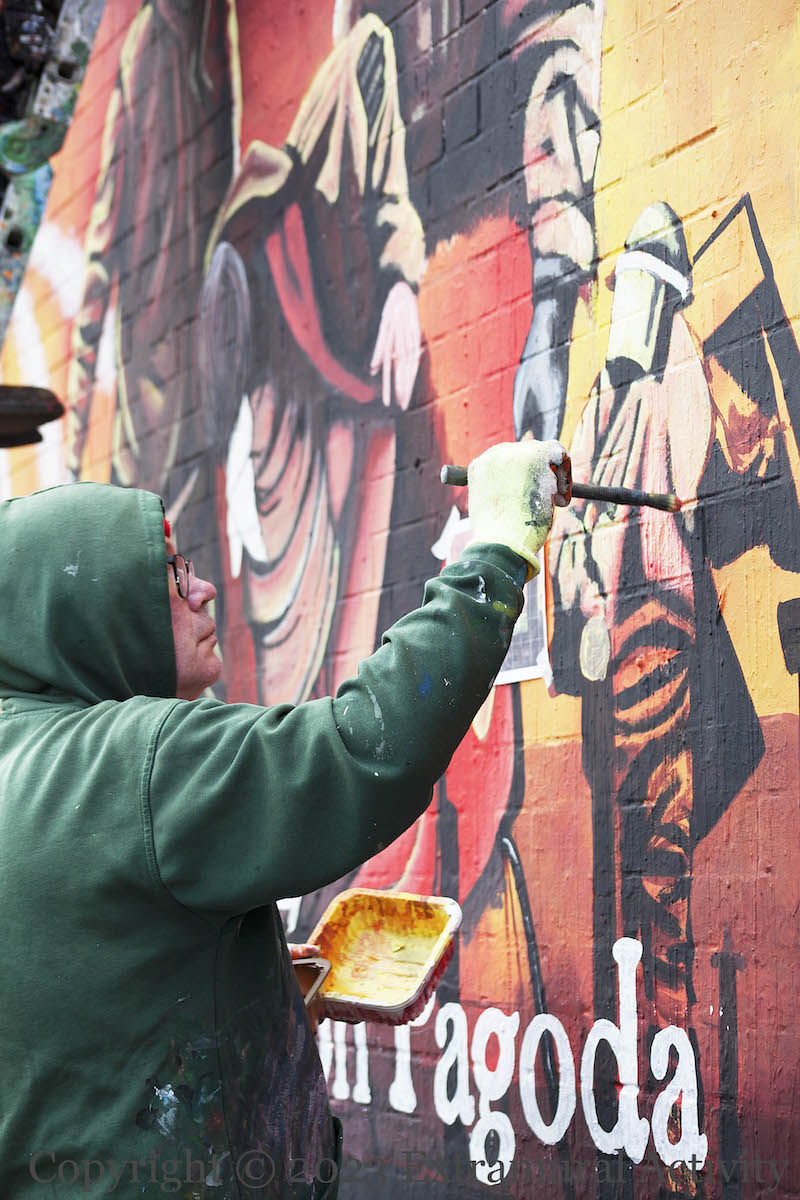
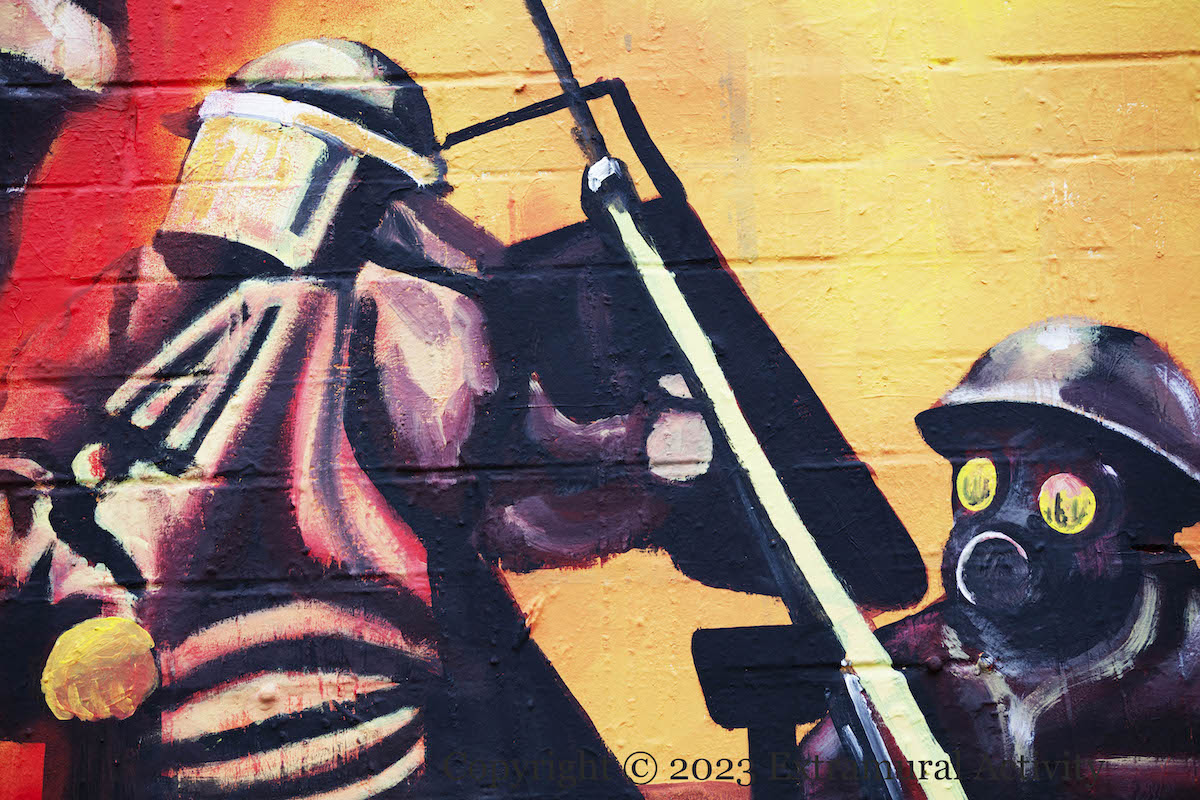
“CR Gas & The Burning Of Long Kesh, 15th-16th October, 1974 in Long Kesh. Operation Pagoda – the British government authorised and sanctioned the use of a chemical weapon against Irish Republican prisoners. Members of the 22nd S.A.S. carried out the attack from a helicopter.”
Operation Pagoda was the name of the SAS’s counter-terrorism programme (WP). Its role in the ‘Battle Of Long Kesh’ in October 1974 and its alleged use of CR (dibenzoxazepine) powder – the successor to CS powder (and before that, CN or “tear” gas) (New Scientist) – remains a classified matter. CR had been authorised for use in 1973 (Guardian).
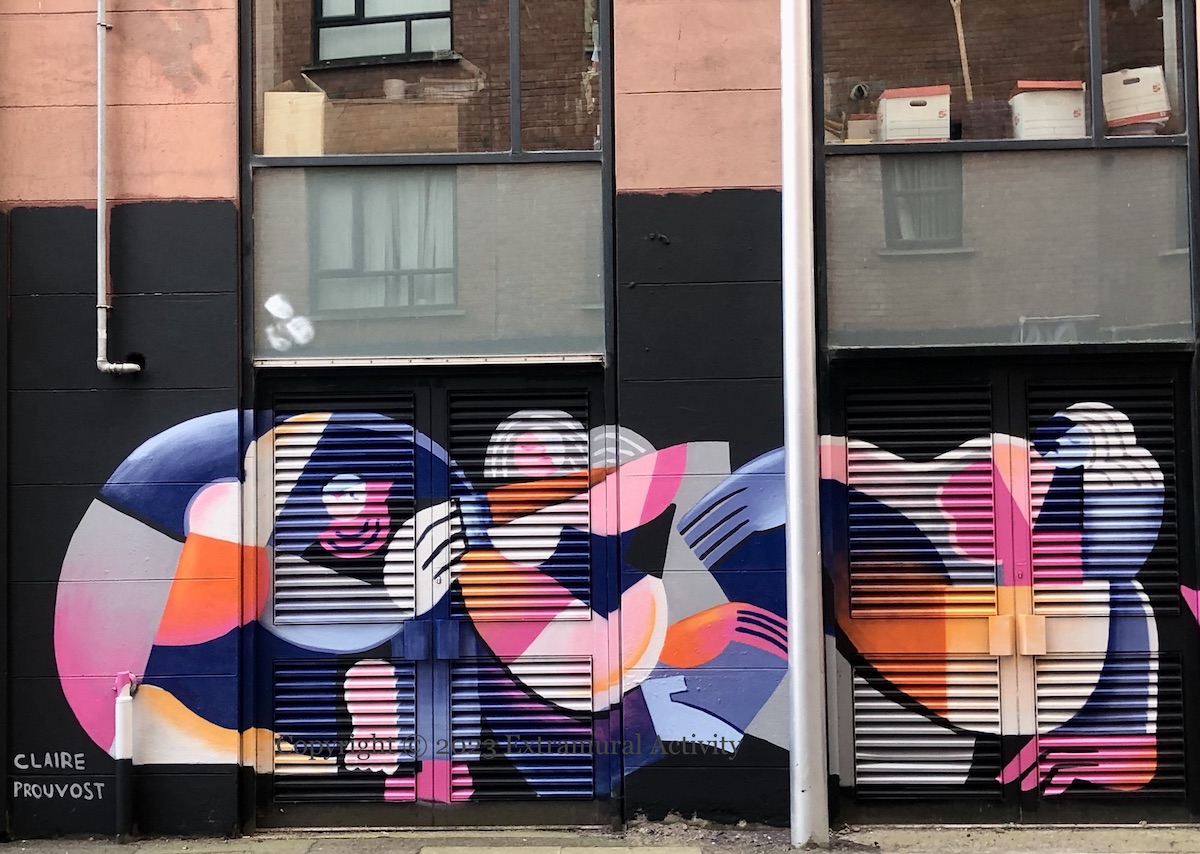
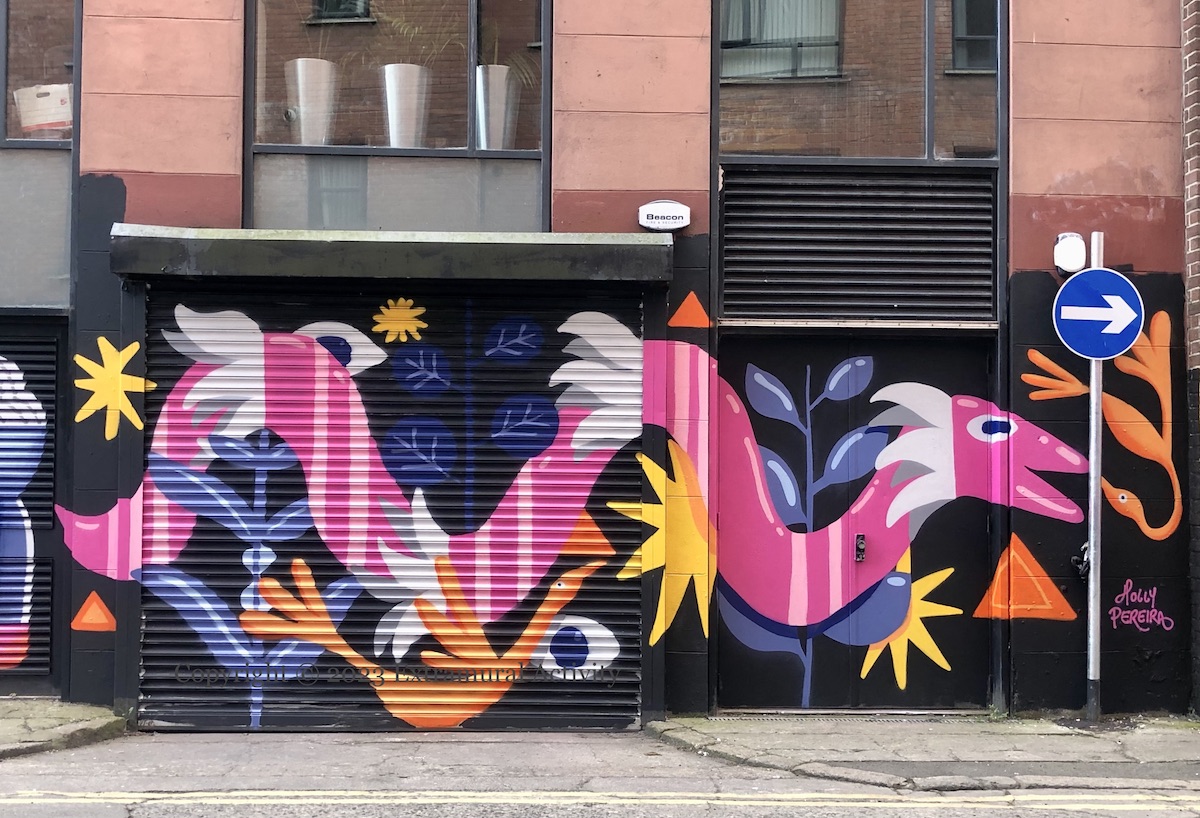
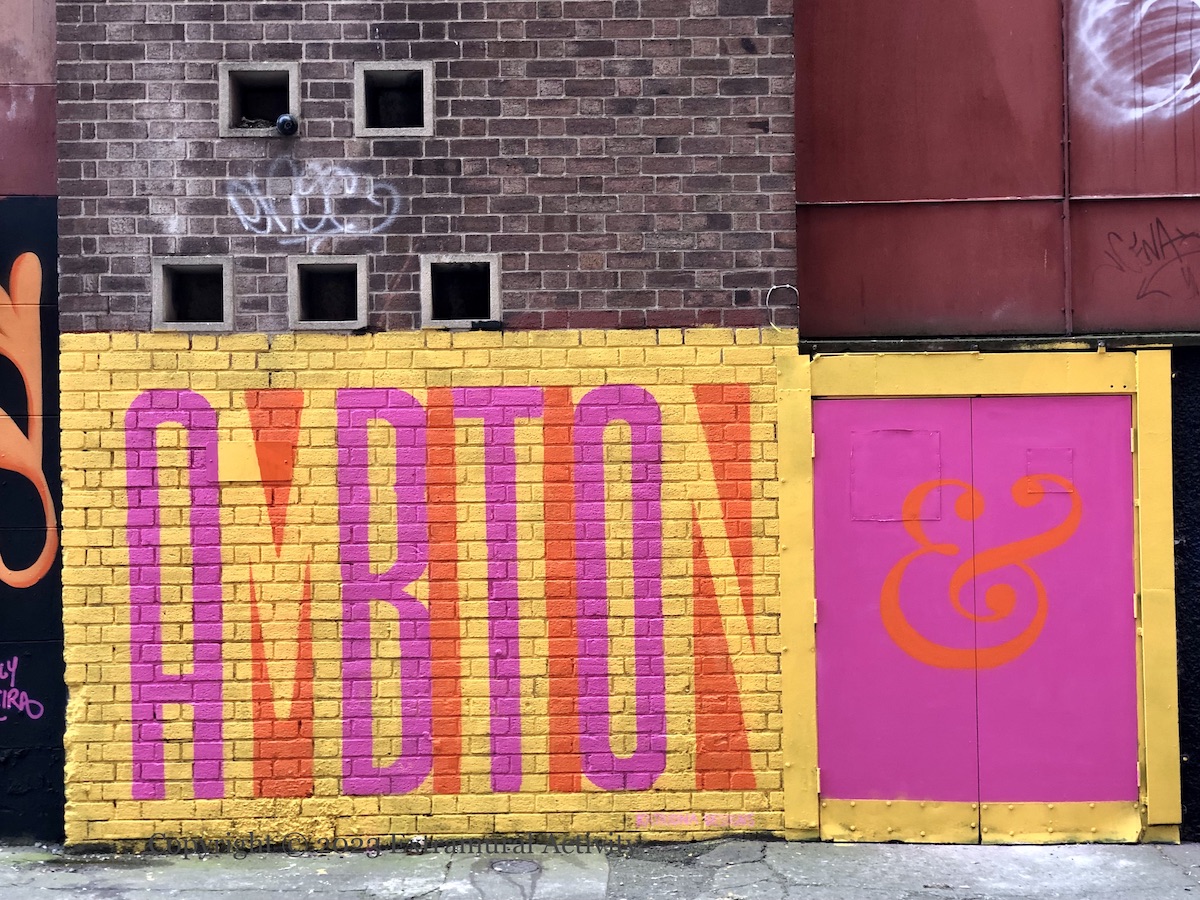
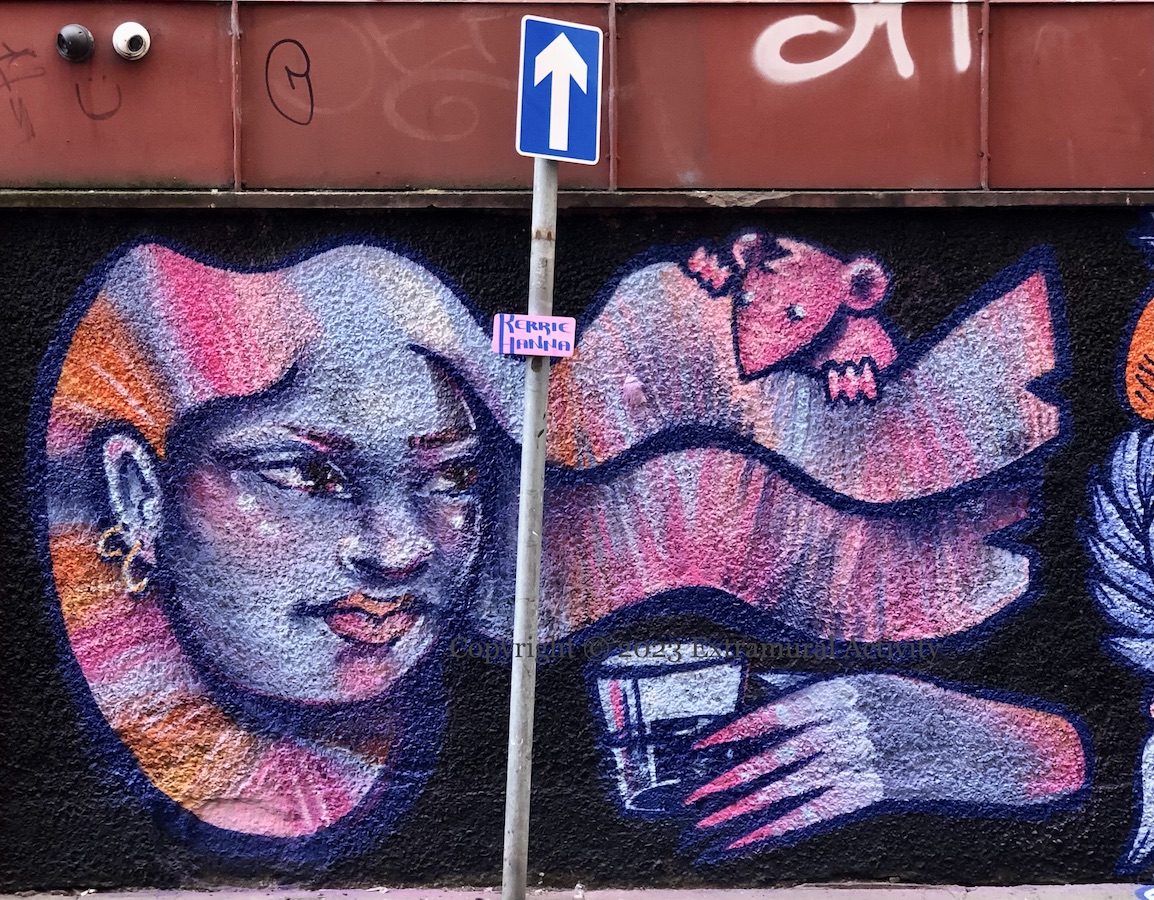
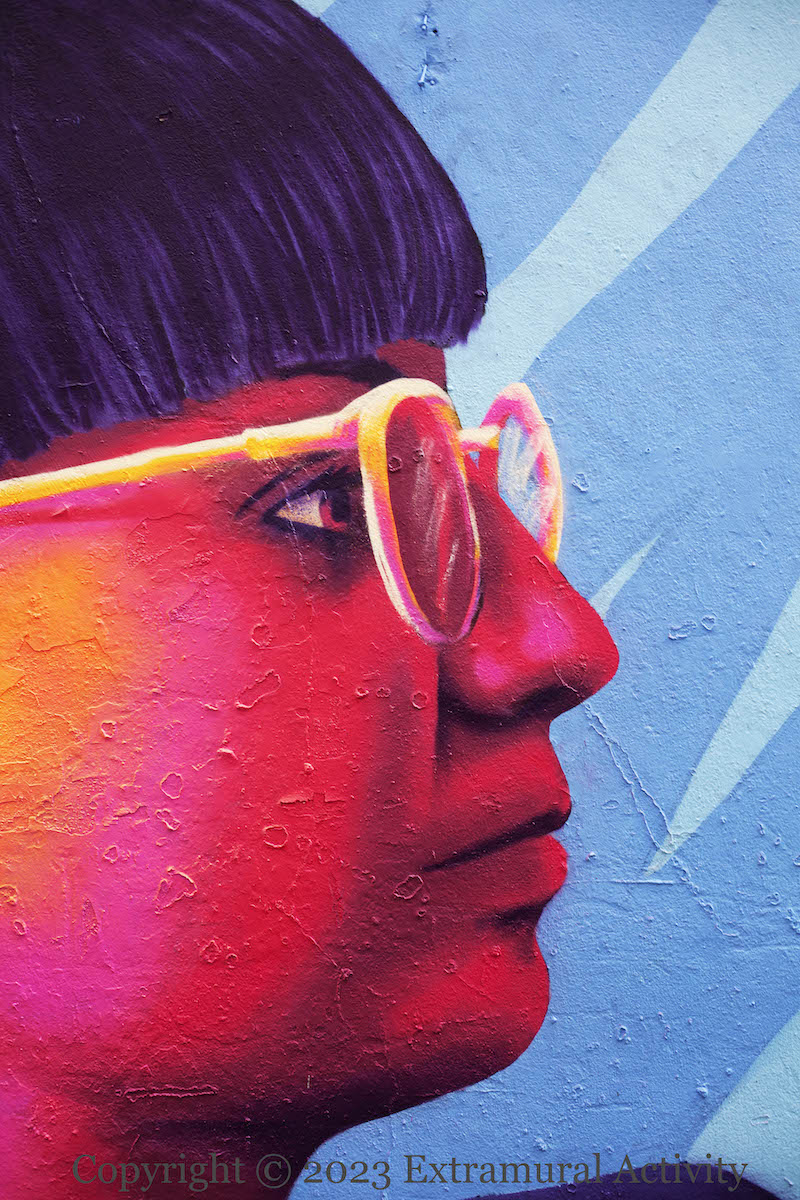
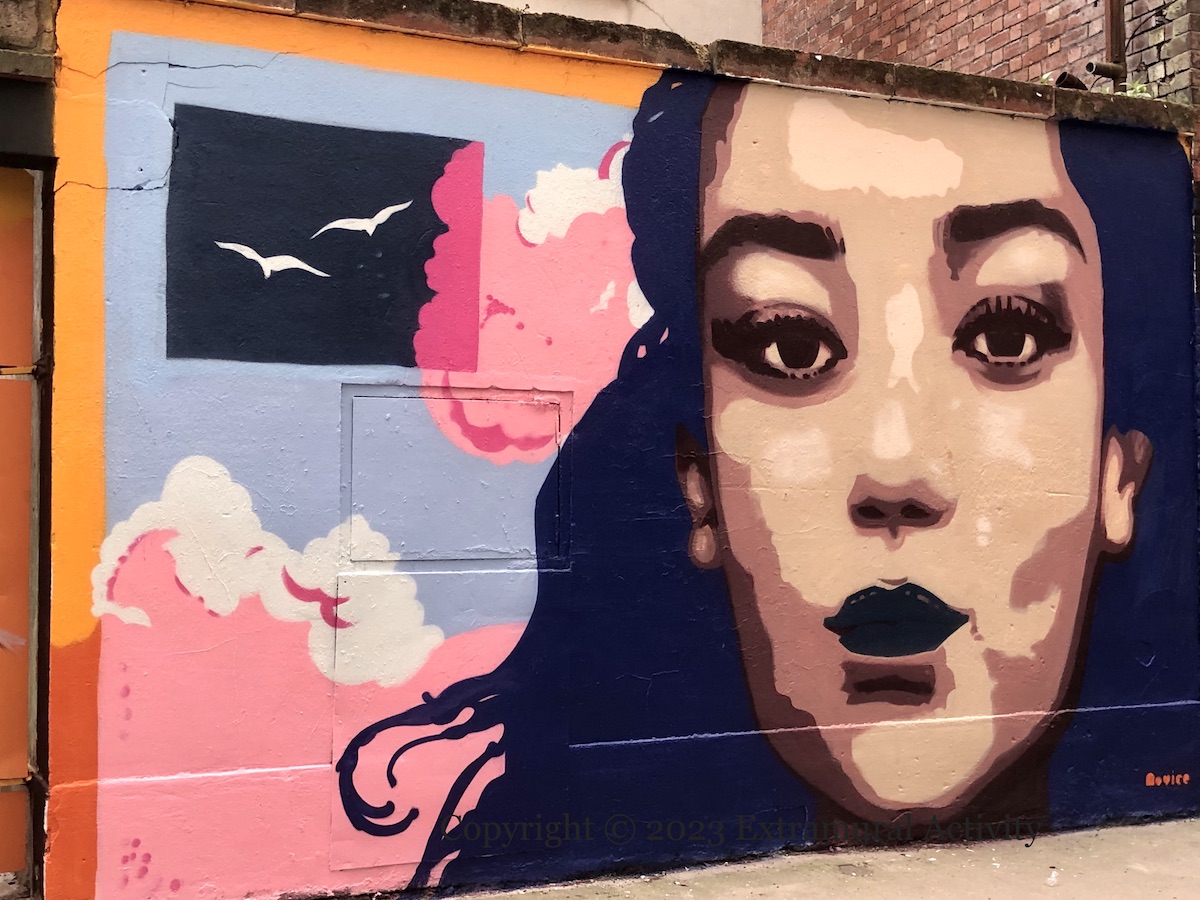
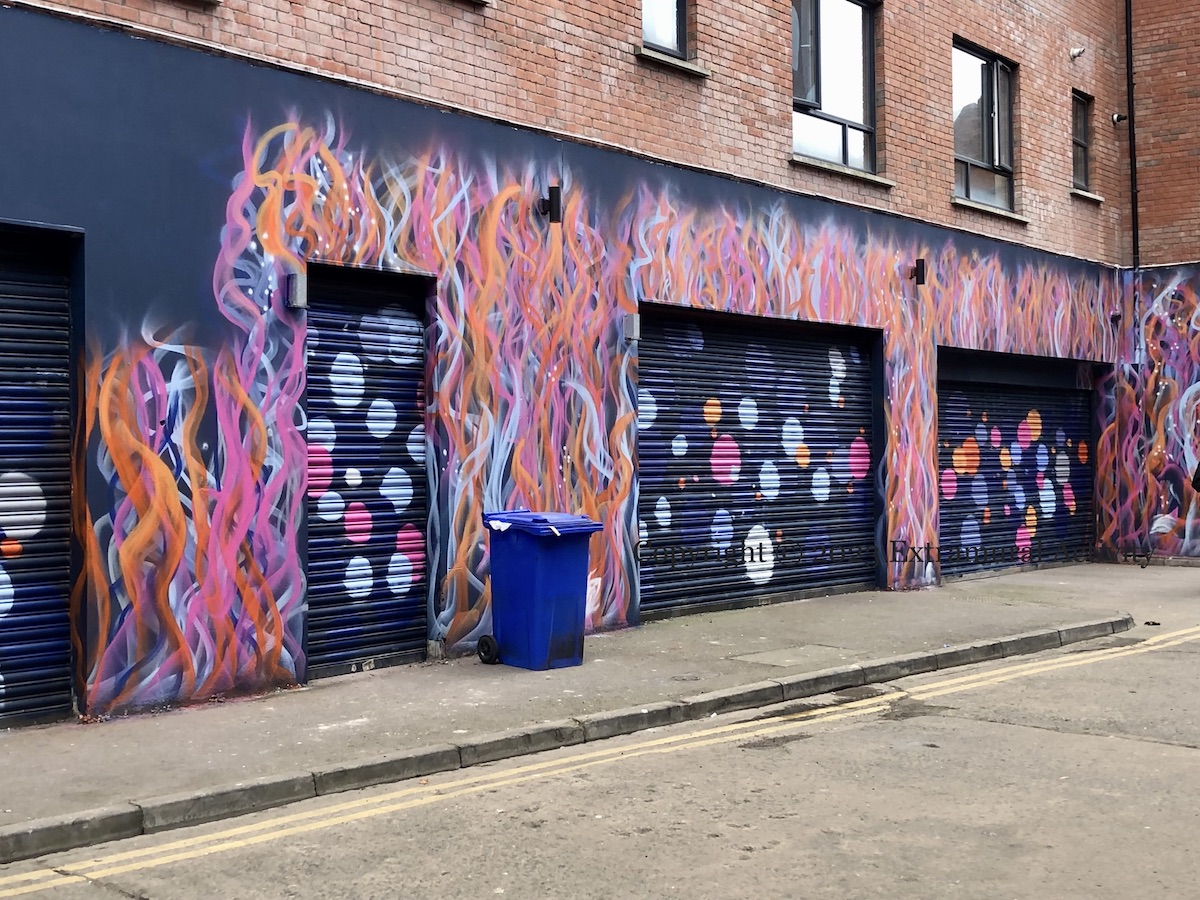
Here is a gallery of completed pieces produced for International Women’s Day 2023 in College Court. The new street art is part of a larger revitalisation project (Belfast City Council).
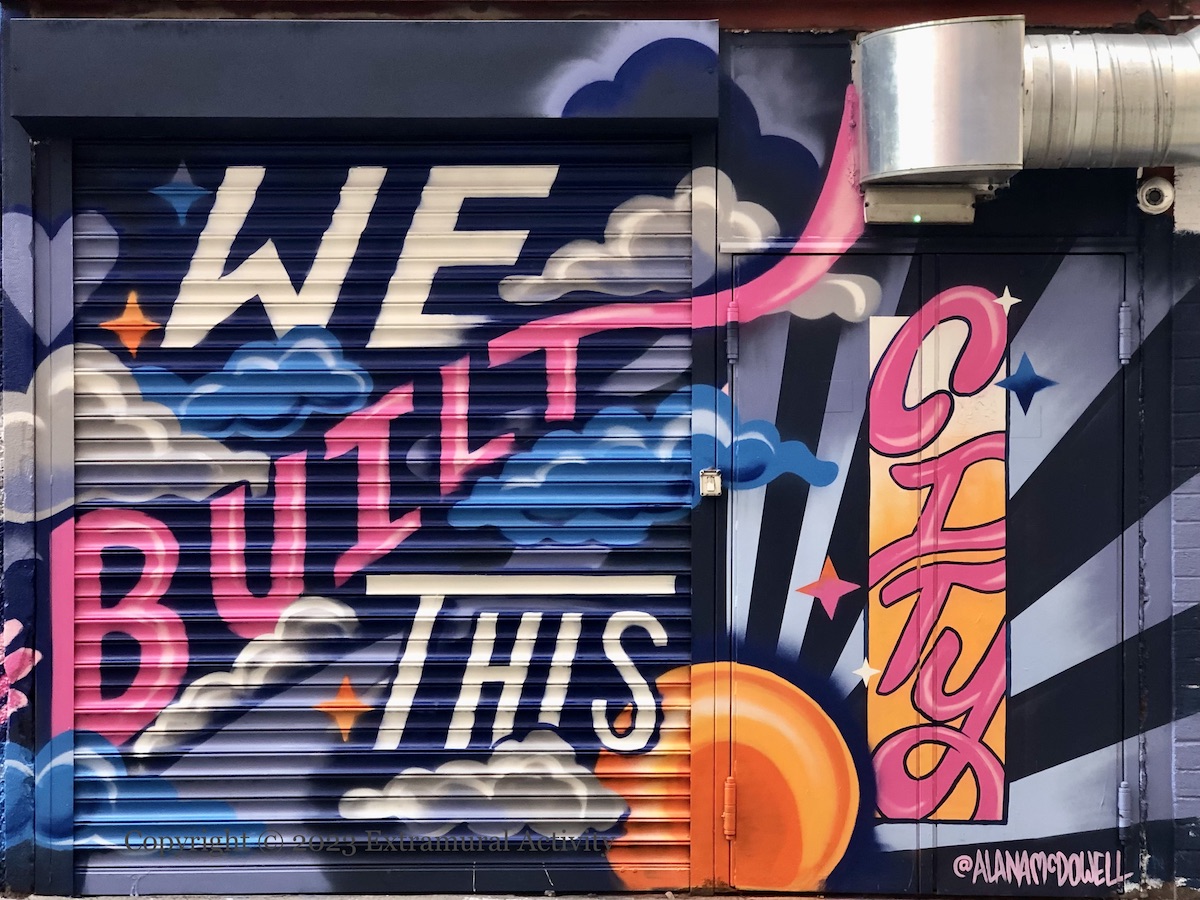
The works shown are (from Castle Street to College Street) by Claire Prouvost, Holly Pereira, Katriona, Kerri Hanna, Danni Simpson, Alana McDowell, ESTR; Laura Nelson, Novice Jess, Friz, (guest artist Hicks who was in town to repair and extend his piece in College Street Mews (see Cool) – it was damaged by a dumpster fire) and, on the other side of the street, HM Constance [Update: 2023-04 a purple cow was painted on one of the HMC shutters – see the image in the Paddy Duffy collection].
“My piece relates to the history of college court and the coming together of committee in 1807 to raise public subscriptions in co-educational, non denominational education.” (tw)
“This piece took inspiration about the history of College Court, which used to be called Water Street, as it was the first place running water pipes were installed in Belfast.” (ig)
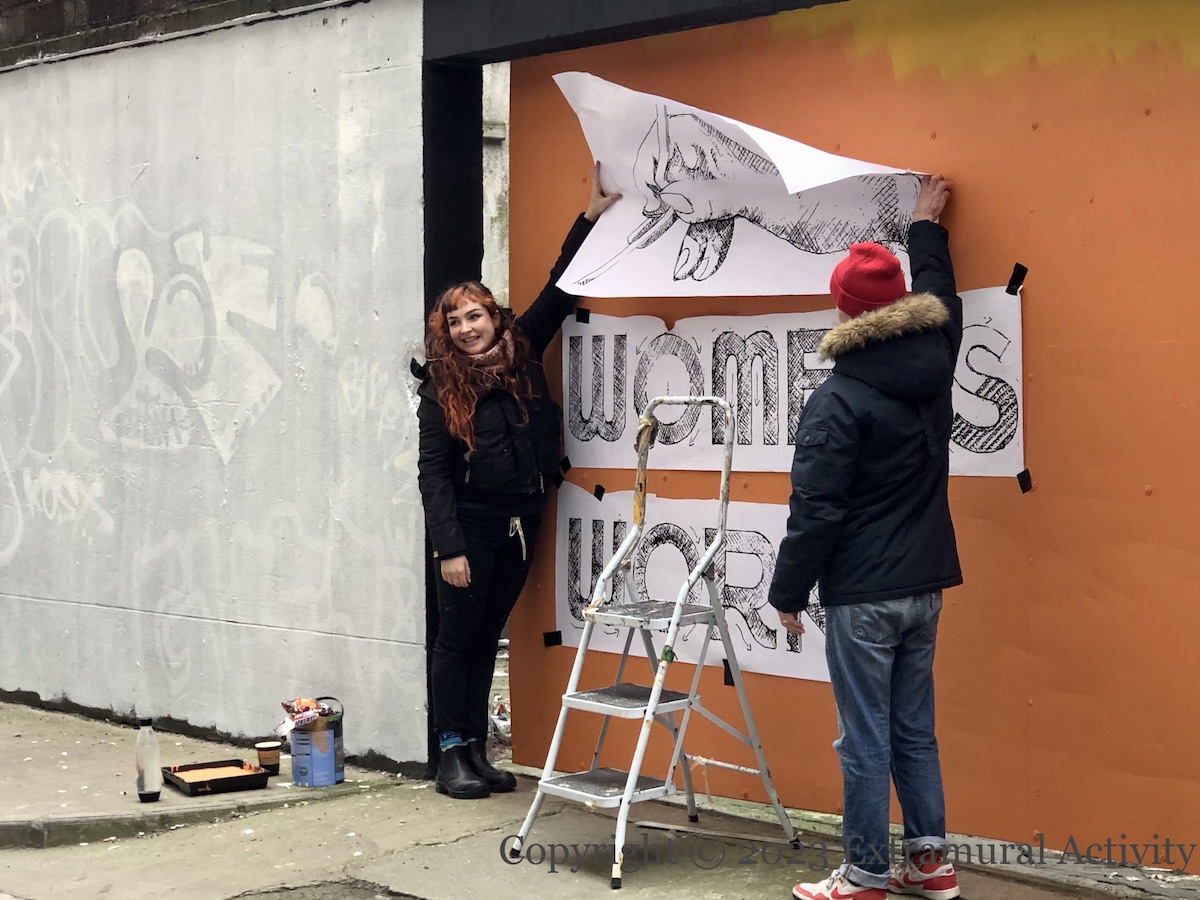
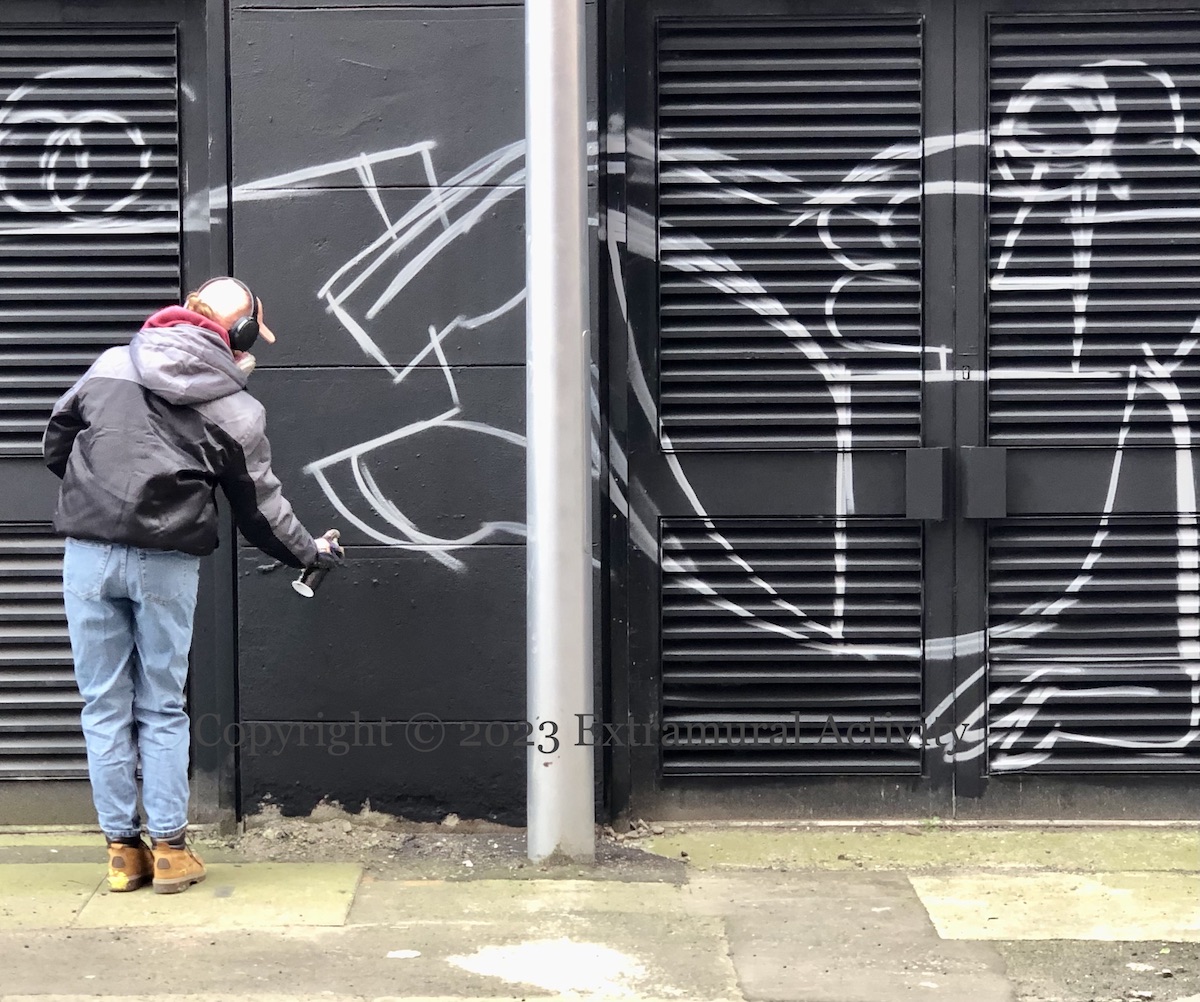
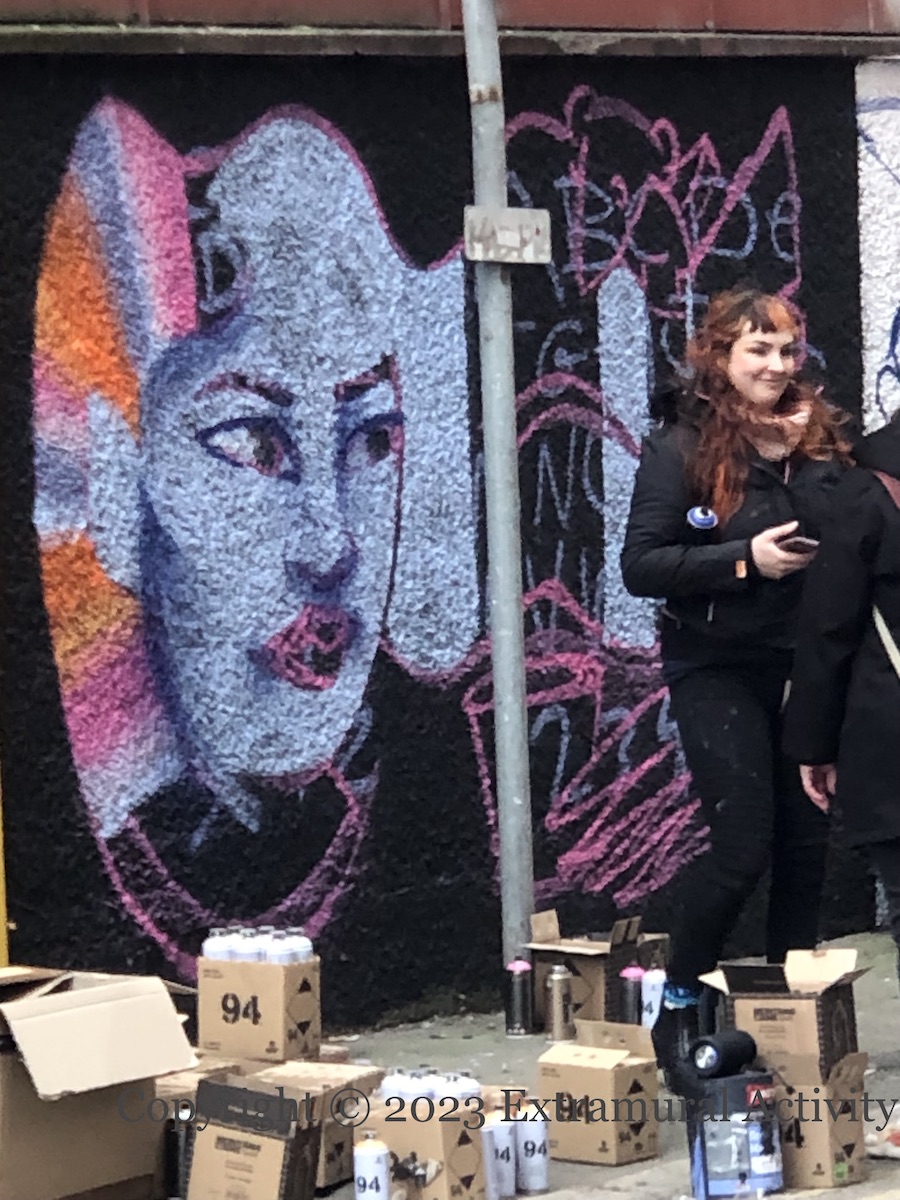
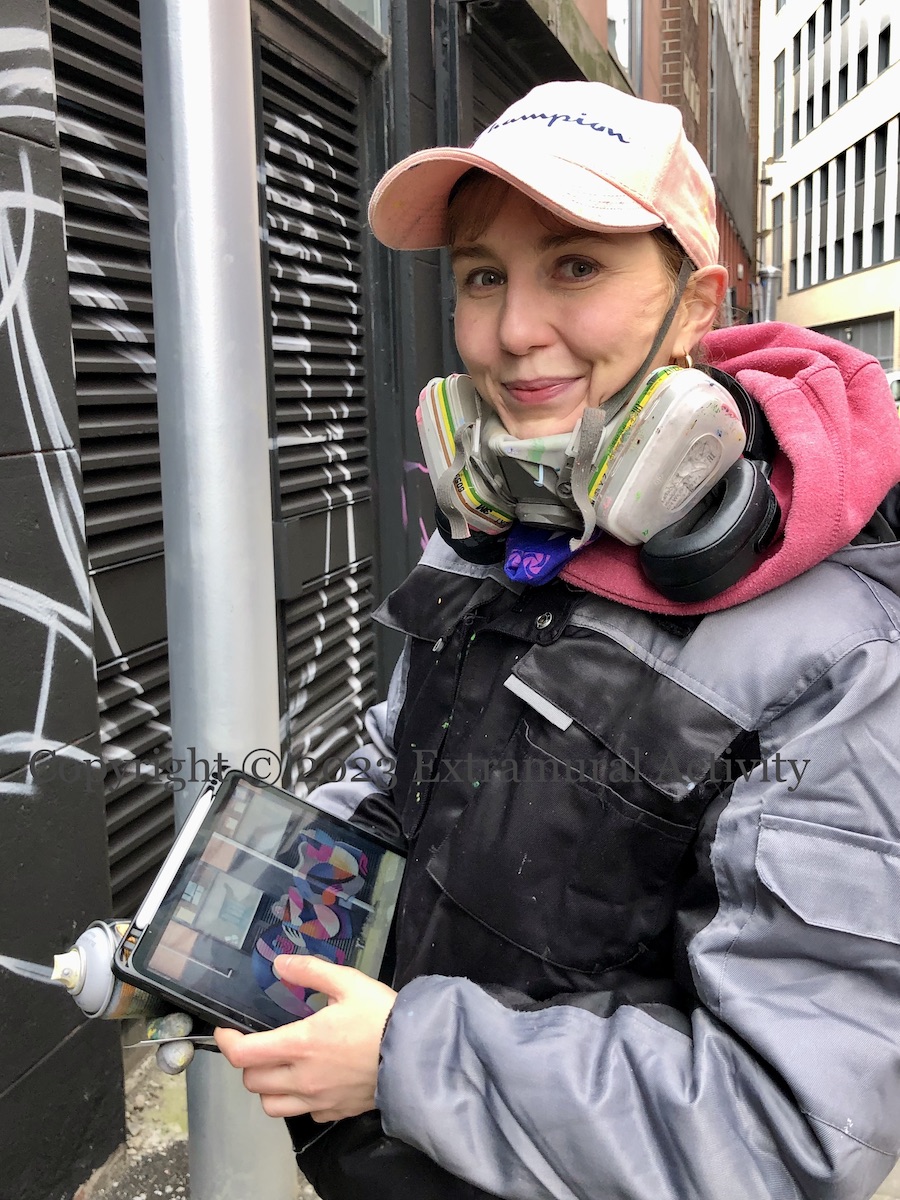
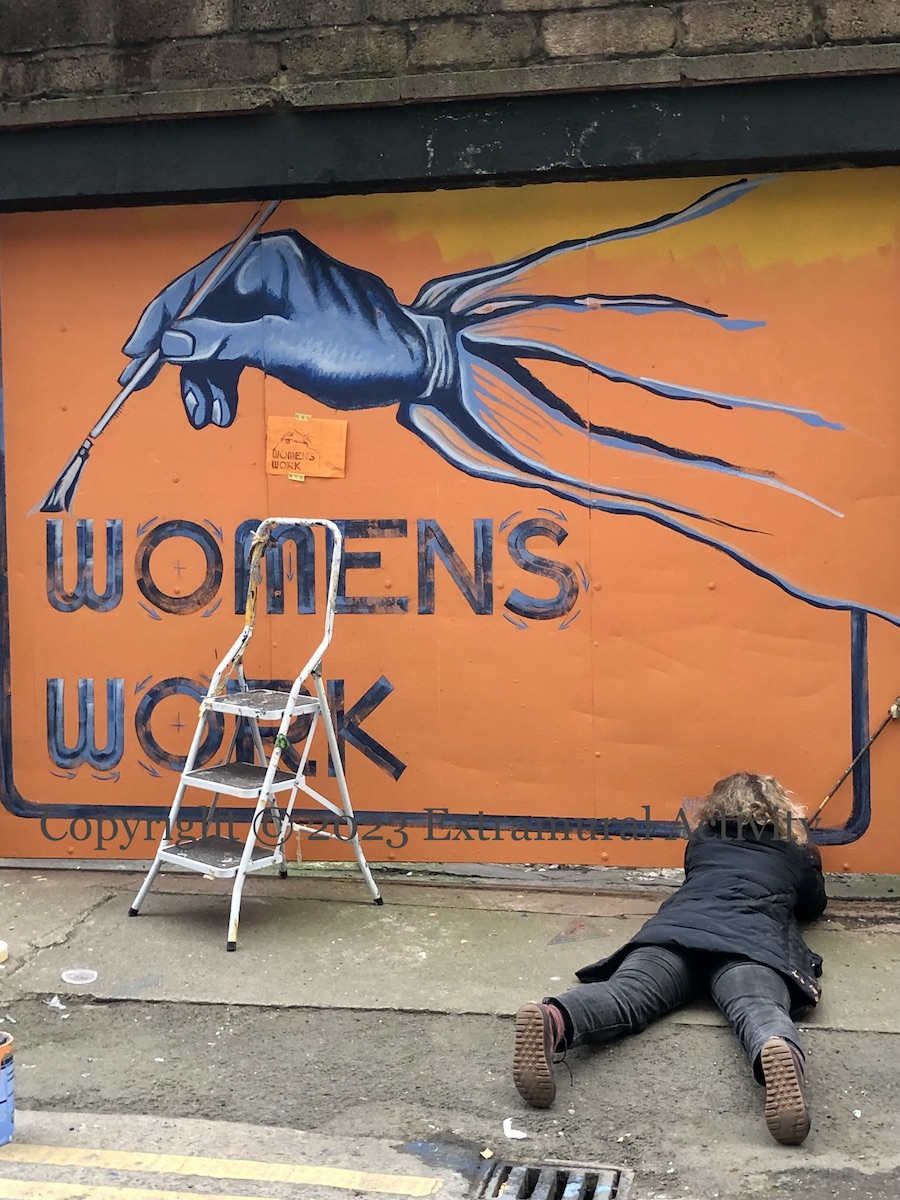
Here is a gallery of “in-progress” images of the street art being painted by female artists for International Women’s Day, all along College Court. (Most of) The completed pieces can be seen in We Built This.
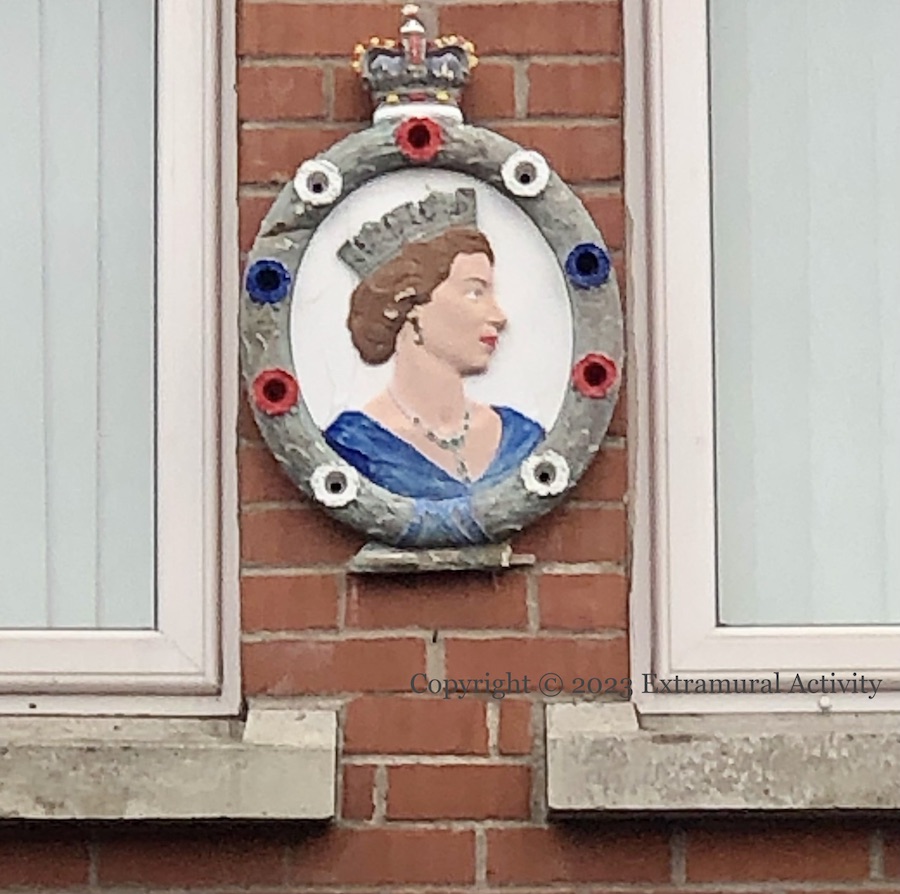
This cast of Queen Elizabeth in profile is mounted on the second storey of a house in Hopewell Crescent, Belfast, prior to her death on September 8th (see e.g. The People’s Queen Is Dead), a few months after her platinum jubilee in June (celebrated with a similar portrait in The Longest Reign).
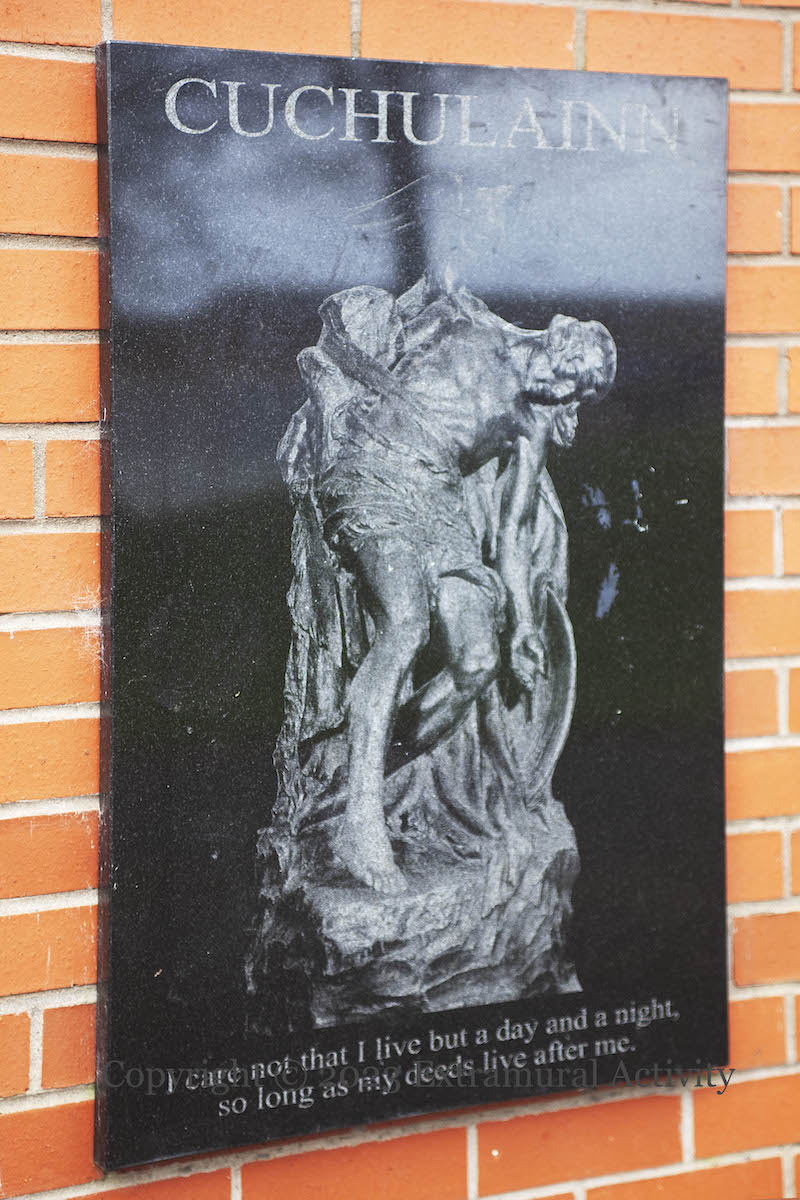
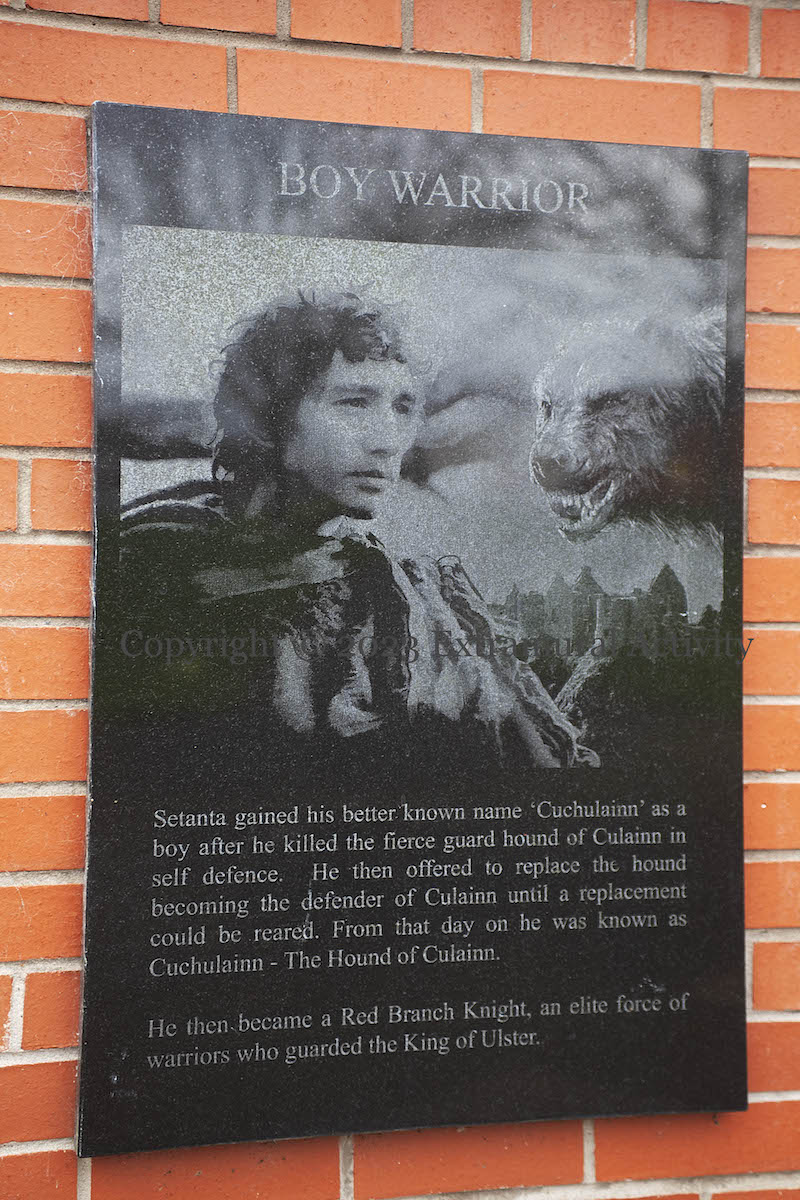
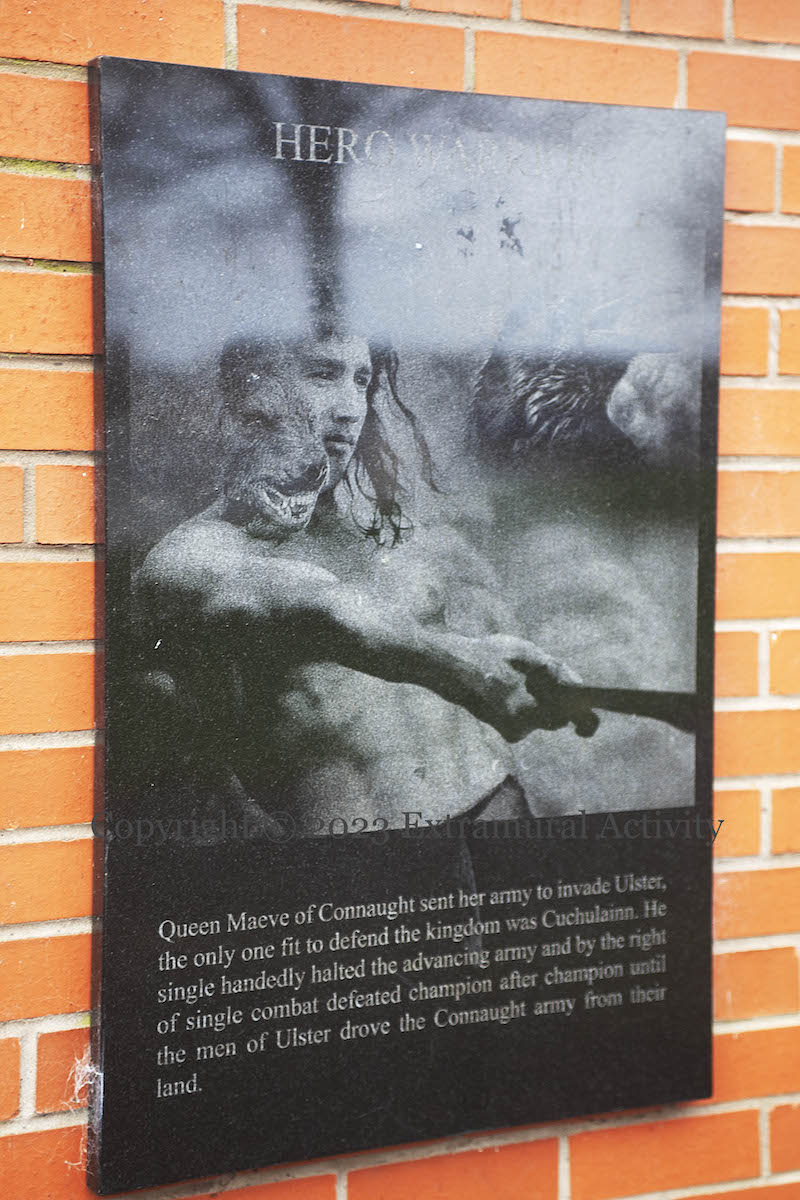
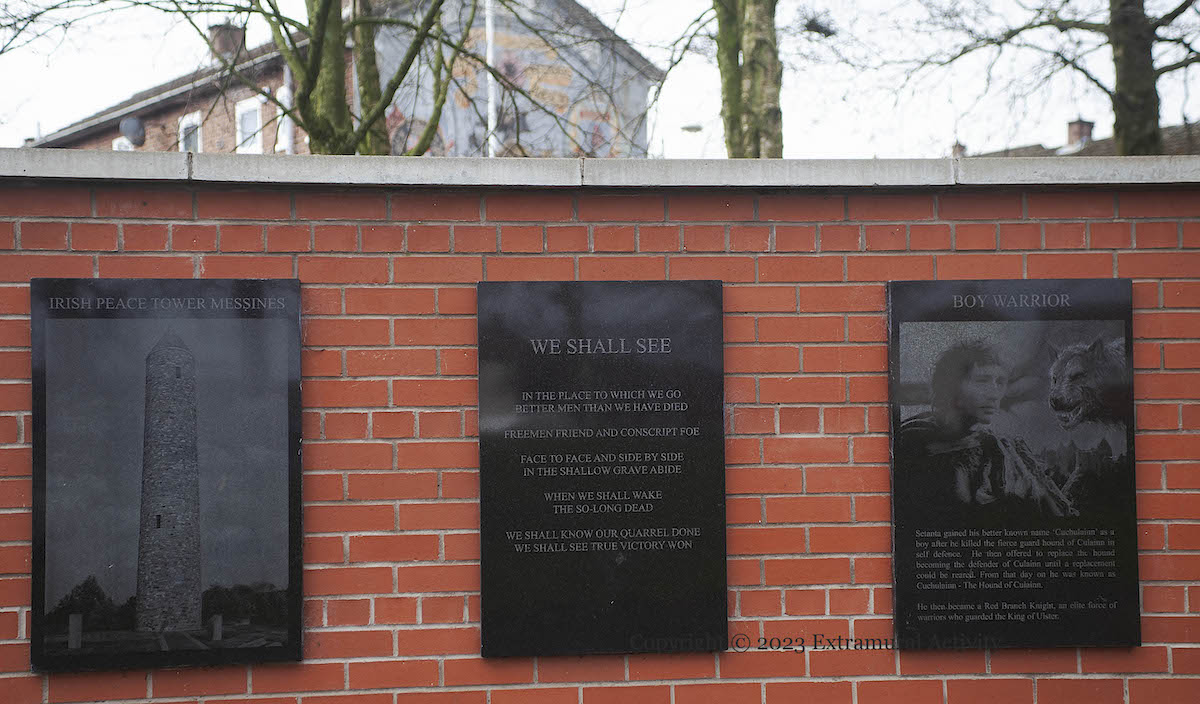
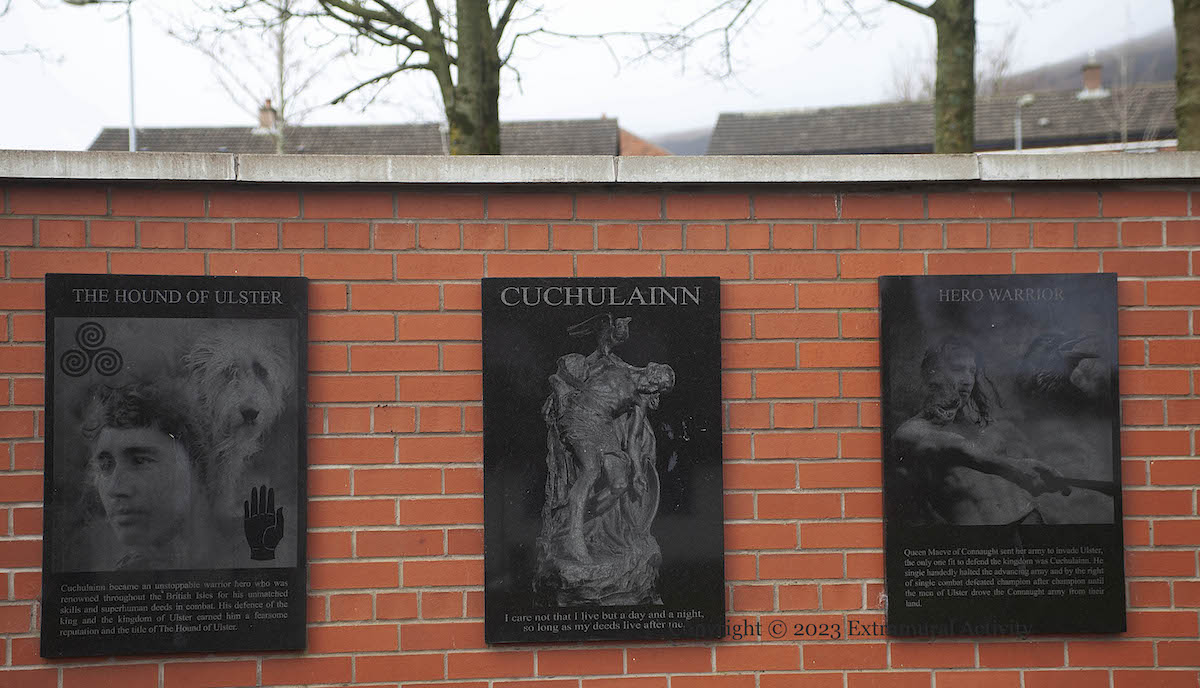
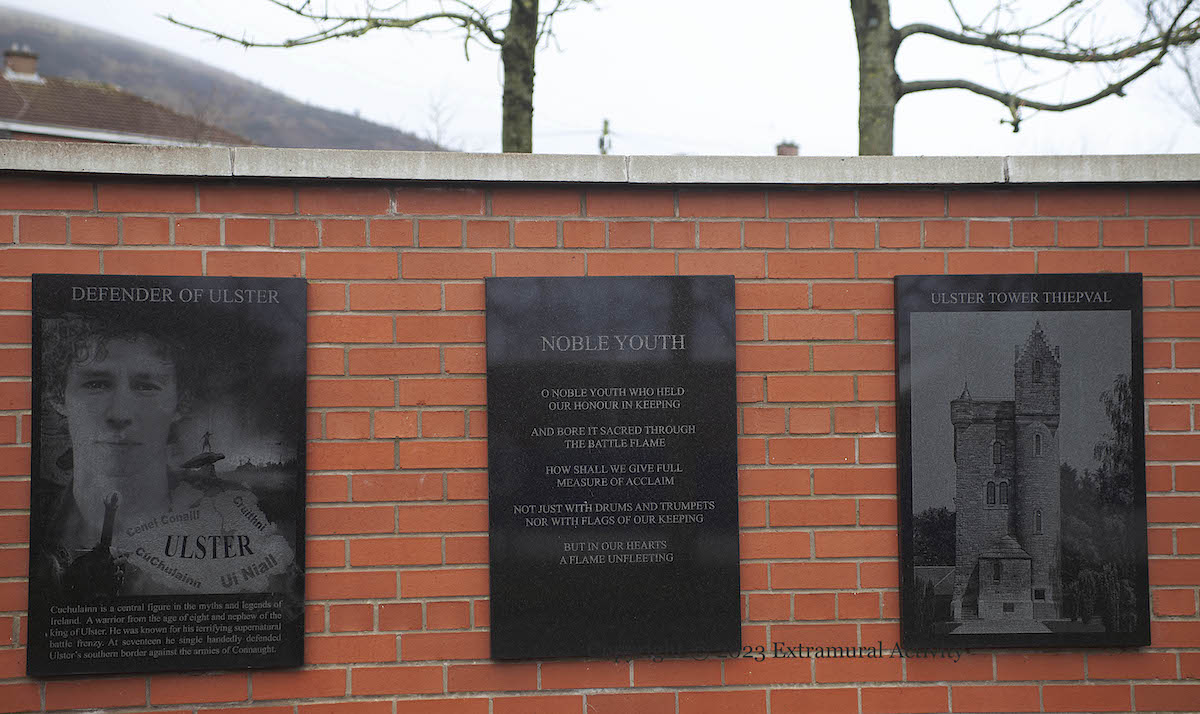
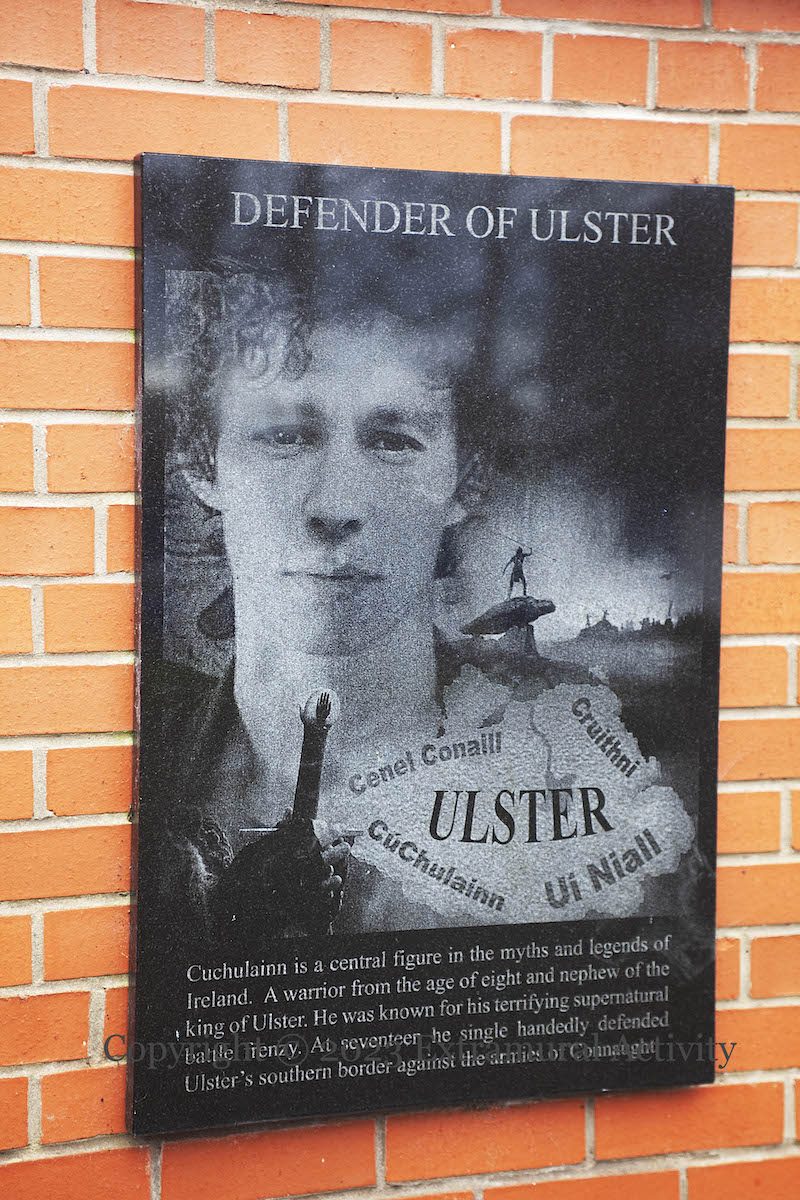
As the Visual History page on the role of Cú Chulaınn makes clear, in PUL muraling and iconography, Cú Chulainn serves as the “ancient defender of Ulster”, and the B Specials, UDR, and loyalist paramilitaries – primarily the UDA but also the UVF – then fit into that tradition. Using Cú Chulaınn as a precursor for service in the Ulster Division of WWI is unique to the panels on Highfield green, five of which are devoted to the hero Cú Chulaınn and four – two on each end – refer to the Great War.
The five Cú Chulaınn panels are (from left to right) Boy Warrior, Hound Of Ulster, Sheppard’s statue, Hero Warrior, and Defender Of Ulster – all shown individually in this post.
On the far left, there are two panels showing Messines tower and a few lines from a Ronald Lewis Carton poem Réveillé (though given a more ‘victorious’ ending) and on the far right, a few lines from Duncan Campbell Scott’s To A Canadian Lad Killed In The War and Thiepval tower. The words to I Vow To Thee My Country (lyrics) are along the bottom (see the wide shot, final image below).
The biographical panels focus on Cú Chulaınn’s age – the sixth panel emphasises that Cú Chulaınn was only 17 when he held off Maeve’s forces – which is perhaps a similarity with those who joined the 36th Division, but how the “defender of Ulster” is connected to the defense of Europe is obscure.



















 Extramural Activity