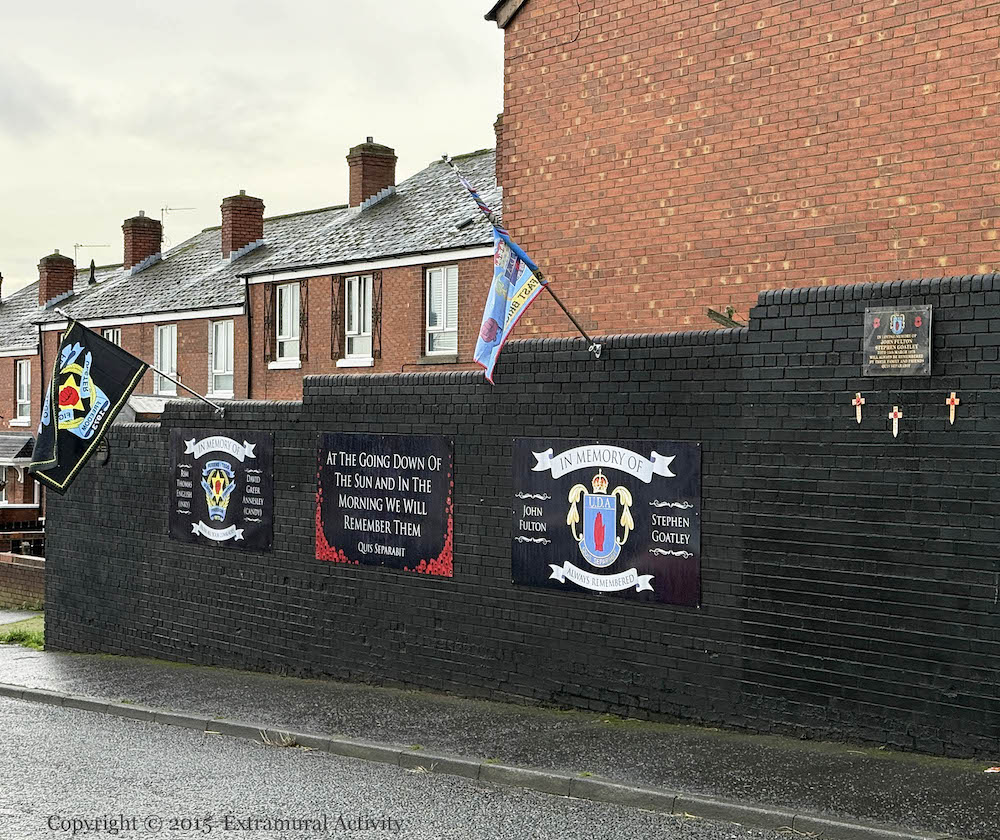
“In loving memory of John Fulton [and] Stephen Goatley, died 15th March 1975. Will always be remembered by their family and friends. Quis separabit.” UDA members John Fulton and were Stephen Goatley were killed together in the Alexandra Bar on York Road (close to the Mervue Street location of this memorial) in revenge for the stabbing of the UVF’s Joe Shaw in the North Star Bar by the UVF as part of the UDA-UVF feud in 1975.
The two men named on the other board were also killed in a feud between the UDA and UVF, in 2000 – see Inky & Candy. “In loving memory Thomas (Inky) English & David (Candy) Greer Annesley. Together in the same old way/would be our dearest wish today./Silent memories true and tender/just to show we still remember.”
Mervue Street, Tiger’s Bay, north Belfast. The small plaque was previously seen in 2017.
Here are three pieces together at the top of the Limestone Road in north Belfast, each one looking ahead to a notable transition:
Above left: Cliftonville Integrated primary (web) has nursery and P1 students space for September 2026
Above right: the play ‘Maggie’s Menopause’ (web) plays in the Opera House in February 2026
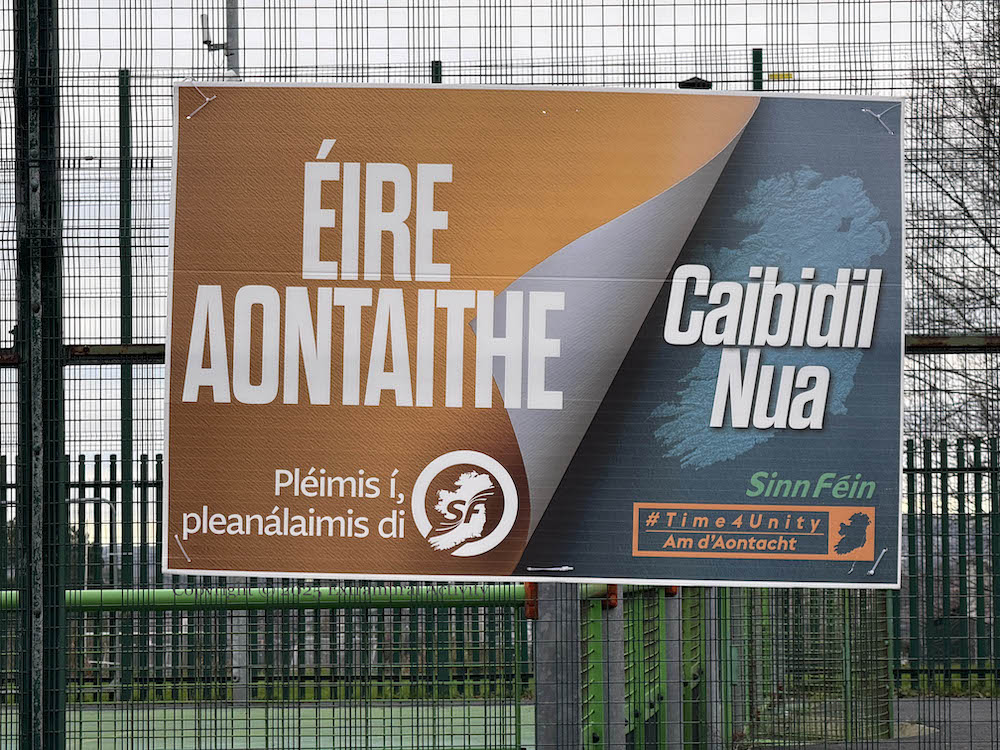
On the railings in the foreground: Sınn Féın (web) placards suggesting “a united Ireland”/”Éıre aontaıthe” as “a new chapter”/”caıbıdıl nua” for Ireland – date undetermined.
The close-up of the placard is from the Whiterock Road.
“Welcome to the homeland of Tiger’s Bay Loyal flute band. “He is our God, and we are the people.”” Tiger’s Bay Loyal [Fb] is a new flute band, formed in 2025.
Ten local streets are named around the central tiger: Robina Street, Edlingham Street, Mervue Street, Upper Mervue Street, Hallidays Road, Mackey Street, Cosgrave Heights, North Queen Street, Canning Street, Hogarth Street.
“The typist with the Webley: Winifred Carney – socialist, republican, freedom fighter, Irish Citizen Army, Cumann Na mBan, suffragist, trade unionist, revolutionary.”
Winifred Carney was a qualified secretary and typist, and became secretary of the Irish Textile Workers’ Union in 1912, in which position she met James Connolly, who was secretary of the Belfast branch of the ITGWU. She was a member of Cumann Na mBan and participated in the Easter Rising of 1916. Carney was in the GPO when it was taken over and was among those who surrendered at the end; during the occupation she typed up dispatches from the Moore Street headquarters – this is how she was portrayed in the the 1916 Centenary mural.
“She hasn’t a sword and she hasn’t a gun. But she’s doing her duty now fighting’s begun.” This entry updates the 2016 entry with details from the board – now almost a decade old – dedicated “To all the women of the Shankill” and highlighting the roles played by women during WWI as nurses and welders and in the Land Army.
The troops in the upper-middle part of the board are shown gathered outside the West Belfast Orange Hall, on the Shankill at Brookmount Street.
outside the Ulster Rangers Supporters Club (Fb) on the Shankill Road
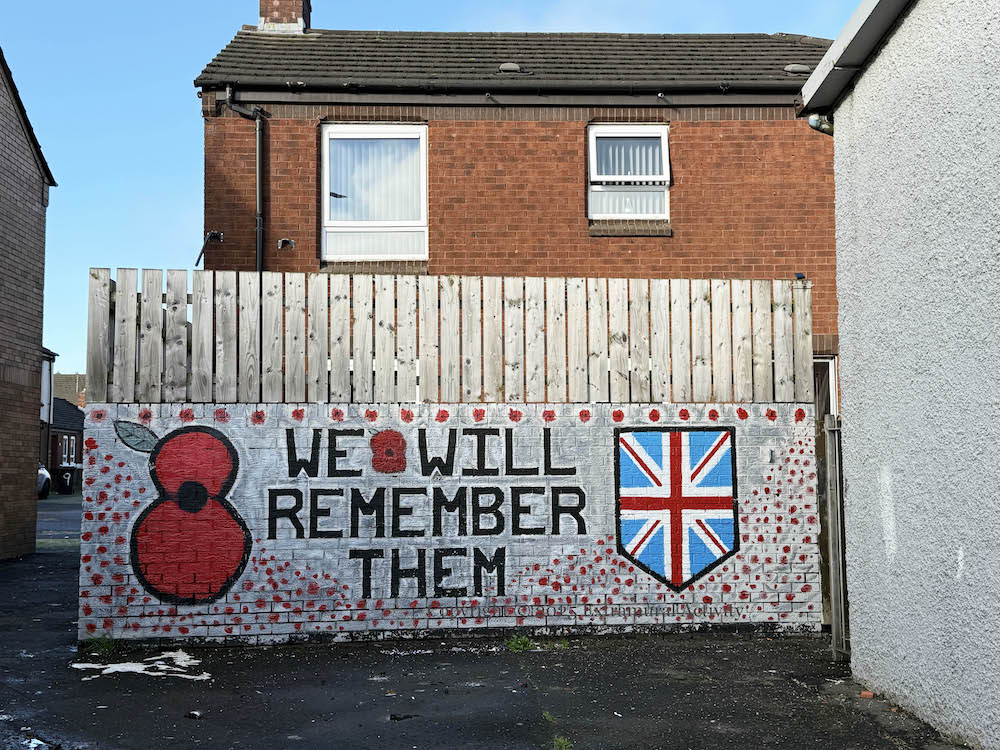
For Remembrance Sunday, rows of hand-painted wooden medallions were attached to the railings at West Kirk Presbyterian to pay homage to the dead of the British armed forces.
This pair of hand-painted (and stencilled) boards is next to the Mount Inn on North Queen Street. Tiger’s Bay is loyal to the memory of “1690” and the service of the 36th Division in WWI in 1916.
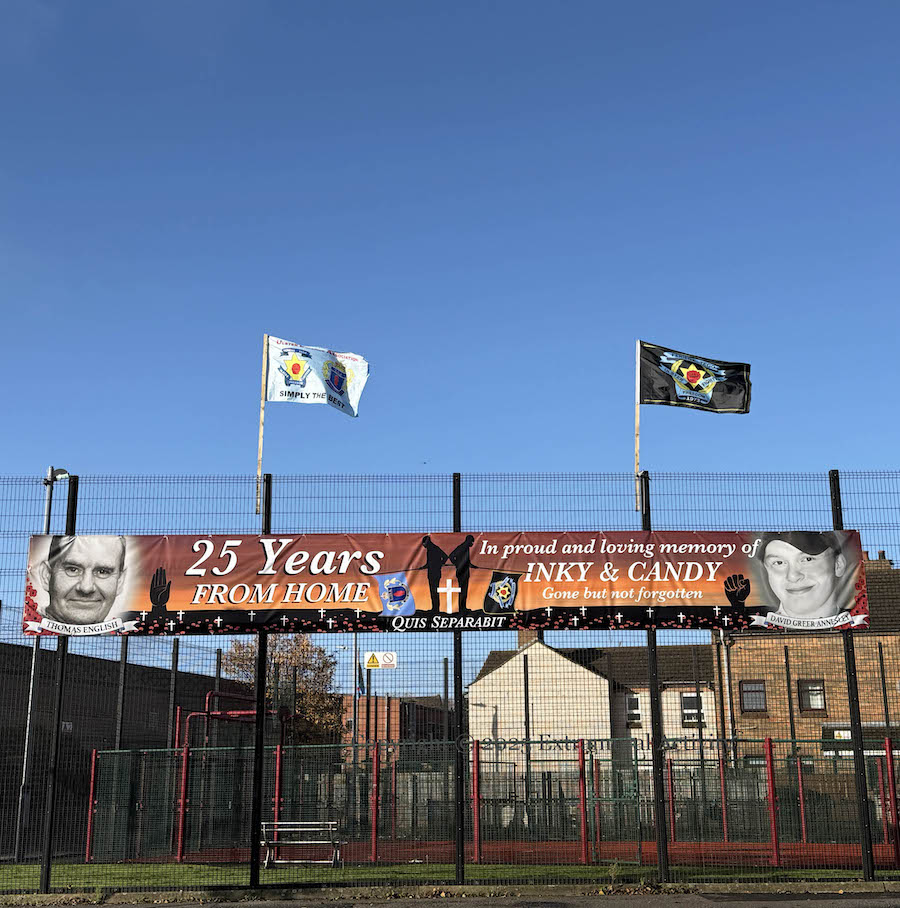
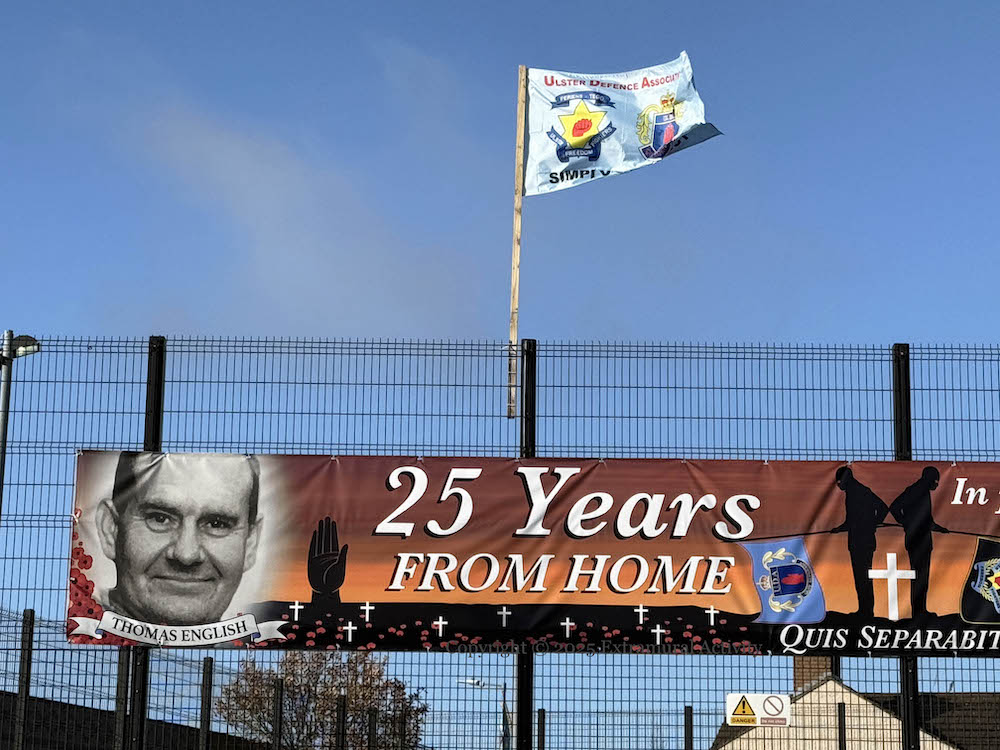
“25 years from home. In proud and loving memory of Inky & Candy. Gone but not forgotten.”
October 2000 was a violent month in Tiger’s Bay, north Belfast, as the UDA and UVF feuded. David “Candy” Annesley (commonly known as David Greer – BelTel) was shot in Mountcollyer Street on October 28th by the UVF. On the 31st, Bertie Rice, veteran UVF member and canvasser for the PUP, was killed by the UDA at his Canning Street house. Later the same day, Tommy “Inky” English – UDA commander in north Belfast who had previously lived in Tiger’s Bay – was shot death by the UVF at his Ballyduff home. Mark Quail of the UVF was shot in Rathcoole on November 1st. (BBC | BBC | WP) There were fears that the feud would end (An Phoblacht) but it was formally ended on December 15th, with a joint statement by both groups (RTÉ).
This twenty-fifth anniversary tarp is on the multi-use pitch on North Queen Street at Upper Canning Street.








 Extramural Activity