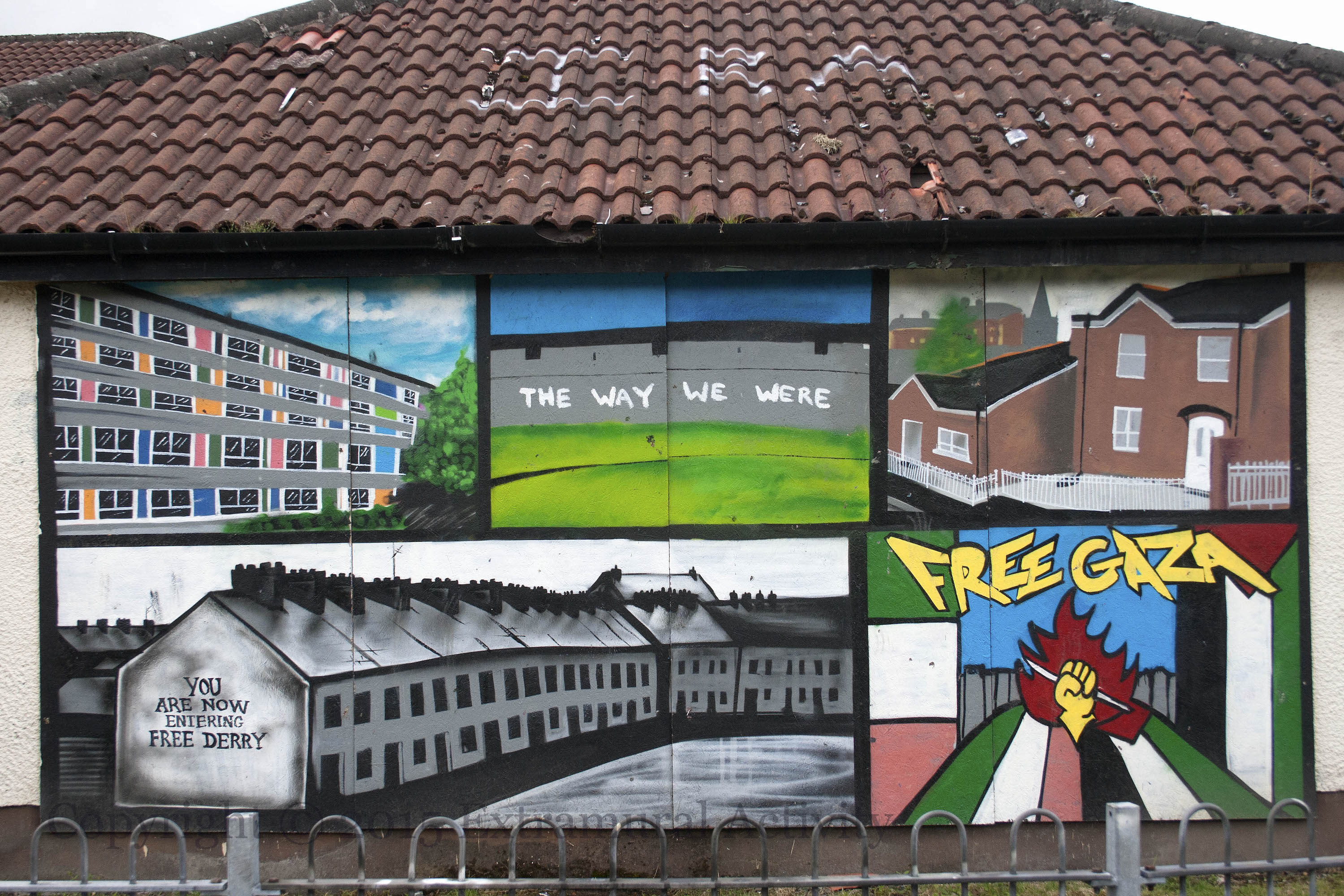
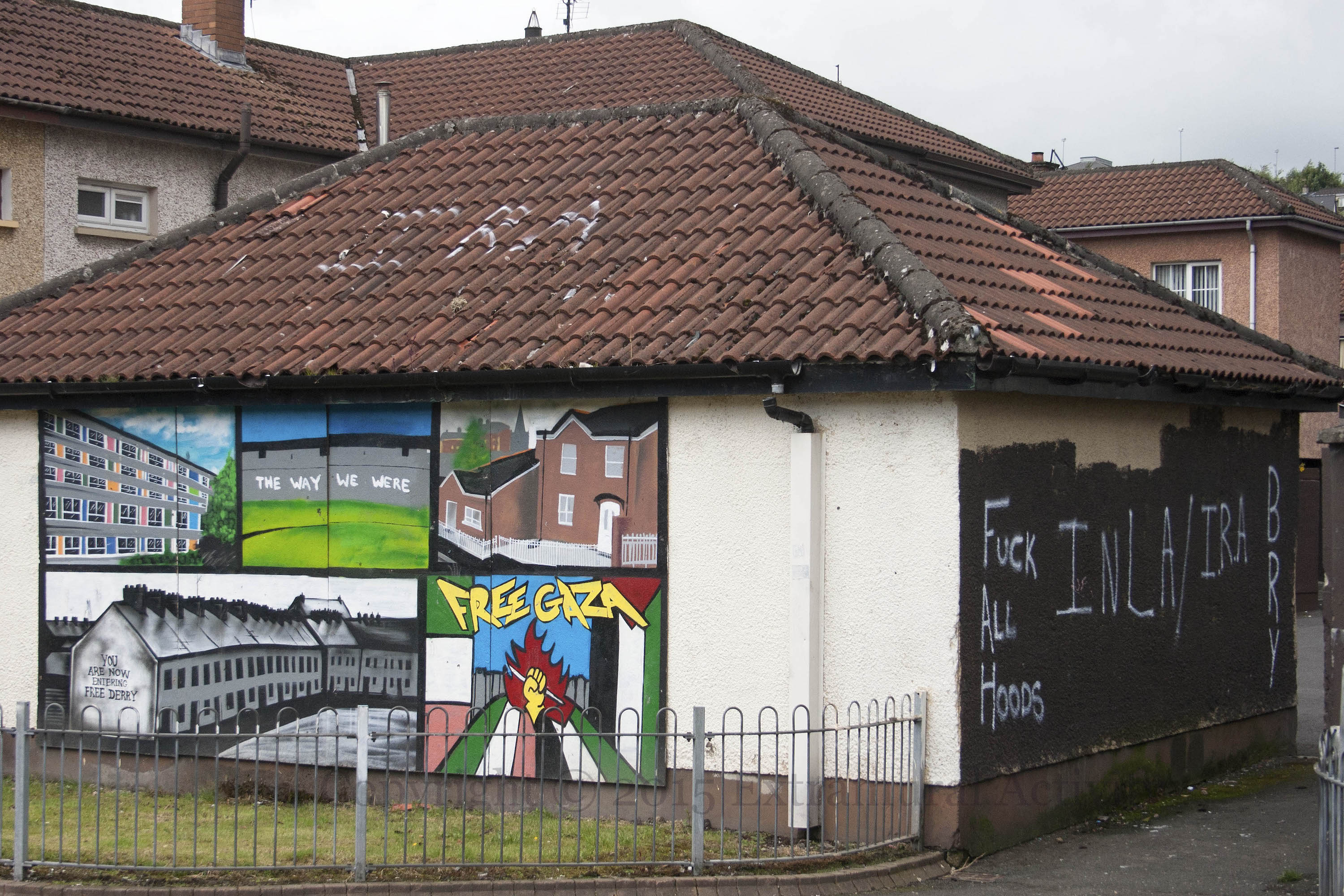
“The way we were” written on the bog side of the walls of Derry provide a name for this mural behind Derry’s Bogside Inn. The old Rossville flats are in the top left hand corner. (Both Rossville flats and graffiti on the walls – “God made the Catholics, the armalite made us equal” – can be seen in this 1982 image (M00039) from Peter Moloney’s collection.)
On Saturday mornings Brandywell Celtic play in the premier division of the Northwest league, while on Sunday mornings Brandywell Harps and Ballymoor FC play in the Senior league. Brandywell Swifts played in the Astroleague. Also included are the Oakleaf Amateur Boxing Club (Fb) and the Long Tower Judo Club.
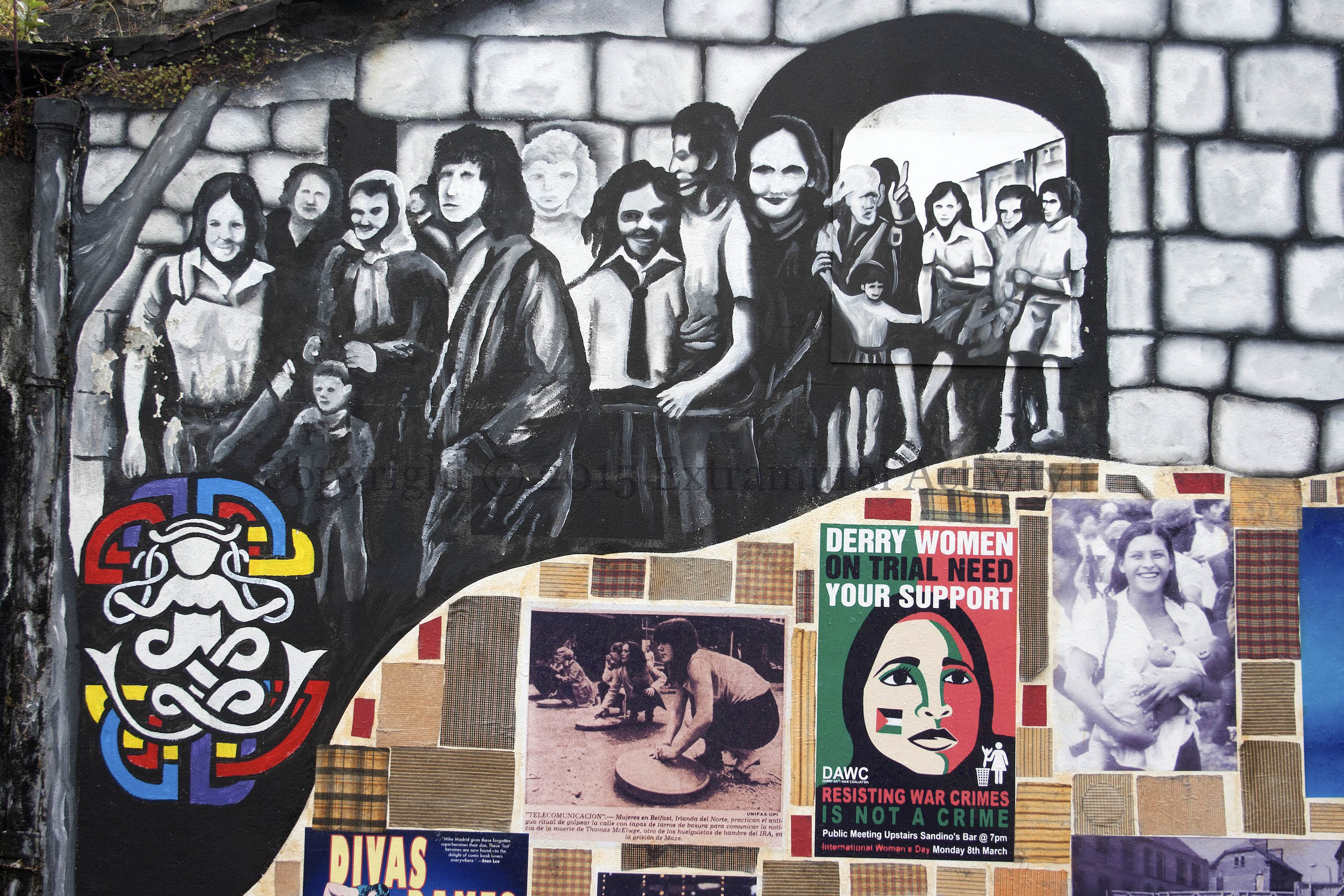
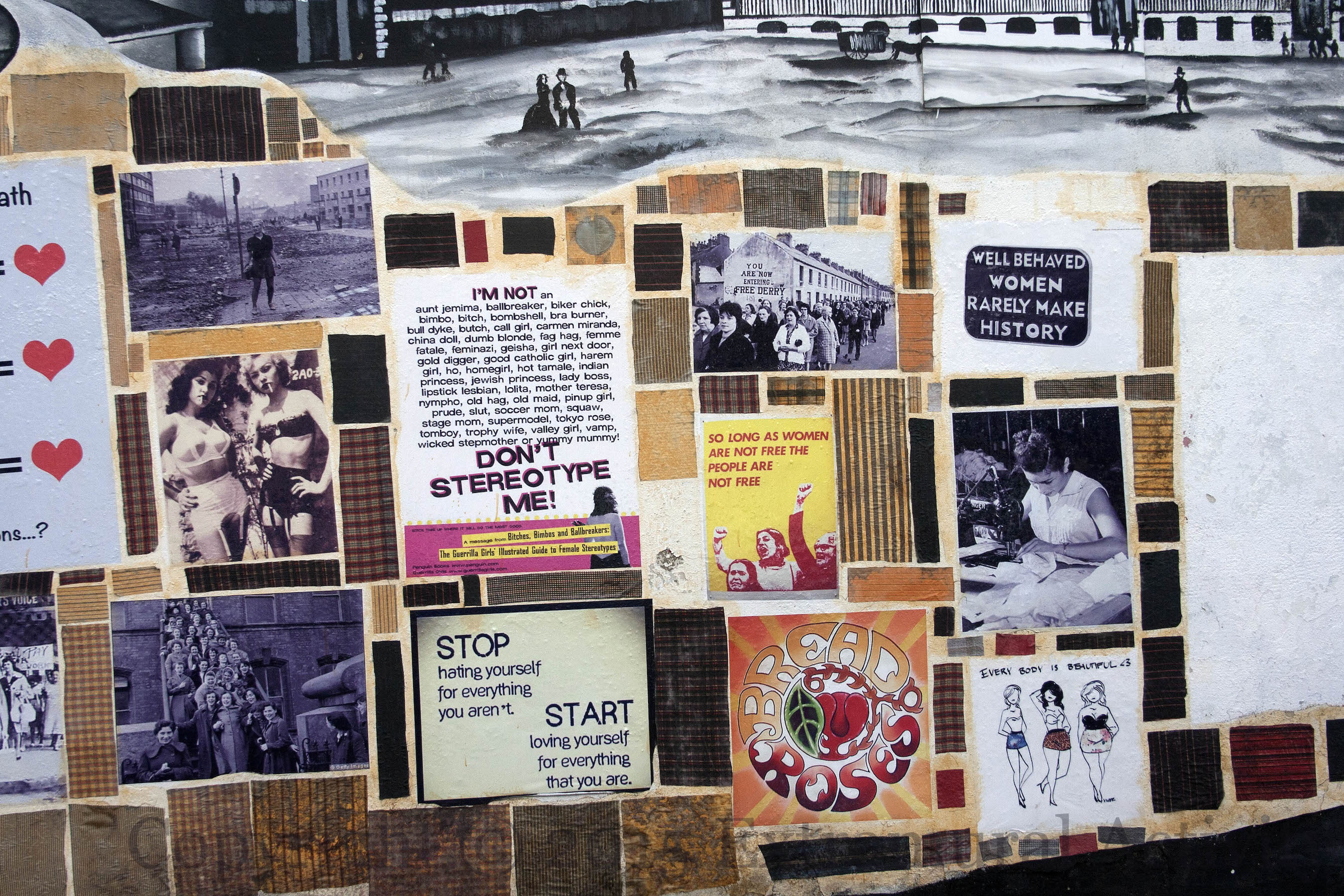
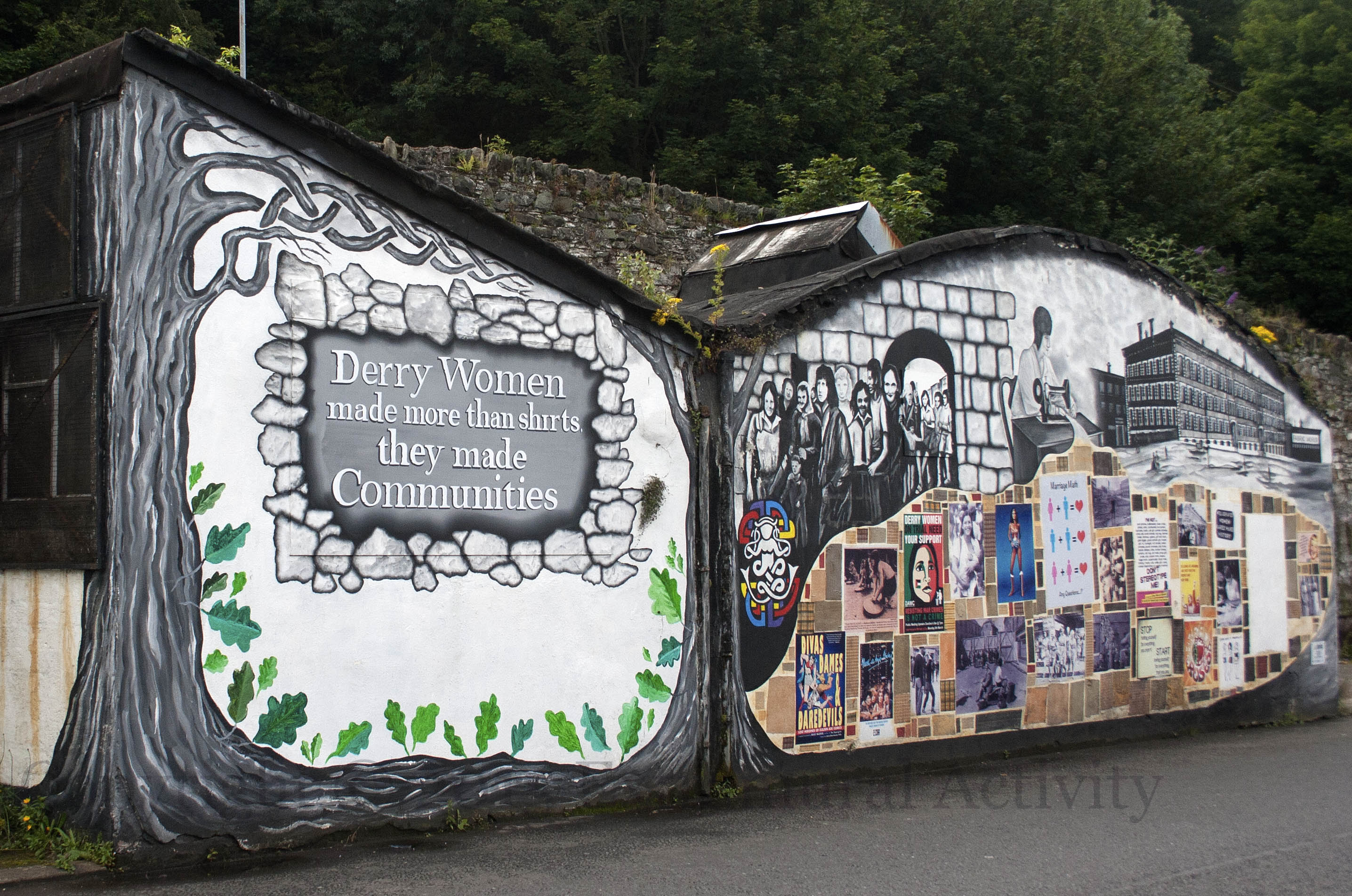
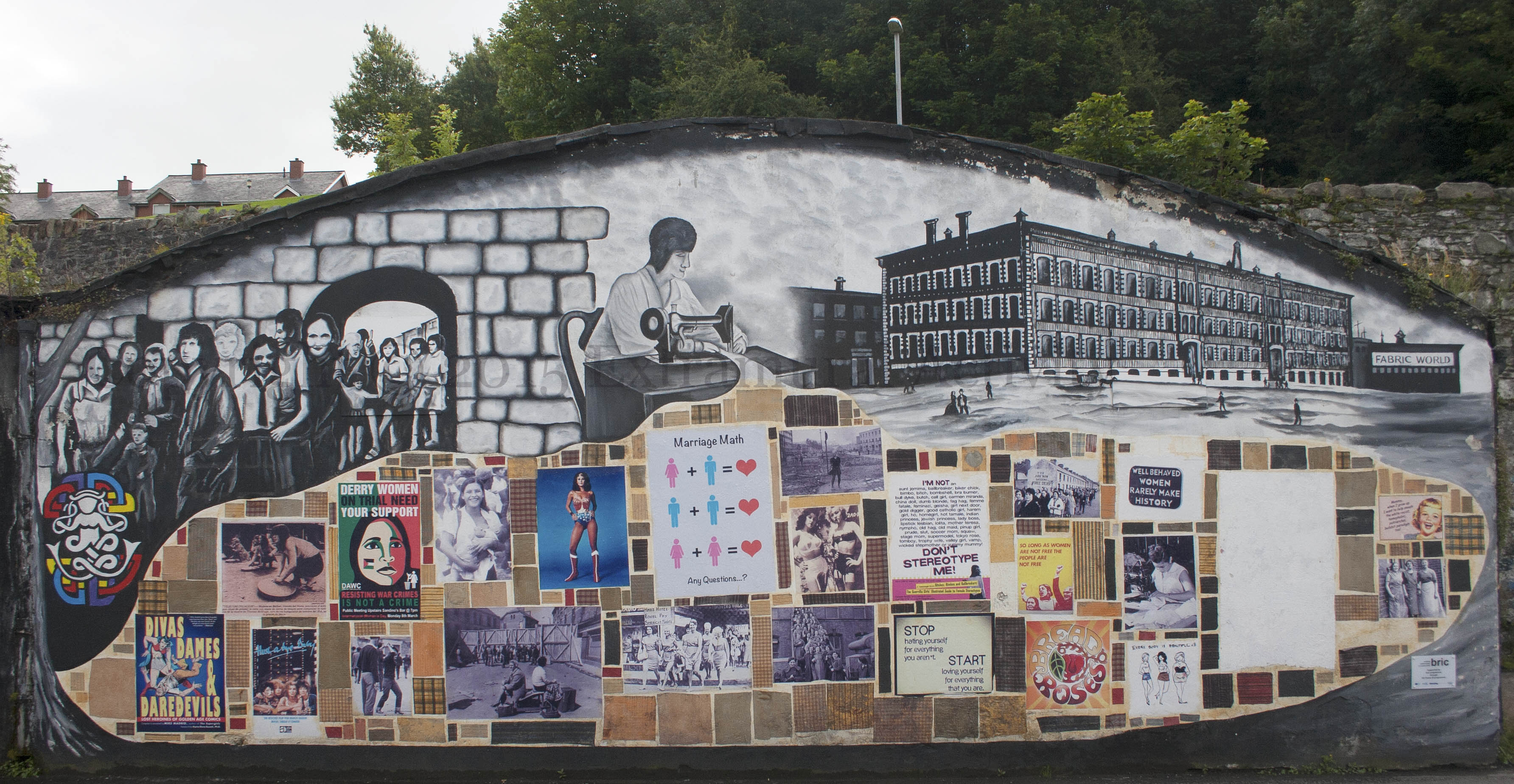
Historian Laurel Ulrich‘s 1976 phrase is one of a variety featured in this Derry mural celebrating the role of women both locally and world-wide. It includes images of local women banging bin lids, marching past the ‘Free Derry’ graffiti on 33 Lecky Road, and rioting; images of women striking and protesting; support for Palestine and gay rights; celebrations of femininity; and Wonder Woman. As the final image, below, shows, the tapestry of images and posters is being sewn by a woman at a sewing-machine in one of Derry’s large shirt- and collar-making factories. (For some history see these Derry Journal articles: one | two.) As the panel on the left-hand side notes, “Derry women made more than shirts; they made communities”.
On the left of the main panel, women march out of one of the city’s gates. The information sheet (which has fallen off) reads as follows: “On International Women’s Day, March 8th [1991, not 1981 as the hand-written addition suggests], the first ever women’s mural in Derry was unveiled on the back of Free Derry Wall. It was designed and painted by Patricia Hegarty and Joe Coyle, and helpers, both men and women. The mural takes its inspiration from a march in November 1968, after Minister for Home Affairs Bill Craig banned all civil rights marches in the walled city. Women factory workers walked out and spent the afternoon marching in and out of every gate in the city, deliberately “breaking the ban”. Men marched in from DuPont to join them, and a rally was held in the Diamond. In the mural you can find the faces of some of those marching on that historic day, as well as other women who played their part in the ongoing struggle for justice. Civil rights workers Bridget Bond and Women’s Aid refuge founder Cathy Harkin march alongside republicans such as Ethel Lynch, Bridget Sheils, Peggy Derry, prisoners’ rights activists Susie Coyle, and many others. You may find images of your granny, sister or aunt. The mural is dedicated to all those women whose energy and determination have changed their lives and the world about them.”
The board on FDC can be seen in Woods’s Seeing Is Believing?, plate 19.
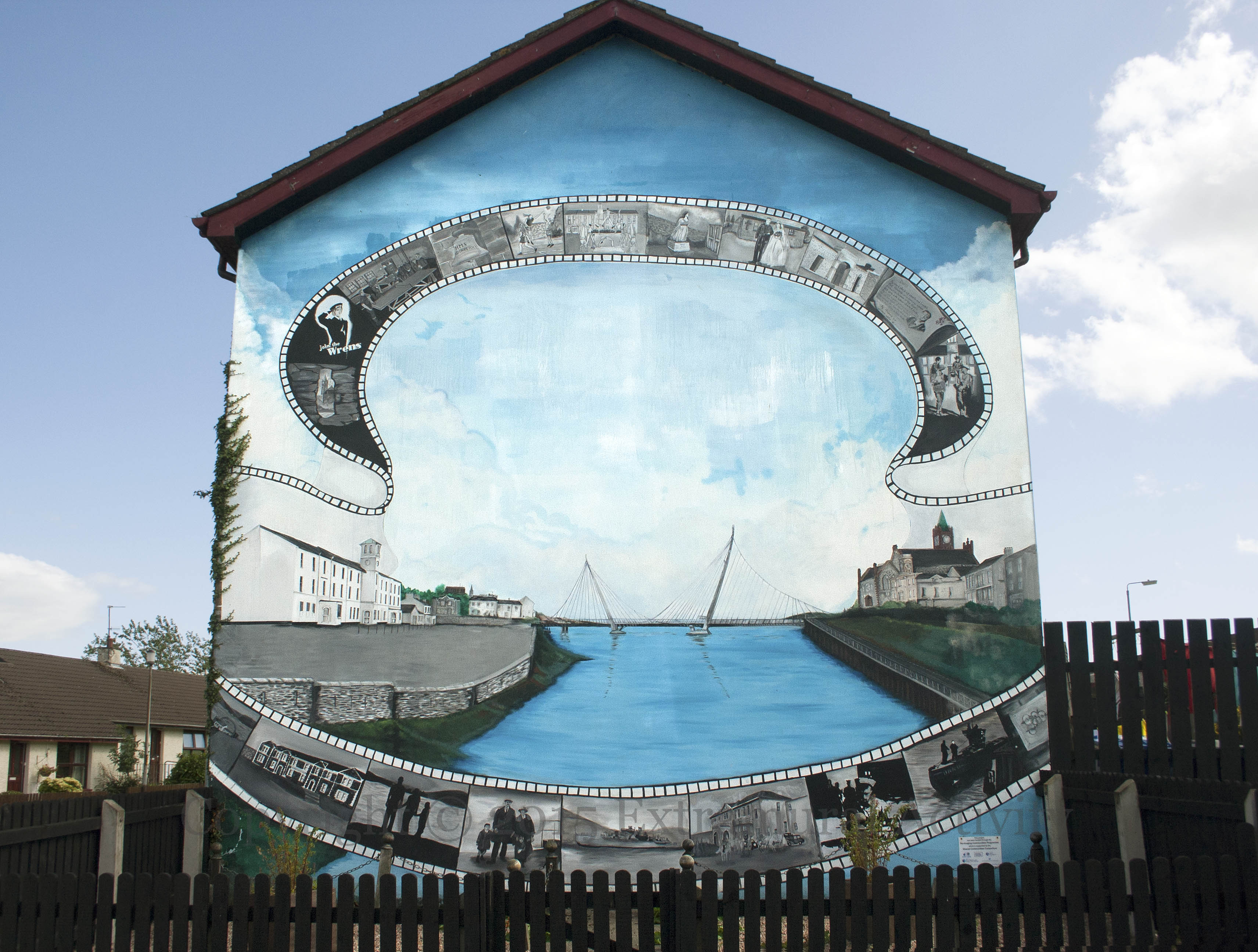
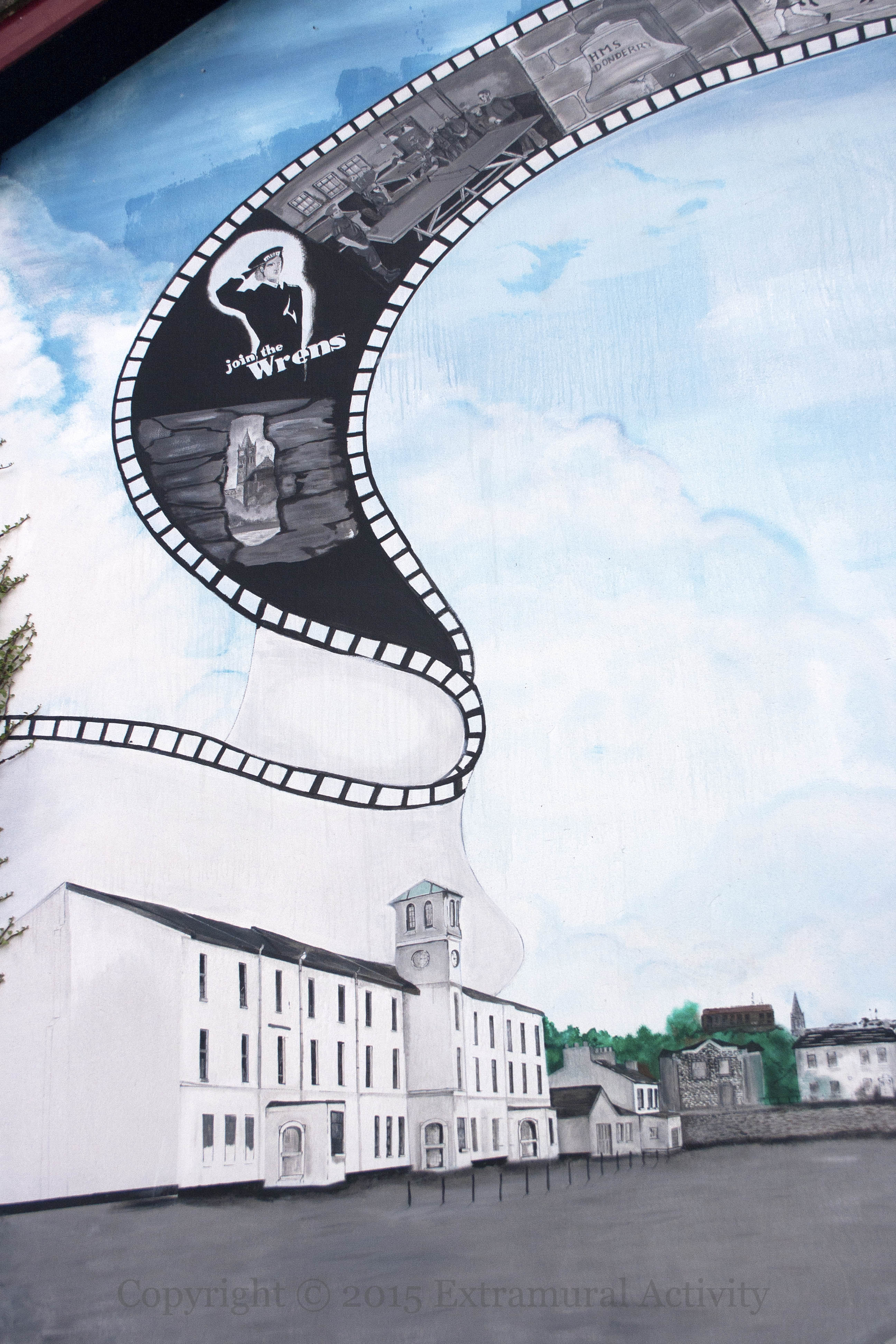
The Peace Bridge is shown spanning the Foyle between (the former) Ebrington barracks and the Guildhall, with a film-strip of images, many depicting naval and military scenes, above and below. The detail below shows a gap in the walls of Derry, a poster encouraging people to “Join the Wrens [and free a man for the fleet]” (the Women’s Royal Naval Service; see the poster at IWM), soldiers playing ping-pong in their barracks, and the ship’s bell of the HMS Londonderry (which served as a training ship during the Falkland War (WP)).
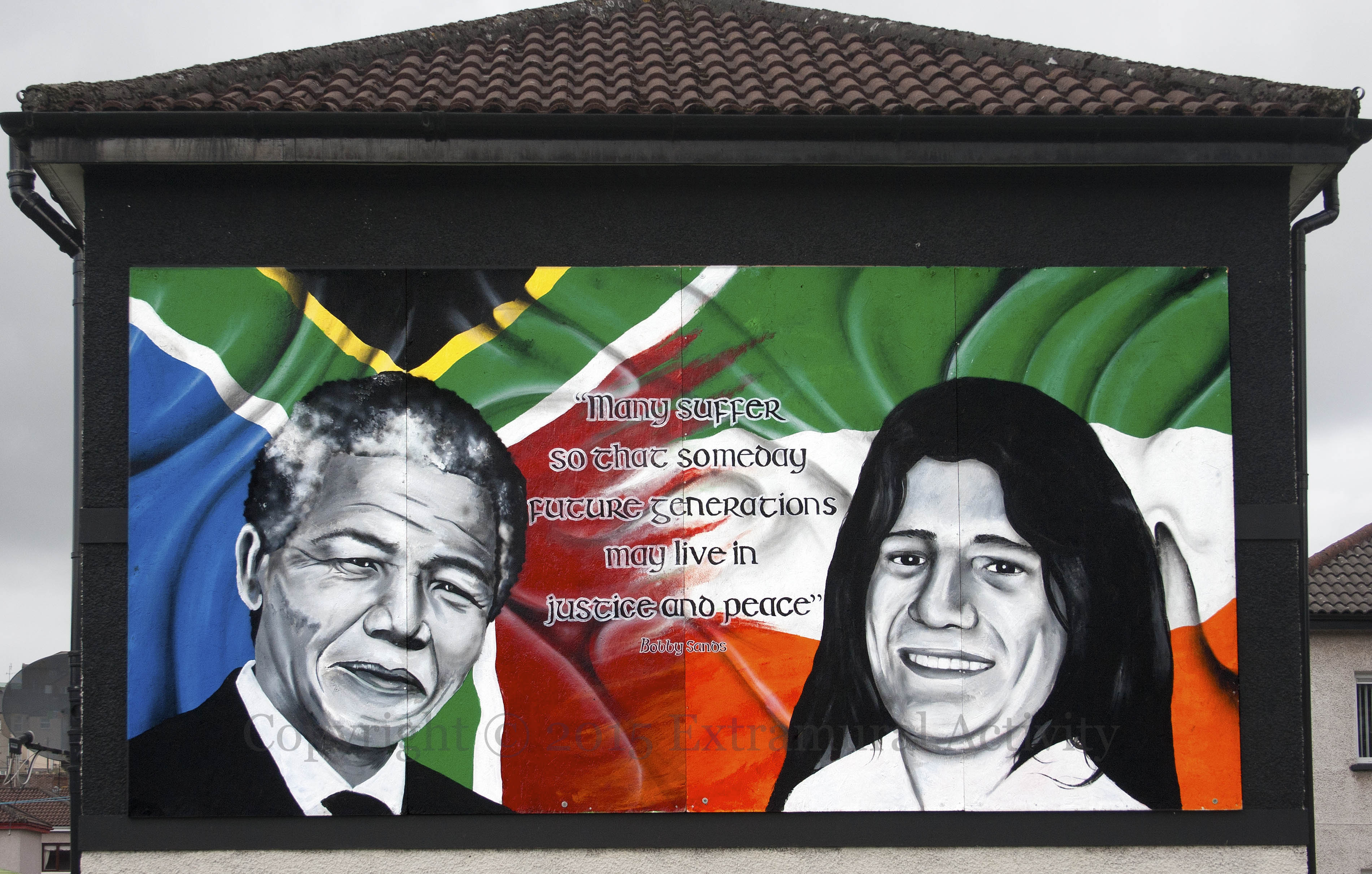
“Many suffer so that someday future generations may live in justice and peace.”
Portraits of Nelson Mandela and Bobby Sands are presented side by side, both smiling, in front of the flags of (post-apartheid) South Africa and the Republic of Ireland.
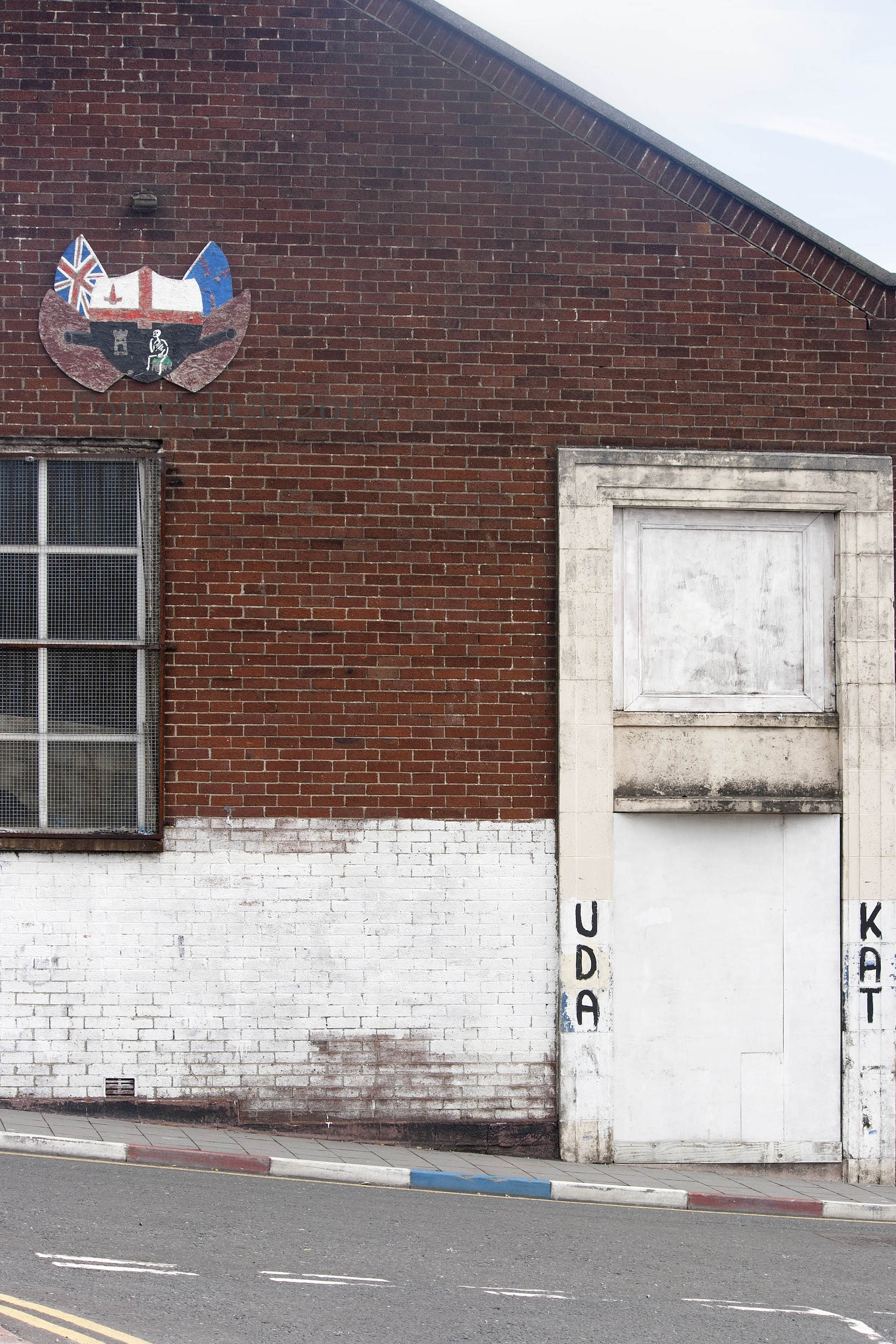
The coat of arms of Londonderry involves “the picture of death (or a skeleton) on a mossy stone & in the dexter point a castle” below the arms of the city of London. It is here joined by the flags of Britain, Scotland, and the crimson of the Apprentice Boys, as well as two cannons from the walls of Derry. The board above is in Hawkin Street, above “UDA” (“Ulster Defence Association”) and “KAT” (“Kill All Taigs”) graffiti.
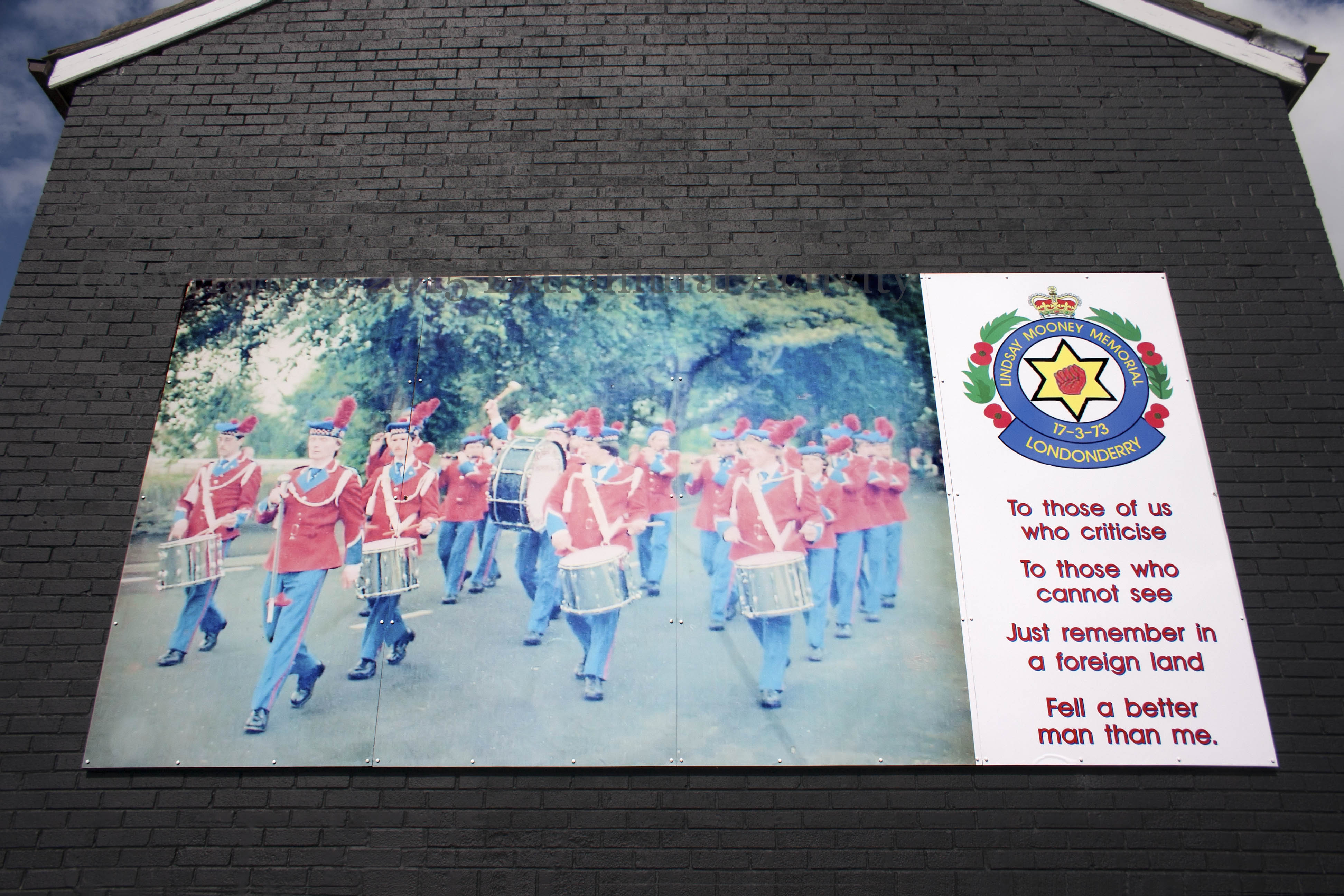
The [Sergeant] Lindsay Mooney Memorial Flute Band was formed in 1973 after the St. Patrick’s day death of Lindsay Mooney, a UDA member killed by the premature explosion of a bomb near Lifford, County Donegal (Sutton). The band dissolved in 1993 but commemorative nights are still held (NI World).
The board above is in the Lincoln Court area of Londonderry, from where Mooney and the band both hailed. “To those of us who criticise, to those who cannot see, just remember in a foreign land fell a better man than me.”
Culture Night Belfast is on tonight (2015-09-18) and will include about 30 pieces of street art under the heading Hit The North. Above is a piece of London-/Derry/Doire street art by artists RTM and TDA representing (we think!) St. Brigid’s ‘Church of the Oak’ (Kildare) and the coming of Spring (after her feast day of February 1st).
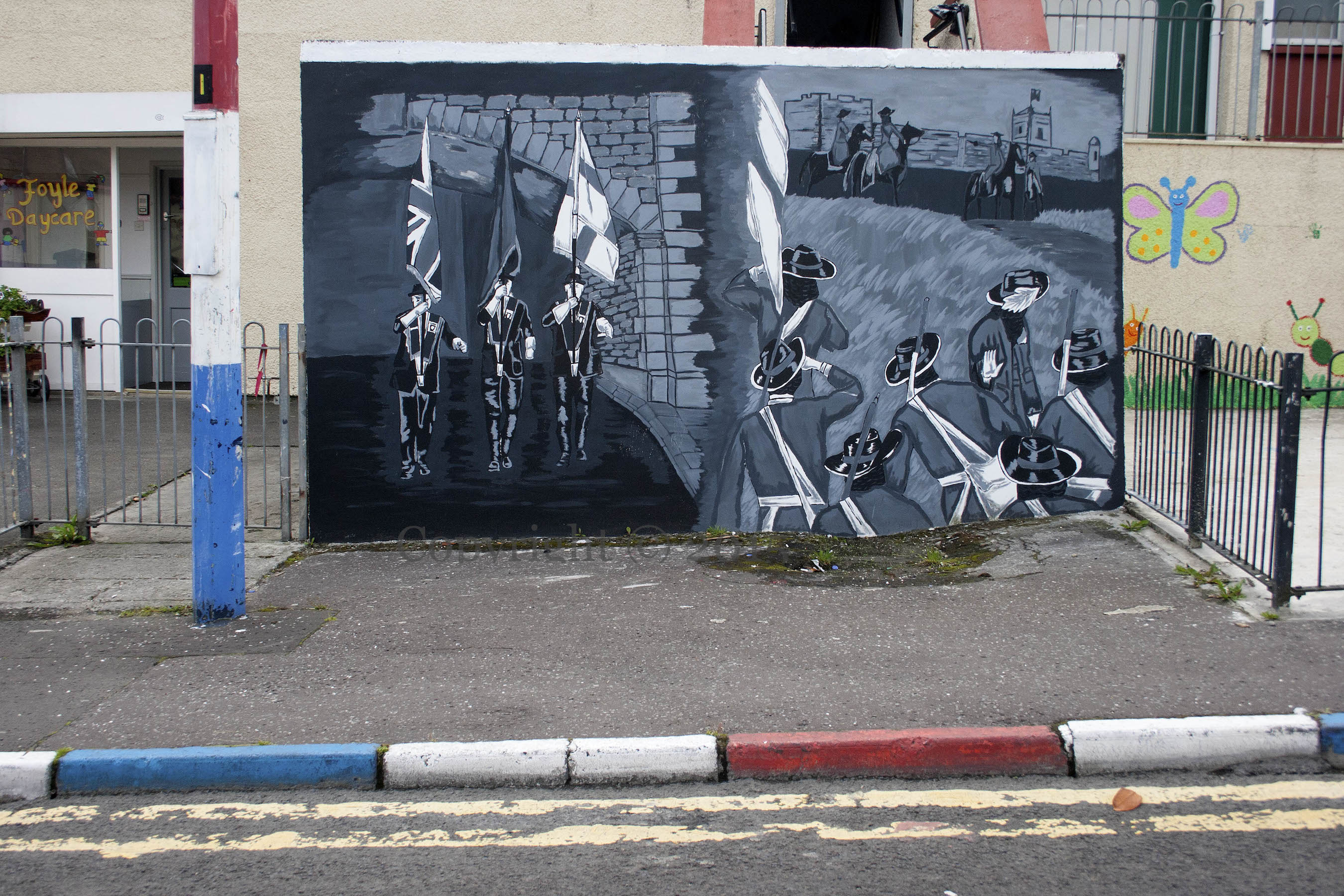
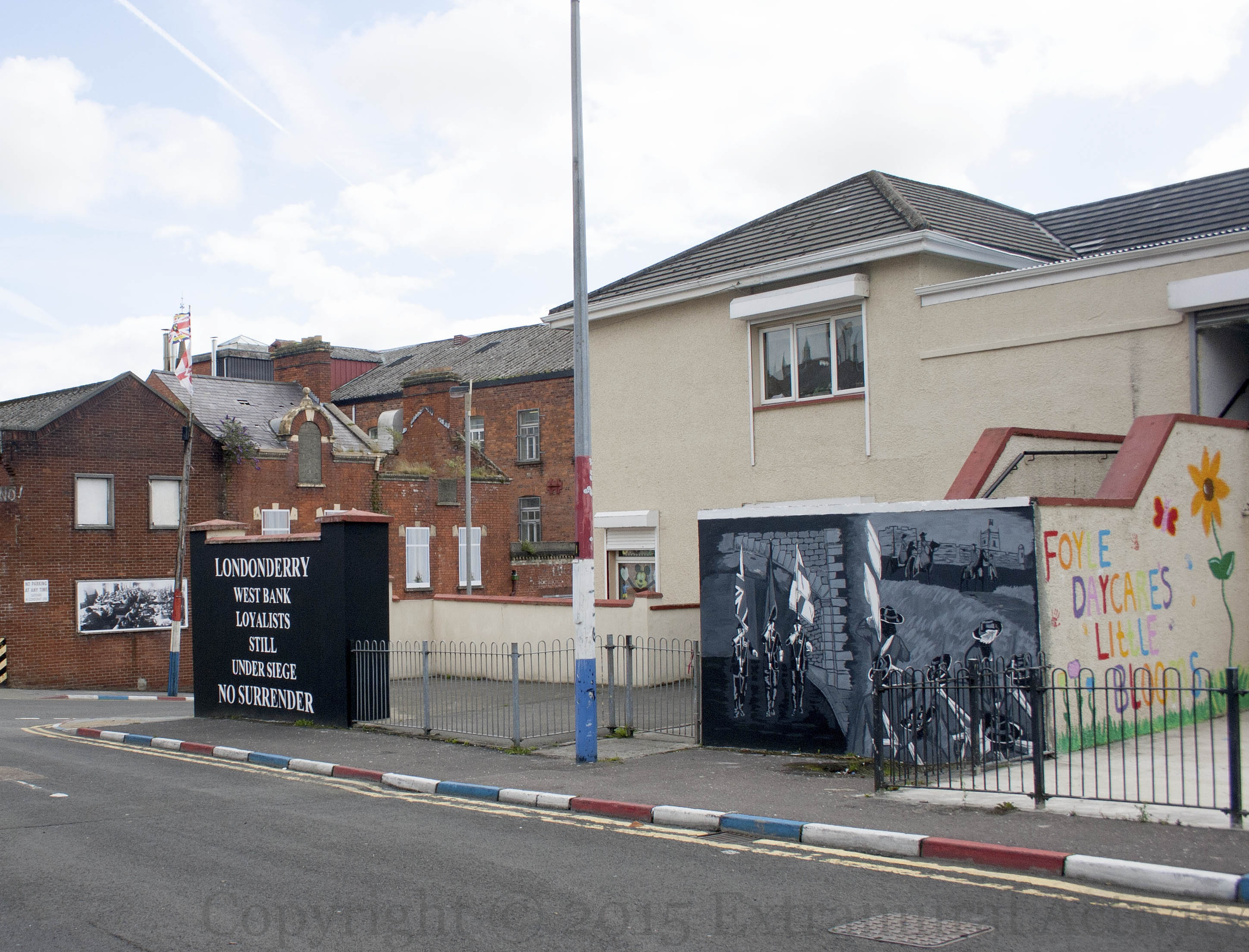
The “Little Blooms” receive a lecture in history and politics each day as they mount the painted kerb-stones and take in a mural of Orange Order flag-bearers and a scene from the Siege of Derry, perhaps of James II demanding the city and being rebuffed with cries of “No surrender”.




 Extramural Activity