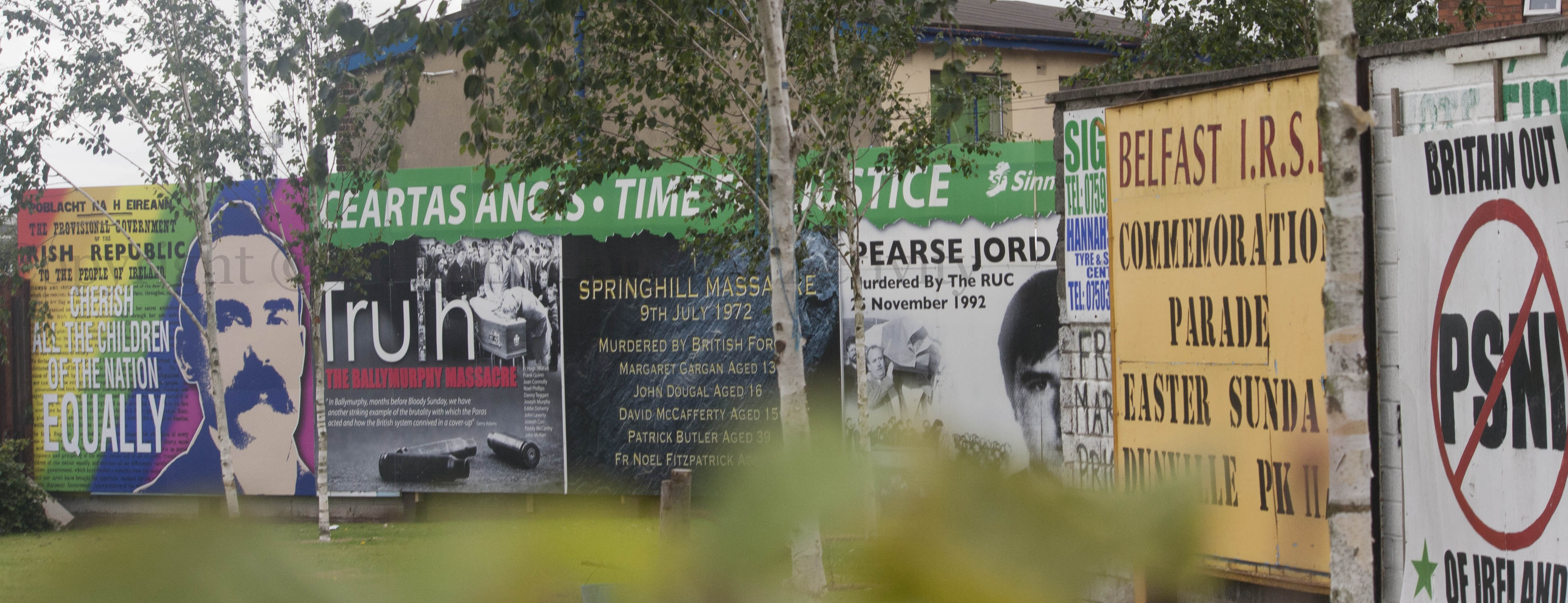
The 1916 Proclamation Of Irish Republic includes the sentence “The Republic guarantees religious and civil liberty, equal rights and equal opportunities to all its citizens, and declares its resolve to pursue the happiness and prosperity of the whole nation and of all its parts, cherishing all of the children of the nation equally, and oblivious of the differences carefully fostered by an alien Government, which have divided a minority from the majority in the past.” At the time, it had a political meaning, but it has since been pressed into service by advocates of children’s right and now, in the board above, by supporters of gay rights. James Connolly (leader of the Irish Citizen Army) and the text of the declaration are shown against a backdrop of the gay pride rainbow flag. Launched 2015-07-31
IRA volunteer (and marksman in the Irish Army) John Starrs was killed in a May 13th, 1972, gun battle with the British Army in William Street (Seachranaıdhe), near his plaque in Chamberlain Street, Derry, which is also home to Connolly House, home of the IRSP in Derry, and Junior McDaid house, home of Saoradh/IRPWA.
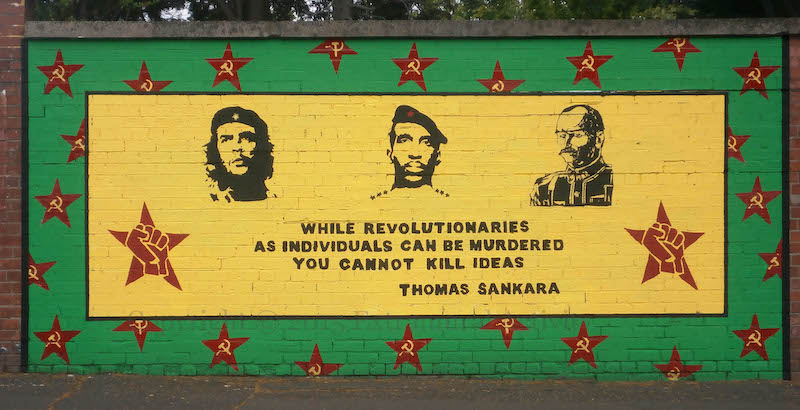
A week before he was assassinated and his government overthrown, Burkina Faso president Thomas Sankara asserted: “While revolutionaries as individuals can be murdered, you cannot kill ideas.” Sankara gained power of Burkina Faso (then Upper Volta) in a 1983 coup and launched an ambitious programme of literacy, feminism, public health, and agricultural self-sufficiency, in addition to launching a drive against corruption and of nationalizing natural resources. He attempted this all without the assistance of foreign aid or the IMF or World Bank. However, he wielded power outside the jurisdiction of the courts and controlled the press. He and twelve colleagues were killed in October 1987.
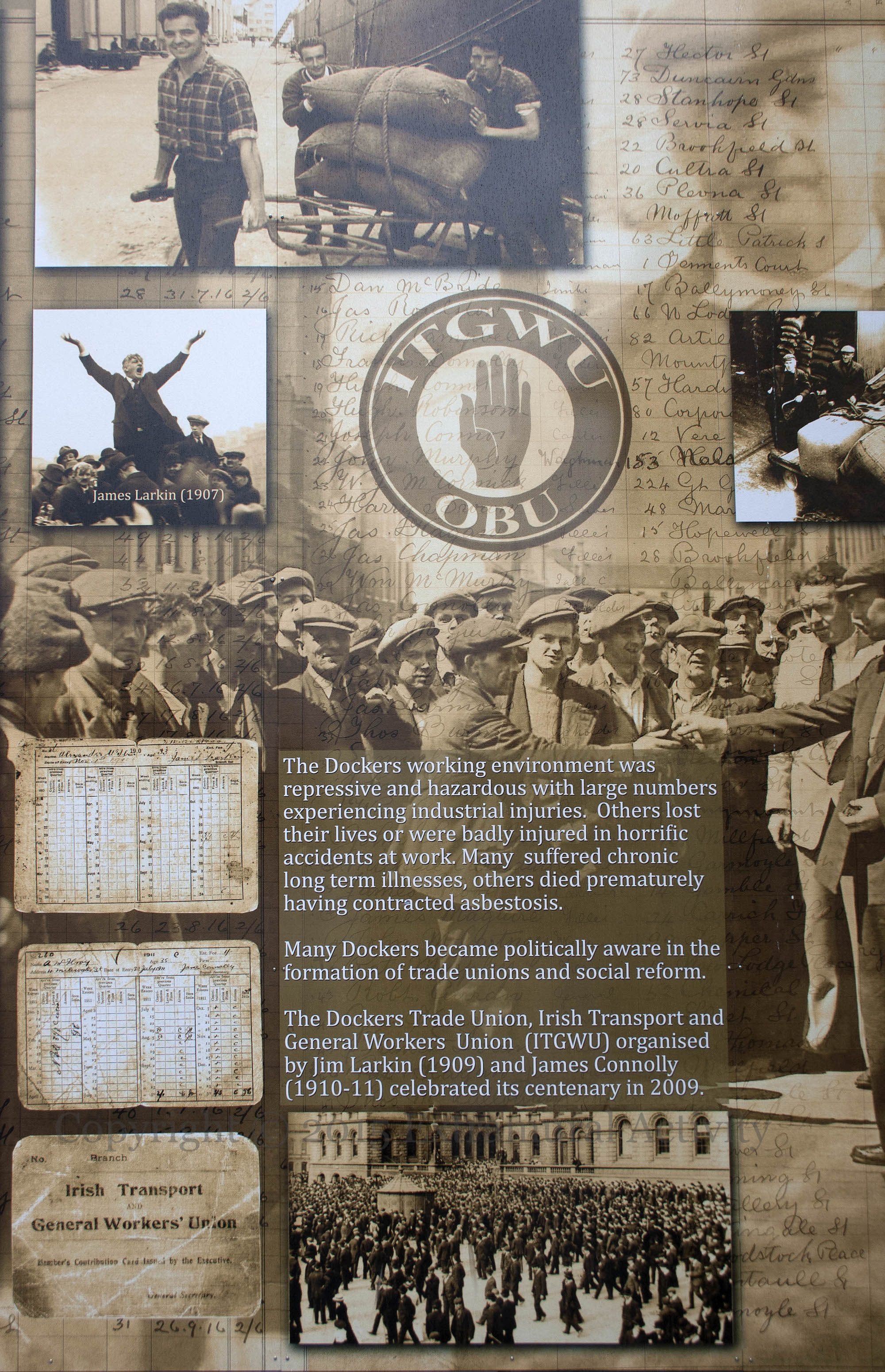
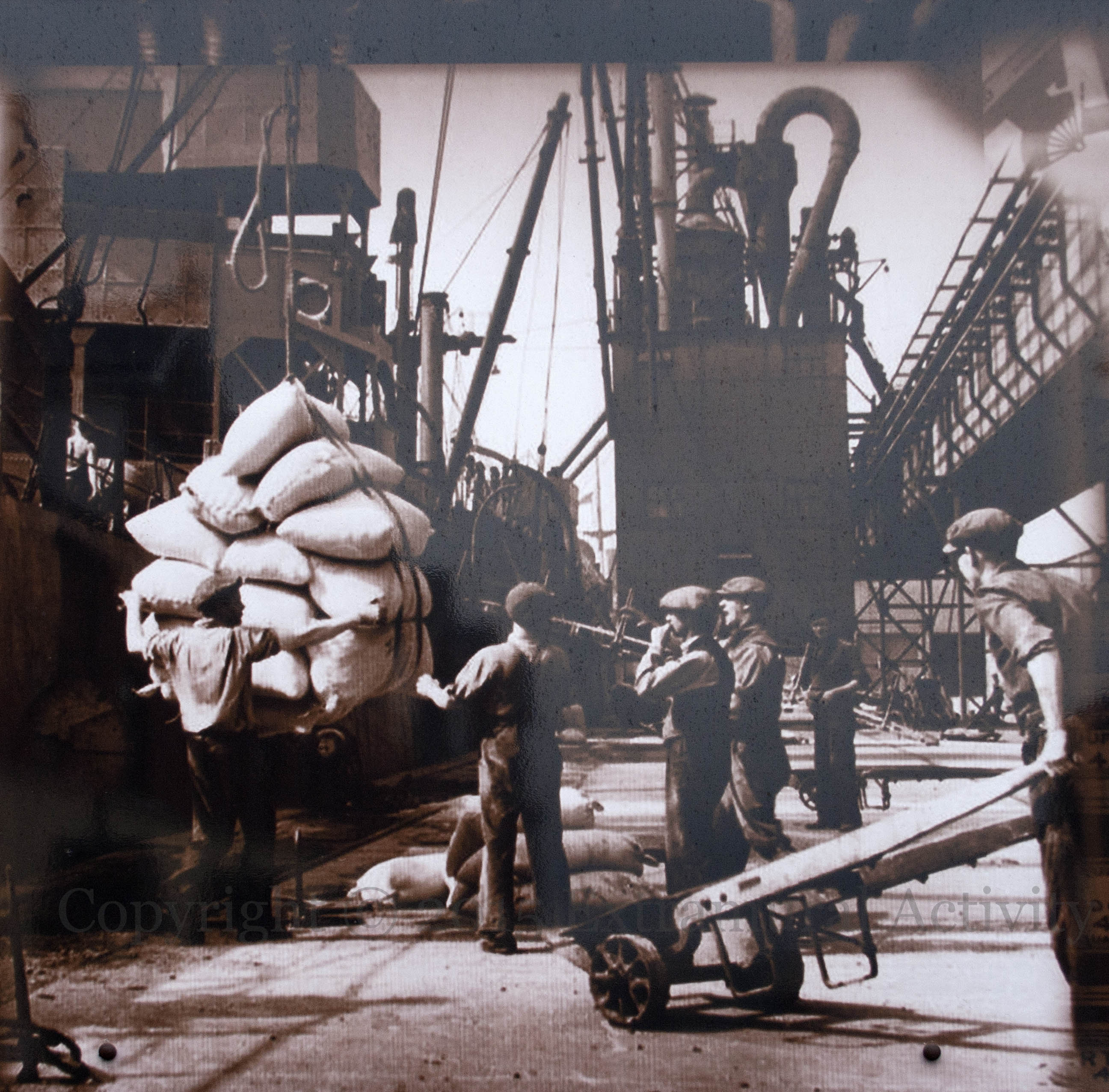
Every day, men would line up in schooling pens on the various docks of the port of Belfast to be hired by foremen. As mentioned on the left-hand side of the board above (recently erected on the New Lodge side of the Duncairn “peace” line) the rise of the shipping container in the 1970s spelled the end of the docker: “from 3000 listed dockers in 1970, the number had fallen to 280 by 1985.” Author and poet John Campbell recalls his first day on the docks in 1952, unloading cement, in this NVTv video.
“This artwork celebrates the unique contribution that generations of dockers have made to the port and City of Belfast.”
“It was a physically demanding job, the hours were long, the conditions were tough and the availability of work was not constant. Without the Dockers, however, the Port of Belfast would not have been able to grow. / Transportation of goods by containers led to a revolution in working practices at Belfast Docks and the number of dockers decreased dramatically. From 3000 listed dockers in 1970, the number had fallen to 280 by 1985. Behind these figures lay the human story of vast social changes in the harbour area as well as the gradual dissappearance [sic] of an entire community who had earned their living from the sea and also through the loading and unloading of ships. These were the Dockers and their families, many of whom lived in Sailortown. / The workforce of dockers spanned both traditions. Red button and Blue button. Dockers had a common allegiance to the Port of Belfast which provided a living for men and families from both communities. / The work was backbreaking, yet the Docks educated us about life, integrity, discipline, about standing up for our rights, about having pride in our identity as working men, as Dockers. / The Dockers[‘] working environment was repressive and hazardous with large numbers experiencing industrial injuries. Others lost their lives or were badly injured in horrific accidents at work. Many suffered chronic long term illnesses, others died prematurely having contracted asbestosis. Many Dockers became politically aware in the formation of trade unions and social reforms. The Dockers Trade Union, Irish Transport and General Workers[‘] Union (ITGWU) organised by Jim Larkin (1909) and James Connolly (1910-11) celebrated its centenary in 2009.” OBU one big union
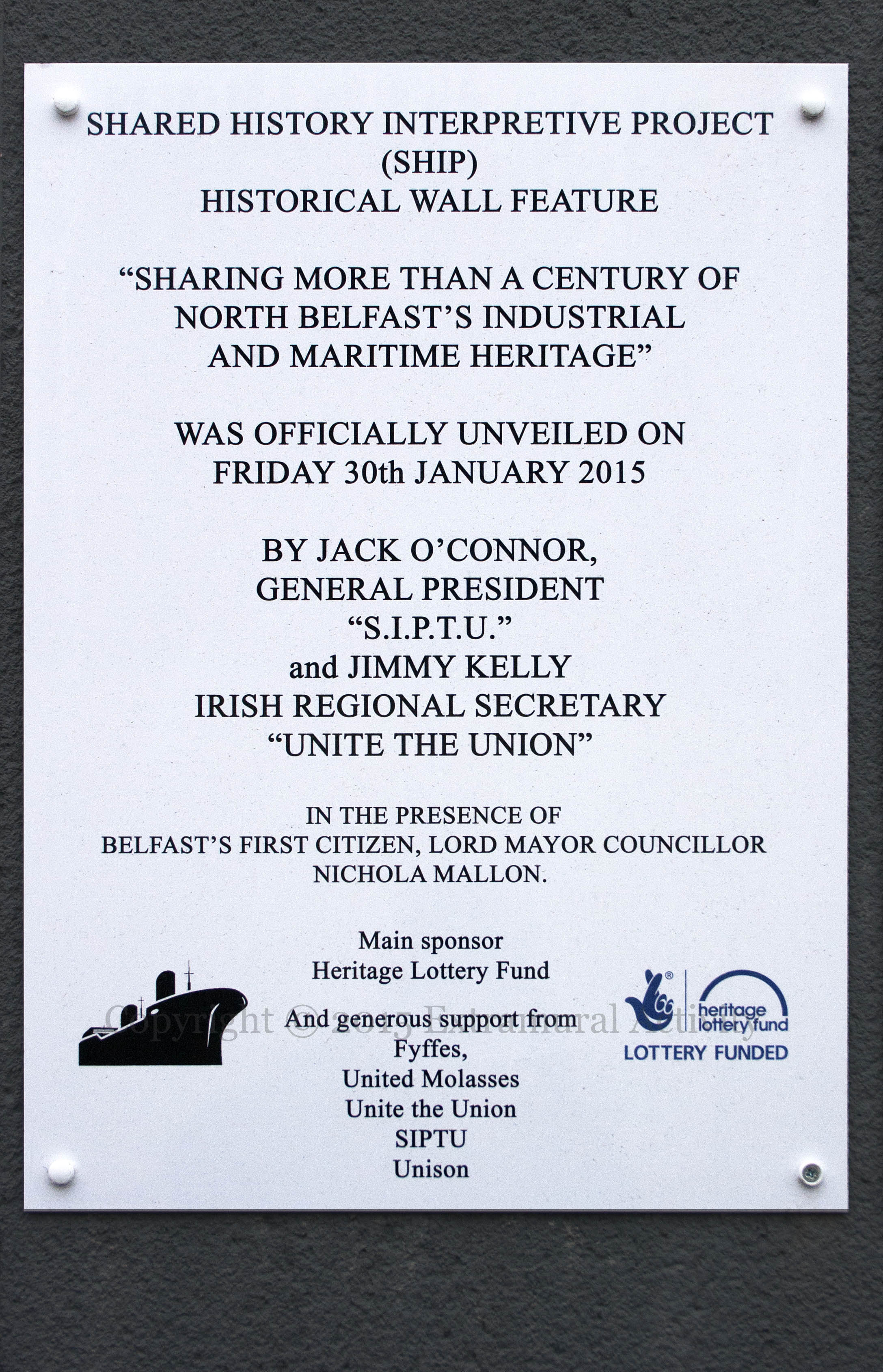
A new “historical wall feature” was unveiled by the Shared History Interpretive Project (SHIP) on the outside of the Dockers Club in Pilot Street in Sailortown. The new piece is a montage of about 60 images of vintage photographs, a census form, and posters of industrial life. In the top-middle (behind the lamppost) there can be seen an image of the board this one replaces, which featured two carters pulling away a heavy load, similar to the carter in the image above. Another addition in the new work is the inclusion of Billy McMullen (1888-1982) and John Quinn (1876-1935) alongside Winifred Carney (1887-1943), James Connolly (1868-1916), and Jim Larkin (1876-1947). Both McMullen and Quinn are Belfast trades unionists. Quinn’s headstone in Milltown Cemetery was featured previously, in Forgotten In Life, Remembered In Death. More information about all five, as well as photographs of dockers and of the unveiling, can be found at the SHIP web site.
James Connolly was concerned not just with the political independence of Ireland but its economic independence: both political and economic liberty were required in order for the human being to live freely. The quote in the image above comes from Connolly’s 1897 essay “Socialism & Nationalism”. The economic context is clear when we read a little more broadly:
“To the tenant farmer, ground between landlordism on the one hand and American competition on the other, as between the upper and the nether millstone; to the wage-workers in the towns, suffering from the exactions of the slave-driving capitalist to the agricultural labourer, toiling away his life for a wage barely sufficient to keep body and soul together; in fact to every one of the toiling millions upon whose misery the outwardly-splendid fabric of our modern civilisation is reared, the Irish Republic might be made a word to conjure with – a rallying point for the disaffected, a haven for the oppressed, a point of departure for the Socialist, enthusiastic in the cause of human freedom.” (marxists.org)
A new mural on the International Wall combines two current events. One is the furore surrounding the recent description of Islam as “satanic” by Belfast pastor James McConnell (Tele) and a ‘Rally Against Racism’ that took place on Saturday (31st) (Tele). The middle of the mural reads “Respect and defend our Muslim brothers + sisters – kardeslik azadi”.
The other is the death of Maya Angelou (WP), who died this past Wednesday (May 28th). Angelou is pictured in the top half of the mural with Muhammad Ali along with a quote: “Prejudice is a burden that confuses the past, threatens the future and renders the past inaccessible.”
In the bottom half appear Padraıg Pearse and James Connolly and a line from the Proclamation of the Irish Republic: “Cherish all the children of the nation equally.”
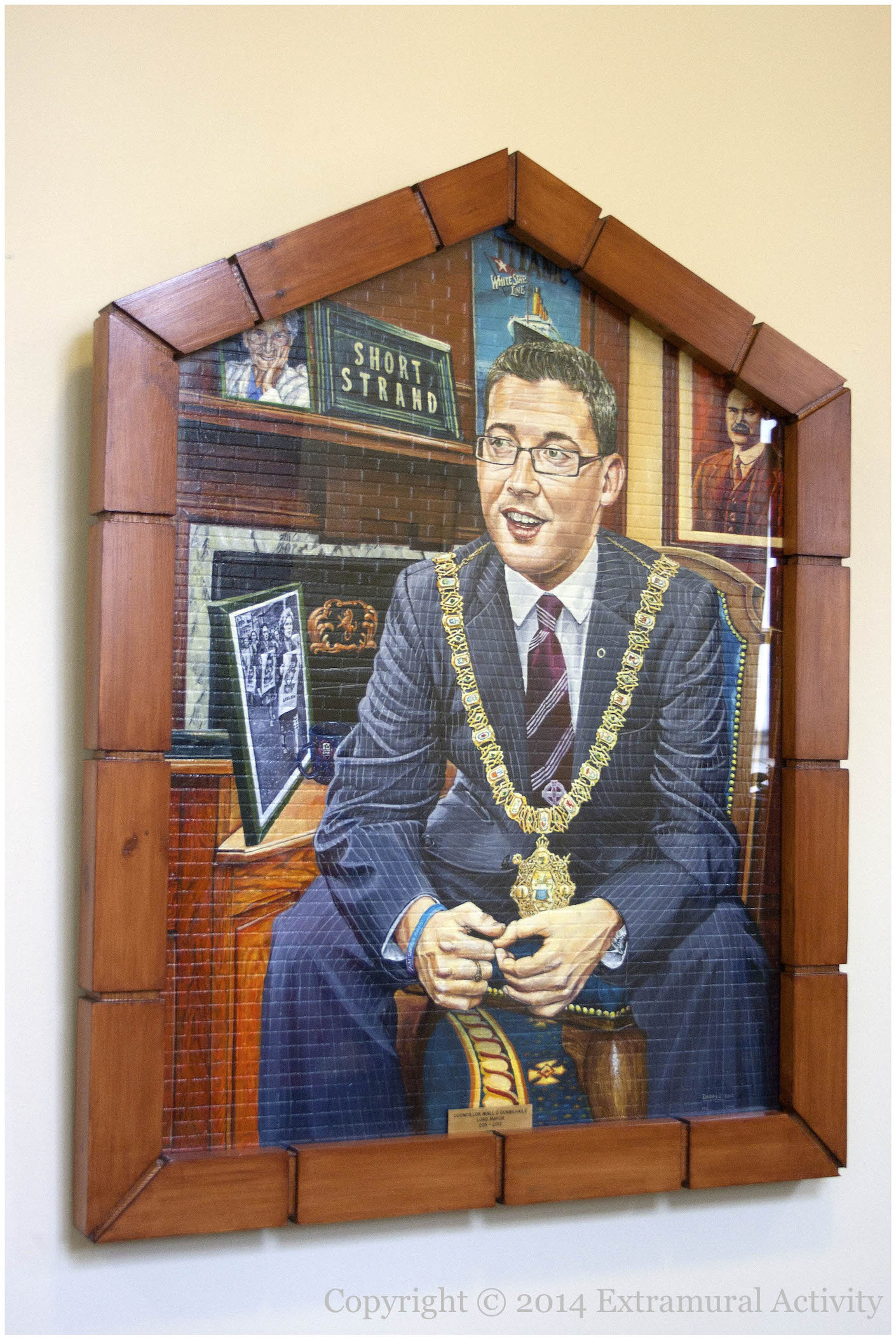
Each Lord Mayor of Belfast has an official portrait which hangs in Belfast City Hall. 2011-2012 Lord Mayor Nıall Ó Donnghaıle’s takes the unusual form of a mini-mural, in the shape of a gable wall and complete with mortar lines. The portrait features a “Short Strand” street-plate (Ó Donnghaıle is from there), images of Titanic, James Connolly – a portrait was mounted at a SIPTU event in the mayor’s chambers in October 2011, after pictures of the royal family had been removed in June, protesters, and an MTV mug. The artist talks about the piece on Slugger (audio) and CultureNI has a good write-up about the process.
Below are a detail from Ó Donnghaıle’s portrait and the more typical portrait of Tom Hartley, Lord Mayor 2008-2009, which includes the bicycle he is famous for riding around town.
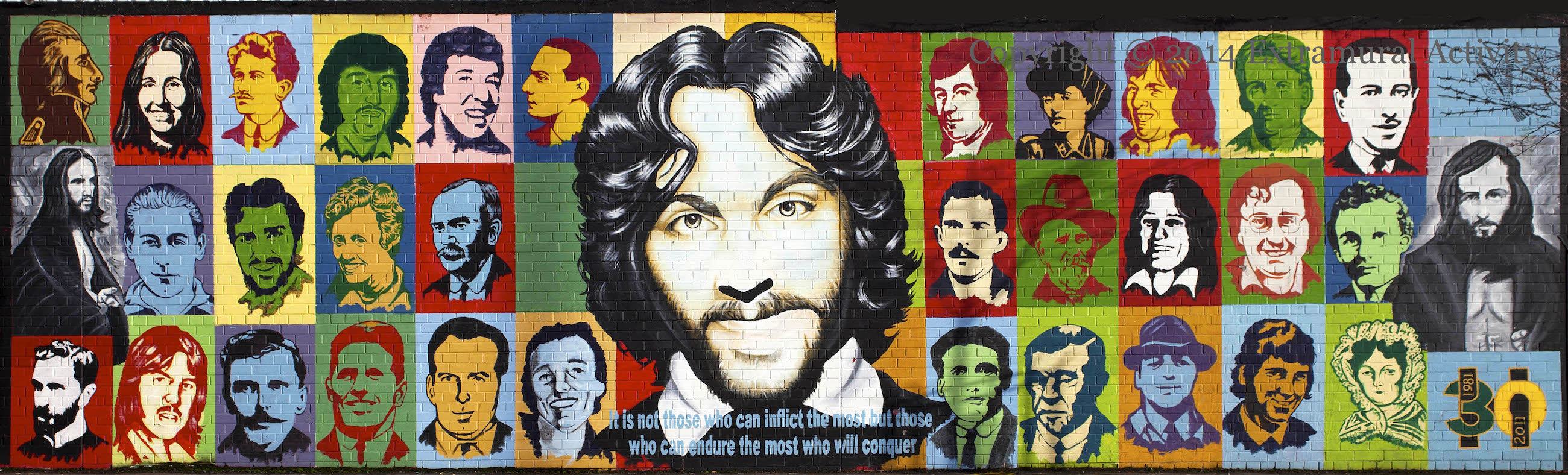
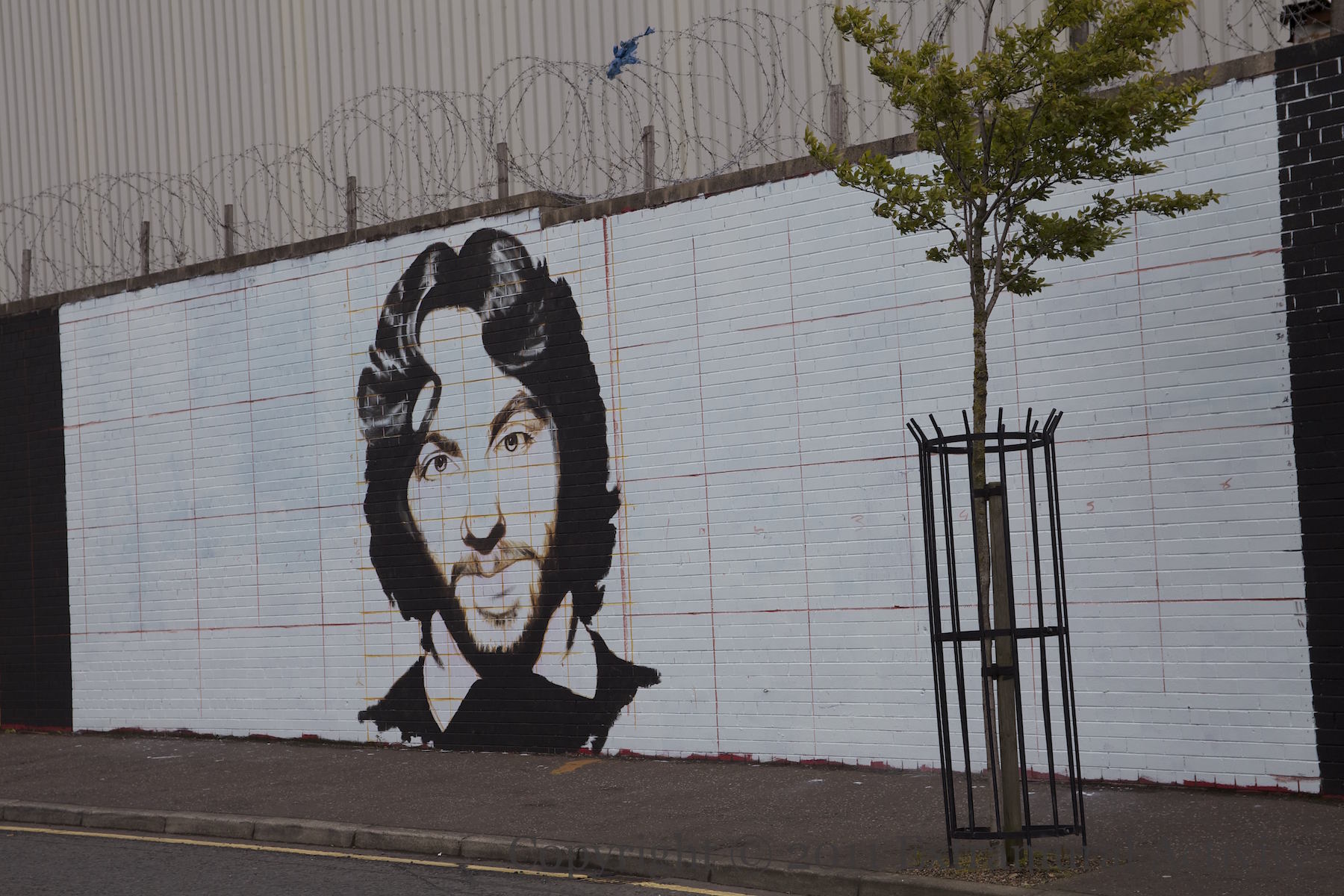
“It is not those who can inflict the most but those who can endure the most who will conquer.” 1981 hunger-striker Francis Hughes is flanked by blanketmen Hugh Rooney and Freddie Toal and surrounded by a host of other republican faces in this 2011 mural commemorating the 30th anniversary of the strikes. Painted by Seany McVeigh.
Top 1. Wolfe Tone 2. Mairead Farrell 3. Thomas Ashe 4. Kevin Lynch 5. Michael Gaughan 6. Padraig Pearse, [FH] 7. Thomas McElwee 8. Constance Markievicz 9. Joe McDonnell 10. Terence MacSwiney 11. Frank Stagg 12. fuiseog
Middle 1. Hugh Rooney, 2. Kevin Barry 3. Patsy O’Hara 4. Máire Drumm 5. James Connolly, [FH] 6. Denis Barry 7. James O’Donovan Rossa 8. Bobby Sands 9. Mickey Devine 10. ? 11. Freddie Toal
Bottom 1. Roger Casement 2. Kieran Doherty 3. Michael Fitzgerald 4. Seán McNeela 5. Tony D’Arcy 6. Ray McCreesh, [FH] 7. Joseph Murphy 8. Andrew Sullivan 9. Seán McCaughey 10. Martin Hurson 11. Anne Devlin
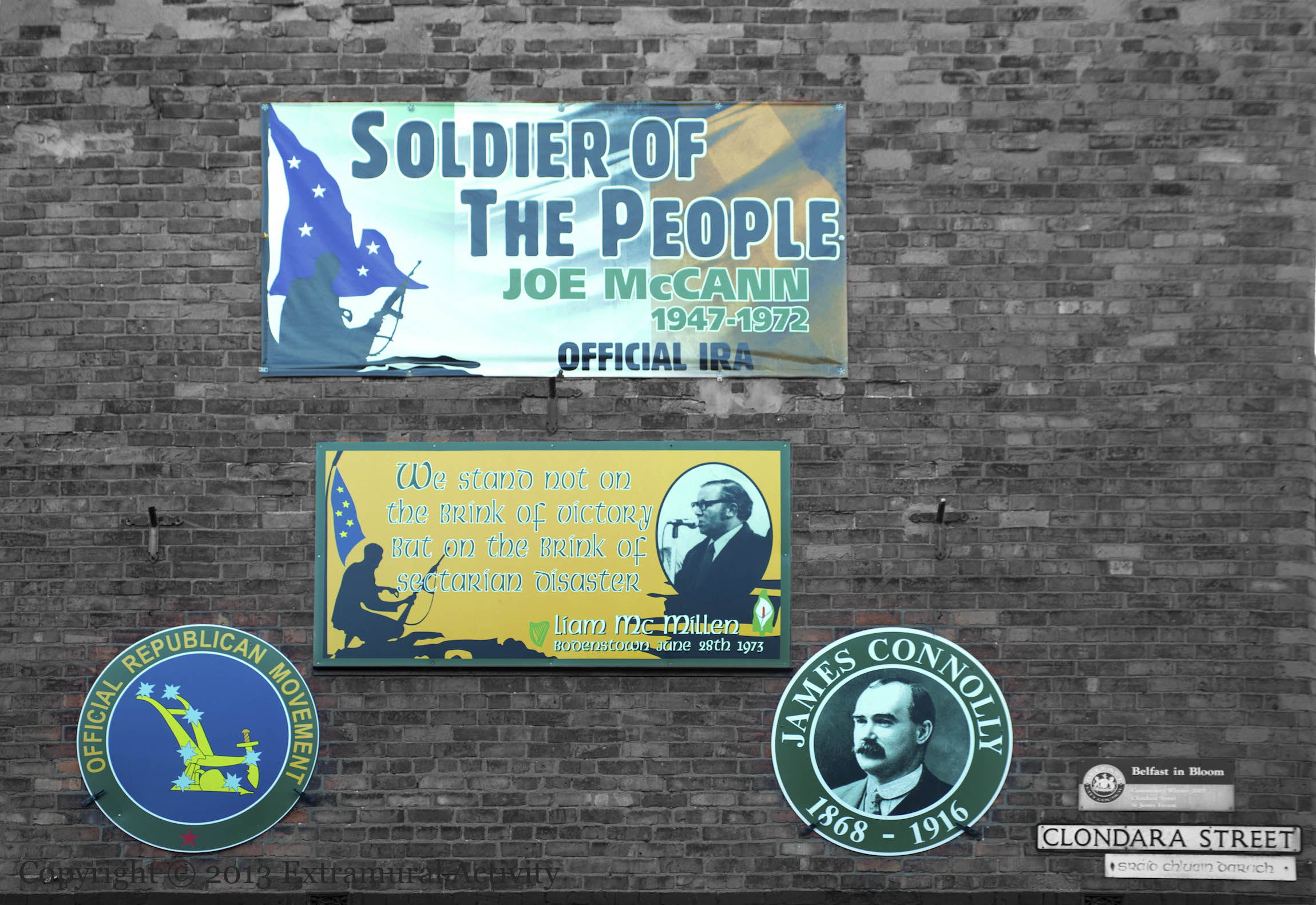
A selection of Republican iconography above the James and Nora Connolly mural in Clondara Street: a tarp to Joe McCann – ‘Soldier of the people, Joe McCann 1947-1972 Official IRA’ (WP) – a board with a Liam McMillen quote – ‘”We stand not on the brink of victory but on the brink of sectarian disaster”, Liam McMillen, Bodenstown June 28th 1973’ (see the post on McMillen at Peter Moloney Collection) – and two circular pieces, one showing the Starry Plough (created in 1914 as the flag of the Irish Citizen Army) and one to co-founder of the ICA ‘James Connolly 1868-1916’ (WP).










 Extramural Activity