The ‘over the top’ mural in Ballyclare has been refreshed, compared to the faded lettering of 2014: the list of battles has been restored (in the bottom right) but the large scroll in the centre has been painted over.
Garlands of poppies, one for each of 38 local men “who gave their lives during the Battle of the Somme 1st July 1916 – 18th Nov 1916”, form a circle around a photograph of “Ballyclare Main Streeet 18th September 1914” as the men go off to war. For information about 17 of the men, see this Love Ballyclare page.
One hundred years ago today, on July 1st, 1916, the Battle of Albert began, the first of many battles in what is known collectively as the Battle of the Somme. Soldiers from the 36th (Ulster) Brigade went “over the top” at 7:28 a.m. By the end of the day, more than nineteen thousand British soldiers were dead, five thousand from the 36th.
The line “We gathered from our towns, our villages and farms, in answer to the echo of alarm” comes from the song “Armagh Brigade”; the alarm is more specifically “Carson’s loud alarm”. Below the main panel, which shows combat at close quarters, are the words of Wilfrid Spender: “I am not an Ulsterman but yesterday, the 1st. July, as I followed their amazing attack, I felt that I would rather be an Ulsterman than anything else in the world … the Ulster Volunteer Force, from which the Division was made, has won a name that equals any in history.”
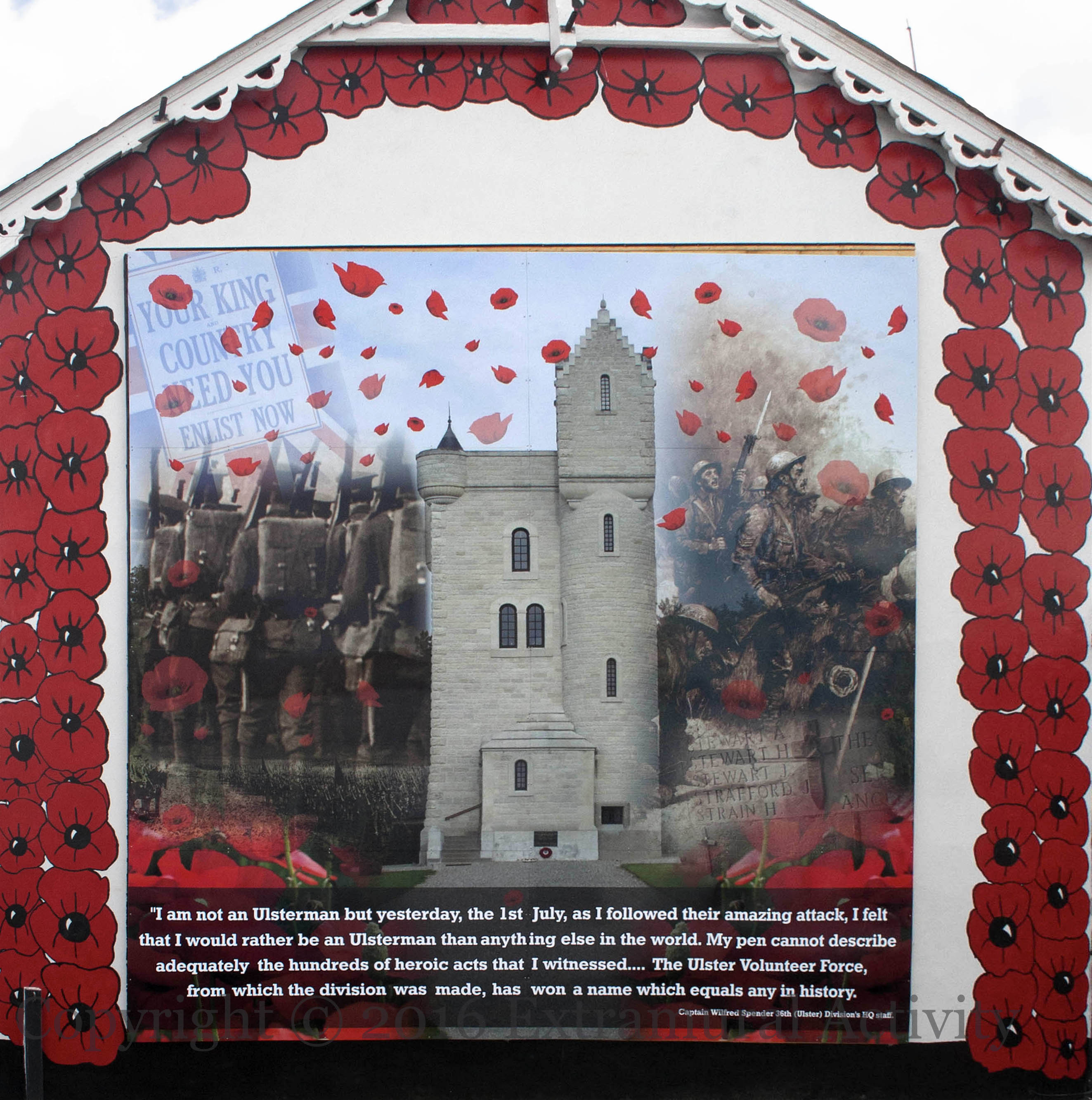
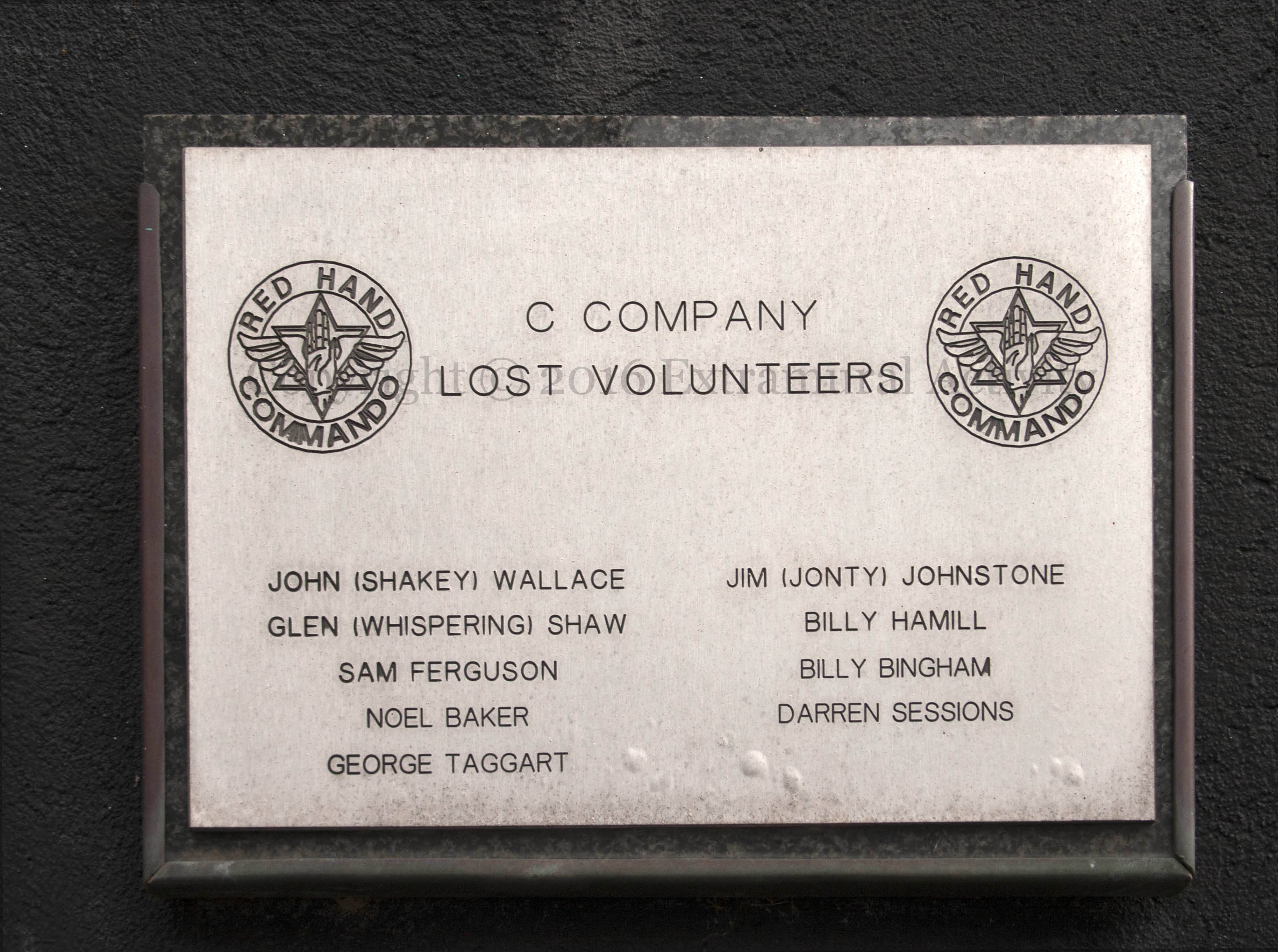
The main part of a Red Hand Commando mural was replaced recently with a board commemorating the action and deaths of the British Army’s 36th (Ulster) Division in World War I’s Battle Of The Somme, of which Captain Wilfrid Spender wrote, “I am not an Ulsterman but yesterday, the 1st July, as I followed their amazing attack, I felt that I would rather be an Ulsterman than anything else in the world. My pen cannot describe adequately the hundreds of heroic acts that I witnessed … The Ulster Volunteer Force, from which the division was made, has won a name which equals any in history.”
As shown in the three additional images, part of the old mural (and its plaques) remains on the right, “In memory of all loyalists who gave their lives in defence of Ulster – Lest we forget.”
For images of the launch (on 2016-03-08) see Belfast Live.
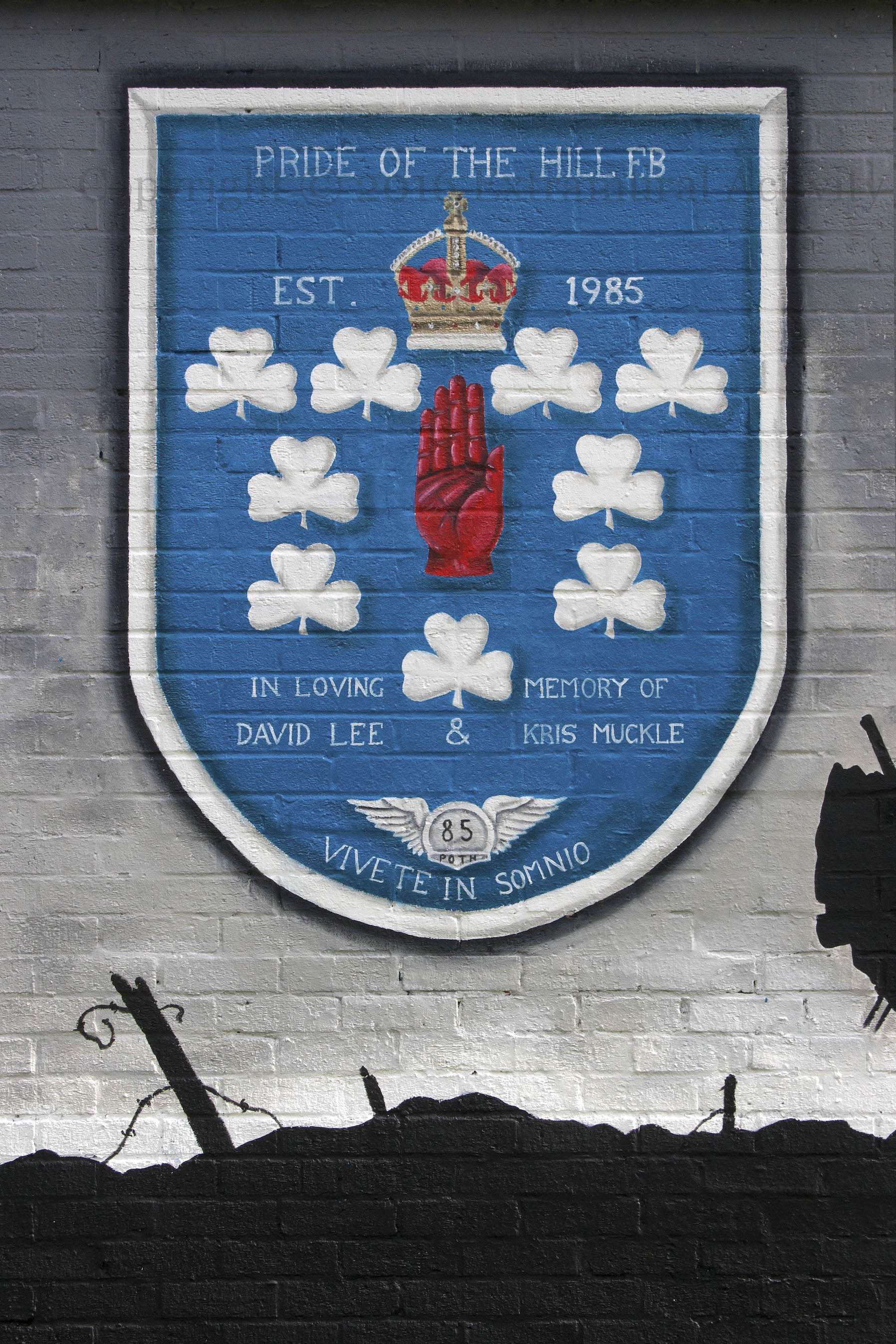
This is a new Somme centenary mural in Carnmoney/Ballyduff, in memorial of the First World War and 1916 in particular. It also serves as a memorial to members of the Pride of the Hill flute band, David Lee and Kris Muckle. (It’s not clear what “Vivete in somnio” means – neither “vivete” nor “somnio” are Latin; “vivete” is Italian but “somnio” is not. Get in touch/leave a comment if you know what is intended.)
The three-storey mural above is in Ballysillan and replaced a UVF mural when it was added in 2011. The mural is the work of Jim Russell, shown below at Arts For All where he is artist-in-residence. The information below was provided by Arts For All.
The Great War: The first panel commemorates the Great War that ravaged Europe from 1914 to 1918 and shows troops advancing into battle, the Ulster Tower at Thiepval commemorating the sacrifice at the Somme and an image showing one of the war cemeteries and highlighting the true cost of war.
Second World War: The second panel features some of the devastation visited upon Belfast during a series of Luftwaffe raids during the early years of the Second World War. Belfast suffered greatly with over 1,000 people dying in four nights of bombing in April and May of 1941.
The Troubles: In the third panel highlight the dark history known as the Troubles. It features two events from the years of that time – the murder of the three young off-duty Scottish soldiers in 1971 [the monument depicted was featured in The Highland] and the Bloody Friday bombings of July 1972. In the midst of the horror that accompanied the early years of the Troubles these events still caused many to struggle to understand how people could carry out such atrocities.
Present Day Conflict: Panel four brings us up to the present day. Military service is a tradition for many in Northern Ireland and for many their first overseas trip came on the back of an overseas posting whilst serving in one of the Armed Forces. From times past, through the World Wars, the Korean War, to more recent conflicts in Iraq and Afghanistan soldiers and regiments drawn from Norther Ireland continue to play a role.
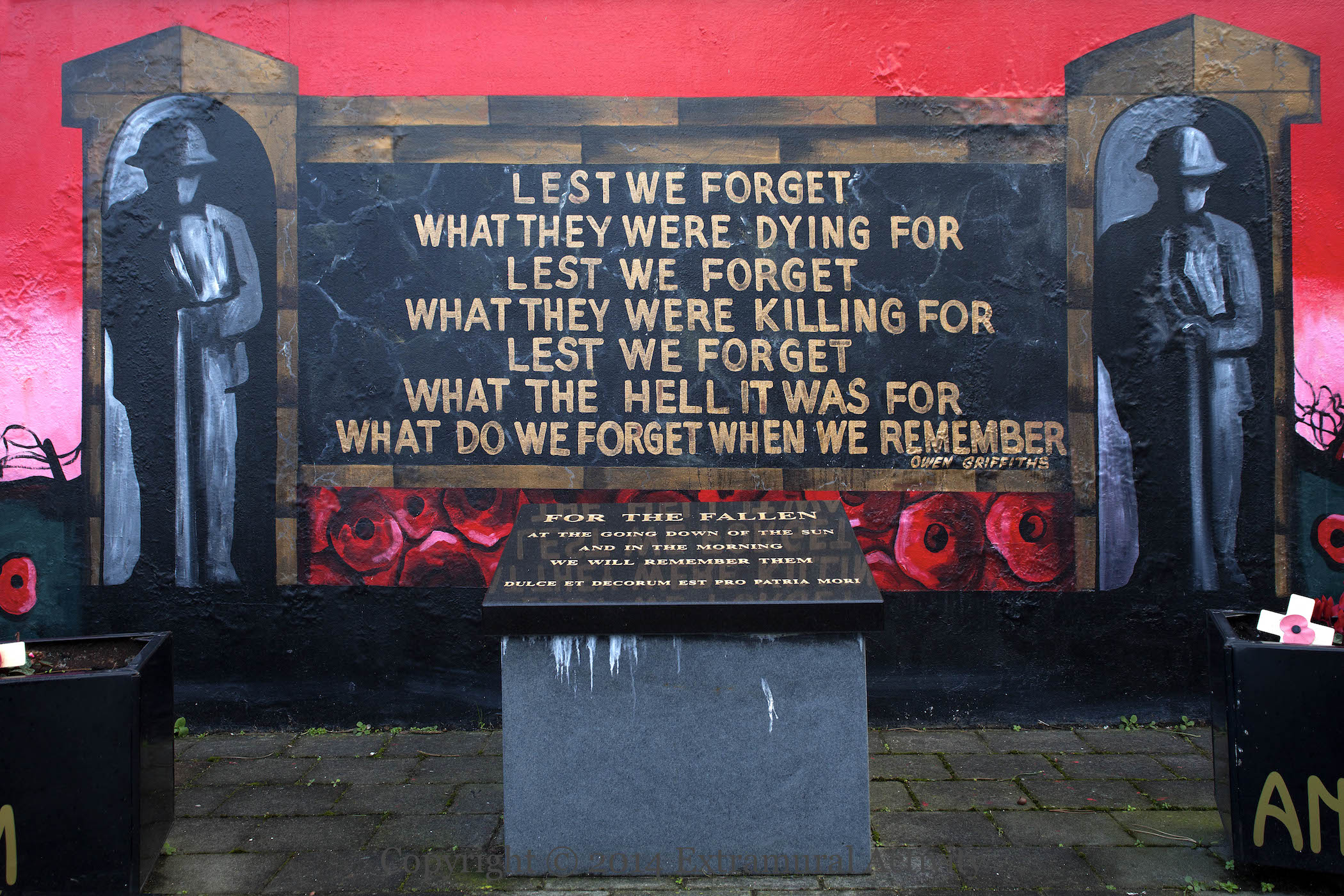
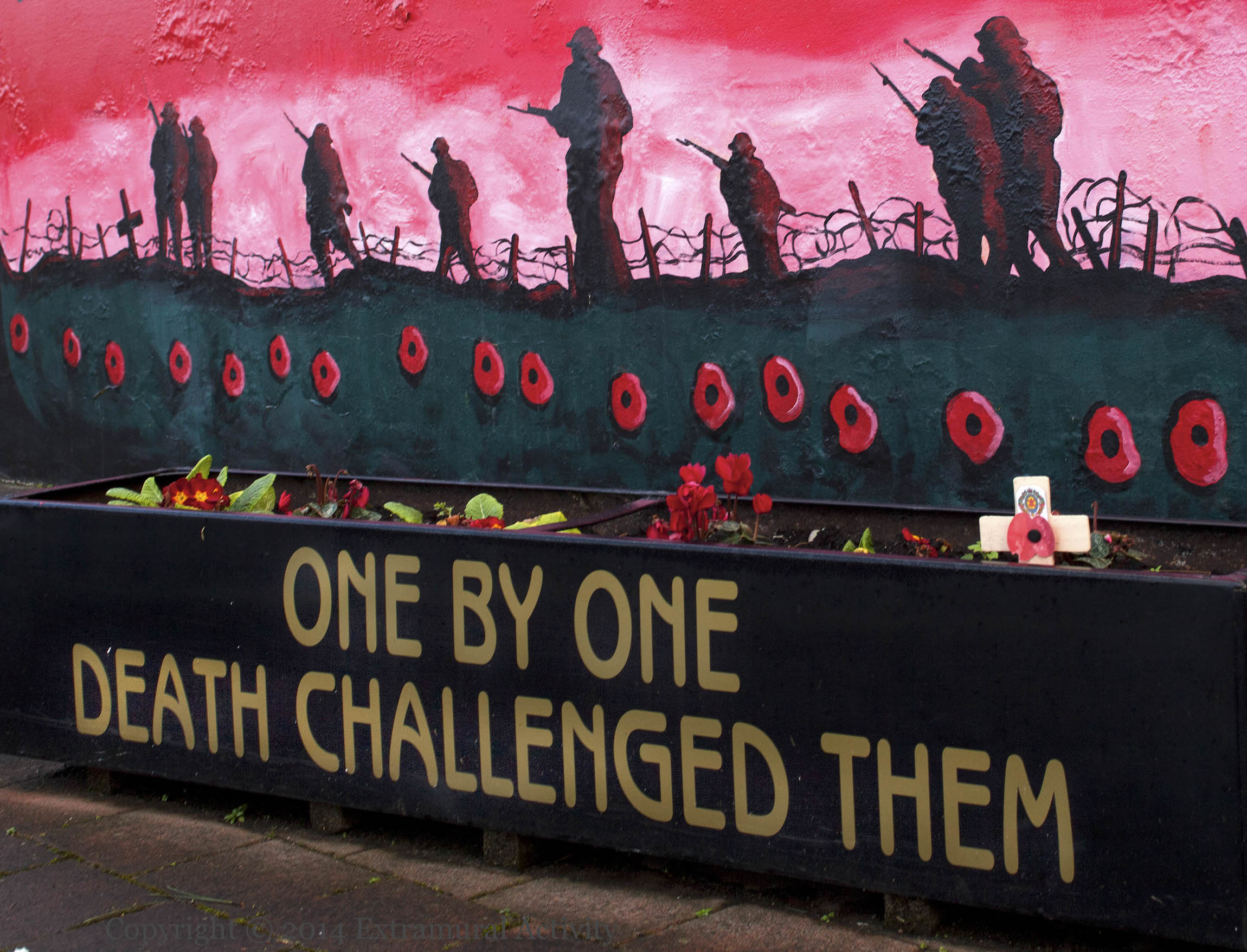
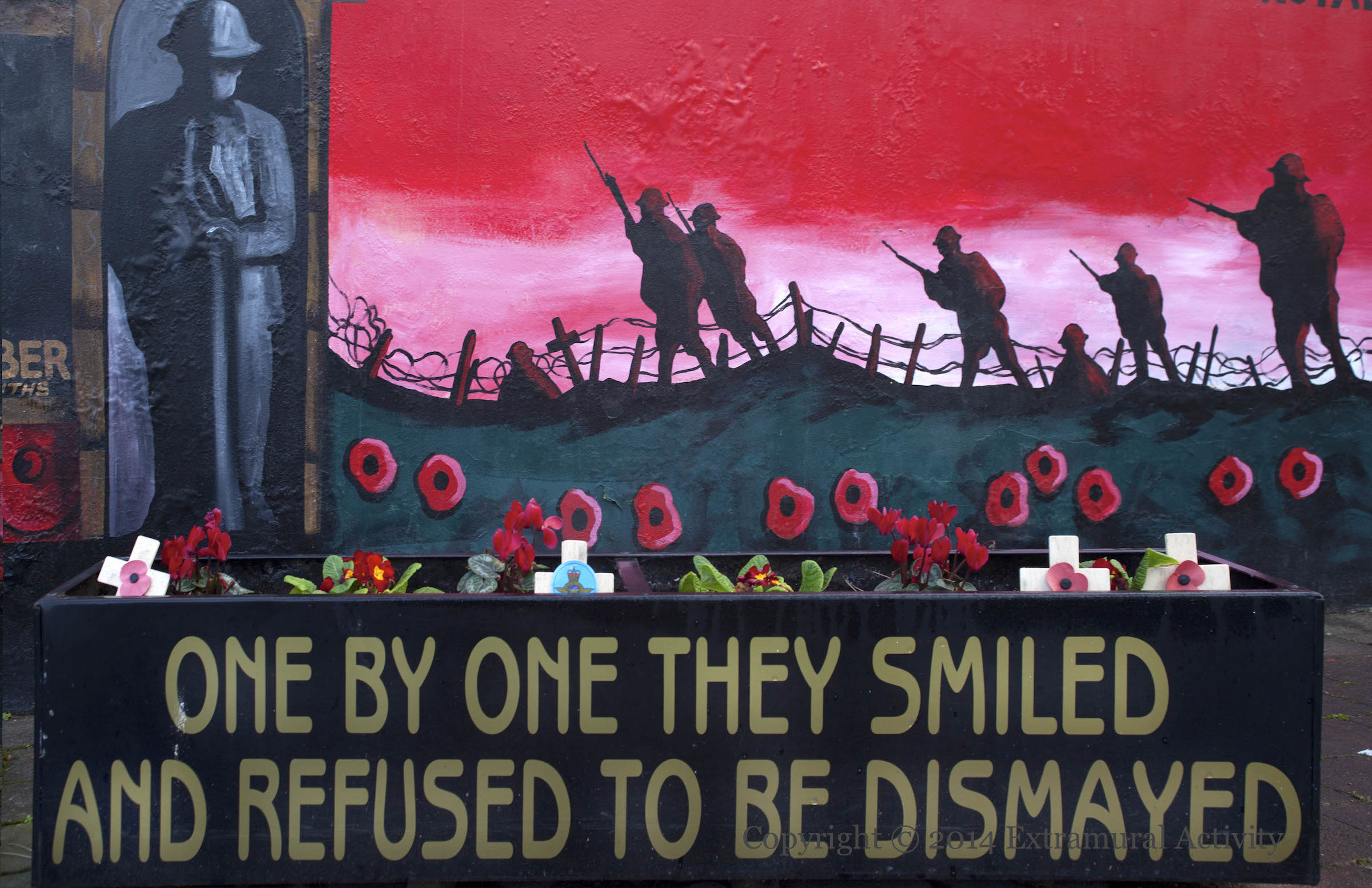
Two poems are featured prominently and another two alluded to in this Newtownards mural and memorial garden to WWI soldiers. The main panel features part of an anti-war work by Owen Griffith, Lest We Forget. Robert Laurence Binyon’s For The Fallen is featured on the stone, above a line of Latin from Horace’s Odes (III.2) – On Virtue(which most famously re-appears in Owen’s Dulce Et Decorum Est). On the left and right (see the wide shot at the very bottom) there appear the mottos of the Royal Irish Rifles – ‘Quis separabit’, which comes from Romans 8:35 – and the Royal Artillery – ‘Ubique – Quo Fas Et Gloria Ducunt’, which comes from Kipling’s Ubique.
For the (WWI) 13th battalion RIR, see Regimental List and similarly for the 16th (rather than the 17th) “Pioneers”. For the (WWII) 5th Anti-Aircraft battery, see Newtownards History.
Four (of five) panels from Main Street, Ballywalter, commemorating the troops who went to France “on October 15th, 1915” and who died in the Great War (“The Last Post” is played by Ballywalter flute band at Ballywalter War Memorial, perhaps at its unveiling in 1922, though no mention of the flute band is made in the report cited at Ulster War Memorials), and the local fishing industry.
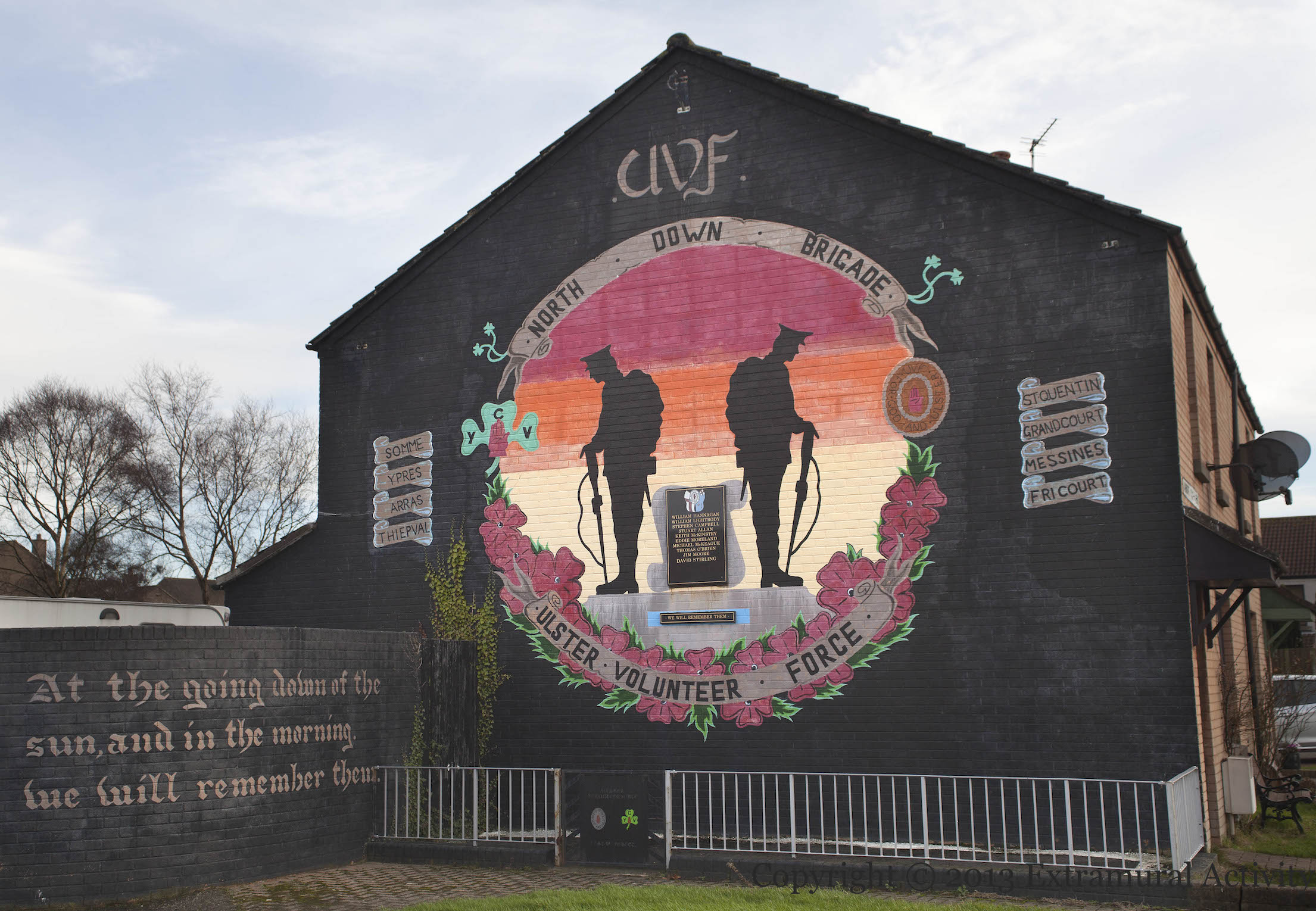
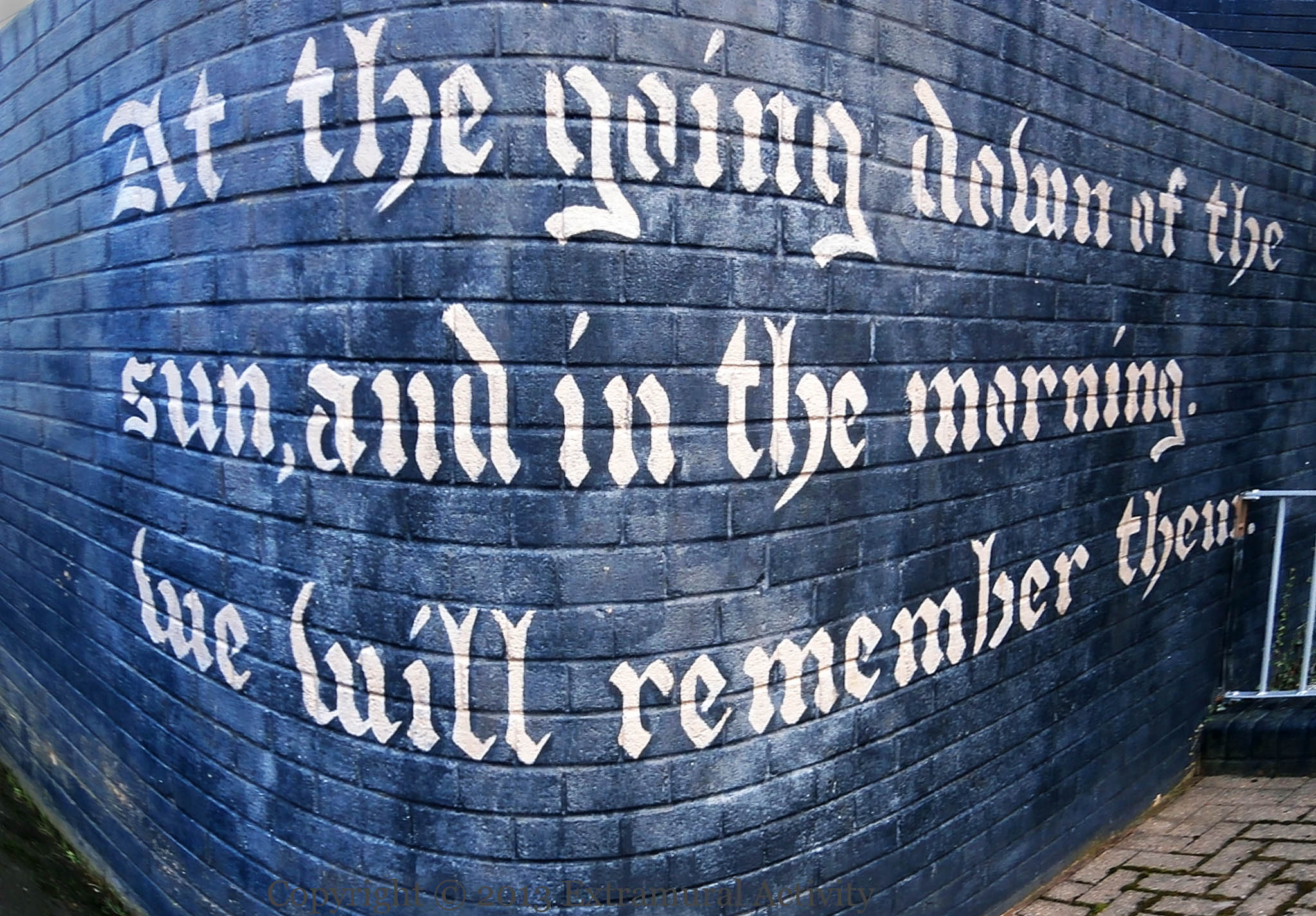
Mural in Newtownards to the Ulster Volunteer Force and Young Citizen Volunteers of the first world war shows two soldiers bent in reflection against an orange and red background, suggesting sunrise/sunset. “At the going down of the sun and in the morning, we will remember them.”
Close-ups of the wall to the left (featuring lines from Binyon’s For The Fallen) and the plaque in the middle can be found below.










 Extramural Activity