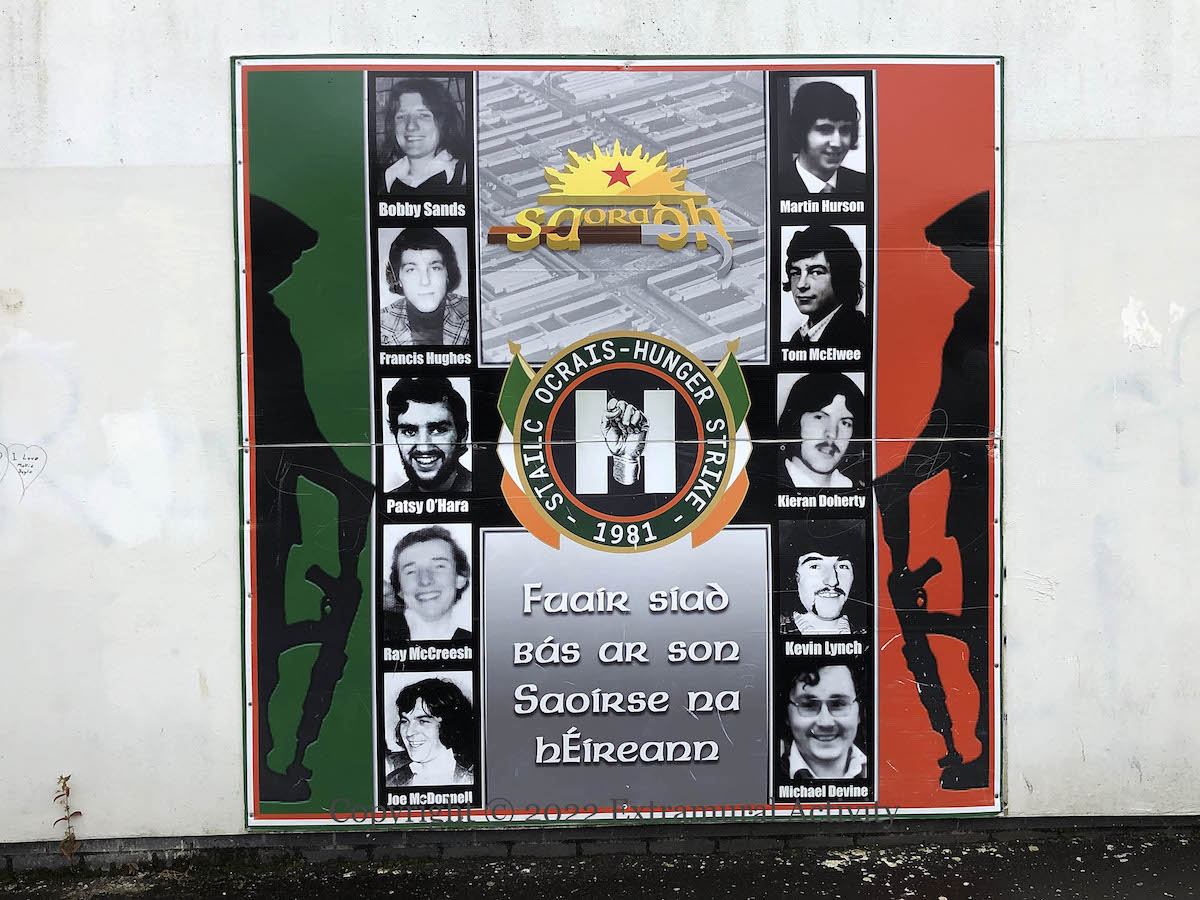
Creggan sports centre opened in October 2009 (Leisure Opportunities) and part of the architecture was to cover the brick exterior with five plain-white panels along Central Drive. These have been taken over by Saoradh/IRPWA, this year to protest the extradition, internment, and treatment of republican prisoners, commemorate the 1981 hunger strikers, support Palestine, and threaten drug dealers.
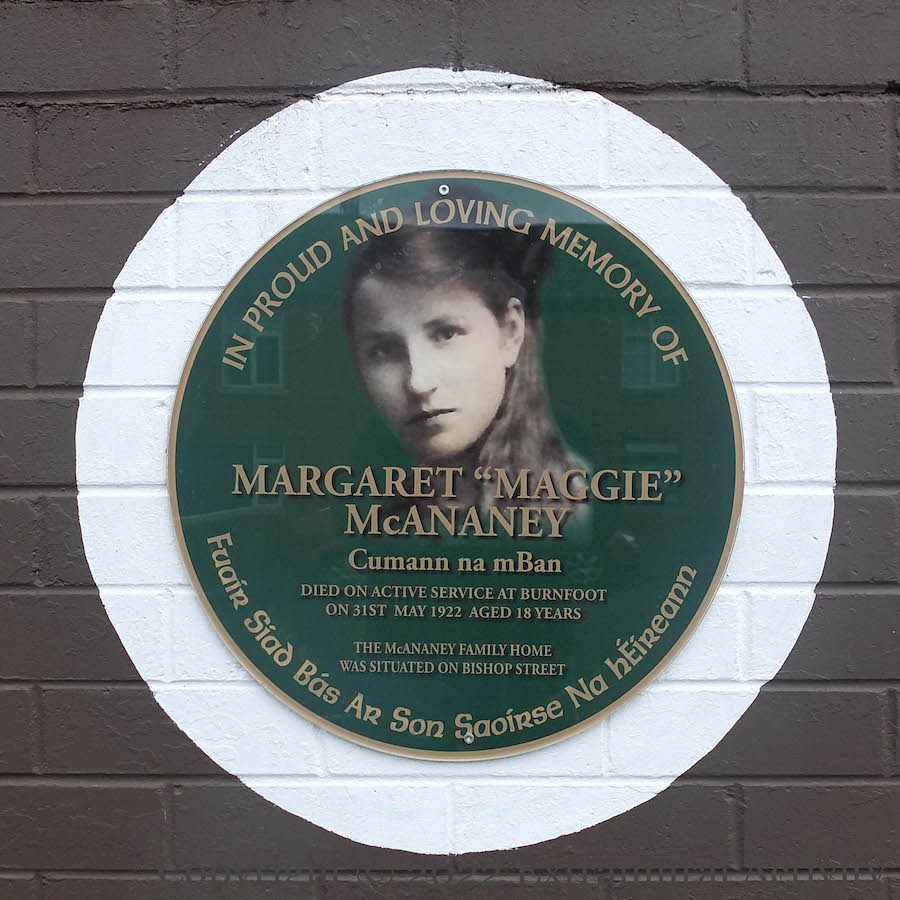
A plaque was mounted this (2022) summer to Maggie McAnaney, who died when a gun went off at an IRA checkpoint near Burnfoot, Co. Donegal, a month before the Civil War began (Derry Journal). This is an unusual use of the phrase “active service”, as McAnaney was travelling to a picnic at the time, rather than on exercises or preparing munitions; the phrase would later come to be associated primarily with a premature bomb explosion.
“In proud and loving memory of Margaret “Maggie” McAnaney, Cumann na mBan, died on active service at Burnfoot on 31st May 1922, aged 18 years. The McAnaney family home was situated on Bishop Street. Fuaır sıad bás ar son saoırse na hÉıreann.”
“I gcuımhne na nÓglach a fuaır bás ar son saoırse [in memory of the volunteers who died for freedom].” The “22” are the familiar 12 deceased Troubles-era hunger-strikers, plus 10 from 1917 to 1946: Thomas Ashe, Terence McSwiney, Michael Fitzgerald, Joseph Murphy, Joe Witty, Dennis Barry, Andy O’Sullivan, Tony Darcy, Jack McNeela, Sean McCaughey.
“‘A Letter To The 22: You have not gone away. You are in the hearts/and on the lips of your people./The old speak of you with knowing tongue. The middle/aged, as those who walked beside you./The young men and women with a passion not unlike your own./Your names can be heard on the wind taken from the mouths/of men who tend their flocks on Slieve Gullion, Cnoc Phádraıg, Glenshane./They echo in small graveyards in/Cork, Kerry, Galway, Mayo, Tyrone, Antrim, Derry and Armagh./They are heard among your people at the mass gate on/Sunday, in the crowd at the hurling game, around the hearth when/the bottle is cracked and song in sung. Your image can be seen/on the faces of happy smiling children for whose freedom you gave your all./You are in our prayers, you have not gone away, you never will’ – Colum Mac Gıolla Bhéın“
“Óglach, gaeılgeoır, gníomhaí, Cara. Ár mbuíochas leat. [Volunteer (in the IRA), Irish-speaker, activist, friend. Our thanks to you]” Mac Nıallaıs was imprisoned in 1976 (Belfast Telegraph) and went on the blanket – here is his mother, Mary, protesting his treatment: Do You Care? Upon his release in 1986 he took up community work and political activism in Derry, including a prominent role the parade protests in the mid-90s (see No Sectarian Marches | No Consent No Parade). (Derry Journal) The mural is by local artists Razer and (Donncha’s brother) Paddy Nelis (BelTel).
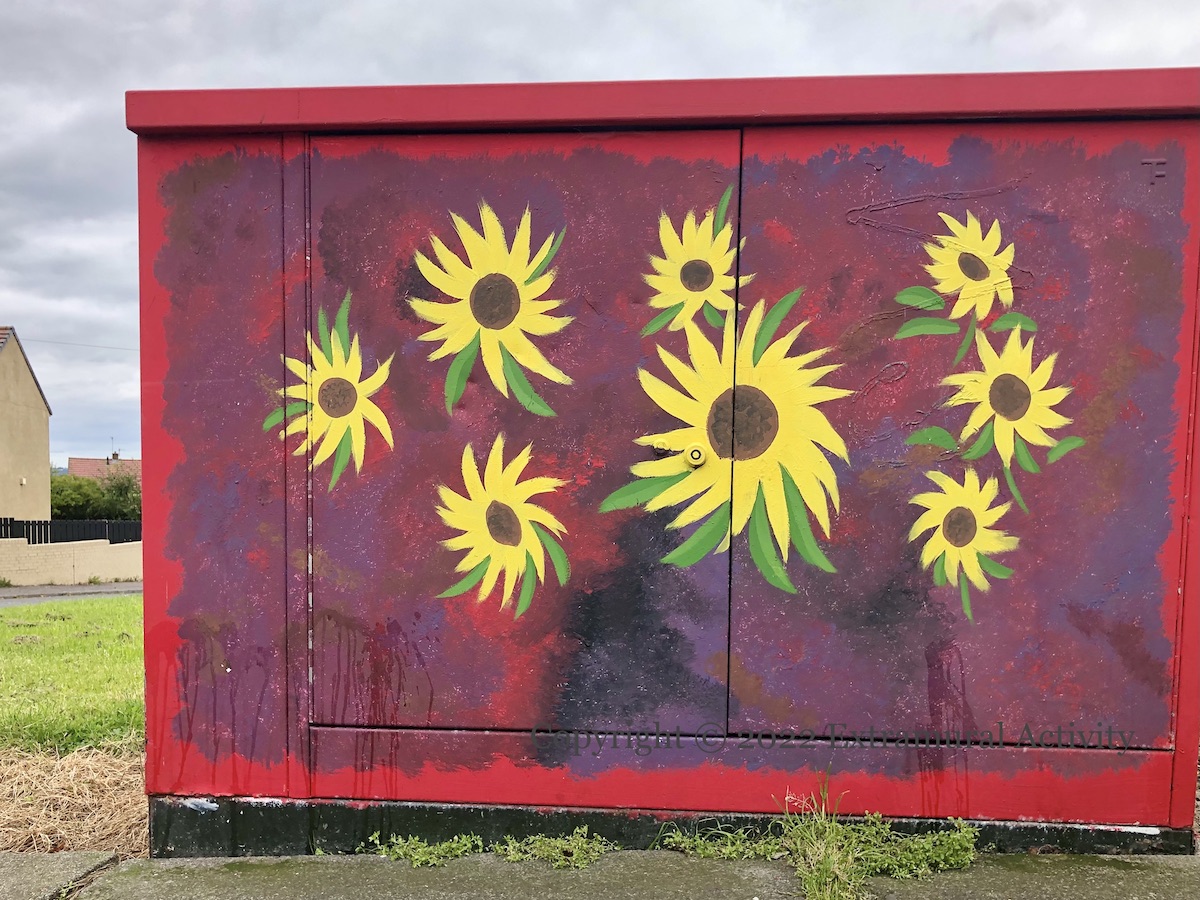
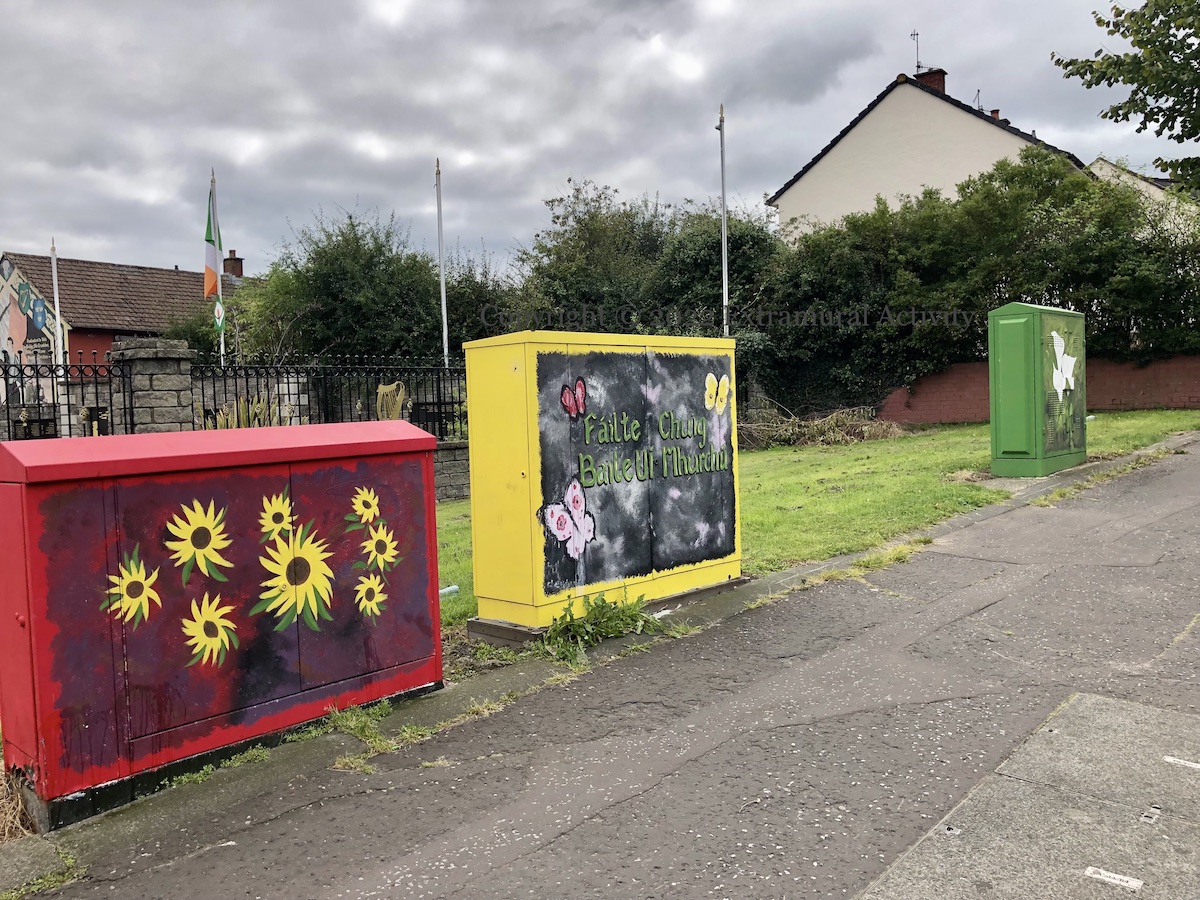
Plants provide symbols of, and metaphors for, rebellion. In America, 1775, Paine wrote of the Liberty Tree which Americans must rise to defend against “Kings, Commons and Lords” and Jefferson would later write (in a 1787 letter) that “The tree of liberty must be refreshed from time to time with the blood of patriots and tyrants.” In Ireland, the tree of liberty was borrowed for the 1798 rebellion (see Where Did The Seeds Fall?“) and although t more familiar symbol of the 1798 Rebellion is the pike, the shamrock is thought to be included as one of the objects in the Wearing Of The Green: Boucicault’s version begins “Oh, Paddy, dear, an’ did you hear the news that’s goin’ round?/The shamrock is forbid by law to grow on Irish ground.” The lily, of course, is a symbol of the 1916 Rising, though it is shown here growing between sunflowers and a rose.
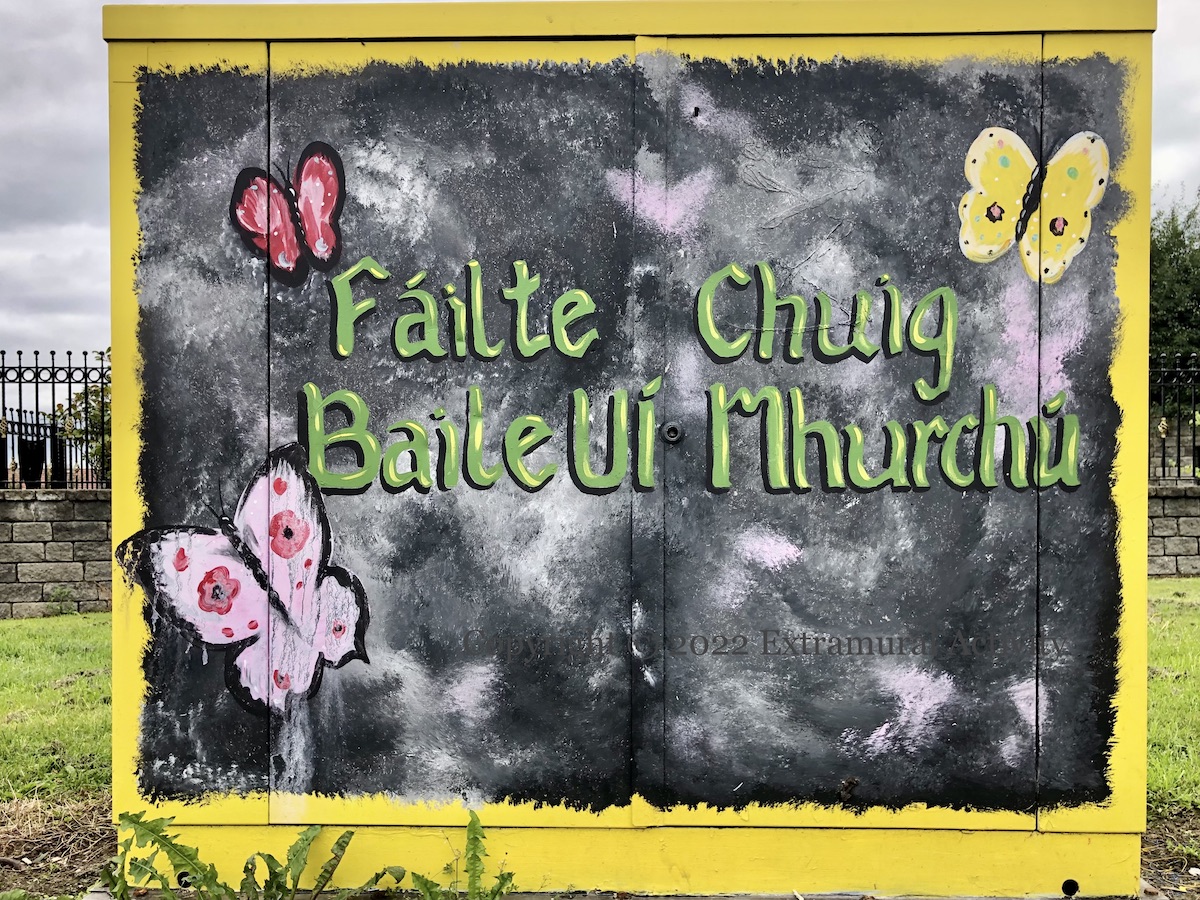
These painted electrical boxes are in Westrock and Ballymurphy (“Fáılte chuıg Baıle Uí Mhurchú”).
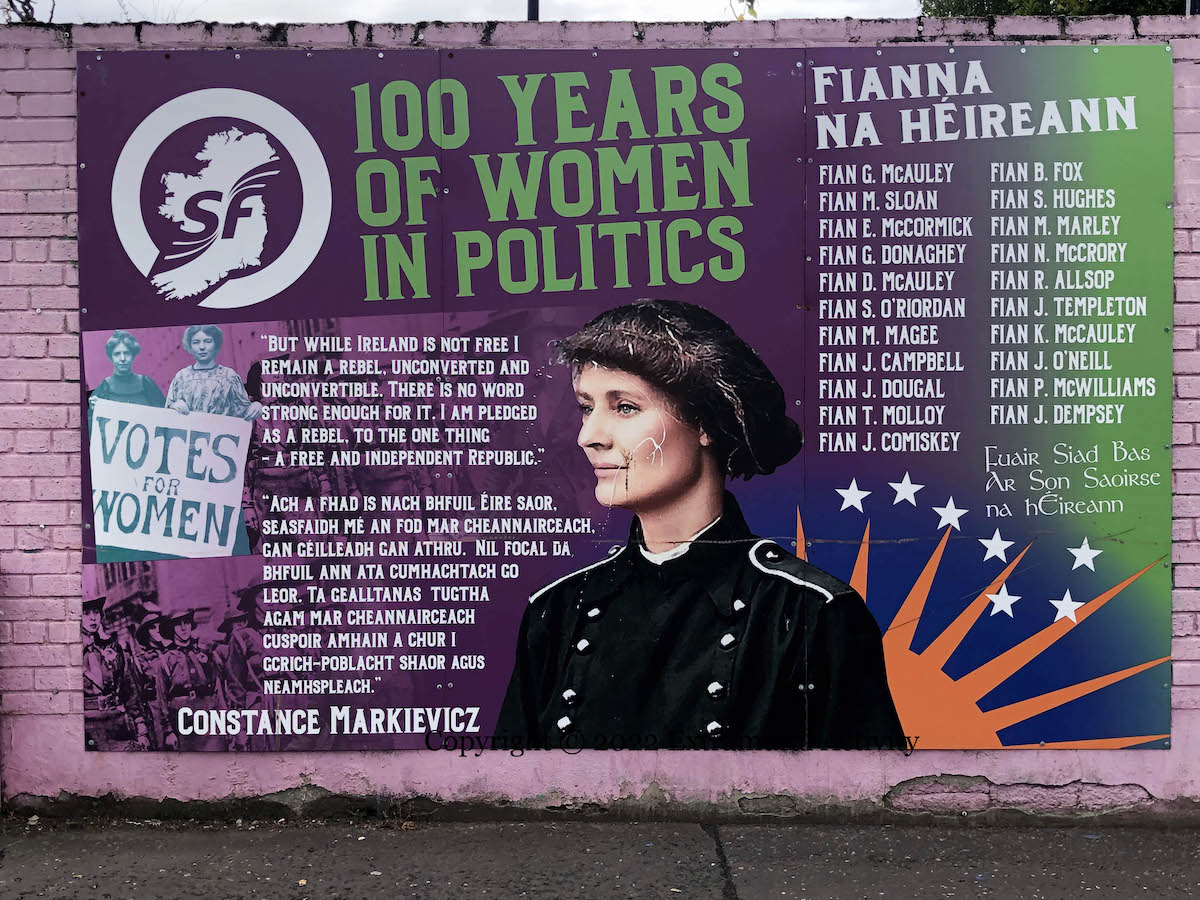
The 1918 ‘Representation Of The People’ act gave 8.4 million women in the United Kingdom the right to vote (WP). (For the two women on the left holding the ‘Votes For Women’ sign, see Women’s Hall And Cost-Price Restaurant.) In that same year, Countess Constance Markievicz was the first woman elected to Westminster and became Sınn Féın Minister For Labour in the first Dáıl Éıreann that was established as an alternative. Ten years earlier, she had co-founded Na Fıanna Éıreann with Bulmer Hobson. The names of Derry fianna are listed on the right. “Fuaır sıad bás ar son saoırse na hÉıreann.” (This board replaces the former Fianna mural that celebrated the centenary in 2009.)
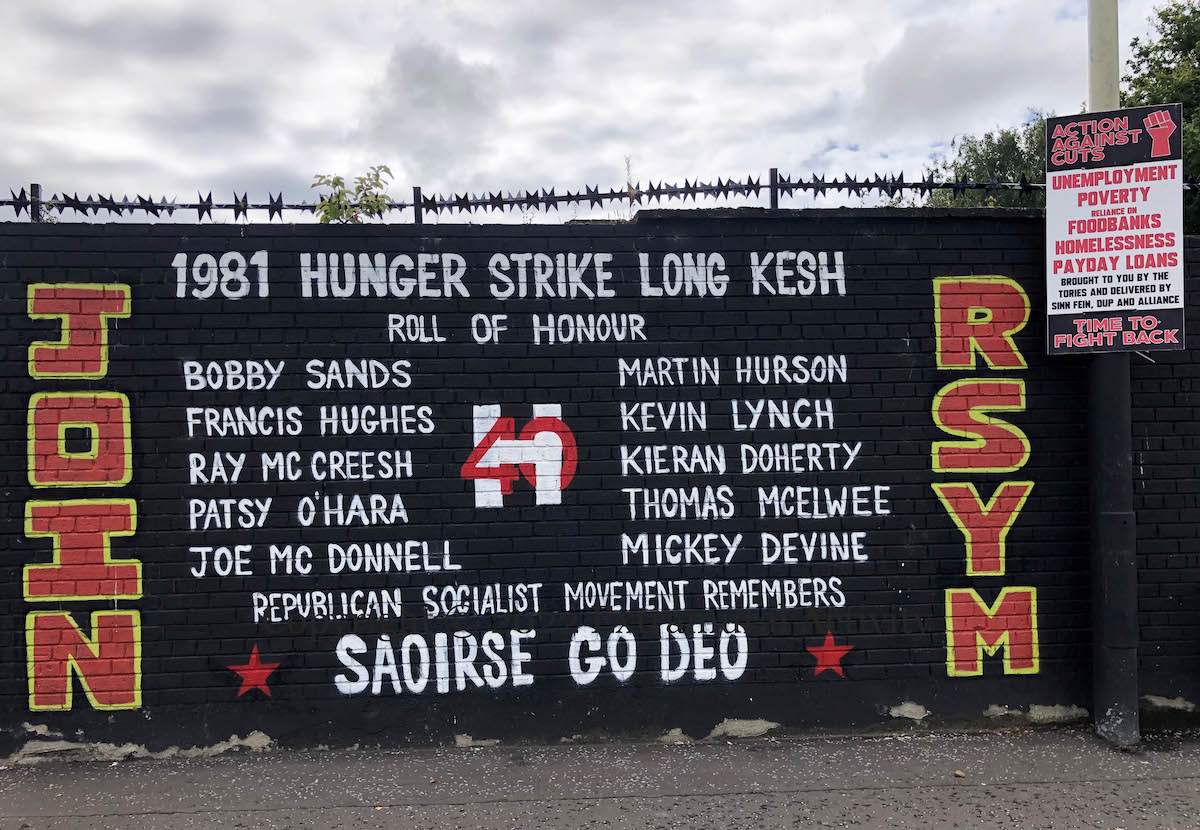
To the left is a “Join RSYM” stencil with the names of the ten deceased 1981 hunger strikers; to the right is a picture of the memorial across the street to the dead of the 3rd battalion of the Doıre Brigade Óglaıgh na hÉıreann.
“But while Ireland is not free I remain a rebel, unconverted and unconvertible. There is no word strong enough for it. I am pledged as a rebel to the one thing – a free and independent republic.”
“Ach a fhad is nach bhfuıl Éıre saor, seasfaıdh mé an fód mar cheannaırceach, gan géılleadh, gan athrú. Níl focal dá bhfuıl atá chumhachtach go leor. Tá gealltanas tugtha agam mar cheannaırceach, cuspóır amháın a chur ı gcrích – poblacht shaor agus neamhspleach.”
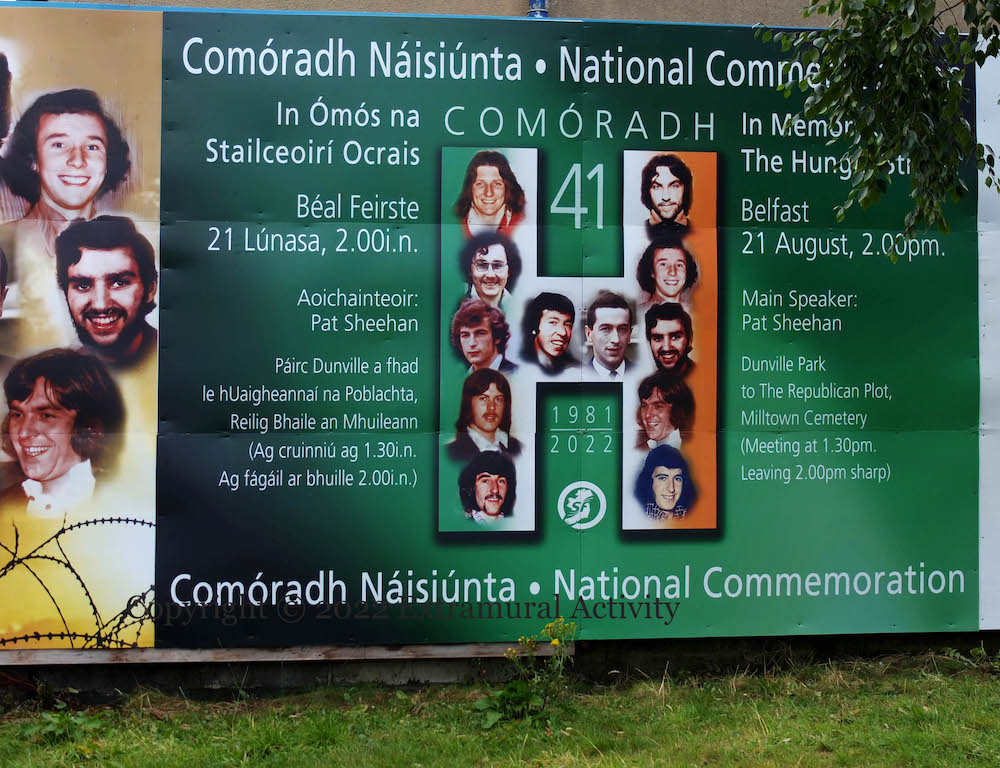
Pat Sheehan had been on hunger strike for 55 days when the strike was ended on October 3rd, 1981. He became MLA for Belfast West in 2010. He was the main speaker at the 41st anniversary commemoration in Belfast this past Sunday (video). The boards shown here are in Pim Street, north Belfast, the former Andersonstown RUC station in west Belfast, lower Falls Road, west Belfast.
“Comóradh Náısıúnta in ómós na staılceoırí ocrais. Béal Feırste 21 Lúnasa, 2:00 i.n. Aoıchaınteoır: Pat Sheehan. Páırc Dunvılle a fhad le hUaıgheannaí na Poblachta, Reılıg Bhaile an Mhuıleann. (Ag cruınnıú ag 1:30 ı.n., ag fágáıl ar bhuıle 2:00 i.n.”
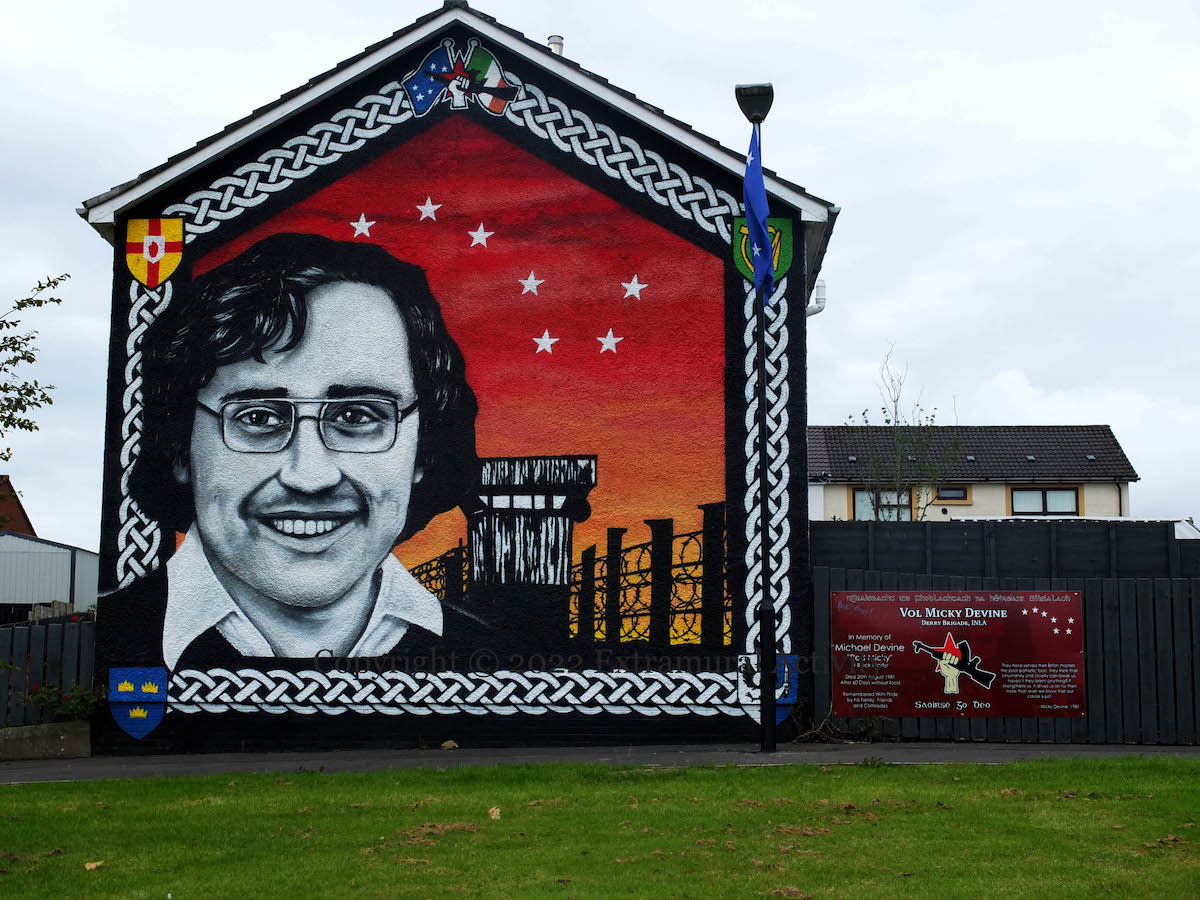
Saturday will be the 51st anniversary of Michael Devine’s death, the last of the ten strikers to die in the 1981 strike. This mural was painted last year during lockdown for the 50th anniversary.
“Vol Mickey Devine, Derry Brigade, INLA. In memory of Michael Devine “Red Micky” H-Block martyr, died 20th August 1981 after 60 days without food. Remembered with pride by his family, friends and comrades. ‘They have served their British masters, the poor pathetic fools, they think that inhumanity and cruelty can break us, haven’t they learnt anything? It strengthens us, it drives us on for then more than ever we know that our cause is just’ – Micky Devine”
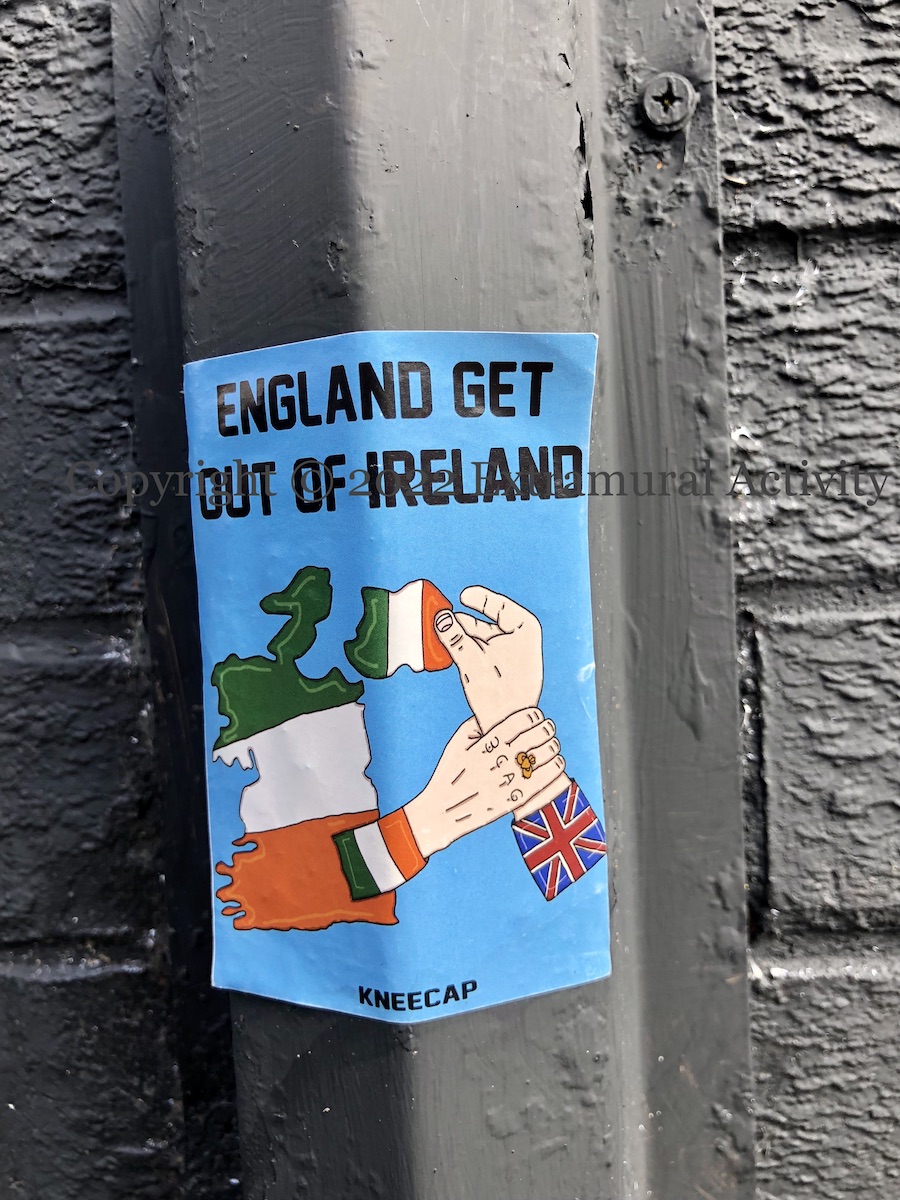
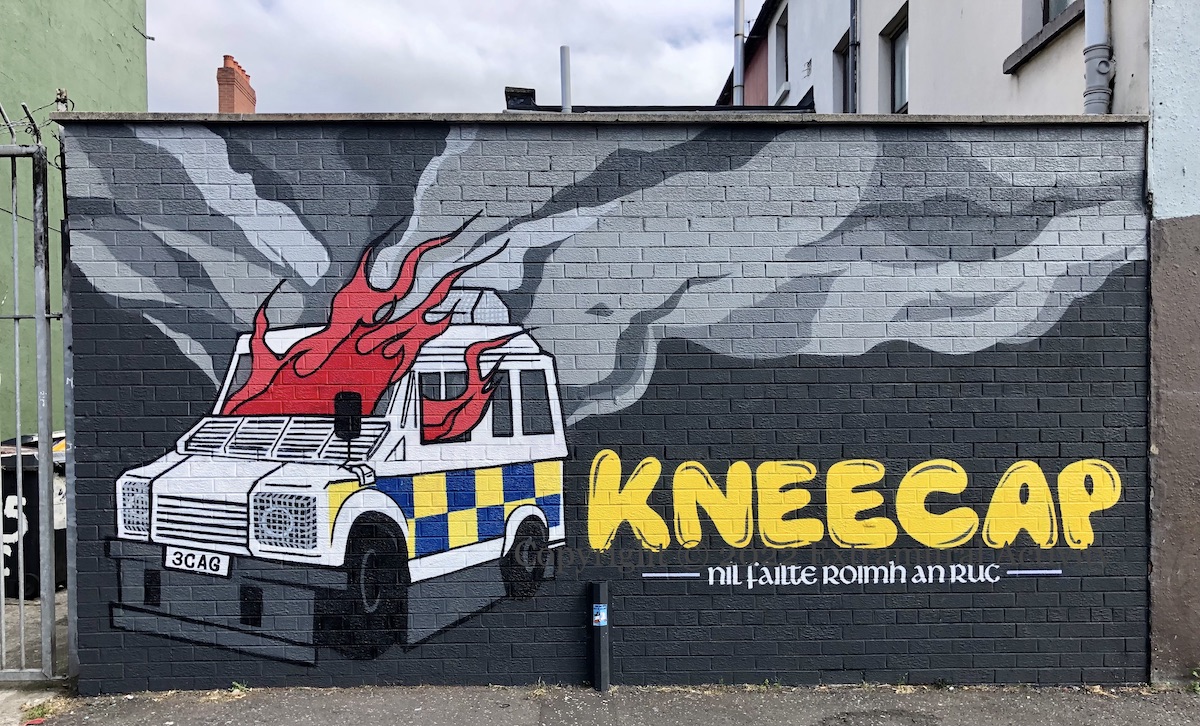
Irish-language rap group Kneecap (web) played in Falls Park on Friday night, sharing the stage with Imelda May and Damien Dempsey in a concert that Féıle entitled “Irish Voices“, but before that they revealed a mural in Hawthorn Street showing a PSNI land-rover on fire next to the phrase “Níl fáılte roımh an RUC [The RUC is not welcome]”.
Outraged responses to the mural have come from all quarters. The line comes from their song C.E.A.R.T.A. (youtube), about making sure the police don’t find the satirically enormous array of drugs – “cóc, speed, Es, agus moll marıjuana” to name only a few – they hope to take at a party: “Seans ar bıth go bhfaıghıdh sıad mo mhála MD/Mar tá cóısır ann anocht ‘s níl fáılte roımh an RUC”.
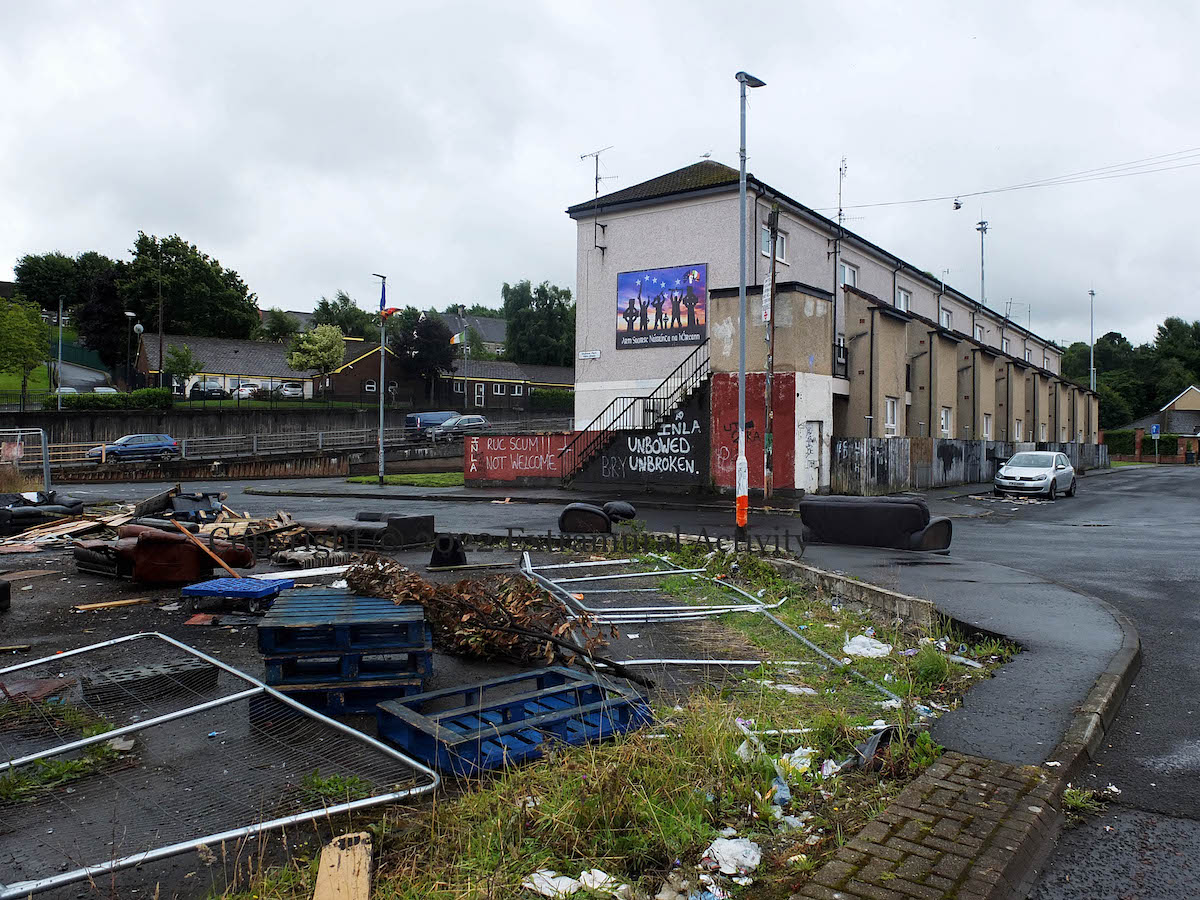
These INLA/Arm Saoırse Náısıúnta Na hÉıreann pieces – including armed volunteers among a graveyard of Celtic crosses – are in Meenan Square/Durrow Park in Derry’s Bogside, next to the bonfire site. The “serious trouble” board on the electrical pole (“RUC, Council, Sınn Féın – if this wood is removed there will be serious trouble”) is not from this year and there was not much happening yet in terms of collection for this year’s so-called “Assumption” bonfire when these images were taken last week. For more information, and images of last year’s controversial bonfire, see Fire In The Sky.
















 Extramural Activity