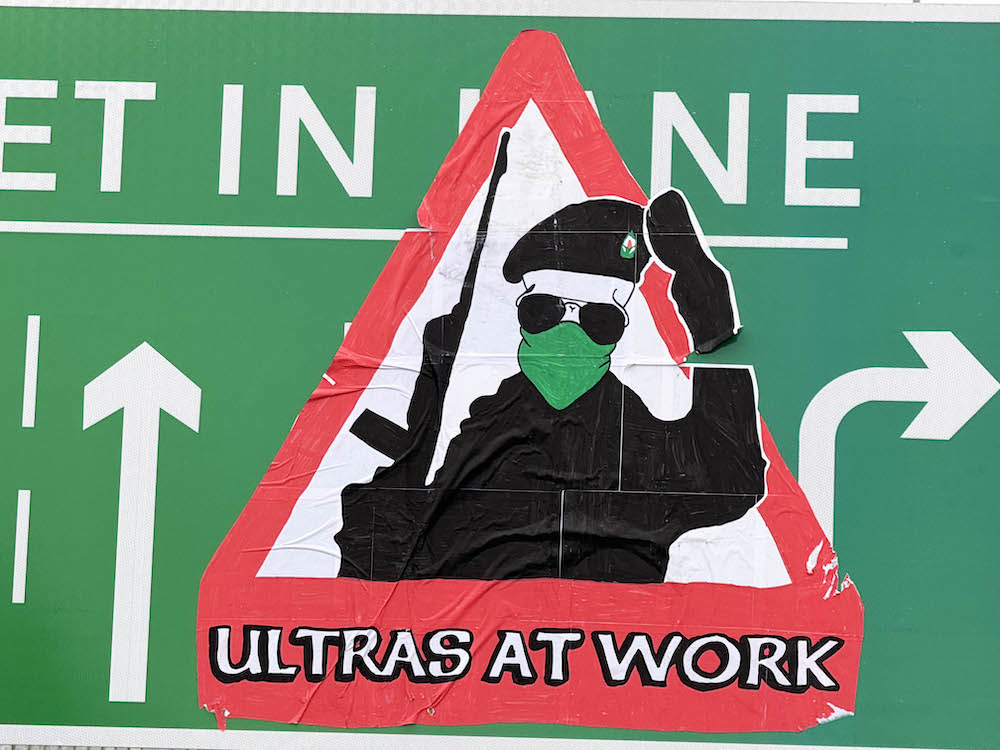
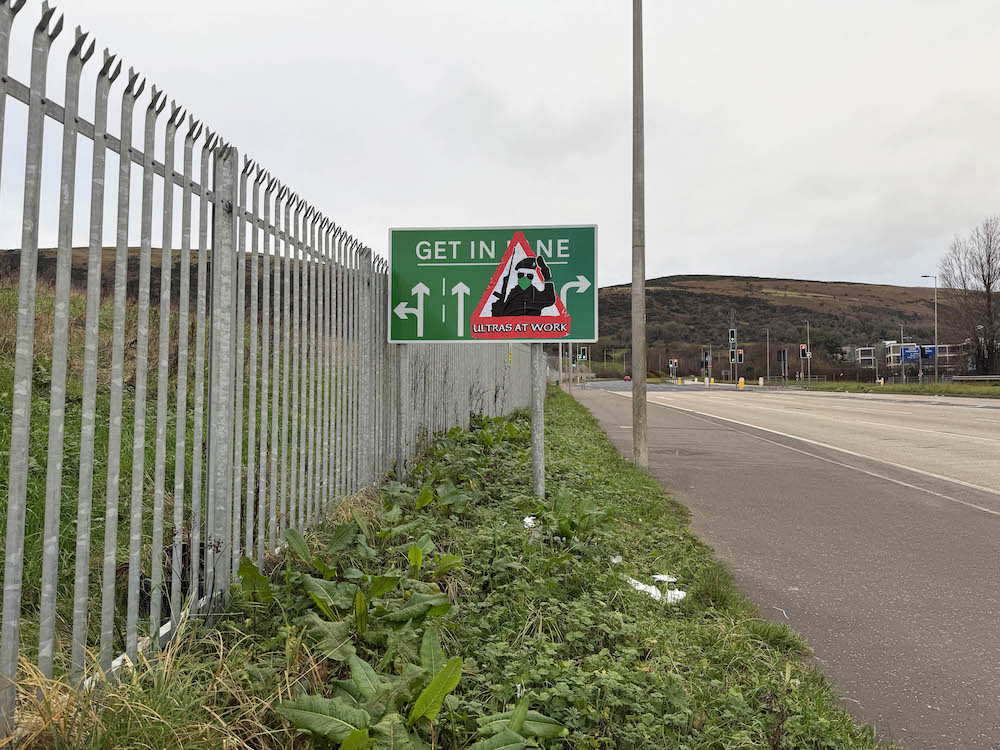
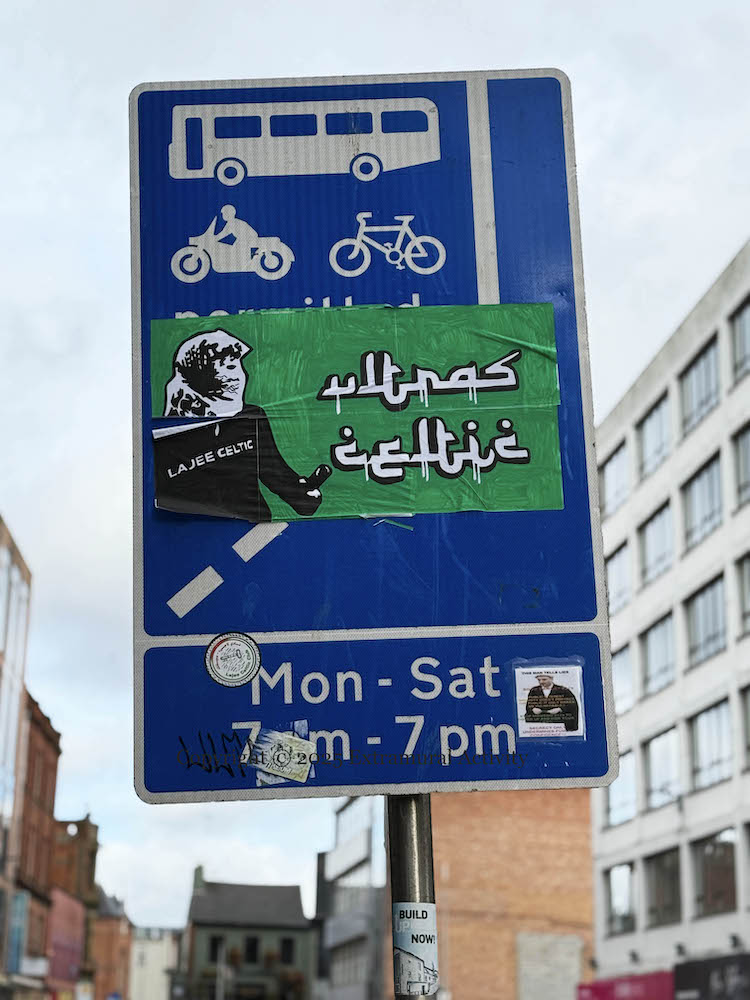
The “Green Brigade” is the name of a group of Celtic ultras (web). The design and slogan of the paste-up come from the “Sniper at work” signs from the 1990s, which celebrated the IRA’s sniper campaign in the south Armagh area – various examples can be seen in the Peter Moloney Collection.
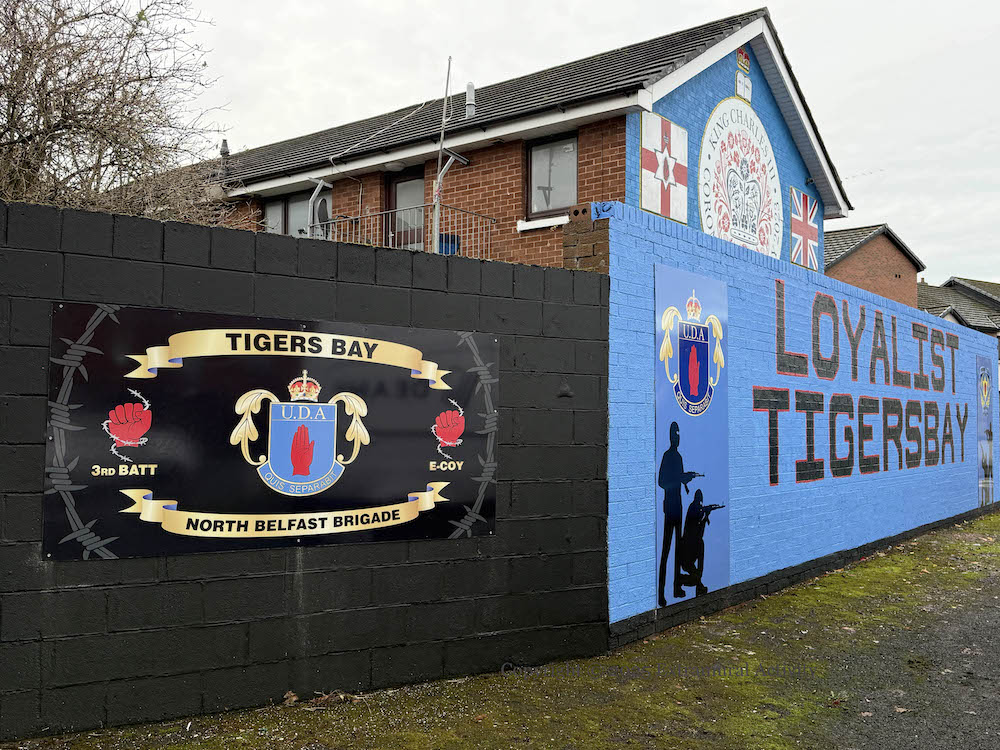
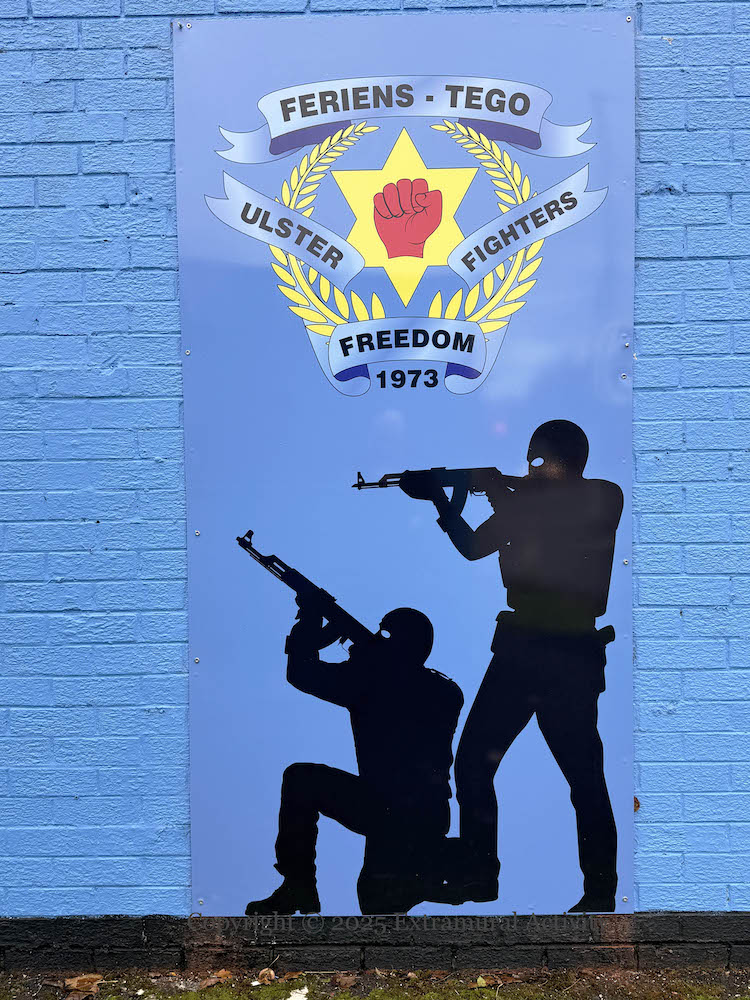
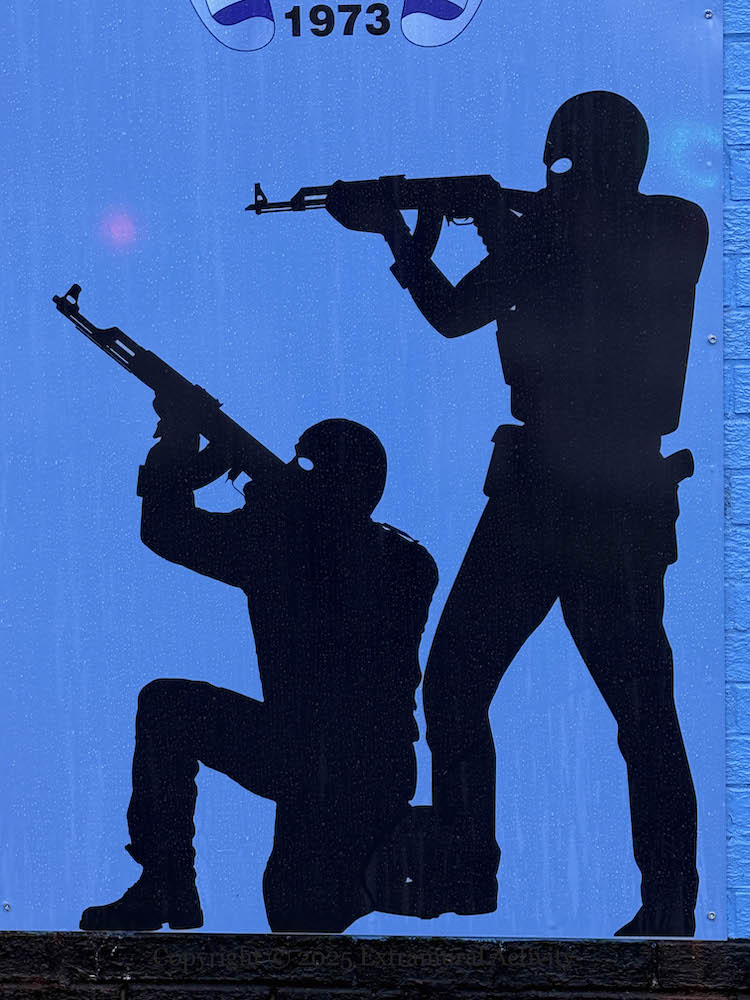
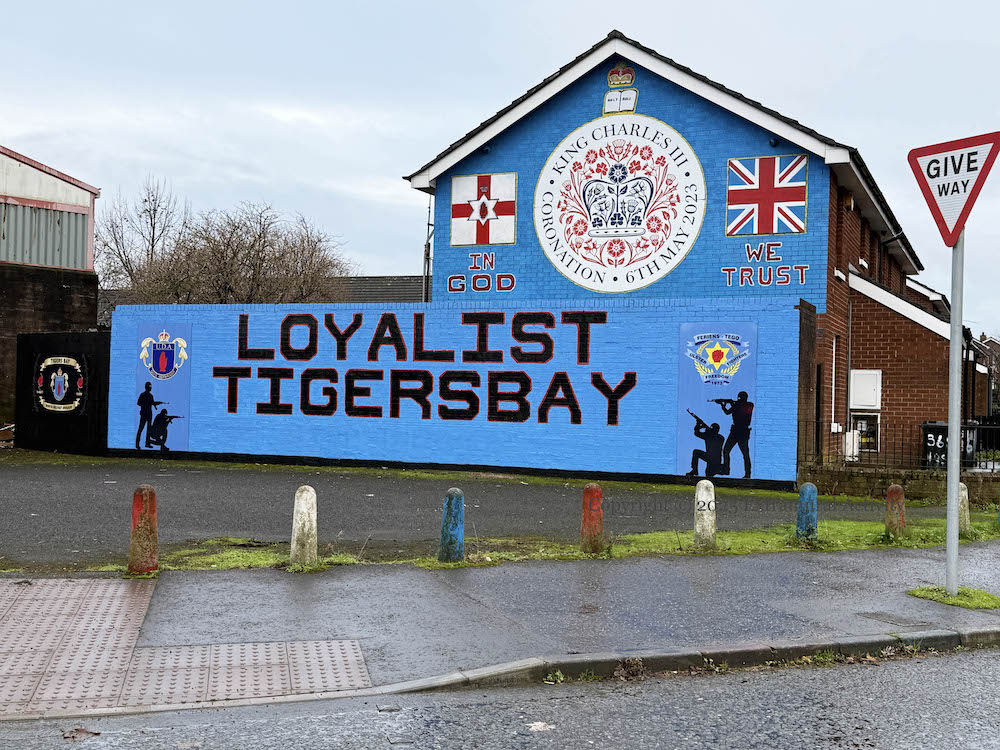
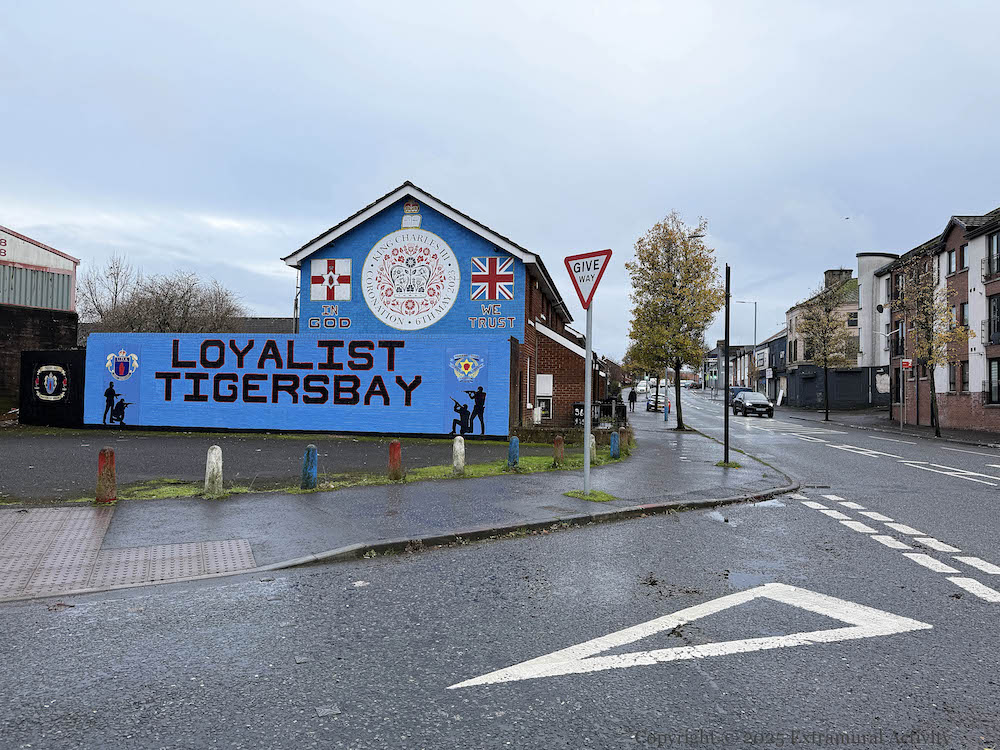
Stop The Boats has been painted out below the large “Loyalist Tiger’s Bay” and the entire wall painted in solid blue and book-ended by UDA and UFF boards showing silhouetted gunmen in active poses.
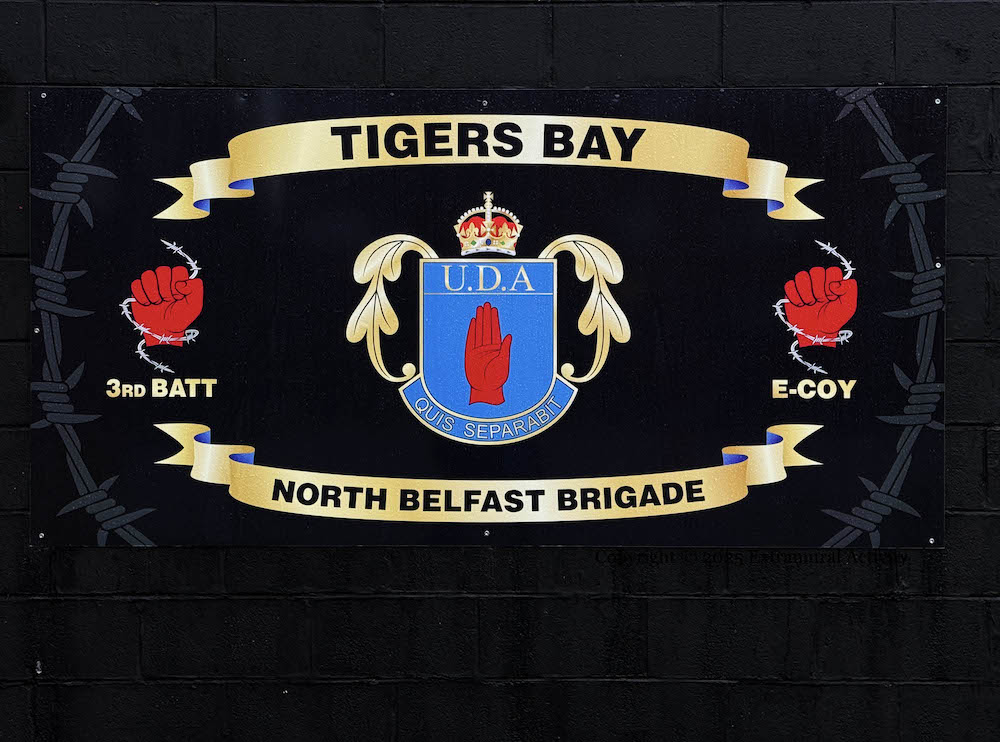
The side-wall, home to painted Orange Order symbols since 2017, has been painted black and a board (above) added to E company from Tiger’s Bay. (It’s possible “North Belfast brigade” and “3rd battalion” are the same thing.)
The UVF mural overlooking the entrance to Mount Vernon has been repainted after Storm Darragh back in December (2024) knocked down part of the wall it was painted on (see Taken By Storm) and the remainder of the wall was subsequently knocked down (see Prepared For Space, Ready For Wall).
There were local voices against the repainting of the mural (Sunday World) but after the wall (which is owned by the Housing Executive) was rebuilt, scaffolding went up at the end of March (BelTel) and painting began in June.
The mural will be officially launched at the Twelfth celebrations. The repainting has been criticised by the father of one UVF victim (BelTel). One (very) small mercy is that neither of the gunmen – from the North Belfast UVF – is directly confronting the viewer (including the drivers coming off the M2 at Fortwilliam.
Images of the completed mural are from June 26th; the in-progress images are as dated below.
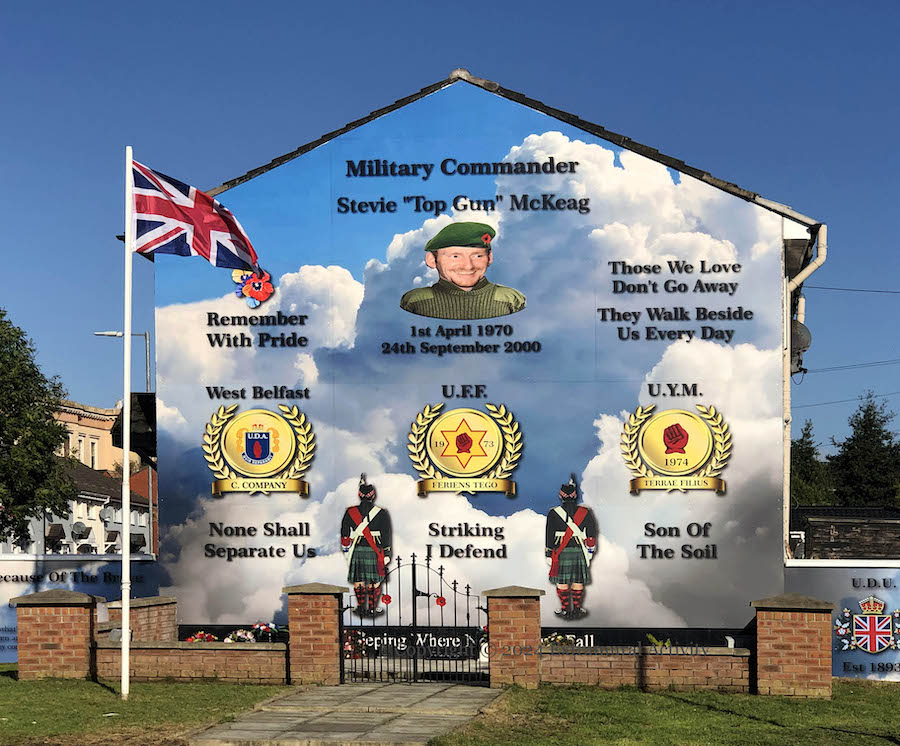
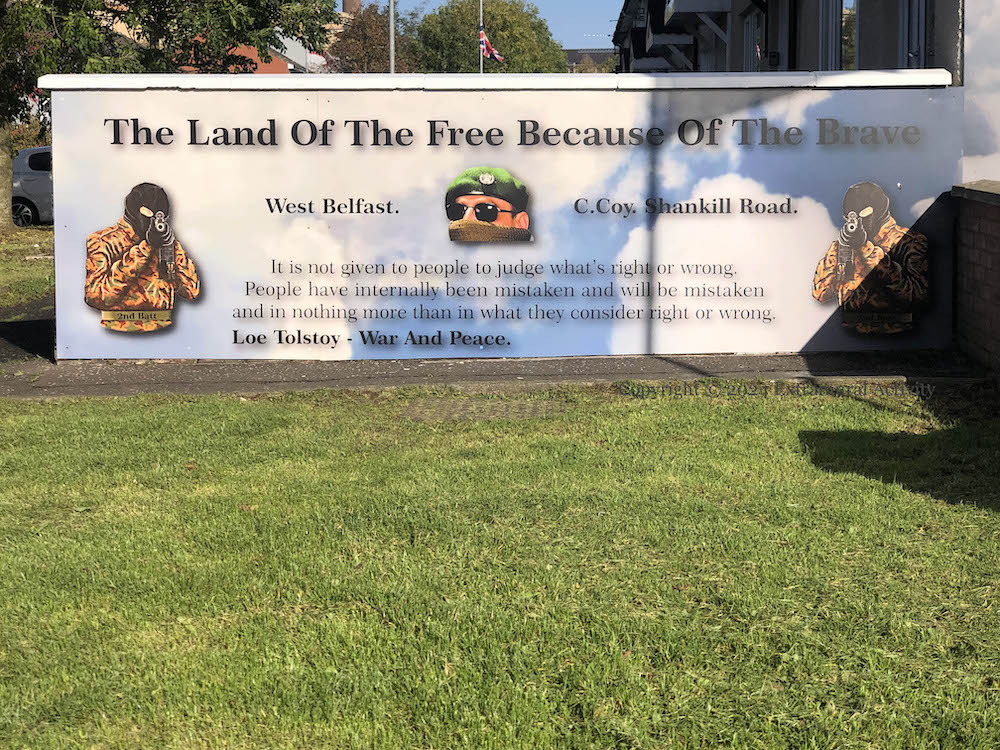
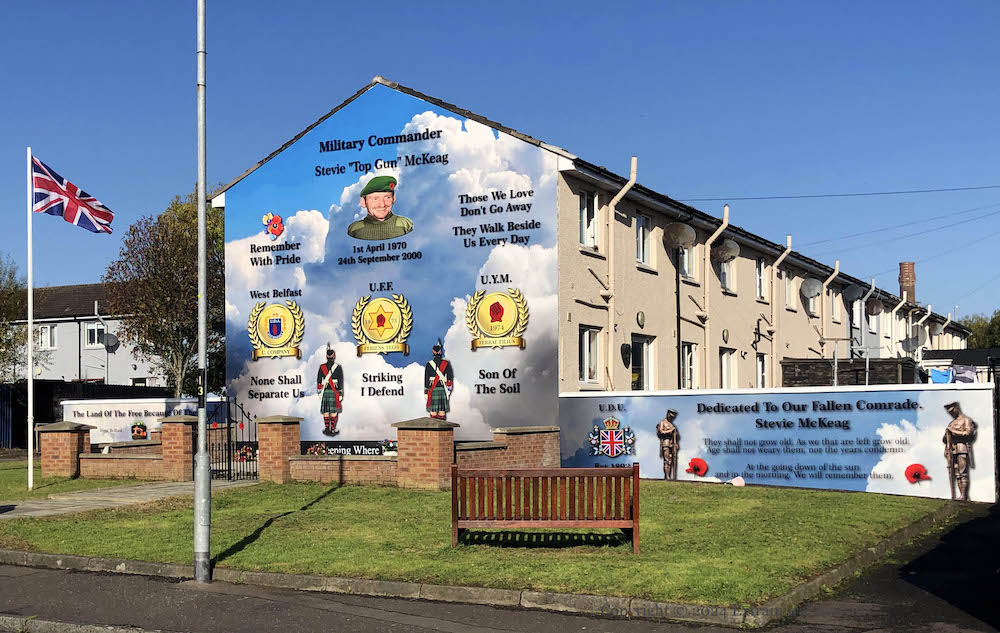
A new tribute to UDA assassin Stevie “Top Gun” McKeag has been put in place in the lower Shankill, replacing the flat-capped version of 2016.
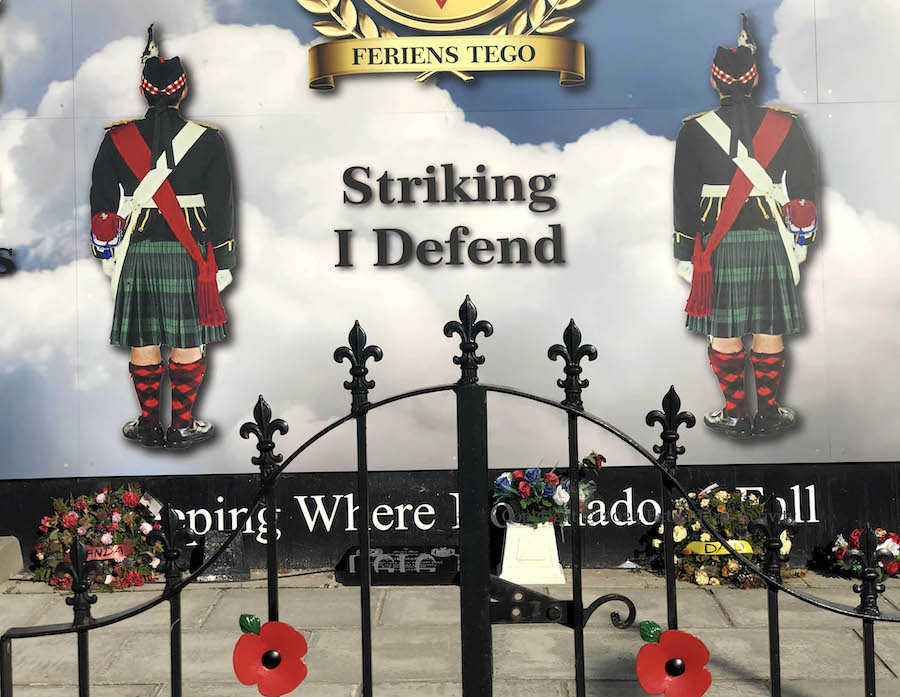
The main-streaming of McKeag continues with this new display: in the previous version he was presented in soldierly garb but as a soldier of the UDA; now, one would be forgiven for thinking that McKeag was a soldier in the British Army, given that the “military commander”‘s beret is now green (rather than grey) and now adorned by a poppy (rather than the UFF star), both complementing the commando-style sweater he is wearing. He is also being mourned by band leaders in ceremonial dress, such as is worn by the Royal Regiment Of Scotland (dress regulations pdf) when serving as equerries to the royal family.
In the right-hand side-wall, the UDU, the poppies, and the graveside mourners are used to put McKeag’s actions in the context of resistance to Home Rule and the British Army’s role in the Great War. McKeag killed at least a dozen Catholics between 1990 and 1998 (WP). He is shown here smiling.
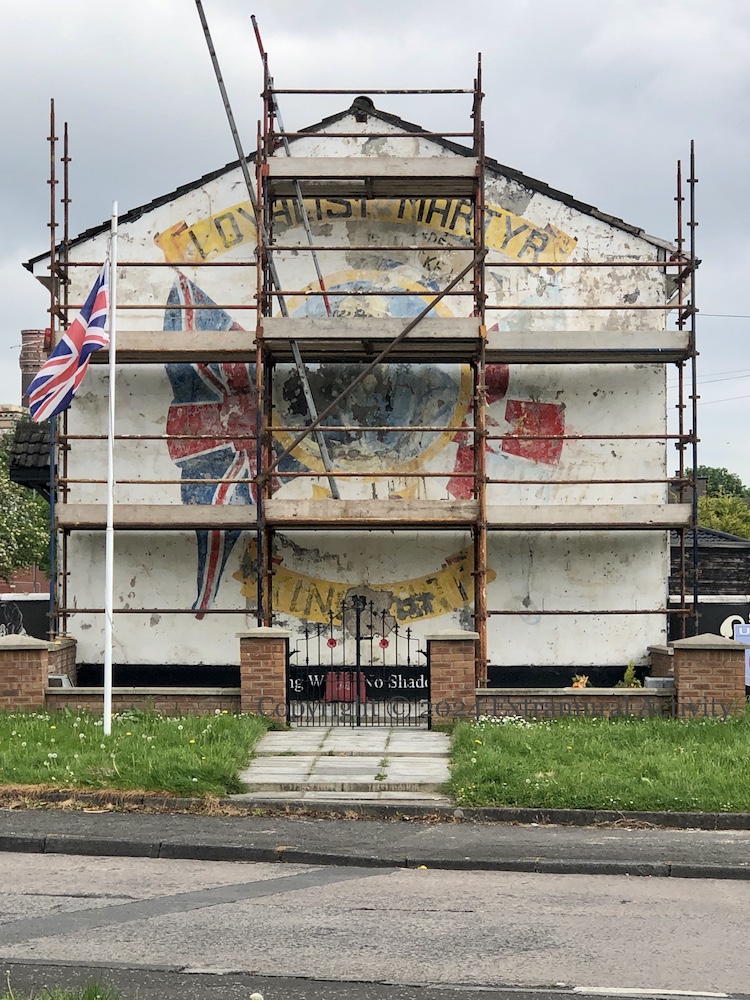
Not only does this display replace the previous display, but the paint from previous murals (and perhaps a layer of plaster) was removed, until the original mural on the wall, of “King Rat” (D01005), was reached. It then appears that the new display was mounted on top of this. The following image is from May 15th:
Dundela “ultras” have been told they are not welcome at the team’s future games after “unsavoury chanting” at the NI Championship match against local rivals H&W Welders – “the most cataclysmic derby match in world football” (BelTel).
Thirteen more soccer-related stickers are below, including [Glasgow] Rangers Action Force.
The “Pilgrims” mural on the Newtownards Road has been replaced with an almost-identical representation on boards. As far as we know, this is the fourth instance of this design. Other instances of this mural are: Mersey St c. 1997-2007 (T00240); Tamar St (c. 2002-2005) (M02337); a small version above Cheepers c . 2006 (M02920); and the previous version in this spot on Newtownards Road, 2011-2022 (X00905). The existing mural was significantly faded; the companion “Elementary Right” mural on the other side of the Newtownards Road is less faded but (as can be seen in the final image, below) the paint is peeling away in places.
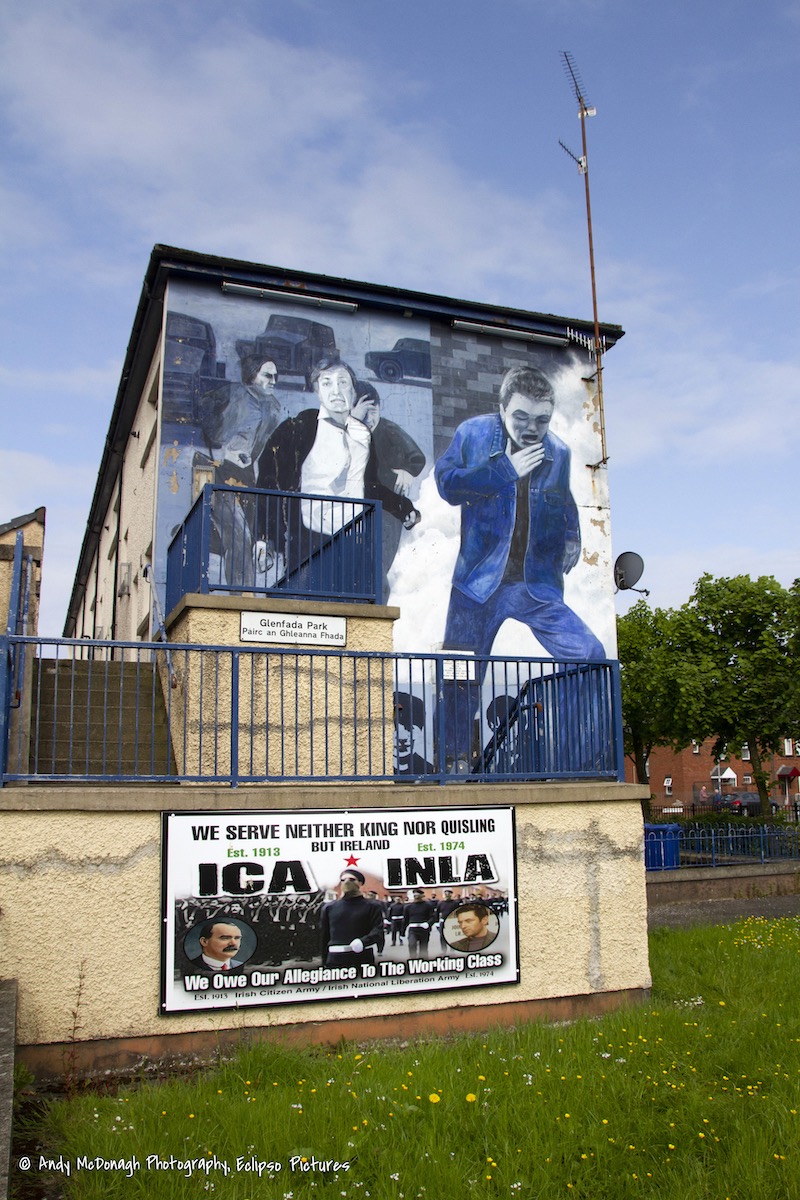
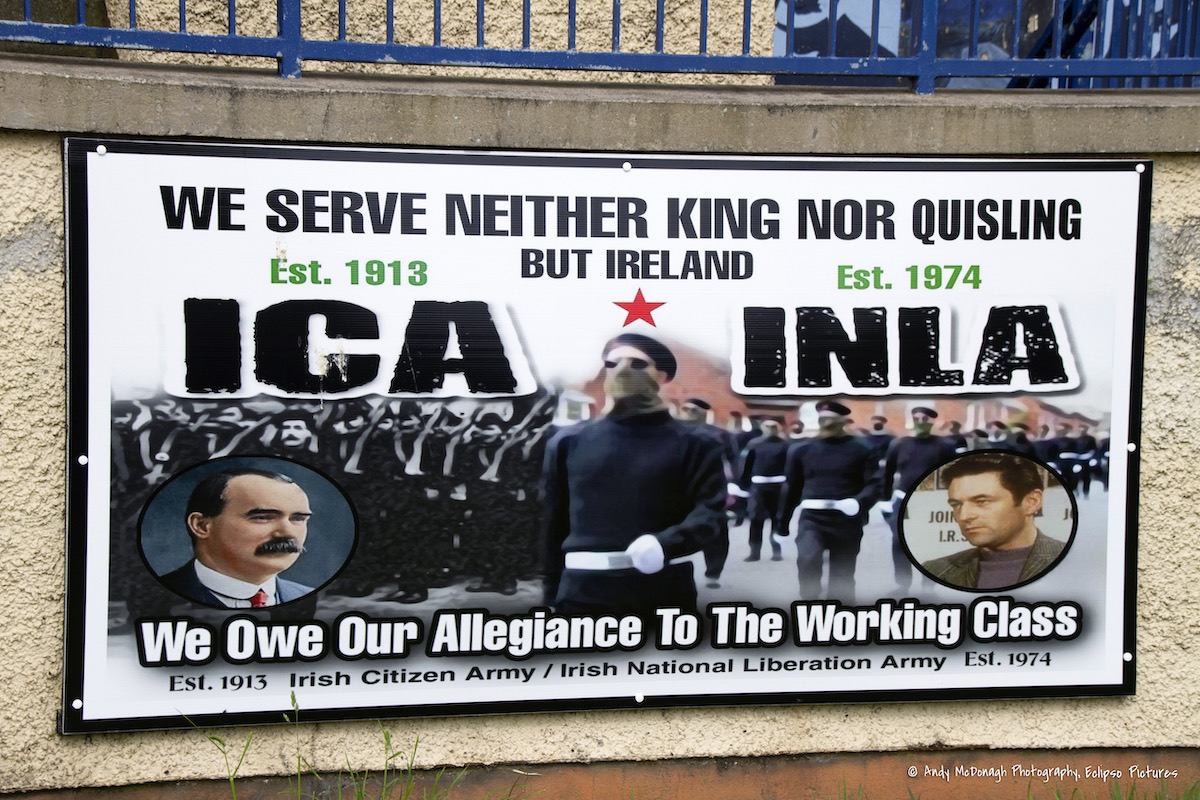
“Est 1913 Irish Citizen Army / Irish National Liberation Army Est. 1974”. The Irish Citizen Army was founded in Dublin in 1913 to protect striking workers from police violence. After taking part in the Easter Rising of 1916, however, the ICA did not participate in the War Of Independence and the Civil War. In 1974, some founding members considered reviving the “ICA” name to reflect the organisation’s “allegiance to the working class” while Costello (pictured on the right) suggested “National Liberation Army”, which was then amended to include “Irish” (History Ireland | WP | WP). MNI includes an “ICA-INLA” Starry Plough on the stairs into the New Lodge from 1989 (C00105).
The banner raised over the Liberty Hall headquarters of the ICA read “We serve neither king nor kaiser but Ireland” – the famous photograph is included in the post of the same name – but this has been updated. The Belfast version of the board, above, reads “nor Nato”, while a Derry version, below, reads “nor quisling”.
There are three hooded gunmen on the main panel of this new installation along Conway Street, Belfast, and the side panel is a gallery of 14 photographs of hooded gunmen, flanked on either by two more hooded gunmen.
Please note: the photograph above has been photoshopped for colour. The true colour (orange) can be seen in the wide shot, below.
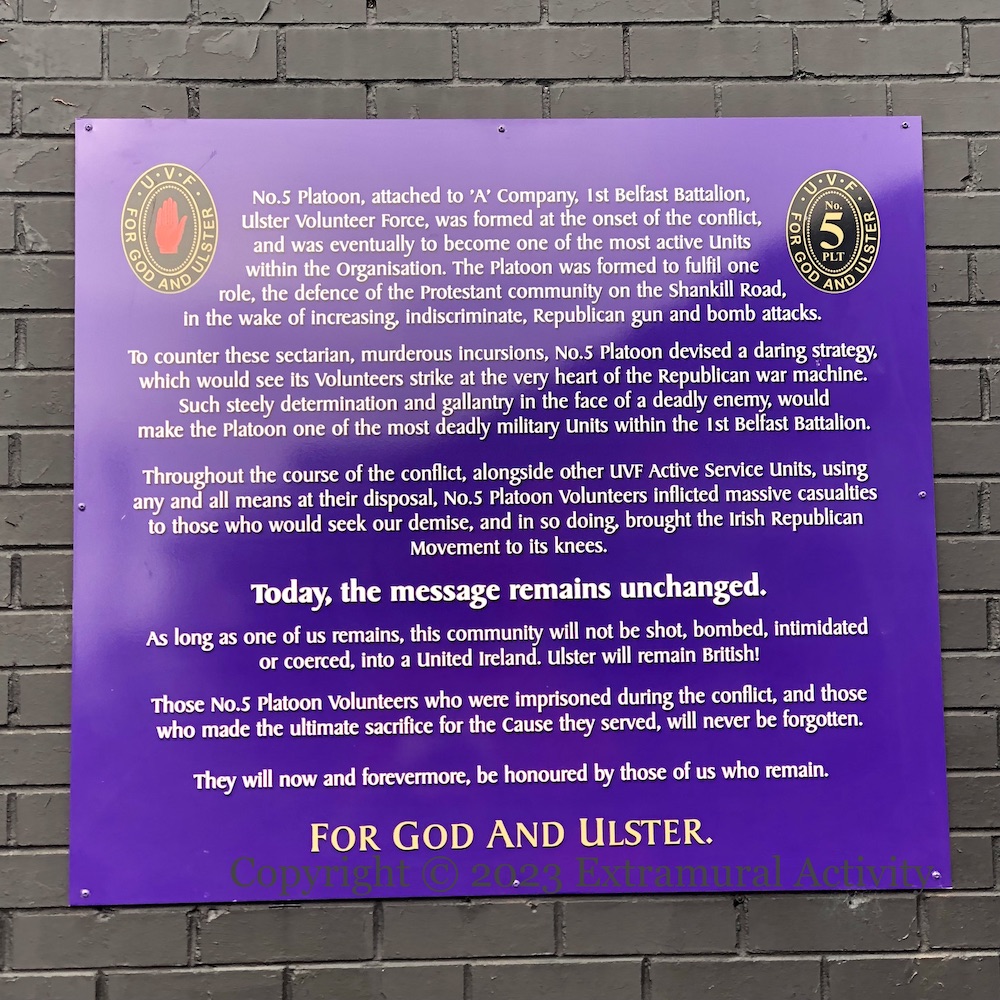
“No. 5 Platoon, attached to ‘A’ Company, 1st Belfast Battalion, Ulster Volunteer Force, was formed at the onset of the conflict, and was eventually to become one of the most active Units with the Organisation. The Platoon was formed to fulfil one role, the defence of the Protestant community on the Shankill Road, in the wake of increasing, indiscriminate, Republican gun and bomb attacks. To counter these sectarian, murderous incursions, No. 5 Platoon devised a daring strategy, which would see its Volunteers strike at the very heart of the Republican war machine. Such steely determination and gallantry in the face of a deadly enemy, would make the Platoon one of the most deadly military Units within the 1st Belfast Battalion. Throughout the course of the conflict, alongside other UVF Active Service Units, using any and all means at their disposal, No. 5 Platoon Volunteers inflicted massive casualties to those who would seek our demise, and in so doing, brought the Irish Republican Movement to its knees. Today the message remains unchanged. As long as one of us remains, this community will not be shot, bombed, intimidated or coerced, into a United Ireland. Ulster will remain British! Those No. 5 Platoon Volunteers who were imprisoned during the conflict, and those who made the ultimate sacrifice for the Cause they served, will never be forgotten. They will now and forevermore, be honoured by those of us who remain. For God and Ulster.”
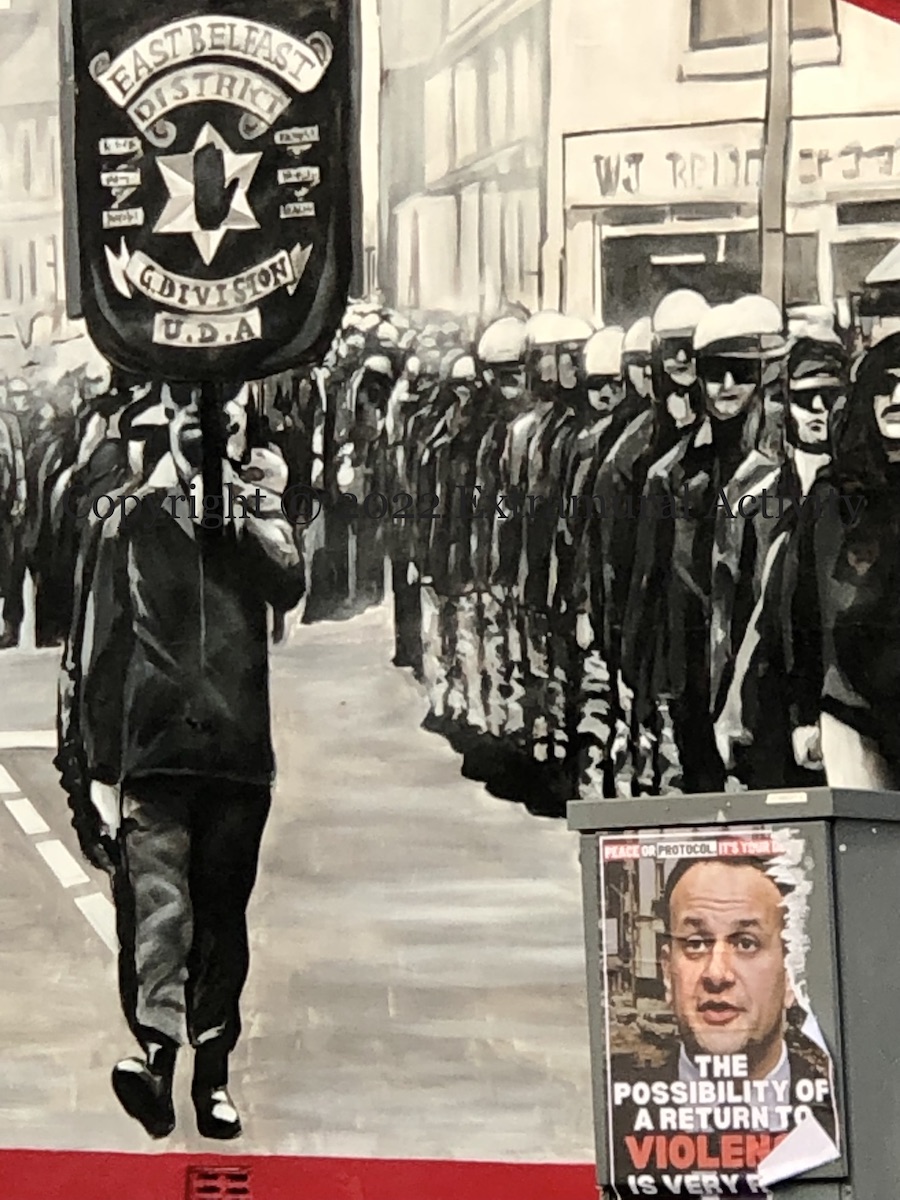
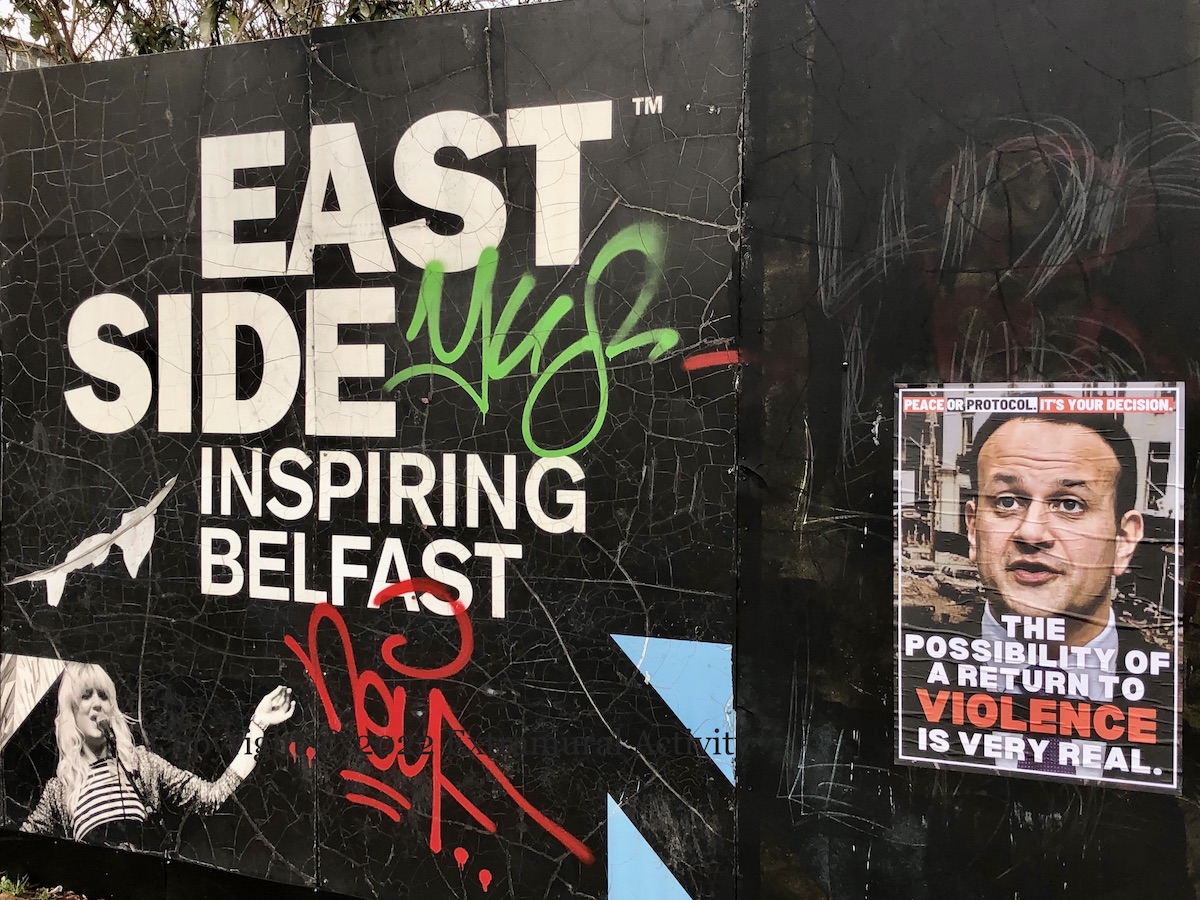
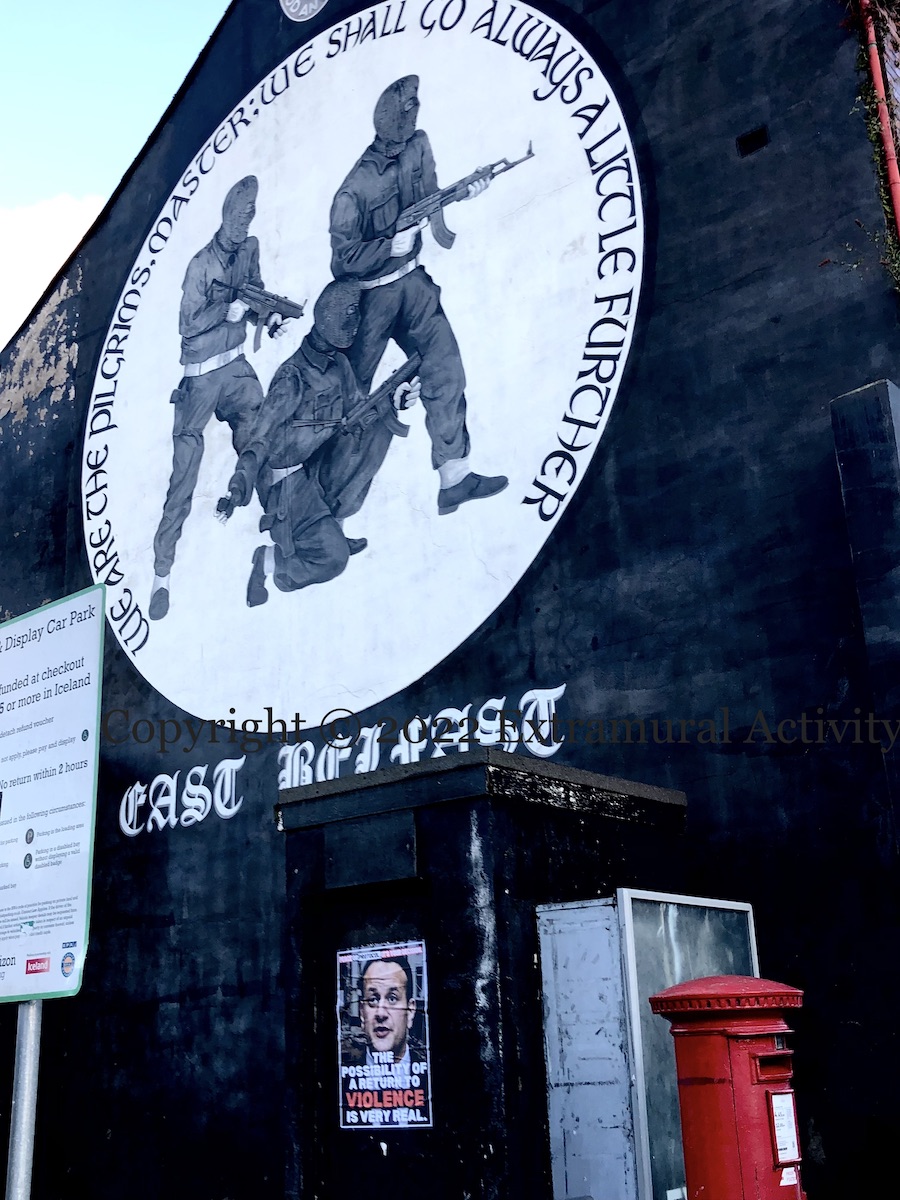
Here is a second set of images showing the “peace or protocol” poster that has appeared in PUL areas in the city, three in east Belfast – along the Newtownards Road. Two others in north Belfast were seen previously in A Return To Violence, which also explains the poster.
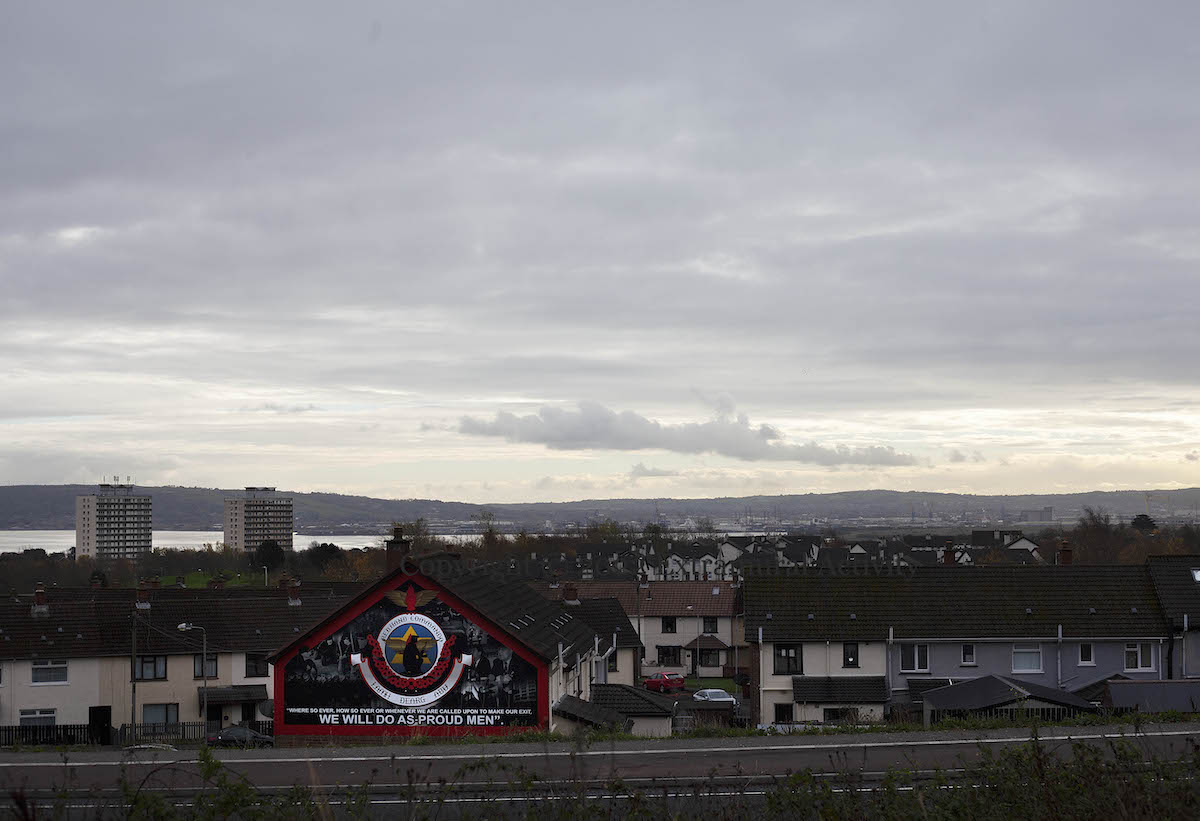
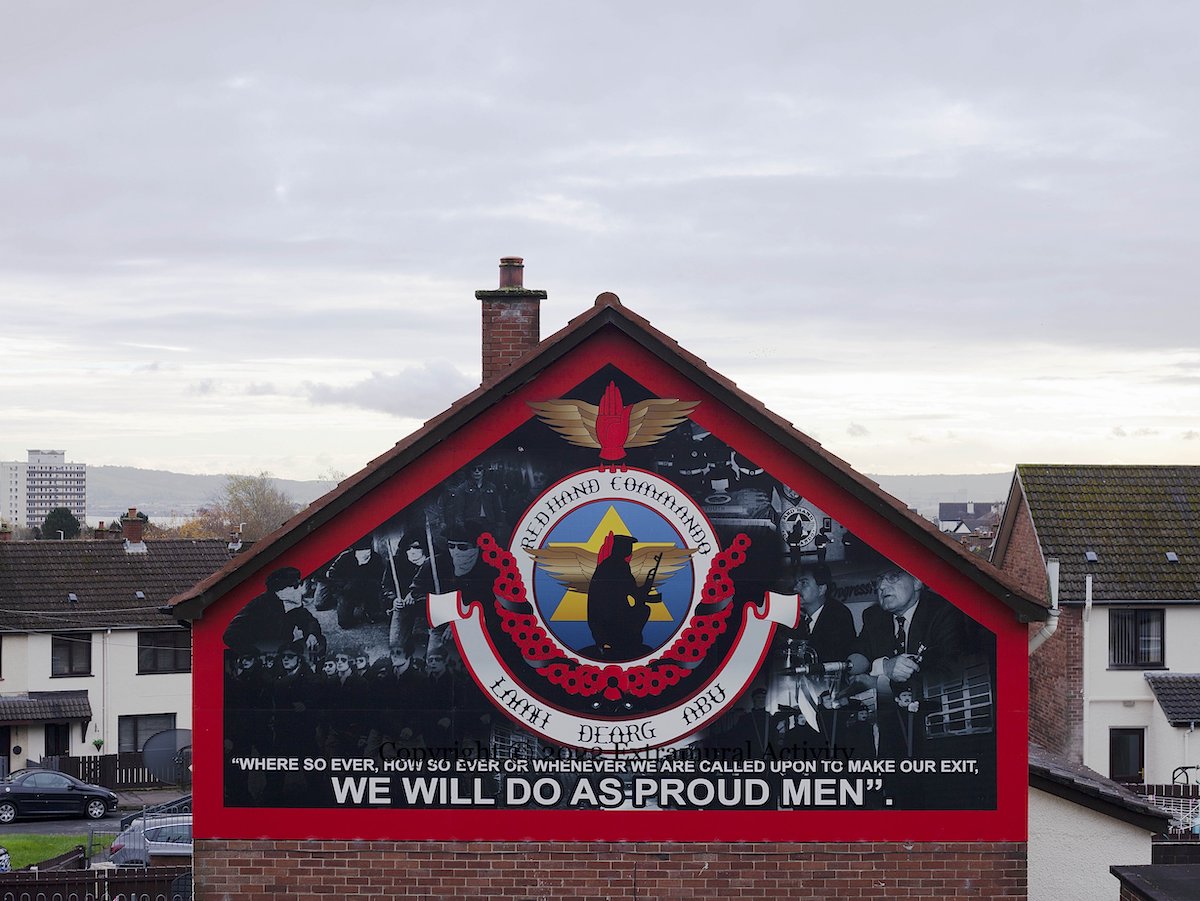
“Where so ever, how so ever or whenever we are called upon to make our exit, we will do as proud men.” This is quite a different message from the one produced within the Rathcoole estate for the 50th anniversary of the Red Hand Commandos, which stated that despite its venerable age, the four Rathcoole companies of the RHC “Await In The Shadows“. (That mural also depicted the kneeling men with sticks (on the left of today’s mural) and the linked post also contains the original photograph.)
It’s not clear who or what within loyalism might call upon the RHC to stand down; loyalist rhetoric at the moment is full of anger at the protocol and warnings/threats about of a return to violence (e.g. BelTel | BBC).
For the use of “Lamh Dear Abu” as the slogan, see Ulster Says “Tá”.















 Extramural Activity