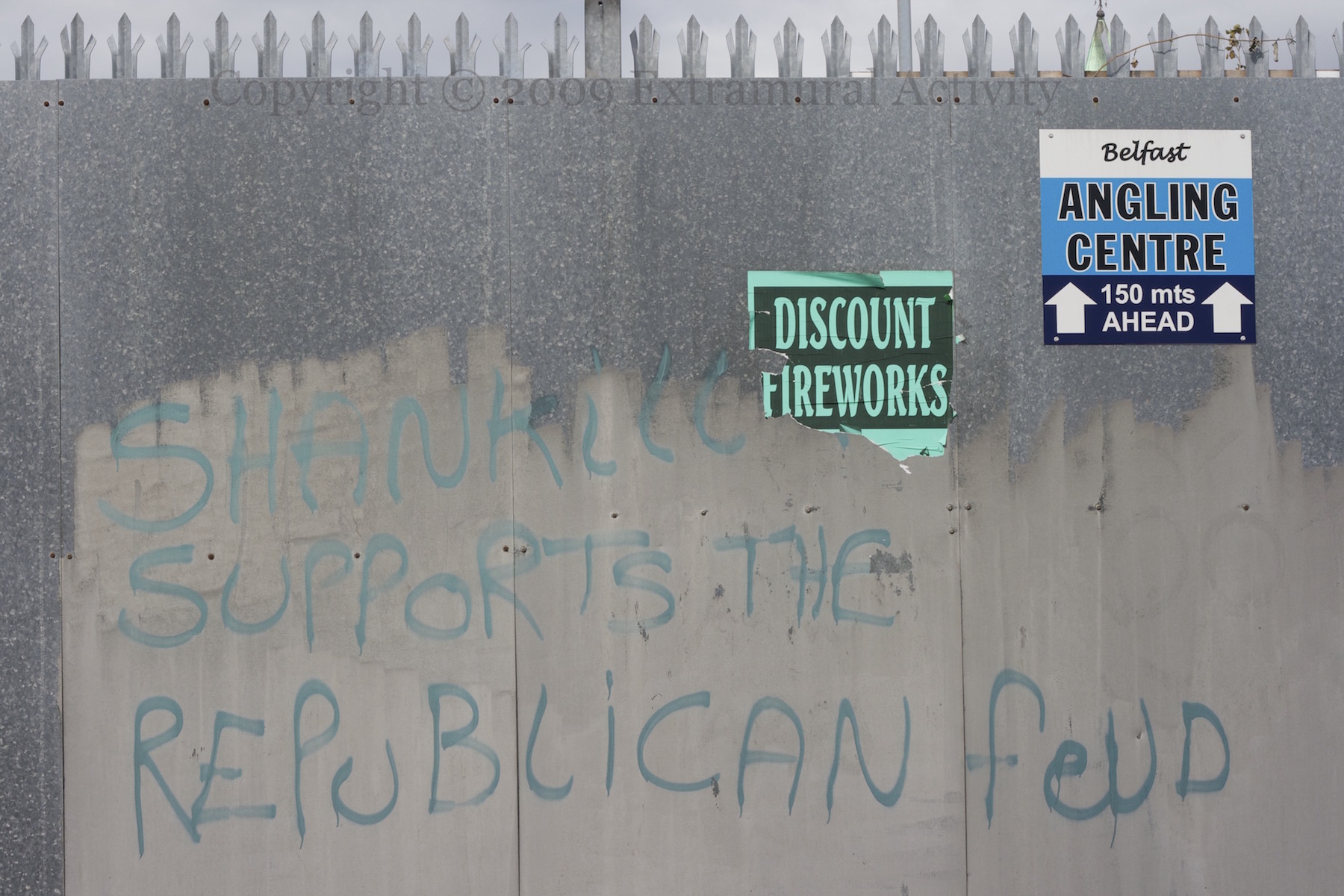
Graffiti next to the upper security gate in Northumberland Street. It is not clear which feud is being referred to.
Click image to enlarge
Copyright © 2009 Seosamh Mac Coılle
X00339
Graffiti next to the upper security gate in Northumberland Street. It is not clear which feud is being referred to.
Click image to enlarge
Copyright © 2009 Seosamh Mac Coılle
X00339

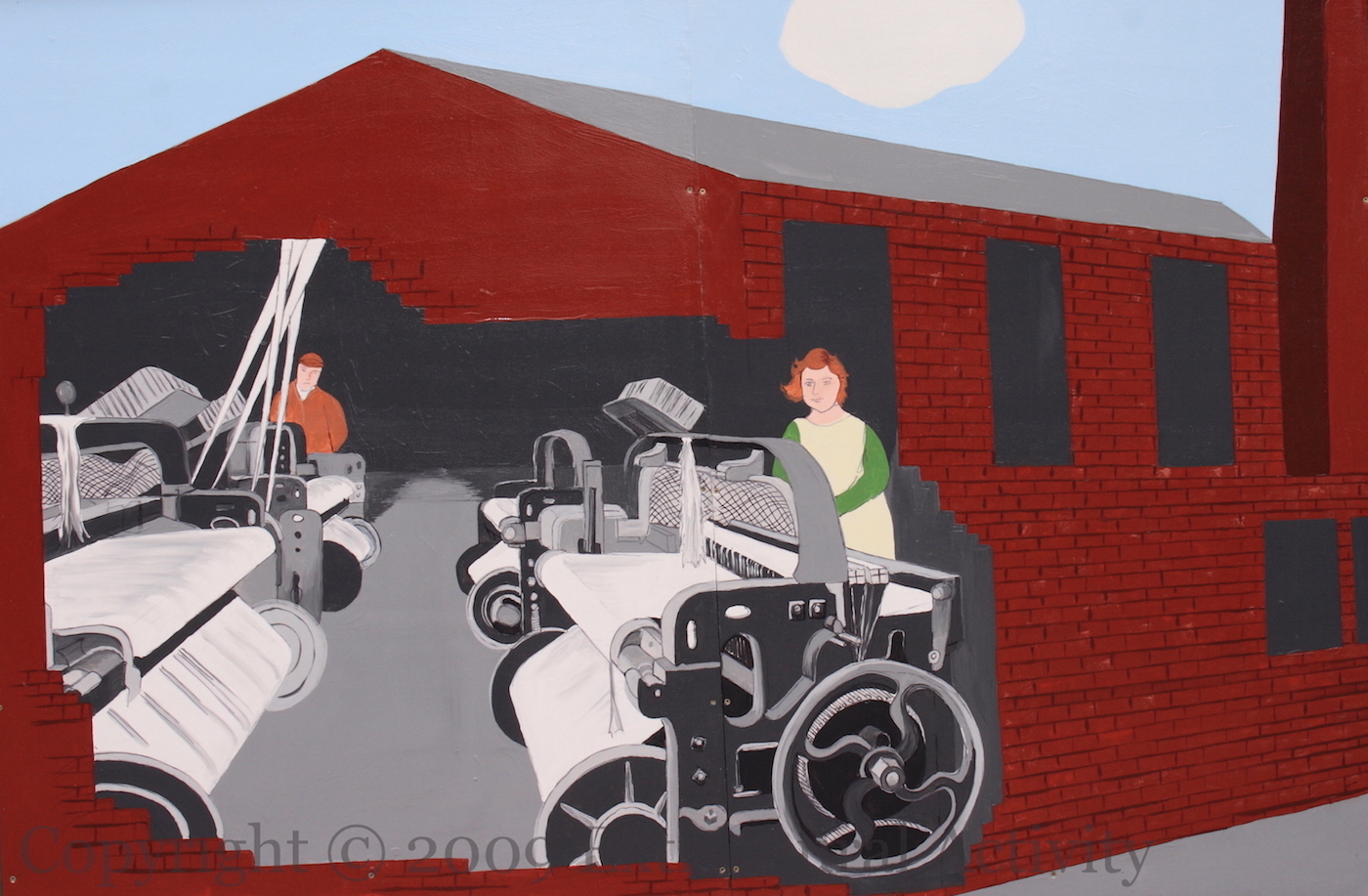
This series of boards, painted by Caroline Jeffrey, presents life in Larne from the early 20th century. As part of the 2009 Re-Imaging Project, it is largely non-sectarian, and begins with the derivation of the name “Tullygarley” from the Irish for “Hillock of the Grey Calf”, but includes the emblem of the 36th (Ulster) Division and the gunrunning ship Clyde Valley. It replaces a “God save the queen”/1690 mural, visible here.
Info board:
“Tullygarley” means “Hillock of the Grey Calf” – thus the grey calf grazing with the cows.
The 36th Ulster Division – In September 1914 the Ulster Division was formed from the Ulster Volunteer Force which raised thirteen battalions for the three Irish regiments in Ulster.
Bleaching Green – Linen laid out in fields to bleach. The Bleaching Factory interior depicts the Bleaching process. (The building is currently derelict.) Blue Flax Flowers are the national floral emblem of Northern Ireland.
Local Primary School, Inver and Larne, known locally as “the Bridge”, as it looked in the 1930’s with the Inver River running through it. The bridge that the school was named after no longer exists.
Linen Factory of Glyn [Glynn] Road (no longer exists, site of abandoned garage) with inset depicting workers with weaving machines (circa 1924).
The old Tullygarley playground (mural site) with the Fountain in the foreground, and rows of houses on either side (Glynn Road and South Circular Road).
Sun Laundry Van. Sun Laundry showing people working inside (now Rea’s Furnishings, Bank Road).
Larne Lough – it is an area of special interest, a special protection area and a Ramsar site in order to protect the wetland environment.
SS Clyde Valley – launched in July 1886. Was used in 1914 to transport arms from Hamburg to Larne.
Roseate Tern – Larne Lough is the only breeding colony in Northern Ireland for the Roseate Tern, one of the UK’s rarest birds.
Glynn Road, Larne




Click image to enlarge
Copyright © 2009, 2015 Seosamh Mac Coılle
X00334 X05035 X05036 X05037 [X00466] X05038 [X05039] X05040 X02556
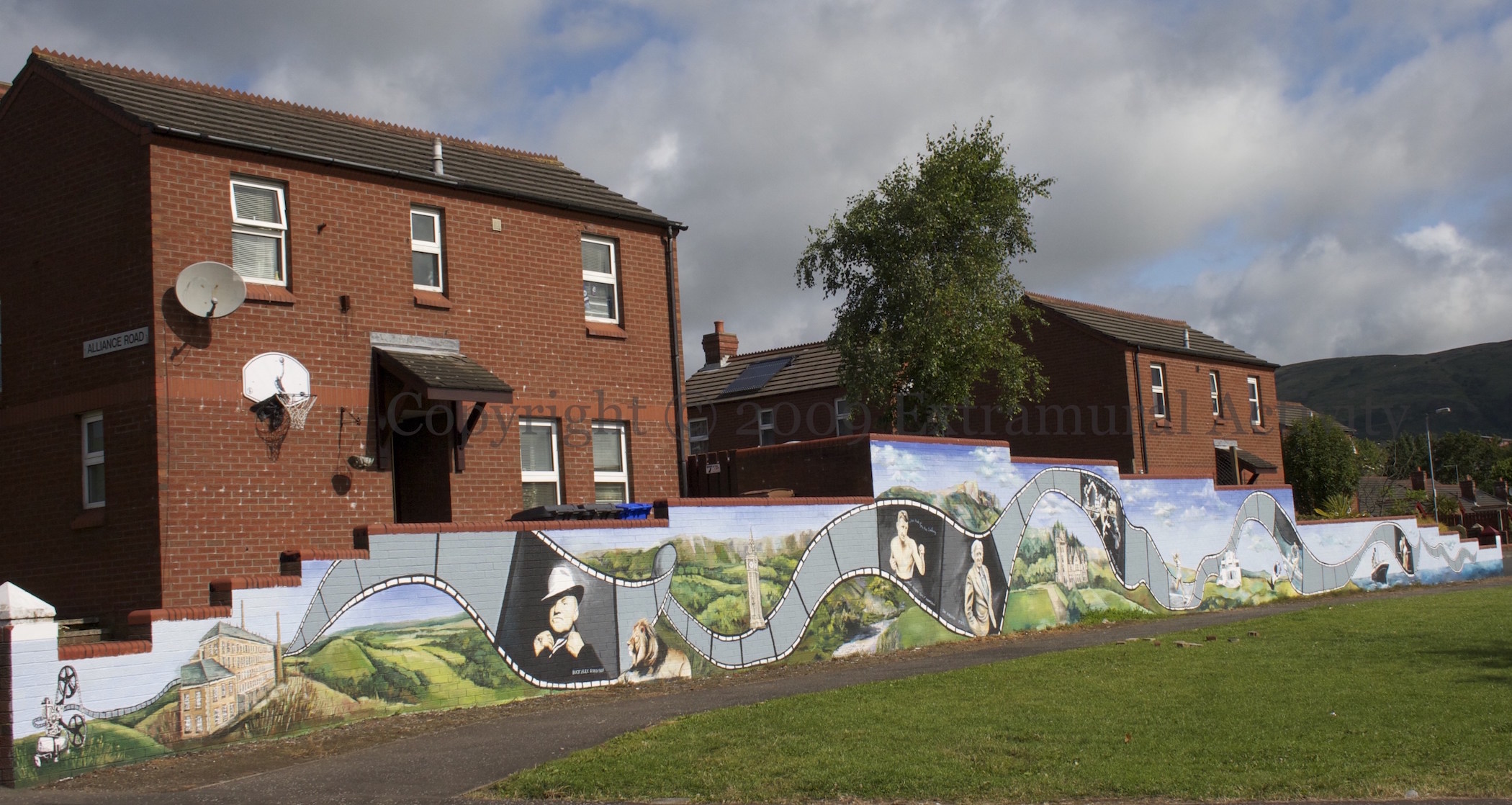
“Artist Daniela Balmaverde has worked with older members of the local community to reminisce and to appreciate those from North Belfast who have made an impact on our broader society. A multiplicity of initiatives has altered the face and conditions of life in this community with Re-Imaging making a positive contribution to a long-term process. The project was launched by the Lord Mayor on August 2009 This project was funded through the Re-Imaging Communities programme of the Arts Council of Northern Ireland and delivered by Belfast City Council with the support of Lower Ormeau Road Resident’s Action Group. This project is supported by the Shared Communities Consortium.”
The figures in the mural include Buck Alec Robinson, Rinty Monaghan, Sam McAughtry, Sir James Galway, Dame Mary Peters, Norman Whiteside, and Wayne McCullough. The mural replaced is the one equating the American Confederates with the Ulster Covenant in Alliance Crescent.


Update: 2022 shot of the blanked wall

Copyright © 2009 Seosamh Mac Coılle
X00331 [X00332] X05041 X05042 X05043 [X05044] [X05045] X05046 X05047 [X05048] X05049 X05050 [X05051]
Copyright © 2022 Seosamh Mac Coılle
X10754 X10753
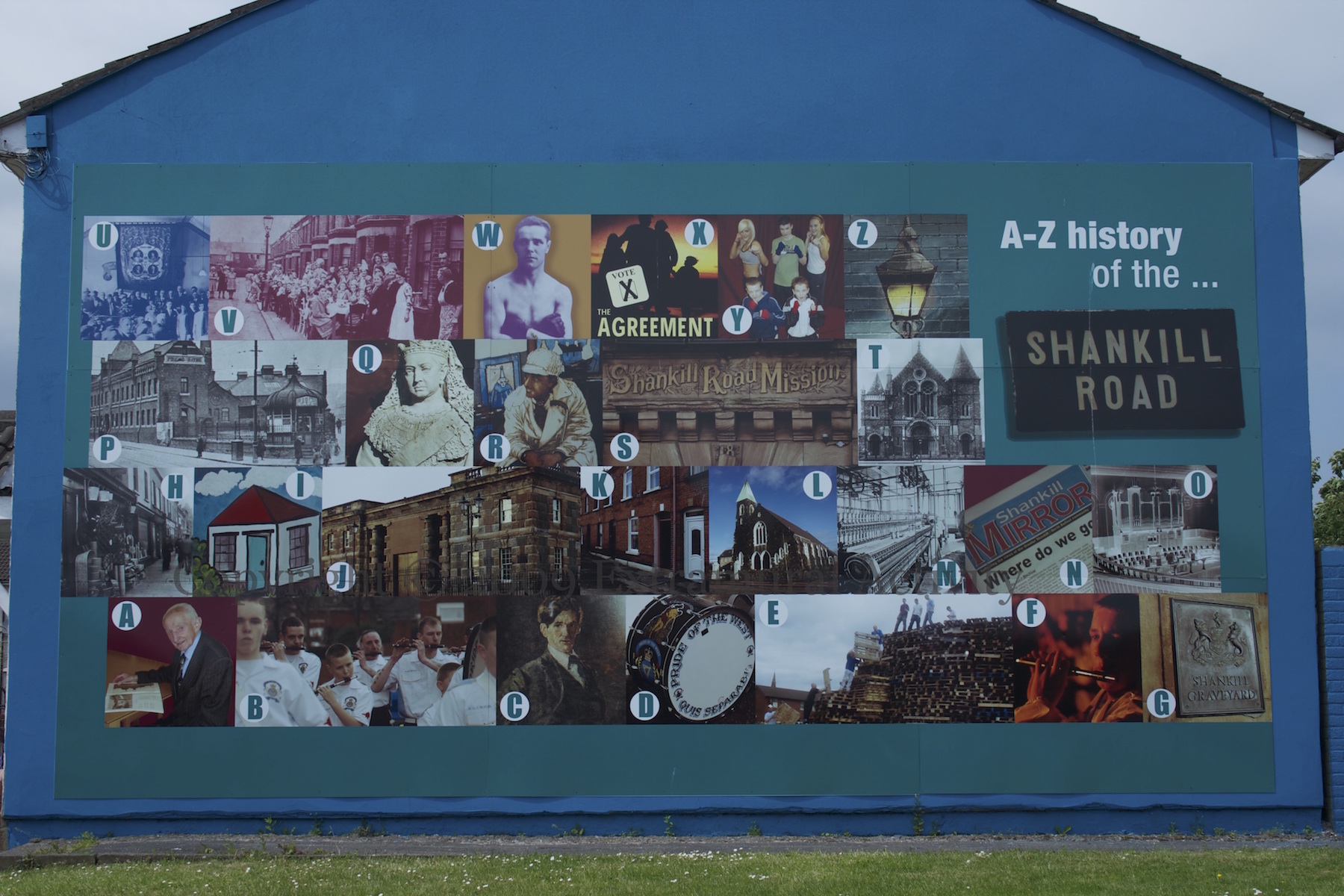
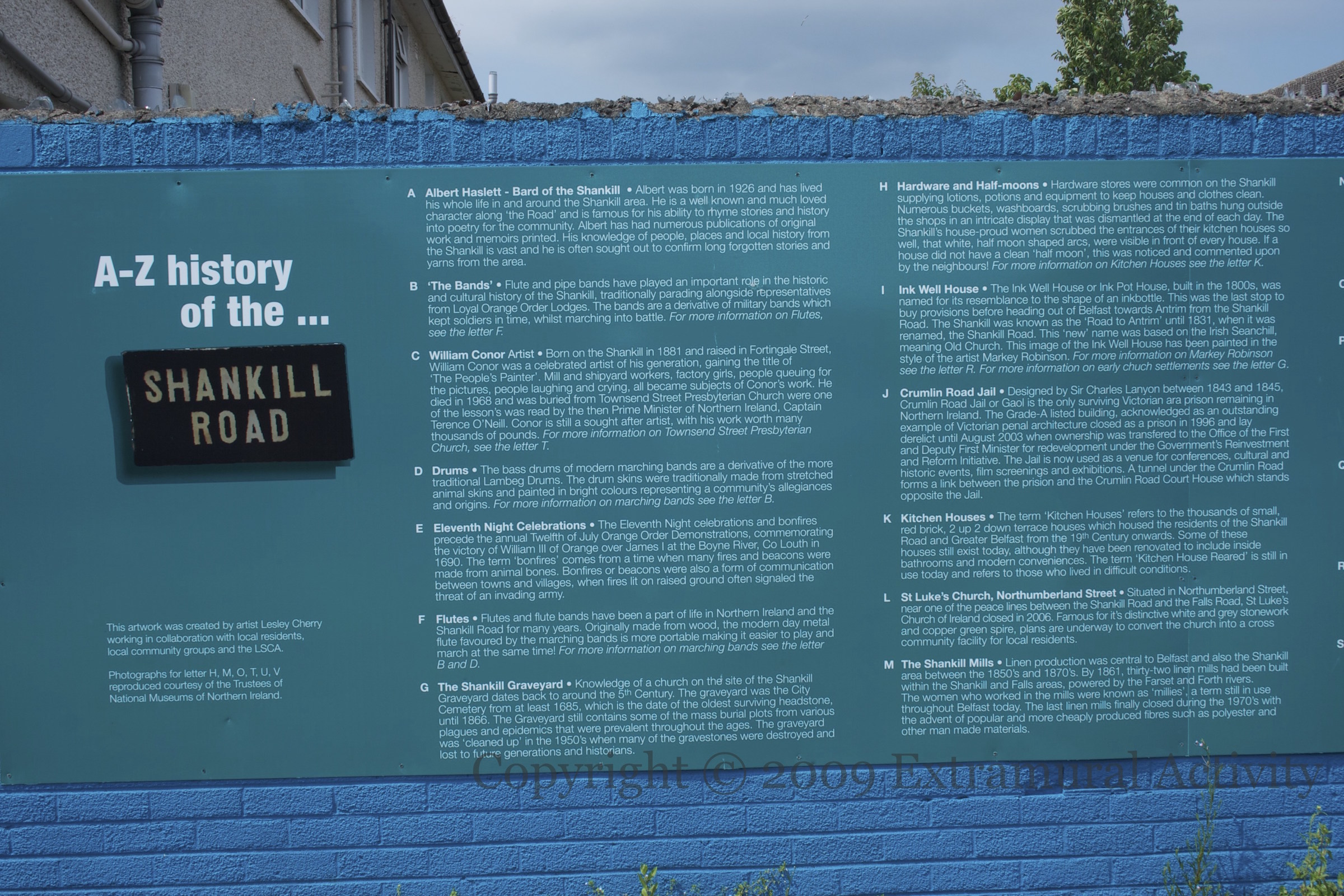
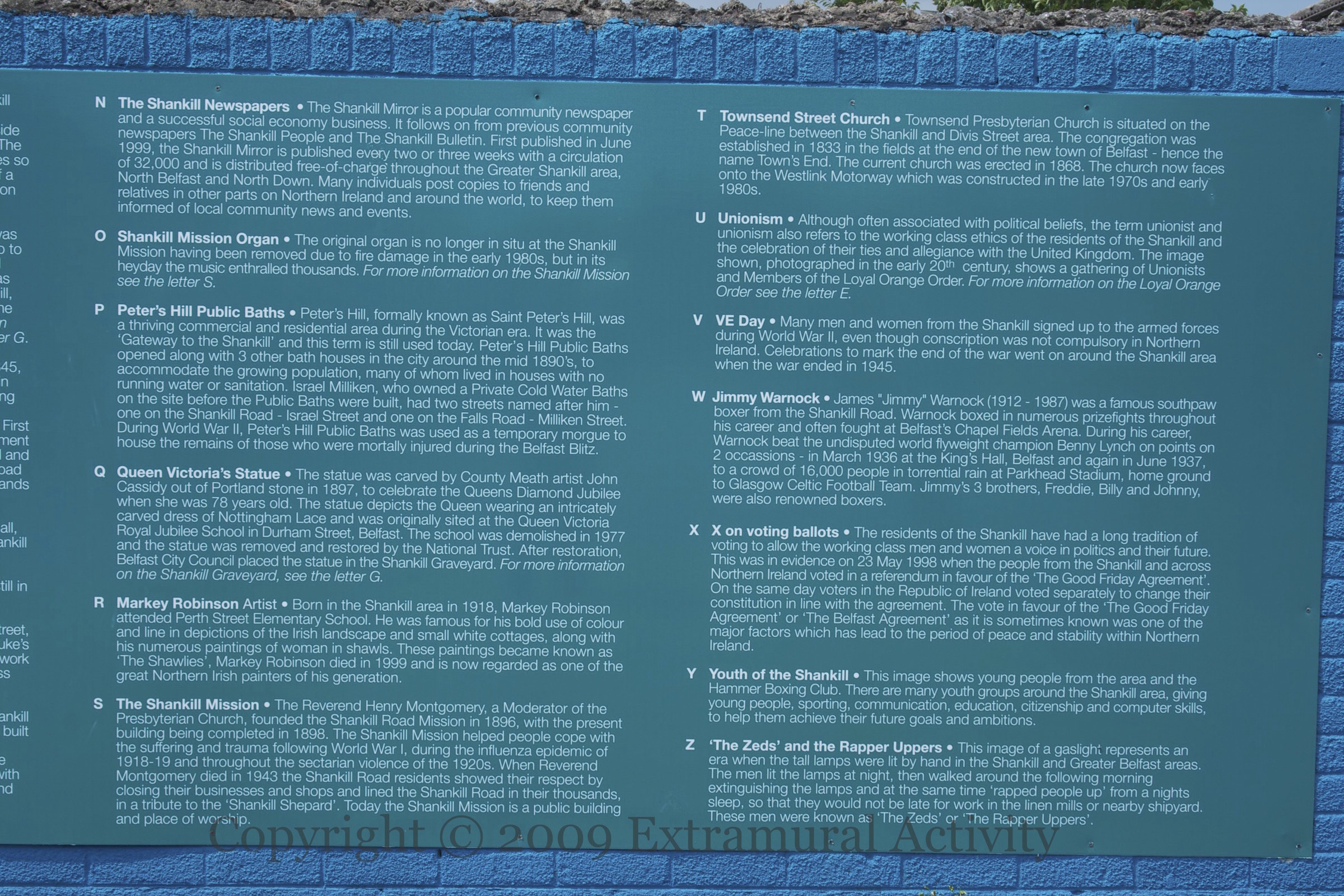
The Drumcree mural (2004 | 2008) is re-imaged in 2009 by this ‘Shankill A-Z’ board, designed by Lesley Cherry.
While bands get mentioned in three letters (“B” for “bands”, “D” for “drums” and “F” for “flutes”), “Unionism” is recast as “working-class ethics” and (perhaps the most striking “re-imaging”) under “X” it is claimed that the people of the lower Shankill voted for the Good Friday Agreement.
Click image to enlarge
Copyright © 2009 Seosamh Mac Coılle
X00336 X00337 X00338
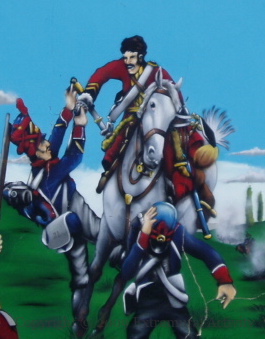
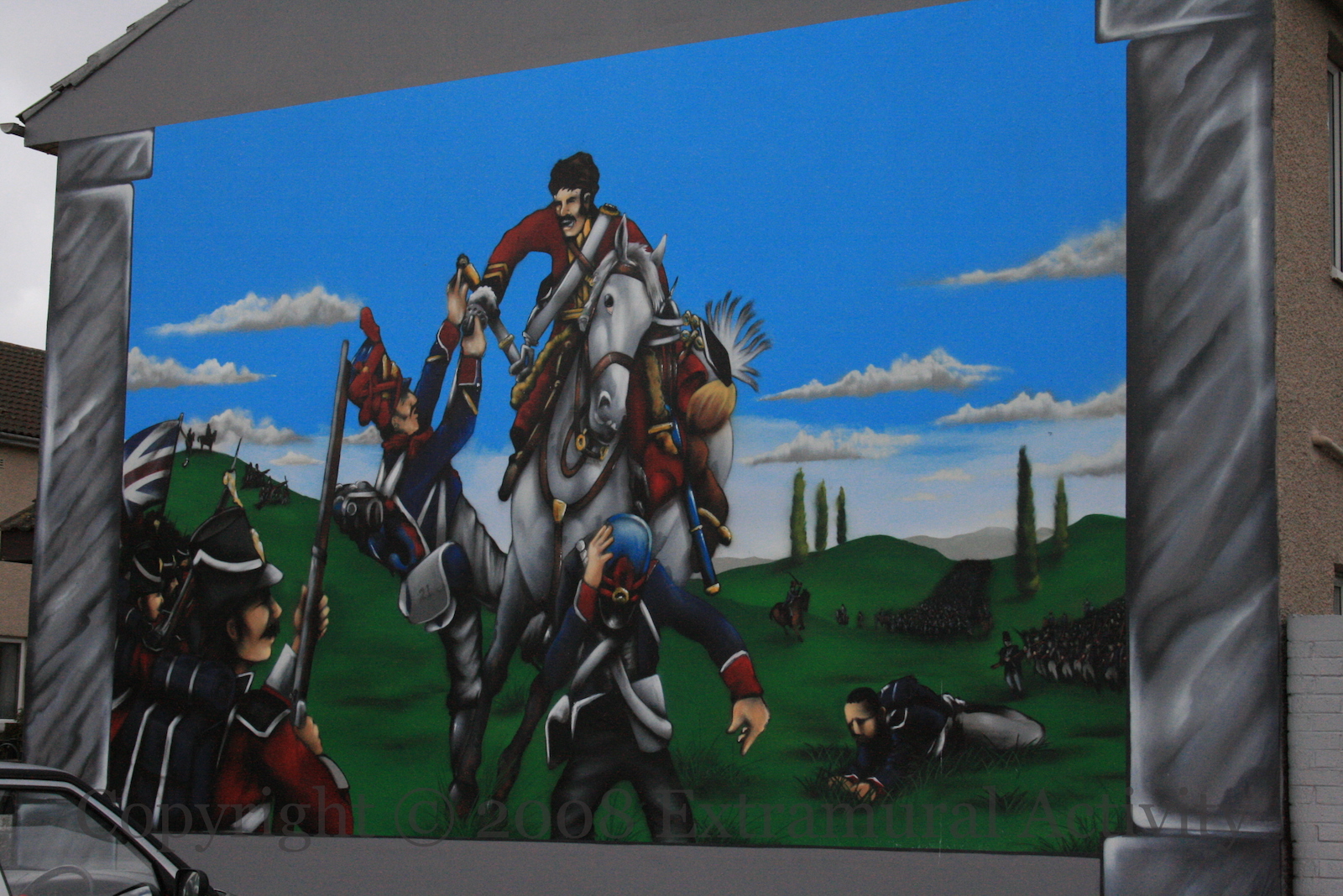
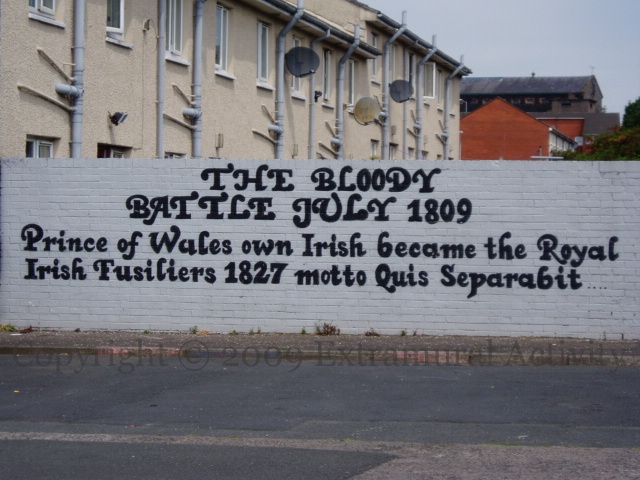
“The Bloody Battle, July 1809. Prince of Wales own Irish became the Royal Irish Fusiliers 1827, motto Quis separabit.”
Talavera de la Reina is southwest of Madrid, Spain. The French, who had invaded Portugal but been driven out by British forces under Wellesley, fought the combined forces of the Spanish (previously allies of the French in the Peninsular War) and British armies. The second battalion of the Prince Of Wales’s Irish fought at Talavera. It then became the Prince Of Wales’s Own Irish, the Prince Of Wales’s Own Irish Fusiliers, and finally the Royal Irish Fusiliers (after the prince had been king for seven years). Its motto seems to have been “Faugh A Ballagh” rather than “quis separabit” but sources are scarce.

Click image to enlarge
Copyright ©
X00326c Cathal Woods 2009
X00279 Seosamh Mac Coılle 2008 in progress
X00325 X00327 Cathal Woods 2009

“Freedom 2000” – this mural commemorates loyalist prisoner kept in the H-Blocks. Previously, the left flank bore the letters UDA and the right flank UFF, with LPOW at the bottom of each (see M02473).
Hopewell Crescent, lower Shankill. Also seen in 2008.
Click image to enlarge small image
Copyright © 2009 Cathal Woods
X00300

Legend has it that Ulster was won in a competition among warriors to be the first to touch the land. In order to win the race, one contestant cut off his hand and threw it ahead of the others. The flag of Northern Ireland (the Ulster Banner) is in the apex.
WP entry on the legend.
Shankill Parade, west Belfast.
Click image to enlarge small image
Copyright © 2009 Cathal Woods
X00309 the red hand of ulster
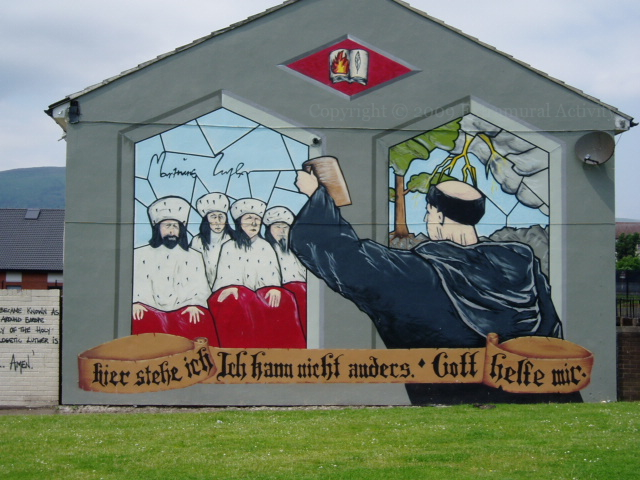
The Protestant Reformation is here attempted as a re-imaging theme in the lower Shankill. Luther’s signature is worked into the “stained glass” on the left.
Below, the accompanying text … “Hier stehe ich, Ich kann nich anders, Gott helfe mir.” Martin Luther 1483-1546. Unhappy with many of the Catholic church’s practices, Martin Luther, a monk, wrote what became know as ‘the 95 theses’. These challenged the authority of the church and were spread quickly around Europe via a new invention, the printing press. Keen to get luther to recant, the general assembly of the Holy Roman Empire summoned Luther to the town of Worms on the Rhine in 1521. An unapologetic Luther is said to have uttered this famous phrase which, translated means ‘Here I stand, I can do no other. God help me. Amen’. Thus began the Protestant Reformation.”

Click image to enlarge small image
Copyright © 2009 Cathal Woods
X00301 X00302

From the info board, later added to the left: “The Gold Rush mural replaces a paramilitary image of two silhouetted gunmen representing Scottish Brigade. This new image by artist Tim McCarthy represents an event in July 1969 in Christopher Street when children digging in the rubble of the then demolished ‘Scotch Flats’ discovered a hoard of gold sovereigns. Word spread quickly and thus began ‘the Gold Rush’. The project was funded by the Re-imaging Communities programme of the Arts Council of Northern Ireland and delivered by Belfast City Council with the support of the Lower Shankill Community Association. The project would not have been possible without the support and participation of the local community.”
There is a short series of BBC radio programmes on the finding of the sovereigns and how they came to be in the chimney.
With support from the Arts Council, Belfast City Council, and Lower Shankill Community Association. By Tim McCarthy/Verz in Hopewell Crescent, lower Shankill, Belfast.
Click image to enlarge small image
Copyright © 2009 Cathal Woods
X00298 [X05054] ’69 gold rush
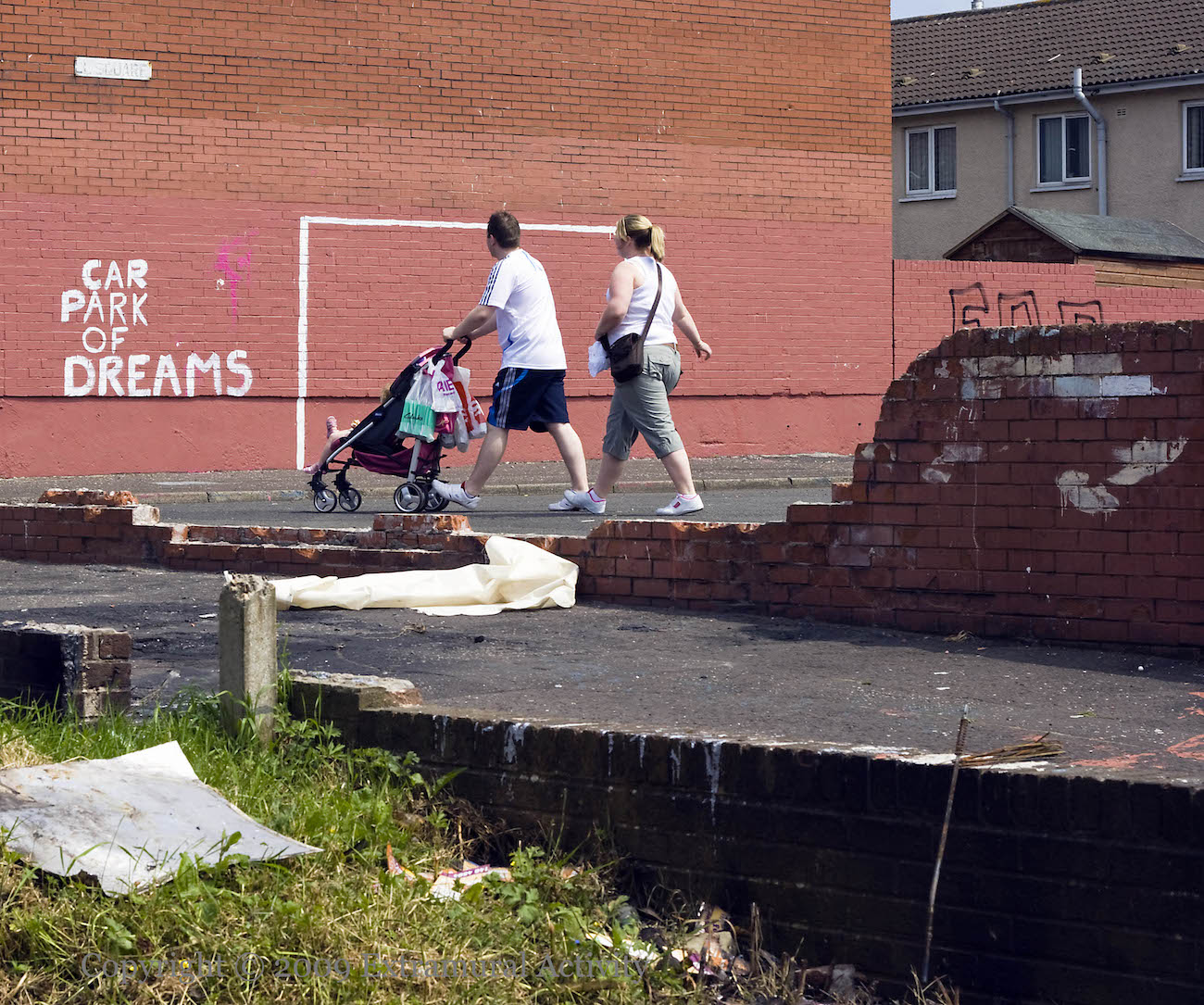
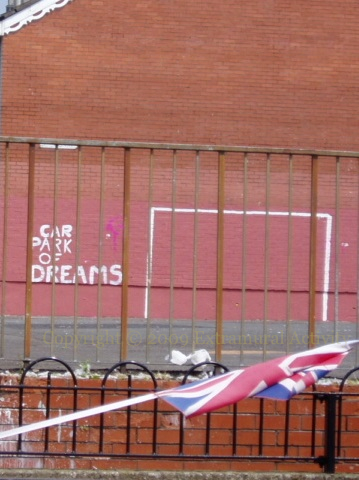
Car Park Of Dreams, Hopewell Square, lower Shankill, west Belfast.
Click image to enlarge
Copyright © 2009 Seosamh Mac Coılle
X13291 X00295
 Extramural Activity