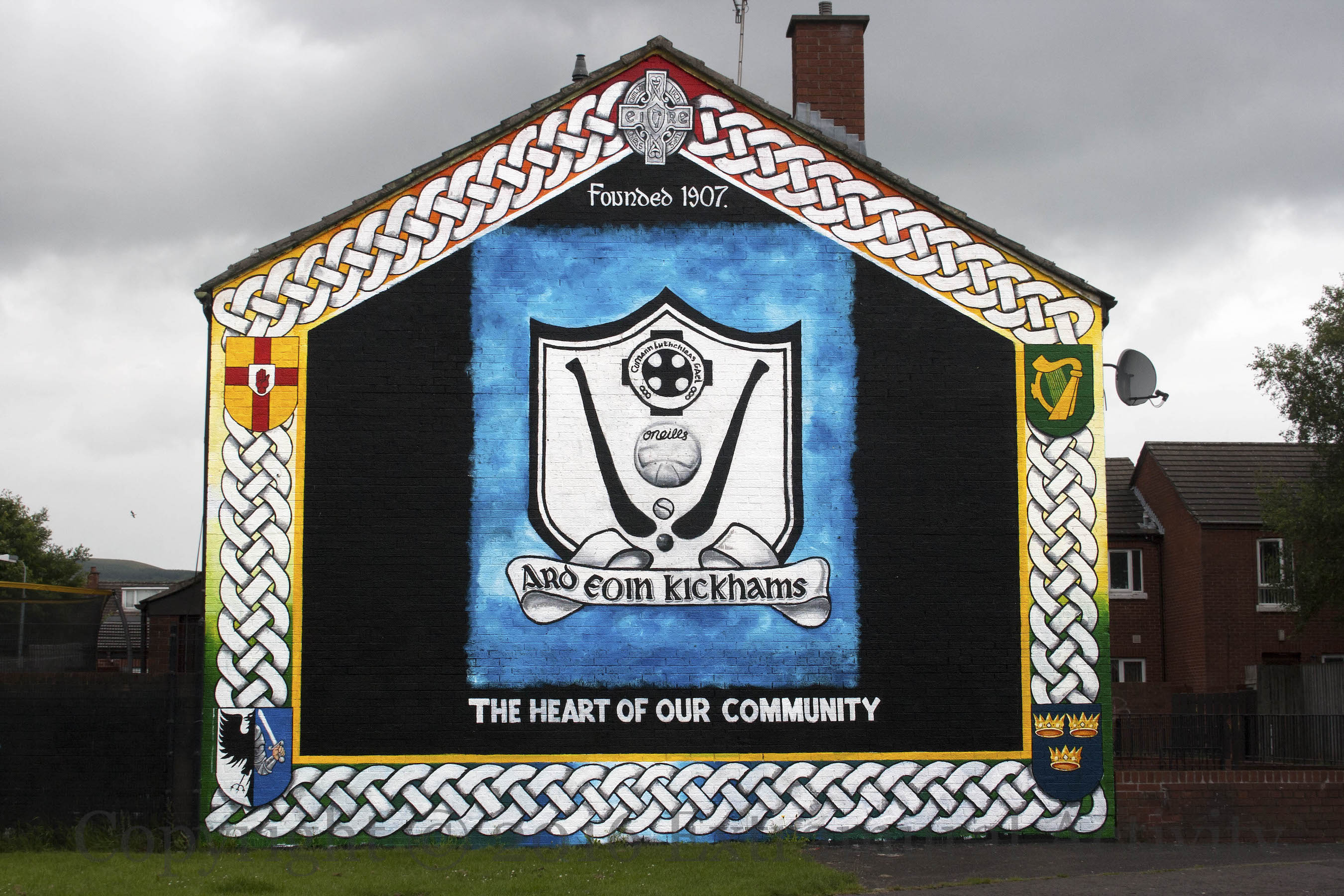
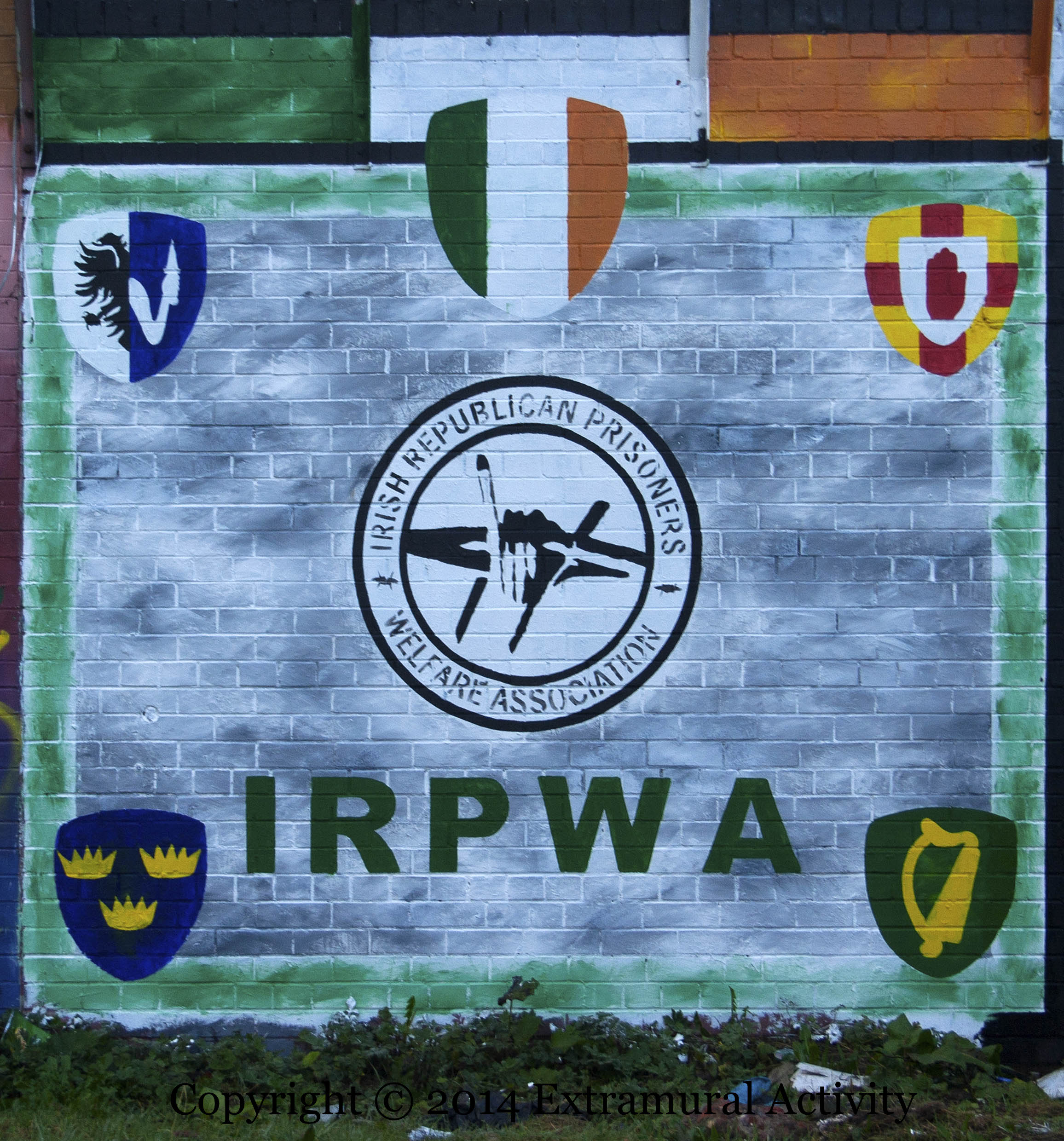
A border of Celtic knot-work and the shields of the four provinces has been added to the Ard Eoın Kickhams mural at the top of Havana Way. (For the previous version, see The Heart Of Our Community.)
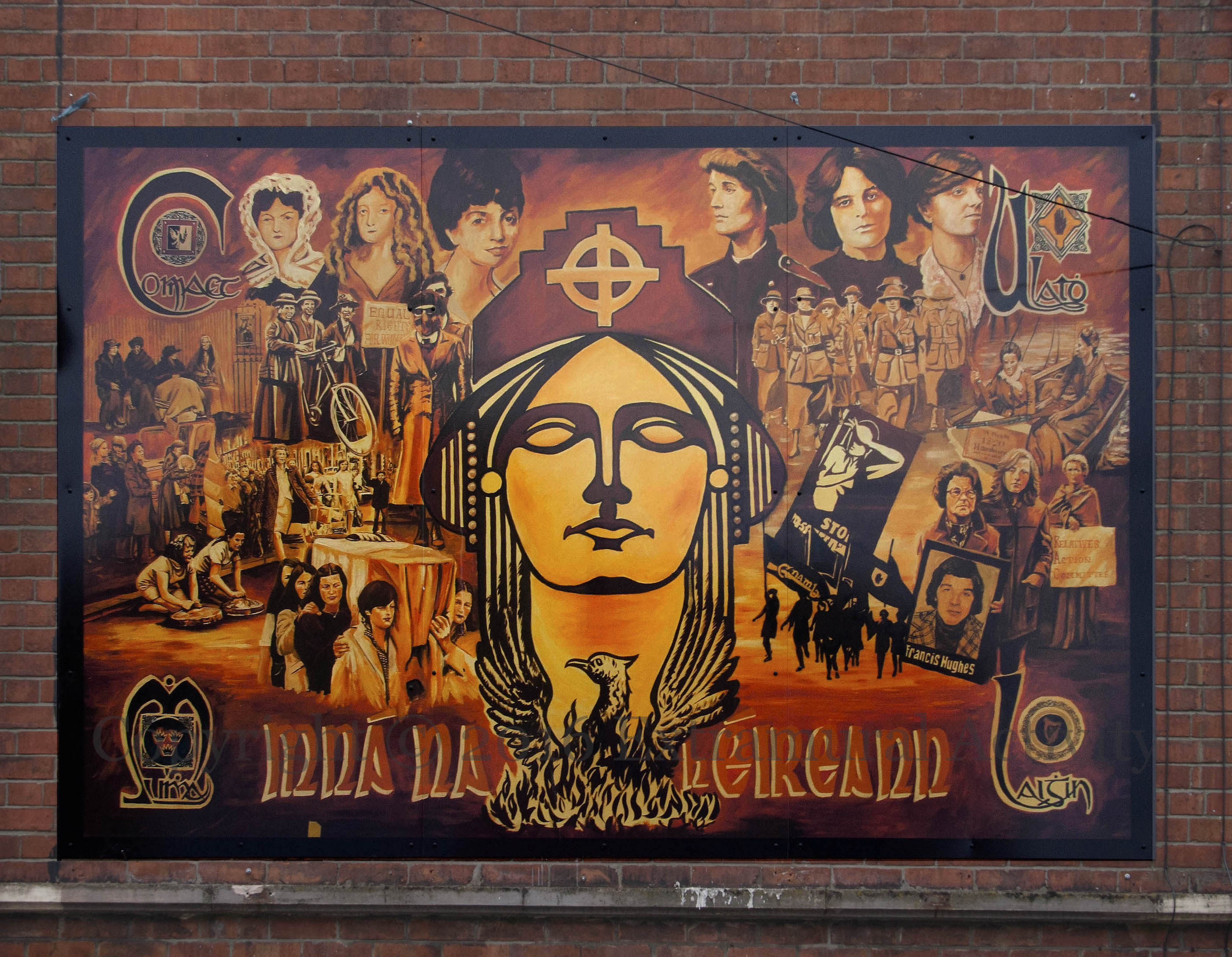
Érıu/Éıre of the Tuatha Dé Danann, queen of Ireland, (as depicted by Richard J King) is at the centre of various representations of republican women. Along the top are Ann Devlin, Betsy Gray, Mary Ann McCracken, Countess Markievicz, Nora Connolly?, and Winifred Carney. Suffragettes, the modern IRA, and Cumman Na mBan are depicted, as are Máıre Drumm at the Falls Curfew, Tom McElwee’s sisters carrying his coffin, and Molly Childers and Mary Spring Rice running guns on the Asgard. There is also an unusual ‘four provinces’ in the corners.
The wide shot (below) shows the James Connolly mural below (seen previously in 2012) and the (recently added) 1916 centenary board – for which see Ag fíorú na poblachta.
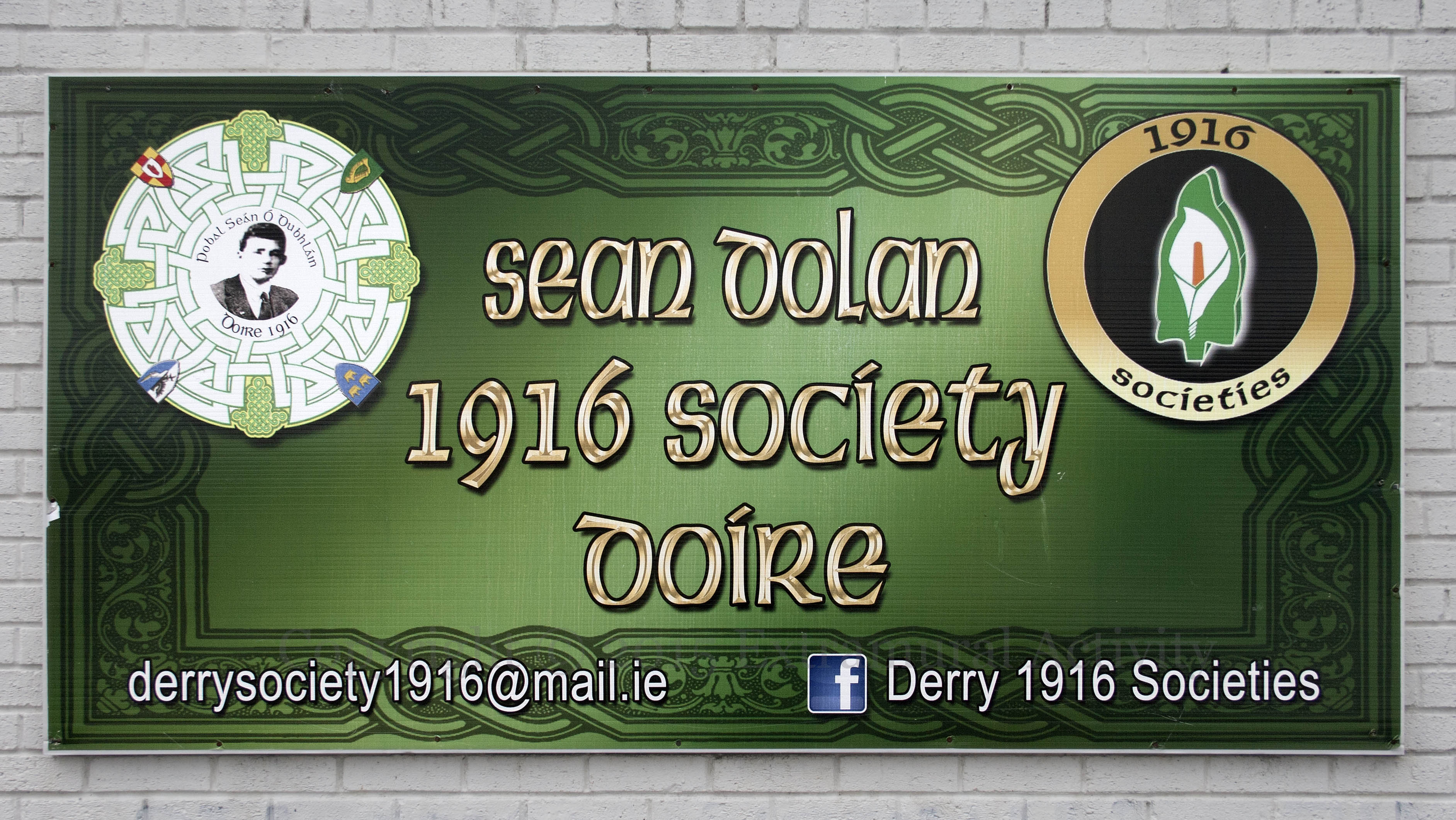
The Derry branch of the 1916 Societies (Fb) is named after Sean Dolan, an IRA volunteer interned at the outbreak of WWII on the prison ship Al Rawdah (WP | saoırse32) before being moved to Crumlin Road gaol. He was released on grounds of ill health shortly before dying in 1941 at age 28 in Derry. The title of today’s post comes from Dolan’s gravestone, which is in Ardmore (findagrave).
It was the 1916 Societies that hoisted an Irish tricolour from the roof of Stormont in June 2015 (BBC).
19 year-old Provisional IRA volunteer Eamonn Lafferty was killed on August 18th, 1971, in a gun-battle with British Army forces who were attempting to dismantle barricades in republican “Free Derry”. The mural and plaque shown (and a headstone) are situated—as the mural states—in the location where he was killed, in Creggan’s Kildrum area. (His body is buried in City Cemetery.)
This is a new mural from the 32 County Sovereignty Movement (web) on the international wall, Divis Street, (Visual History) with symbols of nationalism (the crests of the four provinces, the harp, the tricolour), socialism (the plough in the stars) and support for republican POWs (the barbed wire).
For images of the mural being worked upon, see the Peter Moloney Collection; for an earlier version see 100% British.
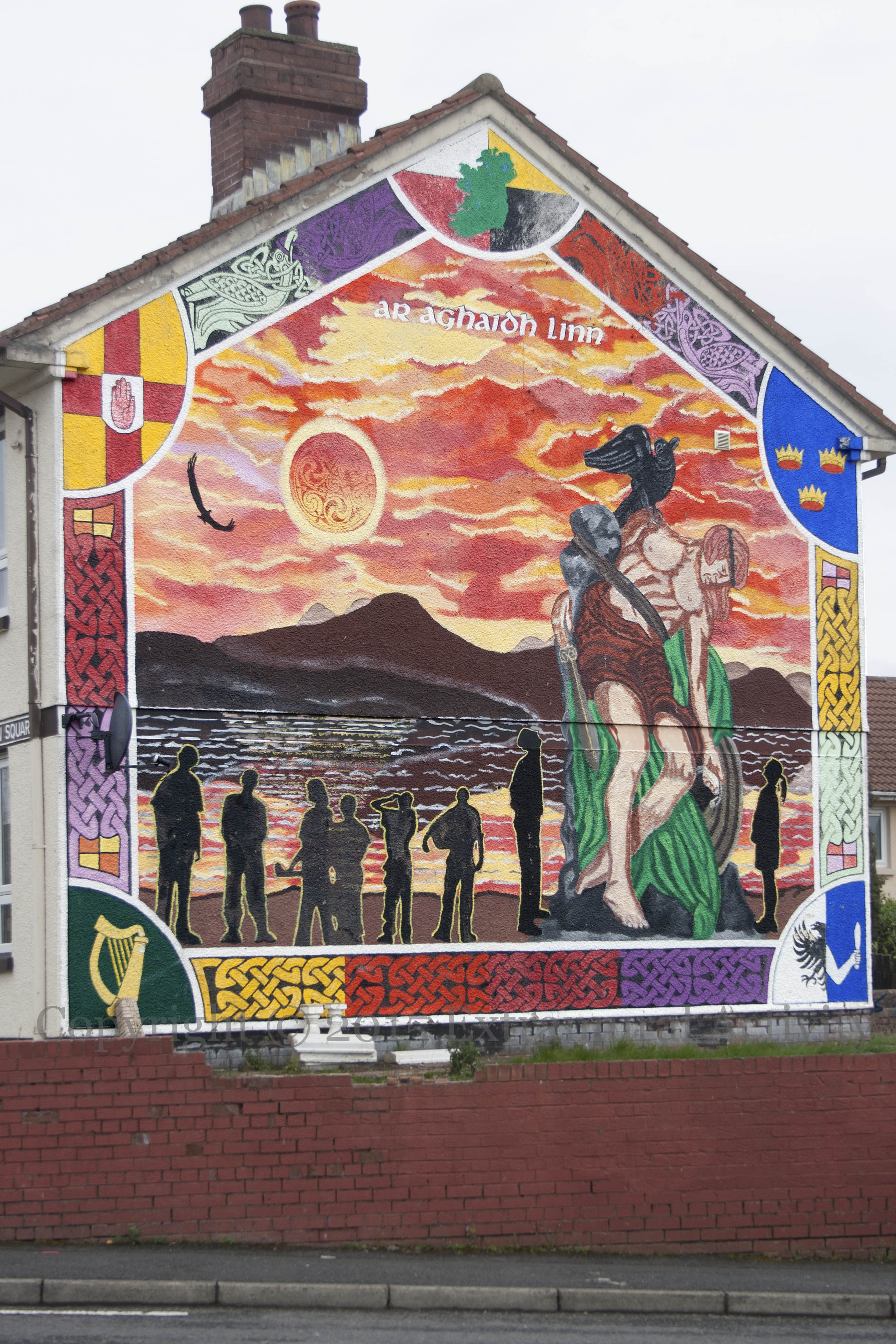
“Ar aghaıdh linn [Onward]” Silhouetted figures, one carrying a hurley, take inspiration from a dying Cú Chulaınn and gaze across a body of water, perhaps Carlingford Lough towards the mountains of Mourne – Cú Chulaınn’s traditional place of death is in County Louth, outside Dundalk. Tuan the hawk historian, who has seen all of the conquests of Ireland, flies overhead.
A pair of boards have been added to either side of one of the Bone memorials in Clós Ard An Lao, one for Na Fıanna Éıreann – the boys – and one for Cumann Na gCaılíní – the girls. The words are those of the Marching Song Of Na Fıanna Éıreann, except that in the second verse (the third stanza shown, first in the image below) the words “Cumann Na gCaılınní [sic]” have been inserted instead of “Fıanna Éıreann”.
The third image, below, shows the whole wall; for a close-up of the central boards, commemorating locals who lost their lives in the troubles, see Bone Memorial.
Joe McDonnell was a Provisional IRA volunteer (óglach) imprisoned in the Maze H-blocks. He was the fifth hunger-striker to die, on July 8th, 1981 after 61 days. The Wolfe Tones wrote a ballad in his memory (for their 1983 LP A Sense Of Freedom), which FAI chief John Delaney was recorded singing in a Dublin pub a few weeks ago (November, 2014) after a 4-1 win by the Republic over the US in a friendly. He at first denied it was him, then apologized, and has kept his job (Guardian).
As of this morning (December 10th, 2014), the song, re-released by the Wolfe Tones as a charity Christmas single in aid of the Simon Community, is the #7 single at itunes.ie.
The mural above was painted in July by Gerard “Mo Chara” Kelly, on the Suffolk Road, Andersonstown, west Belfast.
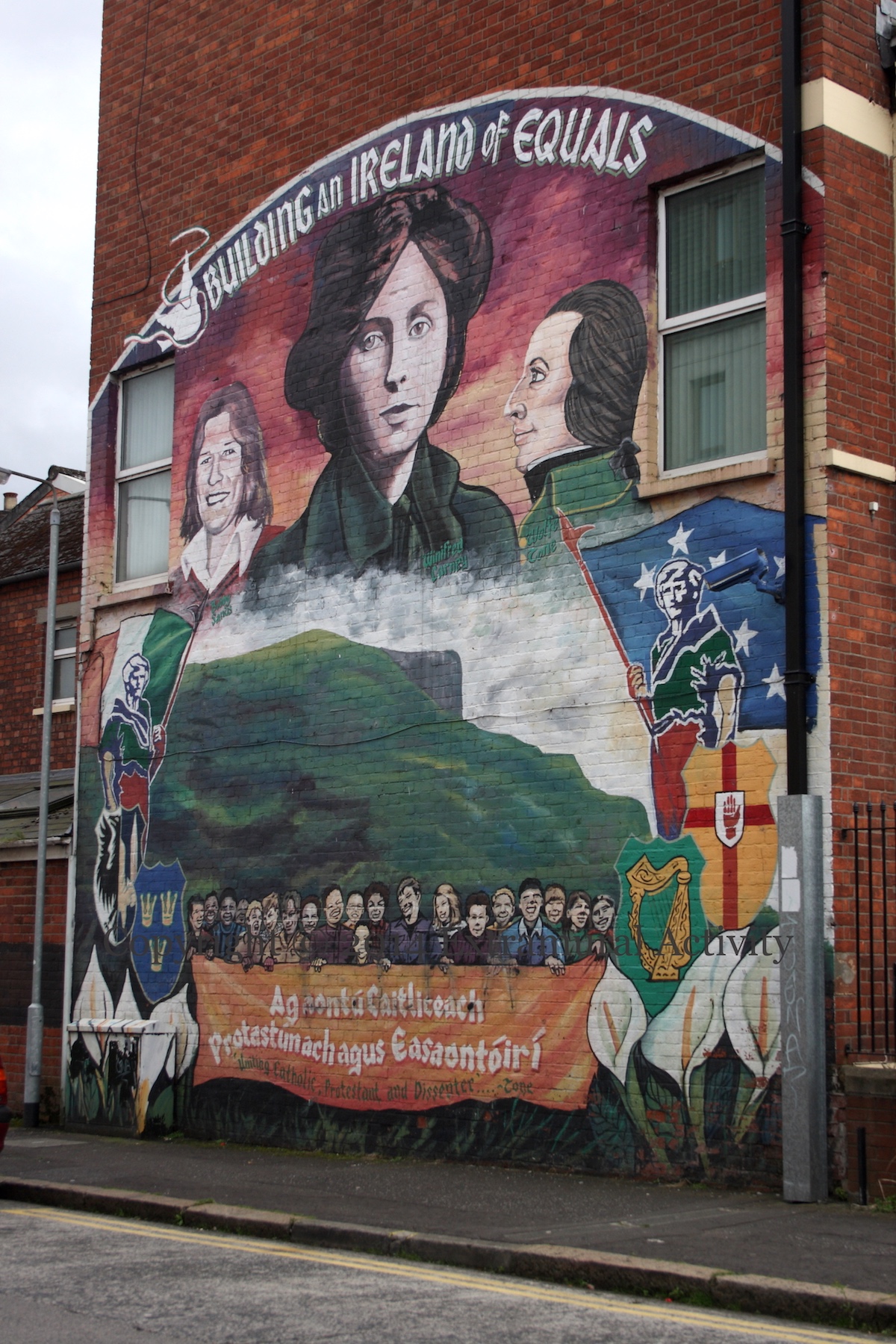
The aspect of Cave Hill commonly known as Napoleon’s Nose is shown sheltering the people of Newington, surrounded by heroes and emblems of the past – Bobby Sands, Wolfe Tone, and in the centre, Winifred Carney. This republican mural is both internally directed (at Newington and the New Lodge) and externally, being on the main Antrim Road (Oceanic avenue, on the side of the Sinn Féin office) which is a main artery between the city and points north.
“Ag aontú Caıtlıceach, Protastúnach agus Easaontóırí.” – “Uniting Catholic, Protestant, and Dissenter.” In An Argument On Behalf Of The Catholics Of Ireland (1791), Wolfe Tone of the United Irishmen wrote, “To subvert the tyranny of our execrable government, to break the connection with England, the never-failing source of all our political evils, and to assert the independence of my country, these were my objects. To unite the whole people of Ireland, to abolish the memory of past dissensions, and to substitute the common name of Irishman, in place of the denominations of Protestant, Catholic and Dissenter, these were my means.”





 Extramural Activity