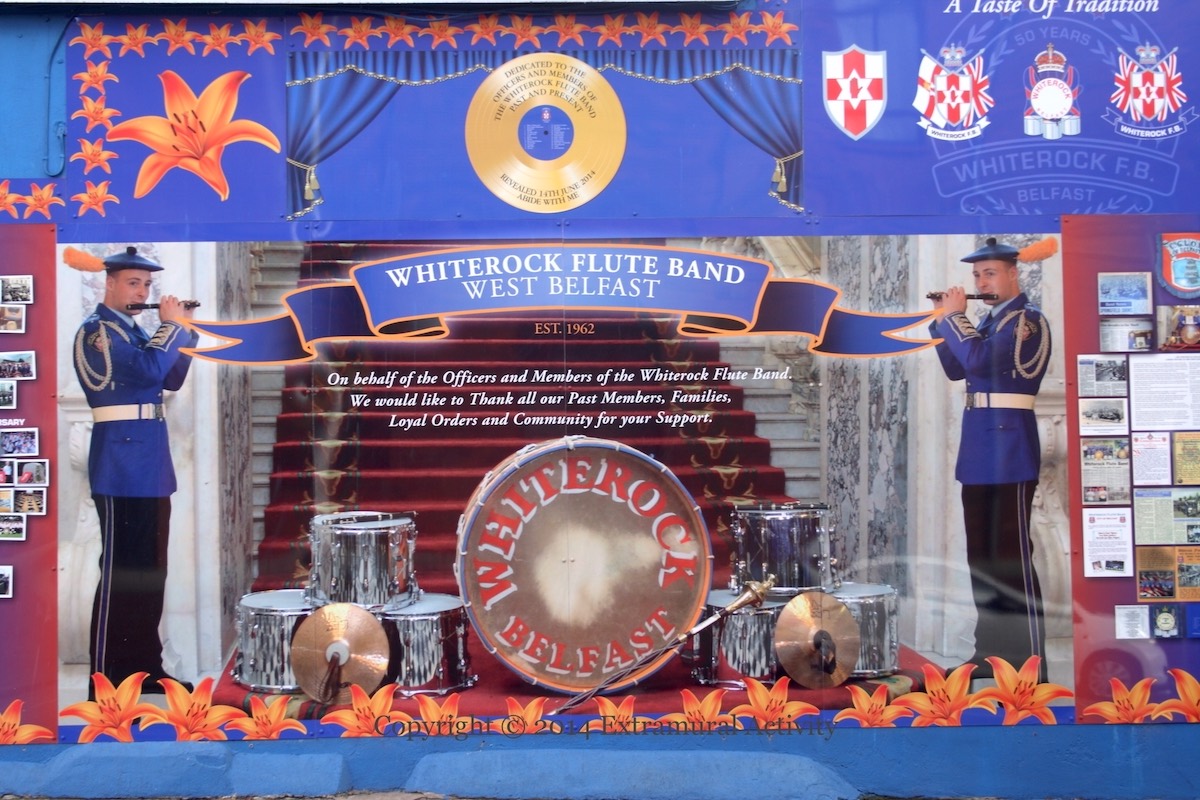
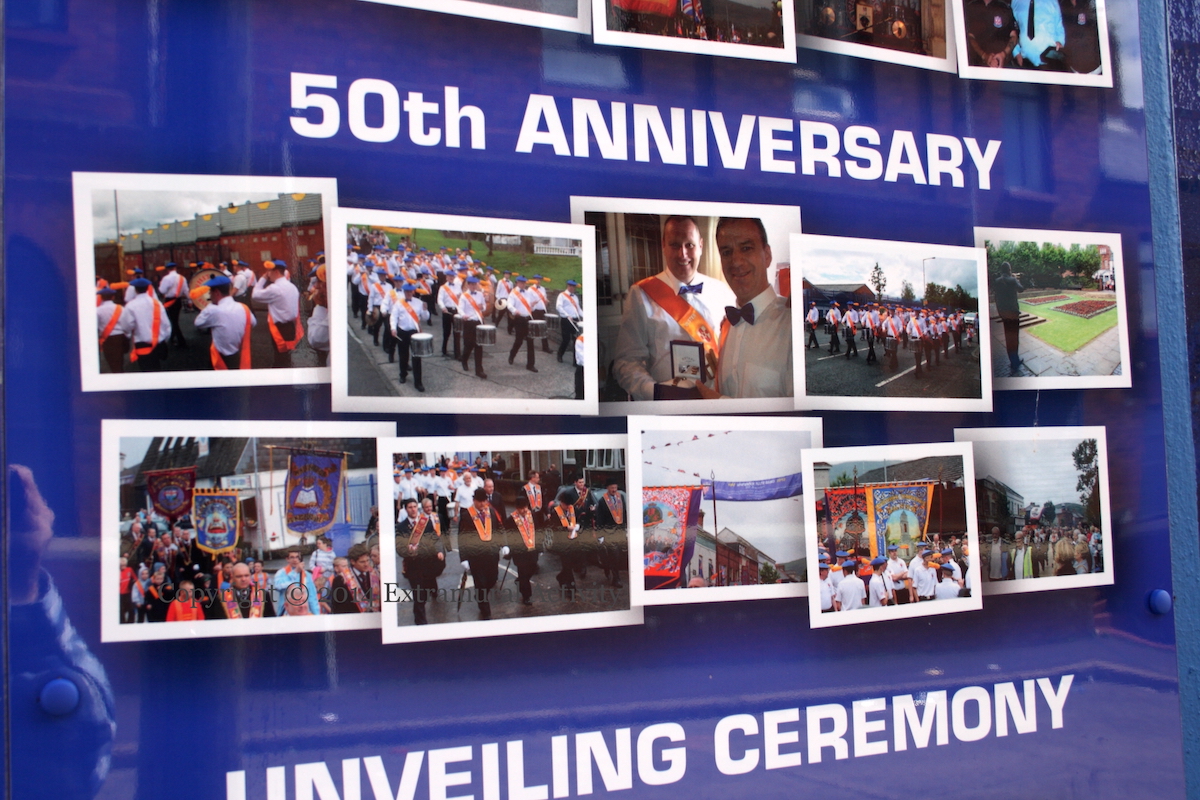
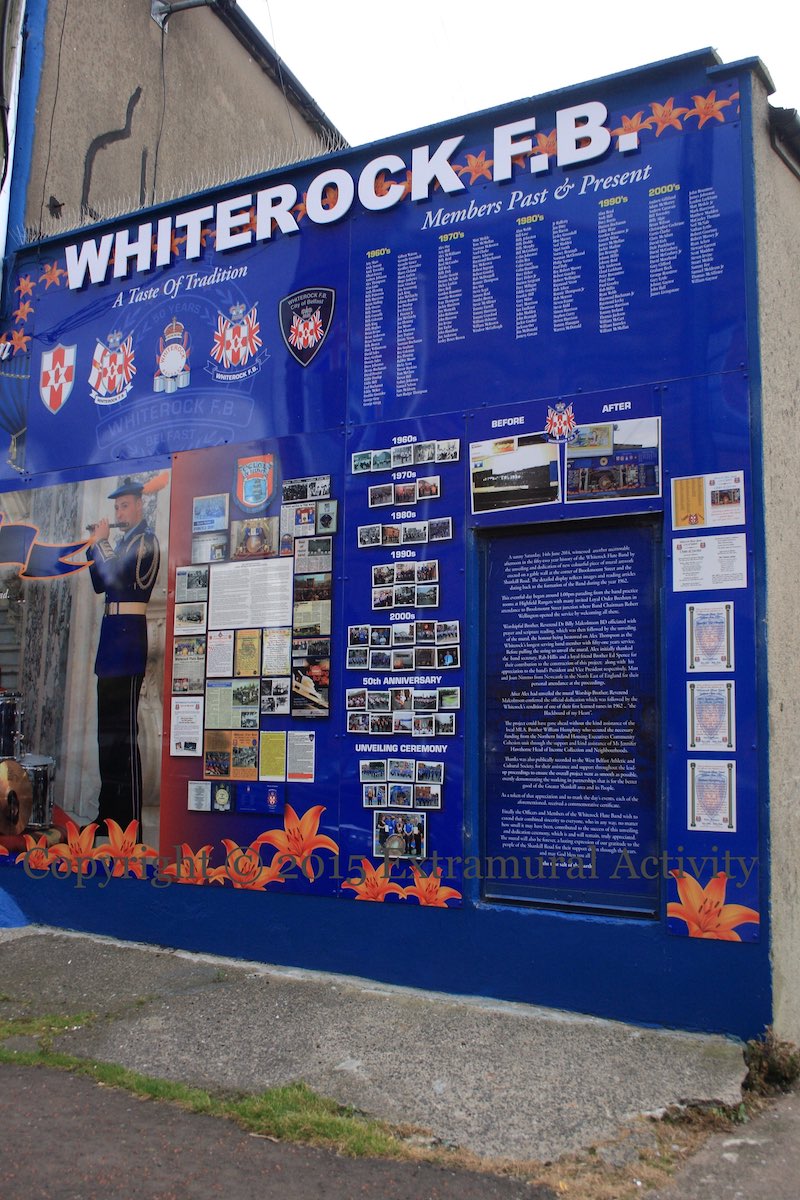
The Whiterock flute band (Fb | spotify) was founded in 1962 and the band’s display in Brookmount Street (originally mounted in 2014 – see M10195) contains a ‘brief history’ and photographs from different decades, to which was added (on the right) an updated history and a list of members past and present. The most recent addition to the wall was a memorial – shown below – to band-member Alex Thompson, who died in May 2019 after 56 years in the band – he is mentioned in both the ‘brief history’ of the band and the updated history.
(Also, the advertising hoarding above the mural has come off.)
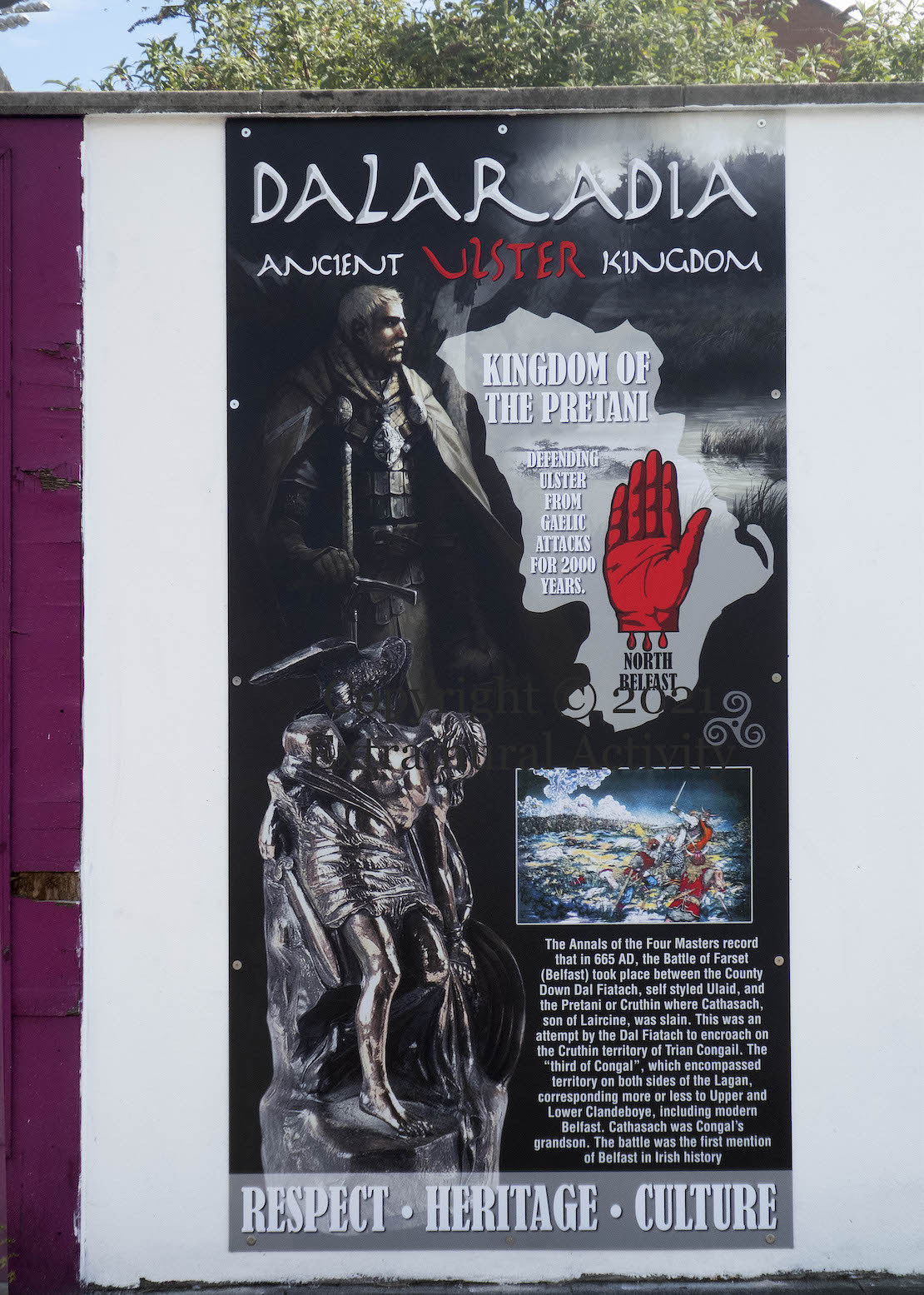
“The Annals of the Four Masters record that in 665 AD, the Battle of Farset (Belfast) took place between the County Down Dal Fiatach, self styled Ulaid, and the Pretani or Cruthin where Cathasach, son of Laircine, was slain. This was an attempt by the Dal Fiatach to encroach on the Curtain territory of Trian Congail. The “third of Congal”, which encompassed territory on both sides of the Lagan, corresponding more to less to Uppers and Lower Clandeboye, including modern Belfast. Cathasach was Congal’s grandson. The battle was the first mention of Belfast in Irish history.”
The battle scene shown is Jim Fitzpatrick’s vision of the battle of Moira (in 637), rather than “Bellum Fertsi”. The salience of this description of intra-Ulster fighting is that there is a contention that the Cruthin were Scots (Picts) thus allowing for the idea (employed especially by the UDA – see Ulster’s Defenders and Defender Of Ulster From Irish Attacks) that present-day northern Protestants have a heritage, and a history of fighting for what is roughly Co. Antrim, that pre-dates the plantations. For more information and a similar board, featuring the tower blocks of Rathcoole rather than Cuchulainn and the Battle of Moira, see Kingdom Of The Pretani. For the debate over a connection to the Picts, see WP.
The Annals date back to the 1630s though they mostly comprise a variety of earlier sources.
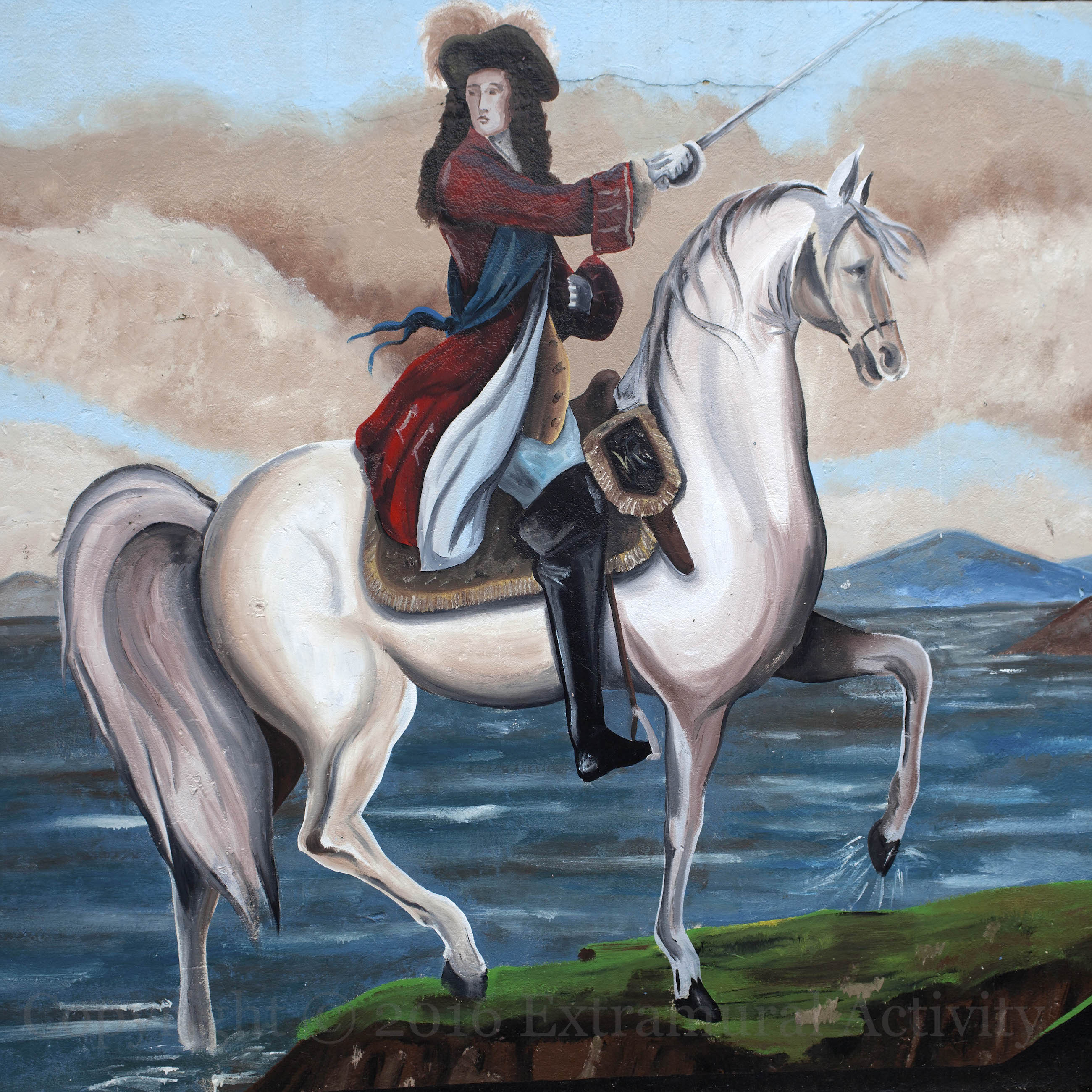
The image of the gentleman with the sword appears to be a stock fantasy image, used for at least two characters in Game Of Thrones fandom (Rhaegon Targaryen and Lord Cameron Umber).
The board on the right reads “Centenary of cultural expression 1921-2021. Sons Of Belfast LOL 743. Castleton Temperance LOL 867. The Memorial LOL 1197. Belfast Harbour LOL 1883. The Coote Memorial LOL 1921. Cave Hill Temperance LOL 1956.”
The Corcrain-Redmanville bonfire in Portadown, that is. The foundational pallets for this year’s bonfire have already been laid (Fb) and the ‘Buck Truck’ is available to collect your donations.
“Big Lily” is a giant (~40′ x 30′) Manchester United flag created by Whitehead man Keith Norris in 1999 as a gesture of friendship towards a fellow United fan from Belfast from the ‘other side’, Martin ‘Faceman’ Cleary. It has subsequently travelled the world – the flags shown are of Catalonia, Japan, Australia, England, the United States, Italy, Northern Ireland, Ireland, Germany, Poland, Scotland, Russia, Brazil, Spain – uniting United fans and being used to raise funds for anti-racism charity Kick It Out and Unicef. The mural is situated in no-man’s land on Northumberland Street and features the Orange lily of unionism and the Easter lily of nationalism. (Carrickfergus Times | Belfast Live | SignBigLily.com)
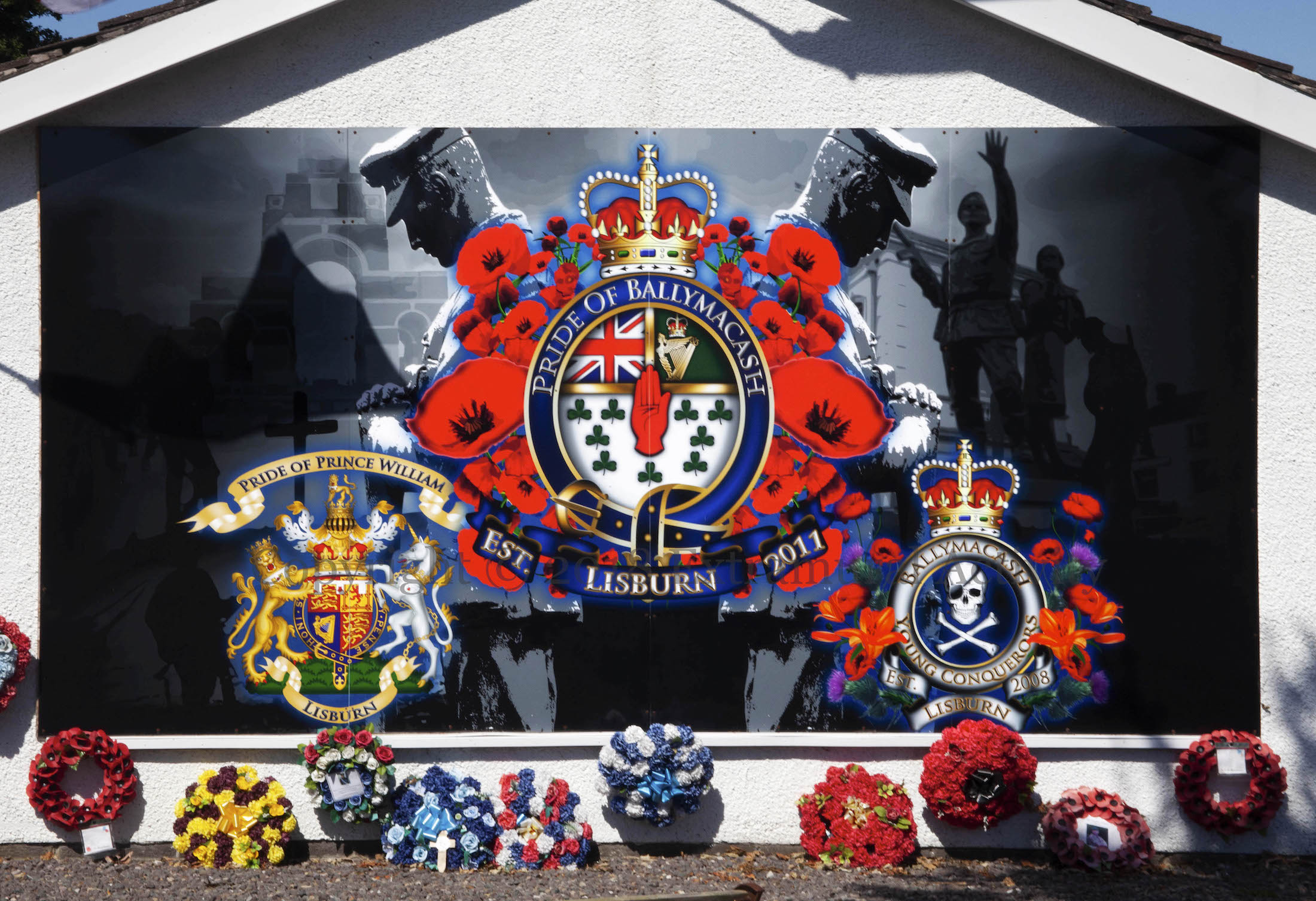
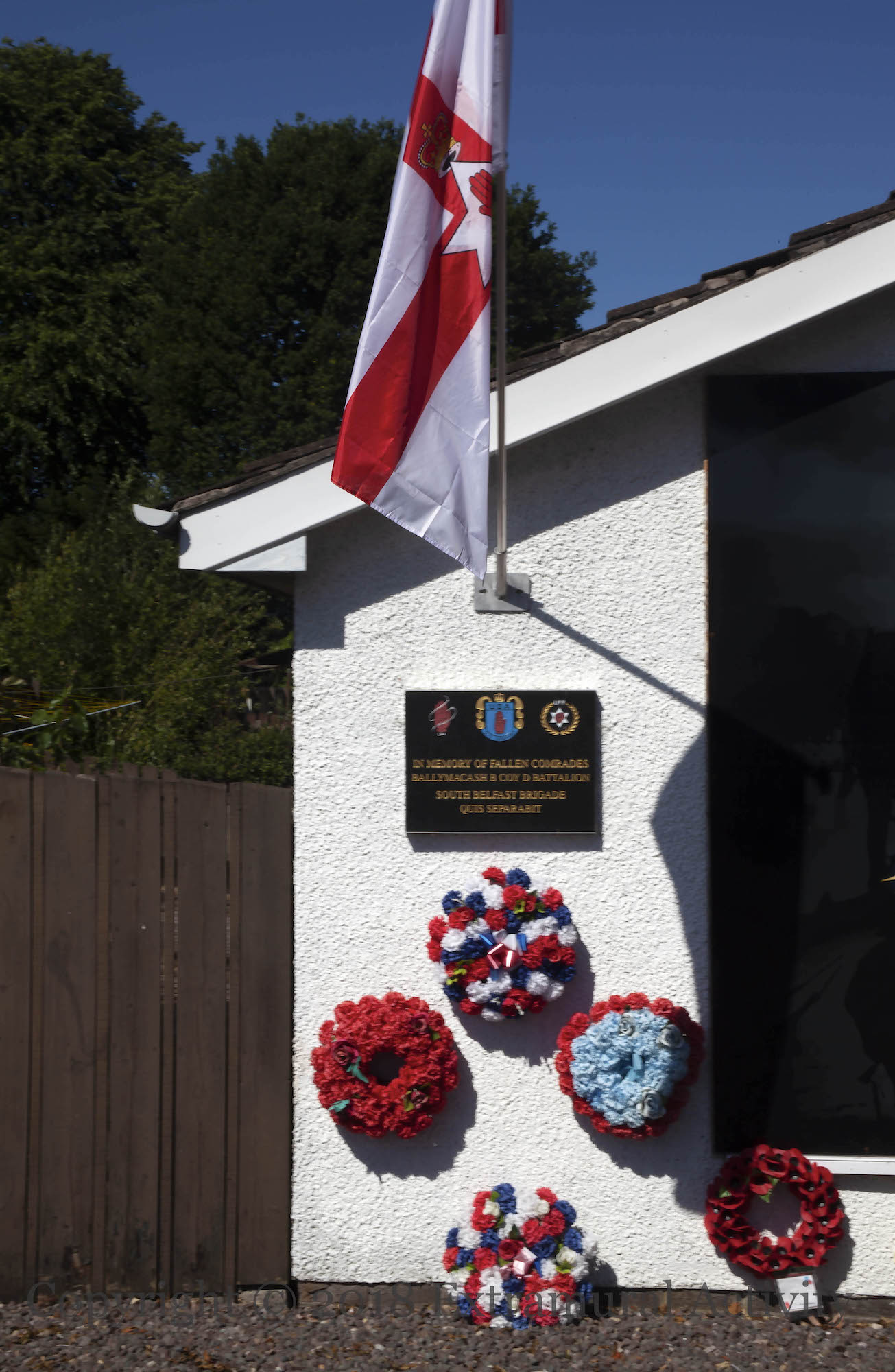
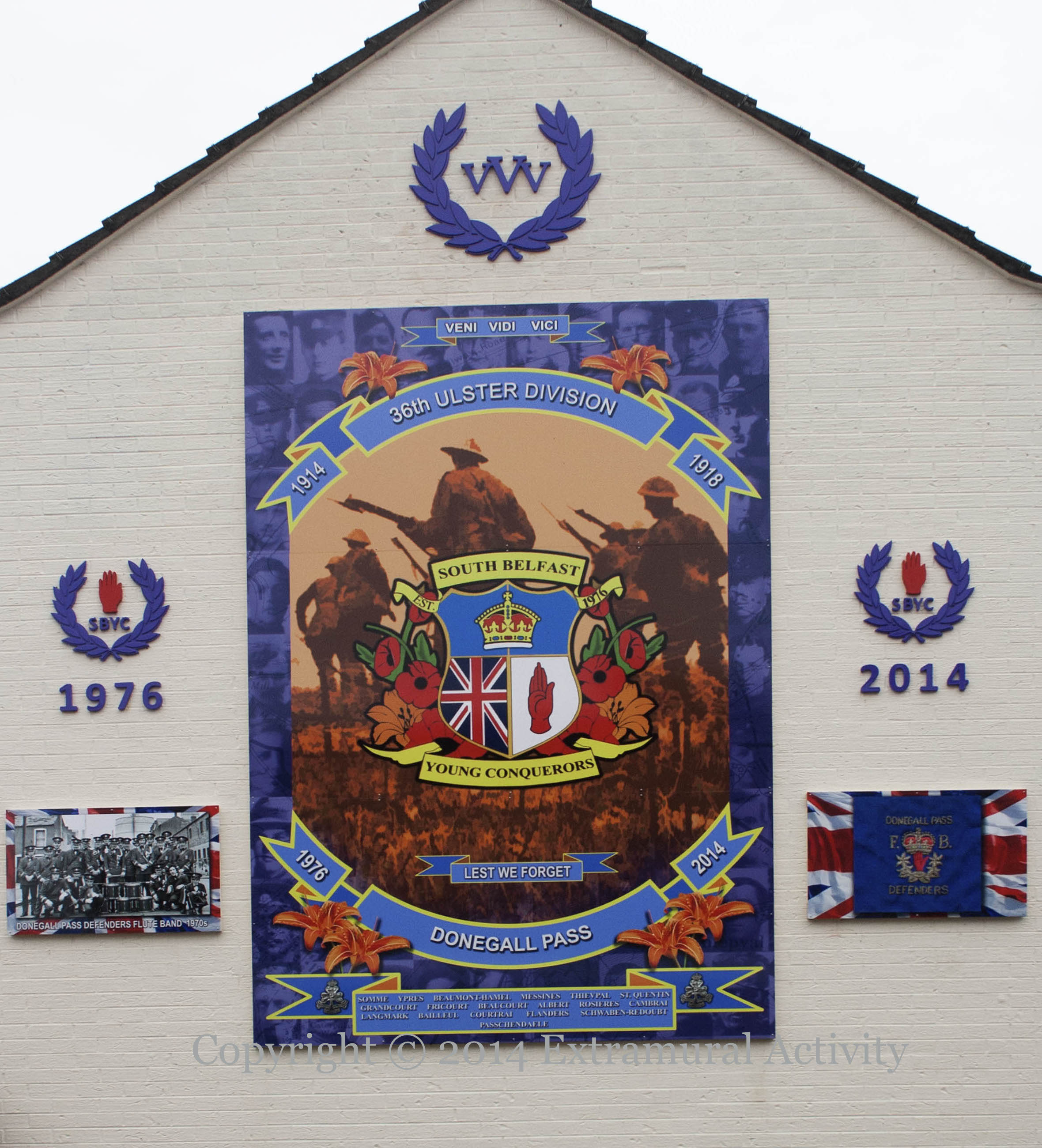
The Pride Of Ballymacash flute band, formed in 2011 from the Pride Of Prince William (bottom left) and Ballymacash Young Conquerors (bottom right), uses the emblem of the 36th (Ulster) Division, in the centre of the mural. In the background on the left is the Thiepval Memorial and, on the right, the UDR memorial statue in Market Square, Lisburn. To the left (in the second image) is a UDA plaque “In memory of fallen comrades Ballymacash B coy D battaltion, South Belfast Brigade. Quis separabit.” For a close-up of the memorial on the ground, see Death & Life.
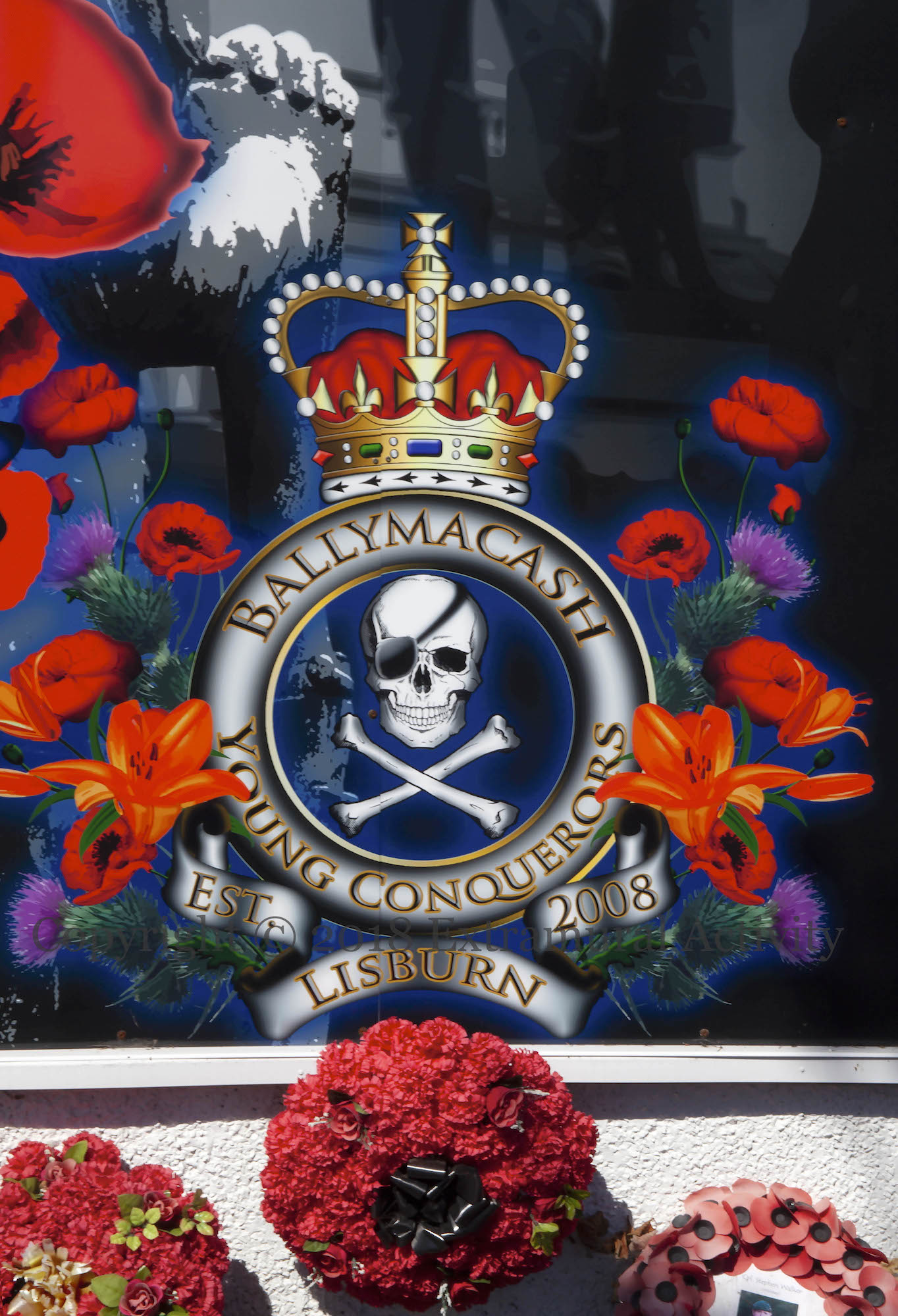
The skull-and-crossbones is the emblem of the Ballymacash Young Conquerors, which merged with the Pride Of Prince William in 2011 to form the Pride Of Ballymacash. (Fb) The symbol is a potent one, however, and still used by the new band in addition to its own. In the mural in its memorial garden, it is surrounded by poppies, thistles, and orange lilies. If you know the name of the young man in the memorial display (second image), please comment/get in touch.
William III of England, commonly known as William of Orange, led his troops to victory on July 1st, 1690 at the Battle of the Boyne against the forces of James II, the deposed English monarch and the father of his wife. The Williamite campaign began with successful resistance against the Siege of Derry in 1689 and James’s final defeat came a year later on July 12th, at Aughrim.
A pre-launch version (from May) of the Whiterock Flute Band mural in Brookmount Street can be seen in the Peter Moloney collection; this includes the main panel and the ‘brief history’ on the left. Since then a golden disc has been mounted above the main panel, and to the right have been added another panel of photographs, a list of members past and present, and an updated history panel. [The final image, from 2015, shows the addition of “Whiterock F.B.” in bold, white, lettering along the top right
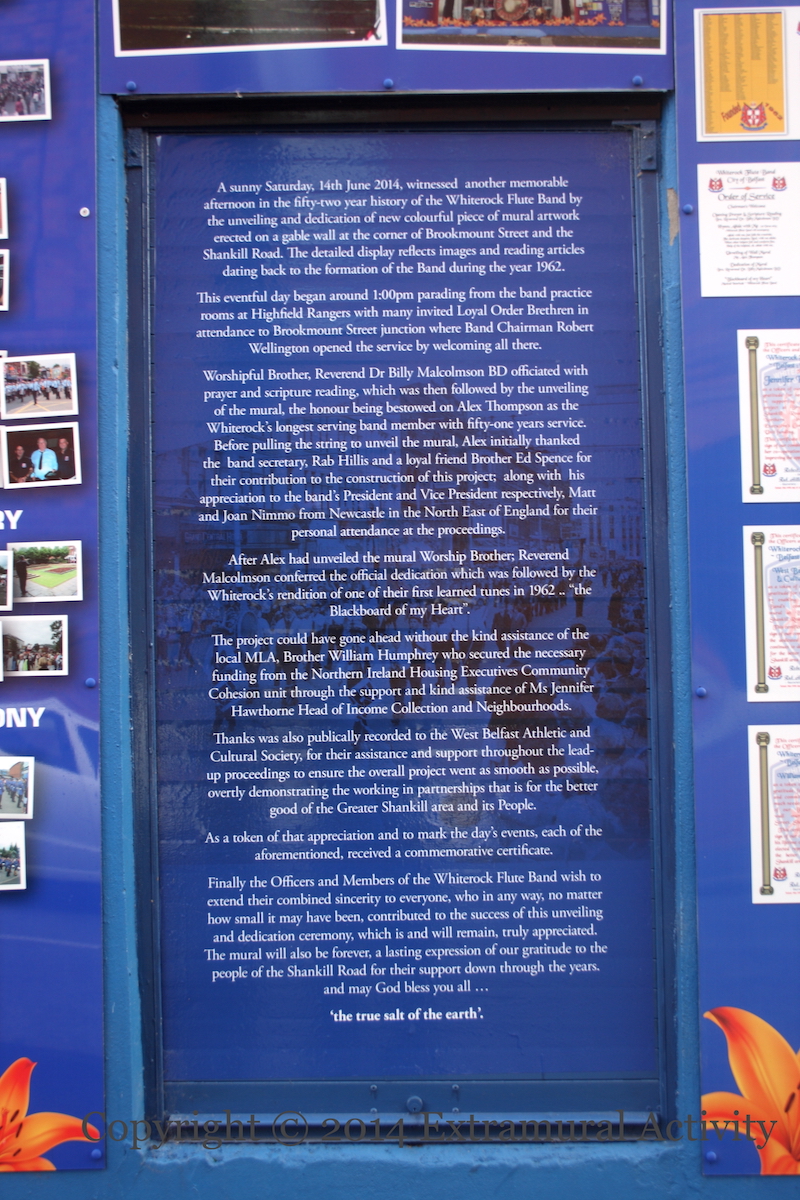
“A sunny Saturday, 14th June 2014, witnessed another memorable afternoon in the fifty-two year history of the Whiterock flute band by the unveiling and dedication of new colourful piece of mural artwork erected on the gable wall at the corner of Brookmount Street and the Shankill Road. The detailed display reflects images and reading articles dating back to the foundation of the band during the year 1962.
This eventful day began around 1:00 pm parading from the and practice rooms at Highfield Rangers with many invited Loyal Order Brethren in attendance to Brookmount Street junction where Band Chairman Robert Wellington opened the service by welcoming all there.
Worshipful Brother, Reverend Dr Billy Malcolmson BD officiated with prayer and scripture reading, which was then followed by the unveiling of the mural, the honour being bestowed on Alex Thompson as the Whiterock’s longest serving band member with fifty-one years of service. Before pulling the string to unveil the mural, Alex initially thanks the band secretary, Rab Hillis and a loyal friend Brother Ed Spence for their contribution to the construction of this project; along with his appreciation to the band’s President and Vice President respectively, Matt and Joan Nimmo from Newcastle in the North East of England for their personal attendance at the proceedings.
After Alex had unveiled the mural Worship Brother; Reverend Malcolmson conferred the official dedication which was followed by the Whiterock’s rendition of one of their first learned tunes in 1962 .. “the Blackboard of my Heart”.
The project could have gone ahead without the kind assistance of the local MLA, Btother William Humphrey who secured the necessary funding from the Northern Ireland Housing Executive’s Community Cohesion unit through the support and kind assistance of Ms Jennifer Hawthorne head of Income Collection and Neighbourhoods.
Thanks was also publically recorded to the West Belfast Athletic and Cultural Society, for their assistance and support throughout the lead-up proceedings to ensure the overall project went as smooth as possible, overtly demonstrating the working in partnership that is for the better good of the Greater Shankill area and its people.
As a token of that appreciation and to mark the day’s events, each of the aforementioned, received a commemorative certificate.
Finally the officers and members of the Whiterock flute band wish to extend their combined sincerity to everyone, who in any way, no matter how small it may have been, contributed to the success of this unveiling and dedication ceremony, which is and will remain, truly appreciated. The mural will also be forever, a lasting expression of our gratitude to the people of the Shankill Road for their support down through the years, and may God bless you all … ‘the true salt of the earth’.”
Update: further additions were made to the display in 2021.
The fourteenth and final panel in Thorndyke Street contains a number of small panels, including the two above, along with emblems of local Orange and Black lodges, John McCrae’s In Flanders Fields, a list of acknowledgements, and a copyright claim.










 Extramural Activity