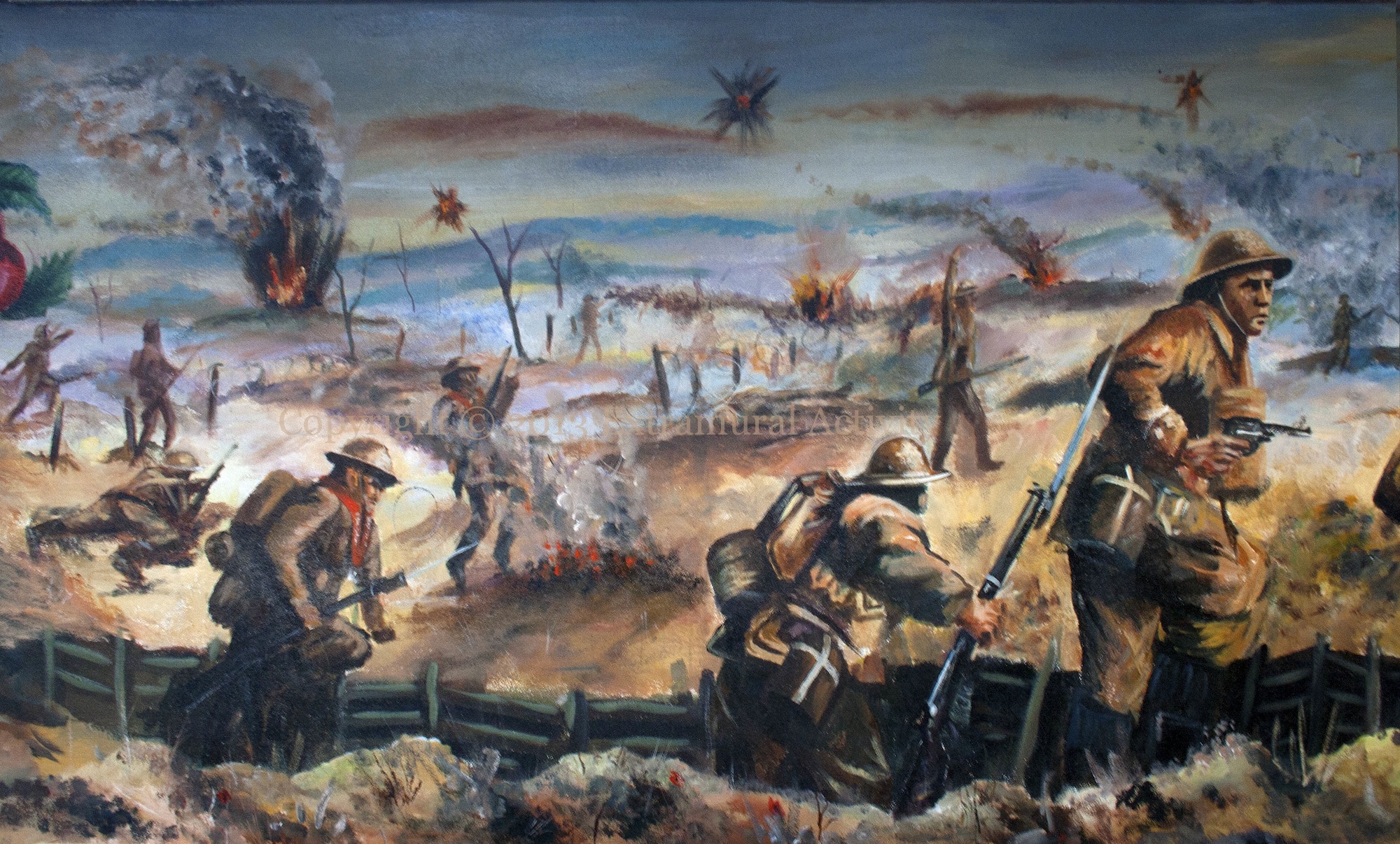
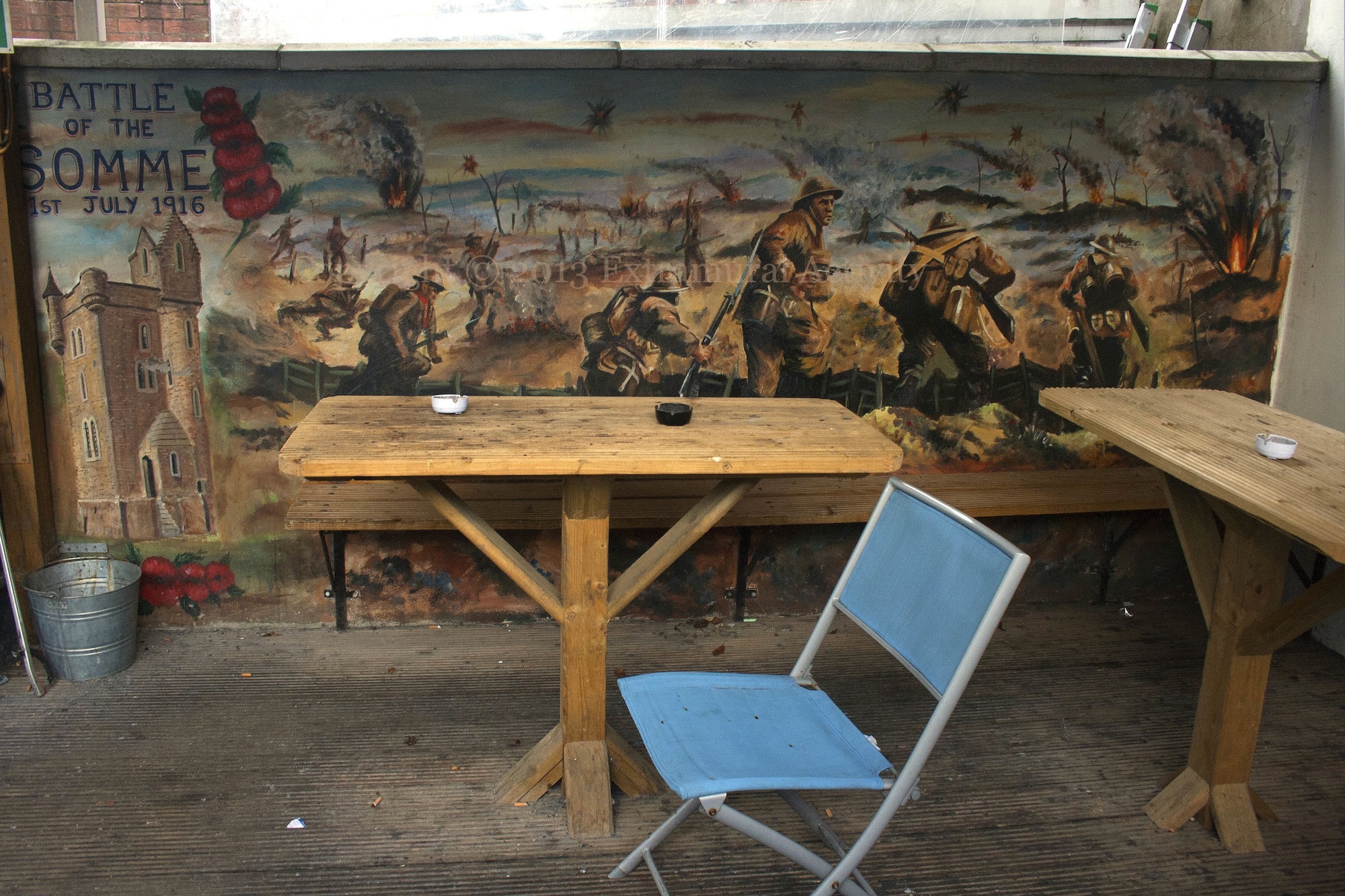
Detail of a mural commemorating the battle of the Somme in the courtyard of the Times Bar, York Road. The mural is probably based on the work of JP Beadle, such as the painting “Battle of the Somme: Attack of the Ulster Division”, which hangs in Belfast City Hall (militaryprints.com).
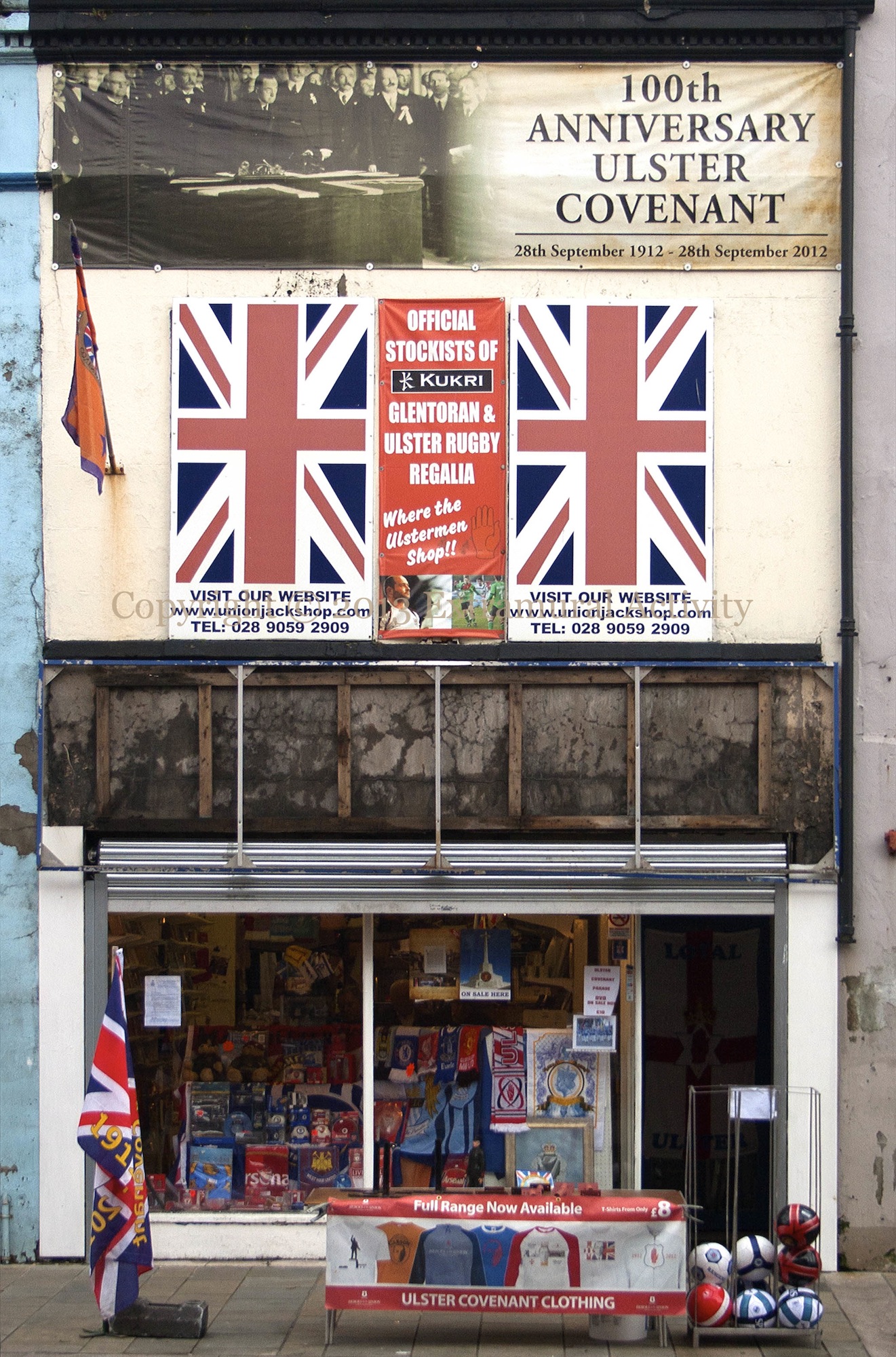
Union flags and a full range of Covenant clothing are available from the Union Jack Souvenir Shop on the Lower Newtownards Road. See also: The Essentials.
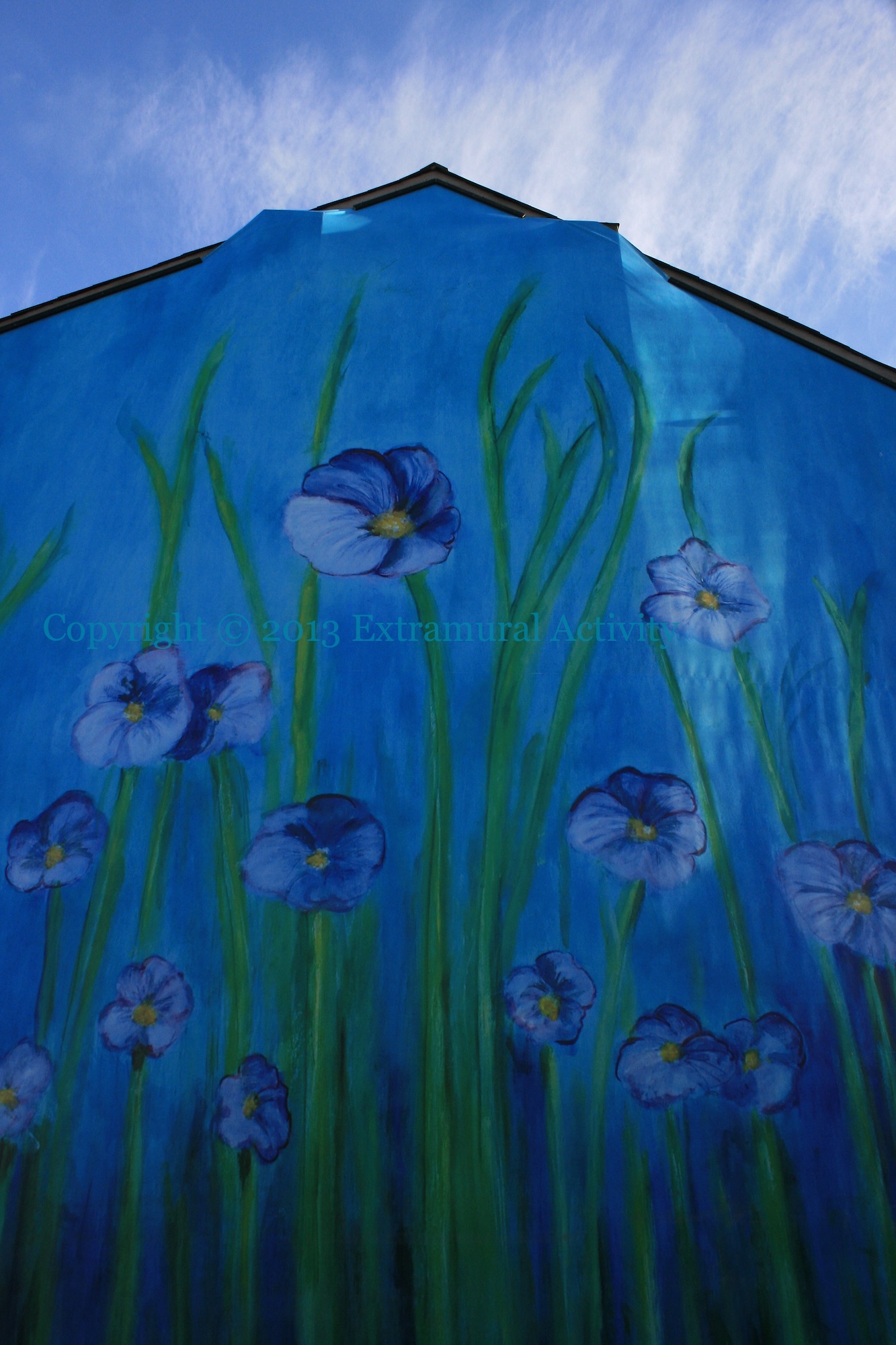
A mural by artist Deirdre Robb (of Creative Exchange Artists) in Tower Street/Newtownards Road of flax plants, somewhat reminiscent of van Gogh’s Irises. (Leave a comment if you detect another inspiration.) The official title is “Urban Meadows” (Robb).
The painting is on a tarp or canvas that is not firmly affixed to the wall, which allows the painting to move in the wind. The wall and the “pocket park” are on the site of the former RHC mural.
7 min. video of Deirdre talking about the pieces in her exhibit ‘Blue’
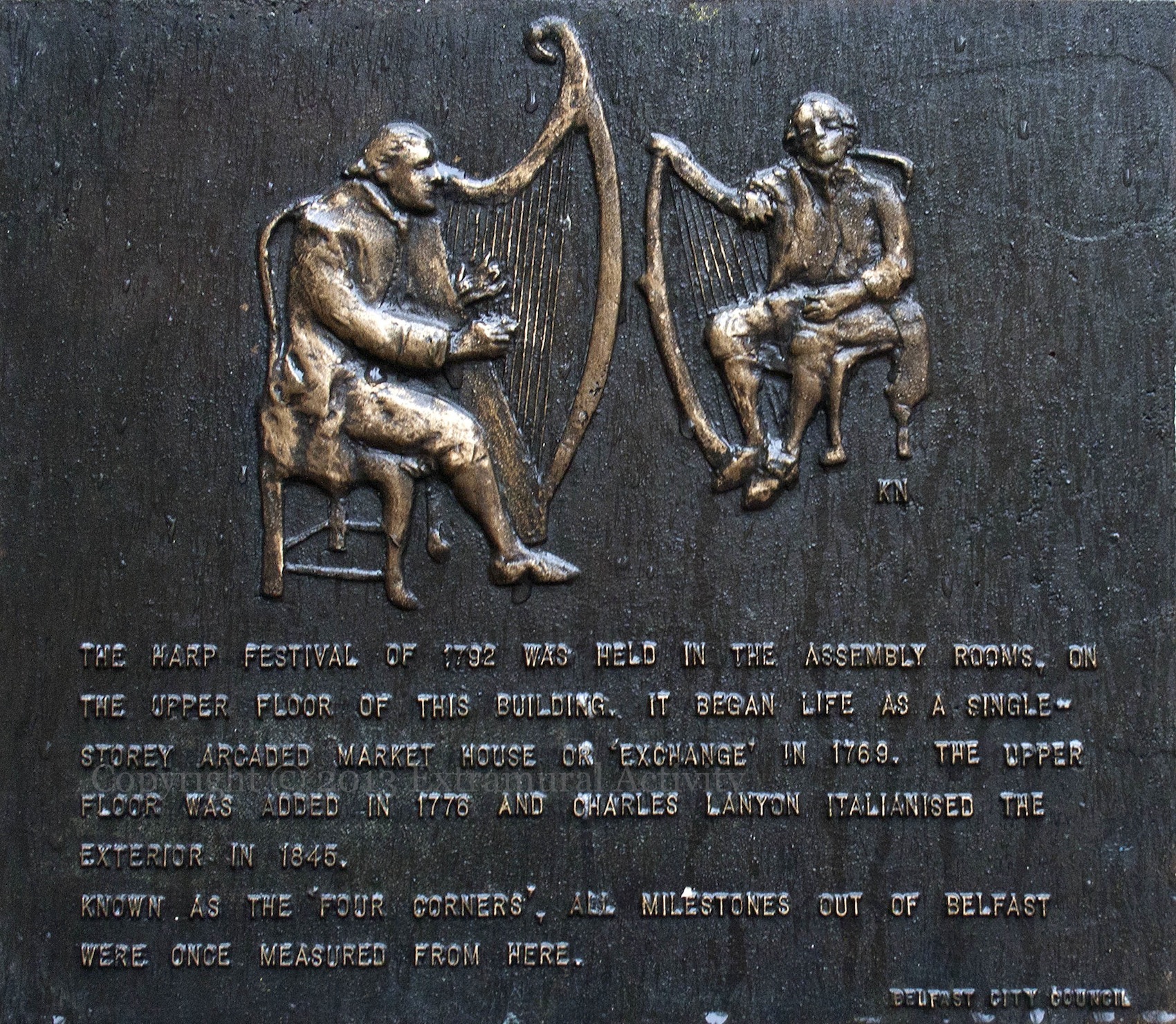
A plaque in Donegall St: “The harp festival of 1792 was held in the Assembly Rooms, on the upper floor of this building. It began life as a single-storey arcaded market house or ‘exchange’ in 1768. The upper floor was added in 1778 and Charles Lanyon Italianised the exterior in 1845. Known as the ‘four corners’, all milestones out of Belfast were once measured from here.”
The Assembly Rooms are in the building that stands between Lower Donegall St and Lower North Street.
Who are these two figures? The link above gives a list of harpists. Is the smaller person Edward Bunting (WP), who transcribed and “corrected” the music played? Who is KN (see below leg of chair) and is this a copy of another piece?
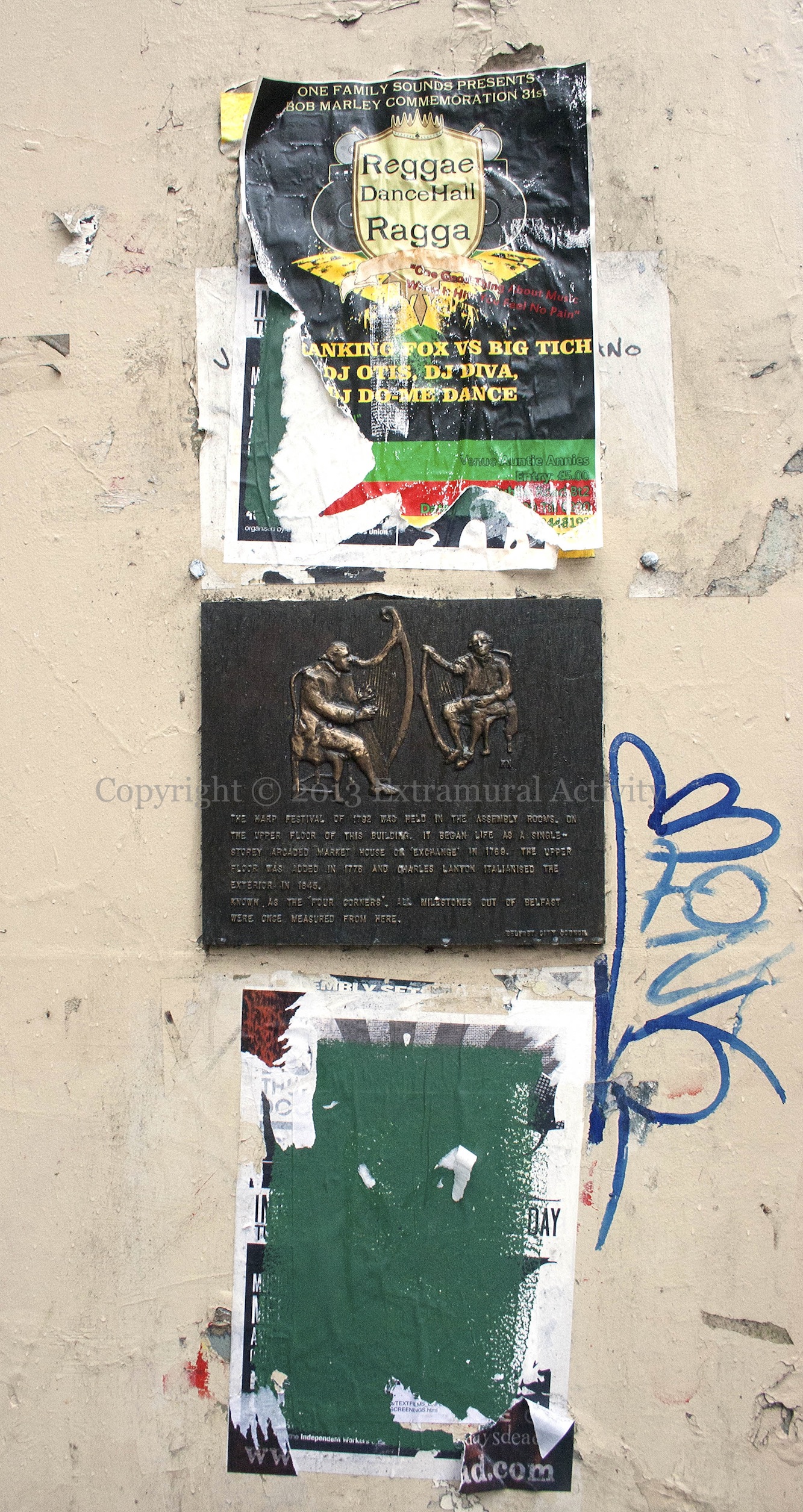
Wider shot below, complete with obliterated — by Belfast City Council — flyer and another for Dance Hall music.
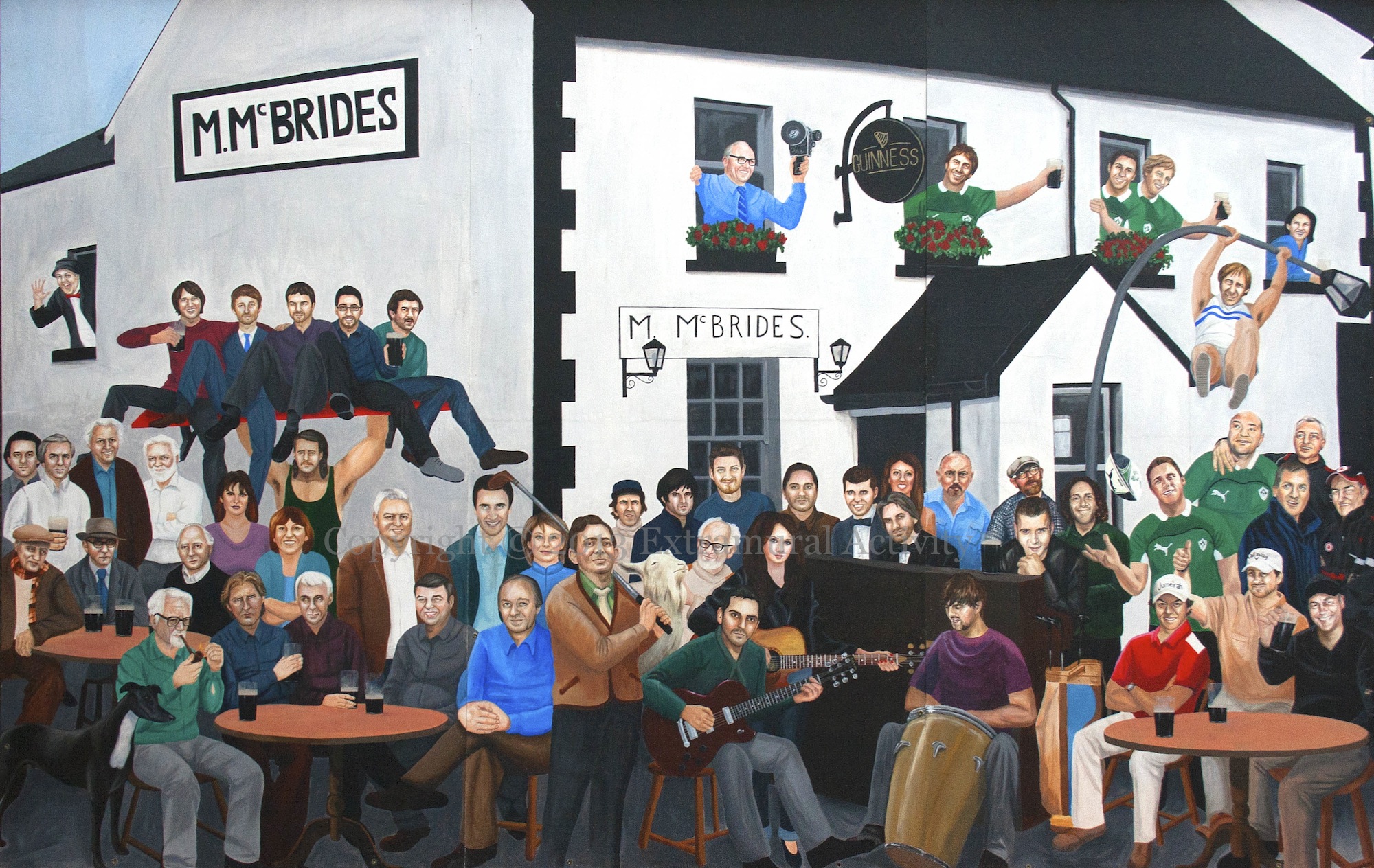
McBride’s pub — in Cushendun — with a variety of local celebrities. This is one of the three images on the back wall of the courtyard of the Duke of York. The artist is Kathryn Bannister (not Ciaran Gallagher, as originally stated – thanks to Ciaran for the correction, April 2013. The pair worked together on the Fritz Lang and Euro-pa pieces, also at the Duke Of York). Kathryn’s web site is here.
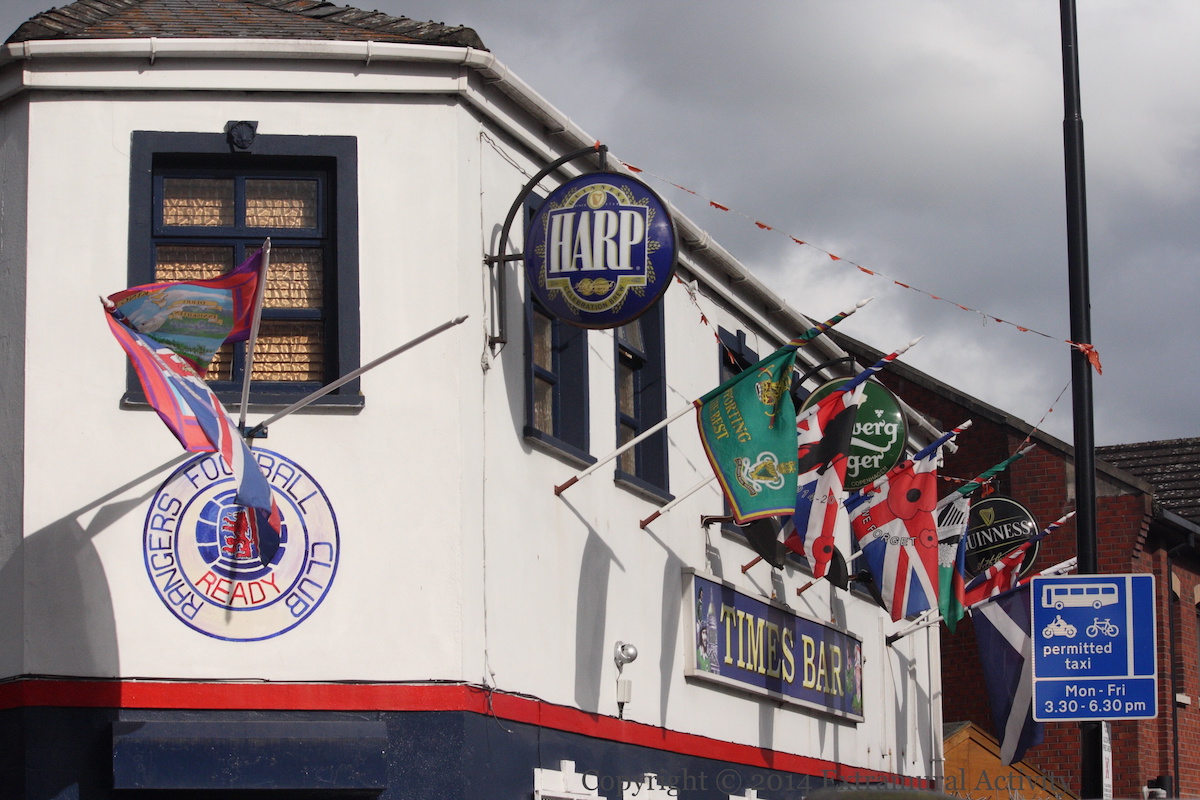
Detail from a mural on the courtyard of the Times bar, York Road. In the 2012-2013 season Rangers are playing in the Scottish League’s Division 3 (i.e. the fourth-tier league) after it became insolvent in February, 2012. Full mural below, along with another copy of the club’s emblem on the outside of the bar.
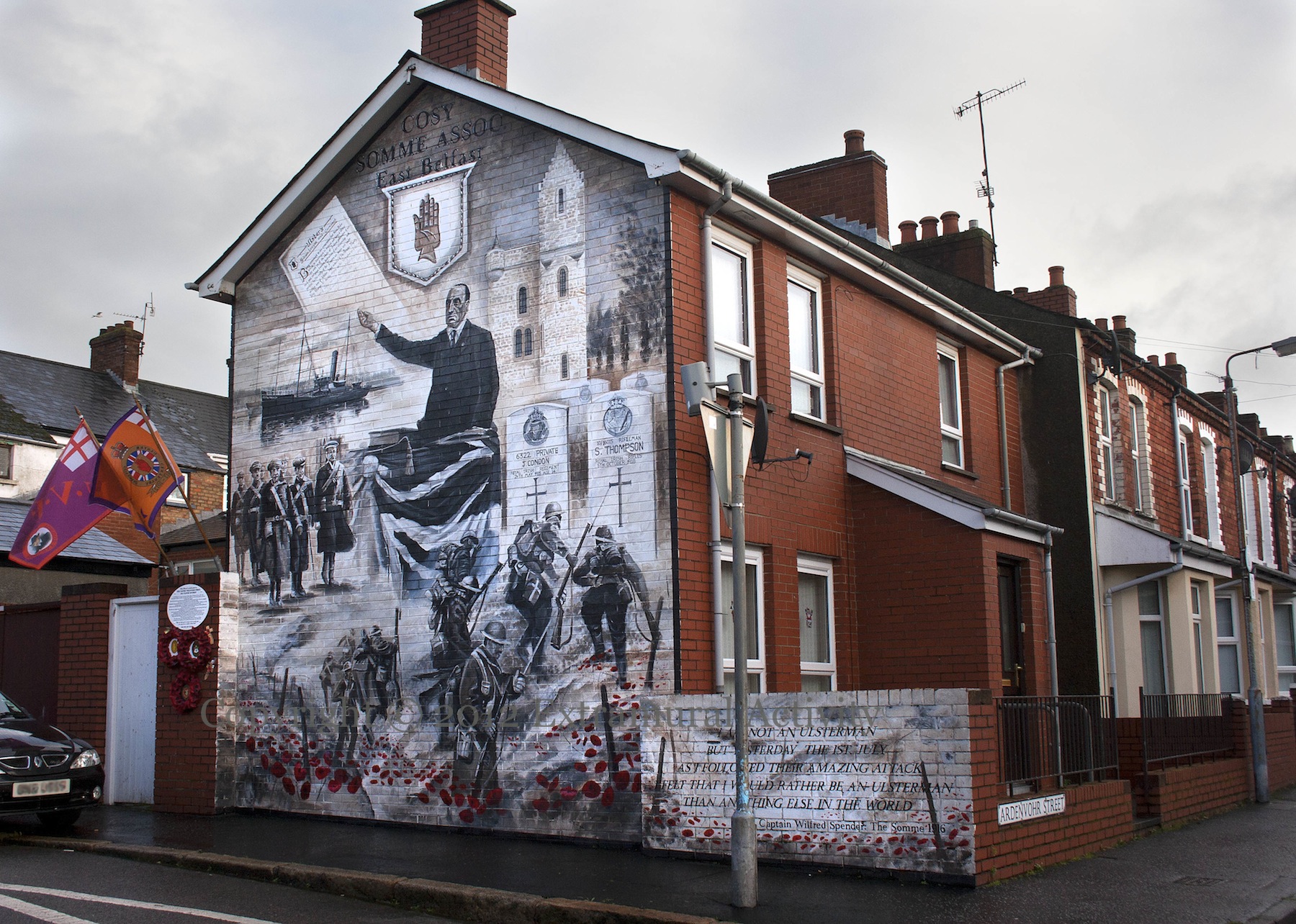
Above is a detail from a mural in Carlingford St, showing gravestones of two deceased locals: “6322 Private J. Condon, Royal Irish Regiment, 24th May, 1915, age 14” and “10/16015 Rifleman S. Thompson Royal Irish Rifles, 5th October, 1918”. Their gravestones are the end-point of a journey that began with the Covenant and the Ulster Volunteers (illustrated by images of Carson, the Covenant, gun-running, and Volunteers drilling).
On the side-wall are the words of Captain Wilfrid Spender, describing the first day of the Battle Of The Somme, 1916: “I am not an Ulsterman but yesterday the First of July, as I followed their amazing attack, I felt that I would rather be an Ulsterman than anything else in the world. [My pen cannot describe adequately the hundreds of heroic acts I witnessed, the Ulster Volunteer Force, from which the Division was made, has won a name that equals any in history. Their devotion deserves the gratitude of The British Empire.]”
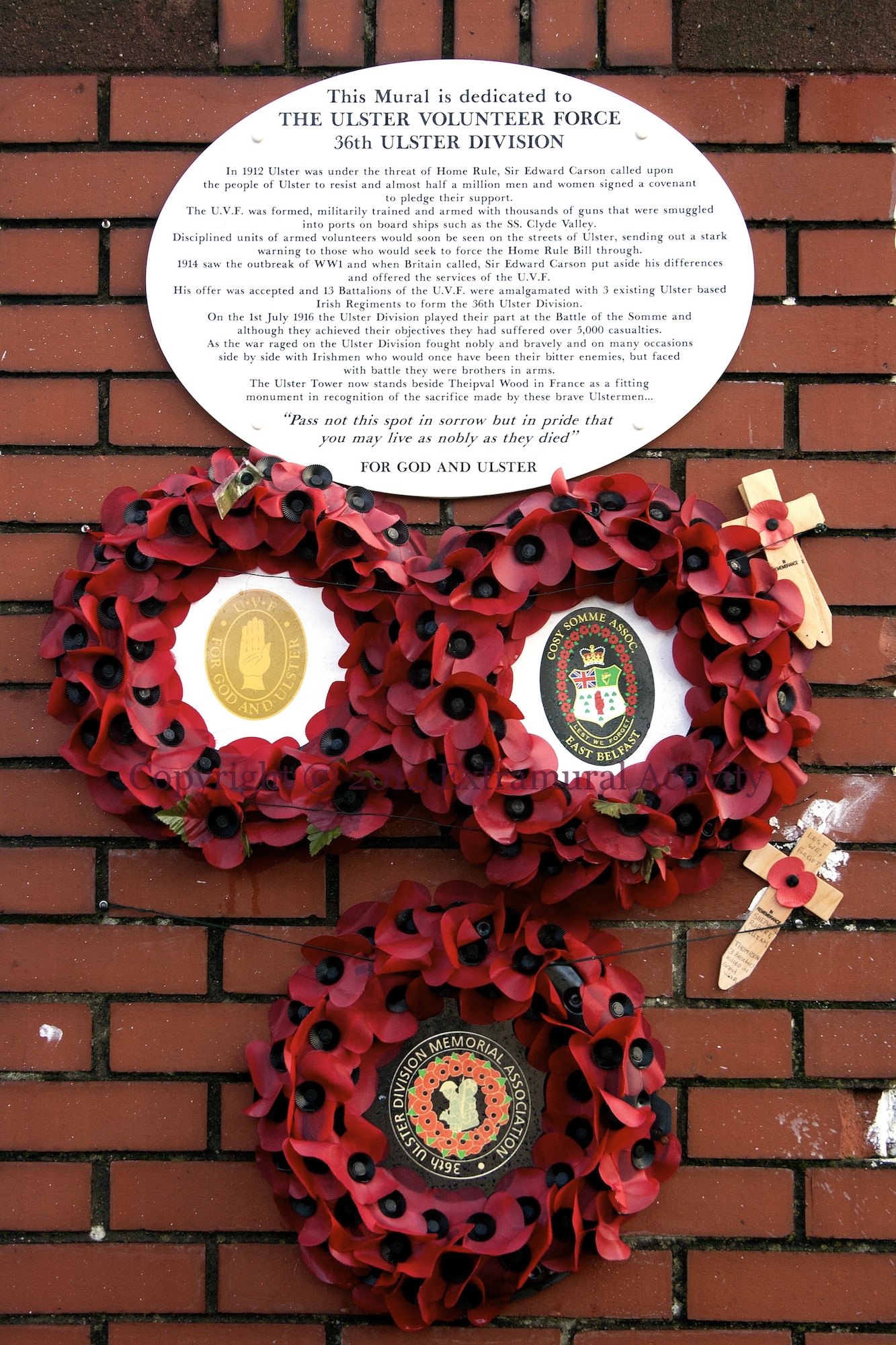
A wide shot of the whole, as well as a close-up of the plaque and wreathes, is below. See also: Attack From Thiepval Wood.
“In 1912 Ulster was under the threat of Home Rule, Sir Edward Carson called upon the people of Ulster to resist and almost half a million men and women signed a covenant to pledge their support. The U.V.F. was formed, militarily trained and armed with thousands of guns that were smuggled into ports on board ships such as the SS. Clyde Valley. Disciplined units of armed volunteers would soon be seen on the streets of Ulster, sending out a stark warning to those who would seek to force the Home Rule bill through. 1914 saw the outbreak of WW1 and when Britain called, Sir Edward Carson put aside his differences and offered the services of the U.V.F. His offer was accepted and 13 battalions of the U.V. F. were amalgamated with 3 existing Ulster based Irish regiments to form the on the 36th (Ulster) Division. On the 1st july the Ulster Division played their part at the Battle of the Somme and although they achieved their objectives they had suffered over 5,000 casualties. As the war raged on the Ulster Division fought nobly and bravely and on many occasions side by side with Irishmen who would once have been their bitter enemies, but faced with battle they were brothers in arms. The Ulster Tower now stands beside Theipval [sic] Wood in France as a fitting monument in recognition of the sacrifice made by these brave Ulstermen … “Pass not this spot in sorrow but in pride that you may live as nobly as they died” For God and Ulster”
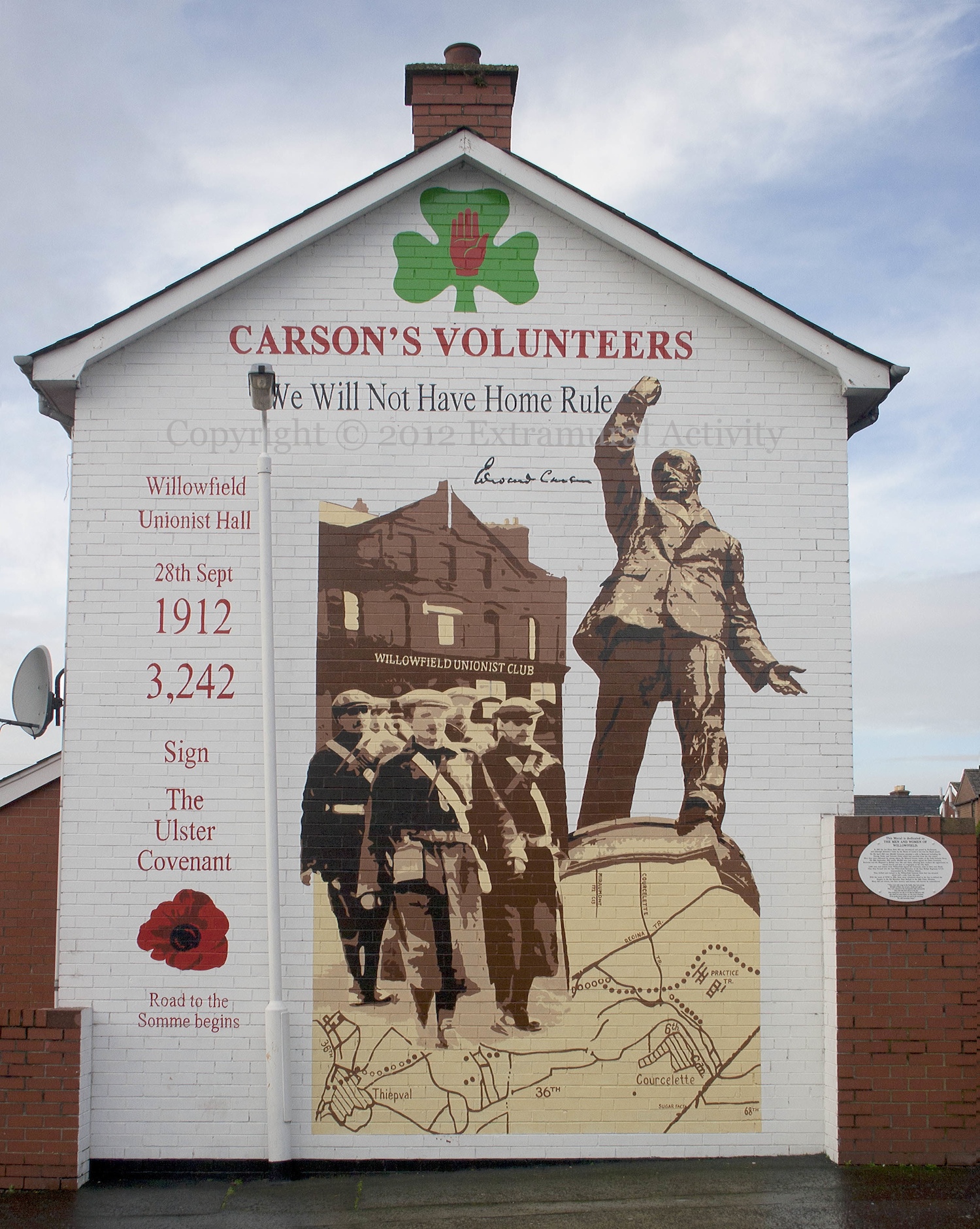
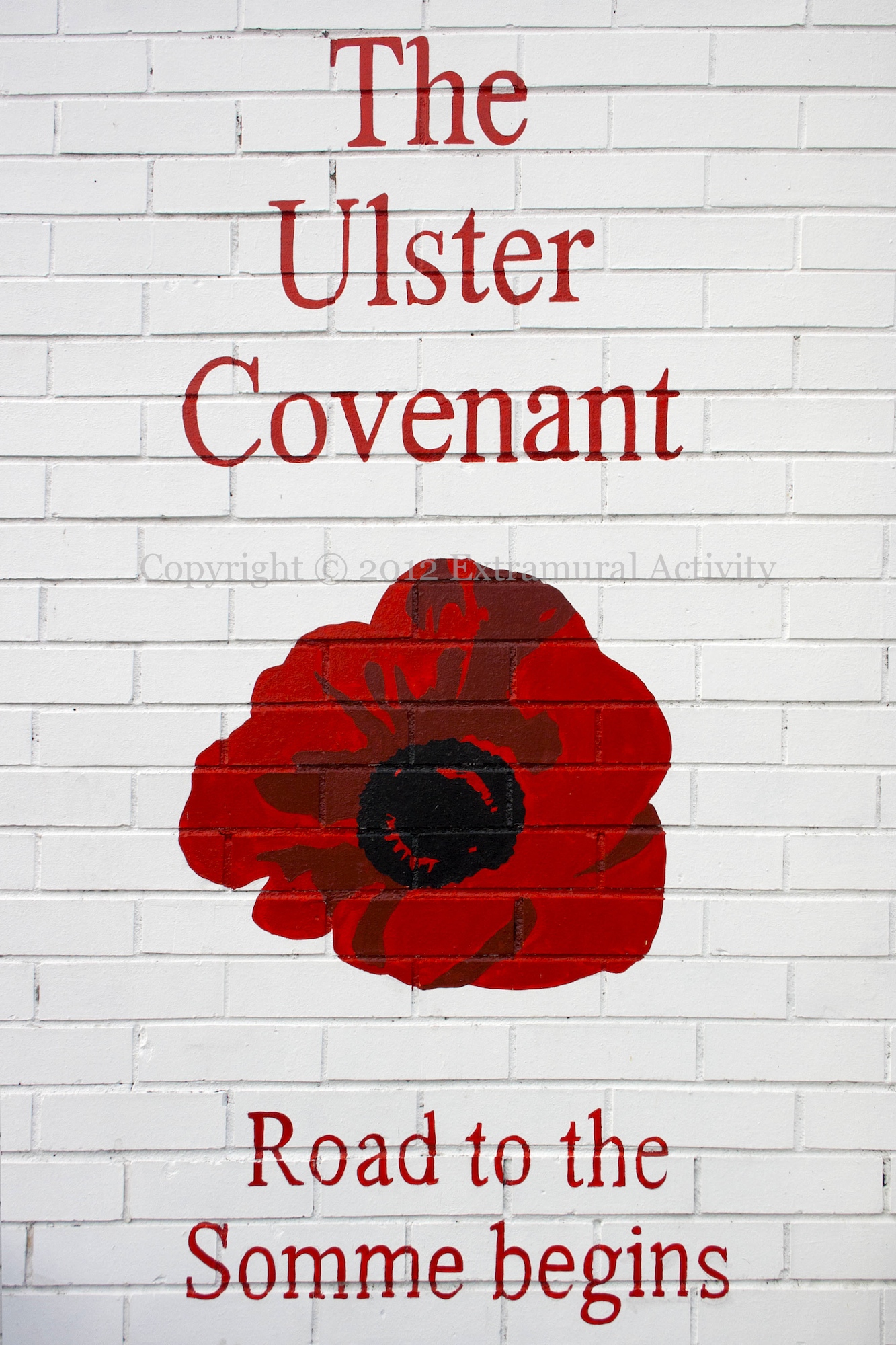
Two murals confront each other on Carlingford Street, east Belfast. Here is one, showing a map of the area, a statue of Carson, and a group of volunteers. Detail and close-up of the plaque below.
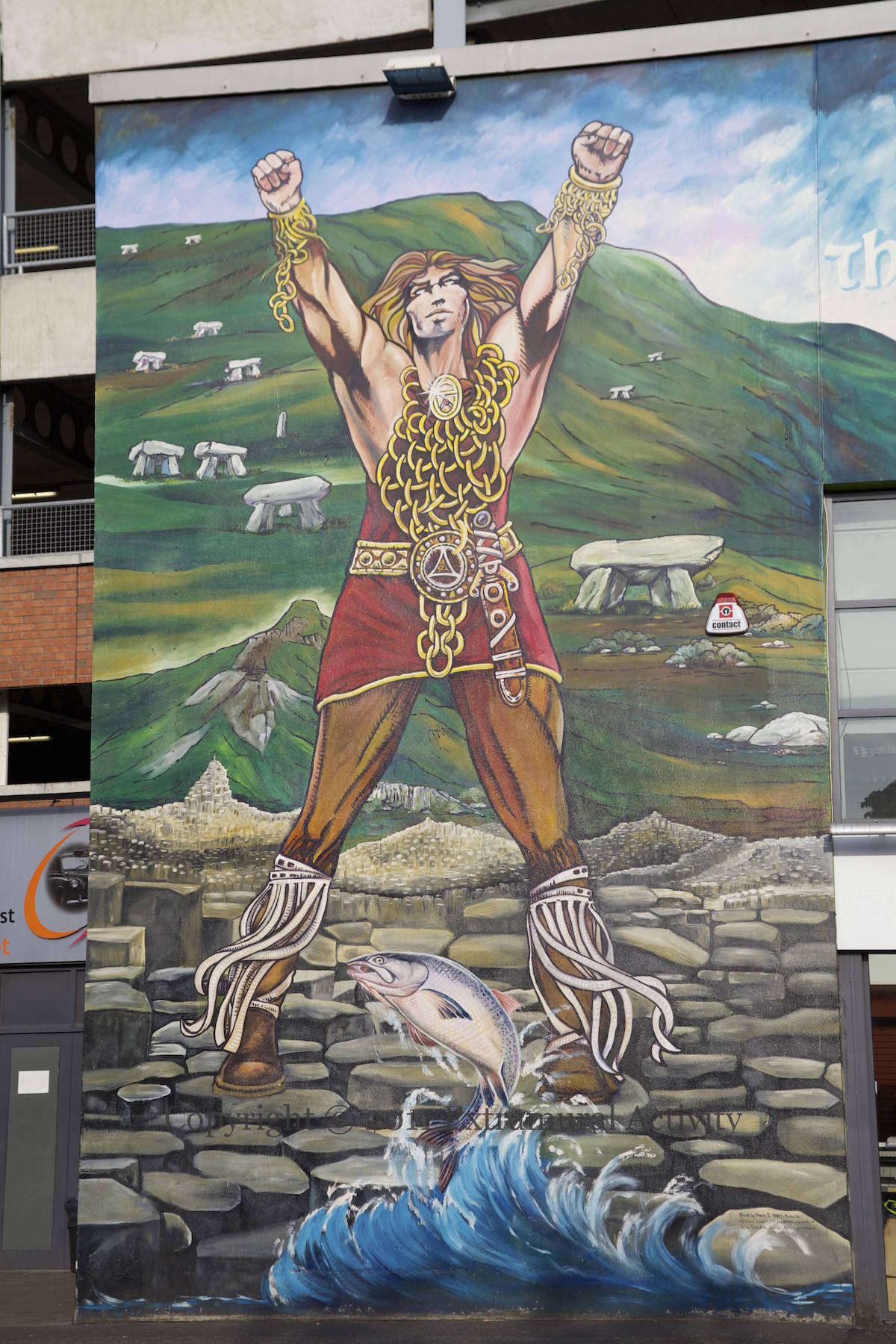
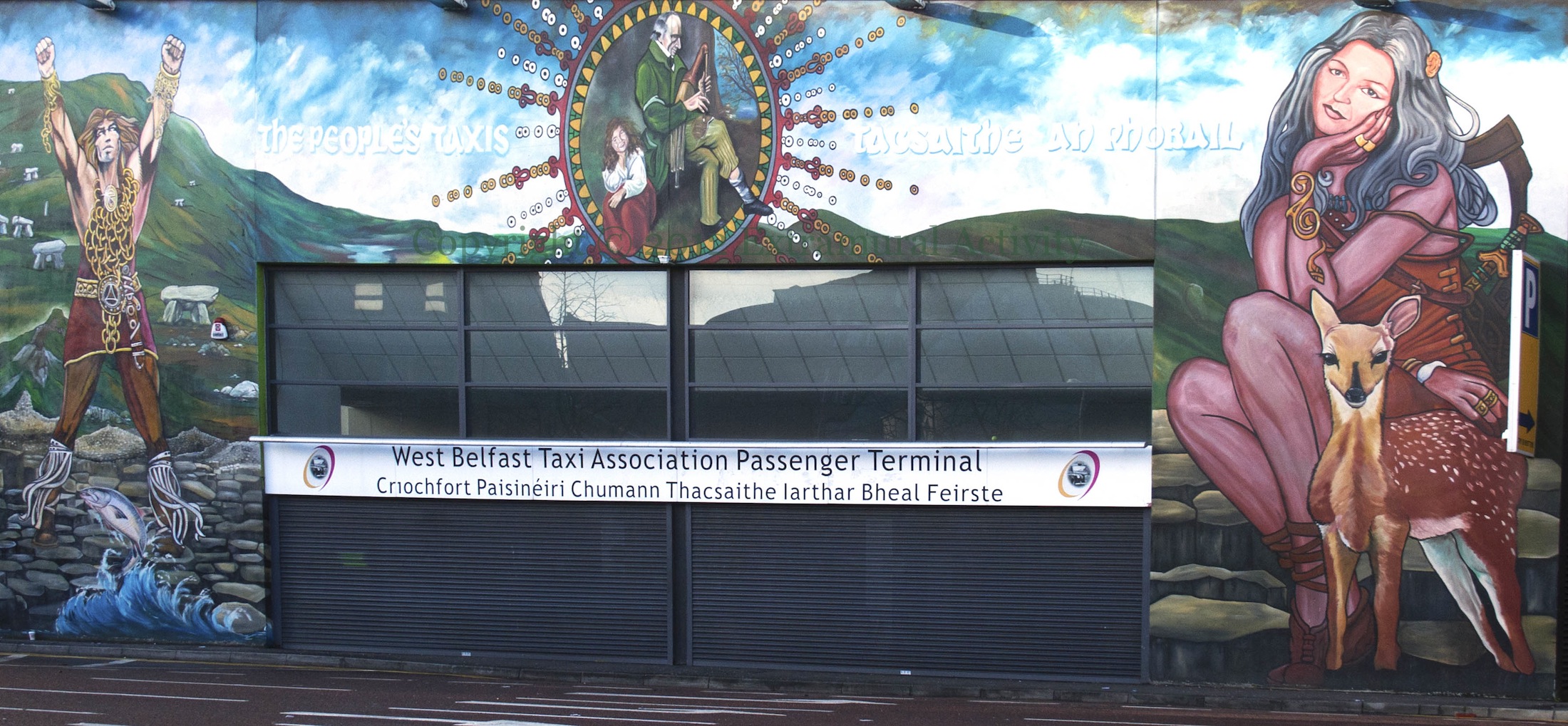
If you’re willing to pay, this piper will take you and yours out of town. This is the centre segment of a large board adorning the front of the West Belfast Taxi Terminal (next to Castle Court), copying The Limerick Piper by John Patrick Haverty (1794-1854) and this Ardoyne mural, which placed the piper under Cave Hill. In this version, the attending girl is smiling. In all three versions, the piper has no visible means of support. On each side are Jim-Fitzpatrick-style Celtic heroes – Nuada on the left (though perhaps meant to be Fıonn Mac Cumhaıll and the salmon of knowledge) and Sadb on the right, though a fawn blocks the view of her shorter-than-short skirt.
Here is another mural celebrating the Northern Ireland football team with the slogan “our wee country” on the top part of a wall of the Times Bar in York Street.
George Best is on the left and (perhaps) David Healy on the right.






 Extramural Activity