Campaign For Truth

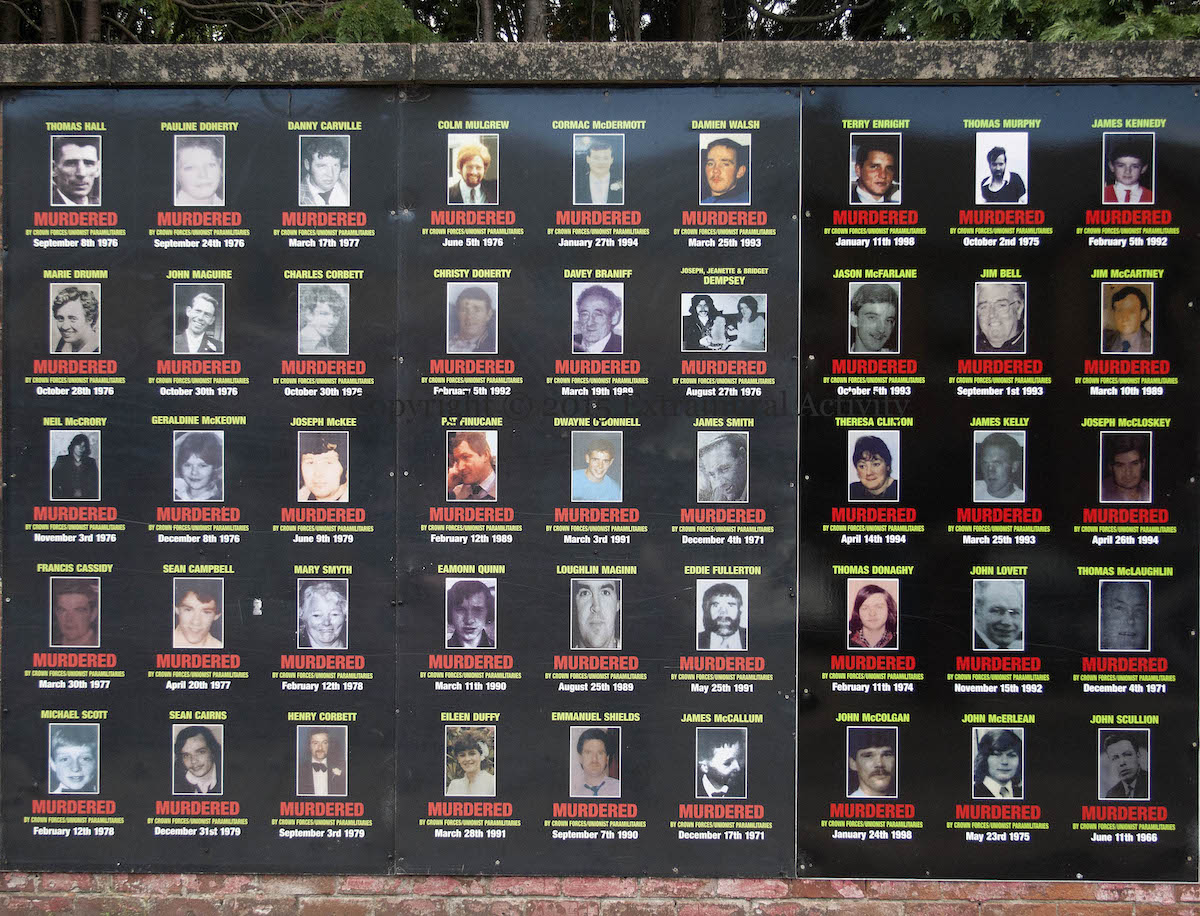
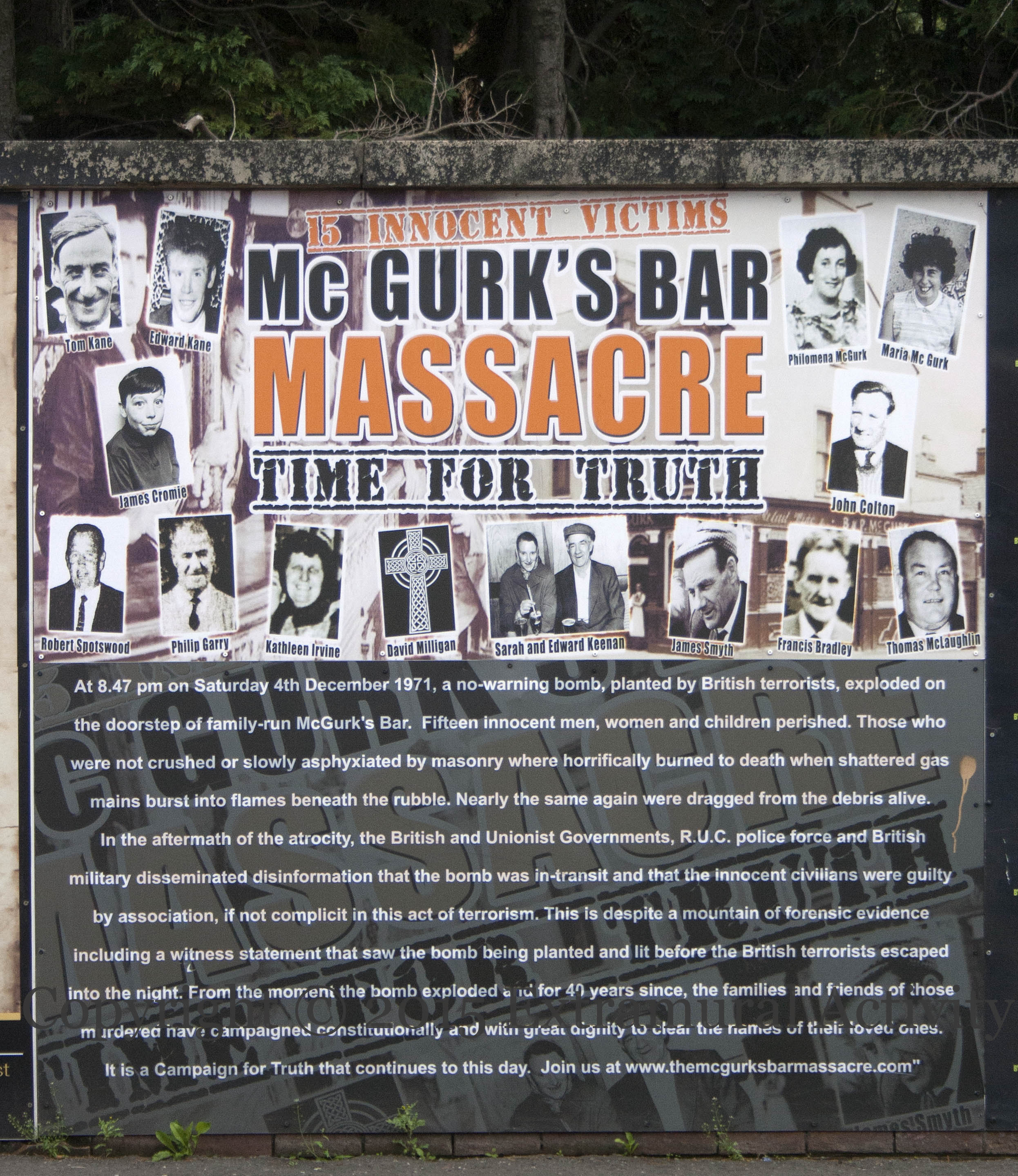
The McGurk’s Bar bombing of December, 1971 killed fifteen people – the most in a single incident during the troubles – capping what had already been a bloody year, including the “Ballymurphy Massacre” of July, in which 11 died, and starting another round of killings that would spread into the new year. Campaigners for an inquiry were busy this week in both Dublin and Belfast (Irish News).

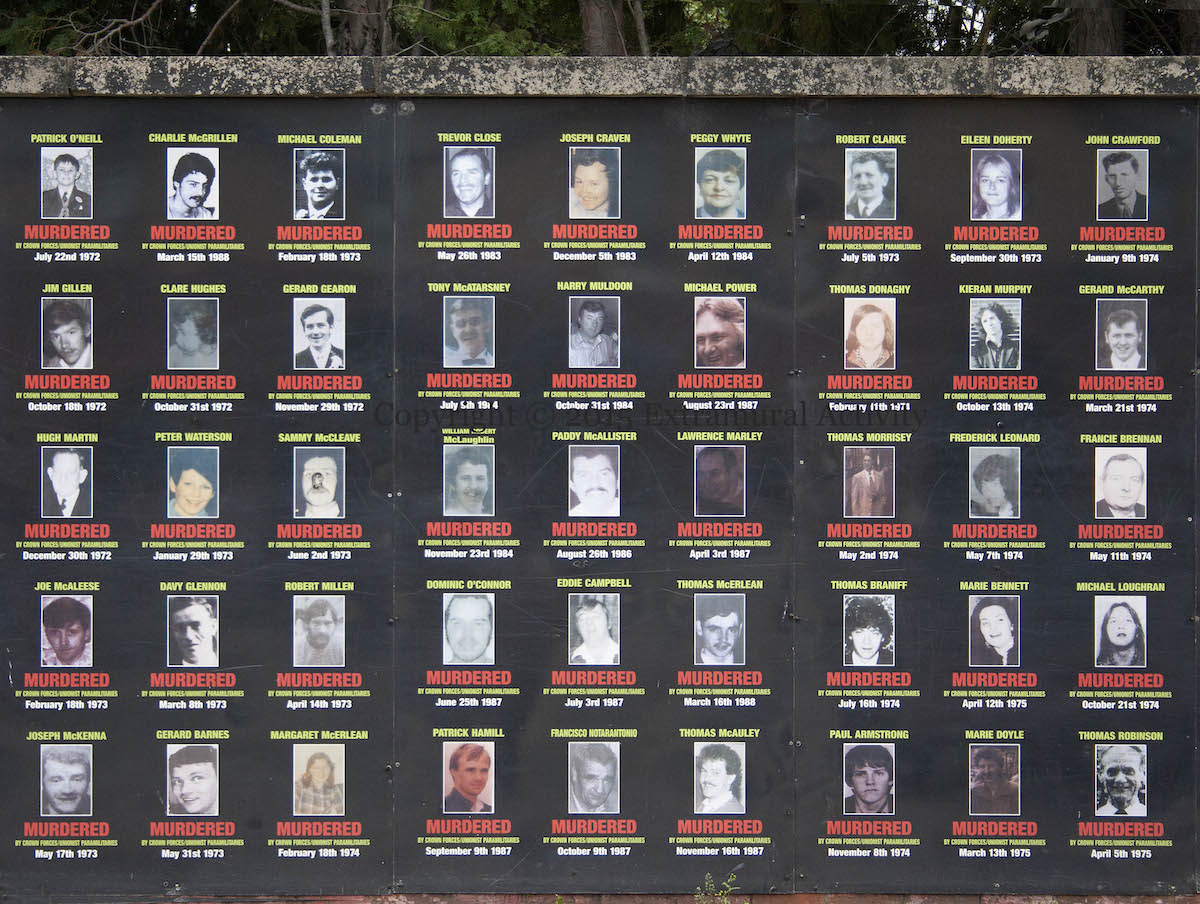
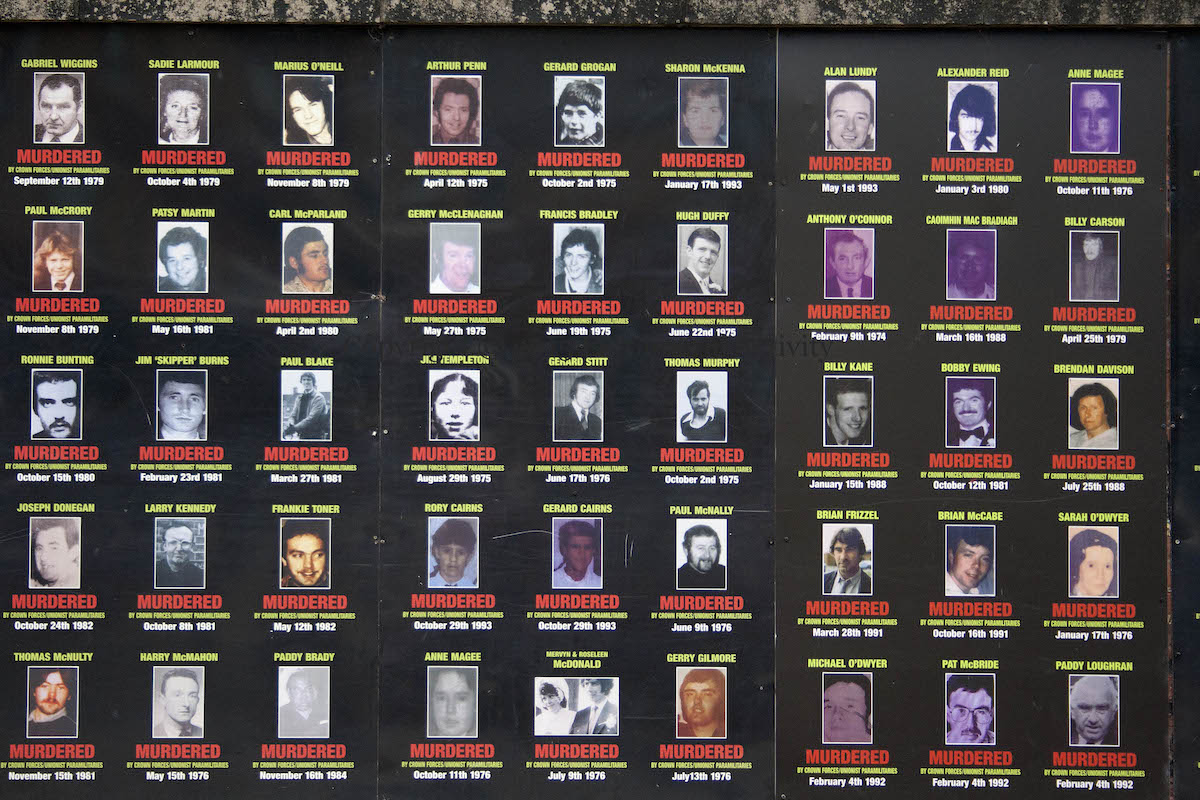
The first nine panels of the ‘murdered’ follow to the right of the McGurk’s Bar board, presented here three-at-a-time. Note that the ninth panel (with Terry Enright in the top left) was previously the 11th panel; it is not clear why it has been moved left.
X02894 2015-09-02 Beechm 03+

X02895 2015-09-02 Beechm 04+

X02896 2015-09-02 Beechm 05+

Click image to enlarge
Copyright © 2015 Seosamh Mac Coılle
X02893 X02894 X02895 X02896
“At 8:47 pm on Saturday 4th December 1971, a no-warning bomb, planted by British terrorists, exploded on the doorstep of family-run McGurk’s Bar. Fifteen innocent men, women and children perished. Those who were not crushed or slowly asphyxiated by masonry where horrifically burned to death when shattered gas mains burst into flames beneath the rubble. Nearly the same again were dragged from the debris alive. In the aftermath of the atrocity, the British and Unionist Governments, RUC police force and British military disseminated disinformation that the bomb was in-transit and that the civilians guilty by association, if not complicit in this act of terrorism. This is despite a mountain of forensic evidence including a witness statement that saw the bomb being planted and lit before the British terrorists escaped into the night. From the moment the bomb exploded and for 40 years since, the families and friends of those murdered have campaigned constitutionally and with great dignity to clear the names of their lived ones. It is a Campaign for Truth that continues to this day. Join us at themcgurksbarmassacre.com” “

In Defence Of The Nation

2015-08-23 32CSM+

This is a new mural from the 32 County Sovereignty Movement (web) on the international wall, Divis Street, (Visual History) with symbols of nationalism (the crests of the four provinces, the harp, the tricolour), socialism (the plough in the stars) and support for republican POWs (the barbed wire).

For images of the mural being worked upon, see the Peter Moloney Collection; for an earlier version see 100% British.

Click image to enlarge
Copyright © 2015 Seosamh Mac Coılle
X02744 End British Rule Smash Stormont 32 County Sovereignty Movement 1997-2015

Ulster Is Not For Sale

2015-08-26 AuglishFull+

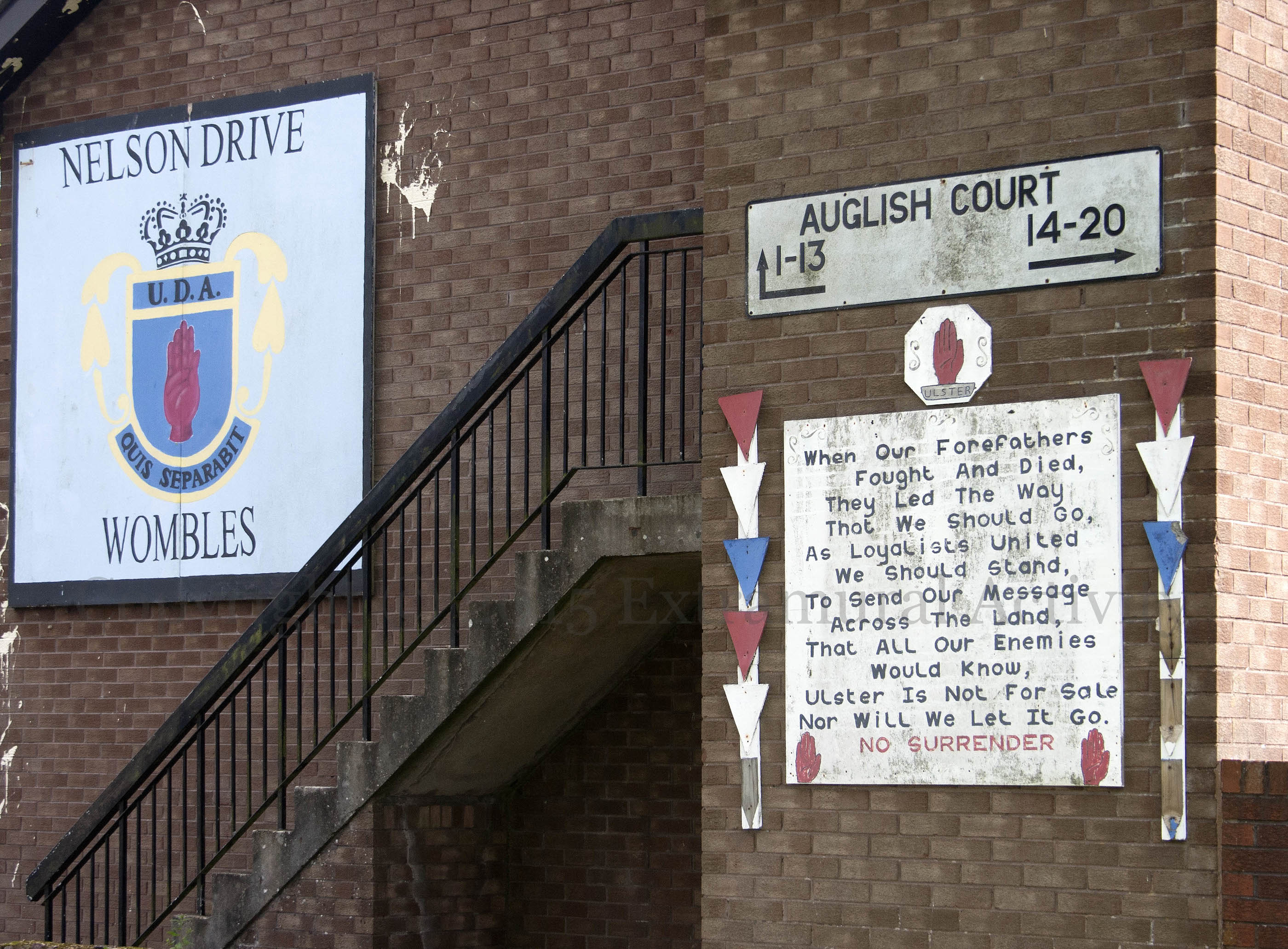
Quiz: The UDA are called “Wombles” because they resemble the stop-motion characters of the BBC children’s show in (a) their fur-lined parkas, (b) their parading, or (c) their ability to acquire anything? You can find all three explanations on-line. Originally the name seems to have been a derogatory one, used by their UVF rivals, but it was adopted by the group itself. A close-up of the text on the right is below.

2015-08-26 AuglishClose+

Click image to enlarge
Copyright © 2015 Seosamh Mac Coılle
X02748 X02747 when our forefather fought and died they led the way that we should go as loyalists united we should stand to send our message across the land that all our enemies would  know ulster is not for sale nor will we let it go no surrender quis separabit nelson drive auglish court

Dhabihah

2015-08-11 RathfernDetail+

The images above and below show a new UDA mural in memory of John Gregg, “The Reaper”, who waged a campaign of terror against Catholics in south-east Antrim and was reputedly associated with British neo-Nazi groups. Gregg was gunned down in 2003, while returning from a Rangers match, as part of the power struggle with Johnny Adair. Watta-Chip (from the previous mural) has been replaced by Turkish Kebabs (Fb).

2015-08-11 RathfernFull+

Click image to enlarge
Copyright © 2015 Seosamh Mac Coılle
X02724 X02725 south east antrim brigade in proud memory of brigadier john gregg 1st batt rathfern b coy grugg Carrickfergus Larne Rathcoole cloughfern young conquerors

United Irishwomen

2015-08-14 MnáNahÉireannLeft+

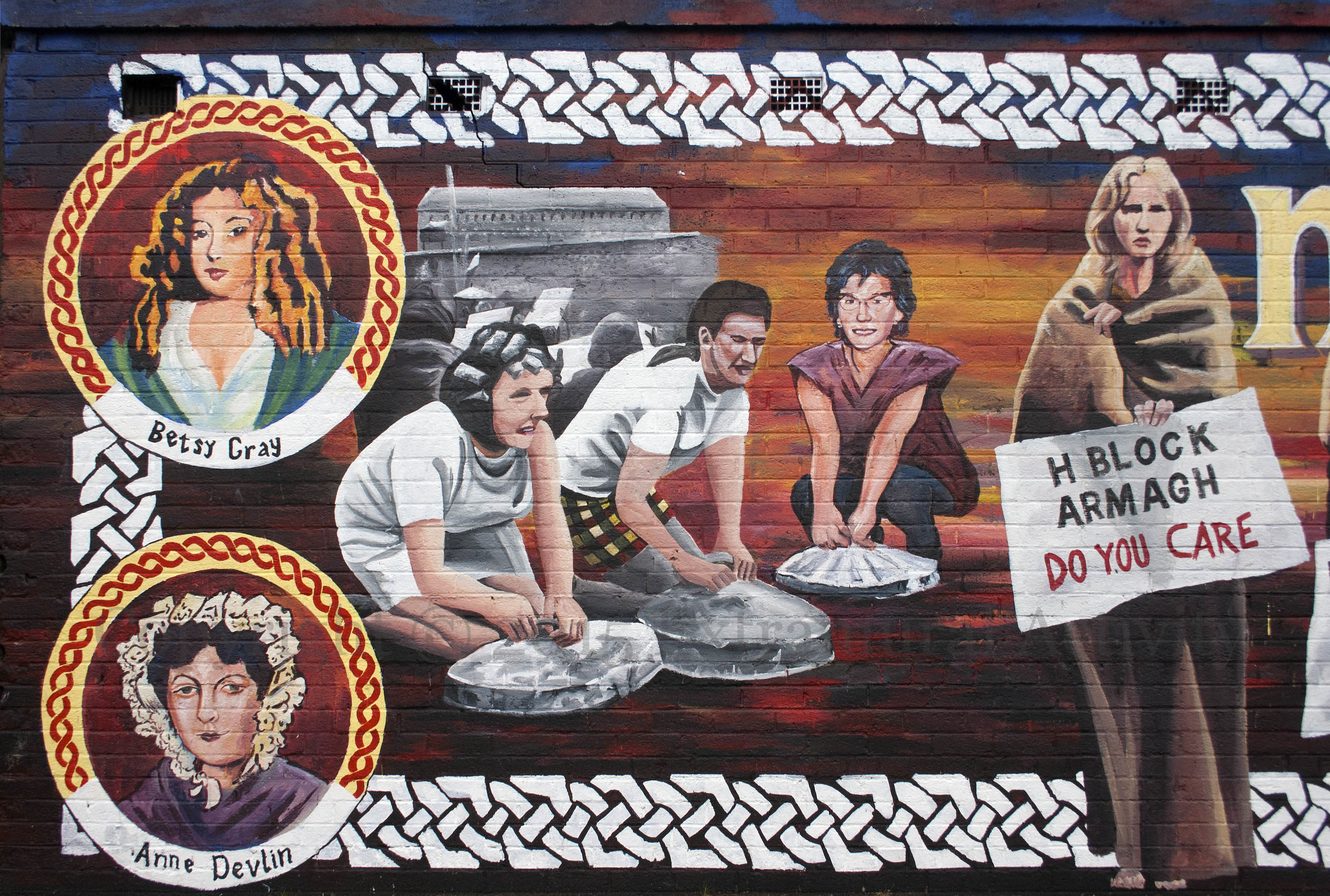
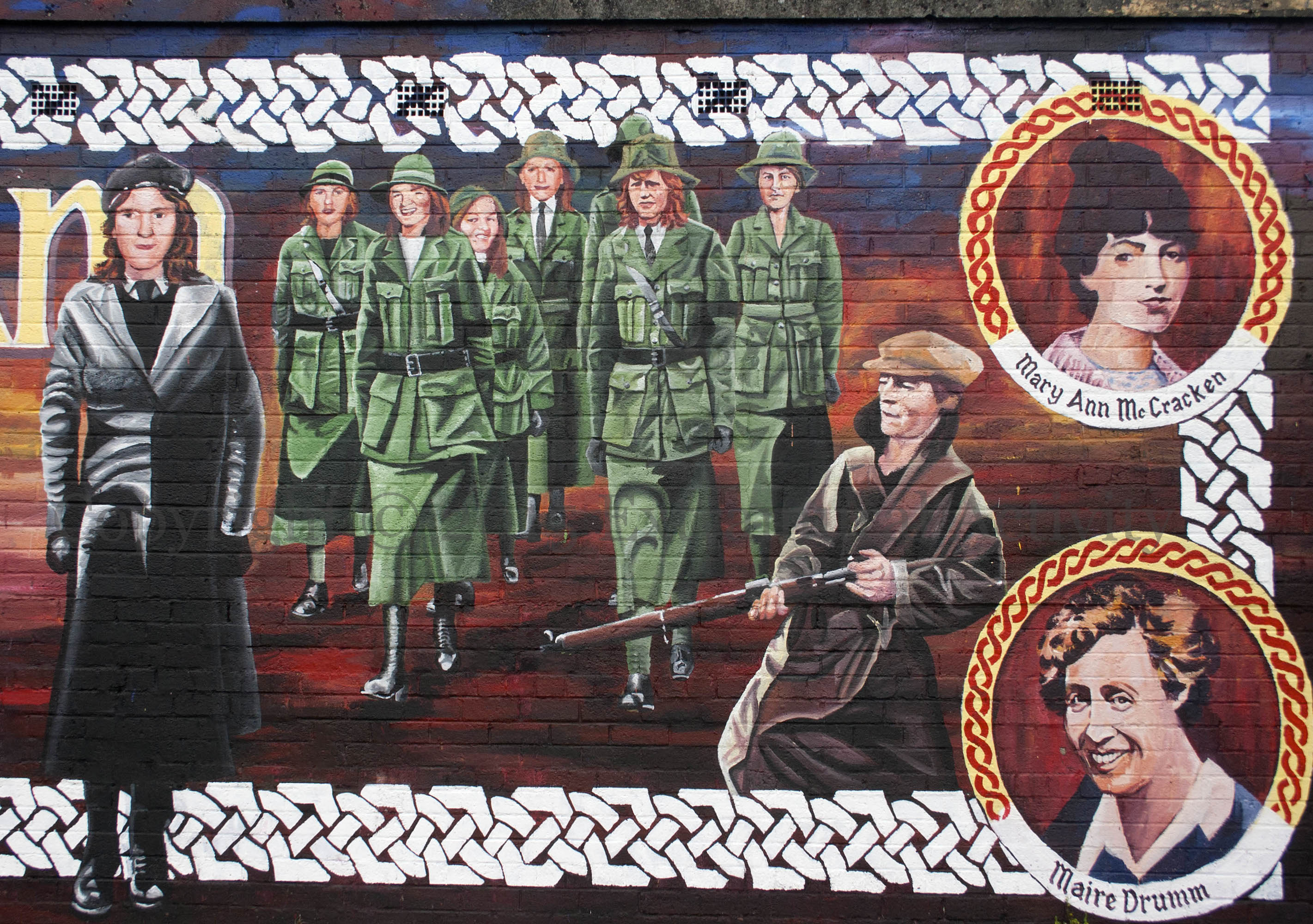
Here are two images of the extremes of the Mná Na hÉıreann mural.

In the four corners are circles of Betsy Gray, Anne Devlin, Mary Ann McCracken, and Máıre Drumm. Gray and McCracken were Presbyterians; Gray fought (or at least, was killed) in the 1798 rebellion, as did McCracken’s brother Henry Joy; Mary Ann went on to work for the poor of Belfast and lobby against slavery. Anne Devlin assisted in Robert Emmet’s 1803 rising. (National Graves Assoc) Máıre Drumm was vice-president of Sınn Féın and commander of Cumann Na mBan, who are shown marching on the right-hand side.

In the cloth cap and holding a rifle is Eithne Coyle, a leader and later president of Cumann Na mBan, imprisoned both by the Black and Tans before the treaty and after it by the Provisional Irish government (WP). For the photograph on which her pose here is based, see An Phoblacht‘s History Of Cumann na mBan, which also includes the photo of marching women (discussed previously in Mothering Sunday In Beechmount) though the faces have been changed here, presumably to those of more contemporary volunteers. The same is probably true of the third woman with a bin lids on the left – leave a comment or send an e-mail if you can put a name to any of these faces.

See also Do You Care?

2015-08-14 MnáNahÉireannRight+

Click image to enlarge
Copyright © 2015 Seosamh Mac Coılle
X02734 X02737 h-block do you care? funeral republican ira

Do You Care?

2015-08-14 MnáNahÉireannInsideLeft+

Here are two details from the Mná Na hÉıreann mural. This one shows three Derry women protesting the conditions in Armagh Women’s Prison and in the H-Blocks. This article on Mary Nelis (the protester on the right, with Kathleen Deeny and Theresa Deery) describes the photograph on which this part of the mural is based. The women in Armagh prison were allowed to wear their own clothes and so were not ‘on the blanket’ as their male counterparts in the H-Blocks of Long Kesh were. However, they did engage in a “no wash” protest, which lasted from February 1980 until March 1981, and three of them – Maıréad Farrell, Mary Doyle, and Margaret Nugent – joined the 1980 hunger strike.

In the second image, below, grieving mothers, wives, and sisters stand over a coffin draped in the Irish tricolour with paramilitary gloves and beret on top.

2015-08-14 MnáNahÉireannInsideRight+

Click image to enlarge
Copyright © 2015 Seosamh Mac Coılle
X02734 X02735

Mná Na hÉıreann/Women Of Ireland

2015-08-14 MnáNahÉireannMid+

Countess Markievicz, carrying a flag of Cumann Na mBan, and Ethel Lynch, carrying a flag of the Derry IRA, take centre stage in the Mná Na hÉıreann mural in London-/Derry/Doıre’s bogside. Markievicz is famous for her role in the Easter Rising of 1916 (WP); Lynch died in December 1974 of injuries sustained when a bomb exploded prematurely. (Derry Journal – also contains the photo on which the painting above is based.) Between them, “Liberty leads the people” waving an Irish tricolour.

This is the one of three posts detailing the 2014-09 piece. See also: Do You Care? and United Irishwomen.

Launched 2014-09-30. In-progress shot in Derry Journal.

2015-08-14 MnáNahÉireannFull+

Click image to enlarge
Copyright © 2015 Seosamh Mac Coılle
X02738 X02733 brıogáıd dhoıre maire drumm mary-ann mccracken betsy gray anne devlin h-block armagh do you care

King Billy’s On The Fence

2015-08-18 ButeParkBilly+

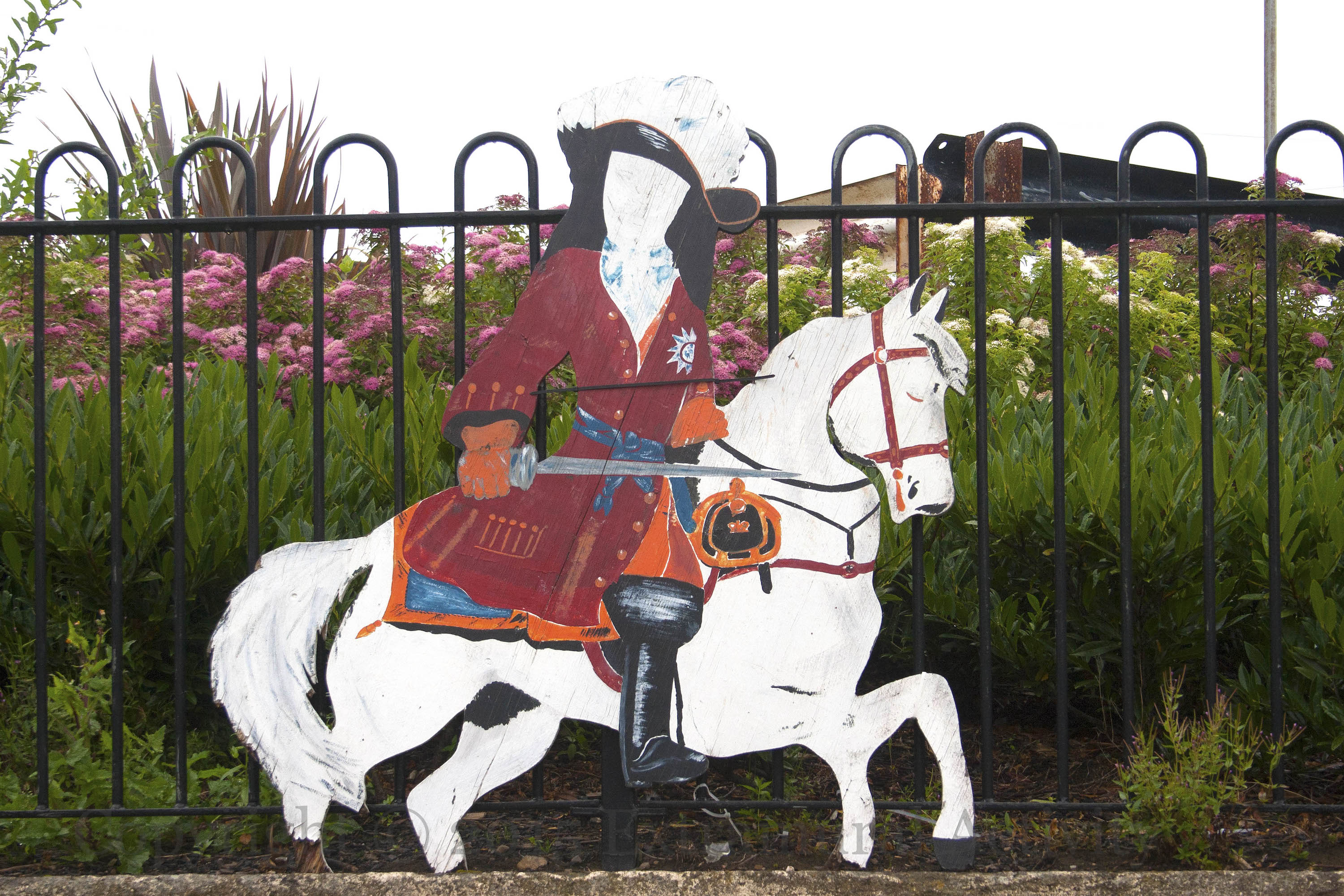
Cut-out boards in the shapes of the red hand of Ulster (both left and right hands!), the five-pointed orange star (usually purple) of the Williamites, the crown of the British monarch, and King Billy on his steed line the fence along Bute Park in Ballybeen.

2015-08-18 ButeParkBillyFull+

Click image to enlarge
Copyright © 2015 Seosamh Mac Coılle
X02742 X02743

End British Internment

“End the torture in Maghaberry Gaol – Smash Stormont – www.irpwa.com – Irish Republican Prisoners’ Welfare Association – strip searching – isolation – controlled movement.”

IRPWA board on the rear of Free Derry Corner.

Click image to enlarge
Copyright © 2015 Seosamh Mac Coılle
X02801

The Executive Collapses

2015-08-04 WorkersStrikeDerryClose+

The Ulster Workers Council (UWC), formed in 1974 with the backing of the UDA, organized a general strike in opposition to the December 1973 Sunningdale Agreement – signed by the British government – which would have shared power with Nationalists in the north and established a cross-border council involving the Dublin government. The strike went on for two weeks in May 1974 (during which the Dublin-Monaghan bombings took place, killing 33 people in the Republic) and concluded with the collapse of the Northern Ireland Executive and rule reverting to Westminster.

The mural was painted for the 30th anniversary of the strike and is now partially covered with ivy (see below). For the mural in better days see M02610. The photograph reproduced can be seen on the Bel Tel.

2015-08-04 WorkersStrikeDerry+

Click image to enlarge
Copyright © 2015 Seosamh Mac Coılle
X02717 X02716