The Ulster Workers Council (UWC), formed in 1974 with the backing of the UDA, organized a general strike in opposition to the December 1973 Sunningdale Agreement – signed by the British government – which would have shared power with Nationalists in the north and established a cross-border council involving the Dublin government. The strike went on for two weeks in May 1974 (during which the Dublin-Monaghan bombings took place, killing 33 people in the Republic) and concluded with the collapse of the Northern Ireland Executive and rule reverting to Westminster.
The mural was painted for the 30th anniversary of the strike and is now partially covered with ivy (see below). For the mural in better days see M02610. The photograph reproduced can be seen on the Bel Tel.
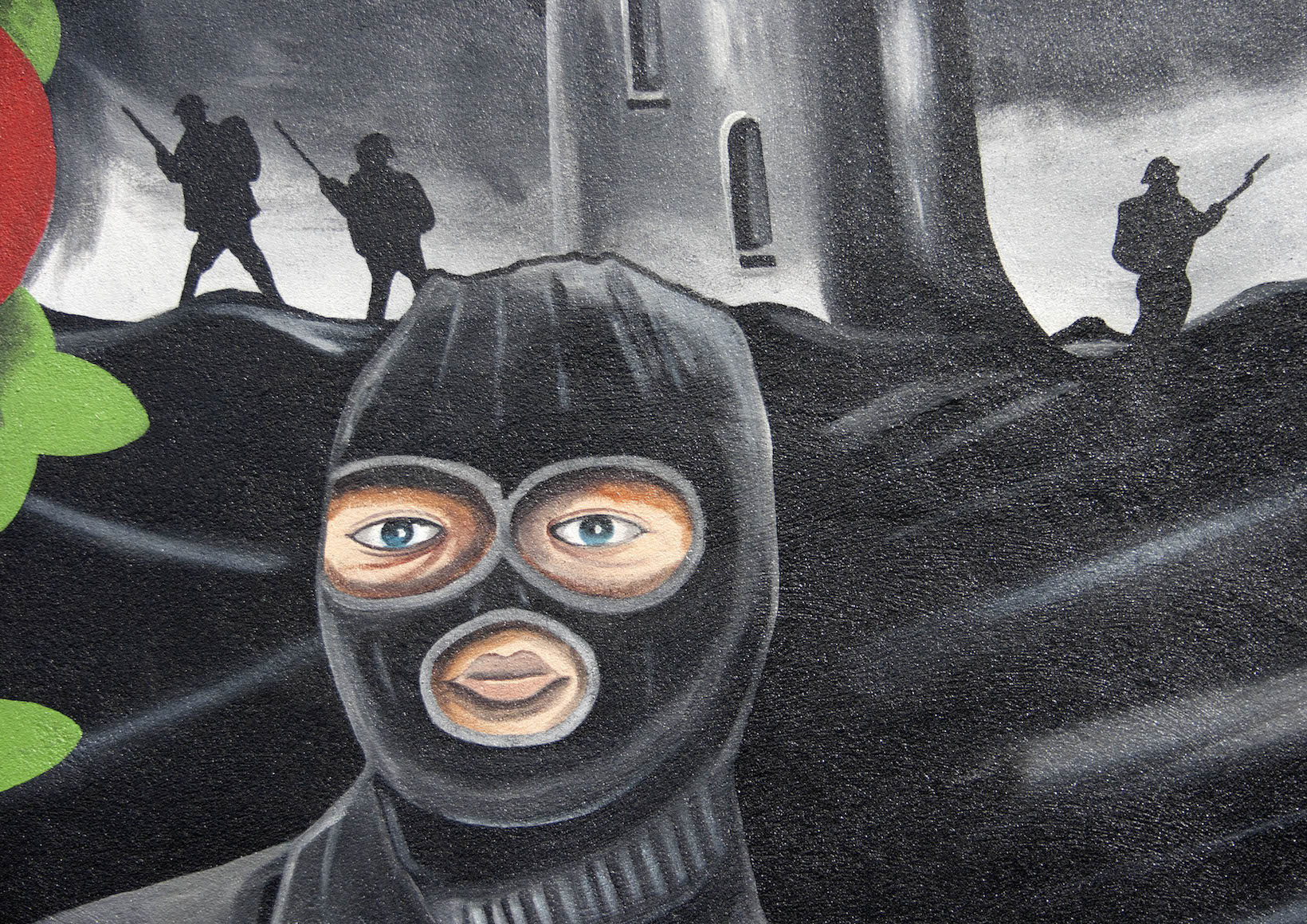
“For he today that sheds his blood with me shall be my brother. We few, we happy few, we band of brothers.” This is a new (July 2014) Red Hand Commando mural in Bangor with RHC Youth and Red Hand Comrades Association insignia against a backdrop of Thiepval Tower and the Somme, with masked gunmen in the foreground and a border of poppies.
The quote is from Shakespeare’s Henry V, act 4, though the lines are reversed (Folger).
The IRPWA (tw | Fb) placed the names of prisoners currently held in Maghaberry in the barbed wire above the so-called “international” wall. Barbed wire is the symbol of republican prisoners though this barbed wire is used to protect Andrews Flour. Above, you can see the boards for Harkin, Mellon and McGilloway.
The full list, from left to right: Seamus Kearney, Gerard McManus, Nathan Hastings, Mark McGuigan, Sean Kelly, Barry Concannon, Damien Harkin, Thomas Mellon, Martin McGilloway, Jason Ceulemans, Gavin Coney, Liam O’Donnell, Neil Hegarty, Jon Paul Wooton, Martin Kelly, Colin Duffy, Harry Fitzsimons, Christopher O’Kane, Tarlach MacDhomhnaill, Seamus McLaughlin, Gavin Coyle, Brendan McConville, Kevin Barry Nolan.
Former CIRA commander Tommy Crossan’s 2014 murder by former colleagues was unusual in that is was carried out during the daytime (and also because he was abducted just off the Springfield Rd). (BBC-NI news video) The graffiti above declares that vengeance will be won.
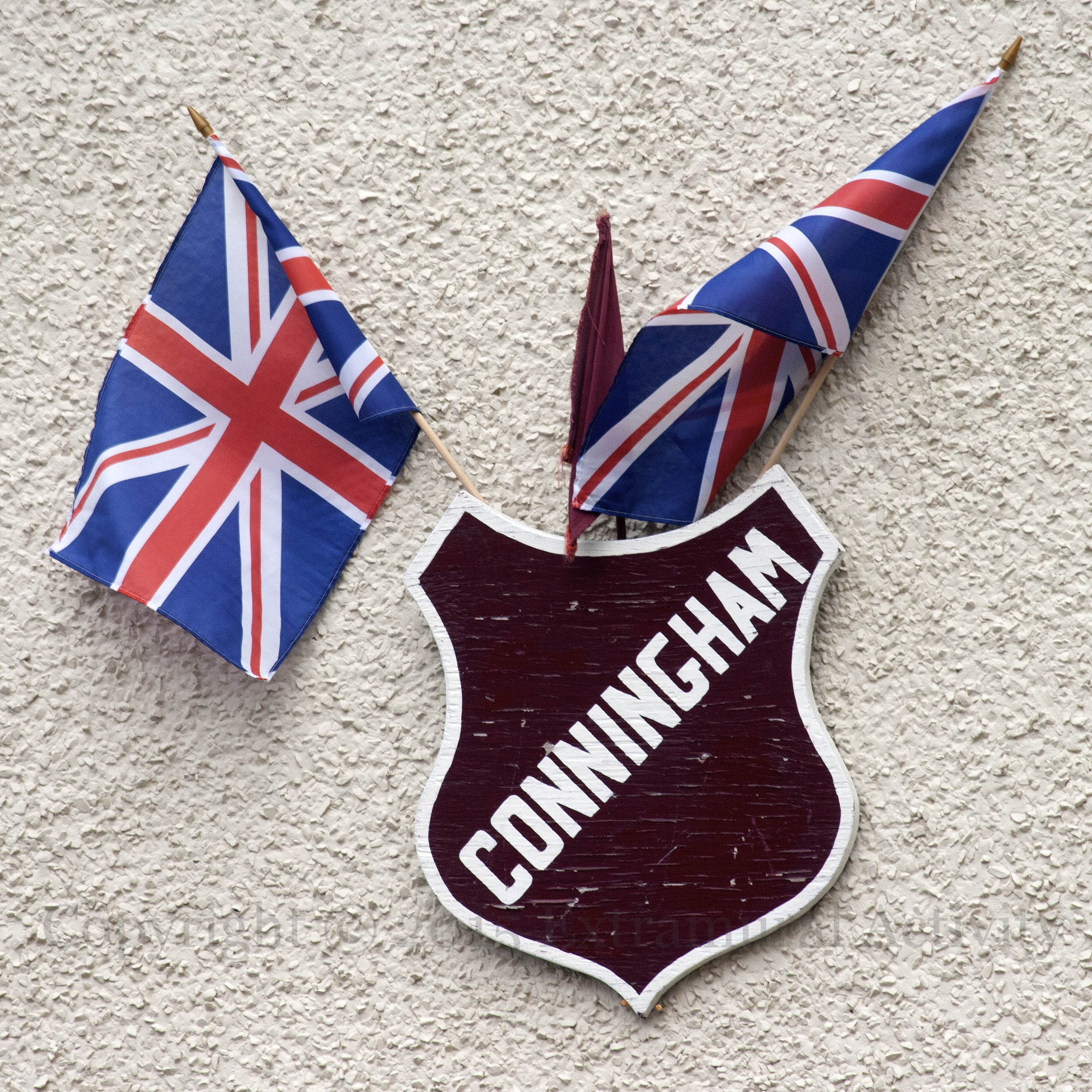
On December 7th, 1688, thirteen apprentice boys grabbed the keys to Derry city and locked the gates against the on-coming Jacobite Redshanks. Their names were William Cairnes, Henry Campsie, John Conningham (also given as Coningham), Alexander Cunningham, William Crookshanks, Samuel Harvy, Samuel Hunt, Alexander Irwin, Robert Morison, Robert Sherrard, Daniel Sherrard, James Spike, James Steward and they each have a small plaque in the Fountain area.
Above is a local interpretation of Robert Ballagh’s 1970 rendering of Goya’s The Third Of May 1808 in Glenfada Park, Derry/Doıre, site of four deaths on Bloody Sunday, 1972.
The original commemorates Spanish resistance to the forces of Napoleon (WP). For this Derry version, features from the city’s skyline – the Guildhall, St. Columb’s Cathedral, and an intact Governor Walker column – have replaced the original’s outline of Madrid, as well as an insignia of the Paras on the arm of a soldier.
IRA volunteer (and marksman in the Irish Army) John Starrs was killed in a May 13th, 1972, gun battle with the British Army in William Street (Seachranaıdhe), near his plaque in Chamberlain Street, Derry, which is also home to Connolly House, home of the IRSP in Derry, and Junior McDaid house, home of Saoradh/IRPWA.
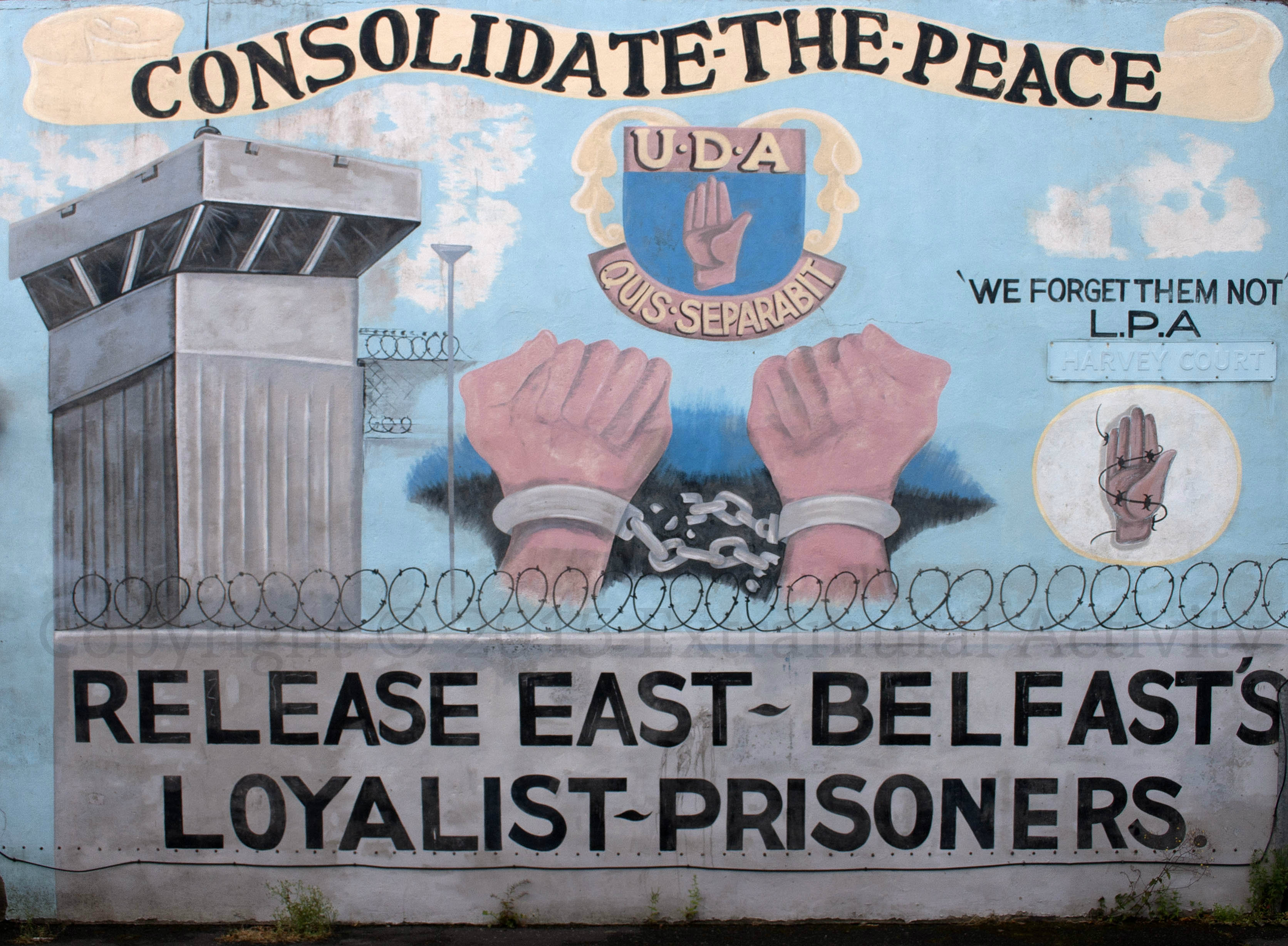
As talks were held at Stormont throughout 1997, (leading to the Good Friday (or: Belfast) Agreement in April 1998) paramilitaries on both sides in the conflict began pressing their case for concessions, including the release of political prisoners. The image above is of a 1997 UDA mural that is still in decent condition in loyalist east Belfast: Consolidate The Peace – Release East Belfast’s Loyalist Prisoners. It shows a Long Kesh tower and barbed wire with red hands breaking the chains between handcuffs. For a similar image (which was painted out this week) in nearby Lord St, see All Gave Some.







 Extramural Activity