“[I assume that I am speaking to Englishmen who value their freedom, and who profess to be fighting for the freedom of Belgium and Serbia [in WWI].] Believe that we too love freedom and desire it. To us it is more than anything else in the world. If you strike us down now, we shall rise again and renew the fight. You cannot conquer Ireland; you cannot extinguish the Irish passion for freedom. If our deed has not been sufficient to win freedom, then our children will win it by a better deed – Gen. P. H. Pearse” at his court martial in 1916.
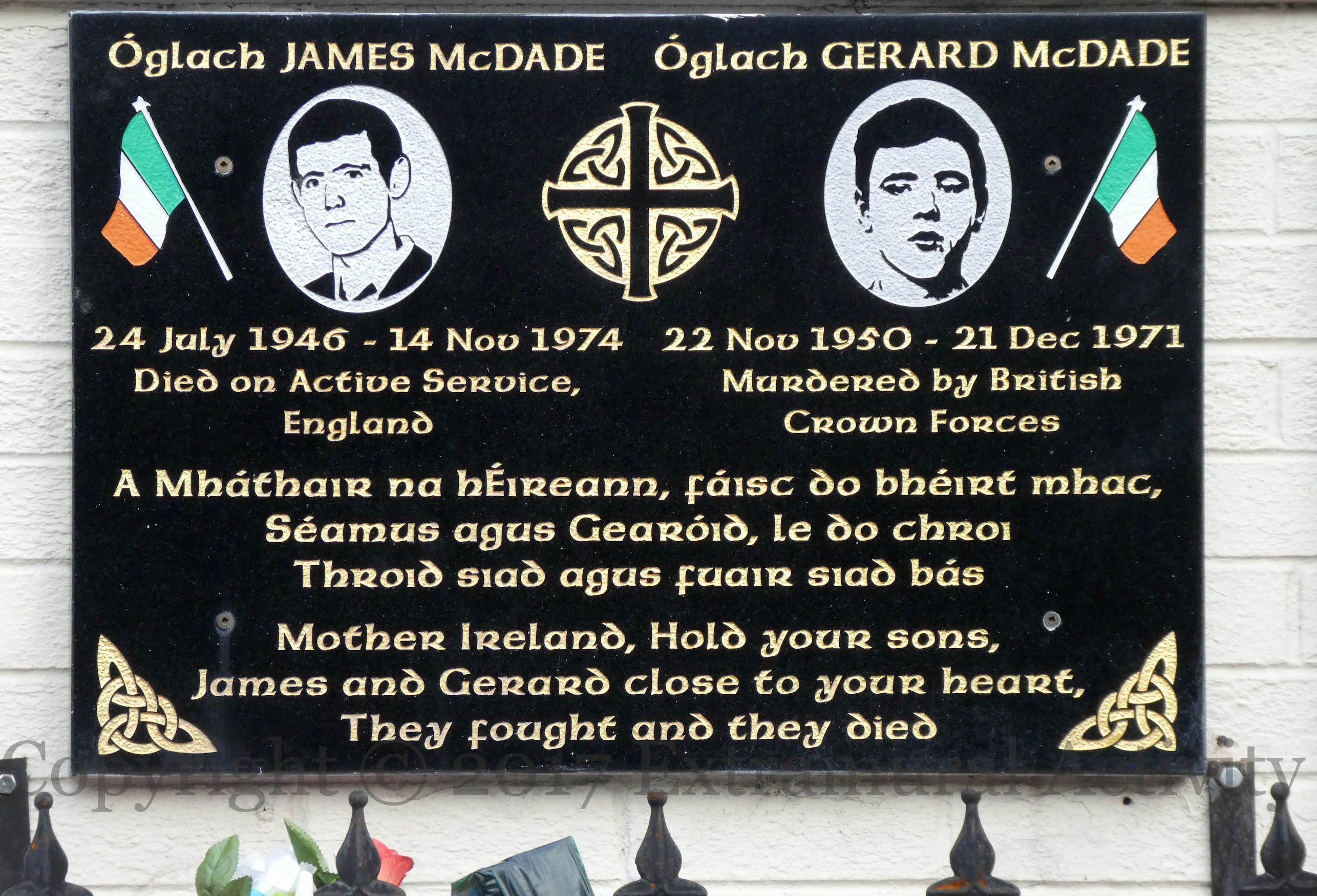
Here are eight images of the memorial plaques to deceased Ardoyne IRA fianna and ógliagh fromt he 1970s: David McAuley, Joseph Campbell, Joseph McComiskey, Bernard Fox, Charles McCann, Seamus Cassidy, Trevor McKibbin, James McDade, Gerard McDade, James Reid, Terry Toolan, Brian Smyth, Paddy McAdorey, Denis Brown, Jim Mulvenna, Jackie Mailey, Frankie Donnelly, Laurence Montgomery.
UDA members John Fulton and were Stephen Goatley were killed together in the Alexandra Bar on York Road (close to the Mervue Street location of this memorial) by the UVF as part of a UDA-UVF feud in 1975. The poppy is more often associated with the Ulster Volunteers (of WWI) and the UVF.
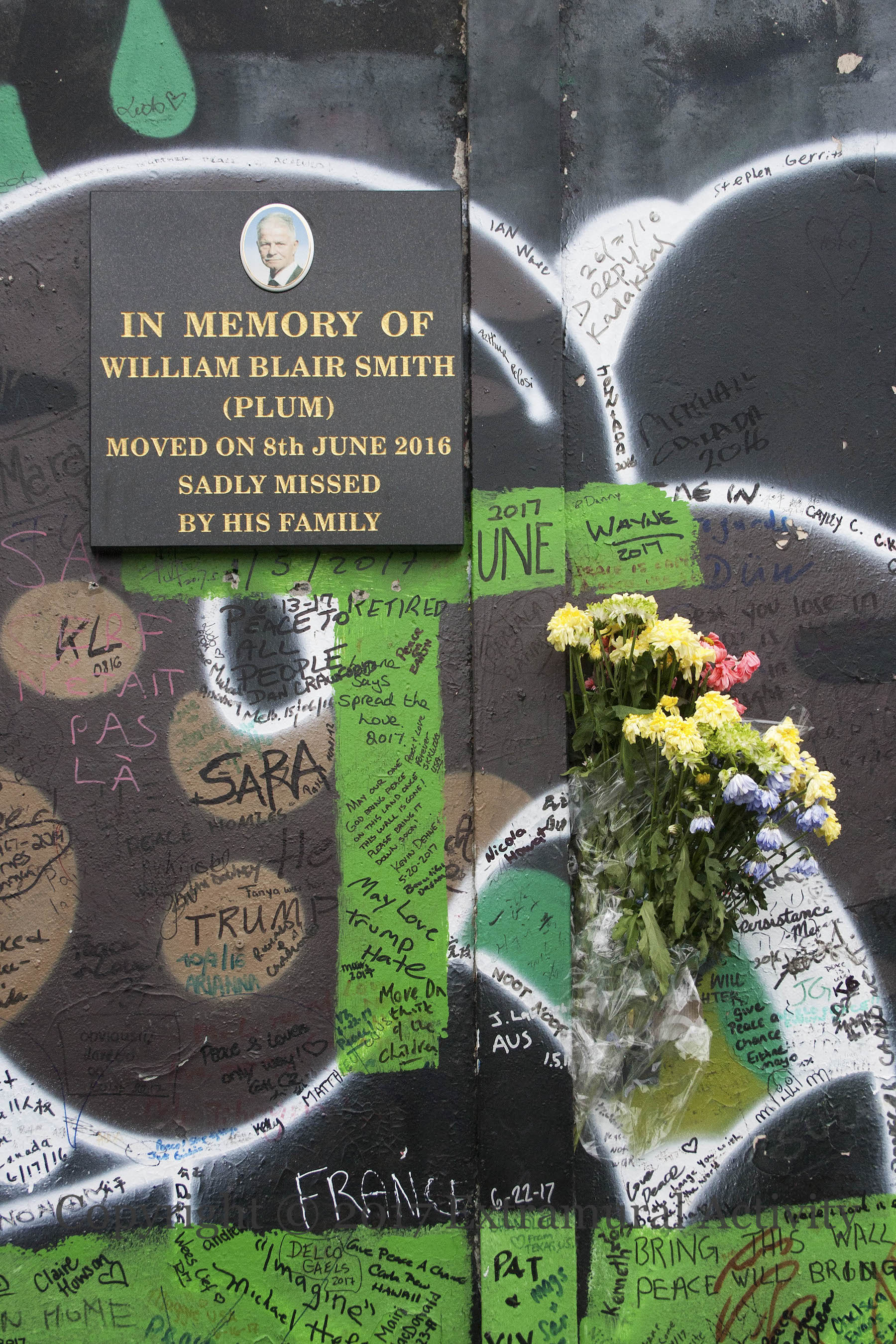
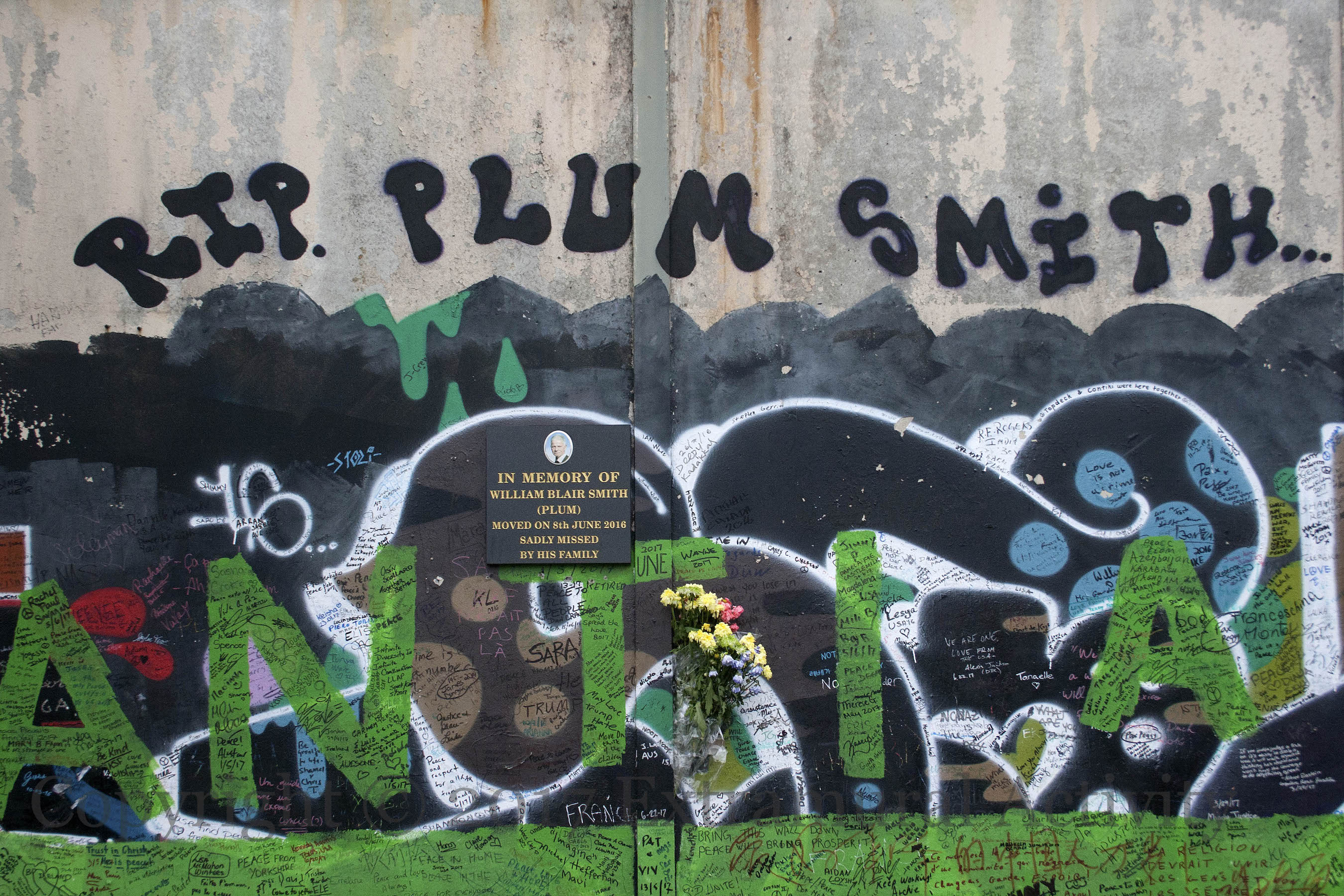
A plaque has been added to the Cupar Way “peace” line memorial to UVF man William “Plum” Smith. “Moved on 8th June 2016 – sadly missed by his family.” For more information on his life, see the previous version.
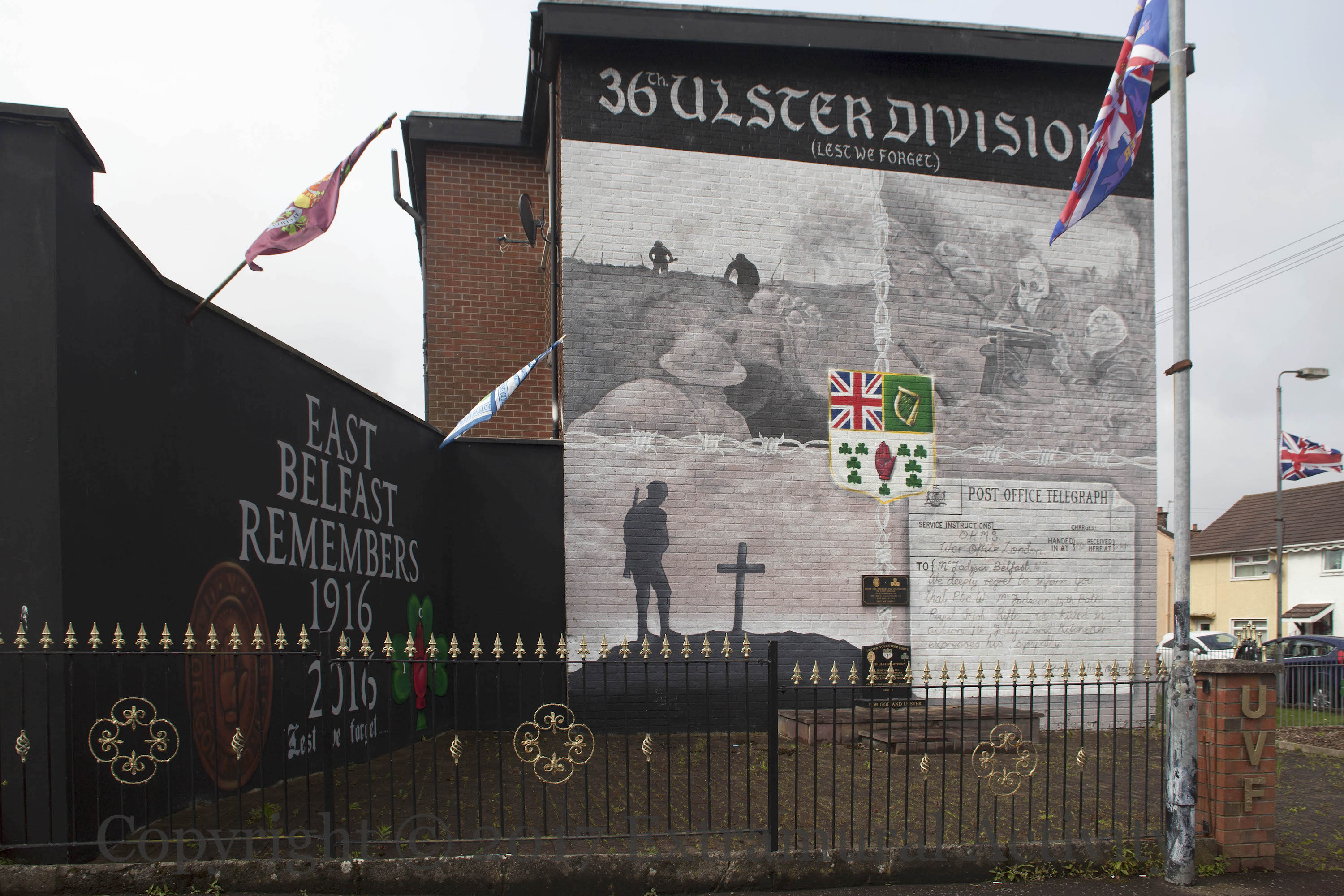
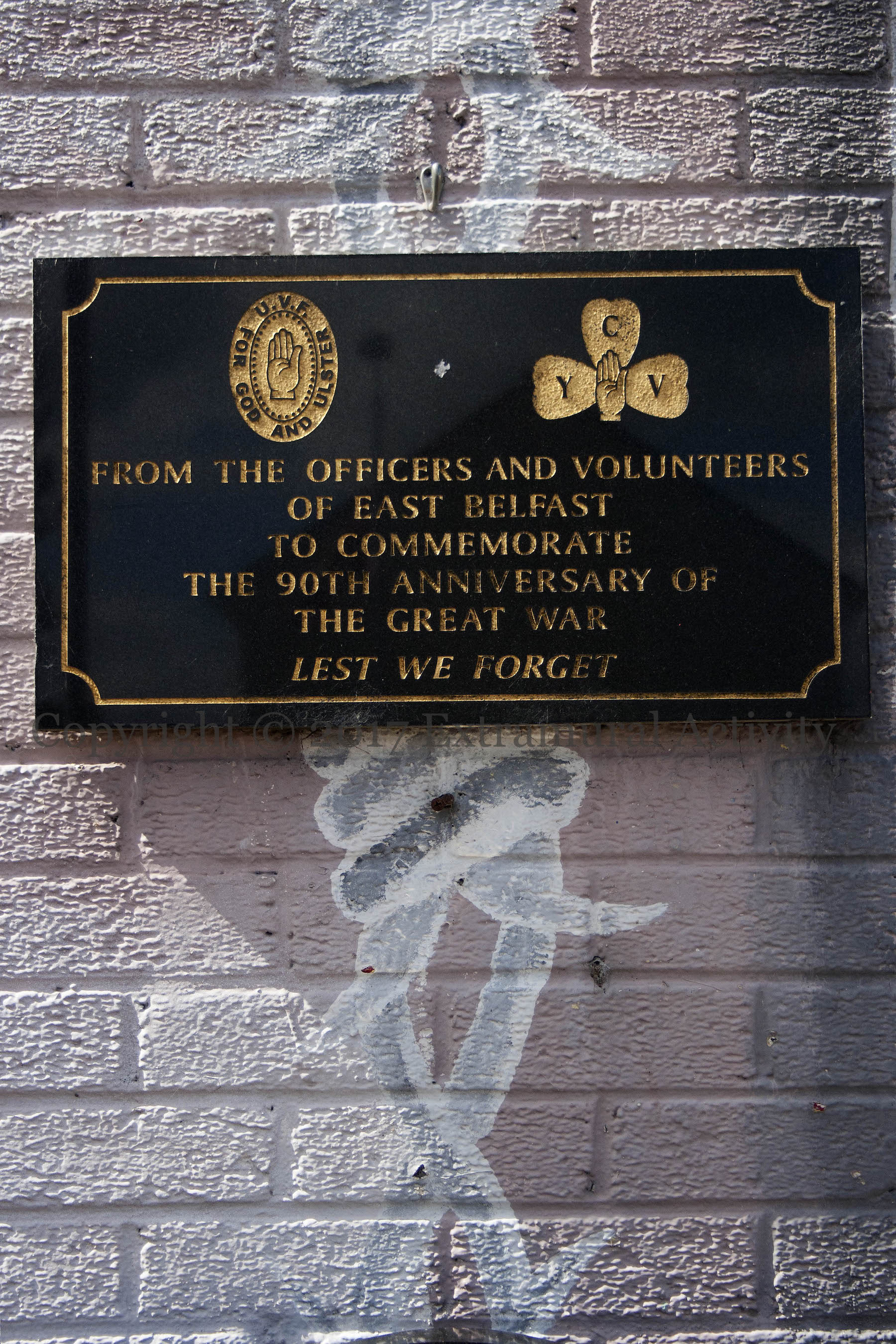
As the plaque in the third images shows, the mural was originally painted in 2006 for the 90th anniversary of the Battle of the Somme. The plaque was originally in the plinth below the headstone – see Killed In Action. The side wall was painted last year for the 100th anniversary.
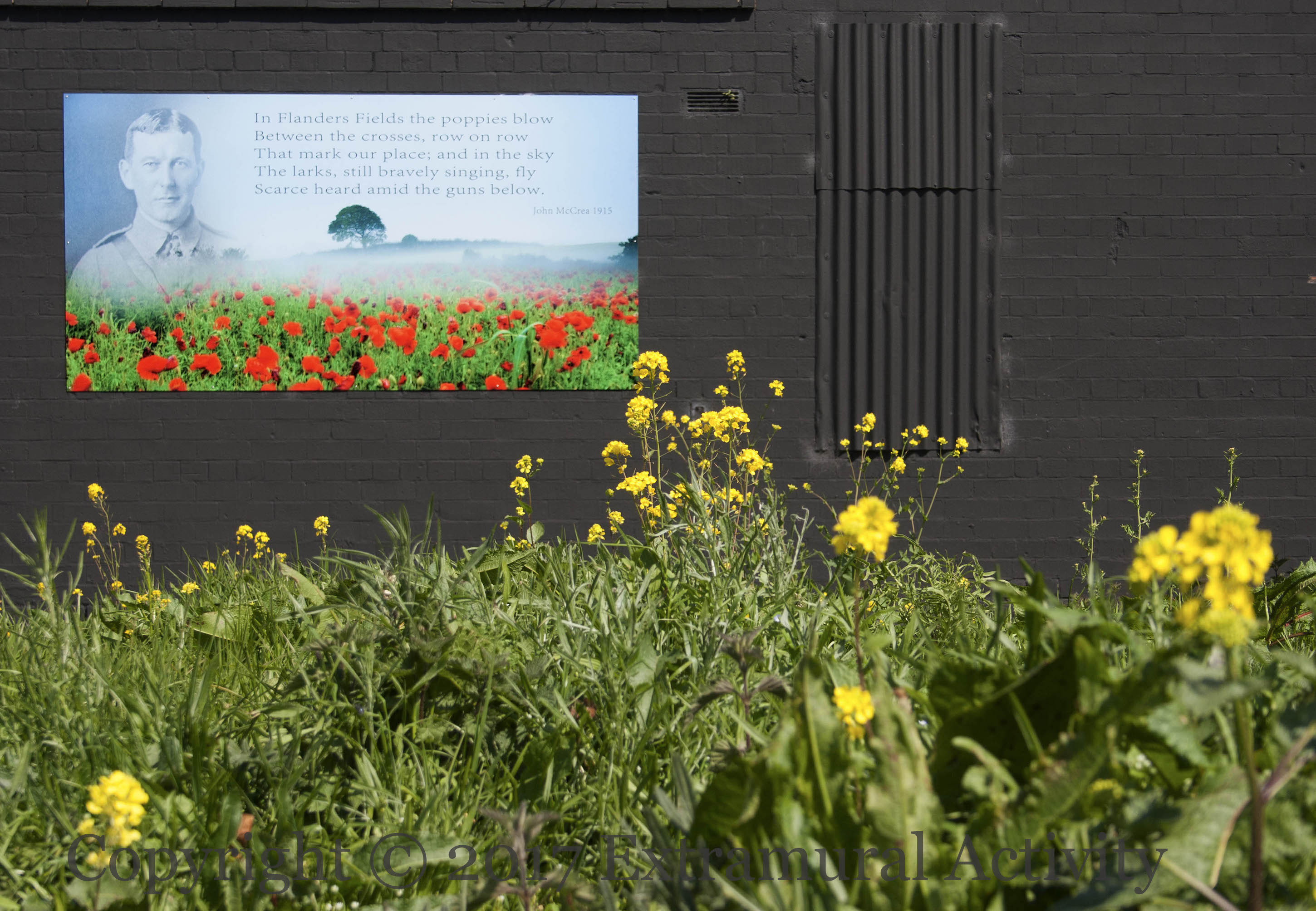
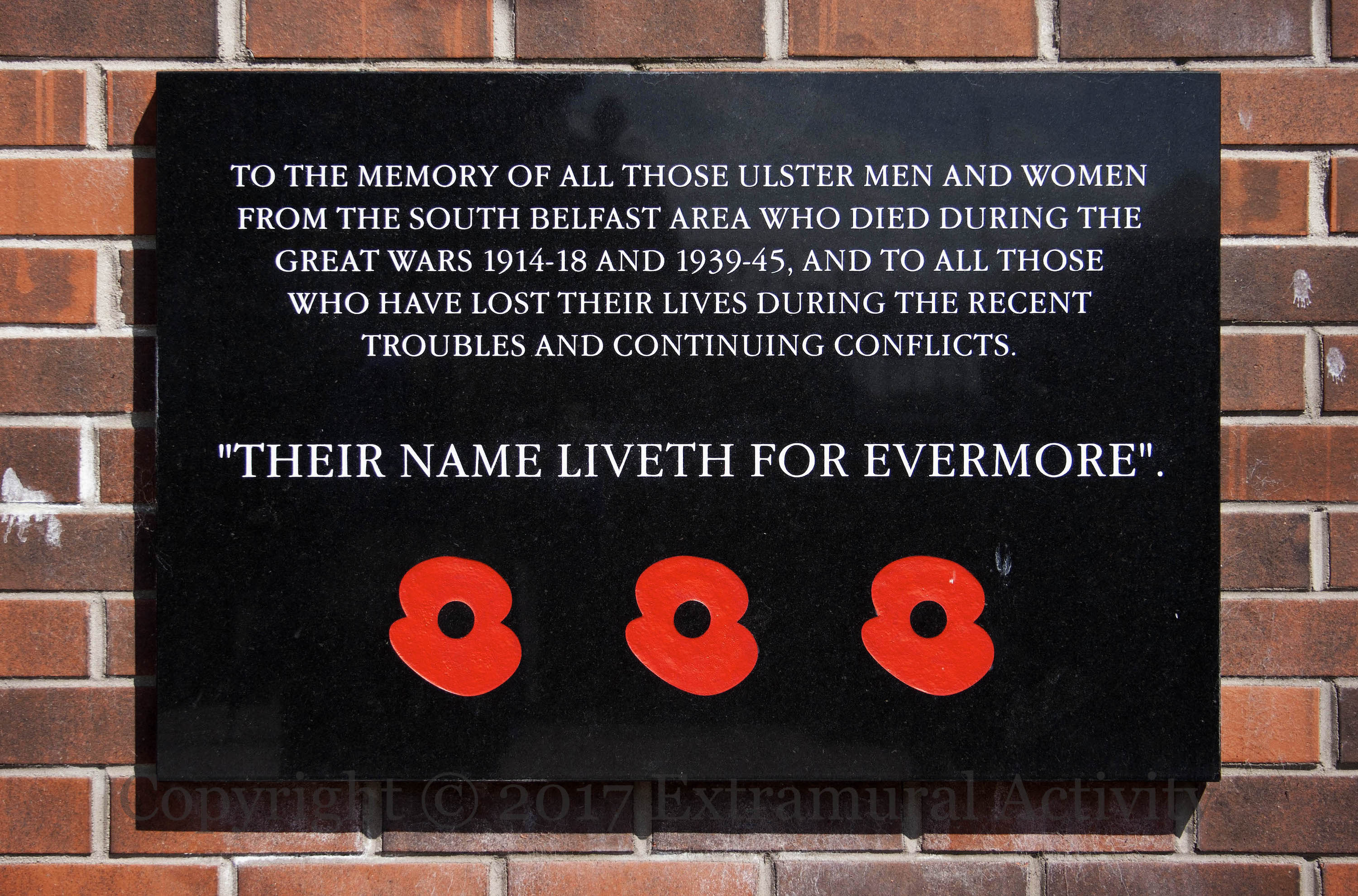
Here are two panels and a wide shot of the memorial garden in Frenchpark Street. Above is a verse from John McCrea’s In Flanders Fields. Below is a plaque “to the memory of all those Ulster men and women from the south Belfast area who died during the great wars 1914-18 and 1939-45, and to all those who have lost their lives during the recent troubles and continuing conflicts.”
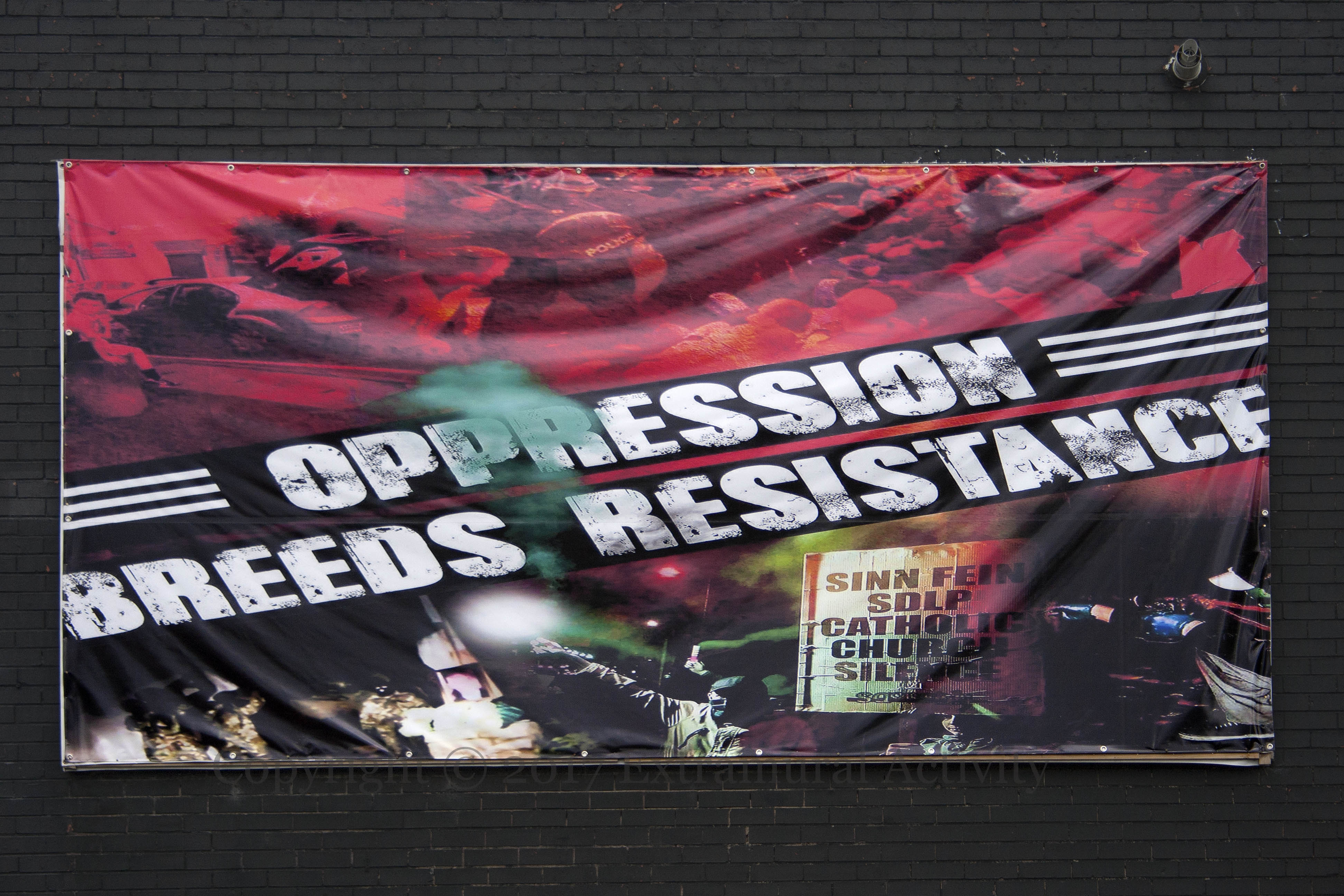
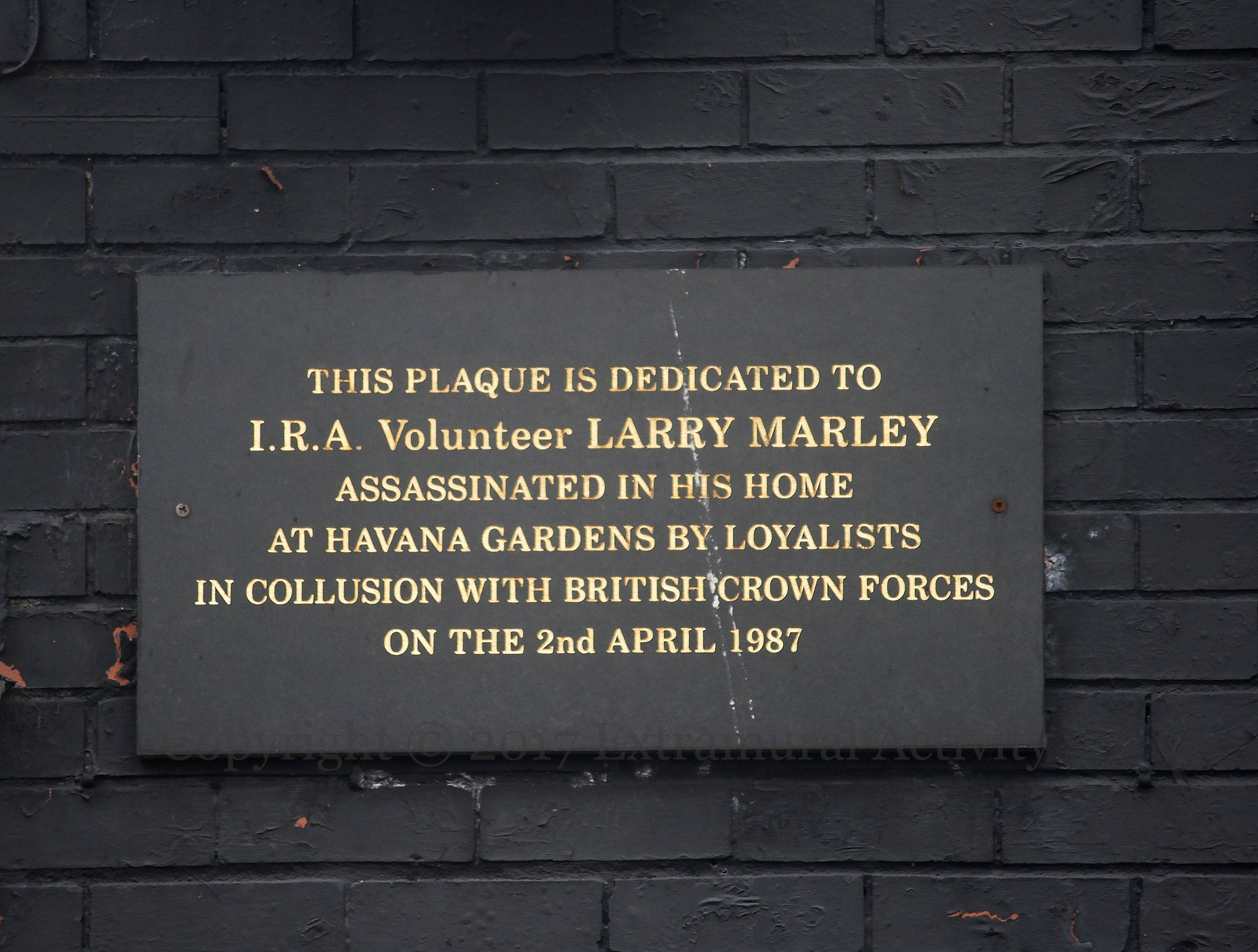
Saoradh (Fb) tarp in Ardoyne with scenes of protest, including a placard reading “Sinn Fein, SDLP, Catholic church silence”. The tarp is next to the plaque for IRA volunteer Larry Marley (shown below), whose protracted funeral meant scenes from Ardoyne being broadcast worldwide.
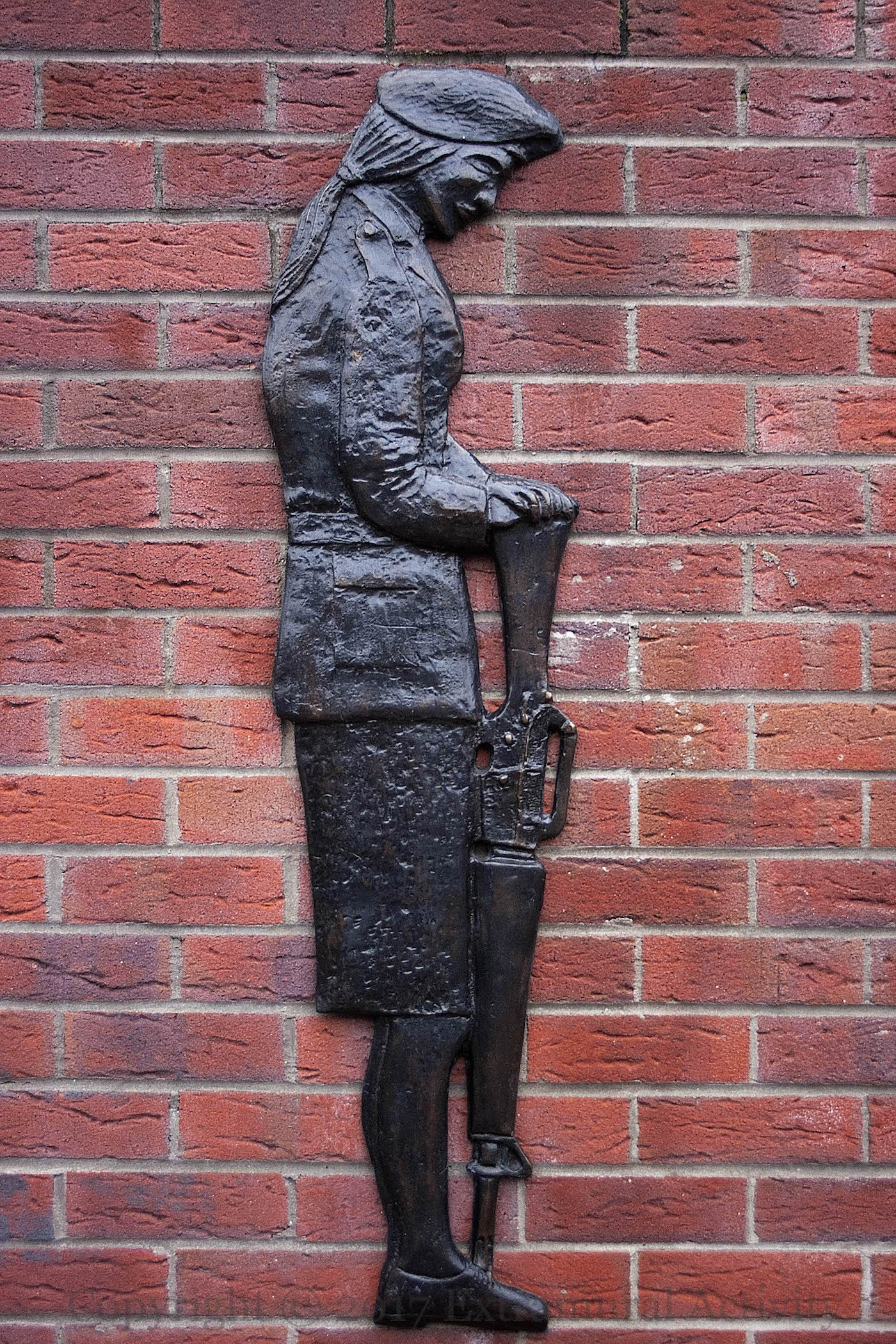
Here, from left to right, are all of the metalworks in the memorial garden on Ascaıll Ard Na bhFeá by sculptor and painter Hugh Clawson. On the stone (above) an IRA volunteer – with the emblem of the Easter lily on his beret – rests in the arms of Mother Ireland and her harp. Then two featuring the lark as the ‘spirit of freedom’ (from The Lark And The Freedom Fighter). In the first, the lark breaks through the bars of a prison cell, and in the image below, it flies in front of an “H” made of bricks, carrying a bin lid. (For a lark carrying a rifle, see Lark Of War and Armed Resistance.) Clawson’s name can be seen on the bars. In the second, a lark carries a binlid, used by locals to signal the presence of British Army troops. “In memory of all Irish martyrs who have died on hunger strike in the fight for Irish freedom. Their inspiration and courage will always be remembered by the republican movement and republican family (mid Falls).” One female and one male volunteer stand with bowed heads. A pair of hands joined in prayer in the Beechmount memorial garden: “in memory of those innocent people from this area who have died in this struggle for Irish freedom”. Finally, a scene of protest, in front of the Free Ireland mural at the bottom of the street. “In memory of the all the unsung heroes off [sic] this area who’s [sic] hardship, sacrifice and support during this struggle for Irish freedom will never be forgotten by the Belfast Brigade óglaıgh na h-éıreann.” The plaque depicts the work of print-makers (“Smash H-Block Armagh”), marchers carrying portraits of hunger strikers (“Mid Falls supports the women of Armagh”), bin-lid rattlers, and muralists. The tarp above reads “Cuımhníonn Lár na bhFál – Mid Falls remembers” Out of picture to the right of the wide shot is Bobby Sands’s quote “Our revenge will be the laughter of our children.” See M04415.
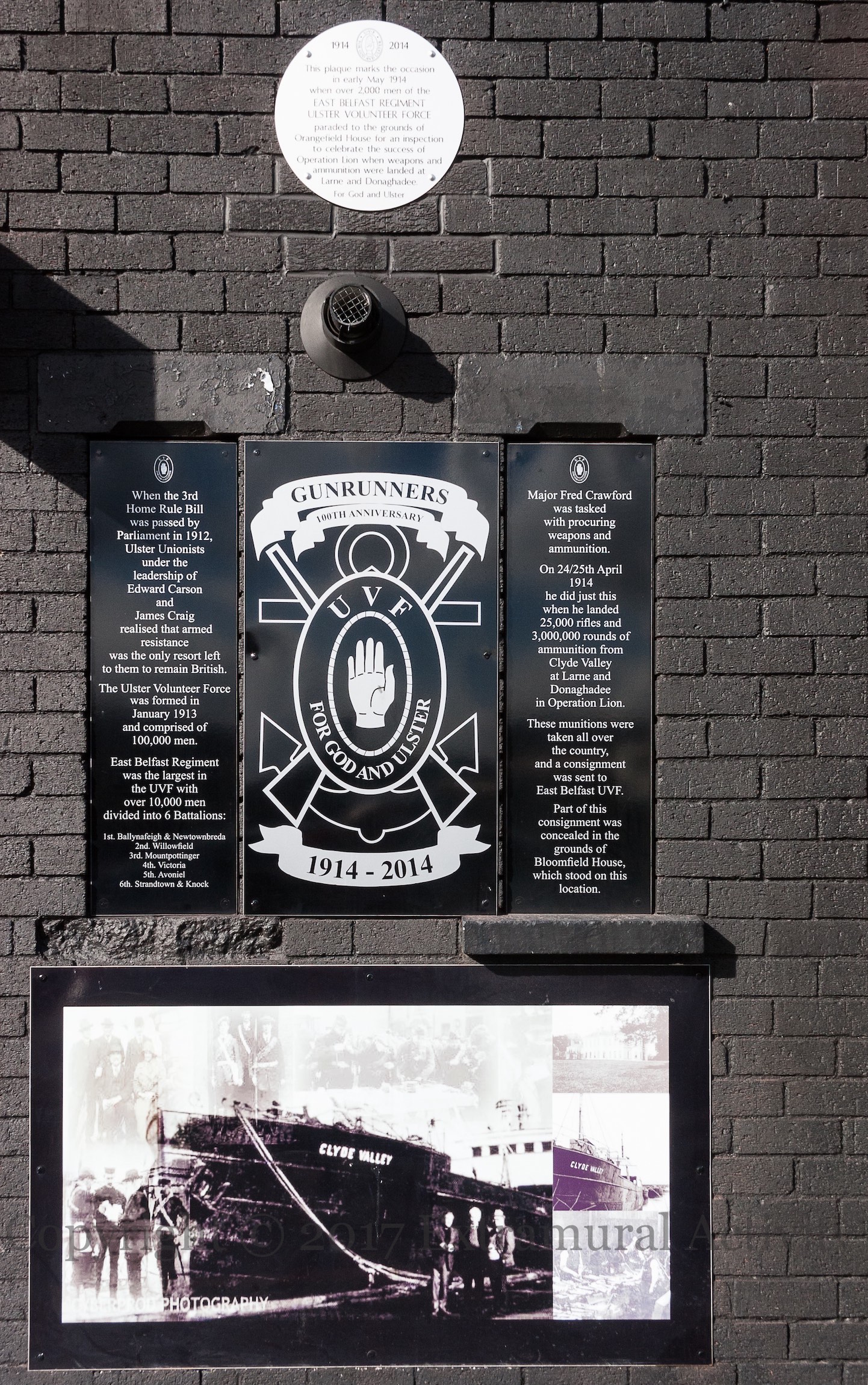
The 100th anniversary plaque and board shown in this entry are on the spot of Bloomfield House (web), where guns from Clyde Valley were held for the East Belfast battalion of the Ulster Volunteers in 1914. See also: John Henry Patterson’s involvement in Operation Lion.
“When the 3rd Home Rule Bill was passed by Parliament in 1912, Ulster Unionists under the leadership of Edward Carson and James Craig realised that armed resistance was the only resort left to them to remain British. The Ulster Volunteer Force was formed in January 1913 and comprised of 100,000 men. East Belfast Regiment was the largest in the UVF with over 10,000 men divided into 6 Battalions: 1st. Ballynafeigh & Newtownbreda, 2nd. Willowfield, 3rd. Mountpottinger, 4th. Victoria, 5th. Avoniel, 6th. Strandtown & Knock. Major Fred Crawford was tasked with procuring weapons and ammunition. On 24/25th April 1914 he did just this when landed 25,000 rifles and 3,000,000 rounds of ammunition from Clyde Valley at Larne and Donaghadee in Operation Lion. These munitions were taken all over the country, and a consignment was sent to East Belfast UVF. Part of this consignment was concealed in the grounds of Bloomfield House, which stood on this location.”
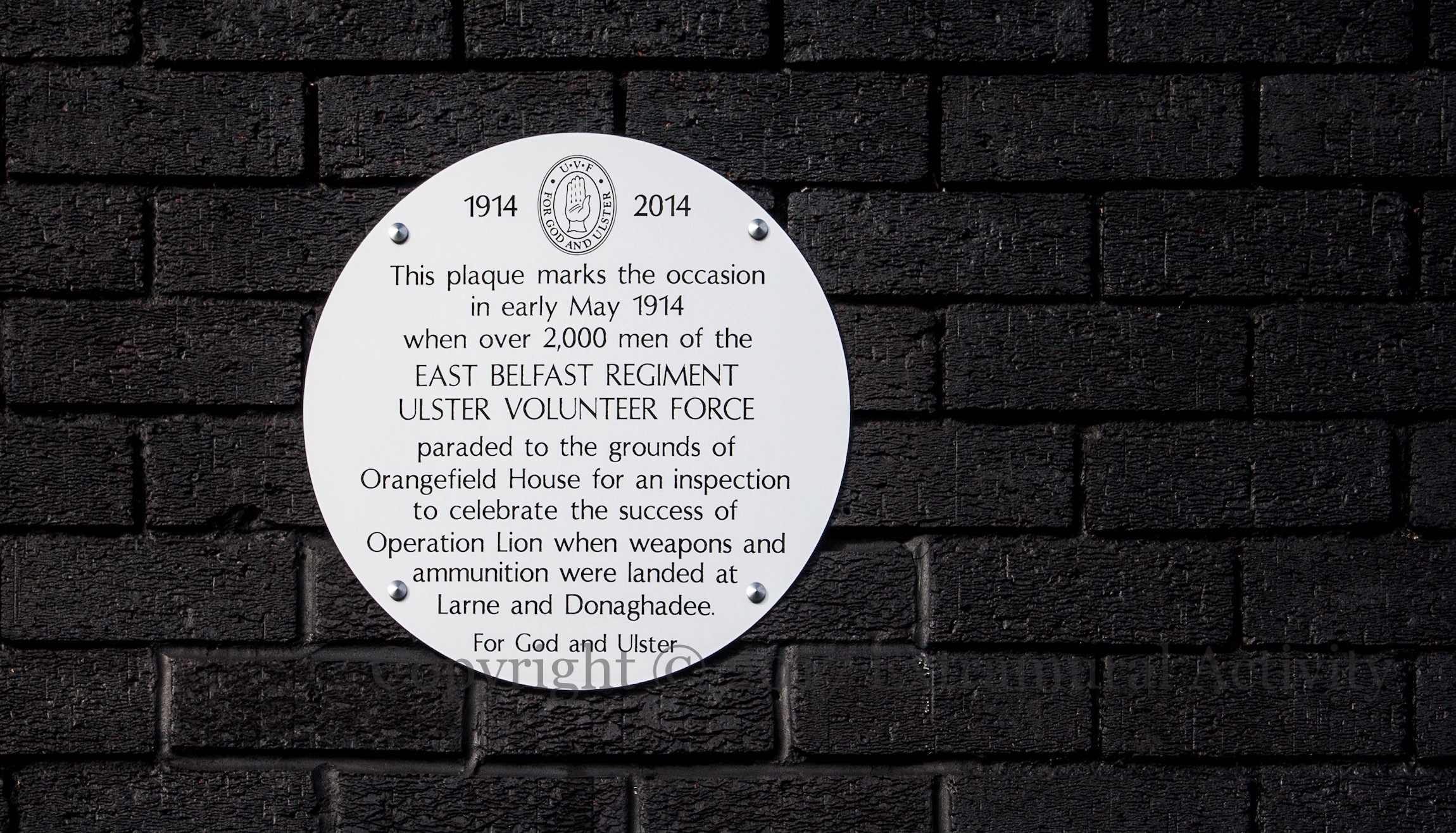
“This plaque marks the occasion in early May 1914 when over 2,000 men of the East Belfast Regiment, Ulster Volunteer Force paraded to the grounds of Orangefield House for an inspection to celebrate the success of Operation Lion when weapons and ammunition were landed at Larne and Donaghadee. For God and Ulster.”
These three are next to (and the same black background) as the Orangefield memorial – see In All Theatres Of Conflict.
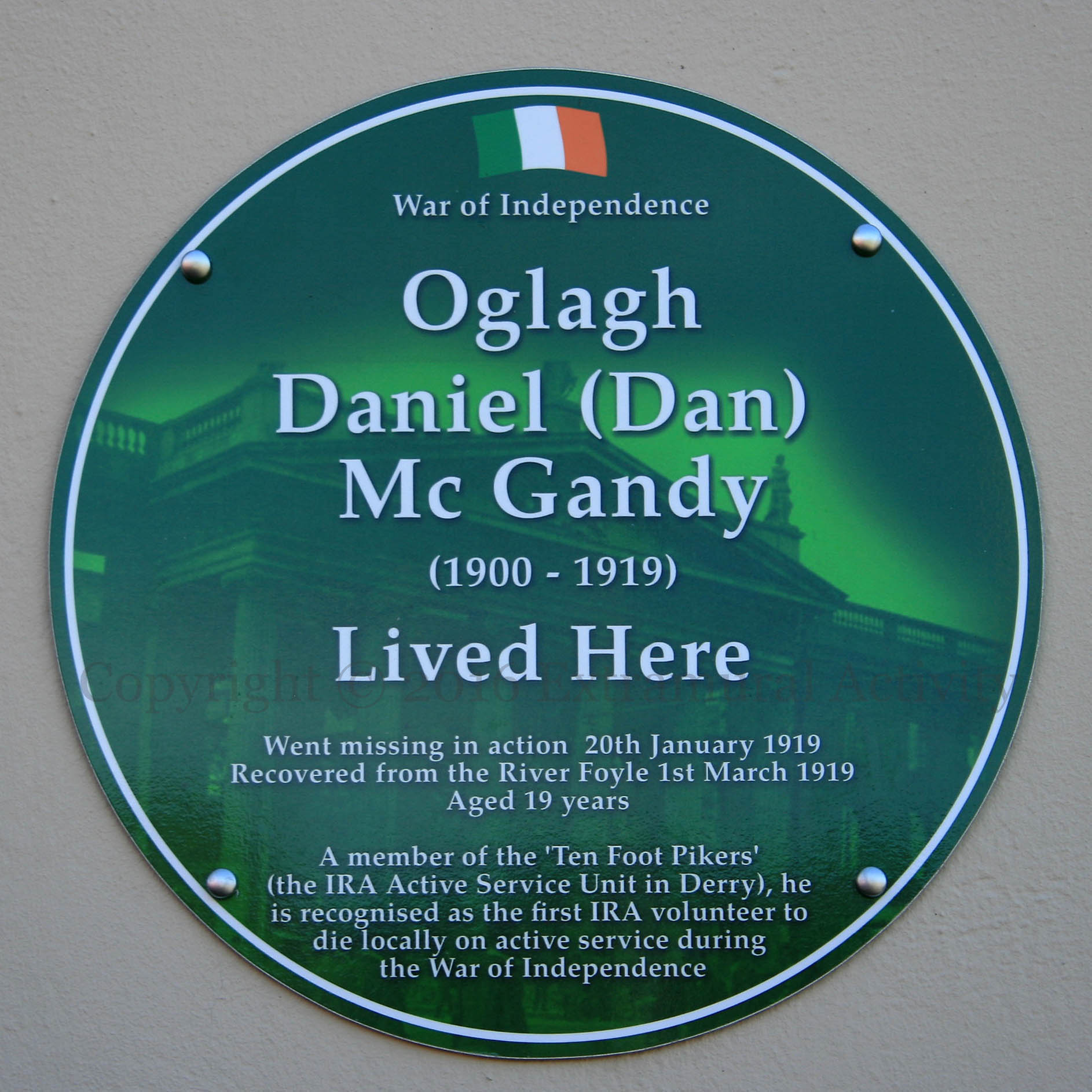
The first few pages of Commandant Michael Sheer’s testimony to the Bureau of Military History describe the activities of the elite squad called the “Ten Foot Pikers”, including how postal officer Dan McGandy stole election ballots sent by mail during the general election of 1918. As described in the plaque above, McGandy went missing in January 1919 and was found in the Foyle six weeks later. This article suggests that he fell in after a struggle with British soldiers who had intercepted him while stealing grenades; this Derry Now article suggests he was thrown in by the soldiers, who then arranged his things to make it appear a suicide.
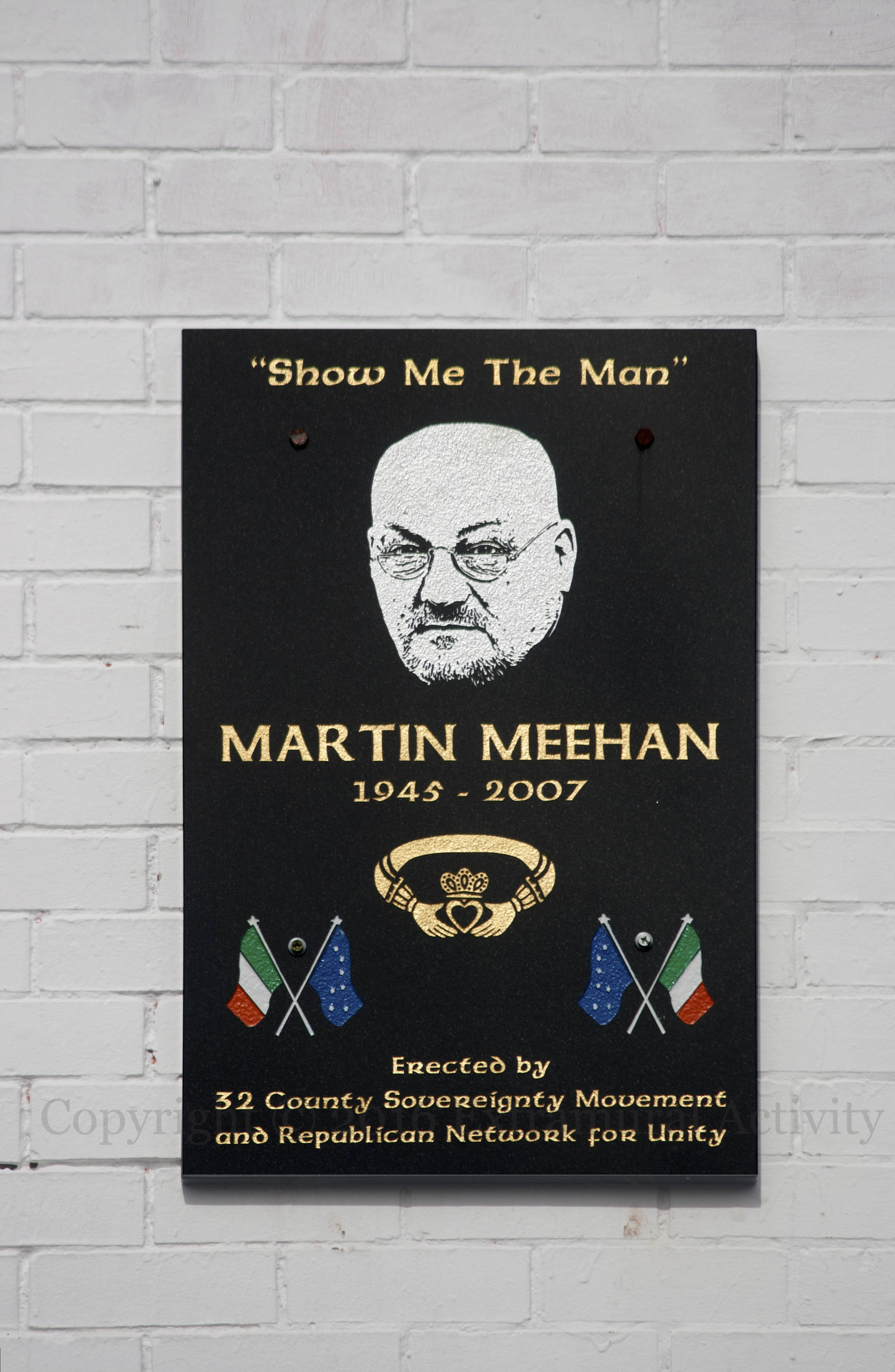
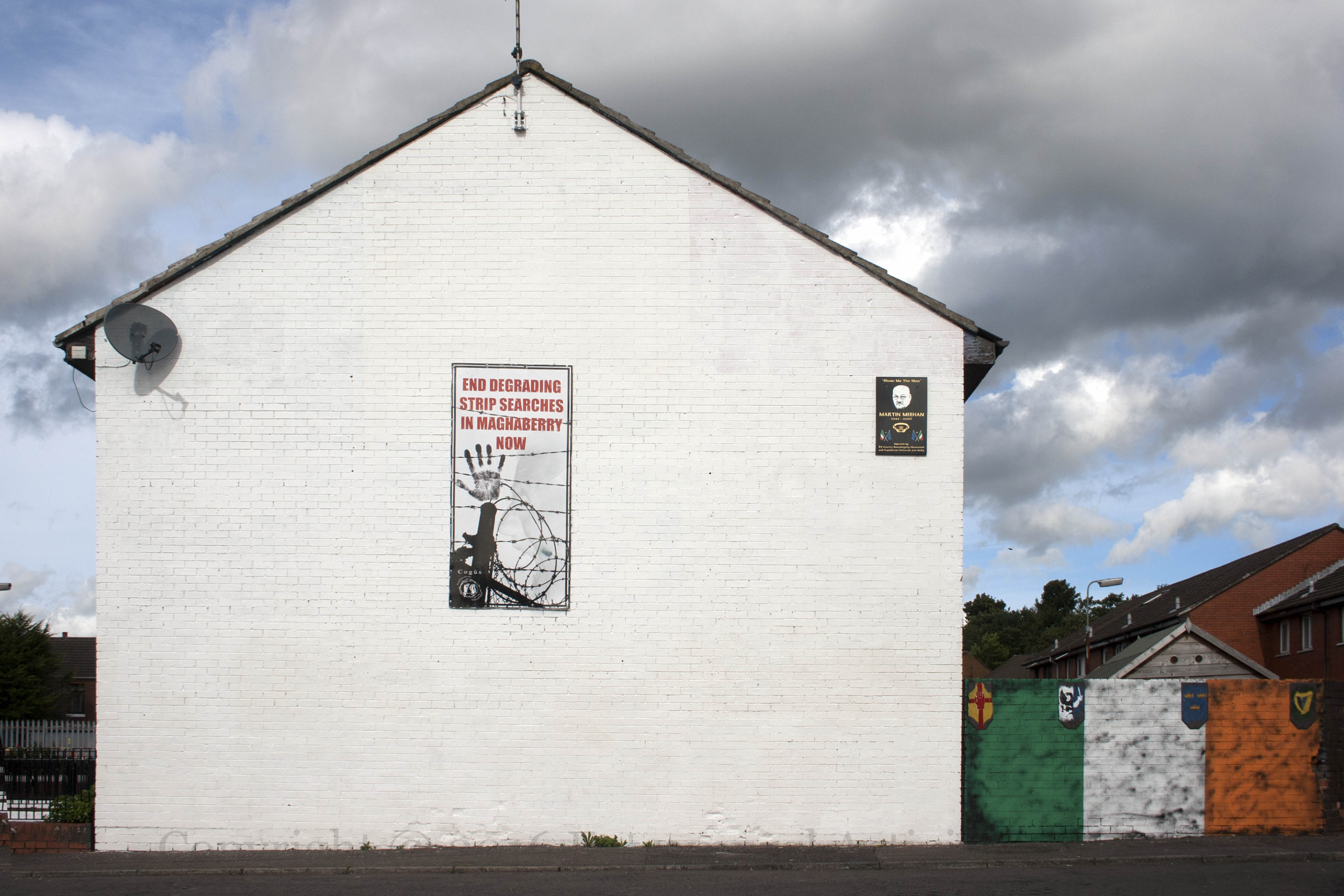
The Martin Meehan tarp in Ardoyne Avenue has been removed and the wall whitewashed. At the moment, all there is to be seen is the plaque shown above – Show Me The Man, Martin Meehan 1945 – 2007 – and a Cogús board – “End strip searching in Maghaberry now”.











 Extramural Activity