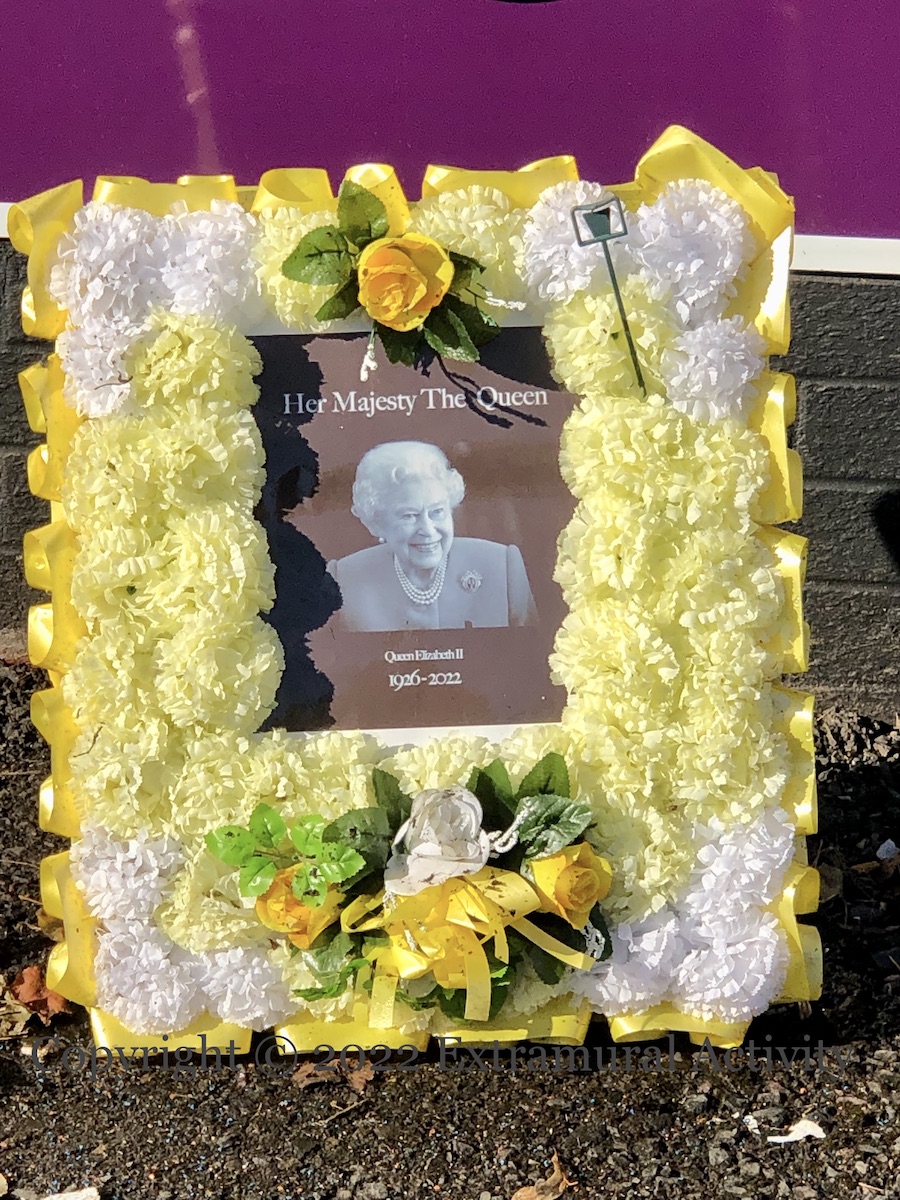
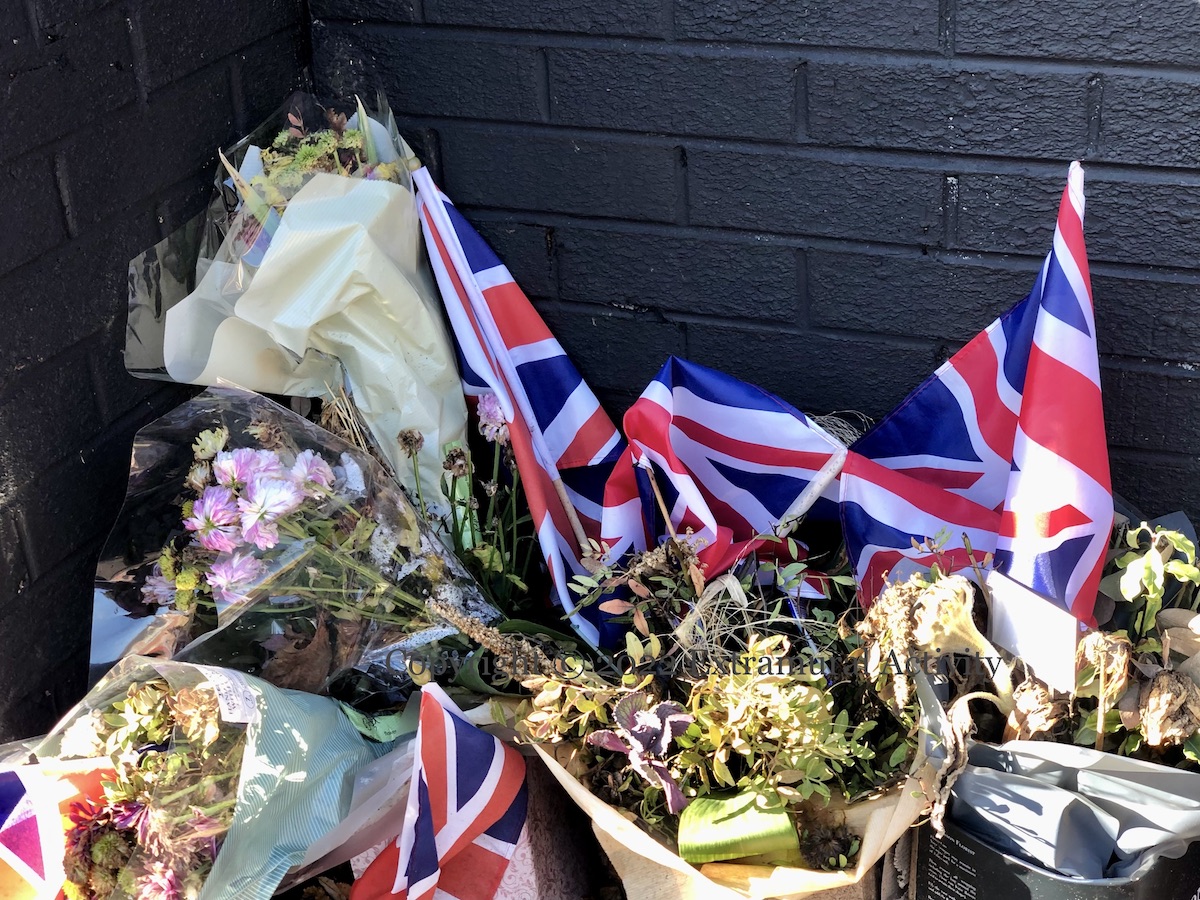
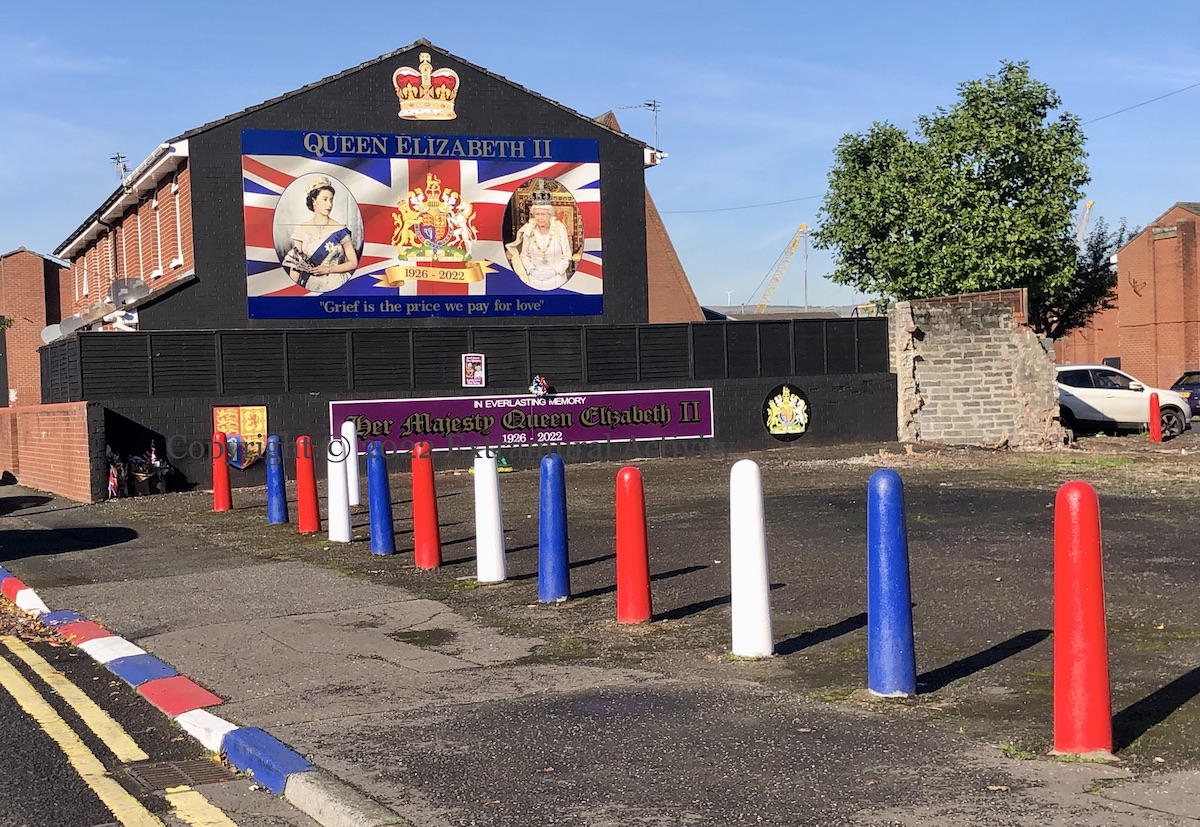
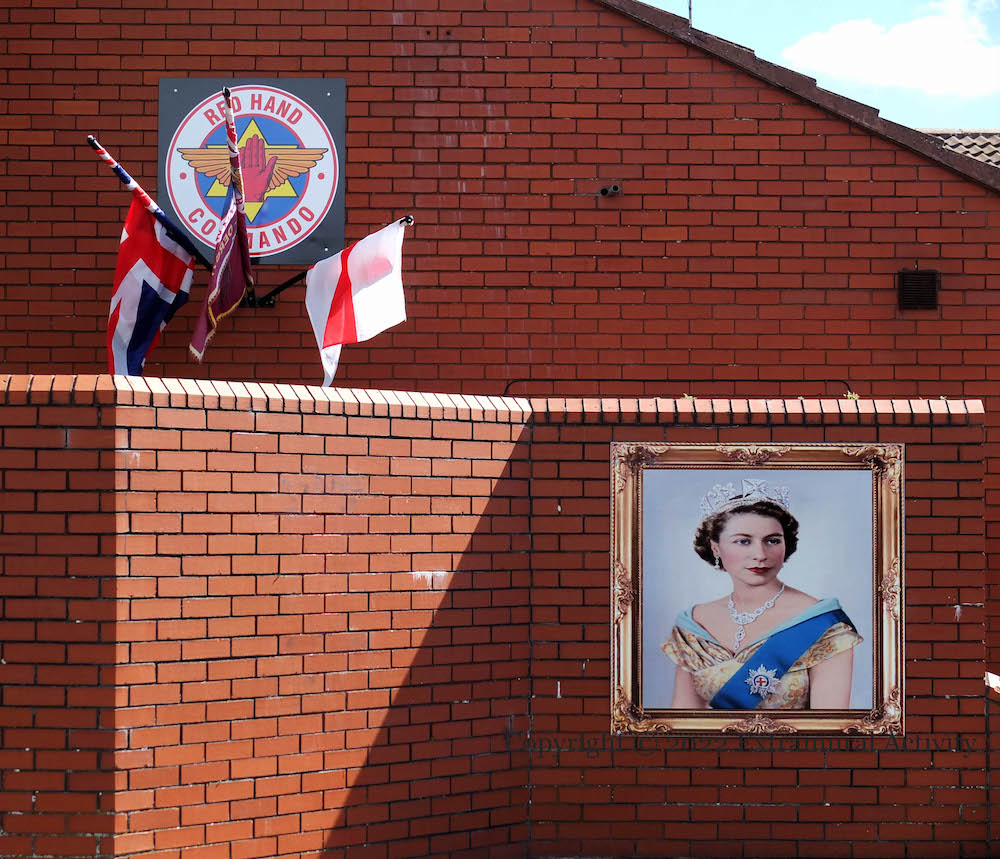
Elizabeth II, queen of the United Kingdom, passed away on September 8th, at the age of 96, in the same year of her platinum jubilee, the 70th anniversary of her accession. The phrase “grief is the price we pay for love” comes from a message from Elizabeth in consolation with the relatives of those killed in the “9-11” attacks in 2001 (text at The Guardian).
“In everlasting memory – her majesty Queen Elizabeth II – 1926-2022.” “Long live the King”
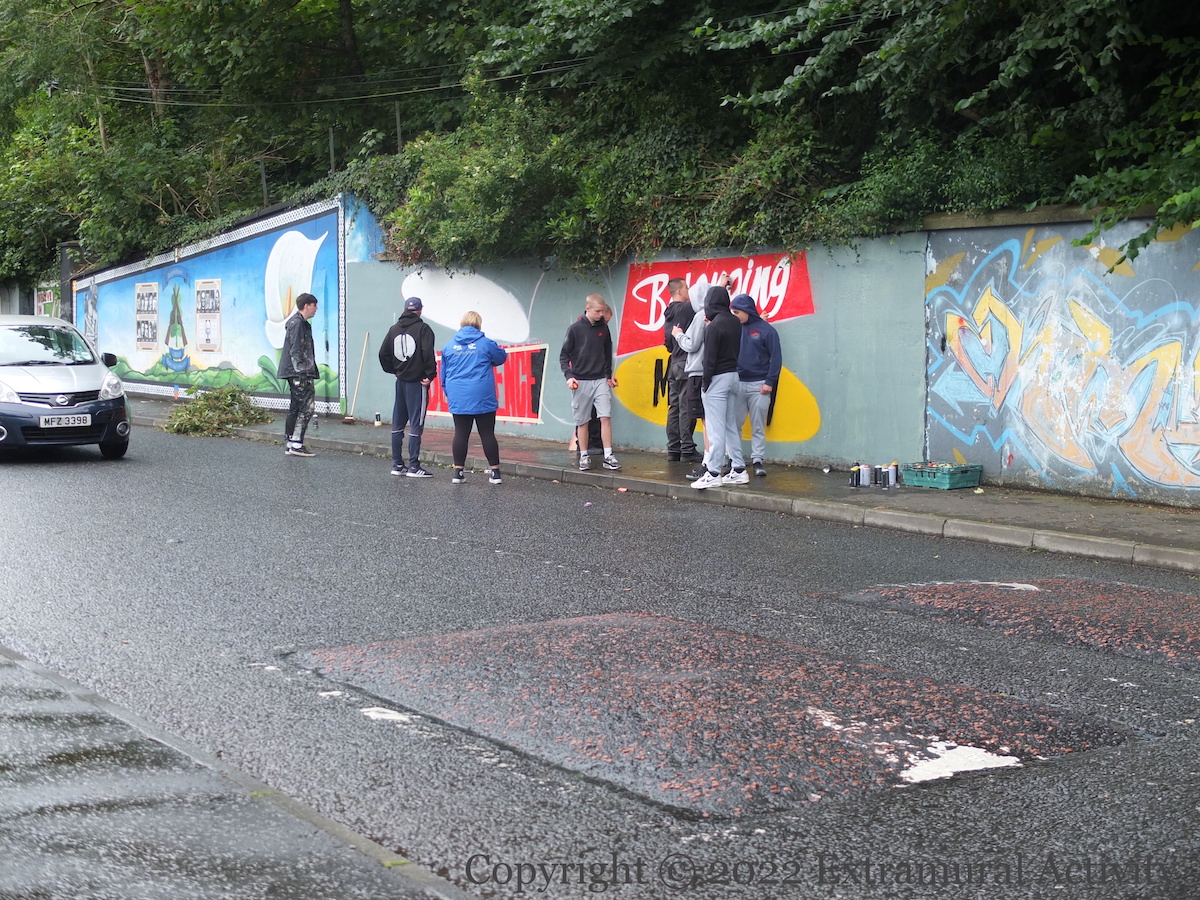
Here is a complete set of images from the Bogside end of the Brandywell. From left to right: “Nasc” by NOYS (ig) for Gasyard Féıle 2022, Long Tower Community Centre (see Brandywell Past And Present), a new “Brandywell” stencil by Peaball (ig), the Ryan McBride Foundation (tw), a new version of the Derry Brigade IRA mural (see previously Brıogáıd Dhoıre), Peaball and local youth at work, various pieces of wild-style writing and graffiti in support of Jason Ceulemans.
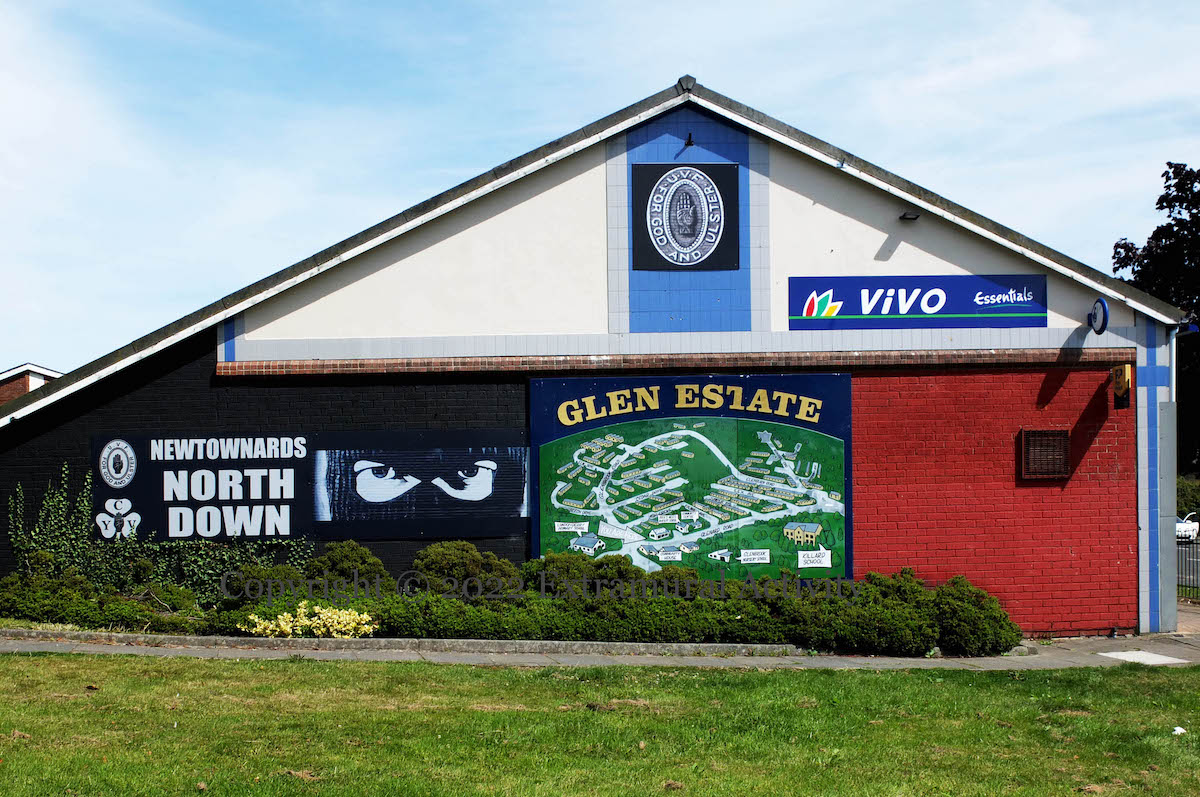
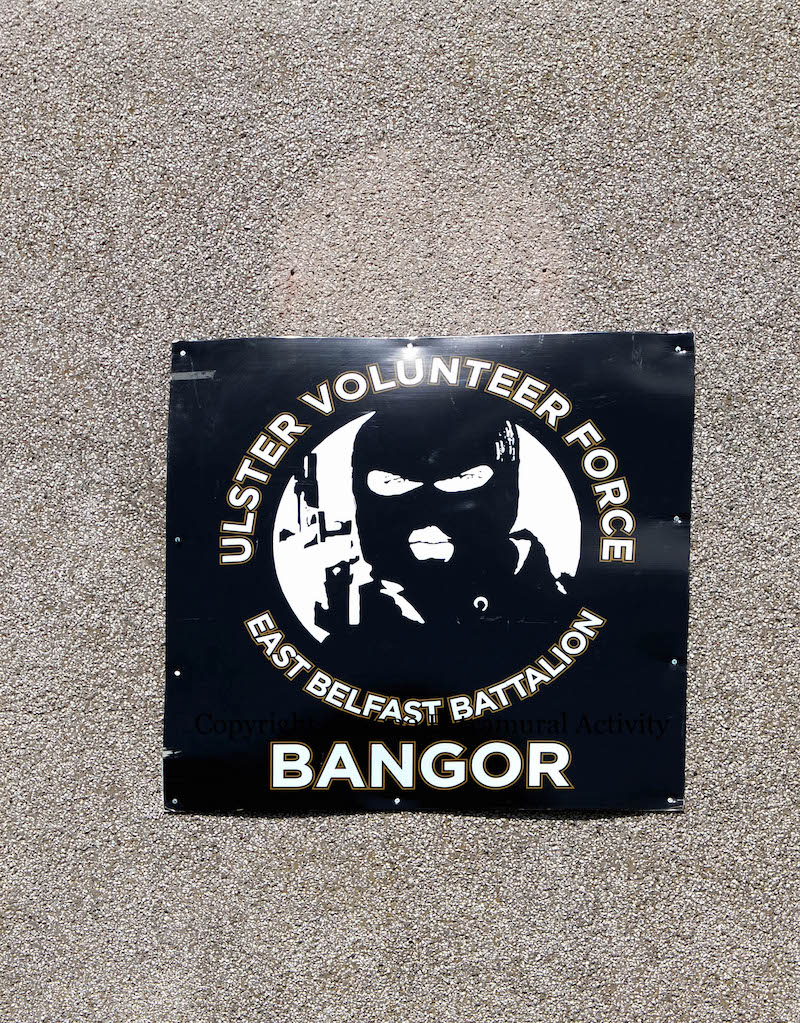
A hooded UVF volunteer has been added to the shops at the bottom of the Glen estate in Newtownards (compare with 2018). It’s unclear (to us) who such a threatening image is directed at: the residents of the estate (in both a controlling and defending function), and/or the UDA at the top of the estate, and/or the East Belfast UVF, and/or outside observers.
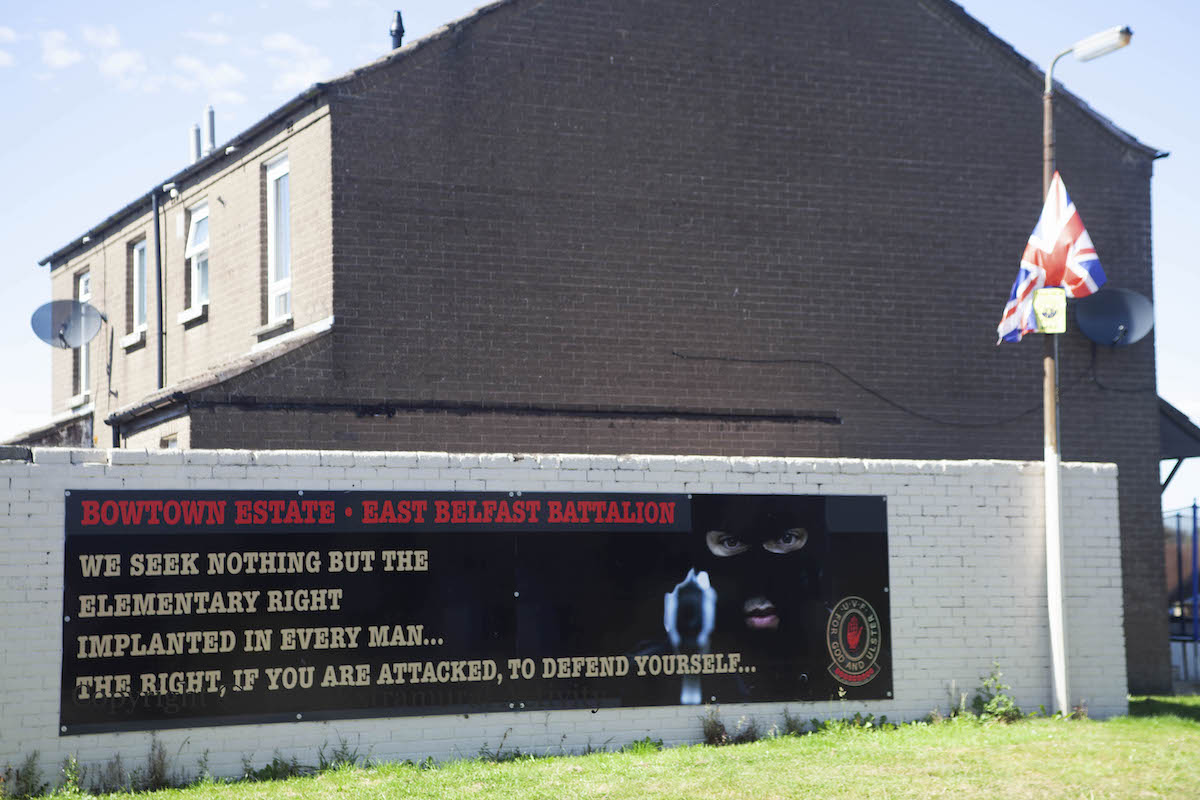
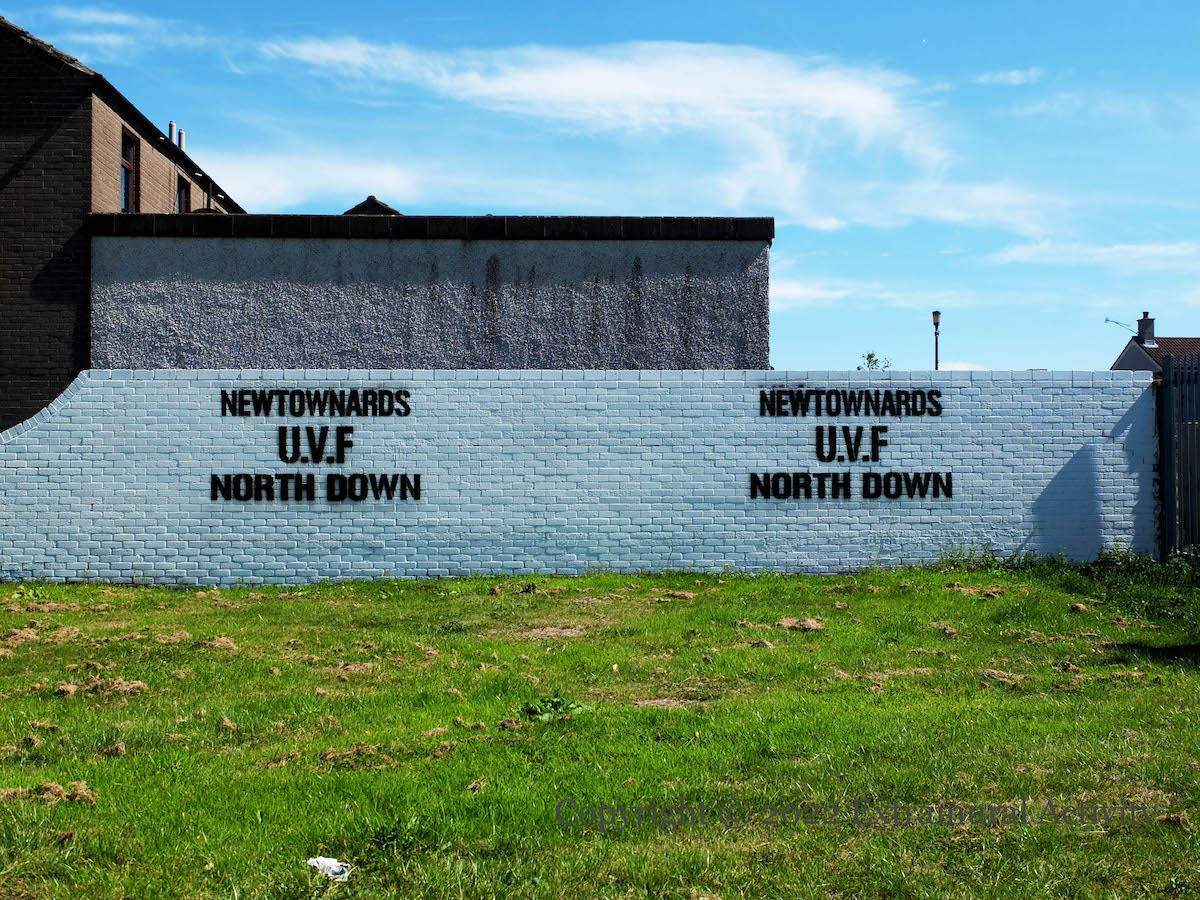
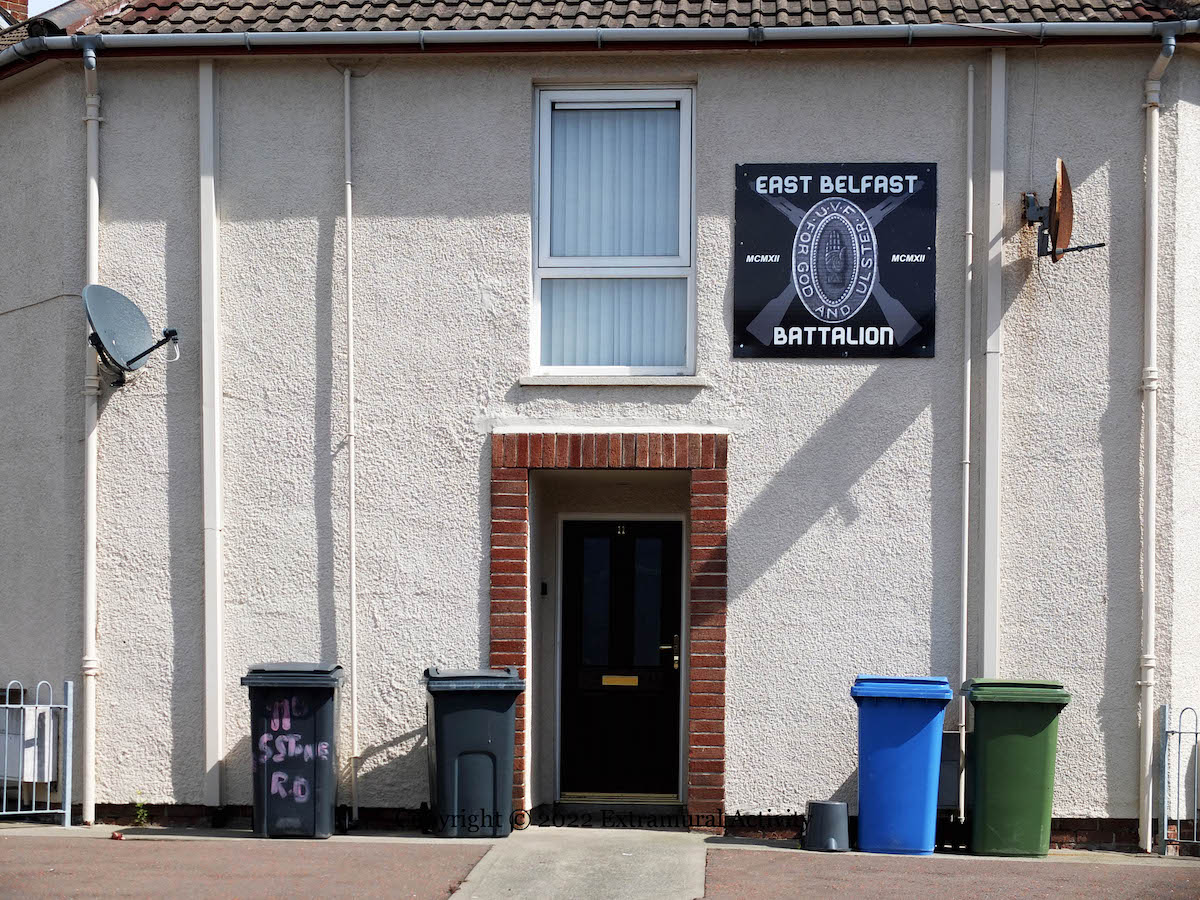
The “east Belfast” board shown above is on the east side of Bowtown while the two pieces of fresh “north Down” graffiti are on the west side, perhaps indicating that the tension between the two UVF factions – persists. The east Belfast faction was suspected in the bus burning in response to the Protocol in 2021 (BBC | Tele).
The phrase on the board is also used in an east Belfast mural: “We seek nothing but the elementary right implanted in every man … the right, if you are attacked, to defend yourself …”
“I gcuımhne na nÓglach a fuaır bás ar son saoırse [in memory of the volunteers who died for freedom].” The “22” are the familiar 12 deceased Troubles-era hunger-strikers, plus 10 from 1917 to 1946: Thomas Ashe, Terence McSwiney, Michael Fitzgerald, Joseph Murphy, Joe Witty, Dennis Barry, Andy O’Sullivan, Tony Darcy, Jack McNeela, Sean McCaughey.
“‘A Letter To The 22: You have not gone away. You are in the hearts/and on the lips of your people./The old speak of you with knowing tongue. The middle/aged, as those who walked beside you./The young men and women with a passion not unlike your own./Your names can be heard on the wind taken from the mouths/of men who tend their flocks on Slieve Gullion, Cnoc Phádraıg, Glenshane./They echo in small graveyards in/Cork, Kerry, Galway, Mayo, Tyrone, Antrim, Derry and Armagh./They are heard among your people at the mass gate on/Sunday, in the crowd at the hurling game, around the hearth when/the bottle is cracked and song in sung. Your image can be seen/on the faces of happy smiling children for whose freedom you gave your all./You are in our prayers, you have not gone away, you never will’ – Colum Mac Gıolla Bhéın“
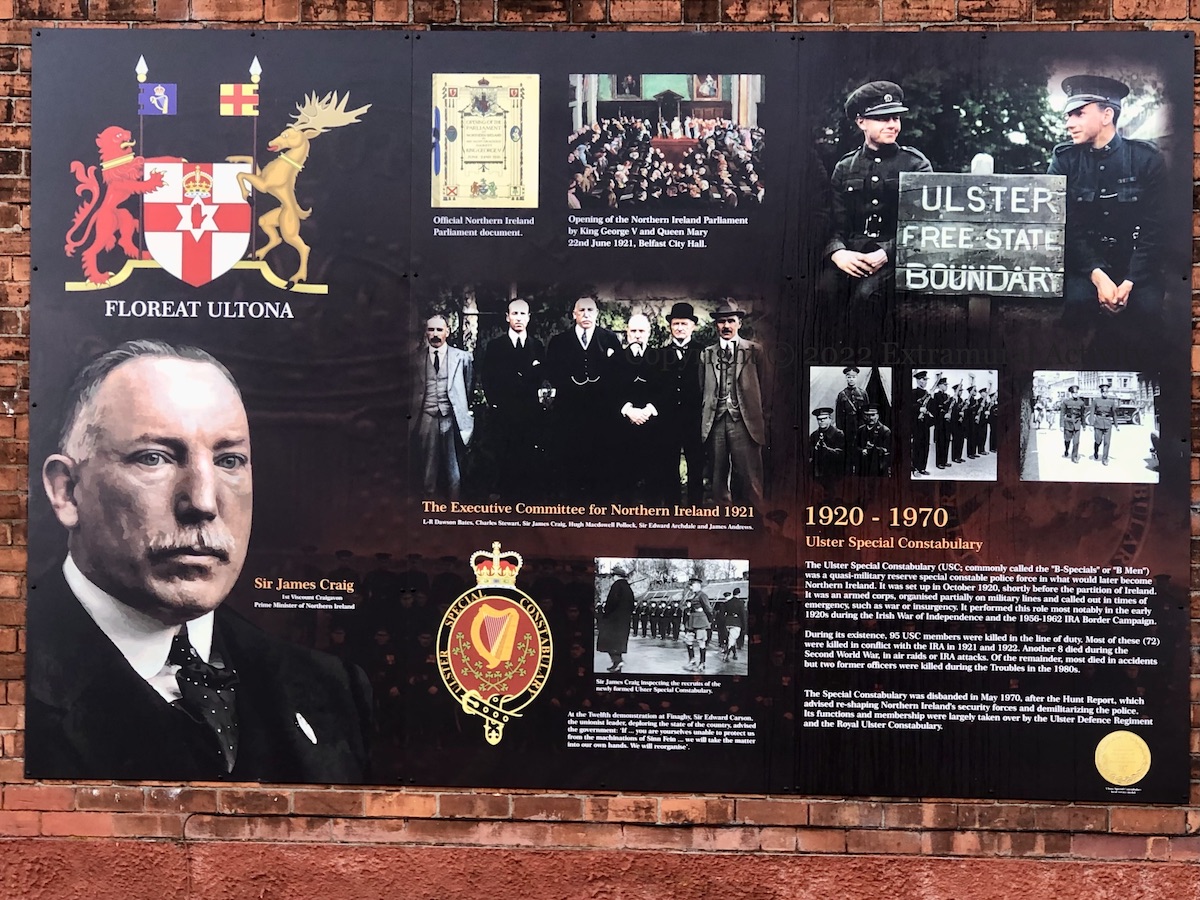
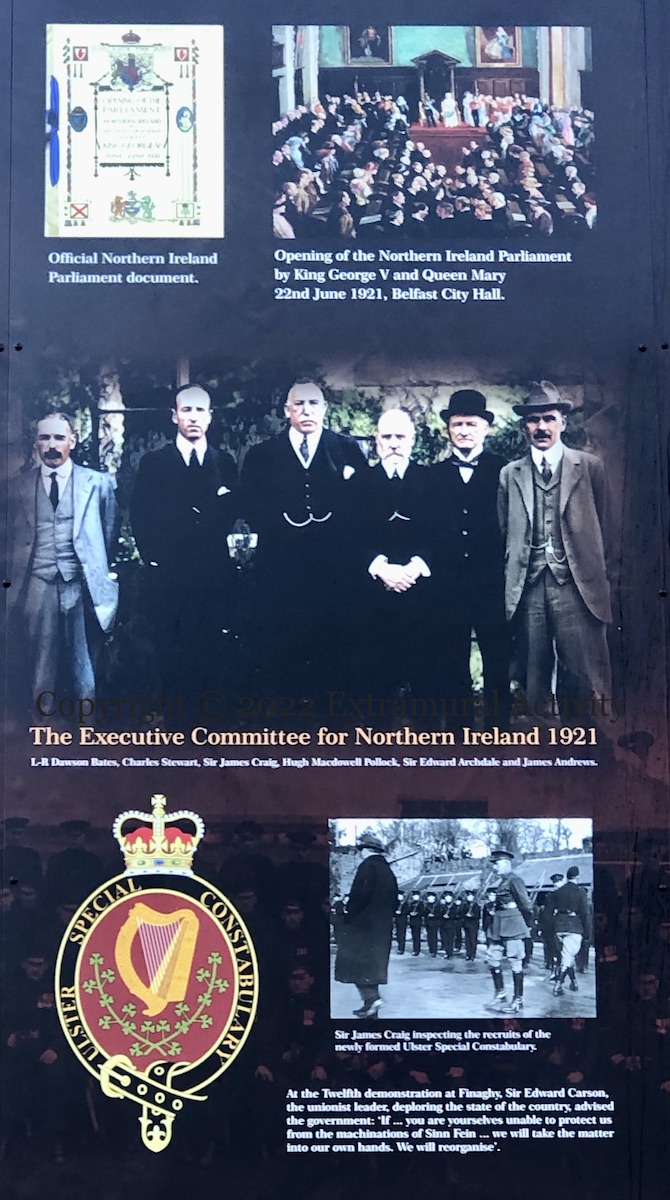
“May Ulster flourish” as the newly created Northern Ireland under “Sir James Craig, 1st Viscount Craigavon, Prime Minister of Northern Ireland”. The Northern Ireland parliament was opened in 1921 and the coat of arms adopted in 1924 (WP); the Special Constabulary (including the B-Specials) had been formed prior to and in preparation for partition – the quote from Carson (also seen in an east Belfast mural) is from July 12th, 1920.
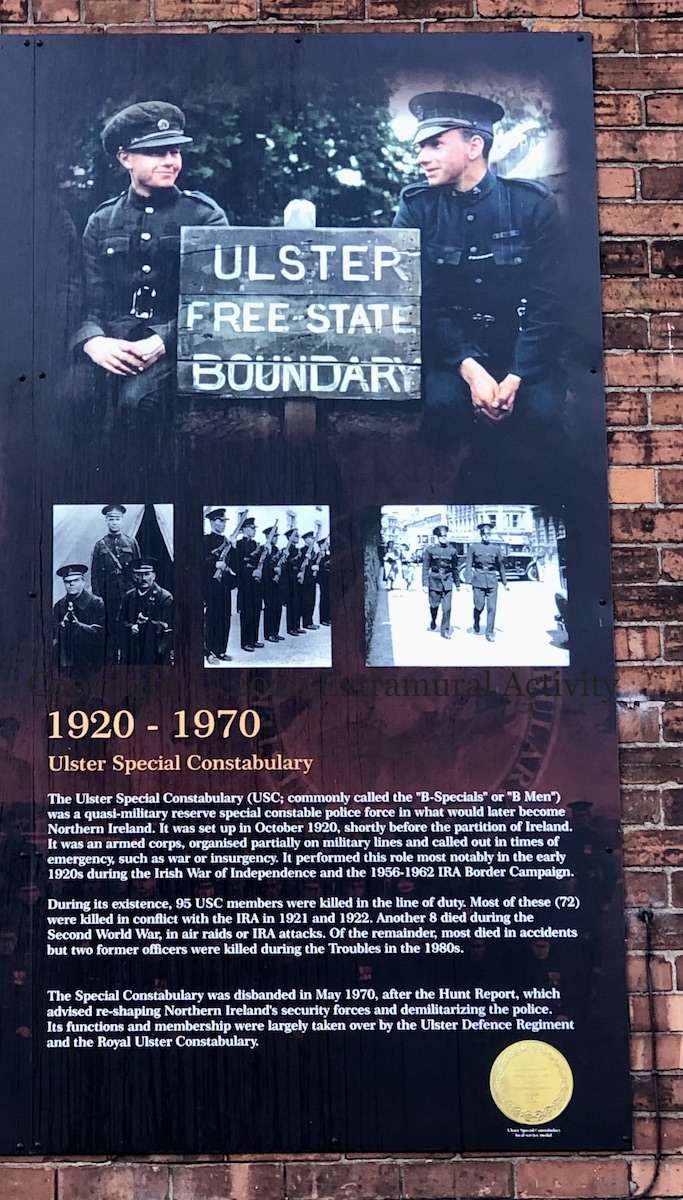
The text on the board is the same as at WP: “The Ulster Special Constabulary (USC; commonly called the “B-Specials” or “B Men”) was a quasi-military reserve special constable police force in what would later become Northern Ireland. It was set up in October 1920, shortly before the partition of Ireland. It was an armed corps, organised partially on military lines and called out in times of emergency, such as war or insurgency. It performed this role most notably in the early 1920s during the Irish War of Independence and the 1956-1962 IRA Border Campaign. During its existence, 95 USC members were killed in the line of duty. Most of these (72) were killed in conflict with the IRA in 1921 and 1922. Another 8 died during the Second World War, in air raids or IRA attacks. Of the remainder, most died in accidents but two former officers were killed during the Troubles in the 1980s. The Special Constabulary was disbanded in May 1970, after the Hunt Report, which advised re-shaping Northern Ireland’s security forces and demilitarizing the police. Its functions and membership were largely taken over by the Ulster Defence Regiment and the Royal Ulster Constabulary.”
This Belfast Live article (which has images from the launch) leads with the headline that this new board replaces a UVF mural, but there hasn’t been anything on this wall since a large “UDA” lettering in 1999. The adjacent wall, which has now been painted over, previously (in 2010) had a UVF flag which had been vandalised with “Jesus Christ Is Lord Of All’ graffiti by 2017.
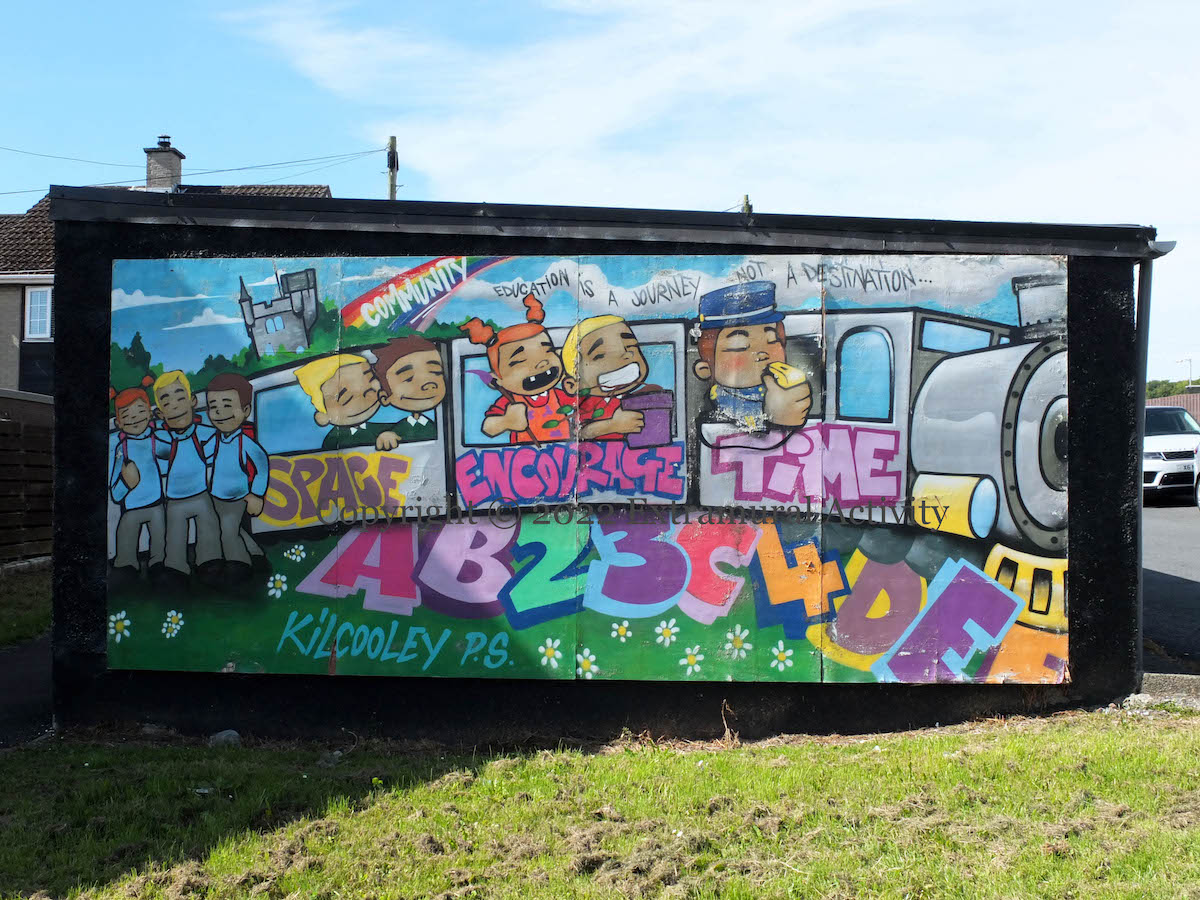
Here are two murals aimed at children in Kilcooley, Bangor. On the one hand, the first one (images 1, 2, 3) includes a WWI soldier and the saying “For your tomorrow, we gave our today”; on the other, the second – Education is a journey, not a destination – is a NIHE project that replaces a UDA mural: see Simply The Best.
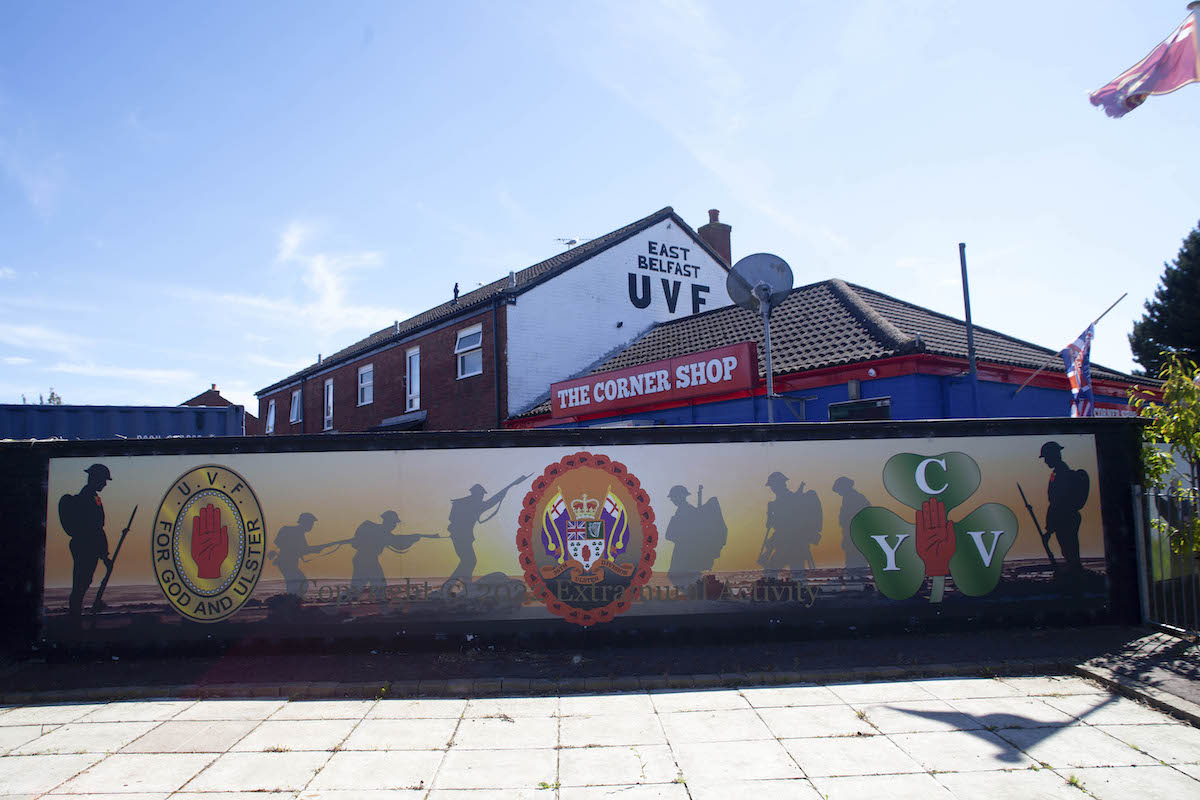
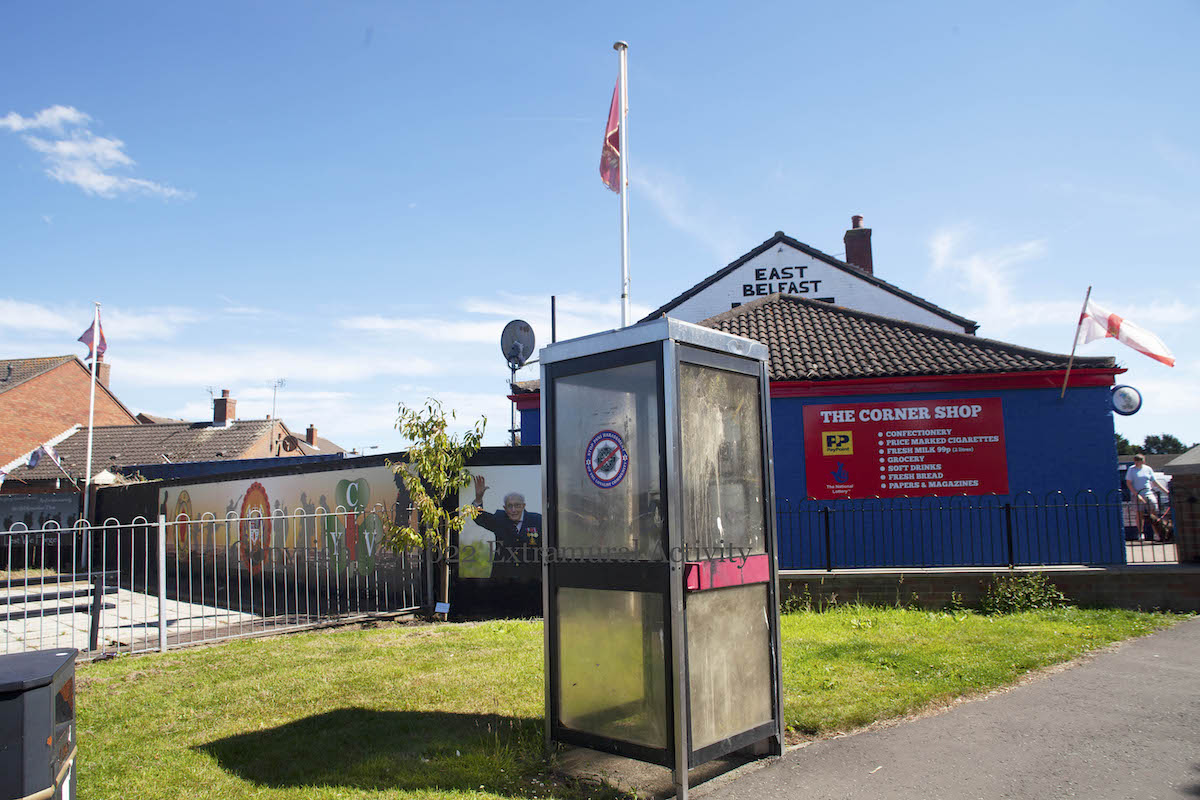
Three-in-a-row at the Bowtown (Newtownards) newsagents: on the left, “Lest we forget” (final image); in the middle, the emblems of the UVF, 36th Division, and YCV against a backdrop of WWI soldiers; on the right-hand, Captain Tom Moore, who raised money for the NHS during lockdown. Above the shop itself can be seen “East Belfast UVF” while the flag is from the North Down UVF. The sticker on the phone box says Stop PSNI Harassment.
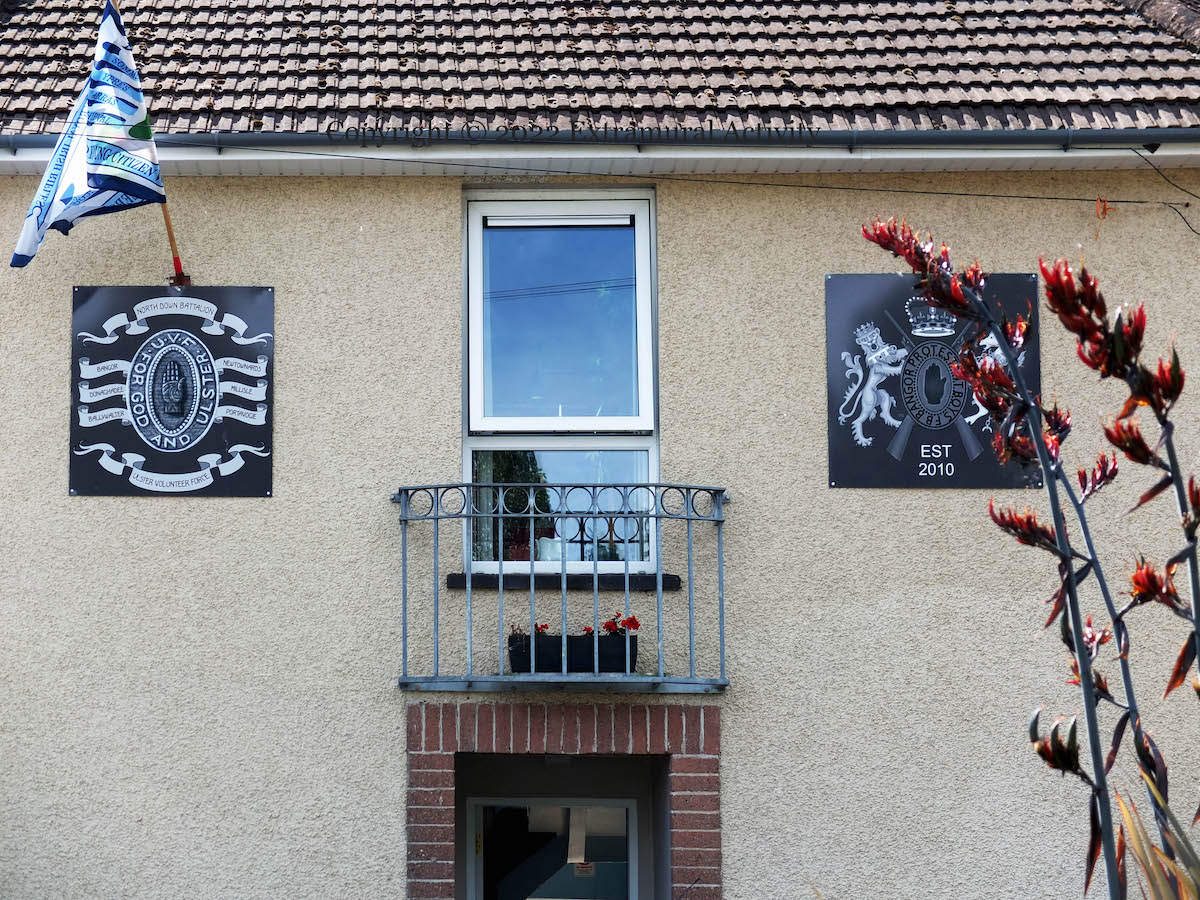
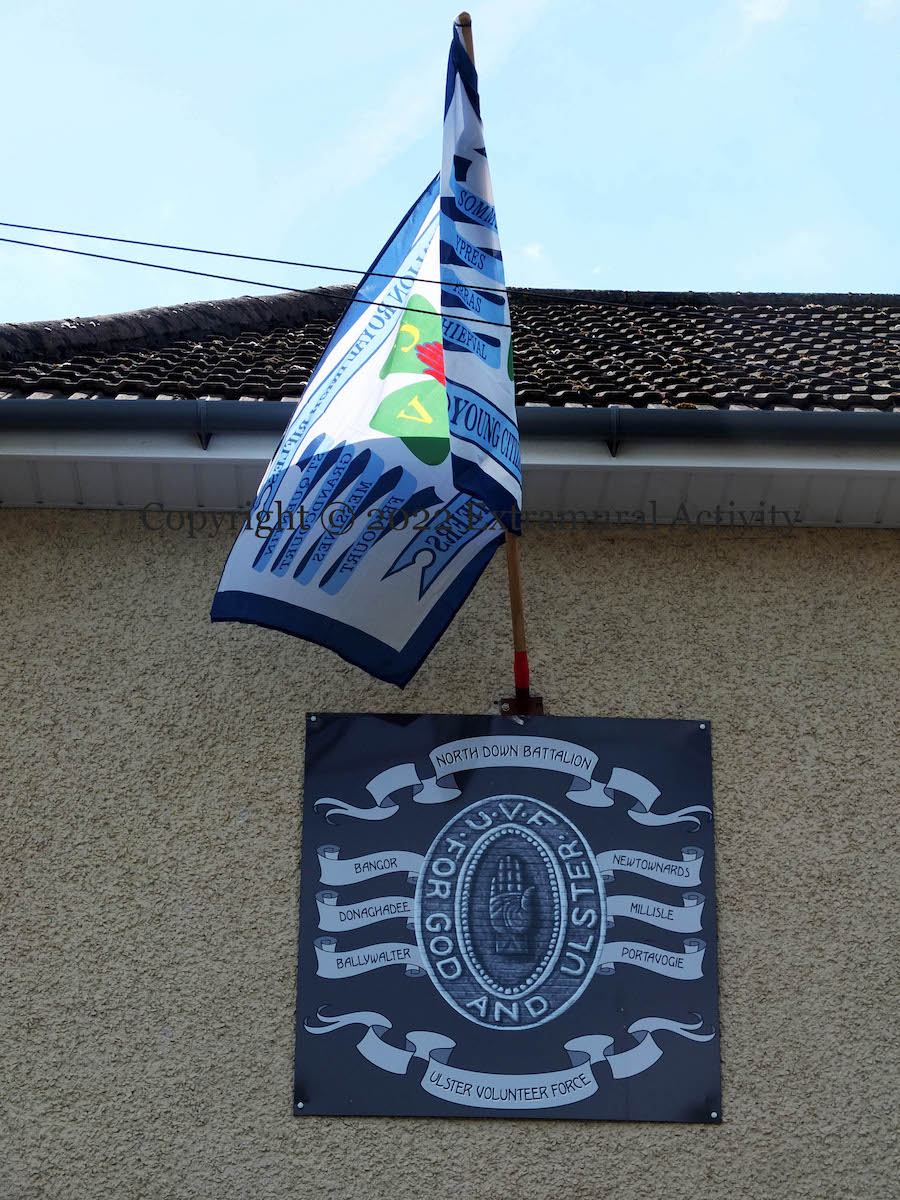
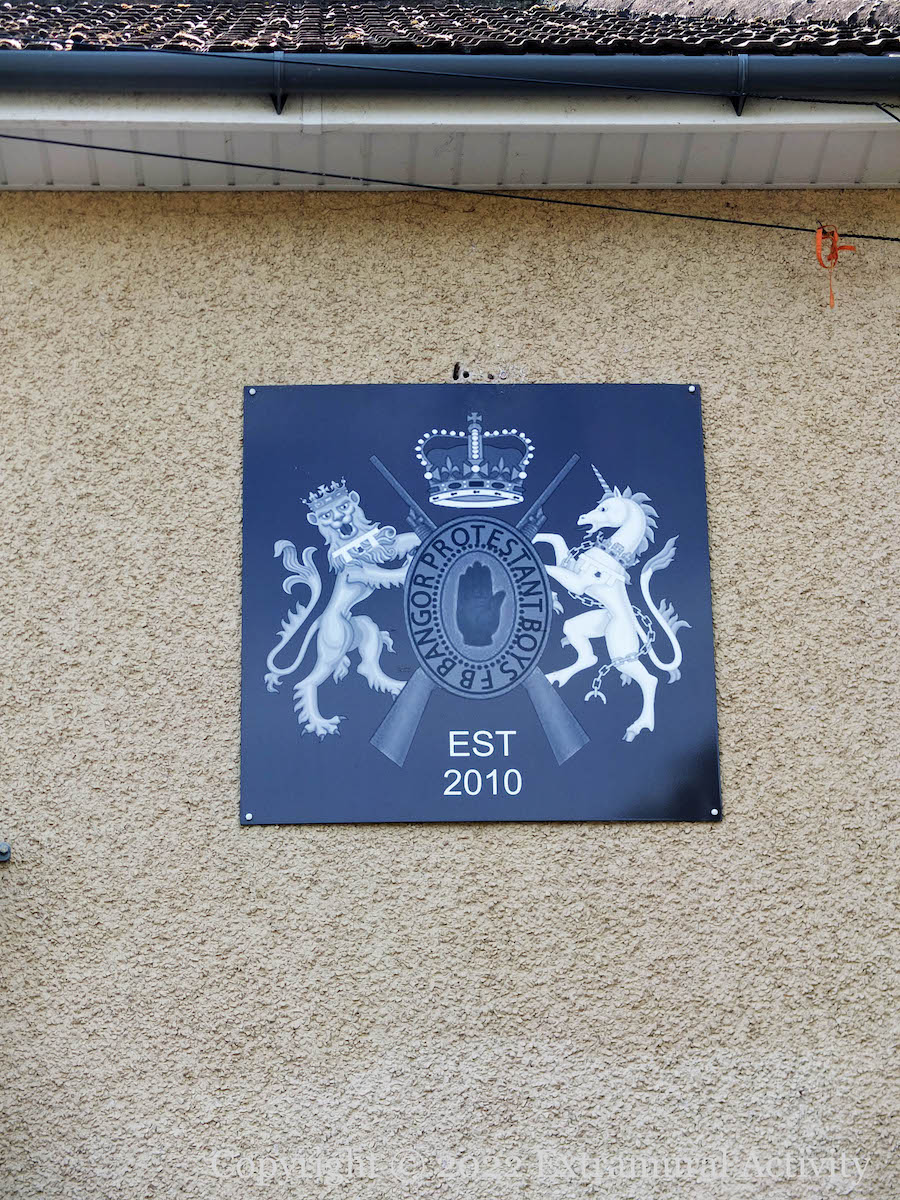
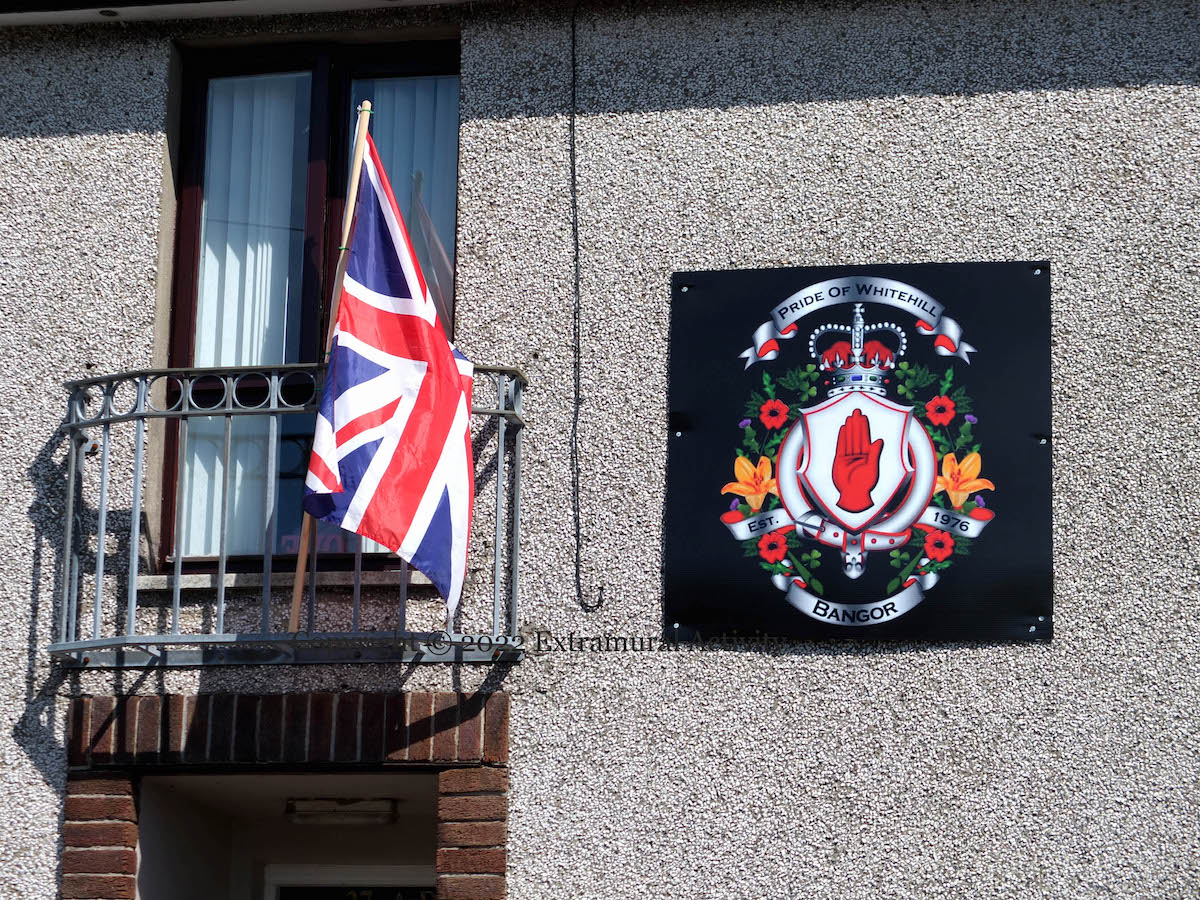
Here is a selection of UVF boards on the fronts of houses in Whitehill (Bangor). Two flute bands are mentioned: Pride Of Whitehill (Fb) and Bangor Protestant Boys (Fb). In the final image, the date of the formation of the Ulster Volunteers is given in Roman numerals: MCMXII.


















 Extramural Activity