Hark! To The Tramp Of The Young Guards Of Éıreann

2014-09-19 ArdanLaoLeft+

A pair of boards have been added to either side of one of the Bone memorials in Clós Ard An Lao, one for Na Fıanna Éıreann – the boys – and one for Cumann Na gCaılíní – the girls. The words are those of the Marching Song Of Na Fıanna Éıreann, except that in the second verse (the third stanza shown, first in the image below) the words “Cumann Na gCaılınní [sic]” have been inserted instead of “Fıanna Éıreann”.

The third image, below, shows the whole wall; for a close-up of the central boards, commemorating locals who lost their lives in the troubles, see Bone Memorial.

2014-09-19 ArdanLaoRight+

2014-09-19 ArdanLaoWide+

Click image to enlarge
Copyright © 2014 Seosamh Mac Coılle
X02202 X02203 X02204 cumann na mban firm each footstep erect each head soldiers of freedom unfearing and eager to follow the teaching of our hero dead on for freedom set we our faces to the dawning day in our own land when strength and daring shall end for evermore the saxon sway truth on our lips purity in our hearts strength in our arms blessed be our and like the who won for her glory in the days that are gone clean be our thinking and fruitful our teaching that we may deserve here when the fight is won soldiers and champions of eire our mother fear we no sassanach his schemes or steel foes of no foeman by comrades sisters all who are striving for weal

Those Days Are Over

2014-05-06 Suffragettes+

“Women have been trained to speak softly and carry a lipstick. Those days are over.” (Bella Abzug).

Above is a board on the Donegall Road bridge showing women drumming up an audience for a suffragette meeting in the Ulster Hall in November 1912. The image in the bottom right is of Emmeline Pankhurst being arrested in London in 1914; the top image is of Pankhurst on tour in the US in 1913 (LoC; see Pieces Of History for a description of the tour; she gave a speech entitled ‘Freedom Or Death’). Pankhurst spoke in Belfast at the 1912 meeting, though the speakers advertised on the placards are “Mrs Charlotte Despard, Miss Irene Miller, Mrs Edith How-Martyn, Miss Alison Neilans“.

The first suffrage group in Ireland was the North Of Ireland Women’s Suffrage Society, founded in Belfast in 1872 by Isabella Tod.

See also Belfast’s Infamous Prison for information about suffragettes held in Crumlin Road Gaol.

Click image to enlarge
Copyright © 2014 Seosamh Mac Coılle
X01836 ulster hall meeting monday nov 25

The Last Post

2014-09-15 GreatWar+

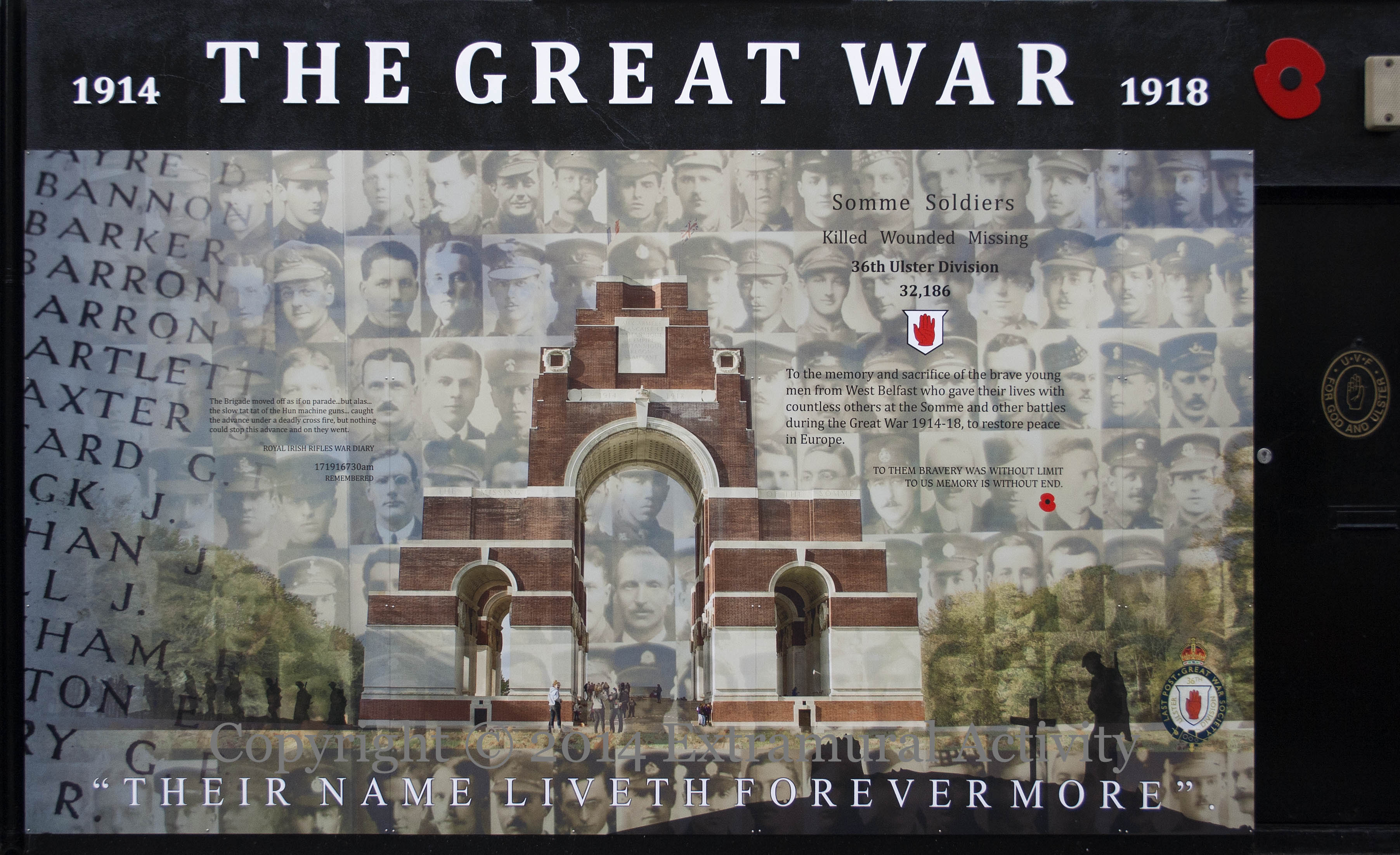
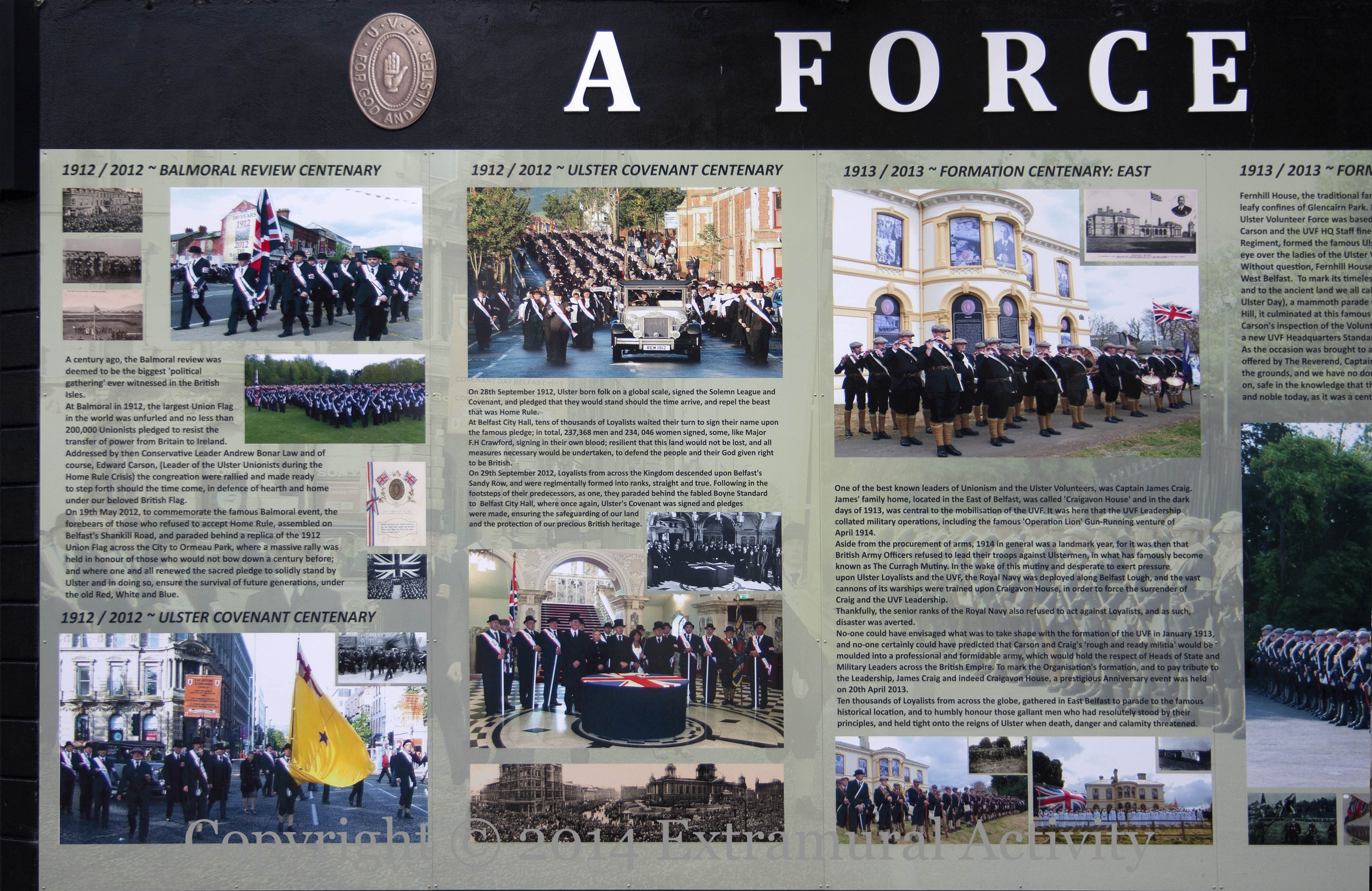
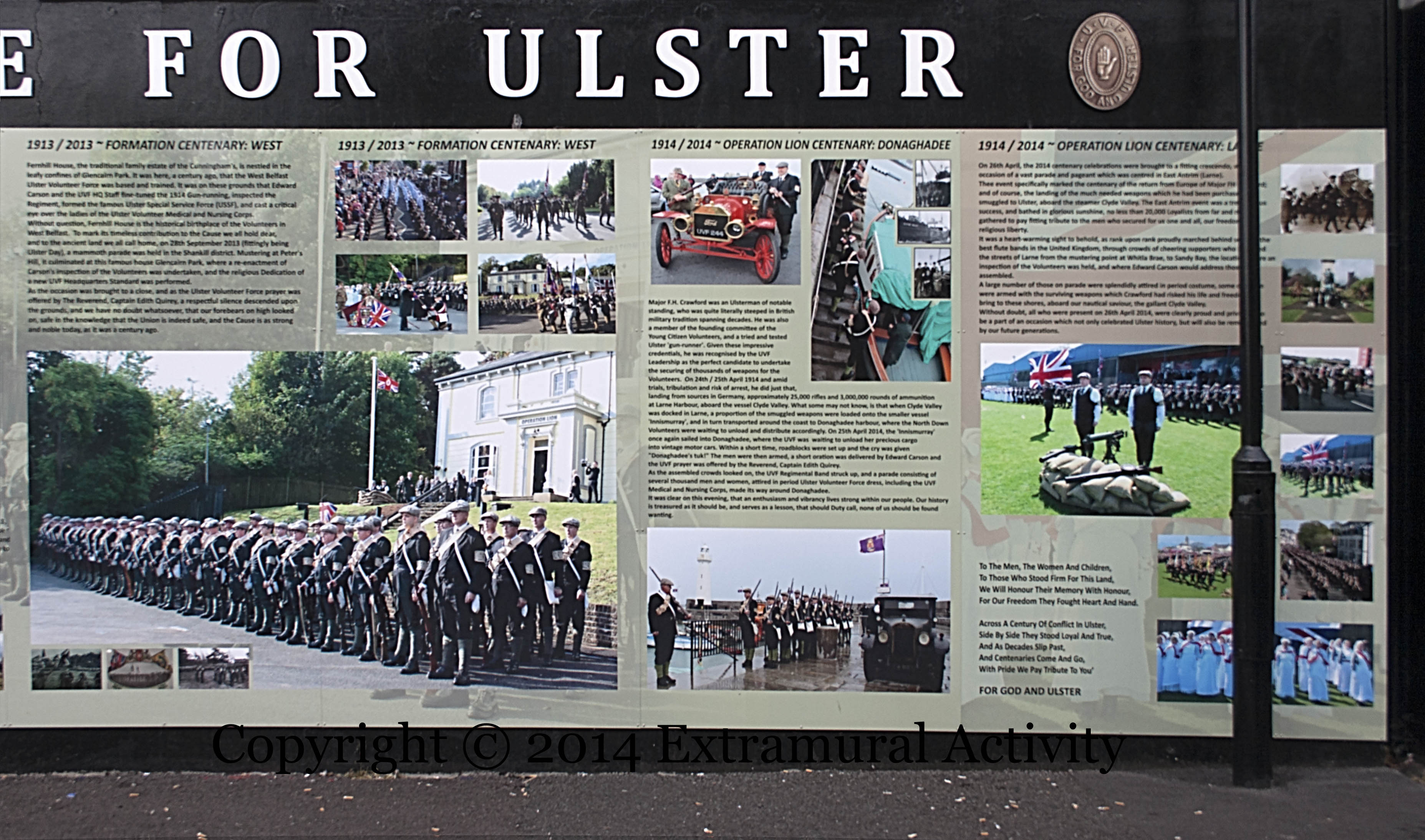
Here are two new boards in the courtyard of the Rex Bar on the Shankill Road, describing the formation of the Ulster Volunteers (‘A Force For Ulster’) and commemorating the losses suffered by the 36th (Ulster) Division of the British Army, which the Volunteers became, at the Somme and in other battles, mowed down by “the Hun machine guns” (‘The Great War’).

‘A Force For Ulster’ includes photographs of the recent centenary re-enactments of the Balmoral Review, the Ulster Covenant, the formation of the Volunteers (“east” and “west”) and “Operation Lion” – more commonly known as the Larne Gun-Running.

According to the ‘The Great War’ board, 32,186 men from west Belfast were killed, wounded, or missing. “To them bravery was without limit, to us memory is without end”. The board shows the Thiepval Memorial To The Missing Of The Somme against a background of portraits.
2014-09-15 ForceForUlster1+

2014-09-15 ForceForUlster2+

Click image to enlarge
Copyright © 2014 Seosamh Mac Coılle
X02189 X02197 X02188 last post great war society their name liveth forevermore the brigade moved off as if on parade but alas the slow tat-tat of the hun machine guns caught their advance under a deadly cross fire but nothing could stop this advance and on they went 1914 1918 balmoral ulster covenant fernhill donaghadee operation lion for god and ulster across a century of conflict decades slip past pay tribute to you crawford cunningham glencairn moscow street
End Maghaberry Torture

2014-08-07 EndTorture+

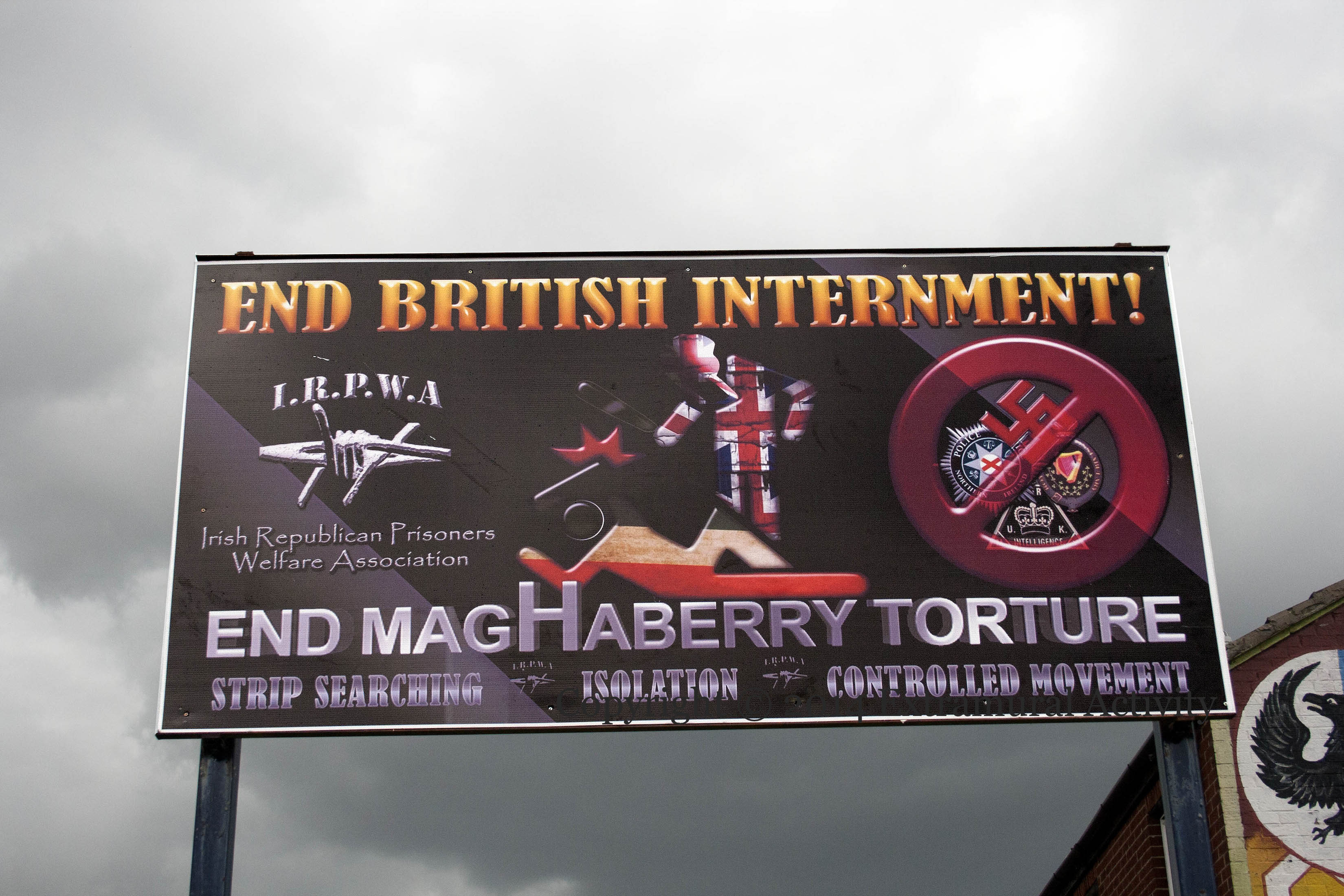
“End British Internment – End Maghaberry Torture – Strip searches, isolation, controlled movement”. The board above at the top of Havana Street, Ardoyne, shows a a prison guard in Union colours beating a prisoner in the Tricolour’s green, white, and orange. On the left is the barbed wire symbol of the Irish Republican Prisoners Welfare Association (IRPWA) and on the right the emblems of the PSNI, the RUC, and MI5 are crossed out under a swastika. A wide shot, showing the CLG/GAA mural in the background, is below.

Previous IRPWA posts: Scaırt Amach | IRPWA | Maghaberry Prisoners. Another view of the Ard Eoın Kickhams mural.

2014-08-07 EndTortureWide+

Click image to enlarge
Copyright © 2014 Seosamh Mac Coılle
X02052 X02053

Composition With Orange, Bathroom Tile, And Dolphin Wallpaper

2014-09-16 BallysillanMondrian+

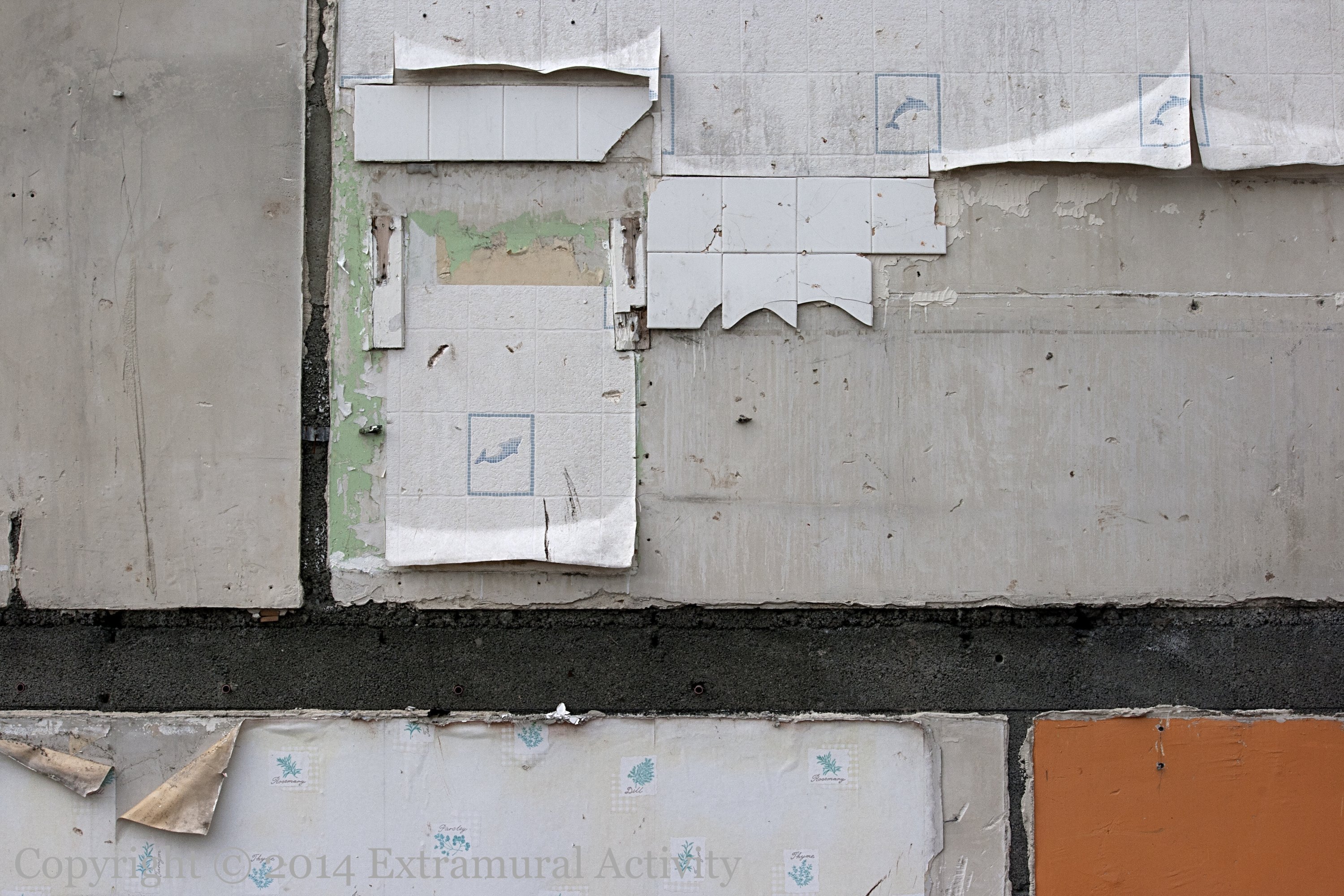
Demolition work in the upper Ballysillan area makes for Mondrian-style artwork (WP).

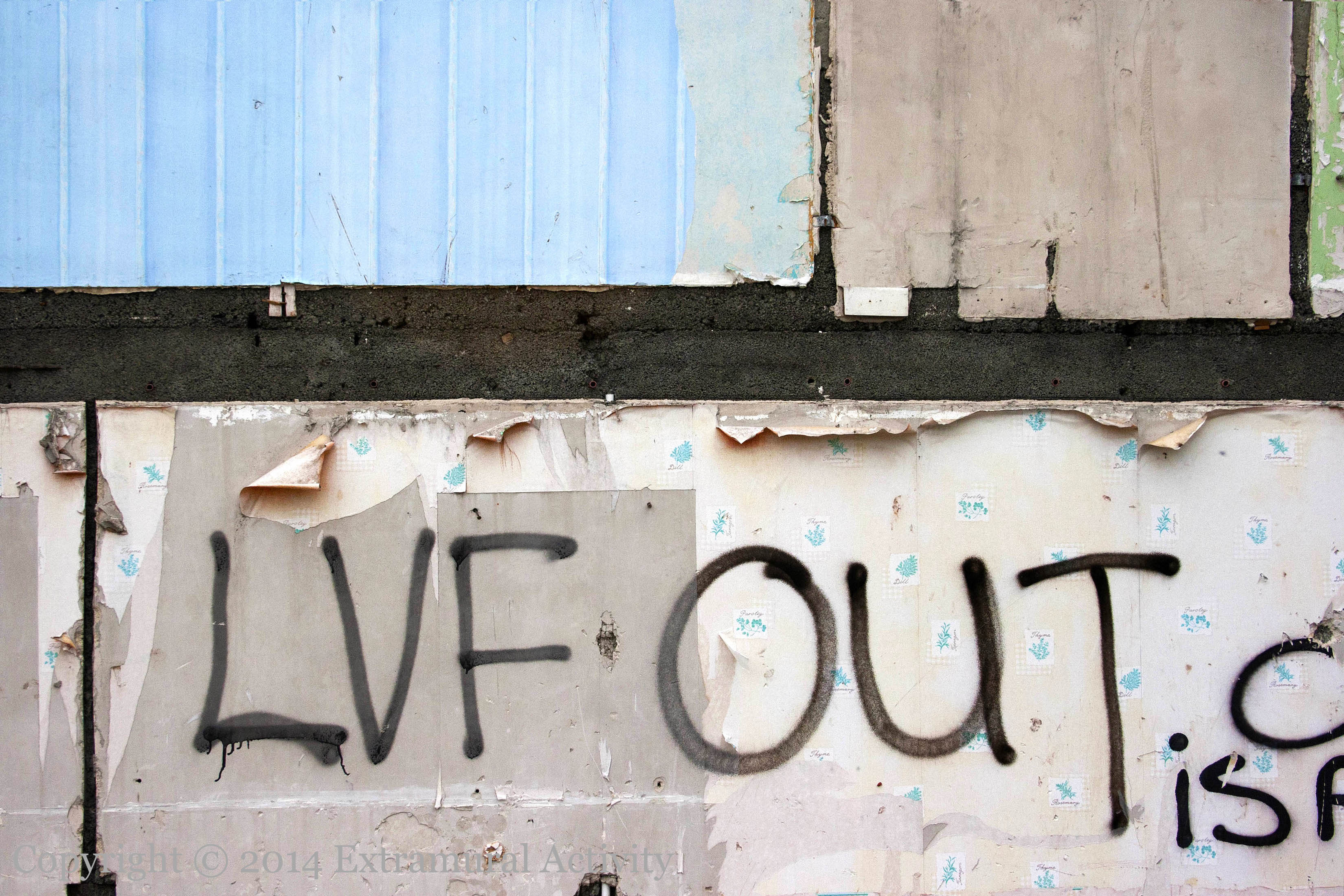
In the shot below: anti-LVF graffiti on the same wall. See also the painted-over LVF mural in the street.

2014-08-28 BallysillanLVFOut+

Click image to enlarge
Copyright © 2014 Seosamh Mac Coılle
X02196 X02133

Art In The Eastside

2014-11-05 ErvineWide+

At the same time that the new David Ervine board was put in place, the existing board next to it, which dates to 2008, was spruced up. The image above is a wide shot of both boards, while the image below shows the commemorative casting in front. For the original board, see David Ervine; for explanations of the sculpture, including its pipe, prayer-book, ticket, and boots, see Memory Chair.

2014-11-05 ErvineChair+

Click image to enlarge
Copyright © 2014 Seosamh Mac Coılle
X02324 X02323

Play Ball

2014-11-05 ErvineMLA+

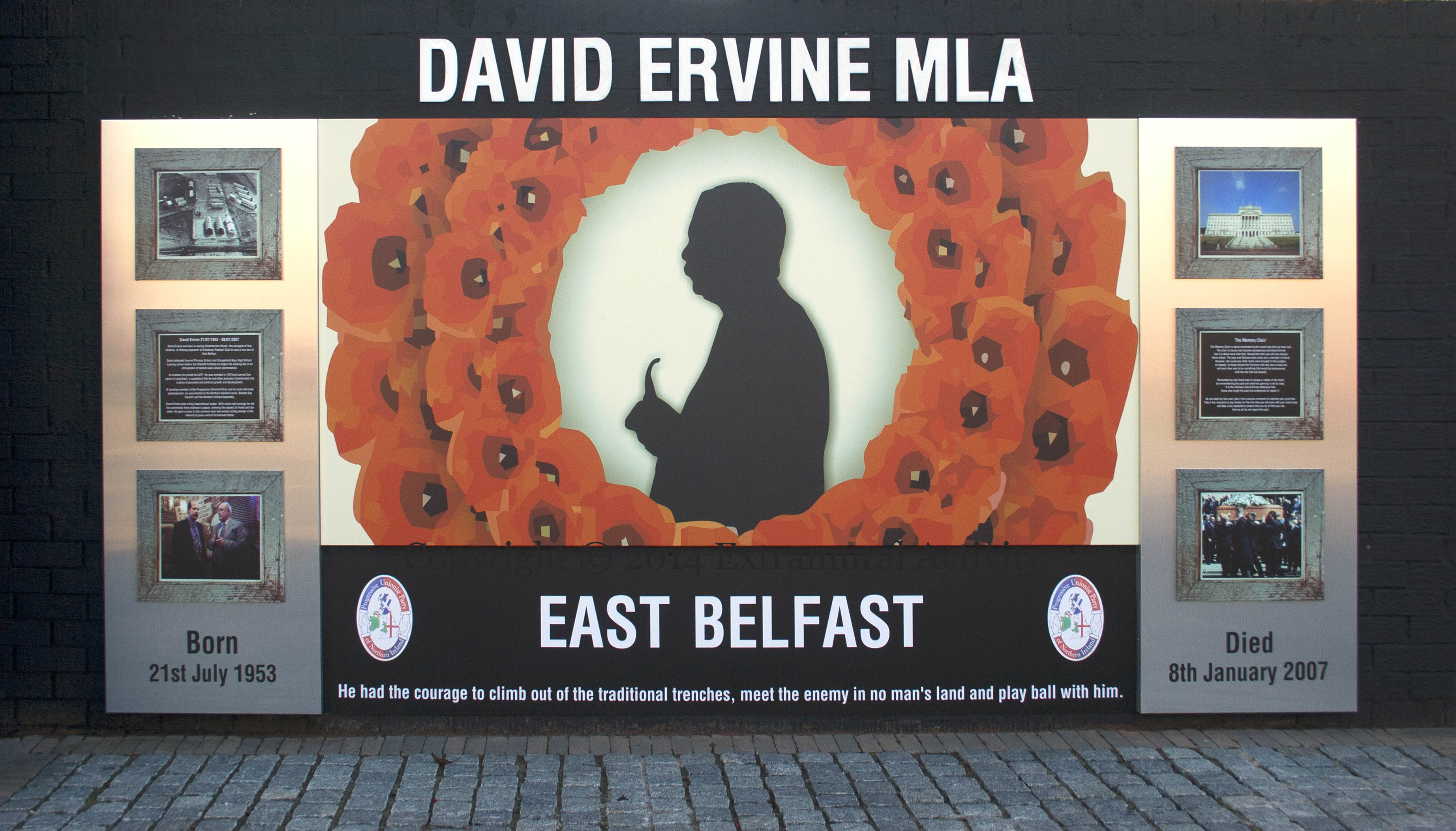
“He had the courage to climb out of the traditional trenches, meet the enemy in no man’s land and play ball with him.” David Ervine was a UVF member, arrested in 1974 and served six years in the Maze before turning to politics. He first ran for office in 1985 and represented East Belfast in the NI Assembly from 1998 until his death in 2007. The new board, above, shows Ervine’s silhouette in a wreath of poppies along with pictures of and information about his life; the image below of the lower left-hand side includes a photograph of Ervine with Gusty Spence.

Video of the launch (on 2014-11-01) is available at U.tv

The info plaque on the right describes the Memory Chair sculpture in front of the first Ervine board.

2014-11-05 ErvinePoppies+

Click image to enlarge
Copyright © 2014 Seosamh Mac Coılle
X02324 X02325
21st july 1953 8th january 2007 red hand comrades association progressive unionist party of northern ireland
“David Ervine was born in nearby Chamberlain Street, the youngest of five children. A lifelong supporter of Glentoran Football Club he was a true son of East Belfast. David attended Avoniel Primary School and Orangefield Boys High School. Leaving school before his fifteenth birthday he began his working life in an atmosphere of tension and violent confrontation. At nineteen he joined the UF. He was arrested in 1974 and served five years in Long Kesh, a wasteland that he and other prisoners transformed into a place of personal and political growth and development. A founding member of the Progressive Unionist Party and its most articulate spokesperson, he was elected to the Northern Ireland Forum, Belfast City Council and the Northern Ireland Assembly. David Ervine was a truly inspirational leader. With vision and courage he led his community from violence to peace, winning the respect of friend and foe alike. He gave voice to the common man and woman acting always in the interest of peace and his beloved Ulster.”

Ardoyne, Bone, Ligoniel

2014-10-24 Ardyone+

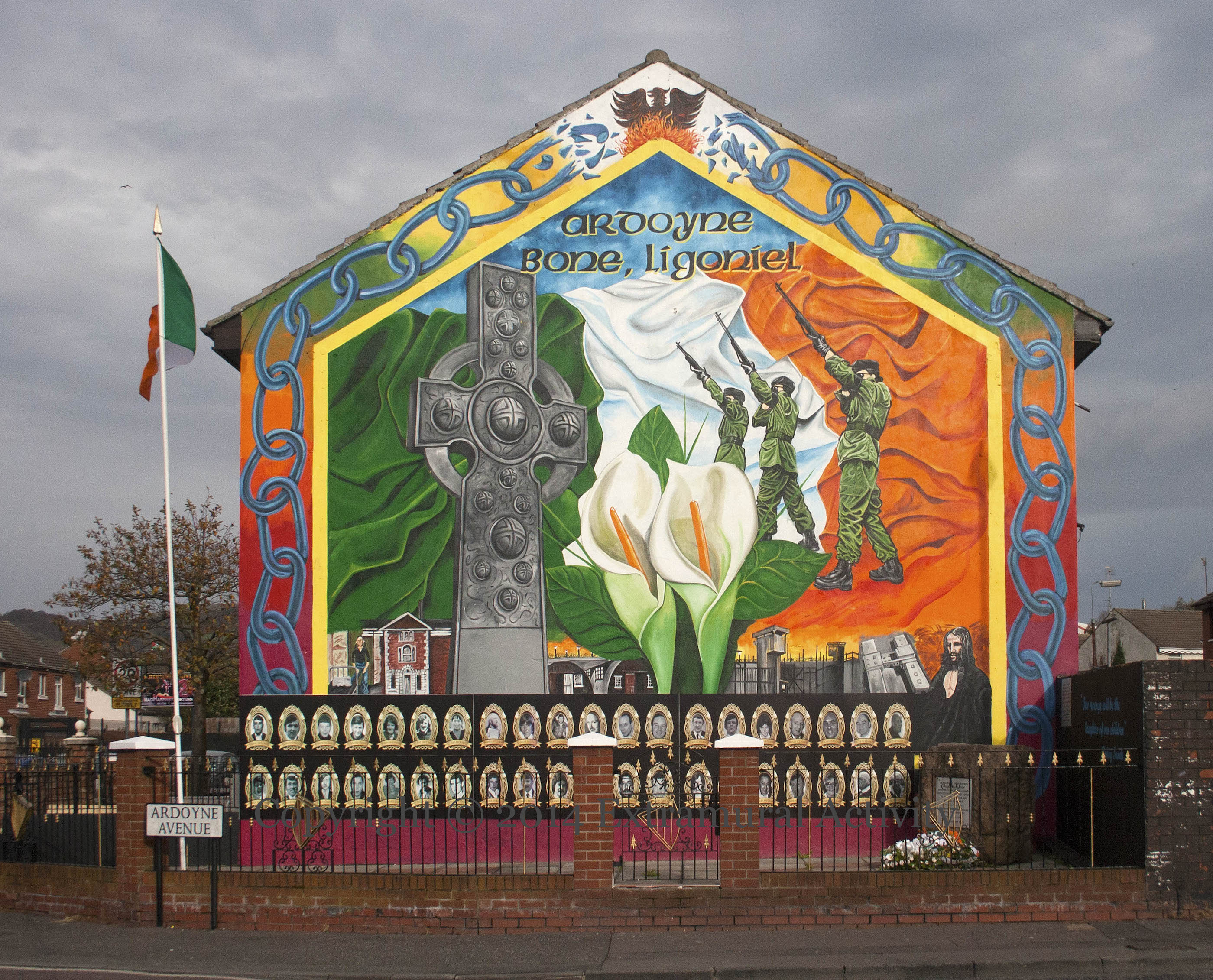
26 volunteers and 14 others from the Ardoyne, Bone, and Ligoniel areas are commemorated in a new (2014-10-05) mural. The images below show artist Mickey Doherty, himself an ex-prisoner, at the start of the process – with the grid-work visible – and shooting an “action” shot for VICE TV.

The previous mural also commemorated local volunteers (34 painted portraits rather than a printed board), but this mural adds a Celtic cross, funeral volley, and images of Armagh women’s prison, the cages at Long Kesh, and the H-blocks, as well as (an inverted image of) blanketman Hugh Rooney – detailed images can be seen in Prison Walls.

2014-10-12 ArdoyneGrid+

2014-10-24 ArdyoneMDoc+

2014-10-24 ArdyoneWide+

Click image to enlarge
Copyright © 2014 Seosamh Mac Coılle
X02304 X02284 X02305 X02306 gerard mcdade david mcauley james reid joseph mccomiskey pat mccabe marley alan lundy john copeland terry toolan stephen scullion terry clarke declan mccluskey patrick markey peter hamilton thomas begley jim saunders martin meehan

Ulster Will Fight

2014-08-18 LindsayCovenant+

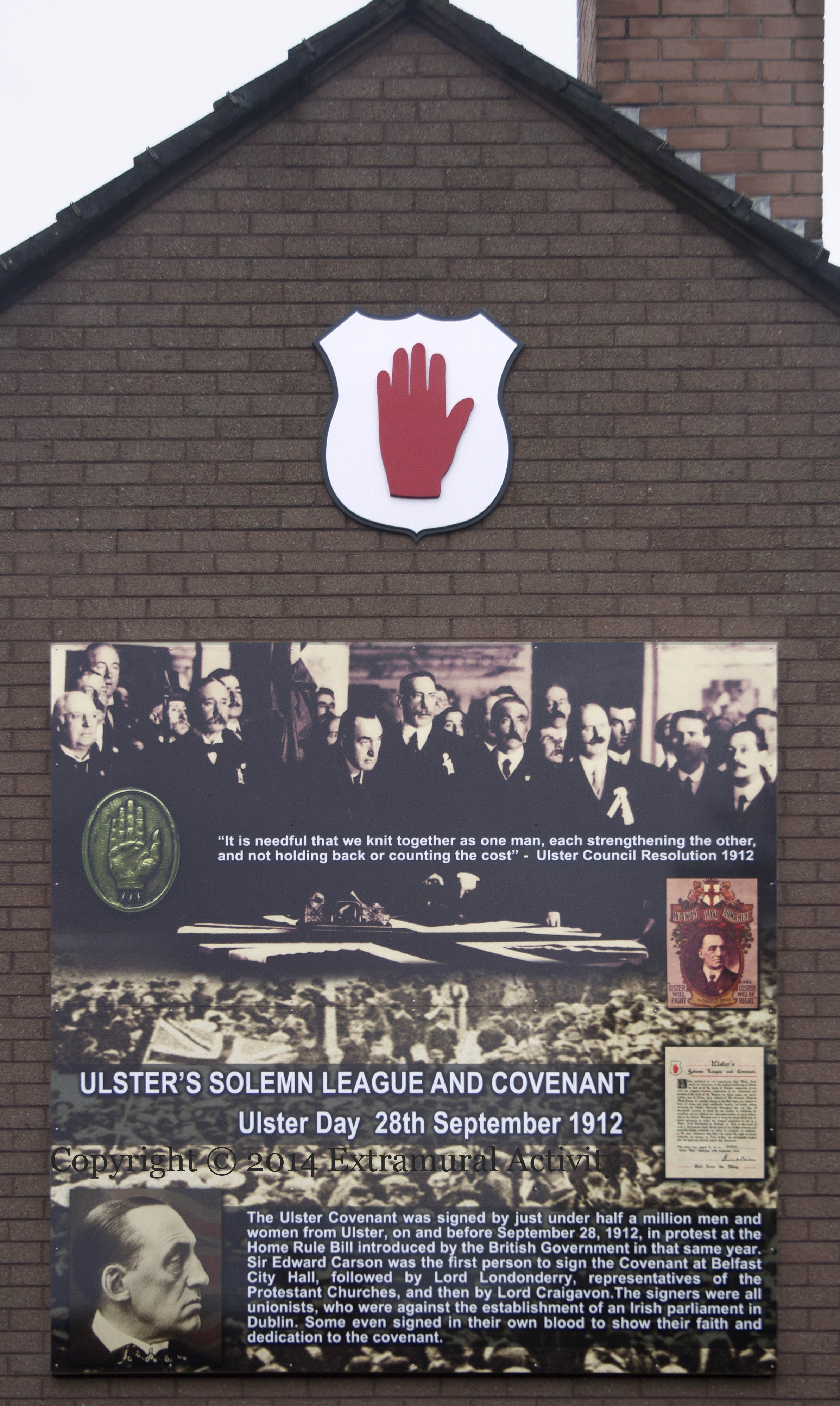
“It is needful that we knit together as one man, each strengthening the other, and not holding back of counting the cost” – Ulster [Unionist] Council Resolution 1912. The Council met on September 23rd and 471,000 people signed the covenant (figures here) on or around the 28th – Ulster Day – led by Sir Edward Carson.

For another board featuring similar images, see Covenant Of Hearts. In the same row of boards: Anthem For Doomed Youth

Click image to enlarge
Copyright © 2014 Seosamh Mac Coılle
X02089 will be right we won’t have home rule just under half a million men women september 28, in protest at the home rule bill introduced by the british government in that same year sir edward carson was the first person to sign at belfast city hall londonderry protestant churches craigavon signers were all unionists against the establishment of an irish parliament in dublin own blood to show their faith and dedication to the covenant

Work Organises Life

14 05 06 SouthWorking+

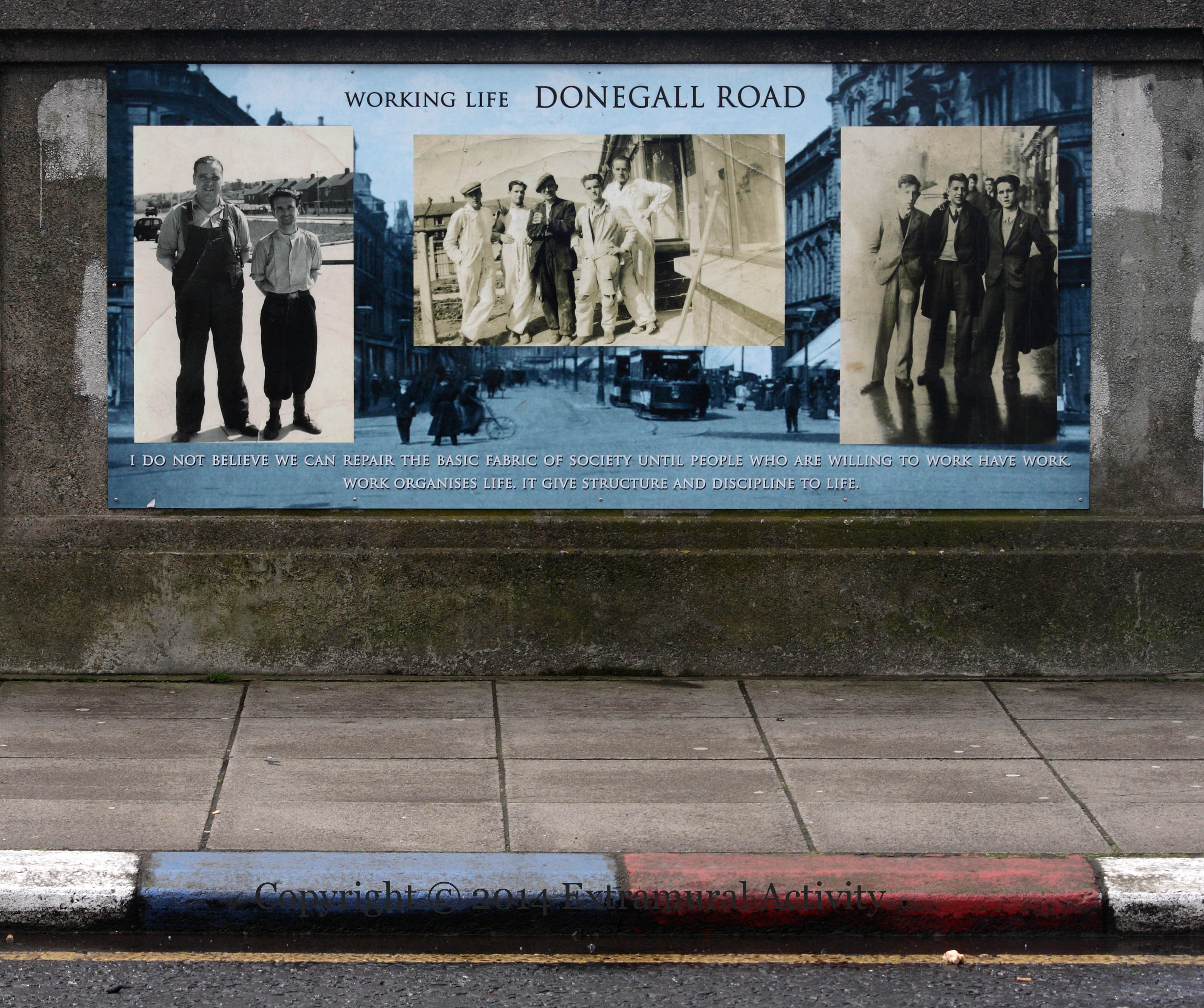
Here are two panels from the Donegall Road bridge at Roden Street both concerned with working life in the area in years gone by. The (uncredited) words at the bottom of the first board come from a Bill Clinton speech. At greater length, it goes “I do not believe we can repair the basic fabric of society until people who are willing to work have work. Work organizes life. It gives structure and discipline to life. It gives meaning and self-esteem to people who are parents. It gives a role model to children …”

The second features two stanzas from a poem called here “The Weaver’s Prayer” but also known as “The Master Weaver”, “The Weaver”, and “Just A Weaver”, and commonly though not unanimously attributed to one Benjamin Malacia Franklin in the 1940s; it is here said to have been penned by a “female Ulster weaver in 1922”: “Not ’til the loom is silent, and the shuttles cease to fly, shall God unroll the canvas, and explain the reasons why. The dark threads are as neatful, in the weaver’s skilful hand, as the thread of the gold and silver, in the pattern he has planned.”

See previously: The Thread Of History which features two reflections on life as a female weaver.

2014-05-06 Prayer+

Click image to enlarge
Copyright © 2014 Seosamh Mac Coılle
X01848 X01854 “are as needed” “are as needful”