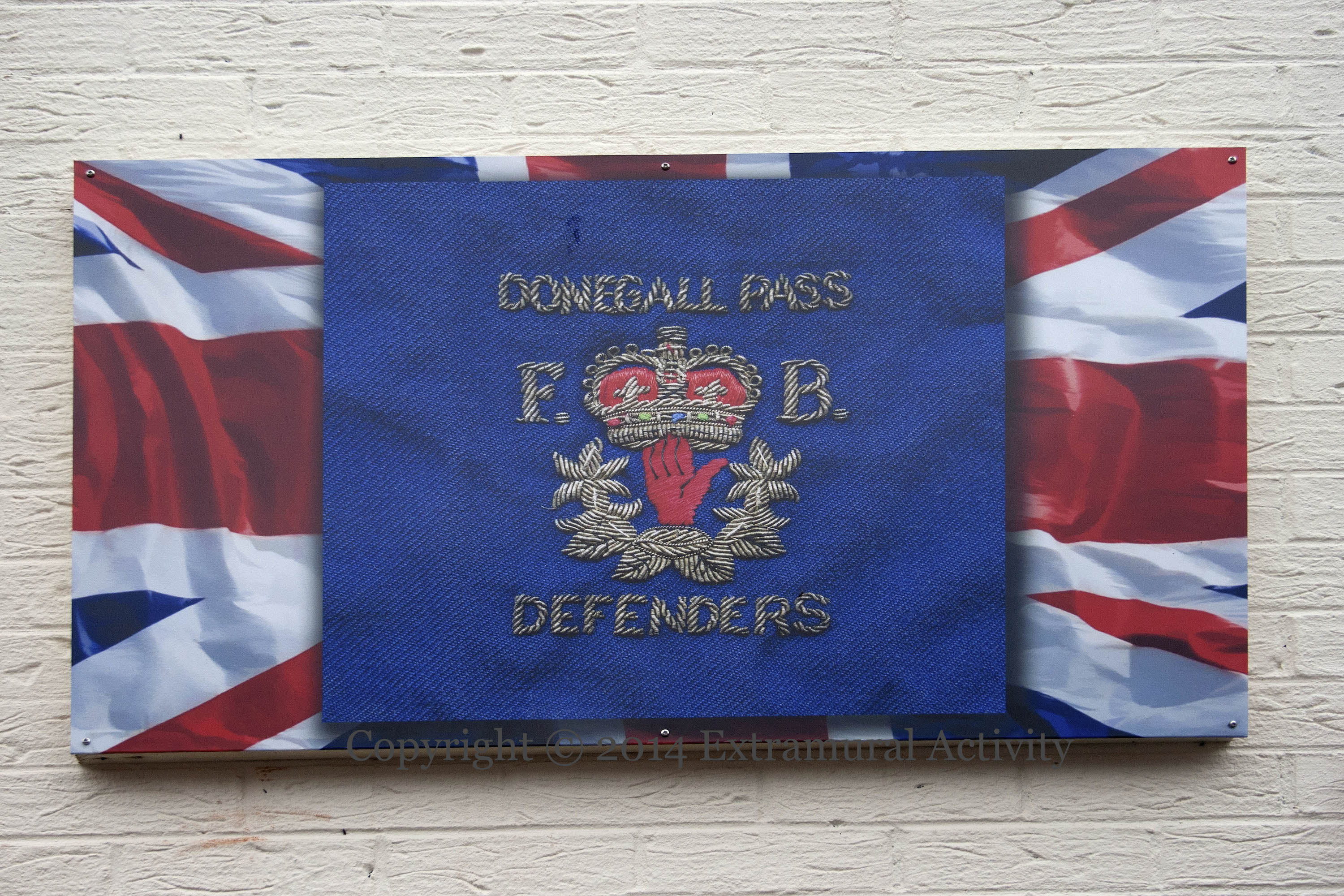
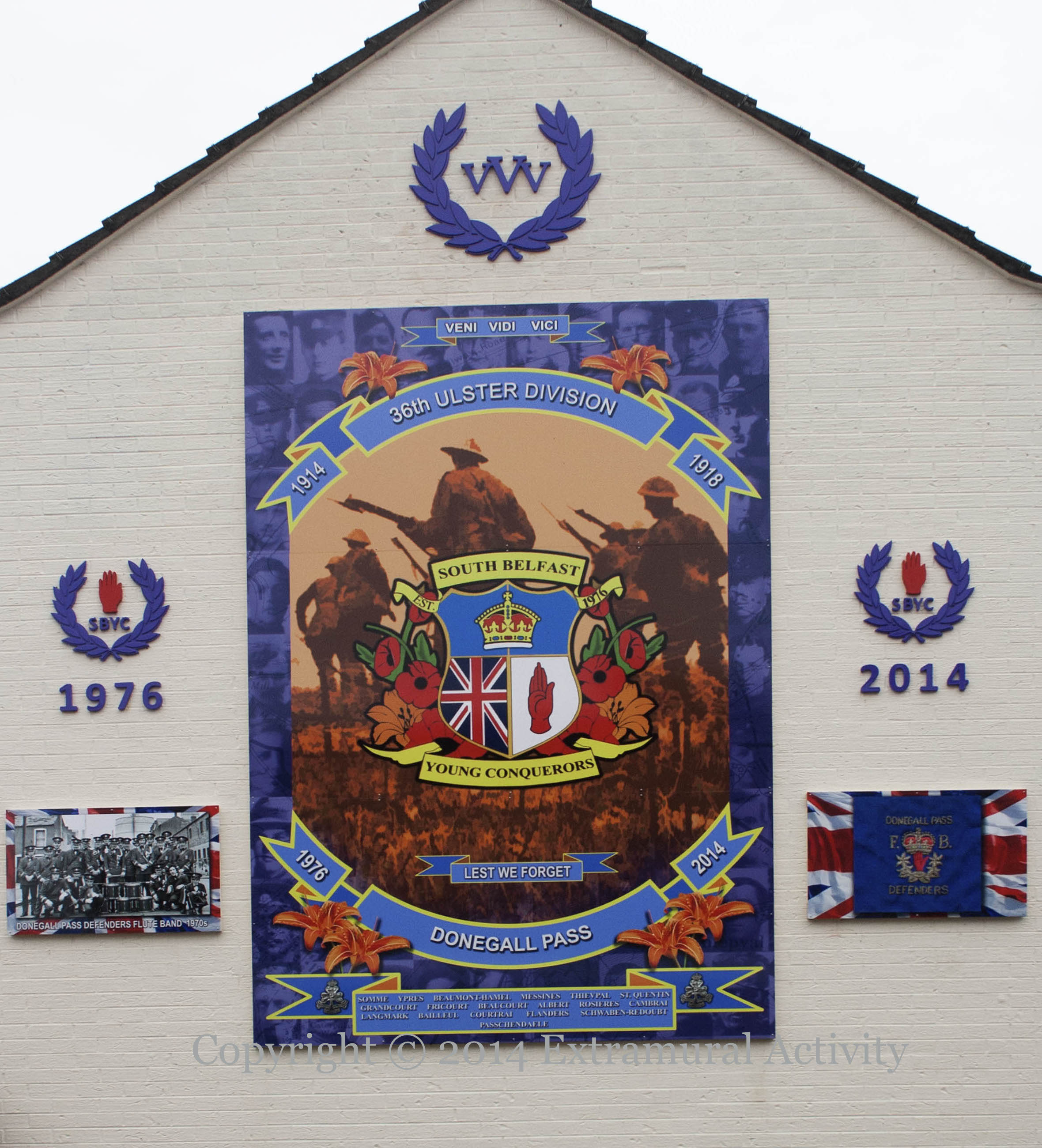
Here are close-ups of the two boards to either side of the new Young Conquerors piece (featured recently in Veni, Vidi, Vici). The first shows a photograph of the original Donegall Pass Defenders Flute Band, which lasted a short time in the 1970s before the formation of the Conquerors in 1977 (Fb). The second shows the patch of the band.
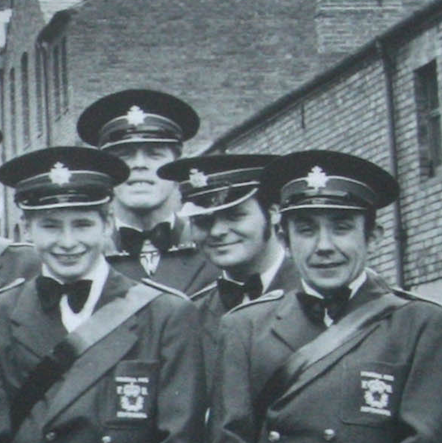
Update (2015-01): Nikki has kindly sent us an image of the band parading, taken sometime in the 1970s. Her grandfather, Thomas Lorimer, recently passed away and she found the picture in his roof space. He was a member of the Defenders and is at the far left of the picture, on the bass drum. She was also able to identify him in the posed picture from the board – shown in detail below; he is the tall gent in the back.
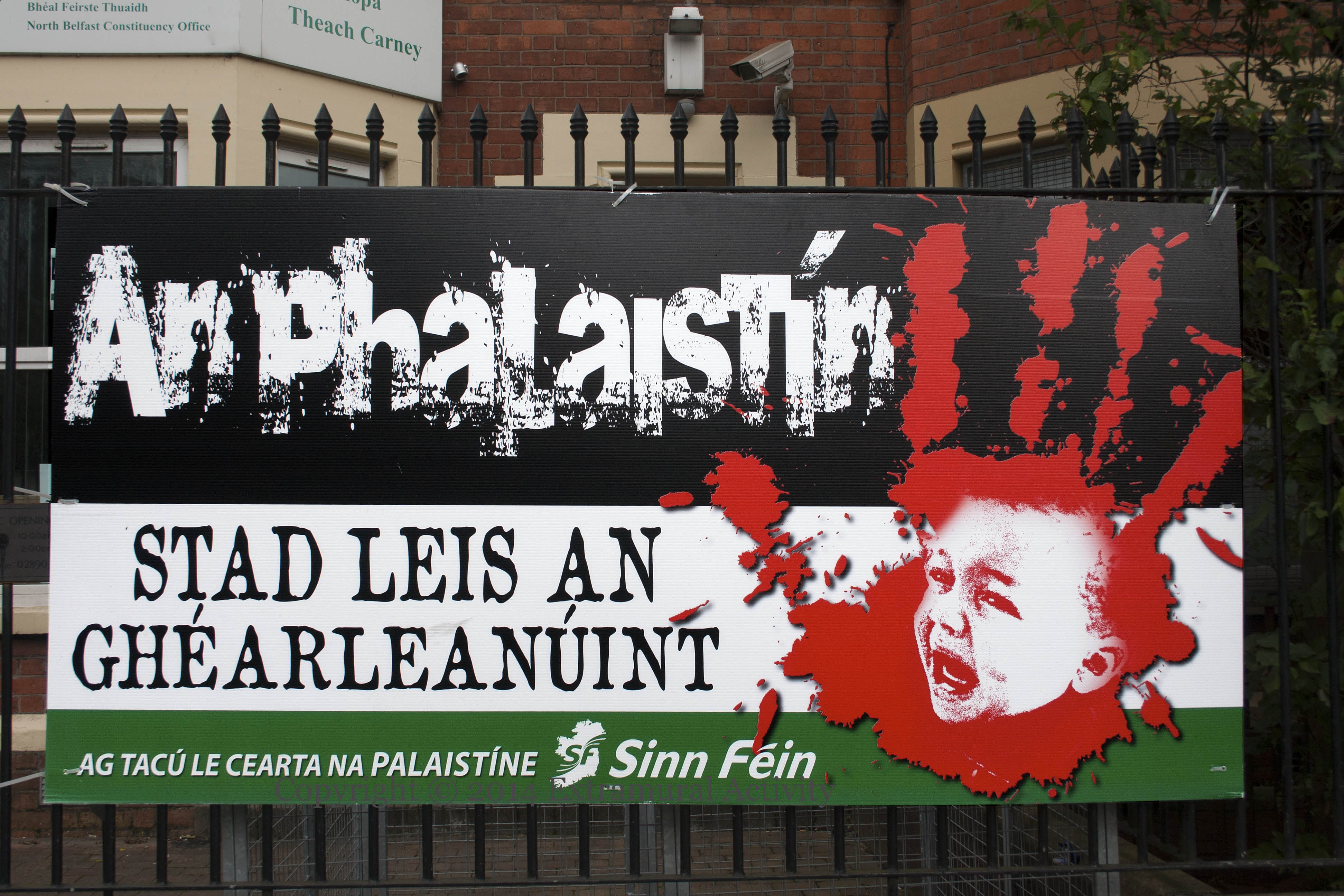
Pro-Palestine board outside the north Belfast Sınn Féın office on the Antrim Road showing a bloody hand-print and the face of a crying child: “Stad leıs an ghéarleanúınt – ag tacú le cearta na Palaıstíne” : “Stop the persecution – supporting Palestinian rights”. The close-up of the hand and face, below, is taken from an English-language version of the board in Beechmount Street. The third image is of the same board at the Glen Road/Andersonstown Road junction.
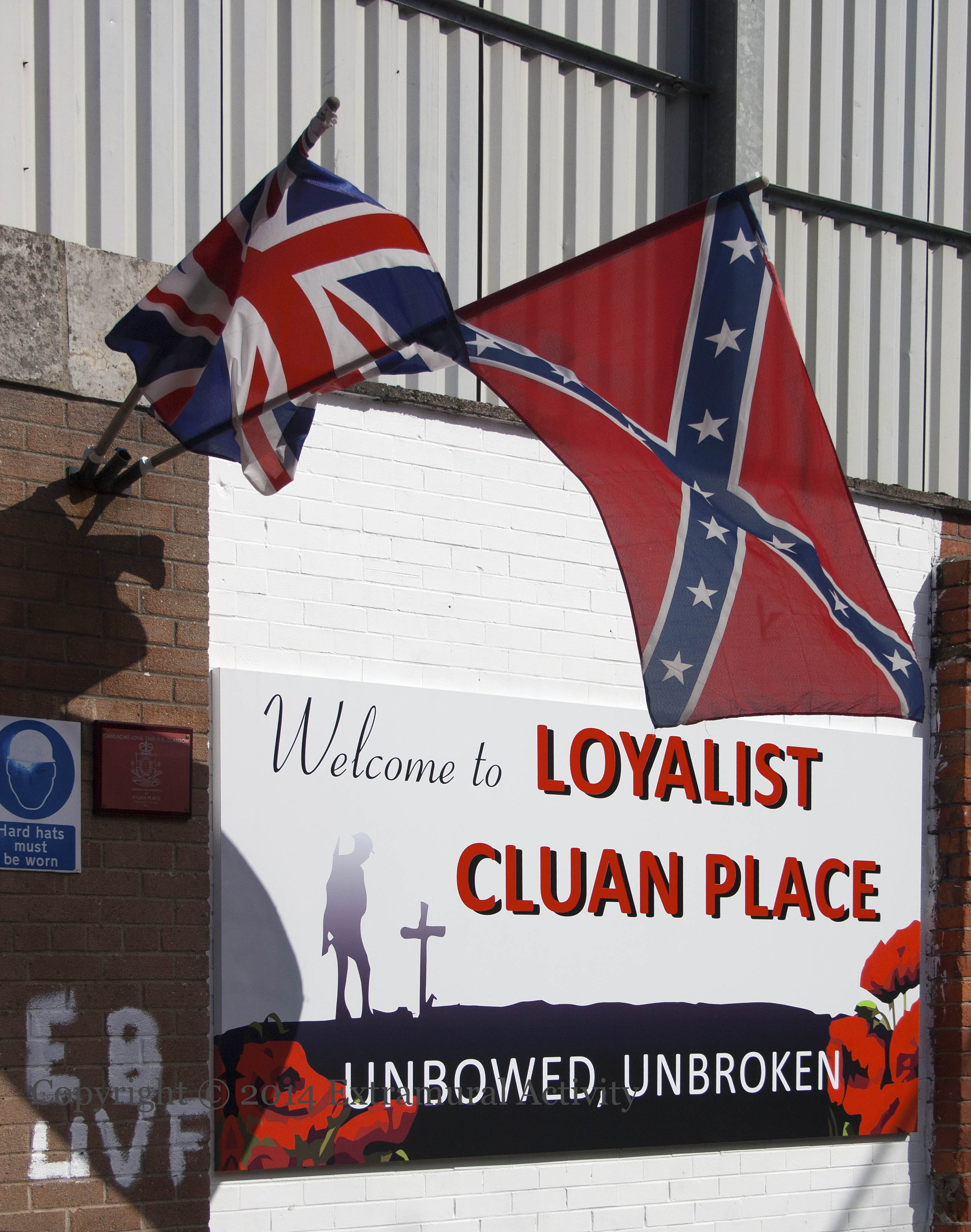
Below the “peace” line, a confederate flag flies alongside the union jack over a new board in Cluan Place reading “Unbowed, Unbroken” and “east Belfast UVF” graffiti.
“But in their eyes shall shine the holy glimmers of goodbyes … Their flower the tenderness of patient minds, and each slow dusk a drawing down of blinds.” Lines from Wilfred Owens’ (1893-1918) ‘Anthem For Doomed Youth‘ on a new board in Lindsay Street.
The text at the bottom reads: “The last three month of WWI became known as the hundred days. Realising they were defeated an armistice was signed by the Germans. Germany finally surrendered and WWI ended on November 11th 1918. The terms of the agreement called for the end of fighting along the entire Western Front to begin a precisely 11 am that morning. Records show that the last British soldier killed in WWI was Private George Edwin Allison of the 5th Royal Irish Lancers. He was killed at Mons at 09:30 am, just 90 minutes before the ceasefire.”
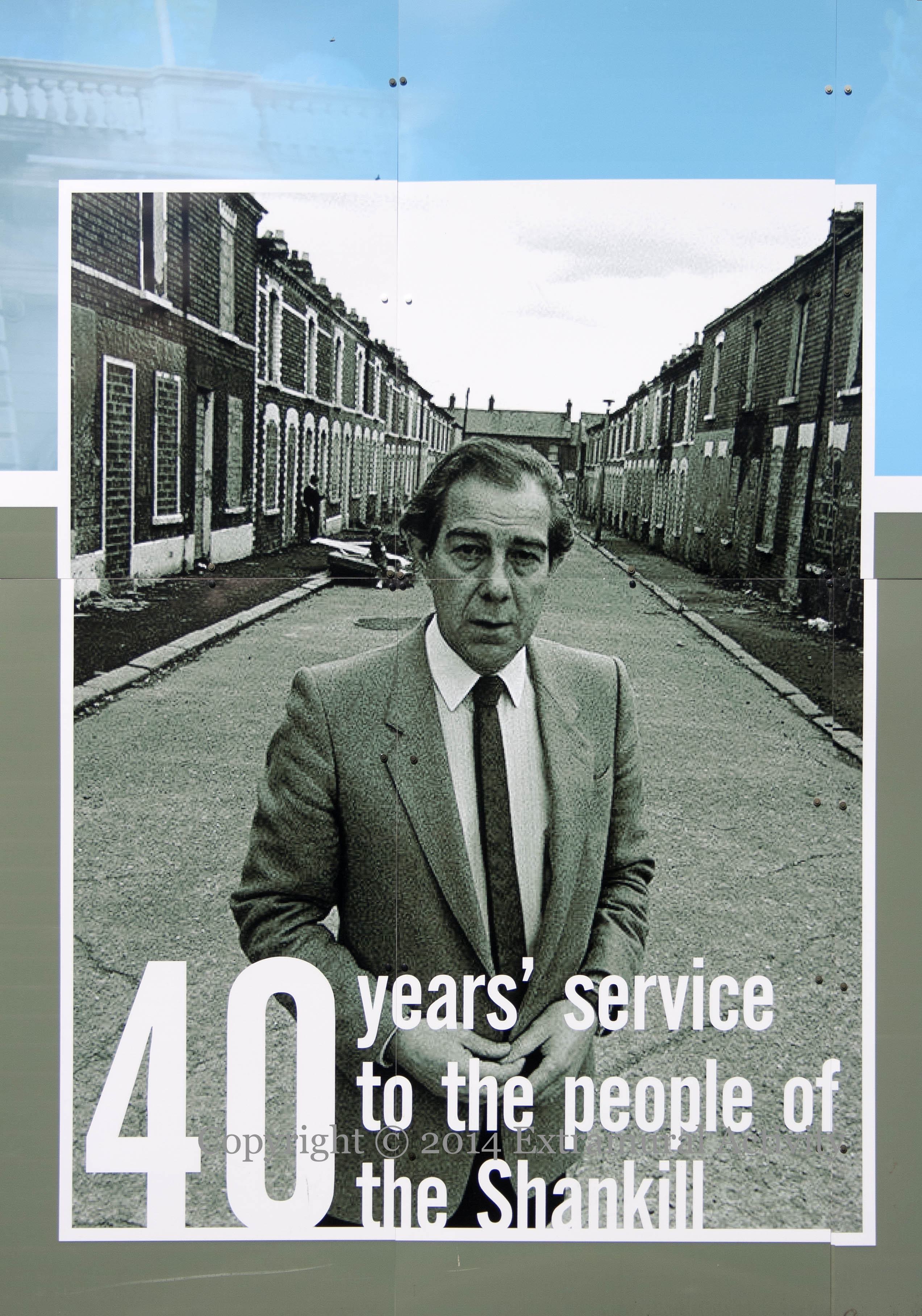
Hugh Smyth OBE was born in the Woodvale area and represented the upper Shankill as an Independent Unionist and then a Progressive Unionist in Belfast City Council for forty-one years, until the year before his death in May 2014, including a term as Lord mayor in 1994-1995 – he is pictured in the main image (above) in his mayoral robes.
The portrait on the right (shown solo below) was taken by Bobbie Hanvey and is kept in a Boston College archive; more from the archive of 50,000 images can be seen at BC.edu and on Flickr.
As the quote (shown in the final image below) indicates, his politics were oriented towards the working class: “Historically, Unionist politicians fed their electorate the myth that they were first class citizens… and without question people believed them. Historically, Republican/Nationalist politicians fed their electorate the myth that they were second class citizens… and without question the people believed them. In reality, the truth of the matter was that we all, Protestant and Catholic, were third class citizen, and none of us realised it!” The board was officially launched on June 19th.
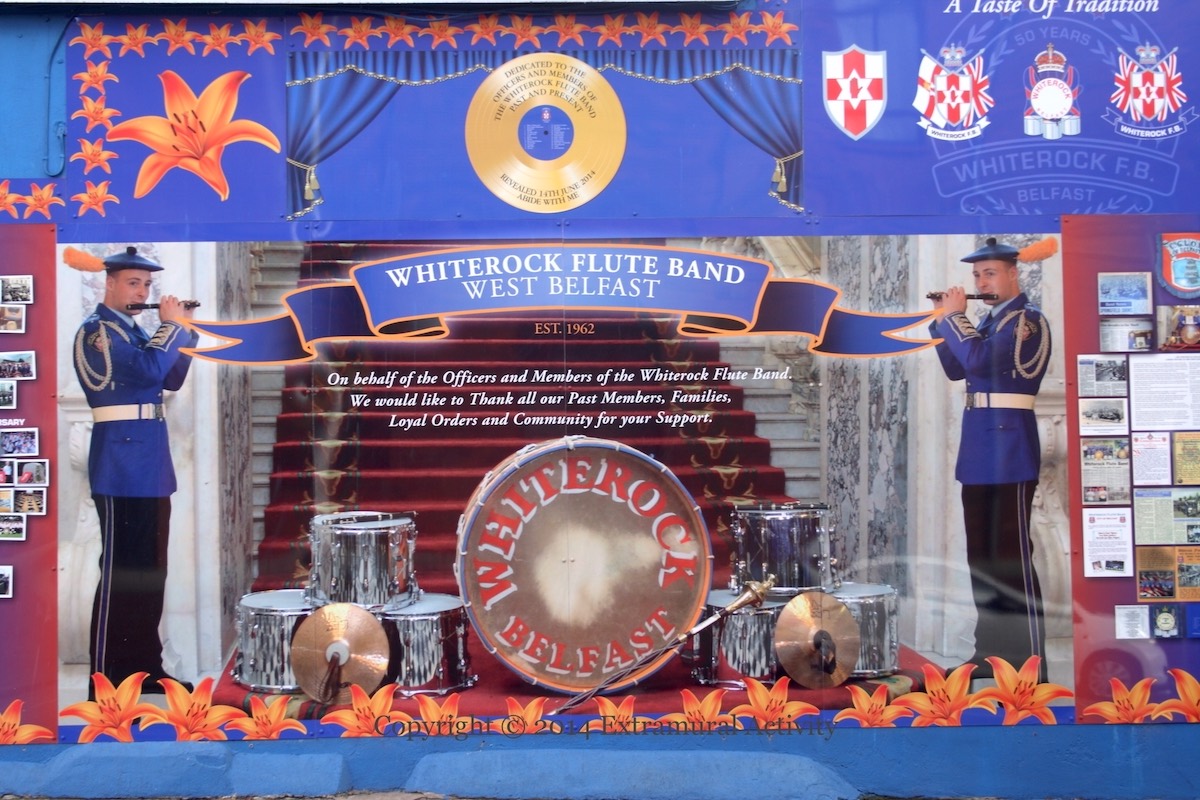
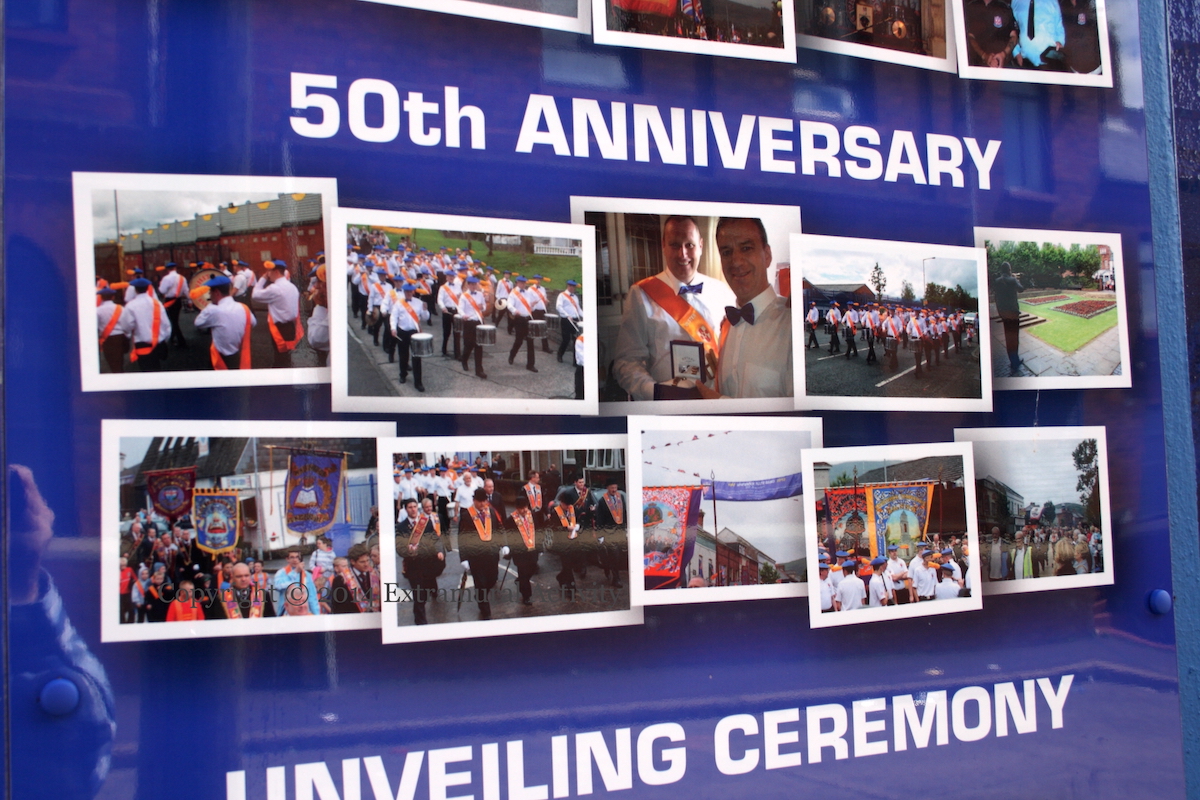
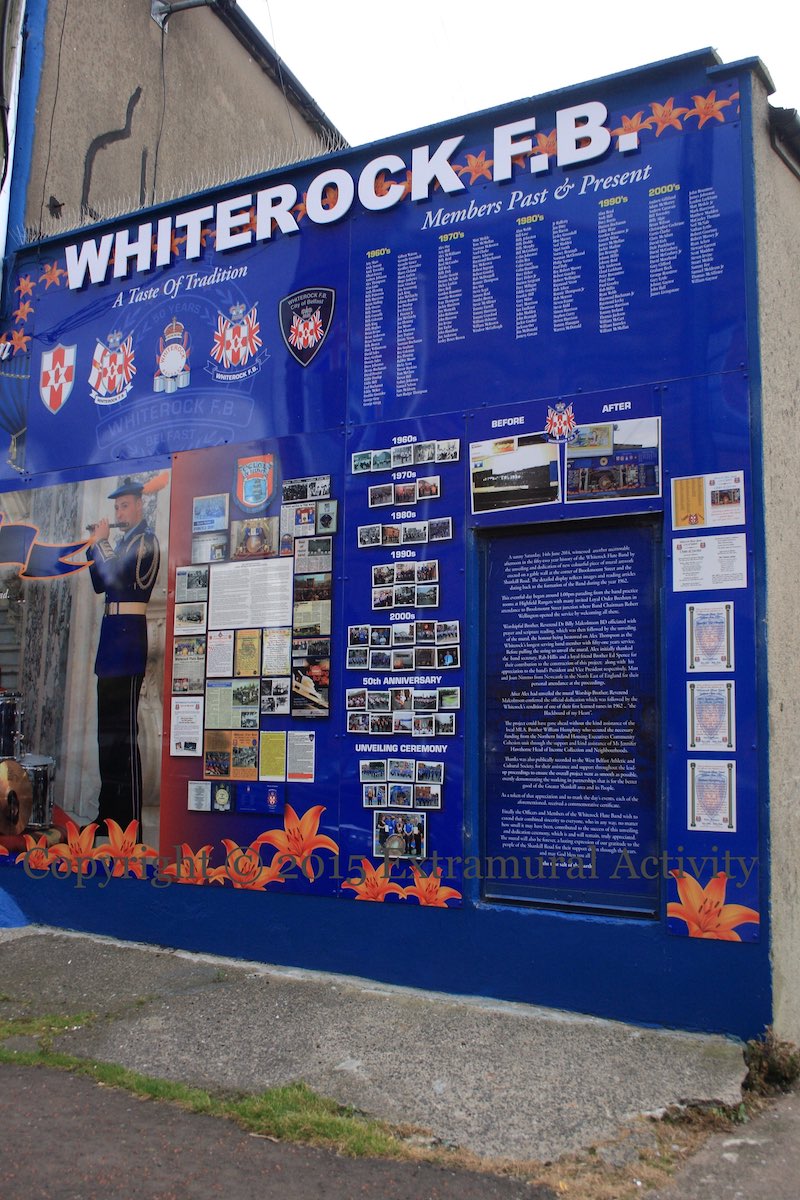
A pre-launch version (from May) of the Whiterock Flute Band mural in Brookmount Street can be seen in the Peter Moloney collection; this includes the main panel and the ‘brief history’ on the left. Since then a golden disc has been mounted above the main panel, and to the right have been added another panel of photographs, a list of members past and present, and an updated history panel. [The final image, from 2015, shows the addition of “Whiterock F.B.” in bold, white, lettering along the top right
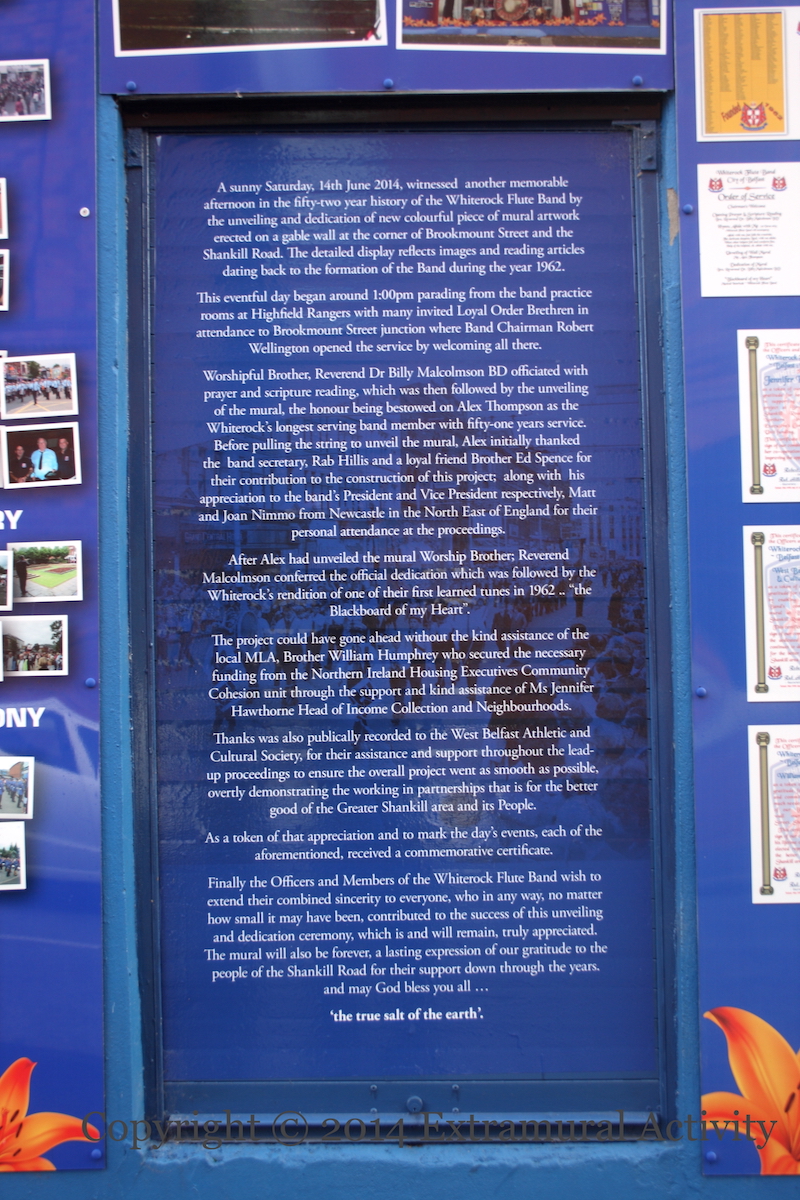
“A sunny Saturday, 14th June 2014, witnessed another memorable afternoon in the fifty-two year history of the Whiterock flute band by the unveiling and dedication of new colourful piece of mural artwork erected on the gable wall at the corner of Brookmount Street and the Shankill Road. The detailed display reflects images and reading articles dating back to the foundation of the band during the year 1962.
This eventful day began around 1:00 pm parading from the and practice rooms at Highfield Rangers with many invited Loyal Order Brethren in attendance to Brookmount Street junction where Band Chairman Robert Wellington opened the service by welcoming all there.
Worshipful Brother, Reverend Dr Billy Malcolmson BD officiated with prayer and scripture reading, which was then followed by the unveiling of the mural, the honour being bestowed on Alex Thompson as the Whiterock’s longest serving band member with fifty-one years of service. Before pulling the string to unveil the mural, Alex initially thanks the band secretary, Rab Hillis and a loyal friend Brother Ed Spence for their contribution to the construction of this project; along with his appreciation to the band’s President and Vice President respectively, Matt and Joan Nimmo from Newcastle in the North East of England for their personal attendance at the proceedings.
After Alex had unveiled the mural Worship Brother; Reverend Malcolmson conferred the official dedication which was followed by the Whiterock’s rendition of one of their first learned tunes in 1962 .. “the Blackboard of my Heart”.
The project could have gone ahead without the kind assistance of the local MLA, Btother William Humphrey who secured the necessary funding from the Northern Ireland Housing Executive’s Community Cohesion unit through the support and kind assistance of Ms Jennifer Hawthorne head of Income Collection and Neighbourhoods.
Thanks was also publically recorded to the West Belfast Athletic and Cultural Society, for their assistance and support throughout the lead-up proceedings to ensure the overall project went as smooth as possible, overtly demonstrating the working in partnership that is for the better good of the Greater Shankill area and its people.
As a token of that appreciation and to mark the day’s events, each of the aforementioned, received a commemorative certificate.
Finally the officers and members of the Whiterock flute band wish to extend their combined sincerity to everyone, who in any way, no matter how small it may have been, contributed to the success of this unveiling and dedication ceremony, which is and will remain, truly appreciated. The mural will also be forever, a lasting expression of our gratitude to the people of the Shankill Road for their support down through the years, and may God bless you all … ‘the true salt of the earth’.”
Update: further additions were made to the display in 2021.
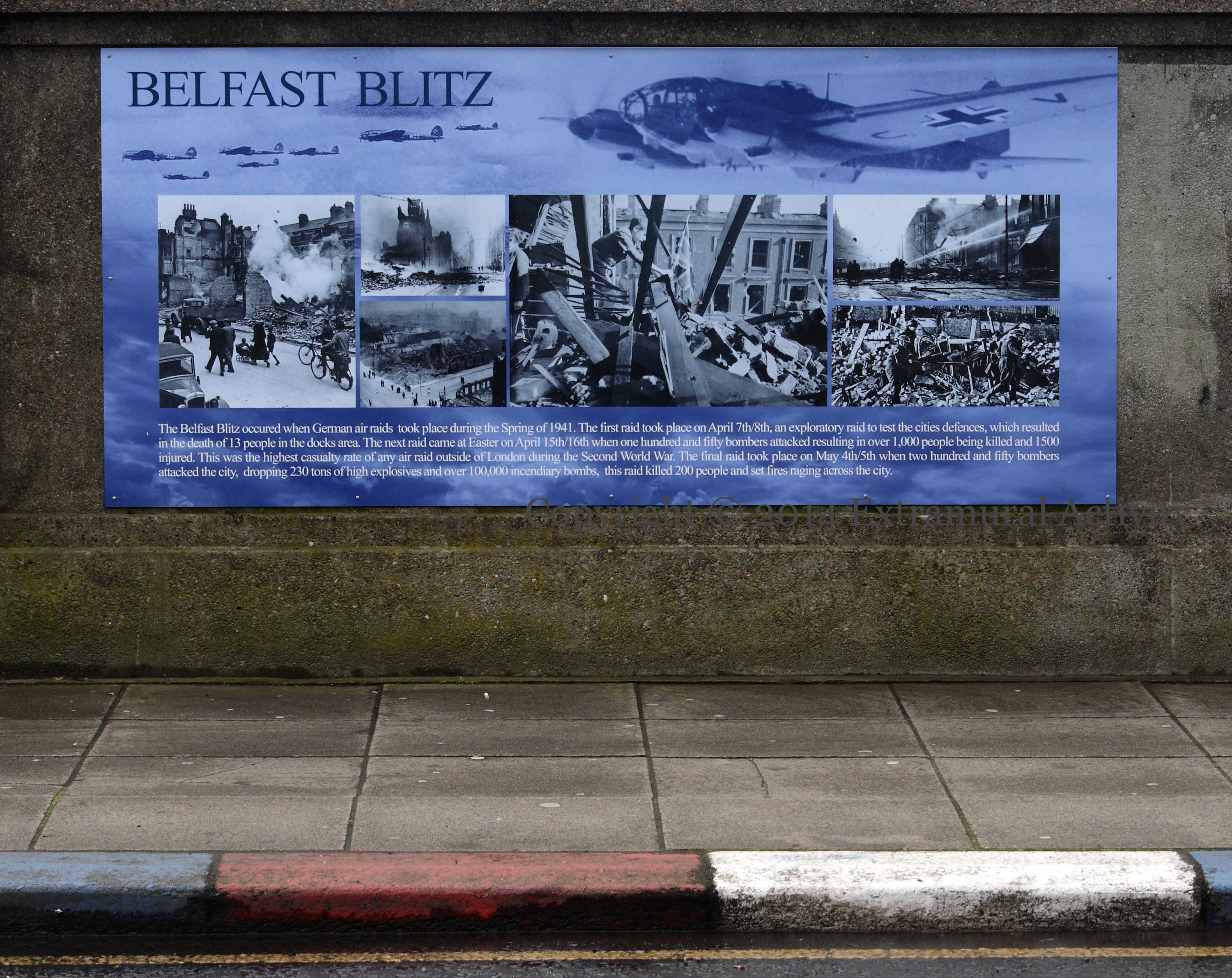
“The Belfast blitz occur[r]ed when German air raids took place during the spring of 1941. The first raid took place on April 7th/8th, an exploratory raid to test the cities [sic] defences, which resulted in the death of 13 people in the docks area. The next raid came at Easter on April 15th/16th when one hundred and fifty bombers attacked resulting in over 1,000 people being killed and 1,500 injured. This was the highest casualty rate of any air raid outside of London during the Second World War. The final raid took place on May 4th/5th when two hundred and fifty bombers attacked the city, dropping 230 tons of high explosives and over 100,000 incendiary bombs, this raid killed 200 people and set fires raging across the city.” Board on Donegall Road.
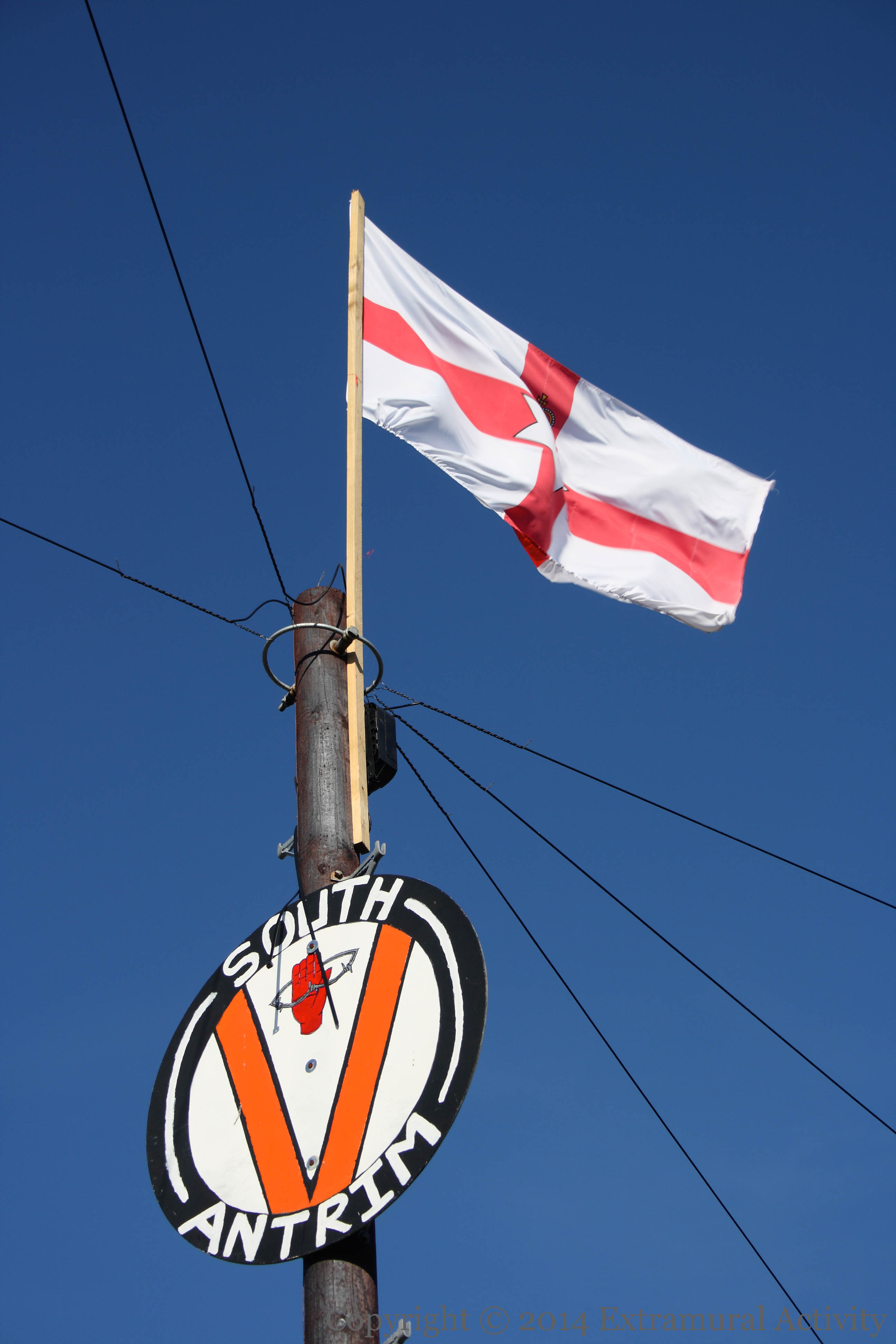
An Ulster Banner tops an electrical pole in Stoneyford sporting a picture of an Orange Order collarette and the red hand in barbed wire of the Loyalist Prisoners Association.
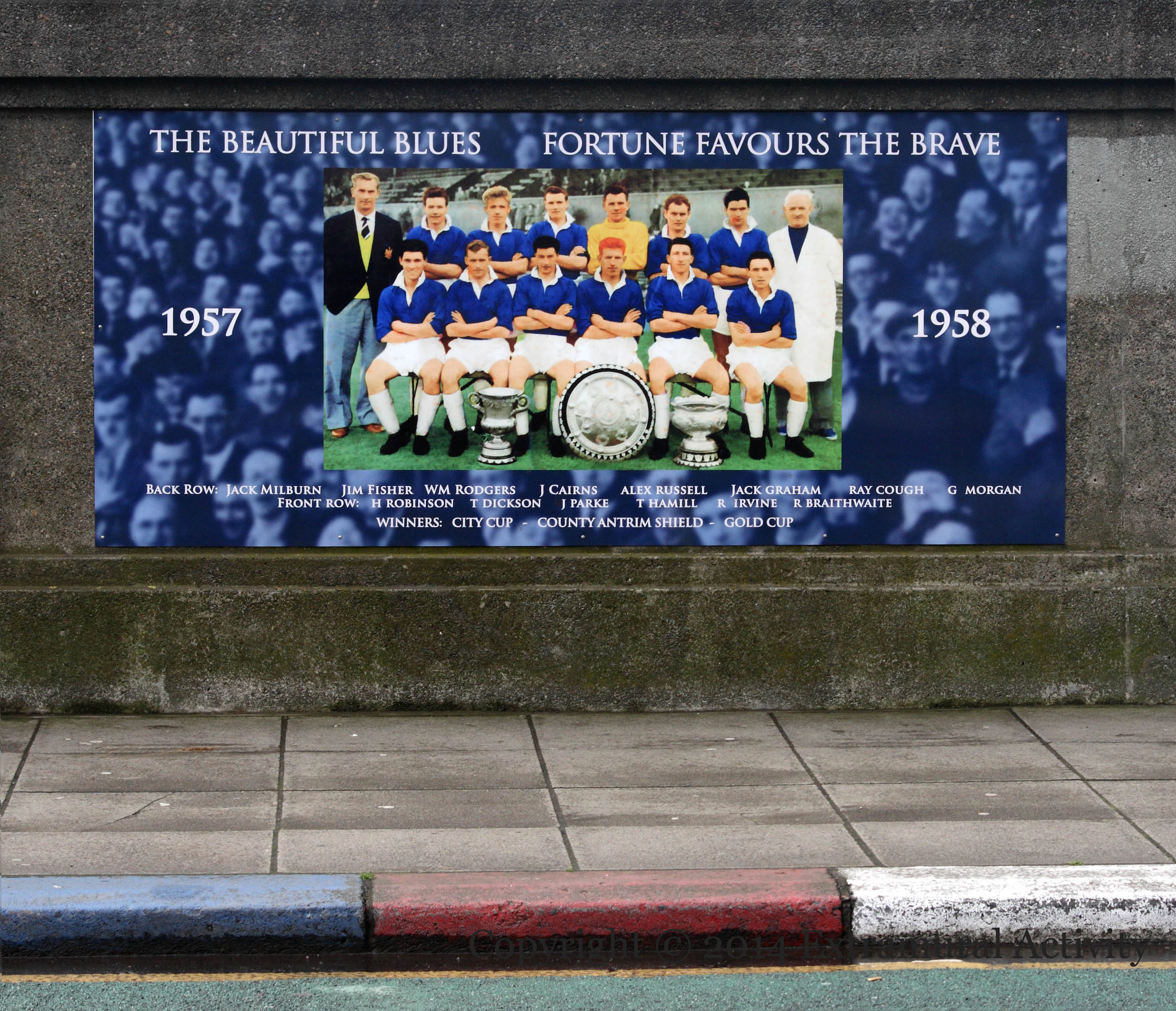
Two boards on the Donegall Road feature Linfield football club. The one above (at the bridge near Roden Street) features the 1957-1958 team; the one below (near the City Hospital station) has the founding team of 1886 and champions in 1890-1891 in the background (shown in Fortune Favours The Brave) “with Sandy Row former Linfield players Daryl Fordyce and Albert Watson, with the modern day youth of Sandy Row” (linfieldfc.com).









 Extramural Activity