“This stone was erected by the republican movement, south Armagh, in proud and loving memory of the twelve hunger strikers who laid down their lives during this phase of the struggle for Irish freedom.” “Fuaır sıad bás ar staılc ocraıs ar son saoırse na hÉıreann. Go ndéana Dıa trócaıre ar a nanamacha.” “Beıdh an bua agaınn go fóıll (We will win yet) – Raymond McCreesh – two days before he died.”
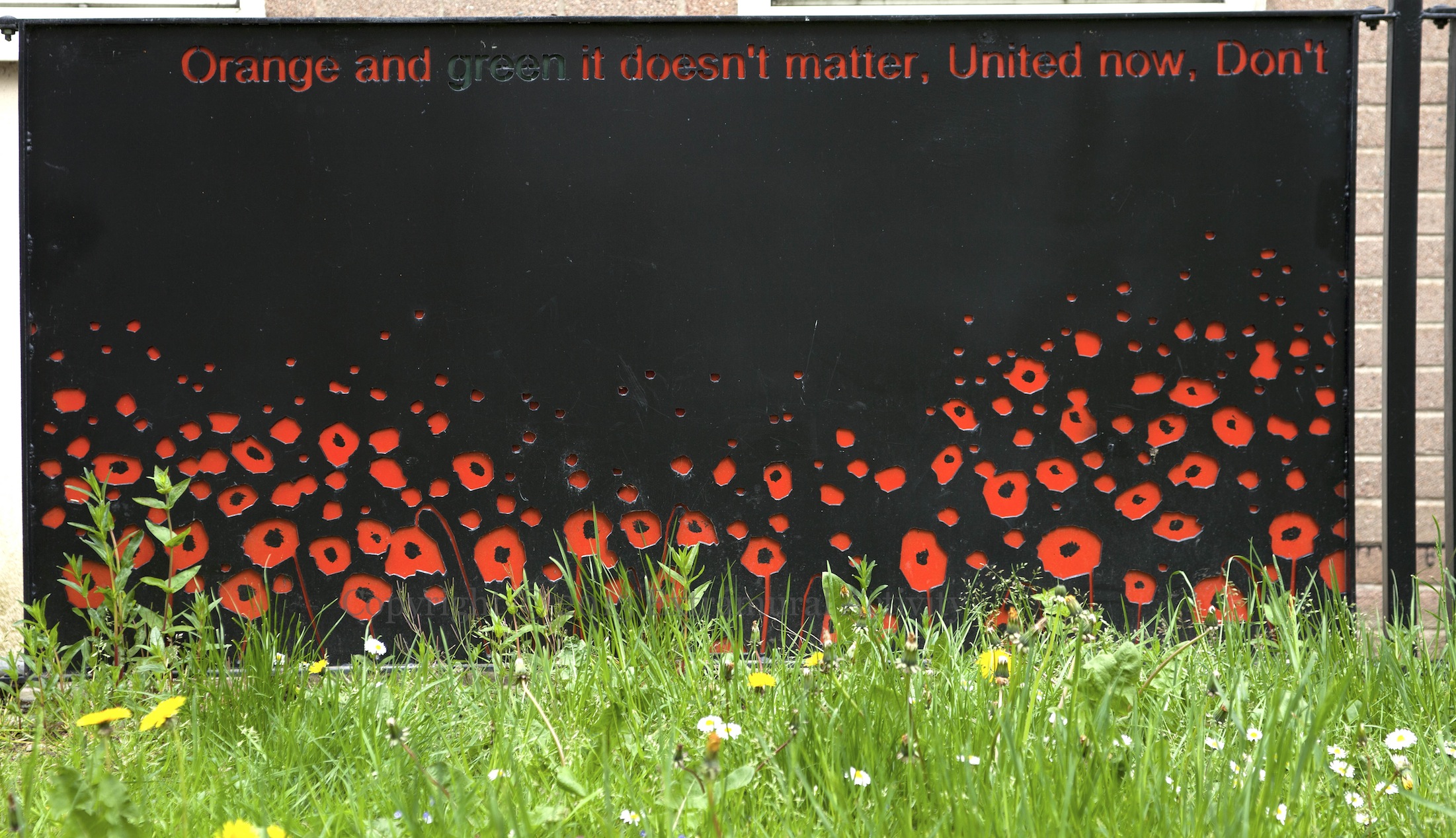
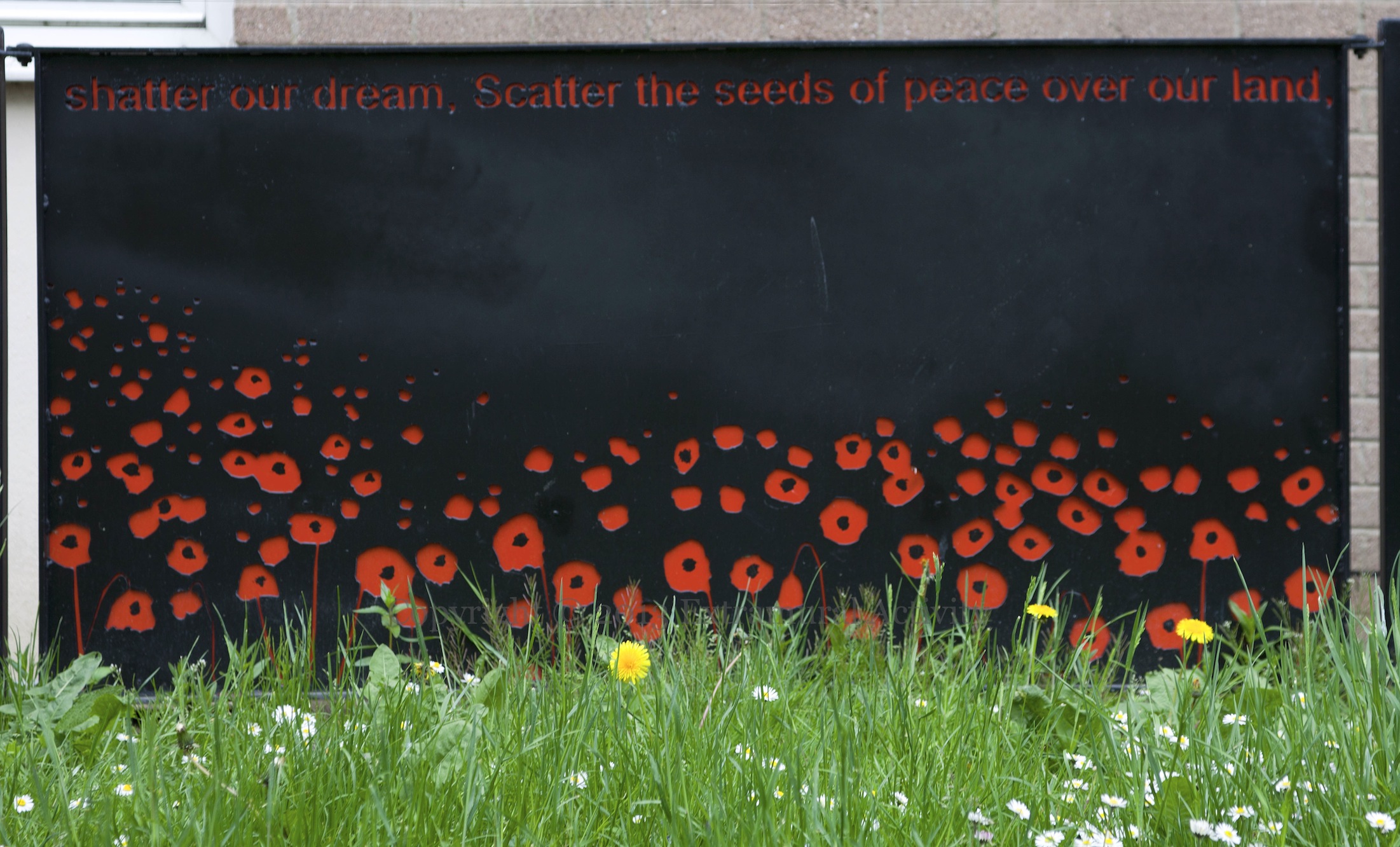
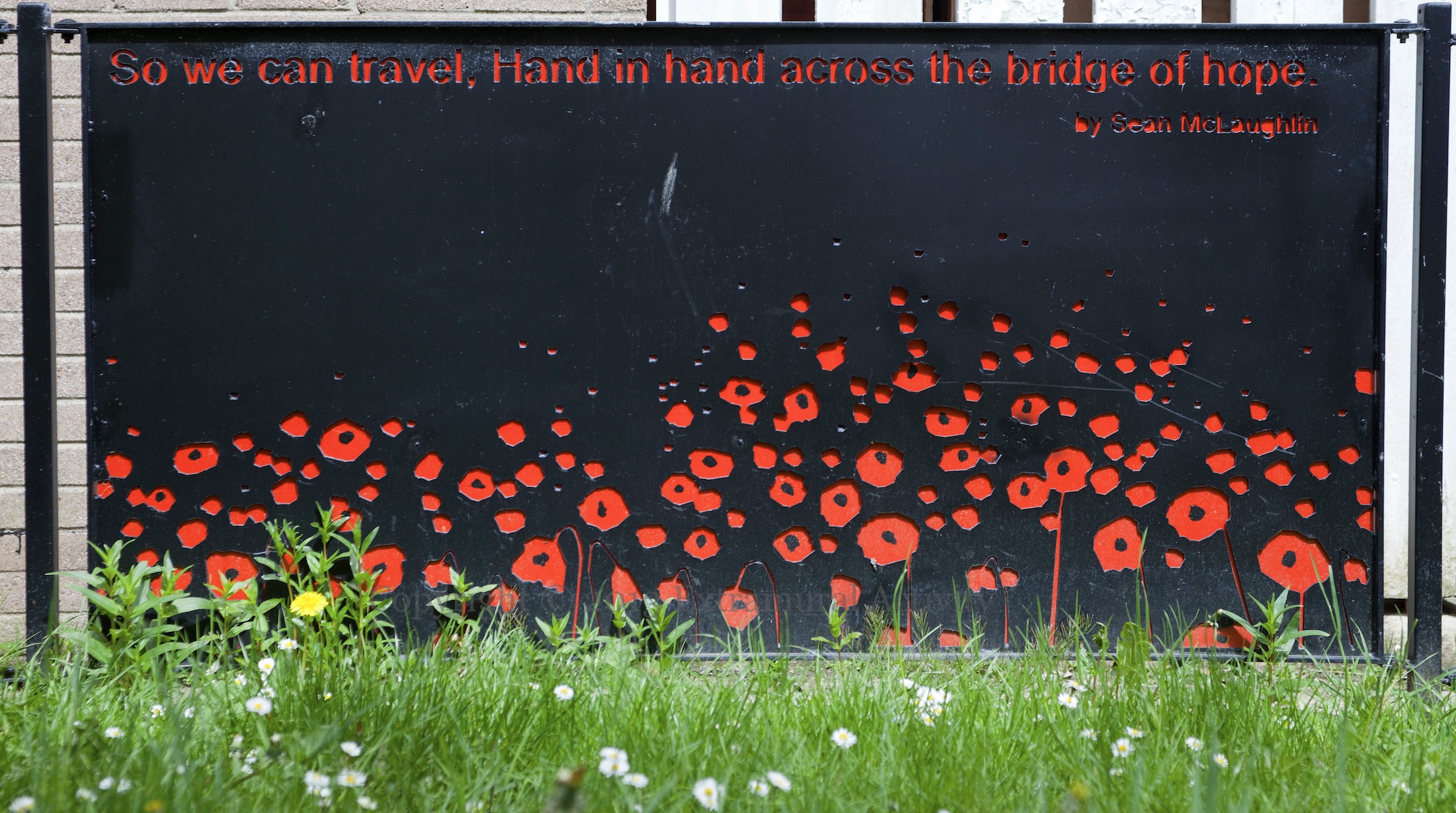
A three-piece stone in the same Tullycarnet garden as the war memorial and peace mural featured previously. “Orange and green it doesn’t matter, United now, Don’t shatter our dream, Scatter the seeds of peace over our land, So we can travel, Hand in hand across the bridge of hope.” by Sean McLaughlin, a twelve-year-old who was killed in the Omagh bombing of 1998 (WP). The garden was unveiled June 2010 (IFI).
The three central panels of the World Wars memorial in Tullycarnet (featured previously), along with two smaller stones, stand in front of a mural reading “Time for peace. Invest in kids … not war!”. The image of a boy playing with a ball against a wall is based on a 1994 photograph by Crispin Rodwell. The slogan in the photograph, originally, was “Time for peace; time to go” but for publication, as here, the second part was cropped out.
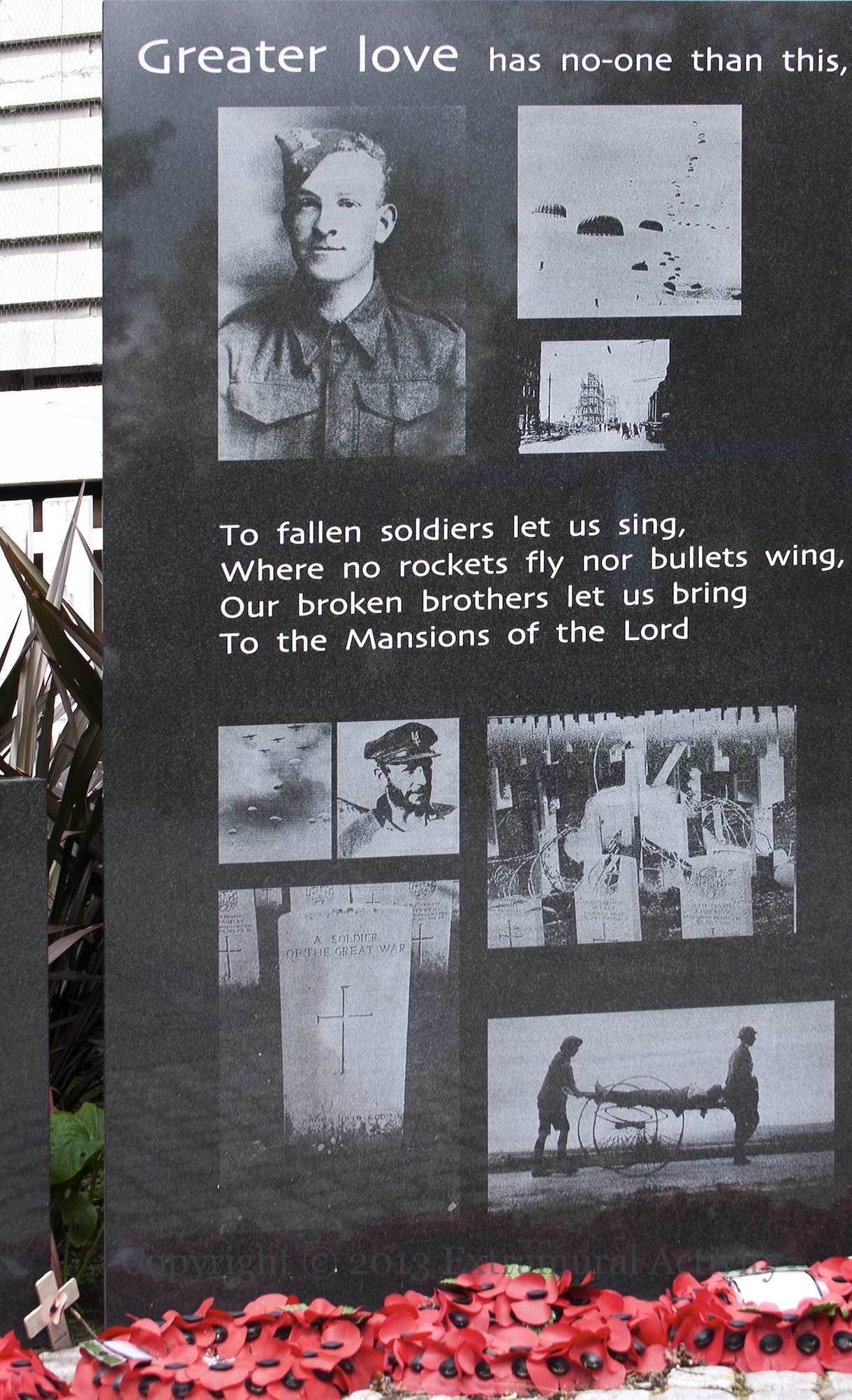
A three-stone memorial to army soldiers from both World Wards in Tullycarnet, featuring a line from the gospel of John (“Greater love has no-one than this, that a man lay down his life for his friends” 15:13) and a song by Randall Wallace for the 2002 movie We Were Soldiers called ‘The Mansions of the Lord’: To fallen soldiers let us sing, where no rockets fly nor bullets wing, our broken brothers let us bring, to the mansions of the Lord. No more weeping, no more fight, no prayers pleading through the night, just divine embrace, eternal light, in the mansions of the Lord. Where no mothers cry and no children weep, we will stand and guard though the angels sleep, Oh through the ages safely keep, the mansions of the Lord.”
By Ross Wilson with support from the International Fund For Ireland (IFI)
For the 40th anniversary, a painted shopfront and plaques to the victims of the McGurk’s Bar Bombing were added last December (2011) to the Celtic Cross and plaque already at the site. The text on the info board to the right is ad follows: “At 8.48 pm on Saturday 4th December 1971, a no-warning bomb, planted by British terrorists, exploded on the doorstep of family-run McGurk’s Bar. Fifteen innocent men, women and children perished. Those who were not crushed or slowly asphyxiated by masonry where [sic] horrifically burned to death when shattered gas mains burst into flames beneath the rubble. Nearly the same again were dragged from the debris alive. In the aftermath of the atrocity, the British and Unionist Governments, RUC police force and British military disseminated disinformation that the bomb was in-transit and that the innocent civilians were guilty by association, if not complicit in this act of terrorism. This is despite a mountain of forensic evidence and a witness who saw the bomb being planted and lit before watching the British terrorists escape into the night. From the moment the bomb exploded, and for 40 years since, the families and friends of those murdered have campaigned constitutionally and with great dignity to clear the names of their loved ones. It is a Campaign for Truth that continues to this day. Join us at www.themcgurksbar.com.”
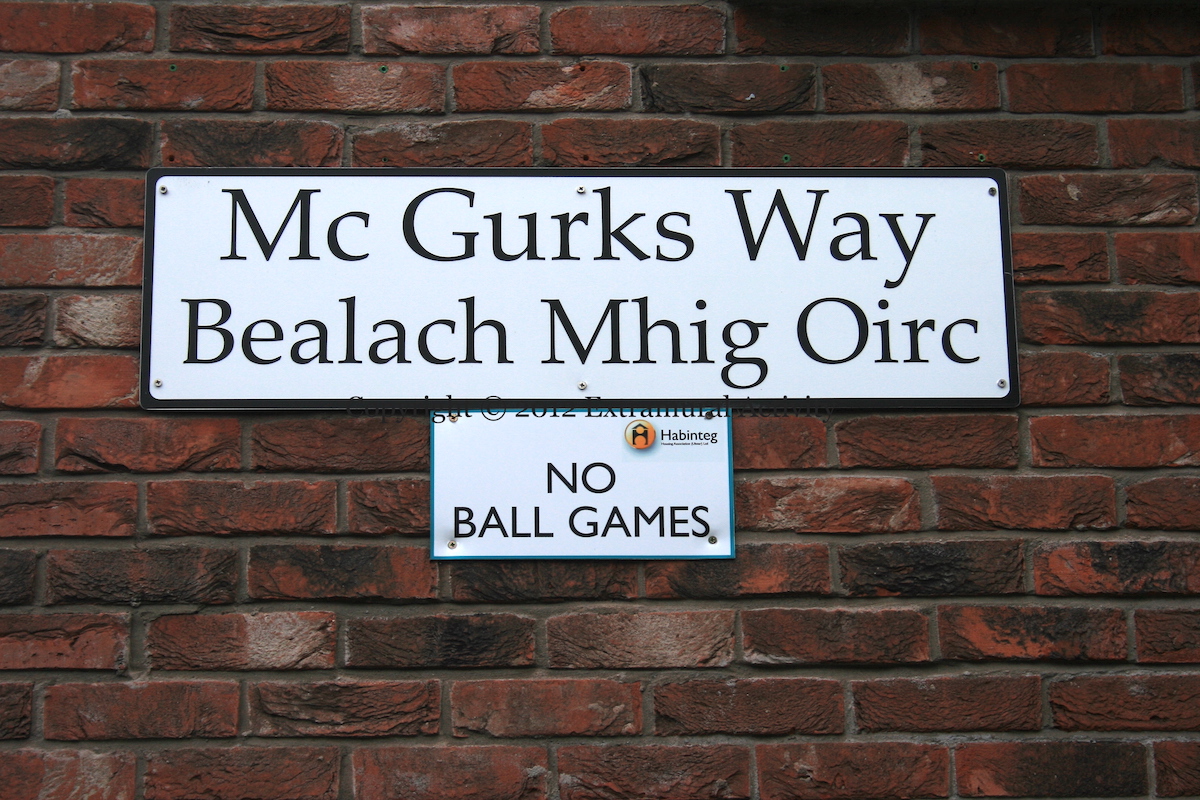
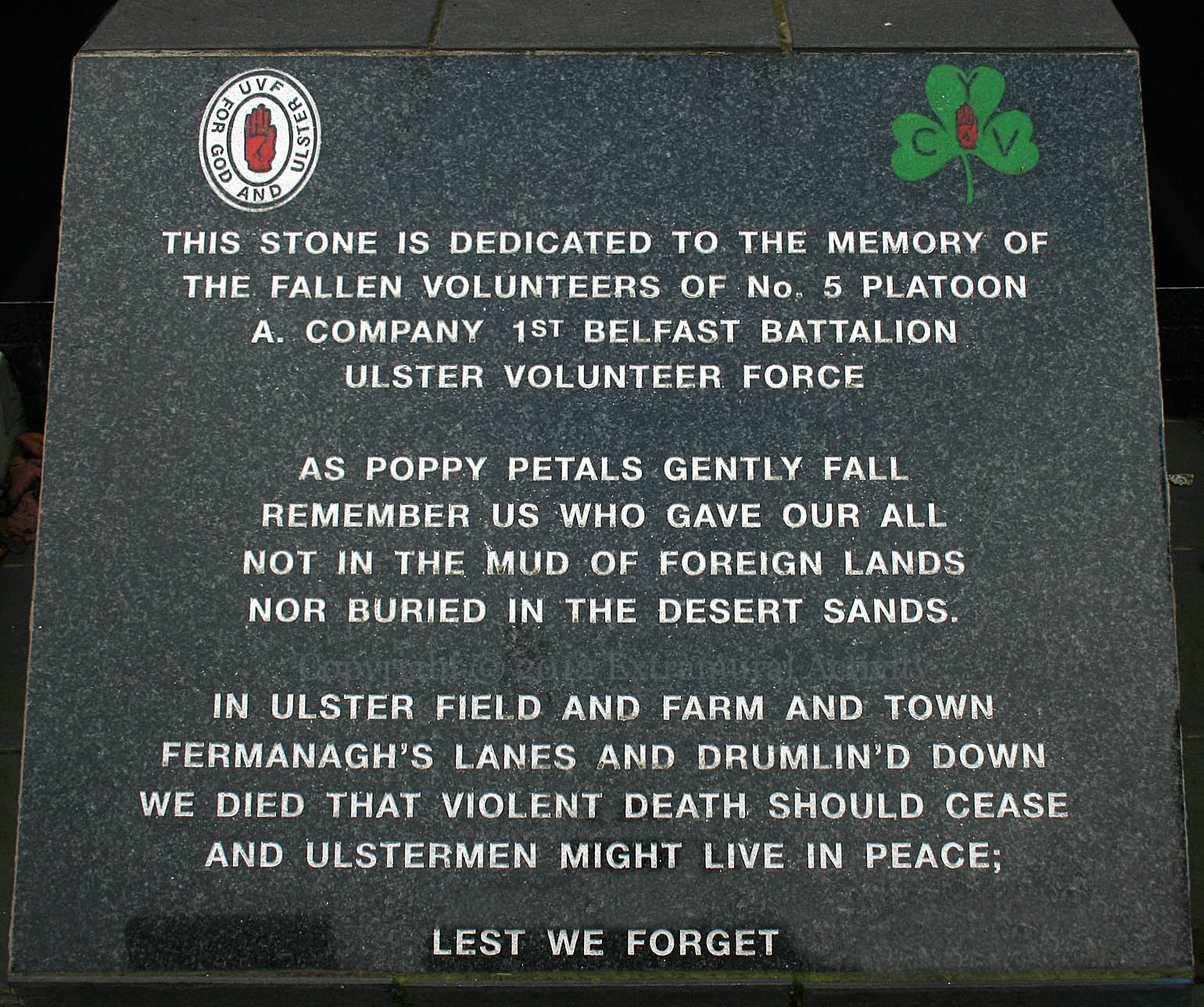
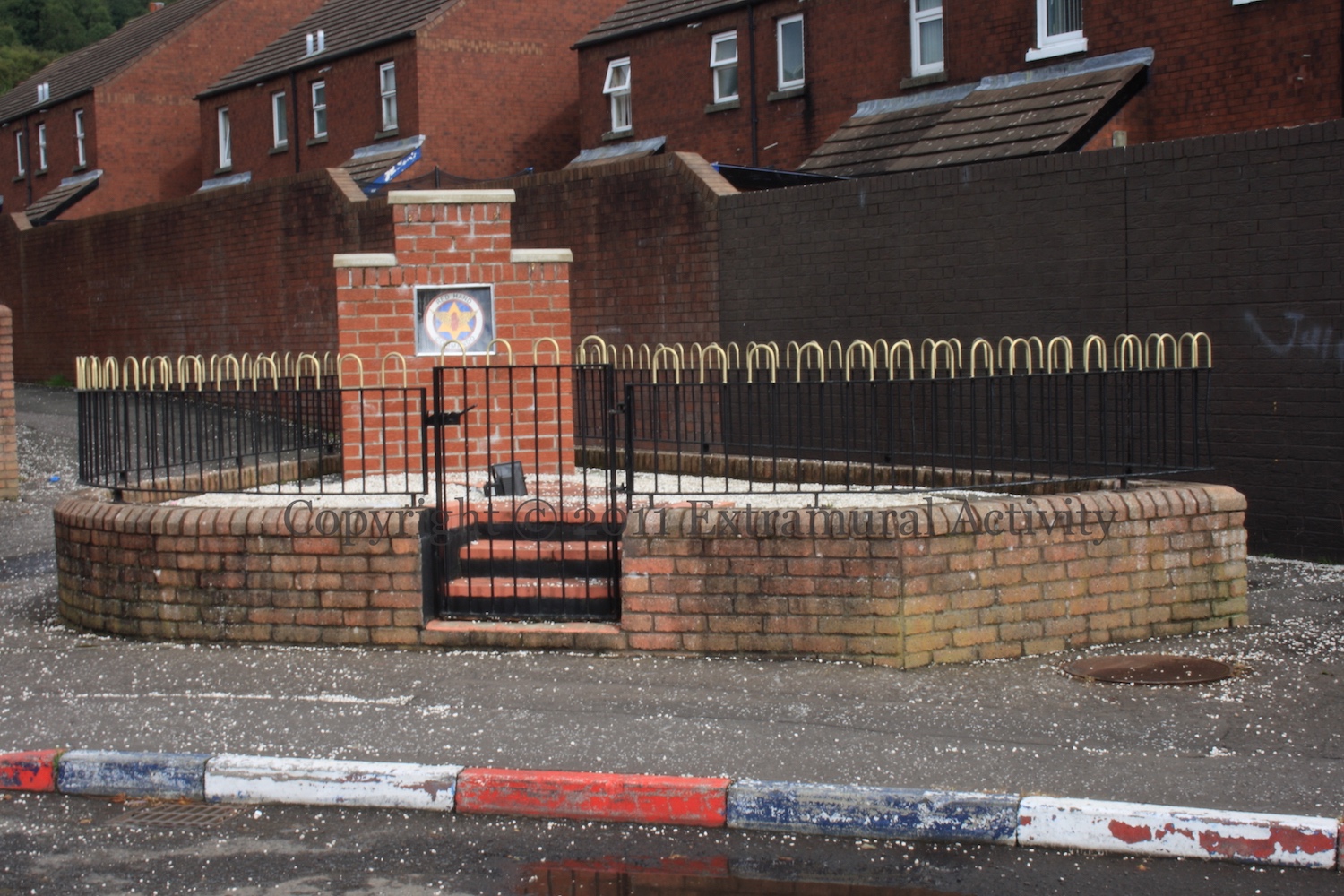
The nameplate on the lower corner of Northland Street now reads “Thiepval Street” and the Thiepval board above adorns the end wall (replacing an earlier mural to UVF A Company 5th platoon; the stone shown below, although not present in 2006, perhaps belongs to the era of the previous mural). On the other side of Conway Street is/was North Howard Walk where a plate now reads “Passchendaele Court“. It’s not clear whether the names have been changed officially or not. The names are unofficial (as of November 15th, 2012). In the New Lodge earlier this year (April-May, 2012), Fishers Court became McGurk’s Way (U.tv | BBC-NI).
The UVF memorial garden in Mount Vernon gets a new wall, with poppy crosses on either side of the gate (see the previous wall). On the mural, the battles that the 36th (Ulster) Division took part in are listed on either side of the silhouetted soldier: Ypres, Fricourt, Cambrai, Thiepval, Messines, Beaucourt, Somme, Albert, Flanders, St Quentin, Bailleul, Courtrai. Although the mural is in Mount Vernon, the scroll at the top says “Tiger’s Bay”. The memorial stone is to the “3rd battalion, north Belfast”. A plaque would later replace the poppy cross to the left of the gate.










 Extramural Activity