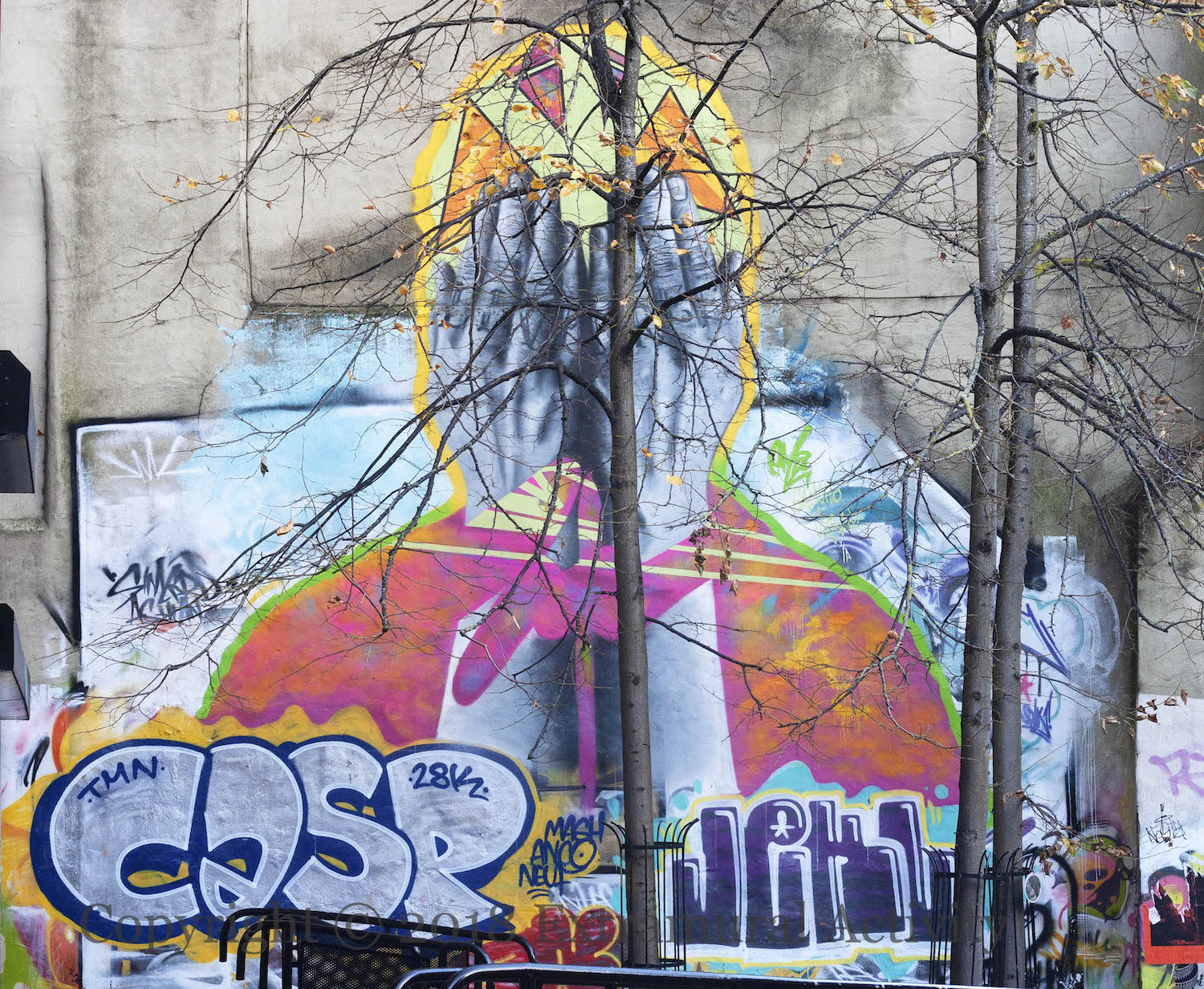
The Universal Declaration Of Human Rights was declared 70 years ago, on December 10th, 1948. emic (tw | web) and the Northern Ireland Human Rights Council teamed up to mark the occasion with this CNBX/HTN18 piece of street art.
Between its construction in 1841 and decommissioning in 2003, Ebrington Barracks served as a home to many military units, including those whose emblems are at the bottom of the mural above (from left to right): the Royal Irish Rifles, Royal Inniskilling Fusiliers, Royal Irish Rangers, UDR, and the Royal Irish Regiment.
HMS Ferret and HMS Sea Eagle are not in fact ships but a part of Ebrington barracks given to the navy to serve as a “stone frigate” during (Ferret) and after (Sea Eagle) WWII. HMS Londonderry was an anti-submarine frigate but does not appear to have a particular connection to Ebrington (please comment if you know otherwise).
The Northern Ireland General Service medal – in the middle of the mural – was awarded to any soldier who served at least 30 days during Operation Banner, the deployment of British troops in Northern Ireland from 1969 onwards.
“The English may batter us to pieces, but they will never succeed in breaking our spirit – Maud Gonne.” The lesser-known figures here are Helena Moloney [Molony] and Margaret Skinnider. Both participated in the 1916 Rising. Actress Molony took part in the failed attack on Dublin Castle and, although ultimately captured, was not executed (Stories | WP). Scotland-born Skinnider was a sniper in the Easter Rising; she was shot three times but survived to flee to the USA where should would write a 1917 account of the Rising before returning to Ireland and a career in teaching (WP).
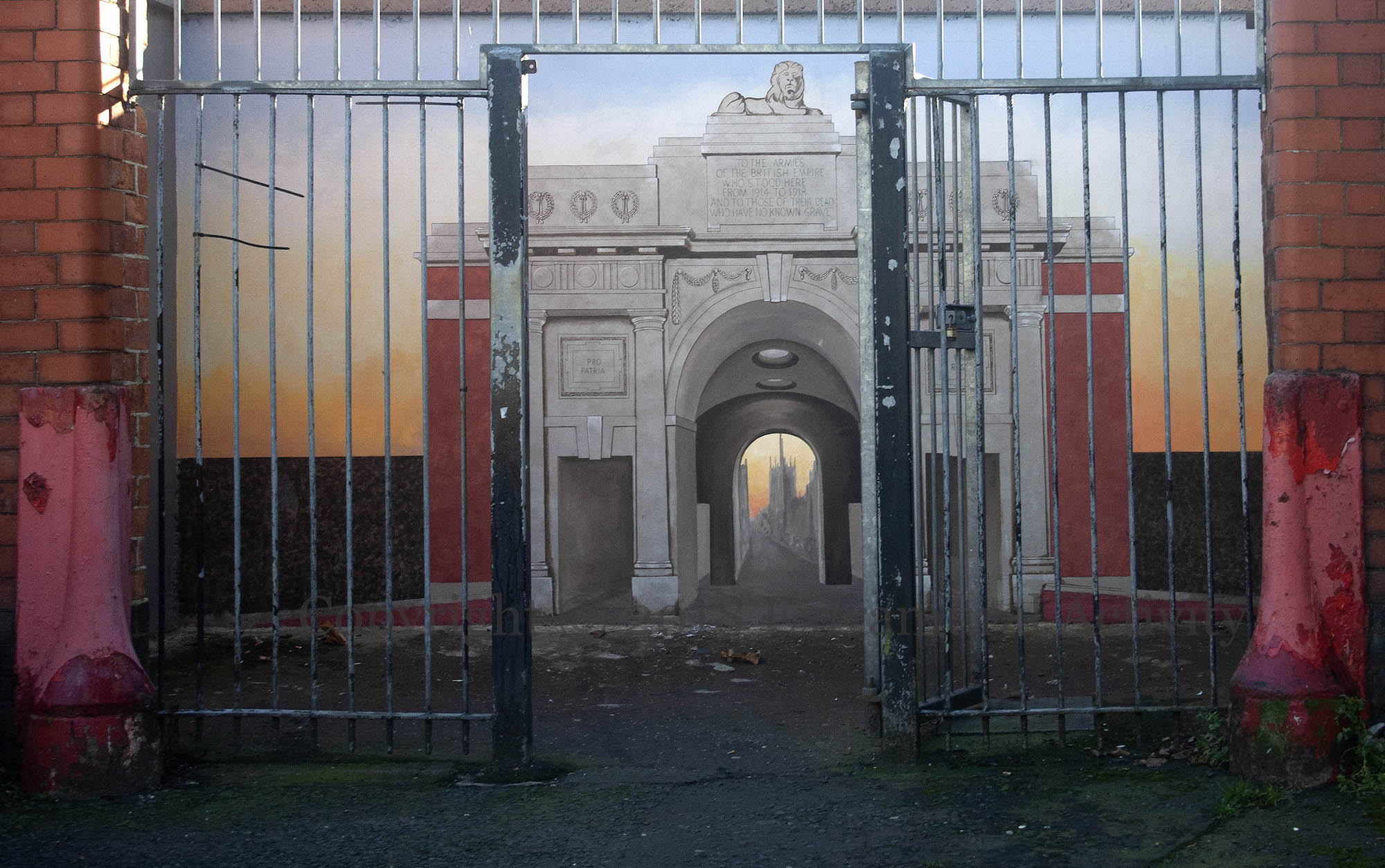
The Menin Gate memorial, at the eastern edge of Ypres, Belgium, commemorates 54,896 Commonwealth soldiers who died in the area during WWI and whose bodies were not recovered. “To the armies of the British Empire who stood here from 1914 to 1918 and to those of their dead who have no known grave.” The gates in the image above are off Bond’s Street, Londonderry, leading to the Ebrington Centre car park.
A covered walkway has been added around the Bank Buildings to join Royal Avenue and Donegall Place while construction goes on after the fire which gutted the building on August 28th, 2018 (BBC-NI).
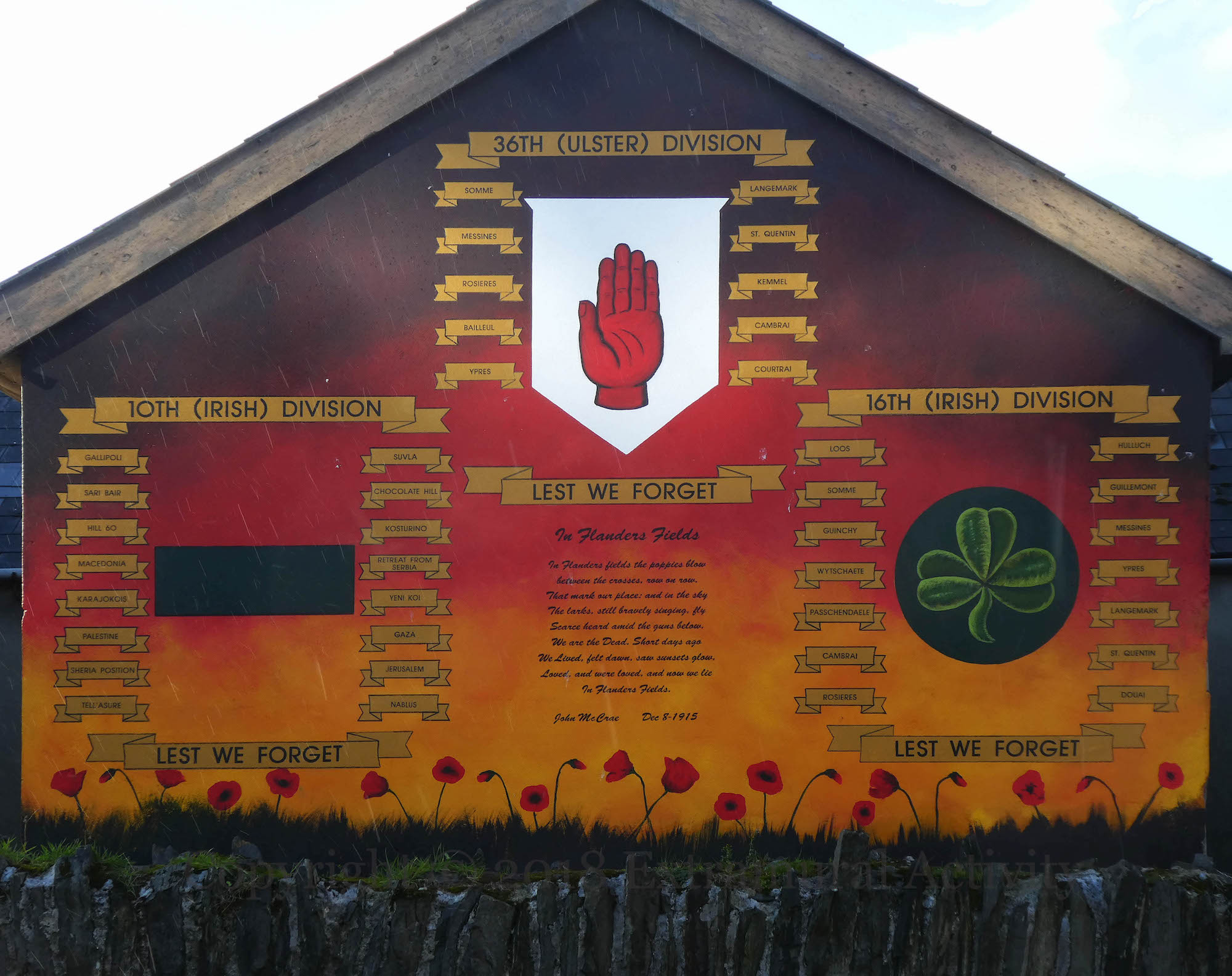
The 10th (Irish) Division fought only briefly “in Flanders fields”, towards the very end of the war, having spent most of its time in Gallipoli (in the Ottoman Empire), Macedonia, Egypt, and Palestine. The 16th took part in the Somme, especially at “Guinchy” [Ginchy] and Guillemont, while the 36th were deployed on the first day (the Battle Of Albert).
The poem in the middle is the first half of John McCrae’s In Flanders Fields: “In Flanders fields the poppies blow/Between the crosses, row on row/That mark our place, and in the sky/The larks, still bravely singing, fly/Scarce heard amid the guns below.//We are the dead; short days ago/We lived, felt dawn, saw sunset glow/Loved and were loved, and now we lie/In Flanders fields.”
“Welcome to West Belfast.” The sights of nationalist west Belfast are depicted in (part of) a new mural by Mickey Doherty and Marty Lyons on the side wall of the tourist office. From left to right: The (2015) Bobby Sands mural in Sevastopol Street, tourists being introduced to the IRA D Company memorial garden on the lower Falls by Peadar Whelan, Conway Mill, Divis tower, RISE at the bottom of Broadway (better known as the “Balls on the Falls”), the Falls library, the “international wall” in 2012 (with marchers in support of a nondescript international cause, crocodiles for the Irish language, and gay rights), St Peter’s pro-cathedral, a black taxi, the Connolly statue outside Comhaırle Phobaıl an bhFál, and the model for the new Casement Park stadium.








 Extramural Activity