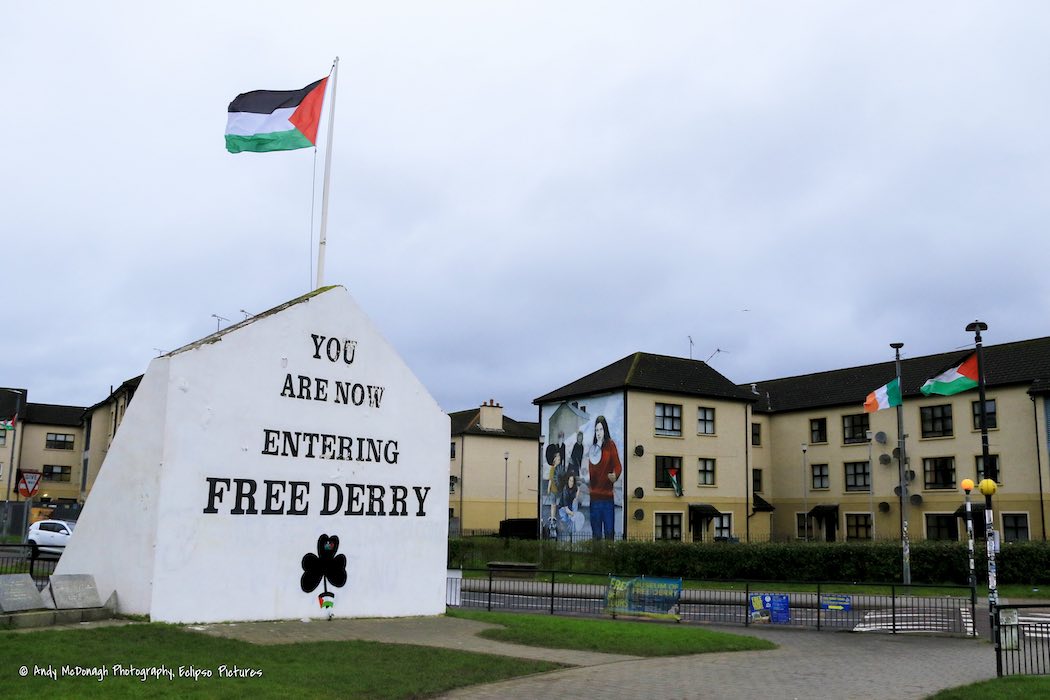
The black shamrock is a symbol of Irish neutrality dating back to 2006 (Irish Times | Pensive Quill). In the light of the attack on Gaza it is being used by the IPSC and other pro-Palestinian causes as a symbol of solidarity. This shamrock, on Free Derry Corner, has been augmented with two small Palestinian flags, one with a dove and the word “peace” (shown below).
This RNU (Fb) board calls for attendees at a gathering in Milltown cemetery to commemorate the Easter Rising of 1916. The signatories to the Proclamation can be seen above and behing the large Óglaıgh Na hÉıreann gravestone on the right.
In 2000, during the Second Intifada, Palestinian teenager Faris Odeh was photographed by an AP photographer in the act of throwing a stone at an Israeli tank. He was shot and killed a few days later and the image became a symbol of resistance. (A mural of the photograph was painted in Springhill: see David And Goliath.) The iconic image is updated here for Israel’s current invasion of Gaza, showing a young girl with a soft toy standing in front of a tank that is bedecked with the flags of the European Union, France, the USA, the UK, and Germany.
The F-16 jets and rubble and child with teddy-bear are the same as in the We Stand With Palestine mural in Ardoyne.
The “Put it back, thief” imagery is applied here to Palestine and Israel, except that there is no piece of territory in the Israeli arm, only a grasping hand, and the slogan is “Saoırse don Phalaıstín”.
Here are a few pieces from the so-called “peace” line dividing CNR and PUL west Belfast, featuring, above, ‘Road rage Ruth’ by Kilian (ig). Previously by Kilian on the “peace” line: The Brain Is Wider Than The Sky. See also the works done for HTN23, HTN22, and HTN21.
For wild-style from December (2023) see Bombing The “Peace” Line. For ten or so pieces of street art and wild-style writing on the wall from May 2023, see Ready To Rumble.
The obscured piece by Bust and the “World Wall Stylers” tag can be seen in better condition in New Levels, Same Devils (2022). “Ríoghnach” is an Irish-language name.
Here is an assortment of images concerning boycotts of Israeli goods in response to the invasion of Gaza. Above, “Ban Israeli goods” on the wall of the Alexandra Park Tesco, north Belfast; below, V-for-victory fingers as scissors snipping barbed wire (bdsmovement.net) in a shop window in Andersonstown, west Belfast; “BDS” [Boycott, divestment, sanctions] and “IPSC” [Ireland Palestine Solidarity Campaign, which maintains a list of Israeli goods] next to a painted Palestinian flag in the middle Falls, west Belfast; plus an Artists Against Genocide (ig) sticker.
In this new statue in the grounds of Belfast city hall, Mary Ann McCracken is shown handing out abolitionist leaflets with a pleading enslaved woman above the words “Am I not a woman and a sister?” The same supplicant image is on the medallion (perhaps made by Wedgwood for the Society For The Abolition Of The Slave Trade – WP) worn at her throat. See also: The Blots On The Page Are So Black and The World Affords No Enjoyment Equal To That Of Promoting The Happiness Of Others.
“Mary Ann McCracken’s feminist ideals and commitment to the principles of Equality, Liberty, Fraternity applying equally to the Rights of Woman defined her participation in the United Irish Movement.” For McCracken’s connection to the 1798 Rebellion, see These Are Times That Try Men’s Souls.
“Mary Ann McCracken (1770-1866) Abolitionist, educator, social reformer and businesswoman. Sheas Mary Ann an fód ar son na mbocht, na mban, na bpáıstí agus ar son sıúd a bhí faoi dhaoırse. [Mary Ann stood up for the poor, women, children, and for those who were enslaved.]”
The statue was unveiled together with a statue to Winifred Carney on International Women’s Day (March 8th); they were produced by Ralf and Naomi Sander (BCC).
Here is a bonus post, thanks to our London correspondent, of the latest offering from Banksy, showing “foliage” added to the wall behind a pruned-back cherry tree (BBC) by a youth with a canister sprayer. The piece perhaps indicates a desire for more greenery in the area – Finsbury Park in north London; it has already been vandalised with white paint (Guardian).
The final image below is of a 2012 Banksy (Artlyst) that is still hanging on in Kentish town, of a girl with a large lollipop pulling a kiddie-wagon containing a rocket.
Previously on Extramural: Banksy-style art in Belfast and Bundoran.
A statue to Winifred Carney was unveiled, along with another to Mary Ann McCracken, in the grounds of Belfast City Hall on Friday, March 8th (BCC). At her left hand is a typewriter. Carney was a qualified secretary and typist, and became secretary of the Irish Textile Workers’ Union in 1912, in which position she met James Connolly, who was secretary of the Belfast branch of the ITGWU. The 1913 manifesto addressed ‘To The Linen Slaves Of Belfast’ (marxists.org), exhorting “our toiling sisters” in the mills to join the organisation, was signed by Carney, Connolly, and Ellen Gordon.
Her uniform, and the amorphous pistol (or holster?) in her right hand, refer to her membership of Cumann Na mBan and participation in the Easter Rising of 1916. Carney was in the GPO when it was taken over and was among those who surrendered at the end; during the occupation she typed up dispatches from the Moore Street headquarters. A News Letter editorial described the statue as smuggling terrorists onto the grounds of city hall.
“Winifred Carney, born in Bangor, was a suffragist and a committed trade unionist. She was an organiser in the Irish Textile Workers’ Union and became James Connolly’s personal secretary, political confidante and friend. In 1913, She and Connolly wrote the Irish Textile Workers’ Union manifesto entitled ‘To the Linen Slaves of Belfast’. It was a time when Belfast workers, mostly women and children, were working long hours in horrific conditions, barefoot and hungry. “D’oıbrıgh Winnie ar son oıbrıthe Bhéal Feırste, go háırıthe ar son na mban agus na bpáıstí a bhíodh ag obaır sna muılte ar fud na cathrach. “Many Belfast mills are slaughterhouses for the women and penitentiaries for the children.” Chomh maıth leıs an obaır a rınne sí ar son na gceardchumann, ba Phoblachtánach í Winnie a bhí ına ball de Chumann na mBan agus d’Arm Cathartha na hÉıreann. As an officer in the Irish Citizen Army, Winnie was present with Connolly in the Dublin General Post Office during the 1916 Easter Rising and has since become known as ‘the typist with the Webley’. Carney stood as a Sınn Féın candidate in the 1918 elections, but in an ‘unwinnable’ seat. She retained her commitment to socialism and in 1924, Winifred joined the Northern Ireland Labour Party. Here she met her future husband, George McBride, like her a committed socialist. George was a Protestant from Shankill Road who fought at The Battle of the Somme with the 36th (Ulster) Division. Tá Winnie curtha ı Reılıg Bhaıle an Mhuılınn ar Bhóthar na bhFál ın ıarthar Bhéal Feırste.”