“Some days I am more wolf than woman and I am still learning how to stop apologising for my wild.” Words from poet Nikita Gill illustrated by Conor McClure (web | Fb | tw) for Culture Night Belfast/Hit The North 2017.
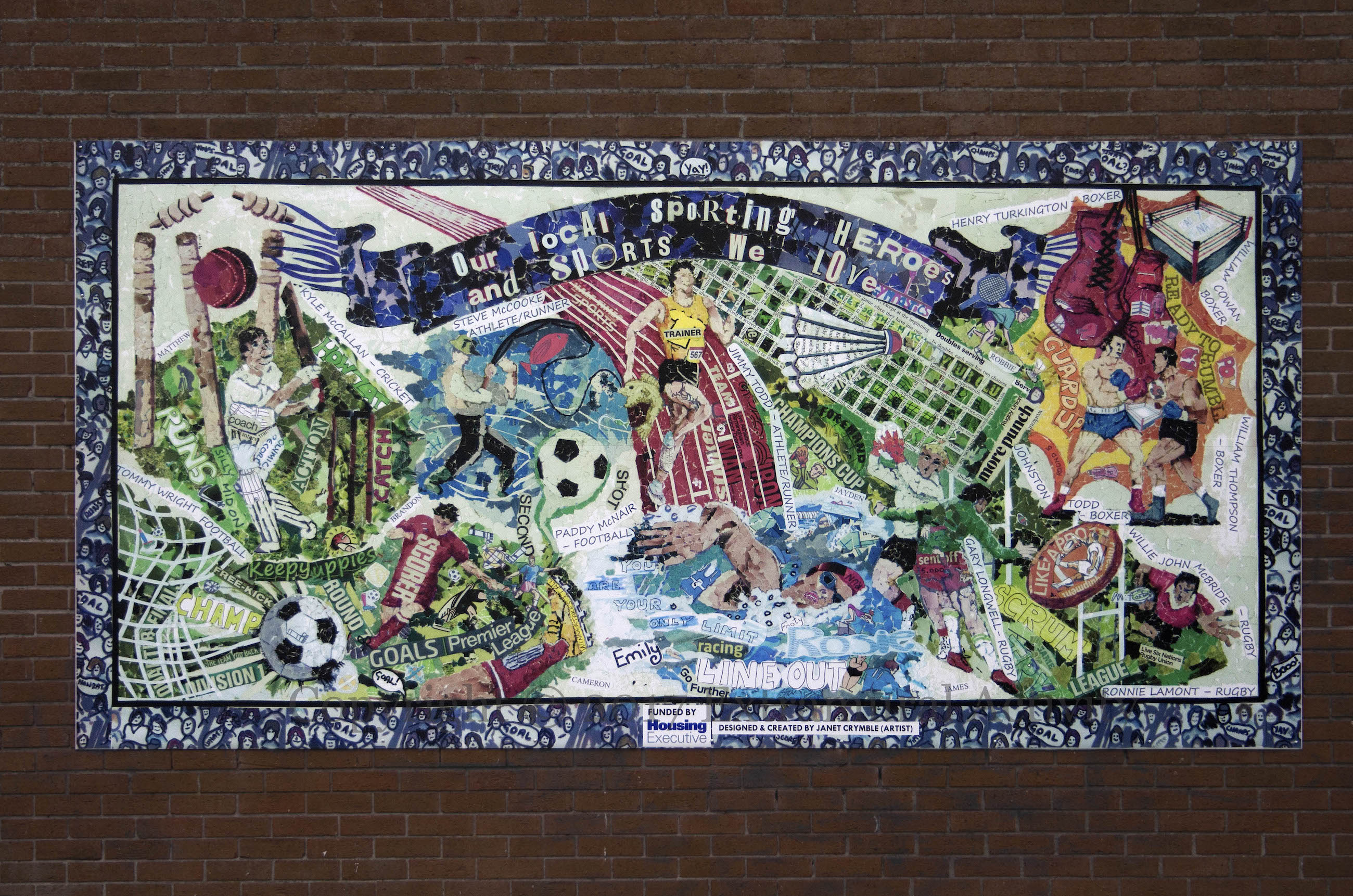
Whitehead artist Janet Crymble “designed & created this new collage in Ballyclare, featuring south Antrim sporting heroes past and present: Kyle McCallan, Steve McCooke, Paddy McNair, Jimmy Todd, Gary Longwell, Ronnie Lamont, Henry Turkington, William Cowan, William Thompson, Johnston Todd, Willie John McBride. John Reid from the NIHE – which sponsored the mural – has an image from the launch of local children posing with the piece.
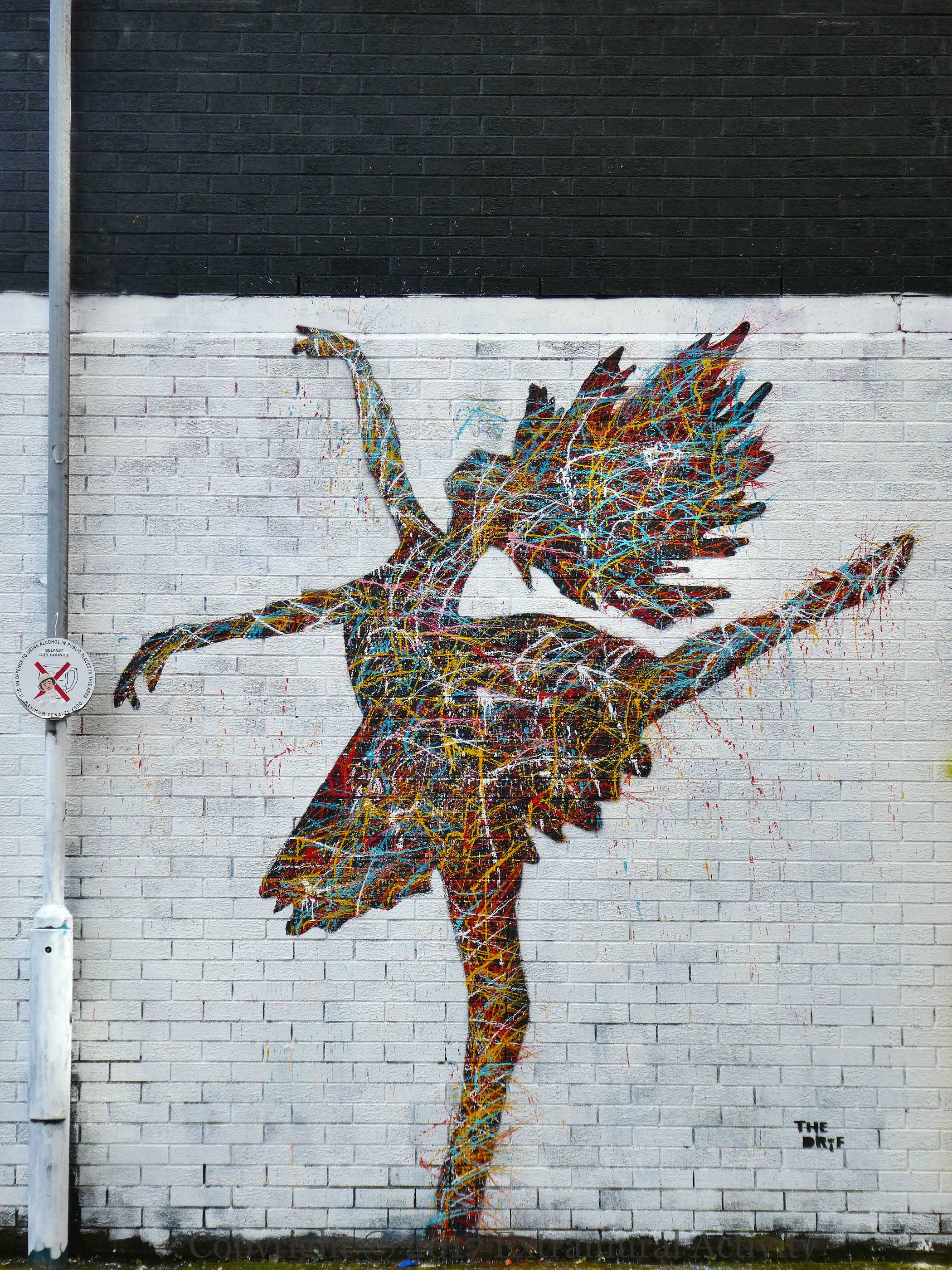
We begin our 2017 Culture Night Belfast/Hit The North coverage with New York street artist and co-founder of the LISA (Little Italy Street Art) project The DRiF (aka Rey Rosa) (Fb | web | tumblr | tw) who came to town to paint a Belfast version of his “Tiny Dancer“.
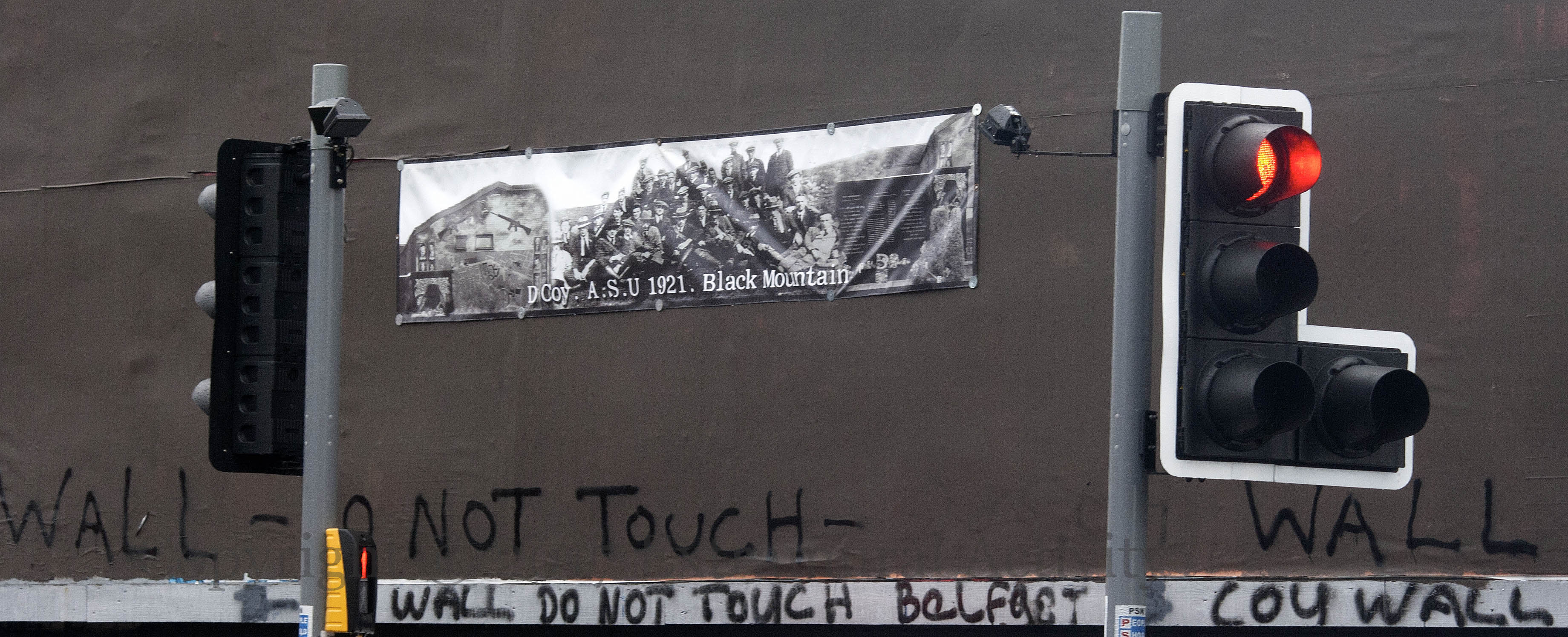
Towards the end of August the advertising hoarding at the corner of Divis and Northumberland Streets was covered with brown paint and a warning scrawled along the bottom rail: “D-Coy wall – Do not touch – Belfast D Coy wall” (though the two “D”s were painted over). (See the second image.)
A few weeks later, the banner above was added, showing the men of the northern IRA’s D Coy “active service unit” (“ASU”), between images of the (Troubles-era) D Coy mural and memorial garden (PMC | Extramural). A direct line between the IRA of and the PIRA unit is possible – some of the Northern Division went with Joe McKelvey, leader of the 3rd Division, to Dublin to support the anti-Treaty forces (WP) though most of the northern IRA accepted the assurance that the six counties would soon join the South. (For some guesstimates at the number of northerners who served pro-Treaty, see treasonfelony.)
But perhaps only an ideological heritage is intended, that the Black Mountain unit of 1921, and the D Coy of the Troubles, and the contemporary D Coy, alike aim at (Northern) Irish independence.
Six of the dead on Bloody Sunday (January 31st, 1972) were from Creggan, and the funeral service for all 13 immediate victims took place in St Mary’s Chapel, at the bottom of Bishop’s Field; the board of photographs shown in today’s post are at the top, on Creggan’s Cental Drive.
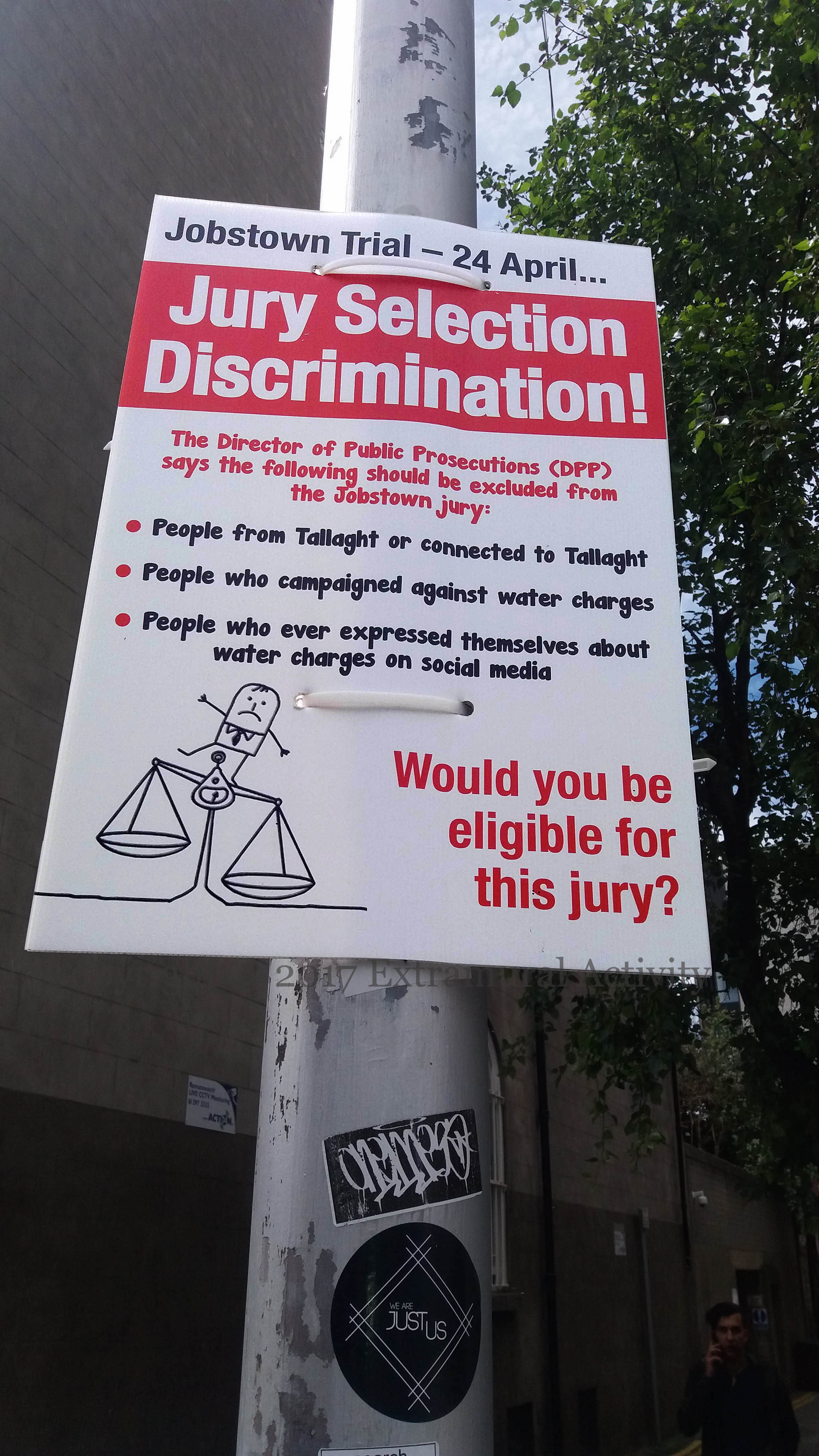
We go beyond the North for today’s post: November 2014 protests over water charges (and austerity measures in general) in Tallaght, Dublin blocked in Deputy Prime Minister Joan Bruton’s car for 2.5 hours (some video | broader account). A teenager was convicted of false imprisonment but conditionally discharged in 2016 (Irish Times). The placard shown above relates to the trial of a first group of (adult) protesters, including TD Paul Murphy, at the end of June, 2017 which ended in their acquittal – which led to an internal inquiry by Gardaí of their handling of the case. Yesterday, charges were dropped against the remaining accused. For yesterday’s events see journal.ie; for a timeline, see the JobstownNotGuilty site.
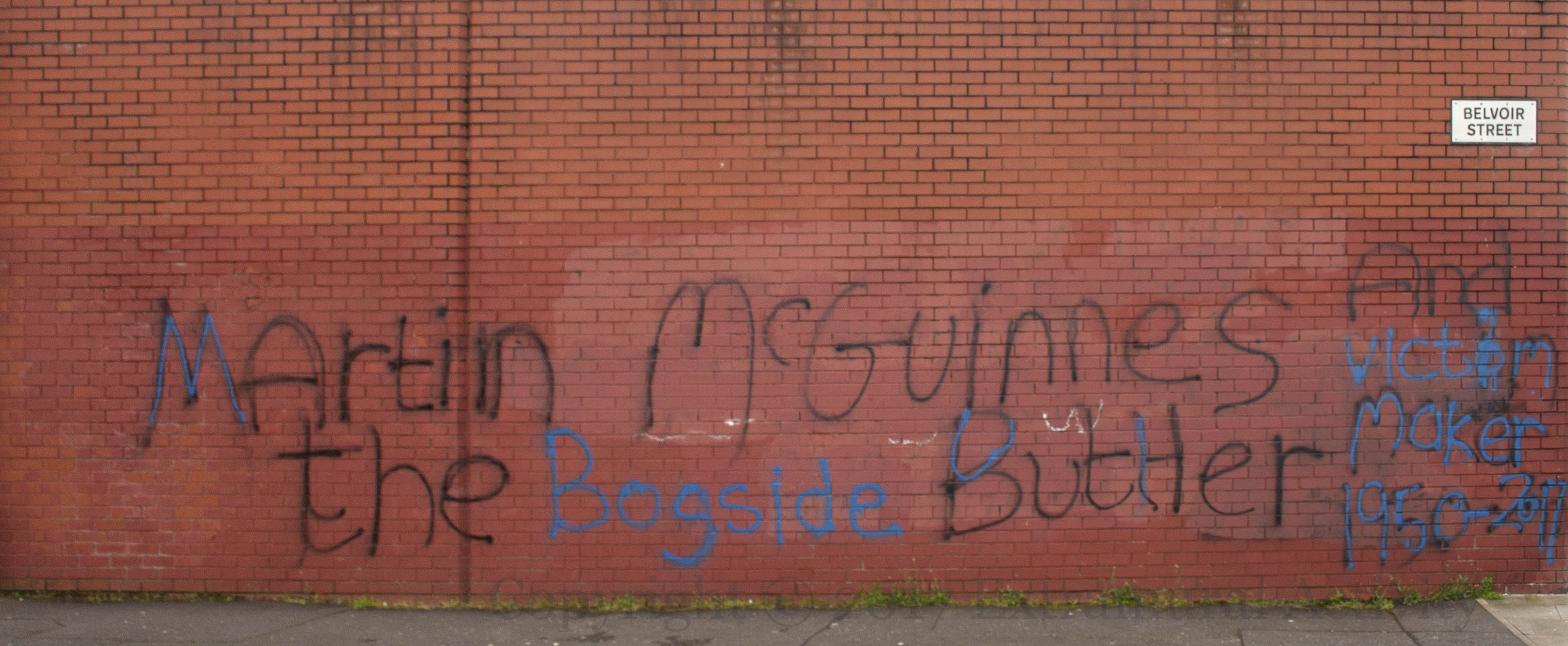
“Martin McGuinnes [sic], the Bogside buther [sic] and victim maker 1950-2017” – commentary on IRA volunteer and Sinn Féin politician Martin McGuinness’s recent (March 2017) death from amyloidosis, in Belvoir Street.
“Civilisation has its roots in the soil & without soil there will be no future life – Tá an duıne fréamhaıthe san ıthır, gan í ní hann dó” by Ed Reynolds (web | tw) and Tancredi Caruso. Together they put on an exhibition and painted a mural for the Belowground Visions Of Life project (Soil Security Programme). The mural is outside Bunscoıl Mhıc Reachtaın (hence the Irish translation) in the old ‘Little Italy’ area of Belfast. Sand or soil has been added to the mural to give it texture.






 Extramural Activity