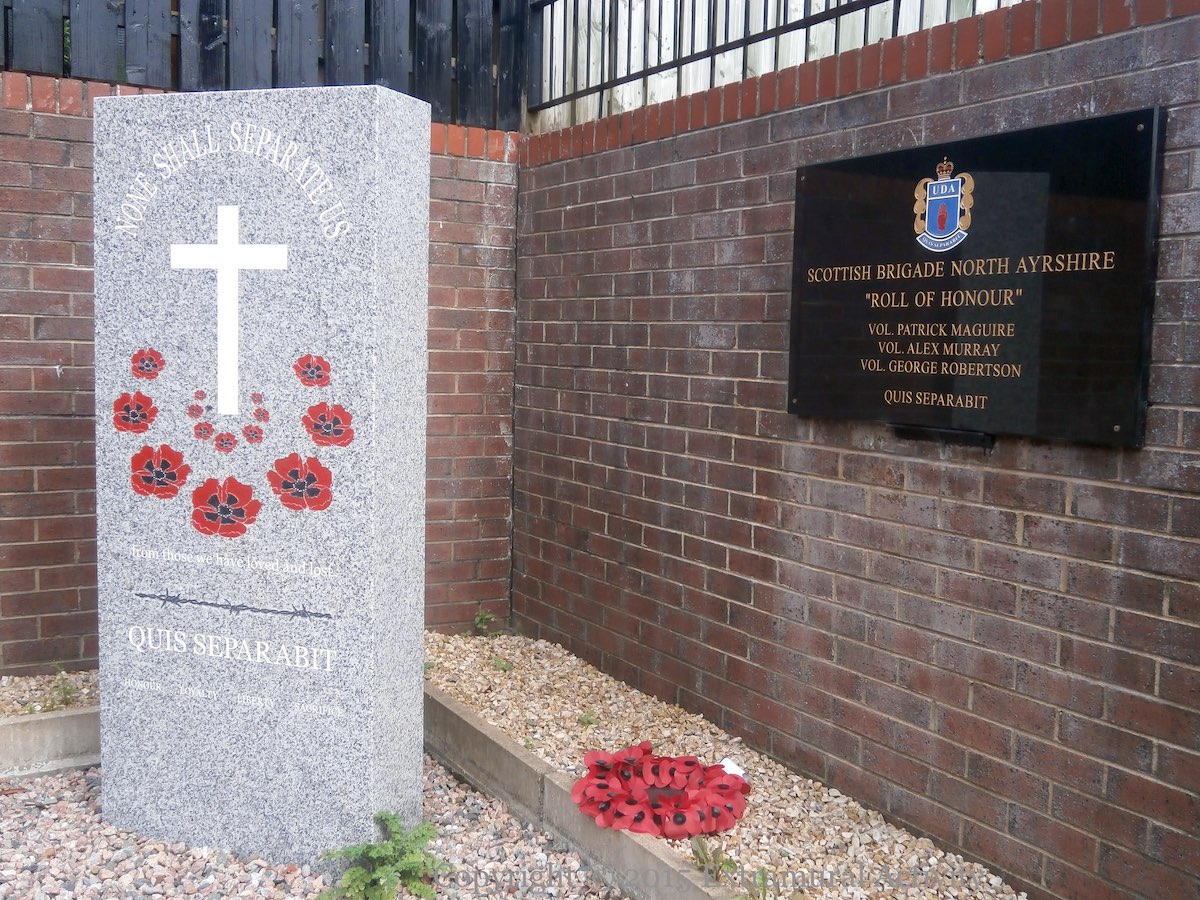
“None shall separate us from those we have loved and lost. Quis separabit. Honour – loyalty – liberty – sacrifice.” A standing stone has been added to the UDA memorial garden in Cosgrave Heights, next to the plaque to the “Scottish Brigade North Ayrshire roll of honour” that was added (circa 2012) to the pair to the North Belfast Brigade that were present in 2008 (see M04397).
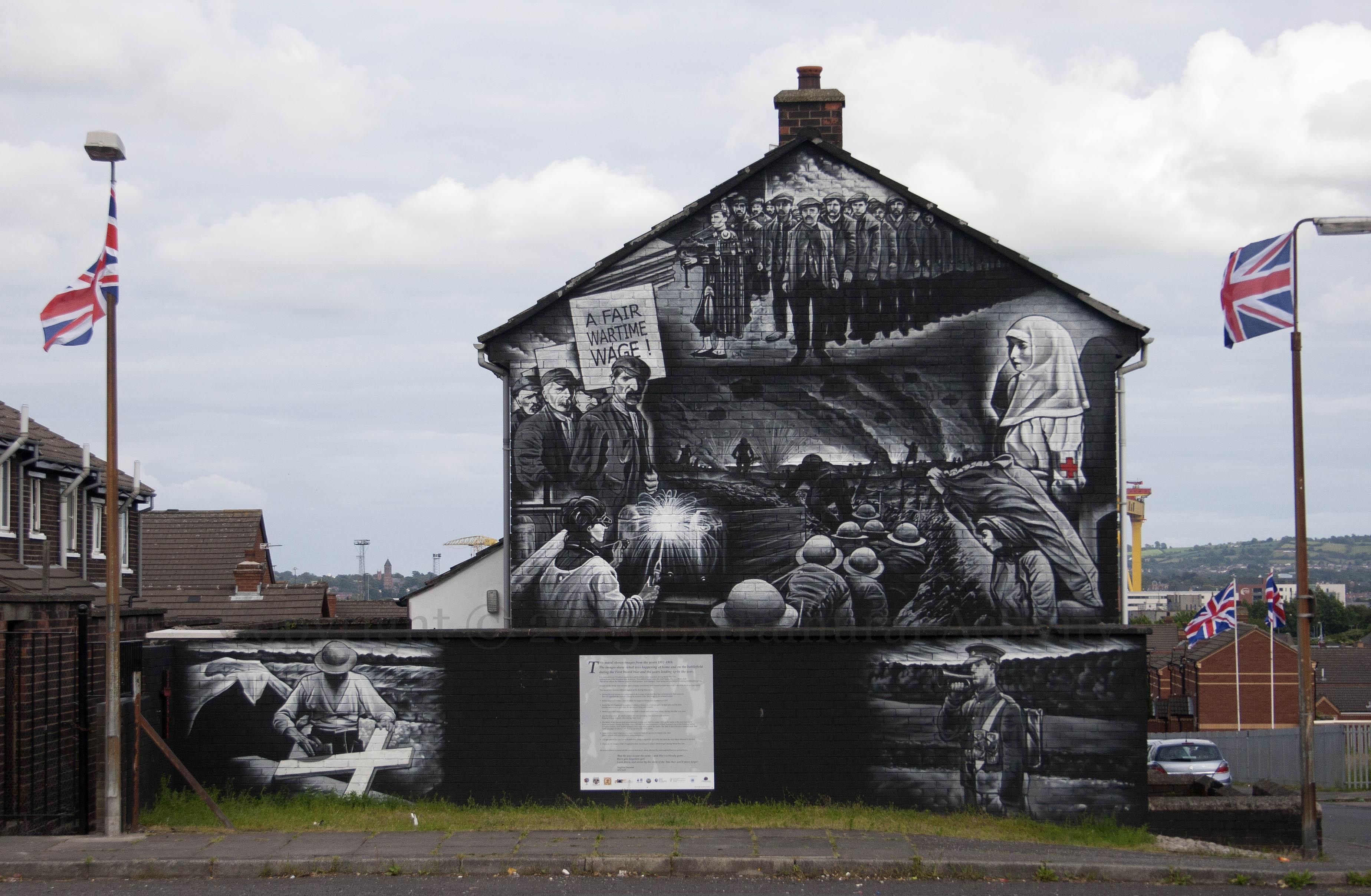
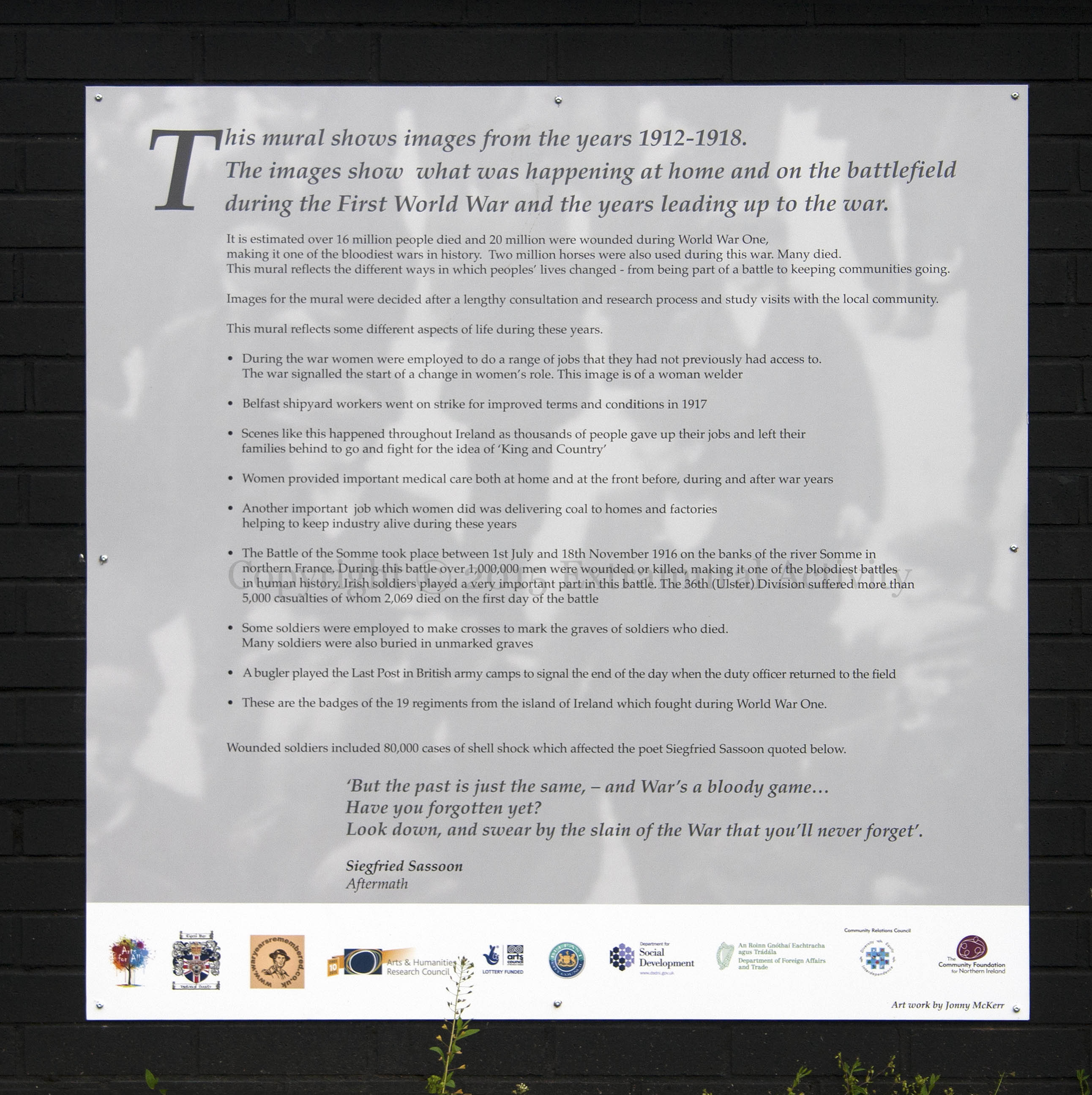
June 15th saw the official ‘Arts For All’ launch of a mural shown all the way back in January. For the launch, artist Jonny McKerr added backgrounds to the cross-maker and bugler on the low wall in front, and the information-board in the centre was added. For background and the images on which the mural is based, see The Home Front (and also The Undertaker).
South Belfast MP Robert Bradford was assassinated by the Provisional IRA in Finaghy at a meeting with constituents; the caretaker of the community centre, Ken Campbell, was also killed by the fleeing attackers. Taking place in late 1981, with the hunger strikes having ended only a month before, the killing was noted around the world and raised fears of broad civil unrest (BBC | NYTimes). The board above serves as a substitute for an earlier mural to Bradford on the adjacent gable wall. See below for a wide shot of Oak Street with the Bradford board between the repainted Cemented With Love and No Surrender Club.
For weeks (since April) a whitewashed panel on the International Wall sat empty, before being partly filled in with “RIC – RUC – PSNI”, “RUC -> Collusion covered up by PSNI”, but progress seems to have halted again and a 32-County Sovereignty Movement tarp has been placed on top: Oppose British political policing.
Badger, hedgehog, squirrel, fox, and owl – along with various butterflies and birds – all inhabit the new community garden at Conduit Street in Donegall Pass. (It’s not all make-believe; the bird box on the tree in the middle is in fact real!) The mural above is the work of Nozzle & Brush.
Click here for work-in-progress shots. And for images of the launch (on April 22, 2015) see the Fb page of the Donegall Pass Community Forum.
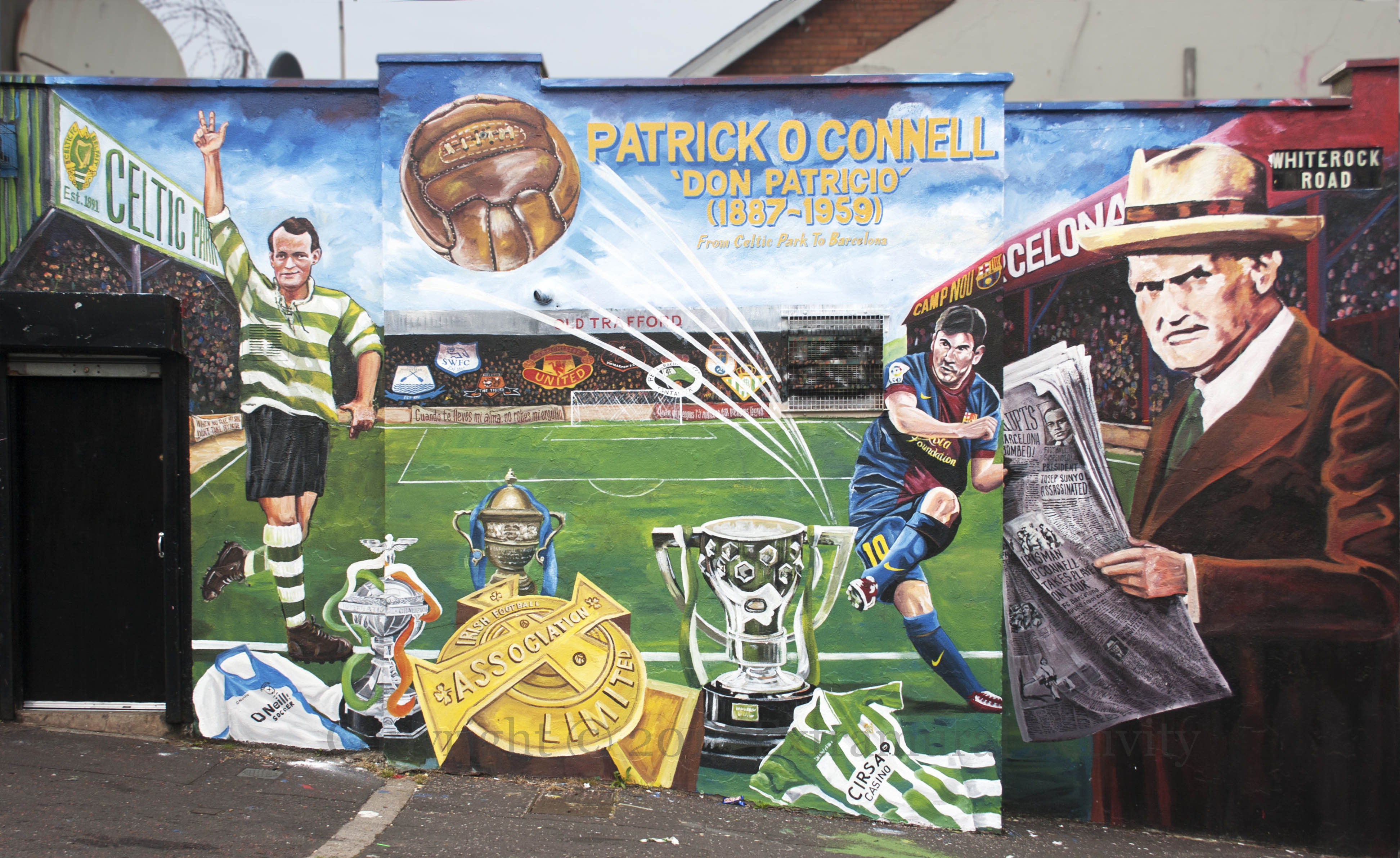
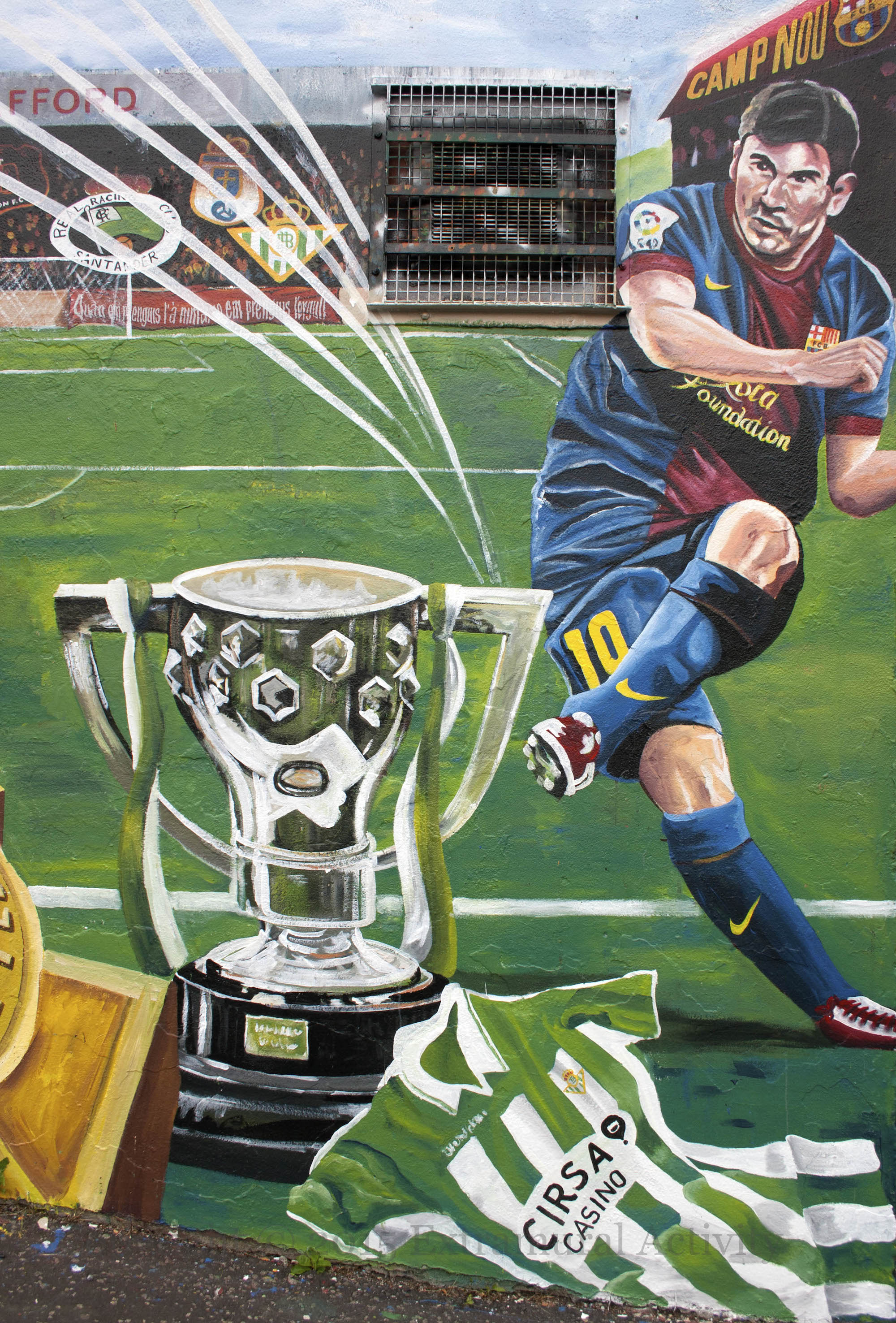
The stands of three football stadiums are shown in the background of the Don Patricio mural at the bottom of the Whiterock: Belfast Celtic’s Celtic Park (“Paradise”), Manchester United’s Old Trafford, and Barcelona’s Camp Nou. The Old Trafford stands bear the emblems of the teams Patrick O’Connell played for and managed: Liffey Wanderers (whose shirt is also featured, on the left), Sheffield Wednesday, Hull City (The Tigers), Manchester United, Dumbarton, Real Racing Club de Santander, Real Oviedo, and Real Betis Balompié (also shirt on the right).
Yesterday we had ‘Barcelona Past’ in the form of Patrick “Don Patricio” McConnell (The Don); today we have ‘Barcelona Present’, in the form of Lionel Messi. The Argentinian forward is shown in front of the Spanish League cup, which Barcelona won this year (2014-2015) with a goal from “La Pulga” (“the flea”) – Messi is 5’7″ but four-time world player of the year.
Here is part of the new Patrick O’Connell, “Don Patricio”, mural at the bottom of the Whiterock. As a player, the Dublin-born O’Connell started with Belfast Celtic before moving on to various English and Scottish clubs, including a period at Manchester United at the time of WWI. He then went on to manage a string of Spanish clubs. As manager of Barcelona during the Spanish civil war, he accompanied the club on their tour of Mexico and the United States. The money from the tour saved the club from bankruptcy but 12 of the 16 players went into exile in Mexico and France. (WP) Barcelona returns to the US this month (2015-07) for games against the LA Galaxy, Manchester United, and Chelsea. (FCBarcelona)
The newspaper in the mural above crams all of this news onto one page: “Civil war erupts in Spain – Barcelona bombed”, “Football suspended – President [of FC Barcelona] Josep Sunyol assassinated” [by Franco’s troops] (WP); “Irishman O’Connell takes players on tour – FC Barcelona saved from extinction”; “Funds lodged in Switzerland”. In the bottom left-hand corner of the newspaper is Robert Capa’s famous photograph of ‘The Falling Soldier’, purporting to show a Republican soldier at the very moment he is struck by a bullet and dies. The image is now thought to have been staged (WP).
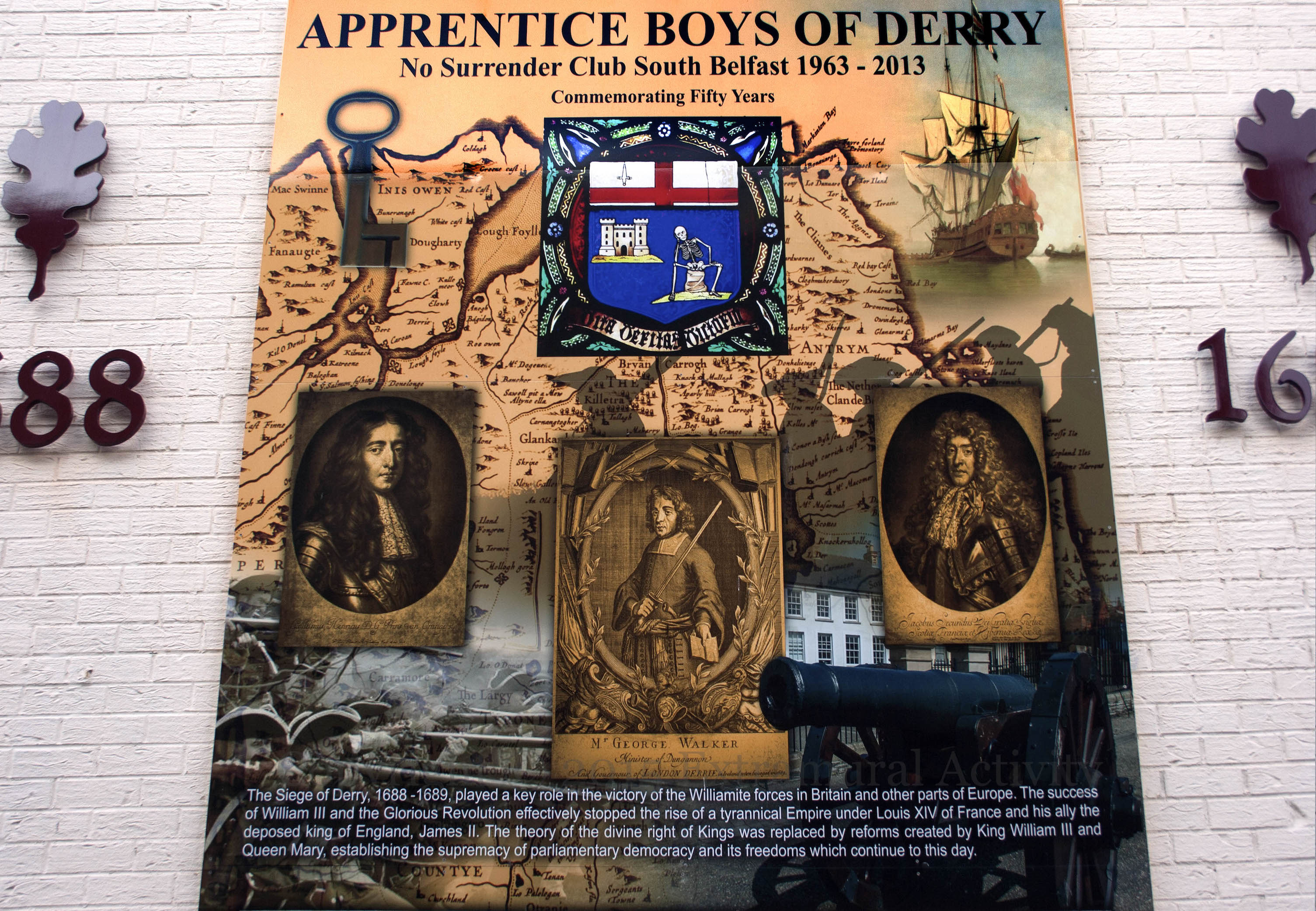
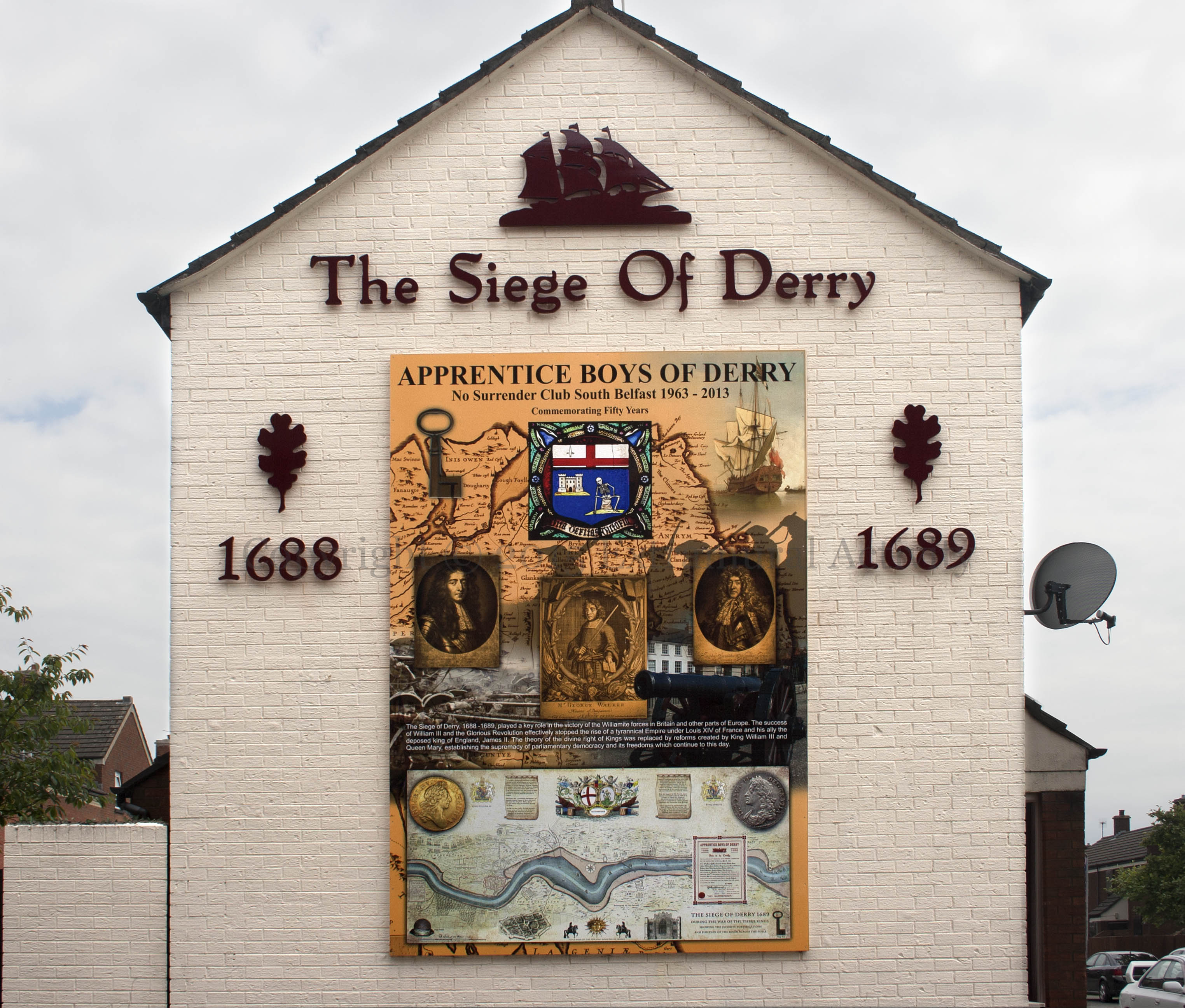
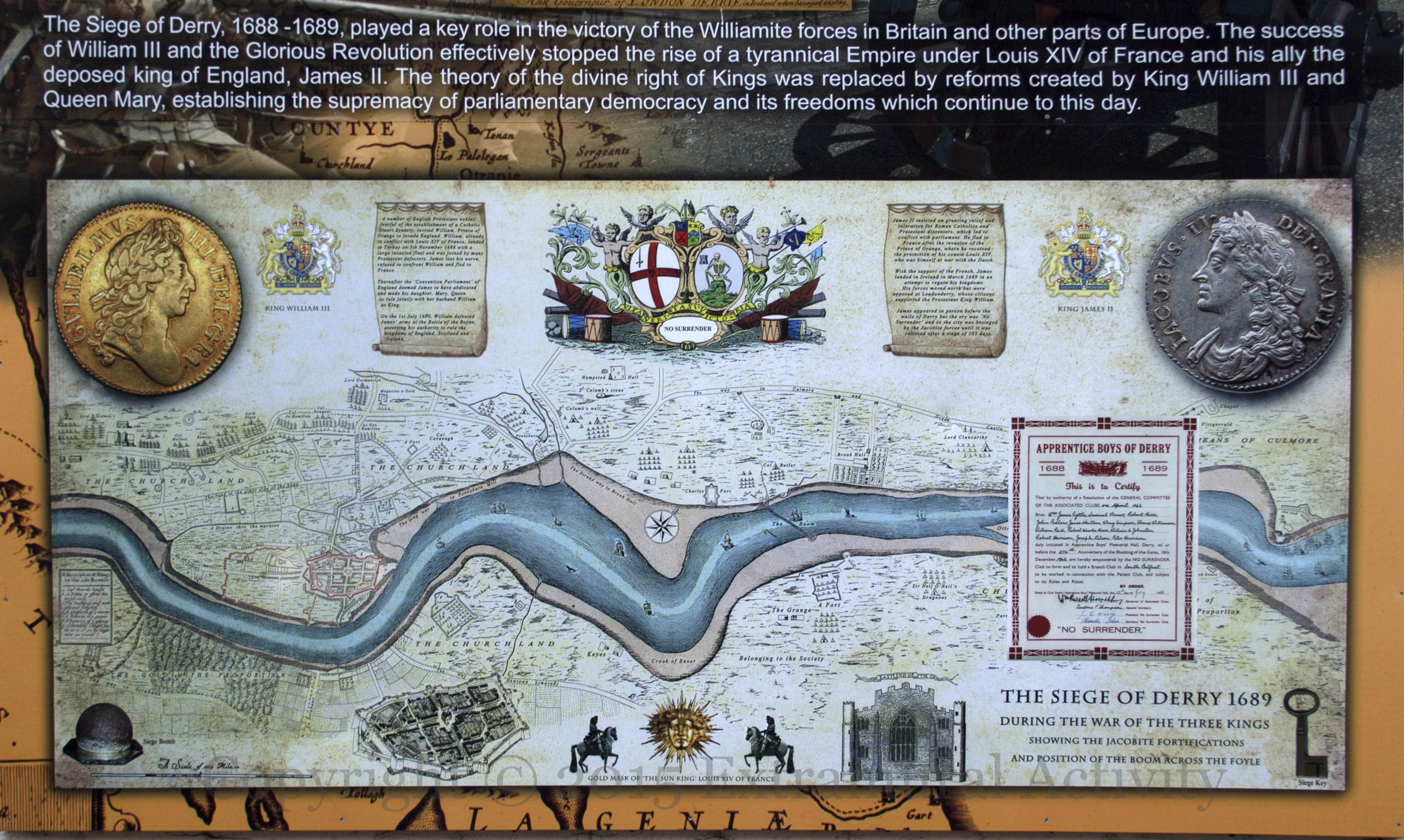
Oak Street is a fitting place for a mural about the Siege of Derry, as the oak leaf, shown to the left and right of the board above (and in the wide shot, below) is a symbol of the town, “doire” meaning an oak grove. The gates to the city were locked by thirteen apprentices, against the wishes of Governor Robert Lundy who wised to surrender the city. When the deposed king James II and his army arrived and demanded the surrender of the city of Derry, the cry from within was “No surrender!” The city was then besieged for 105 days until relief arrived in the form of ships of the navy of the newly crowned William & Mary.
The board shown above celebrates 50 years of the No Surrender Club South Belfast (1963-2013) a club affiliated with the Apprentice Boys Of Derry.






 Extramural Activity