
This is Shane O’Driscoll’s (ig) abstract take on the distinctively Antrim-coast foods dulse (a seaweed) and yellowman (a honeycomb confection) on Castle Street, Ballycastle.

Click image to enlarge
Copyright © 2023 Seosamh Mac Coılle
X14009 X14008
This is Shane O’Driscoll’s (ig) abstract take on the distinctively Antrim-coast foods dulse (a seaweed) and yellowman (a honeycomb confection) on Castle Street, Ballycastle.
Click image to enlarge
Copyright © 2023 Seosamh Mac Coılle
X14009 X14008

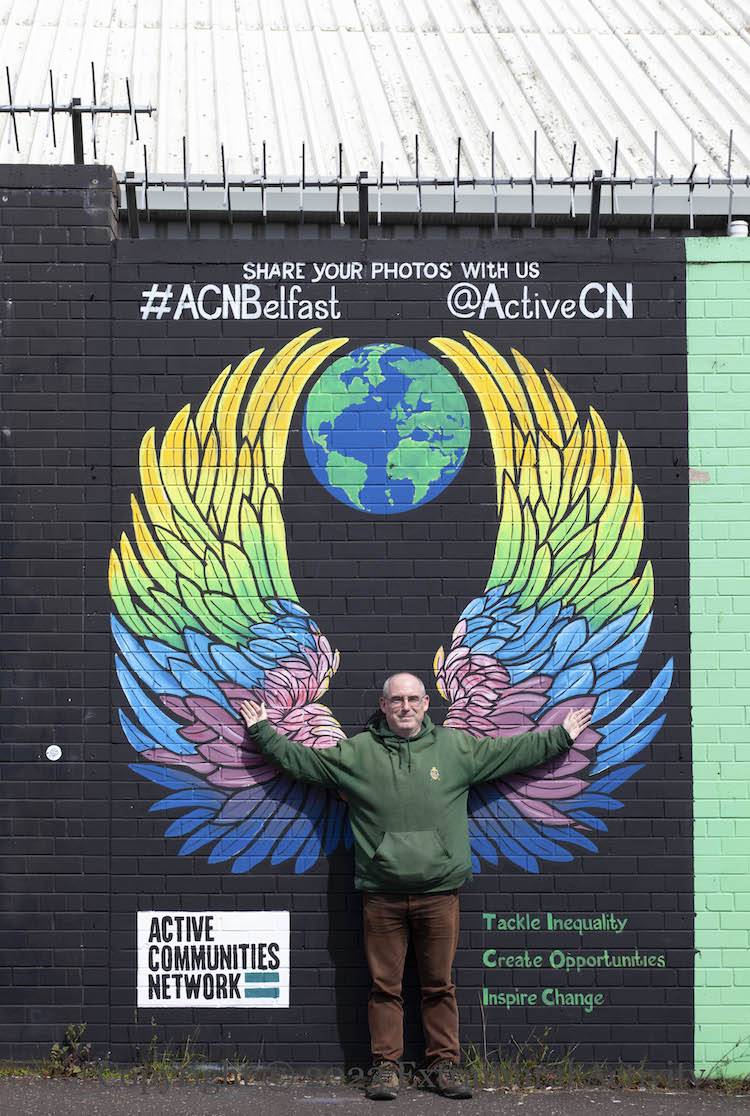
Active Communities Network (web) is a non-profit in Belfast, Manchester, and London, focused on youth and community development: “Tackle inequality; create opportunities; inspire change”. Passers-by are invited to stand in the middle of the mural and “spread their wings”.
Replaces: Embrace Change Together.

Click image to enlarge
Copyright © 2023 Seosamh Mac Coılle
X14004 X14024 X12928 [X12962]
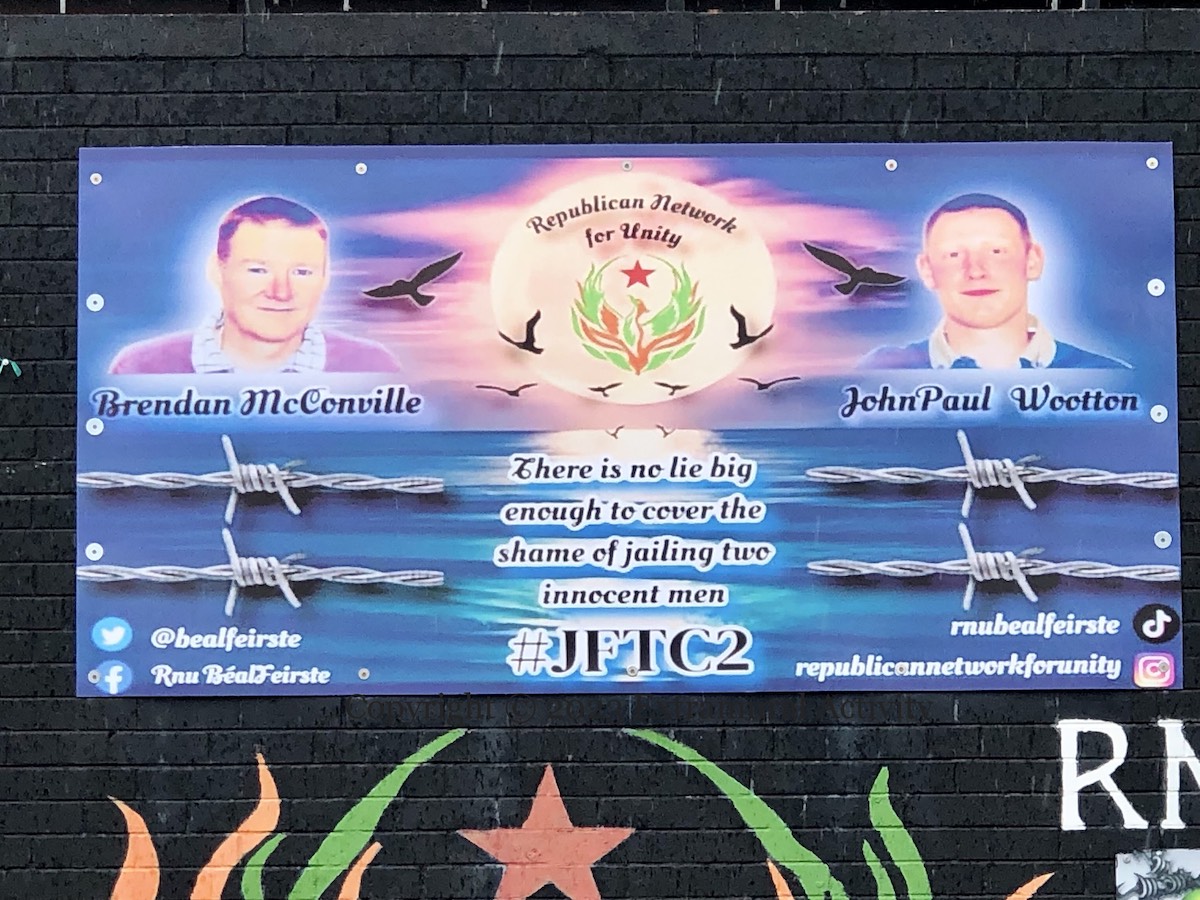
“There is no lie big enough to cover the shame of jailing two innocent men #JFTC2”, in this case Brendan McConville and John Paul Wooton. Their portraits have been appearing on RNU (Fb) walls (and on Sliabh Dubh) since 2013. They are in prison, for 25-year and 18-year minimums, respectively, for the 2009 killing of PSNI Constable Stephen Carroll (BBC).

Click image to enlarge
Copyright © 2023 Seosamh Mac Coılle
X12915 X12924
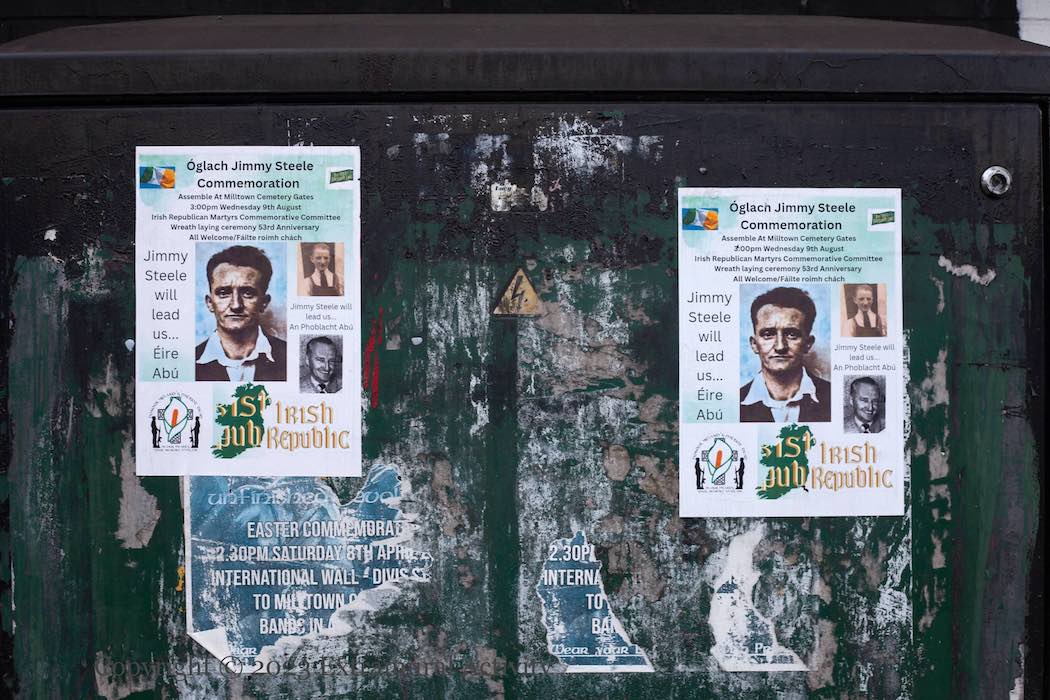
Over the course of a long career as a Fian, IRA volunteer, and Northern Command adjudtant, Jimmy Steele saw action in the S-Plan (see Joe Malone’s gravestone in Far Dearer The Grave Or The Prison) and the border campaign, went on hunger strike and “strip strike” (blanket), escaped from Crumlin Road gaol, and was the first editor of Republican News. (Treason Felony | WP) This poster (from the Irish Republican Martyrs’ Commemorative Committee – Fb)calls people to a commemoration of Steele on the anniversary of his death, August 9th, 1970.
“Óglach Jimmy Steele Commemoration. Assemble at Milltown Cemetery gates 3:00pm Wednesday 9th August. Irish Republican Martyrs Commemorative Committee wreath laying ceremony 53rd anniversary. All welcome/fáılte roımh chách.” “Jimmy Steele will lead us … Éıre abú. An Phoblacht abú.”
Northumberland Street, Belfast.
Click image to enlarge
Copyright © 2023 Seosamh Mac Coılle
X12923

“Fáılte go dtí Marrowbone youth club [club óıge Mhachaıre Bothaın (Fb)] – better our community by working together.” The verbiage is a mix of Irish and English and the imagery is a mix of youth activities and … a minion.
The previous mural – which included Cliftonville (soccer) and Antrim (GAA) emblems – was seen previously in 2013 and in 2021.


Click image to enlarge
Copyright © 2021 Seosamh Mac Coılle
X12944 [X12945] X12946 [X12947] X12948 X12949 X12950
X07820

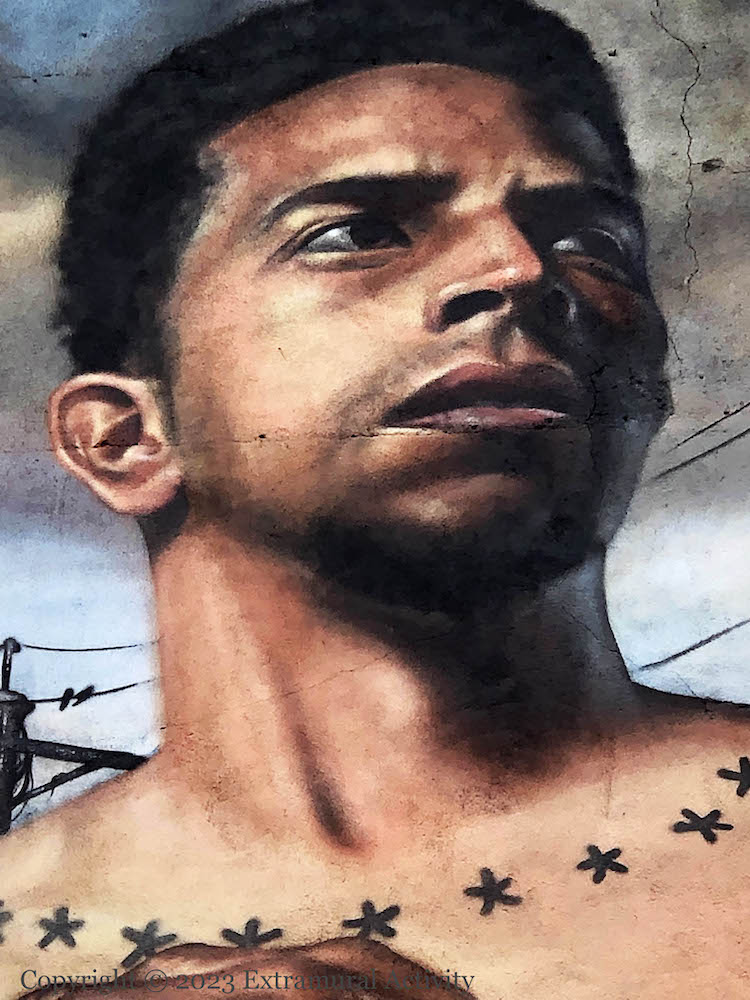
Street art by Voyder (ig) for HTN 2023 in McKibben’s Court, Belfast.

Click image to enlarge
Copyright © 2023 Seosamh Mac Coılle
X12902 X12903 X12901 [X12904]
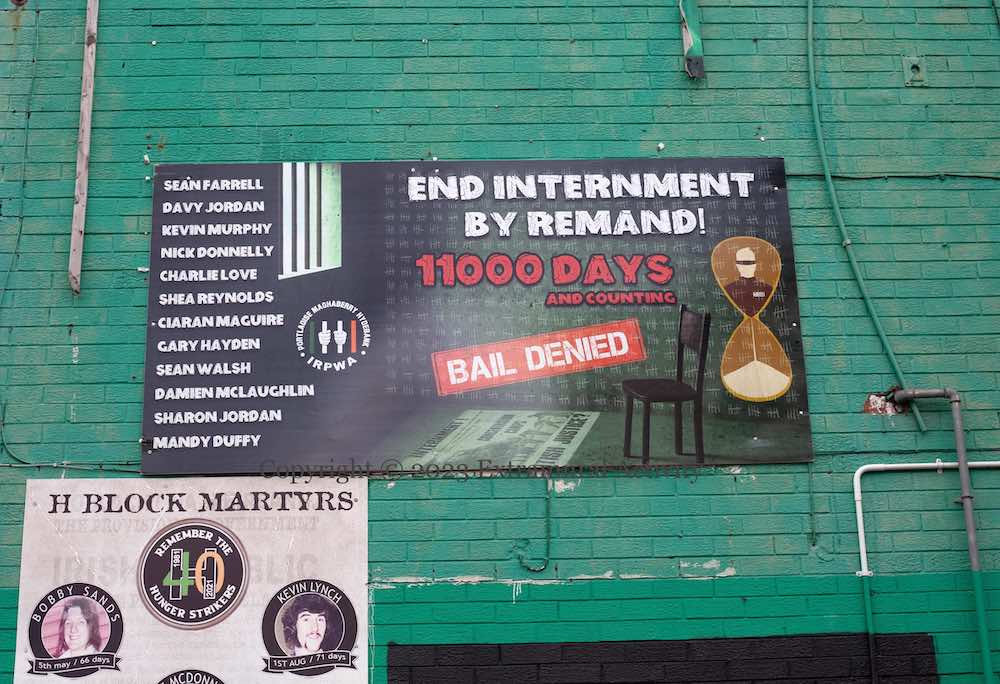
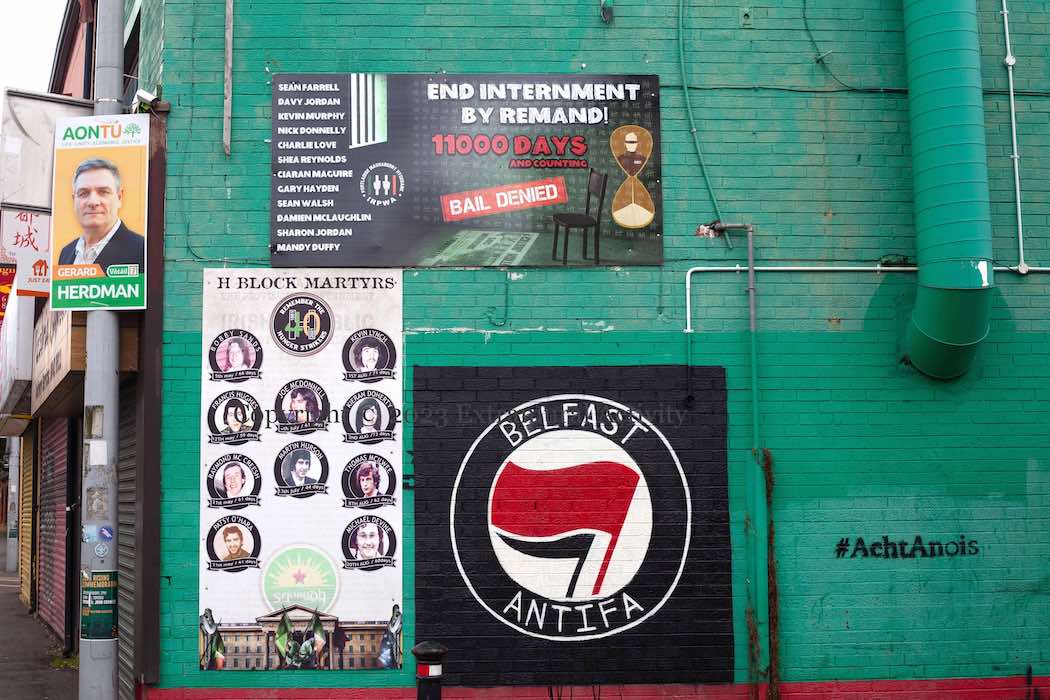
The number is arrived at by aggregating the days served by republican prisoners in Maghaberry, Hydebank, and Portlaoise (IRPWA – page contains images of all the locations in which this board was mounted).
Braemar Street, west Belfast.
“End internment by remand! 11000 days and counting. Bail denied. Seán Farrell, Davy Jordan, Kevin Murphy, Nick Donnelly, Charlie Love, Shea Reynolds, Ciaran Maguire, Gary Hayden, Sean Walsh, Damien McLaughlin, Sharon Jordan, Mandy Duffy.”
Click image to enlarge
Copyright © 2023 Seosamh Mac Coılle
X12939 X12938

A shawlie is a working-class woman wearing a shawl to serve as a coat and hat. In Belfast they are particularly associated with the workers in the linen mills, such as the Brookfield Mill on the Crumlin Road. This statue, designed by Ross Wilson, was inspired by William Conor’s painting of mill workers (and pehaps specifically “Going to the mills, Crumlin Road, 1914” which is included in the info board, below) and installed at the top of Cambrai Street in 2010 (BelTel | BBC).
See also: the trio of boards in tribute to missionary Amy Carmichael, who set up Sunday worship for shawlies at the nearby Welcome Hall.
“The Mill Worker. Belfast was one of the fastest growing urban centres in Europe in the nineteenth-century, with the linen industry a major driver. The city’s status as the world’s biggest linen producer came about partly as a result of the cotton shortages in the 1860s caused by the American Civil War.
In 1896, 96,000 people worked in linen in Belfast, making it the city’s biggest employer. The profits enabled other industries to grow, including engineering, shipbuilding, tobacco, whiskey and rope-making. Belfast became a world leader in all of these industries.
The recession between the world wars led to a dramatic reduction in the demand for linen, reinforced by changes in fashion, so the industry went into almost terminal decline and nearly disappeared.
Today, however, the supreme quality of linen is valued once again – not least on the Milan, Paris and London catwalks.”

Click image to enlarge
Copyright © 2023 Seosamh Mac Coılle
X12980 X12981
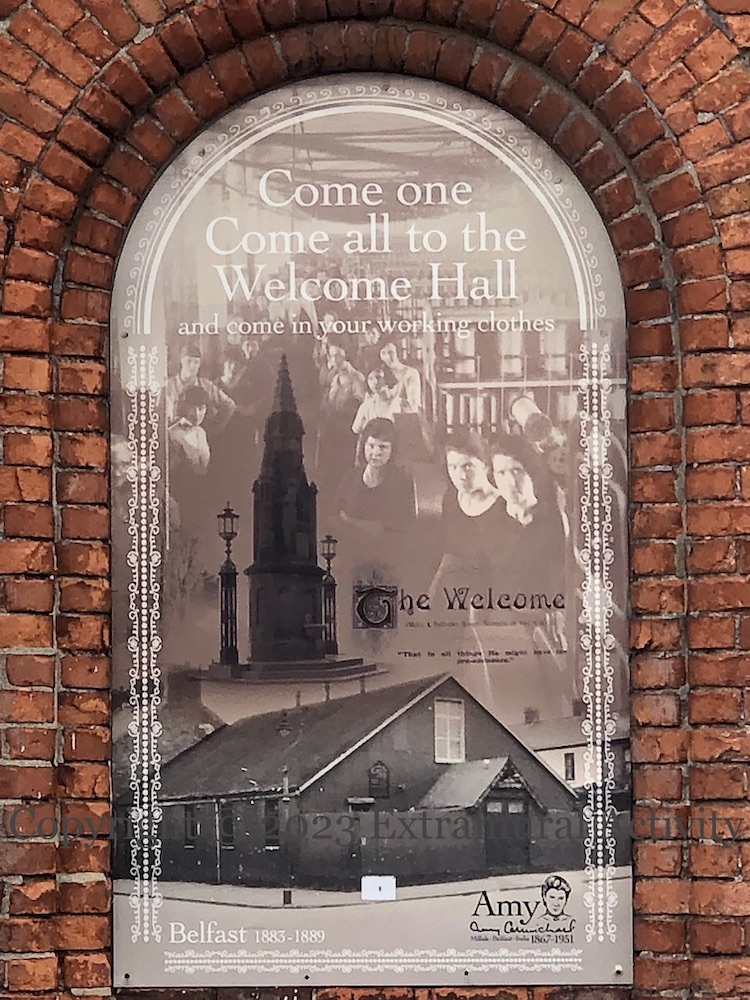
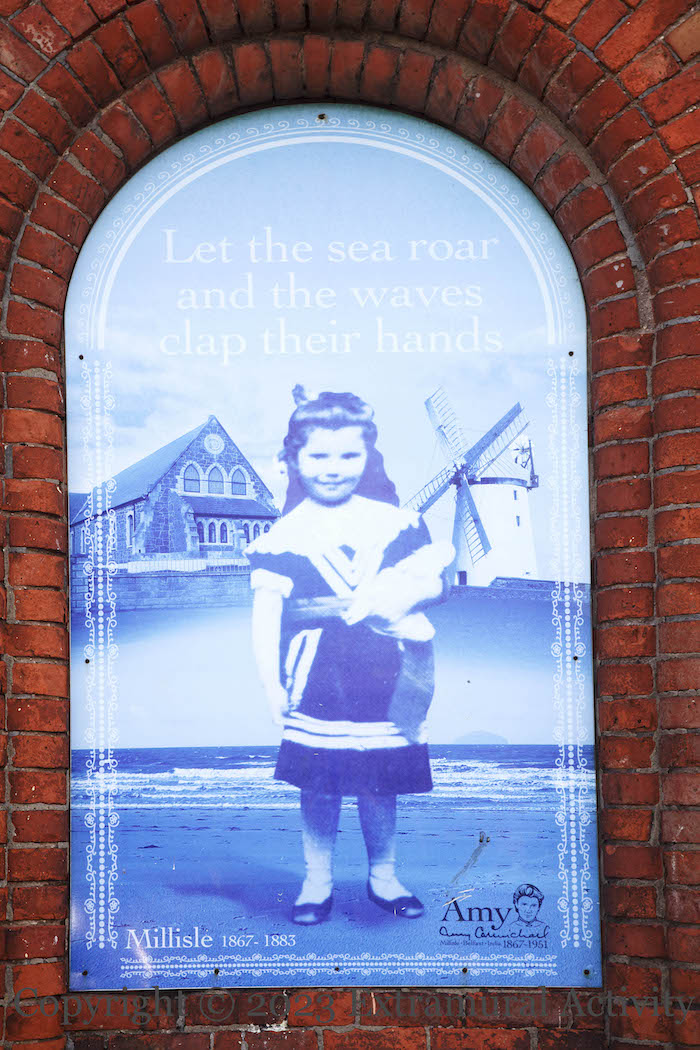
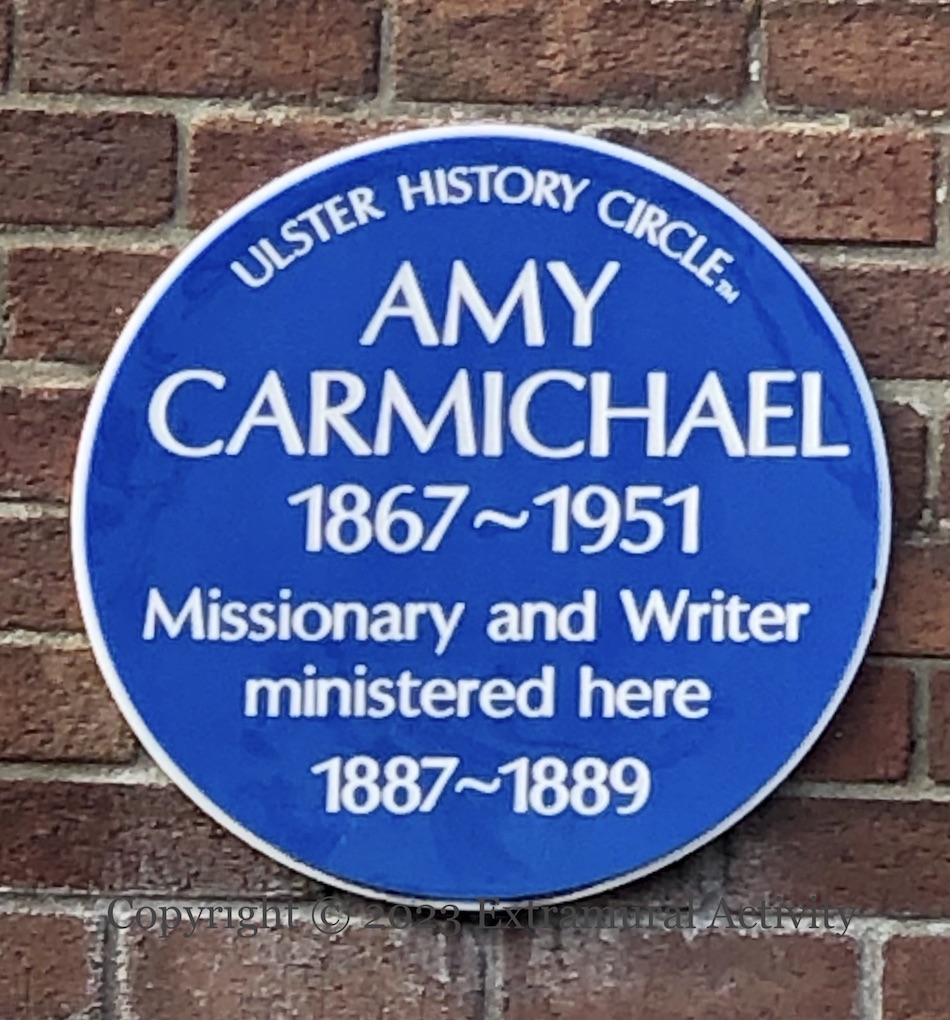
“Come one, come all, to the Welcome Hall, and come in your working clothes.” Amy Carmichael was born in Millisle, Co. Down, in 1867. In 1884 the family moved to Belfast, where Amy started Sunday classes in Rosemary Street Presbyterian for “shawlies” who worked in the mills. These were successful enough that a larger venue was required, and so, in 1887, the Welcome Hall, with seating for 500, opened in Cambrai Street (this subsequently became the Welcome Evangelical Church, where the blue plaque shown below is mounted). Carmichael then went to England (Manchester), Japan, Sri Lanka, and India (Bangalore). (Welcome Church | WP)

Click image to enlarge
Copyright © 2023 Seosamh Mac Coılle
X12838 [X12866] X12865 X12867
X12864

 Extramural Activity