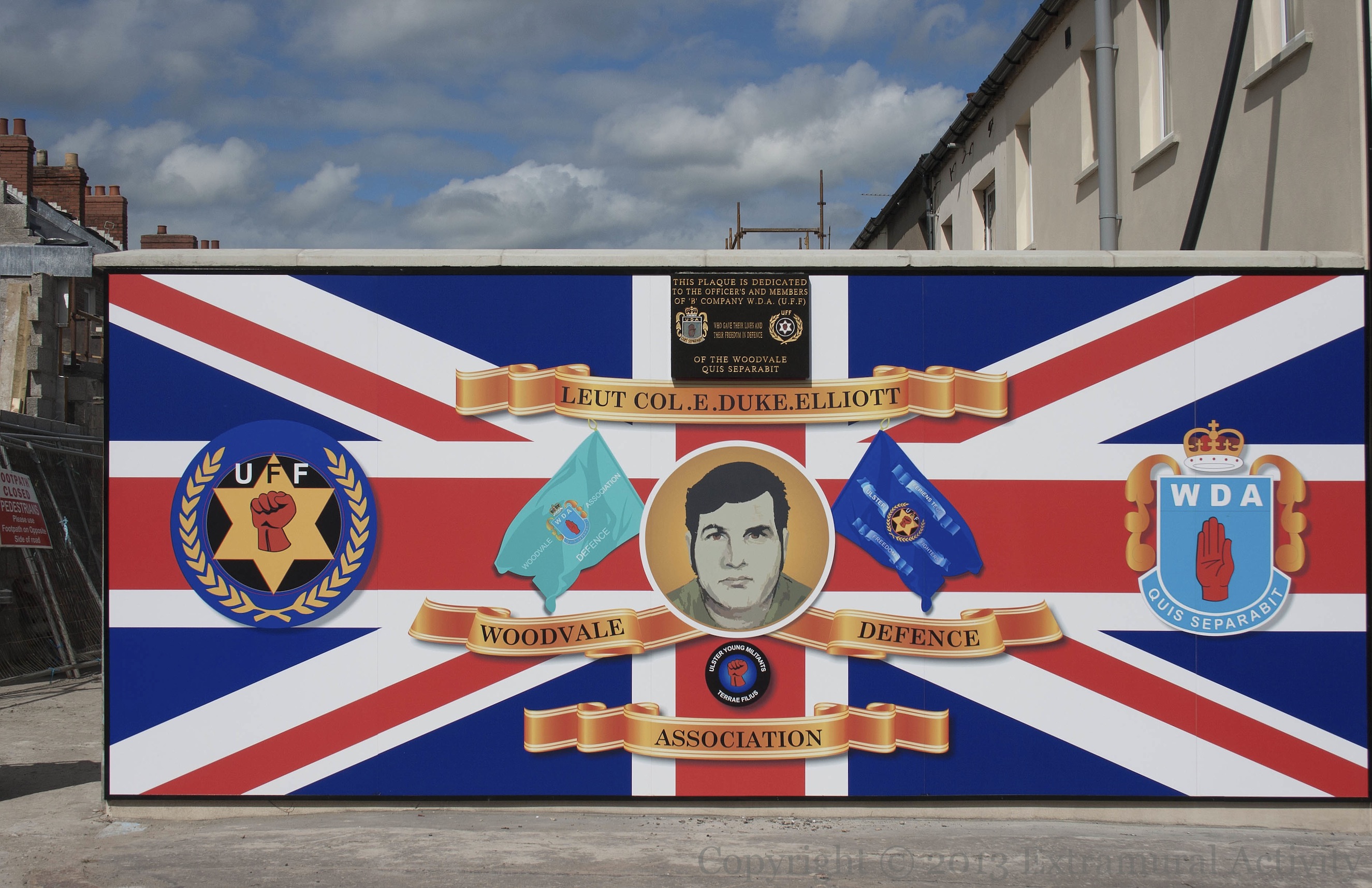
As mentioned in UDU-WDA-UDA-UFF, the end wall of Columbia Street was knocked down, taking with it a former Duke Elliott/UDA mural, which has now been replaced with boards (rather than murals) commemorating the history of the UDA and Elliott. Elliott lived one street over, in Leopold Street (WP). He was killed in 1972, at age 28, in a dispute with other UDA members.
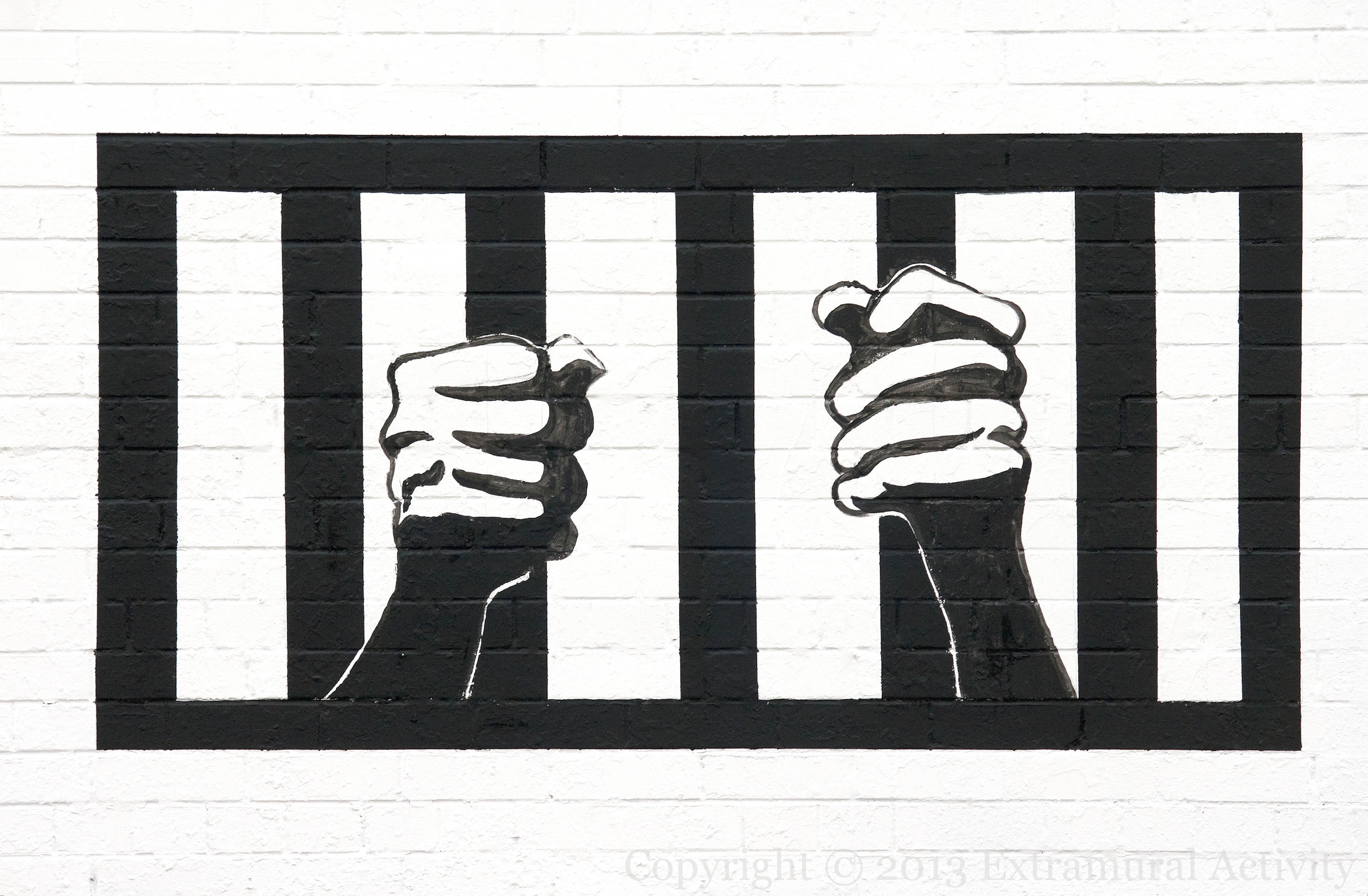
A new half-size (or 2/3rds-size) mural on the International Wall, Divis Street, in stark black-and white: End British Interment of Irish Republicans 2013. The mural was painted to coincide with the anti-internment march on August 9th that was routed through Belfast city centre and sparked violent protests (U.tv video reports).
Replaces the ‘Maghaberry – Stop Strip Searches’ piece, which itself earlier replaced this Maghaberry piece.
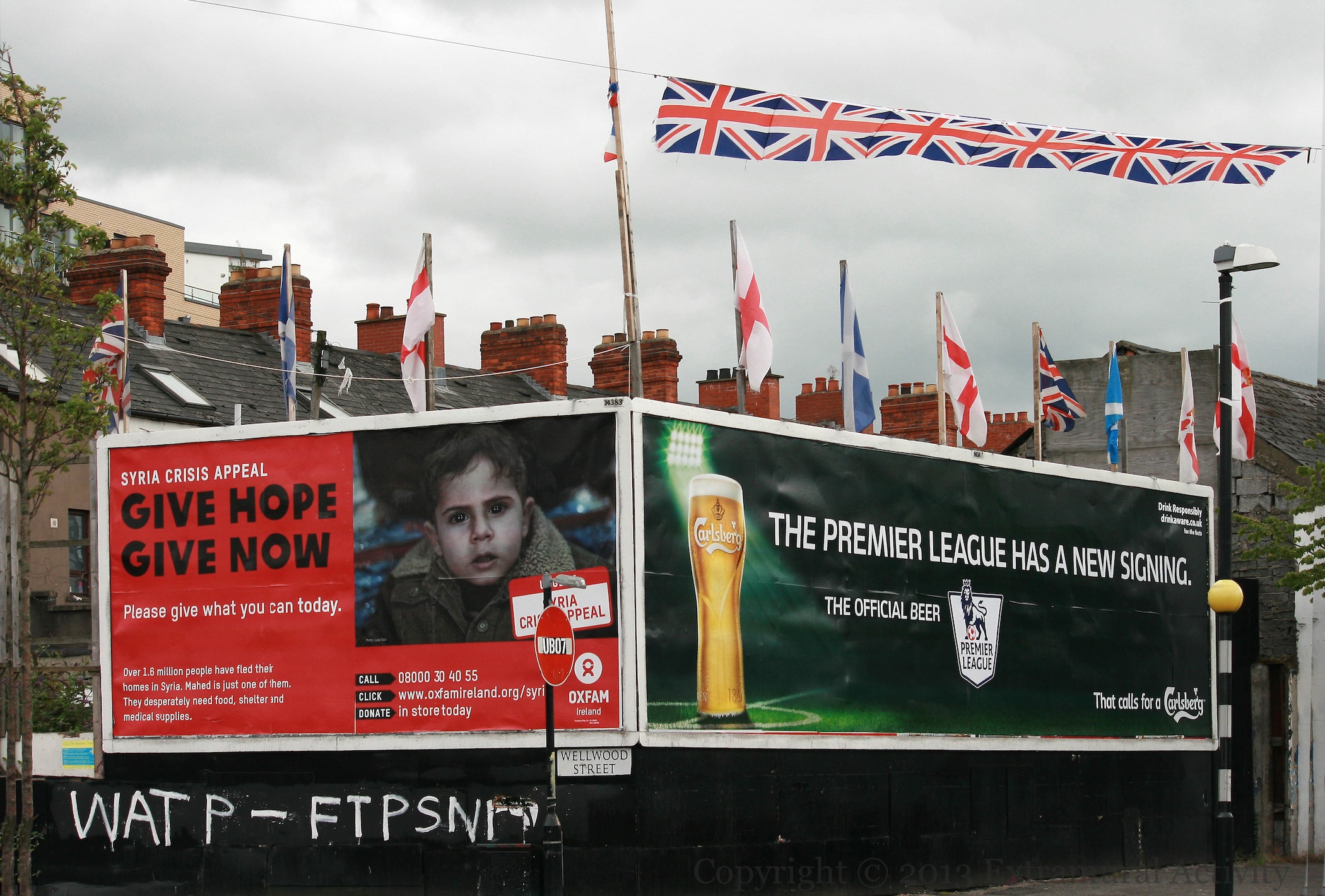
Loyalist graffiti on the corner of Wellwood Street and Sandy Row, beneath a variety of UK flags and union bunting. ‘WATP’ is ‘we are the people’; ‘FTPSNI’ is ‘eff the Police Service [of] Northern Ireland’. On the stop sign you can also see ‘UB07’ – Union Bears, a Rangers supporters club.
Mural from mid-2011 on the “international wall” (Visual History) featuring a quote from early (1976) hunger-striker Frank Stagg (WP), along with portraits of Stagg, Michael Gaughan (d. 1974 WP) and the 10 strikers who died in 1981. The images of Stagg and Gaughan, along with a Tricolour and a copy of the Proclamation of the Irish Republic, are here concealed by a placard announcing a rally commemorating the hunger strikers.
This mural takes the place of a pro-Basque mural (and the Martin Meehan bookmark) in the second half of 2011. There is currently no Basque mural on the wall.
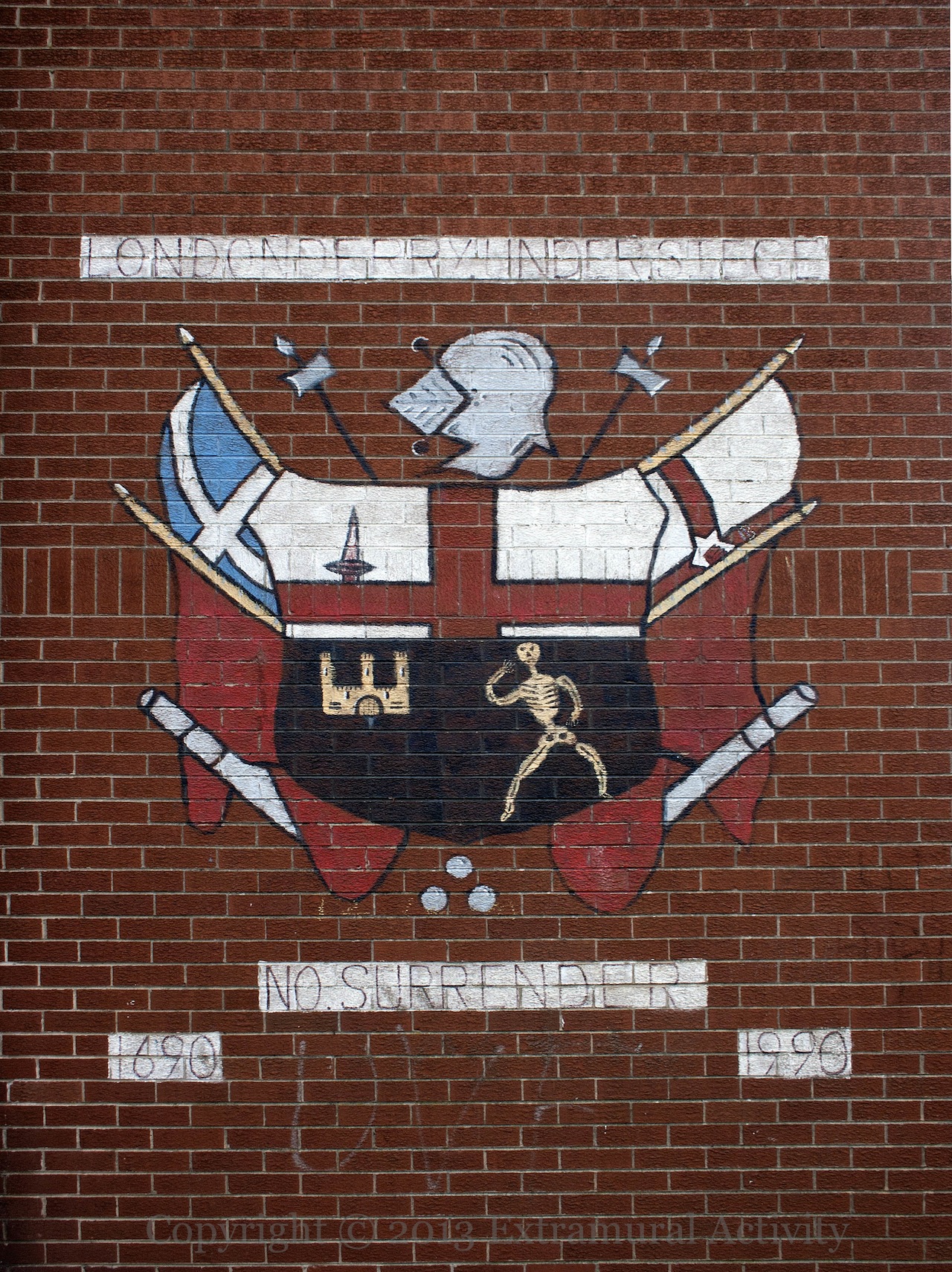
This Sandy Row mural commemorating the siege of London-/Derry is in pretty good shape, despite being more than 20 years old. It features the coat of arms of Londonderry – see this post – Vita, Veritas, Victoria – for some background. For more on the siege, and relief, of Derry, see Breaking The Boom. The siege ended in 1689; the battle of the Boyne was in 1690. It is in Linfield Avenue and is visible from Rowland Way, off Sandy Row.
Graffiti in Linfield Gardens (off Sandy Row) making reference to the banner shown in this post (on a bonfire) and on-going disputes over the routes established by the Parades Commission for Orange Order marches: They may have stole[n] our banner but they will never steal our culture.
A recently installed plaque to Carl Gilbert Hardebeck in the vestibule of Holy Family Church, Limestone Rd. Of German and Welsh extraction, born in London, and blind from an early age, he came to Belfast when he was 24. He learned Irish and began collecting Irish music. Hardebeck believed that if there was music in hell it was the bagpipes!
Eugene Dunphy, who has made a film on Hardebeck, spoke at the unveiling, and the brothers Mac Maoláın, retired priests Breandán and Caoımhín, unveiled the plaque. The unveiling ceremony, including performance of a Hardebeck piece, is documented in the video below. Dunphy is still researching the life of Hardebeck; if you have any information, contact him via his Hardebeck web site. (2016-04 Irish News article)
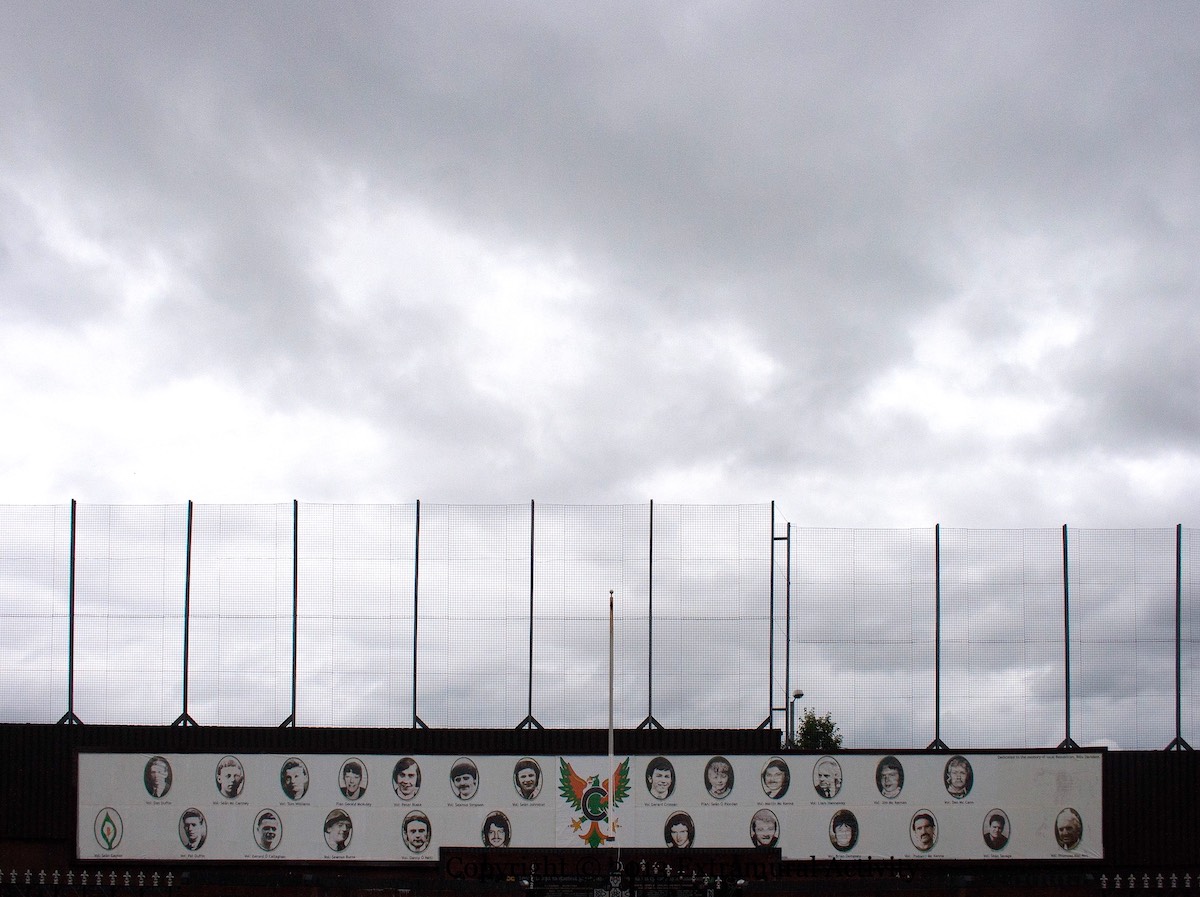
The back wall of Clonard Martyrs Memorial Garden – that is, the so-called “peace” line – is decorated with portraits of twenty-five local óglaıgh and fıanna who died from 1920 to 1992 (though an Easter lily takes the place of Sean Gaynor on the far left).
Left: Dan Duffin, Seán McCartney, Tom Williams, Gerard McAuley, Peter Blake, Seamus Simpson, Seán Johnston, Seán Gaynor, Pat Duffin, Gerard Ó Callaghan, Seamus Burns, Danny Ó Neill, Tom McCann.
Right: Gerard Crossan, Seán Ó Riordan, Martin McKenna, Liam Hannaway, Jim McKernan, Dan McCann, “dedicated to the memory of local republican, Billy Davidson”, Tony Lewis, Joe McKenna, Brian Dempsey, Finbarr McKenna, Seán Savage, Prionsais Mac Áirt.
They are also listed on one of the plaques inside the garden – see the second images in Clonard Martyrs.
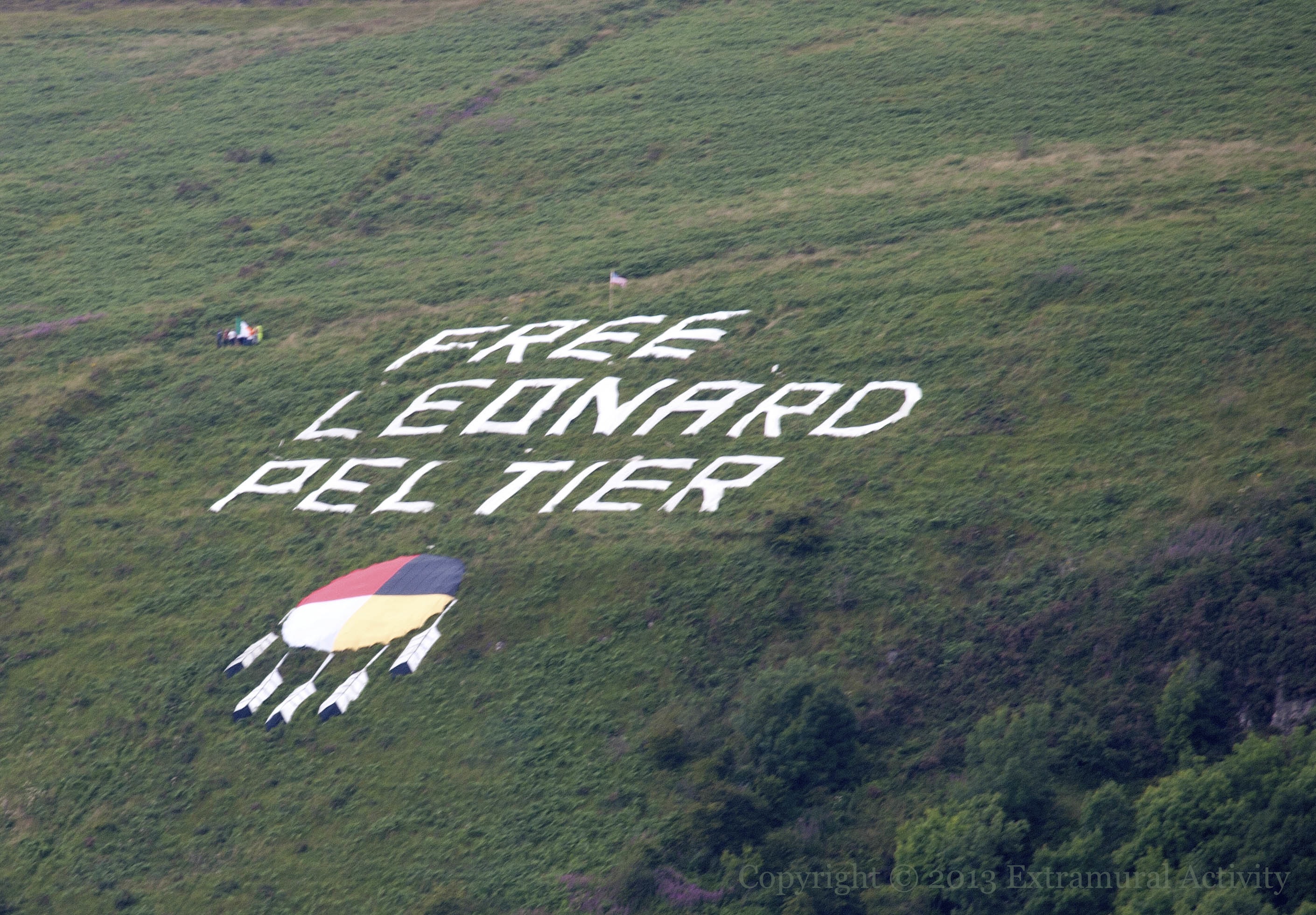
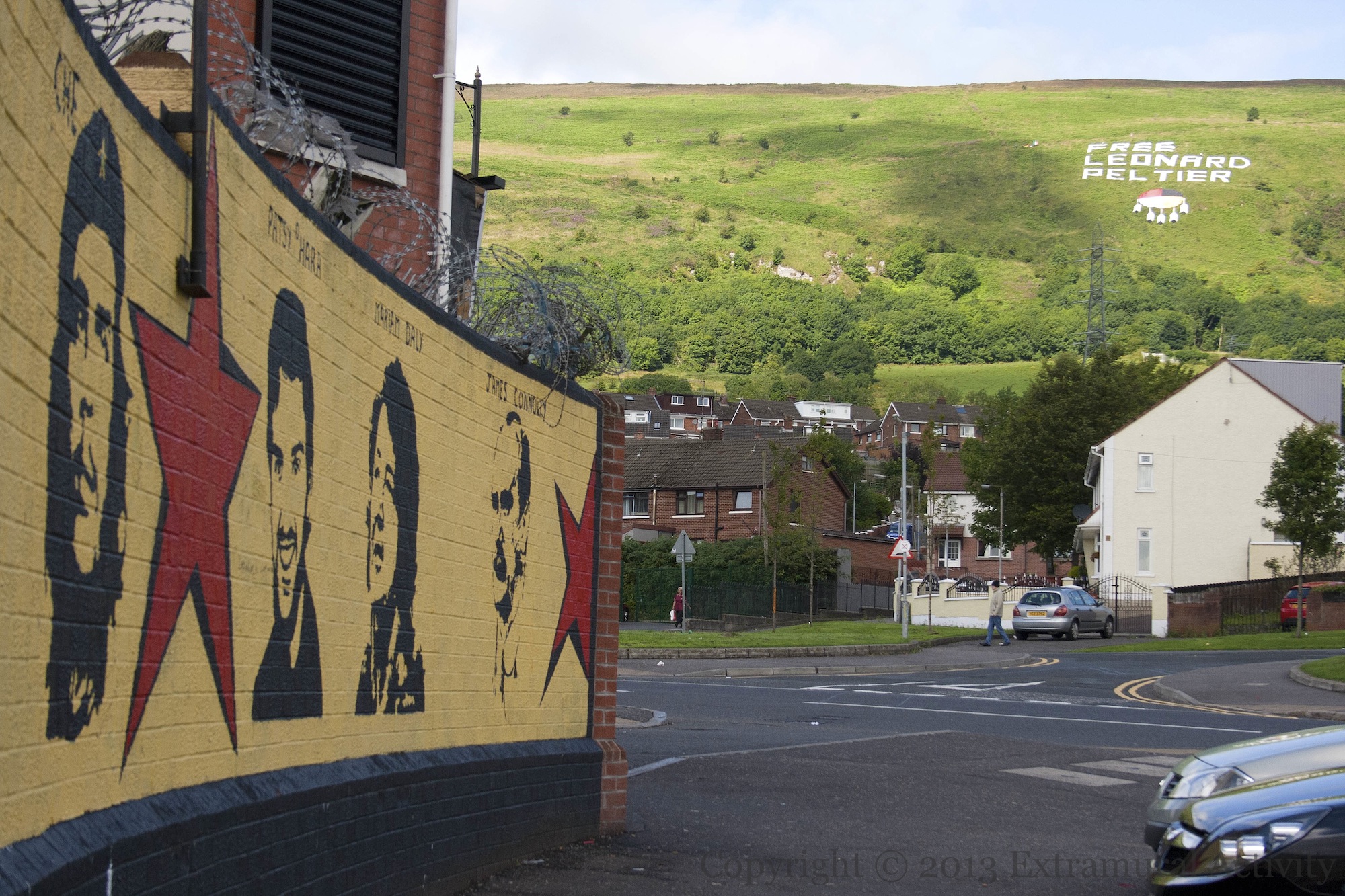
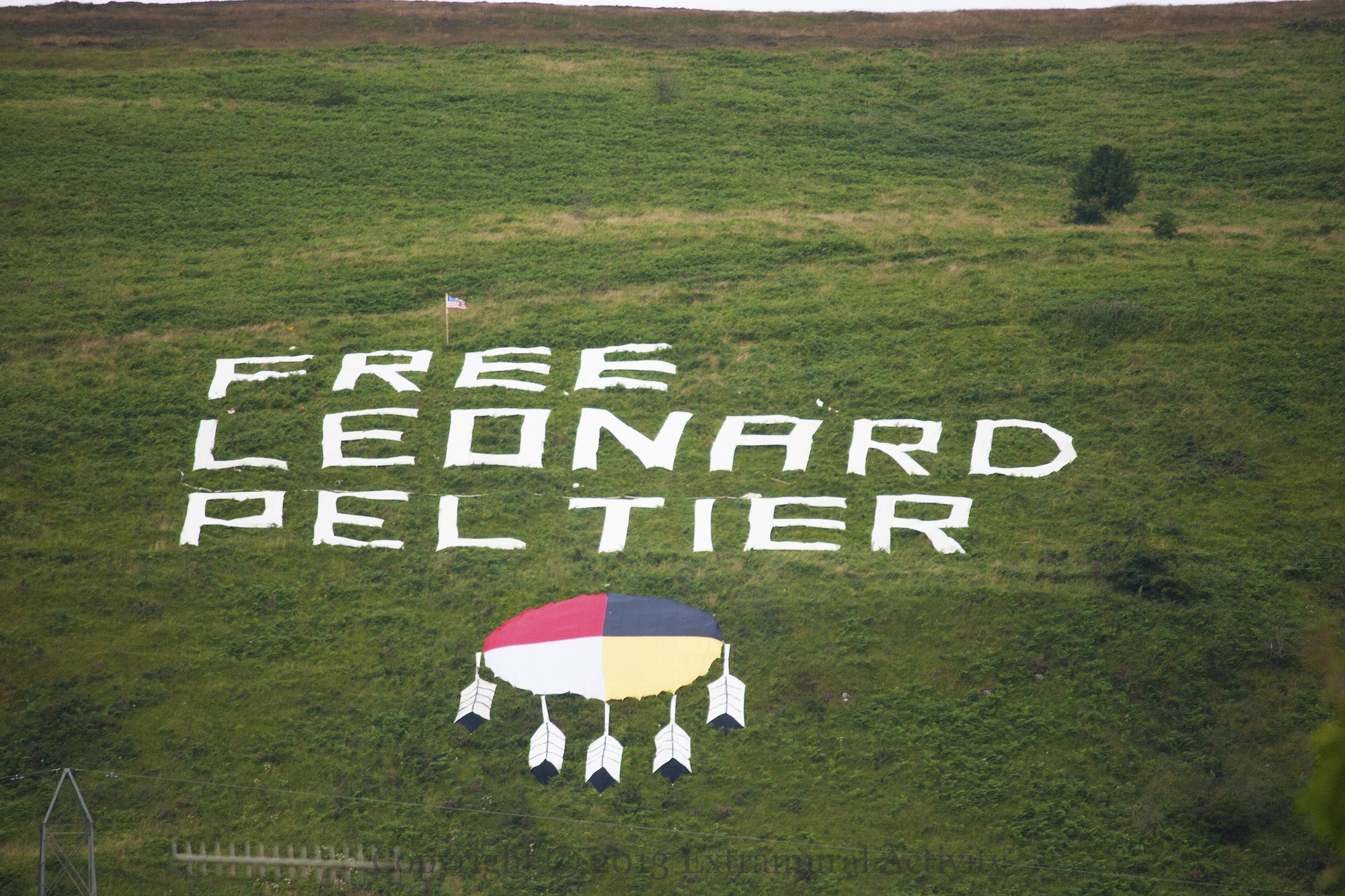
A message for the U.S. government on the side of Black Mountain this week, concerning the incarceration of Leonard Peltier for the shooting deaths of two FBI agents in South Dakota (WP). A U.S. flag flies at the top of the lettering, and the scale of the piece can be gauged from the small crowd of people standing off to the left. Below is a straight-on shot and, before that, a view from the corner of the shops at the Springfield/Whiterock junction.
The gable wall at the end of Columbia Street (on Ohio Street) has been rebuilt and the old WDA/Duke Elliott mural has been replaced. Above is the right side of the piece, which describes the transition from the Woodvale Defence Association to the Ulster Defence Association to the Ulster Freedom Fighters, and grounds all three in the Ulster Defence union of 1893.
In the second image, below, Ewart’s mill, on the Ardoyne side of the Crumlin Rd, can be seen in the background. From the WP page on the Crumlin Rd … “The mill was built for William Ewart, a cotton trader and politician who switched his interests to the production of linen, which at the time became the leading industry in the city. During the Second World War the mill was converted from the production of linen to the manufacture of munitions.” There is a statue diagonally across the street (at the corner of Cambrai and Crumlin Roads) of a millworker.
In 1971 in order to combat an increasingly aggressive republican movement, the WDA amalgamated with a number of other defence groups in form the UDA. This ensured a more organised and coherent response to the onslaught faced by the citizens of Northern Ireland.
The UFF was established in 1973 to take the war to republicanism. With tenacity, courage and resilience the members of the UFF distinguished themselves in battle by striking at the very heart of republican movement and ensuring that the attacks faced by their community didn’t go unanswered.
2013: The genesis of these groups can be traced right back to the formation of the UDU in 1893. Formed to resist Home Rule in the late 19th and 20th centuries, the UDU adapted the motto Quis Separabit. This motto was used by ulster defenders throughout the period known as “the troubles”.








 Extramural Activity