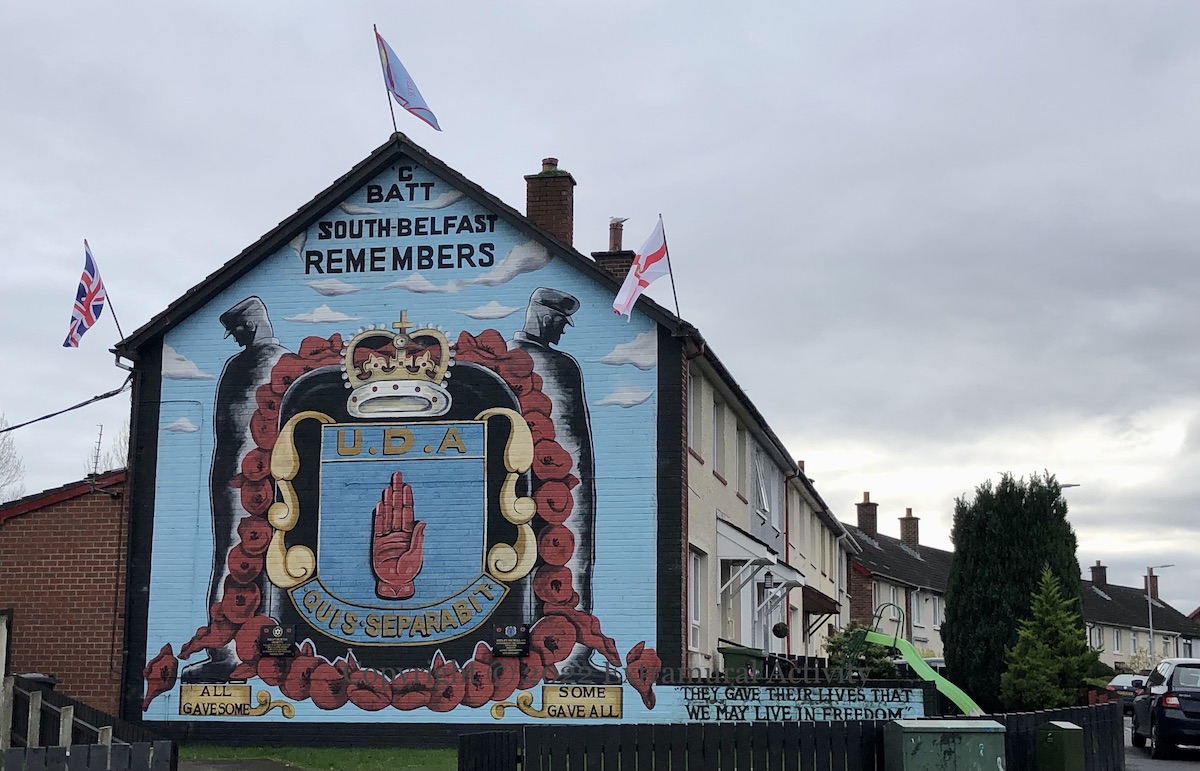
The old C Batt mural further up Hornbeam Road has long been painted over. It used the same line – “They gave their lives that we may live in freedom” – to remember Wesley Nicholl and Brian Morton. A plaque to Morton is now included on top of the new mural. “Brian Morton (Morty) killed in action 07/07/1997, a true Ulster patriot who gave his life in defence of his country. Feriens tego.” As with republican memorials, “active service” means that Morton was killed by a premature bomb exploding.
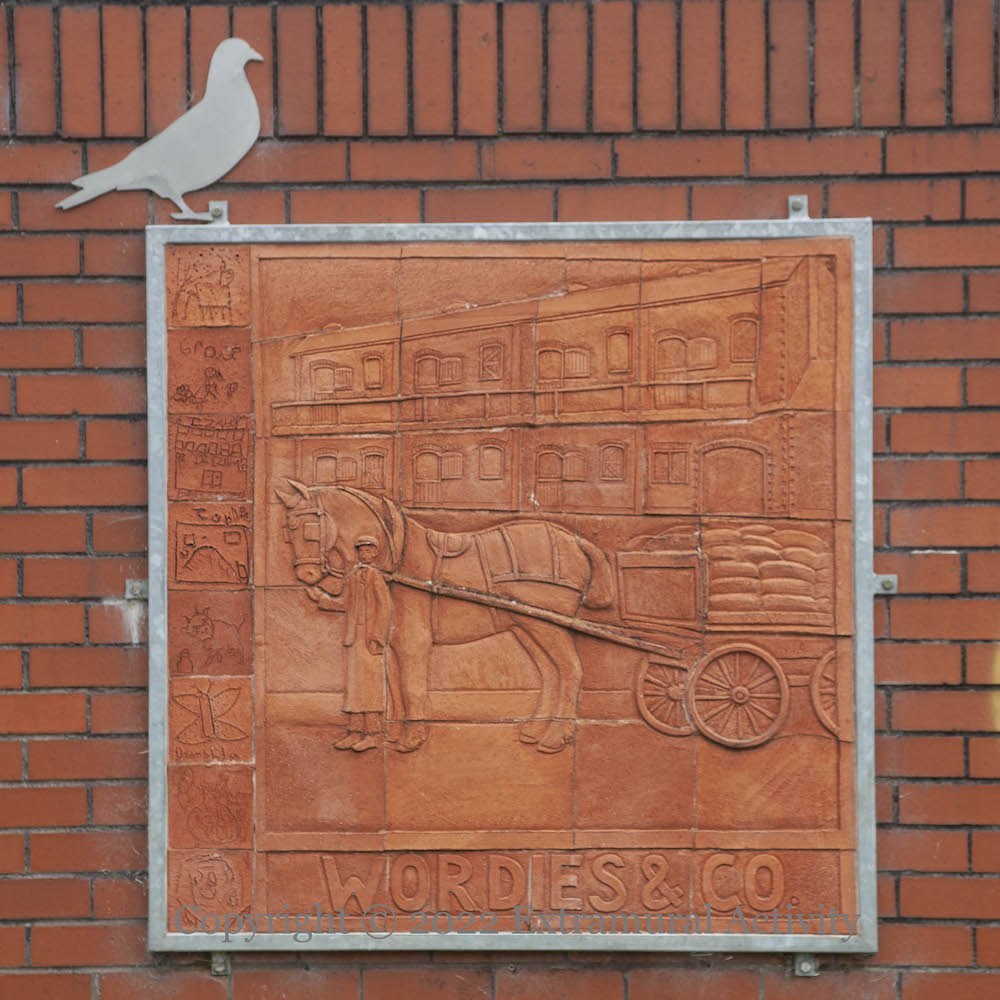
According to a history of Brown’s Square, the area was known as “the oasis” during WWII on account of its 3 dance-halls and 22 pubs (Religion, Riots And Rebels). As with so much publicly-funded art (though we cannot find any provenance for this art) it depicts Belfast in the “good old days” – that is, before the Troubles, which produced the so-called “peace line” dividing west Belfast.
In this case of Brown’s Square, the area was further desolated in anticipation of a planned ring road (formally to be known as the Belfast Urban Motorway). the plan produced only the subterranean “Westlink” that cut Brown’s Square in half. The images in today’s post are in Townsend Street, (these are from below the security gates; there are others above it). Before the construction of the Westlink, which opened in 1981, Townsend Street was considered the western border, and part of Brown’s Square. John Gilbert’s photographs at the Belfast Archive Project show the area in the mid-seventies, when much of it had been abandoned but prior to construction.
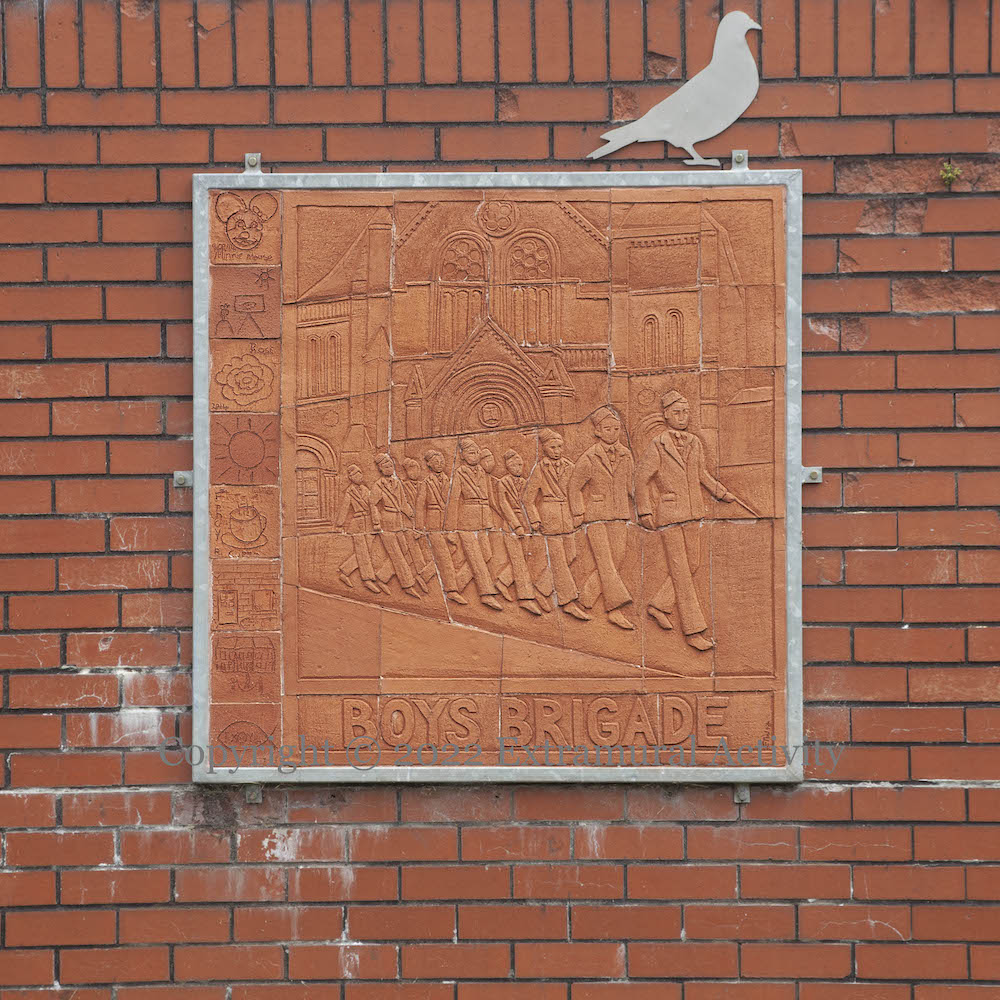
The Boys Brigade are shown parading in front of Townsend Presbyterian which held its last service in September and is being handed over to the Ulster Orchestra (Belfast Media) (see previously On The Other Side for stained glass windows inside the church). The Brown’s Square school was at the junction of Brown’s Square (the street) and Melbourne Street.
The buildings on North Street above the art deco Bank Of Ireland building – including a former home (called The Loft) of the artists’ collective now known as The Vault– were razed in 2017. Since then, the hoarding around the site has been a site for street art and graffiti art, most recently a series of Clash Street Kids pieces (inspired by the ‘Bash Street Kids’) by the TMN krew. The plan for the location is now to produce (for 100 million pounds) a building housing a multi-media presentation of the results of an “unparalleled programme of story collection” (Belfast City Council) that will be attractive to an anticipated 1.8 million annual visitors (Architects’ Journal).
For the street art in the background, see Belfast Deco.
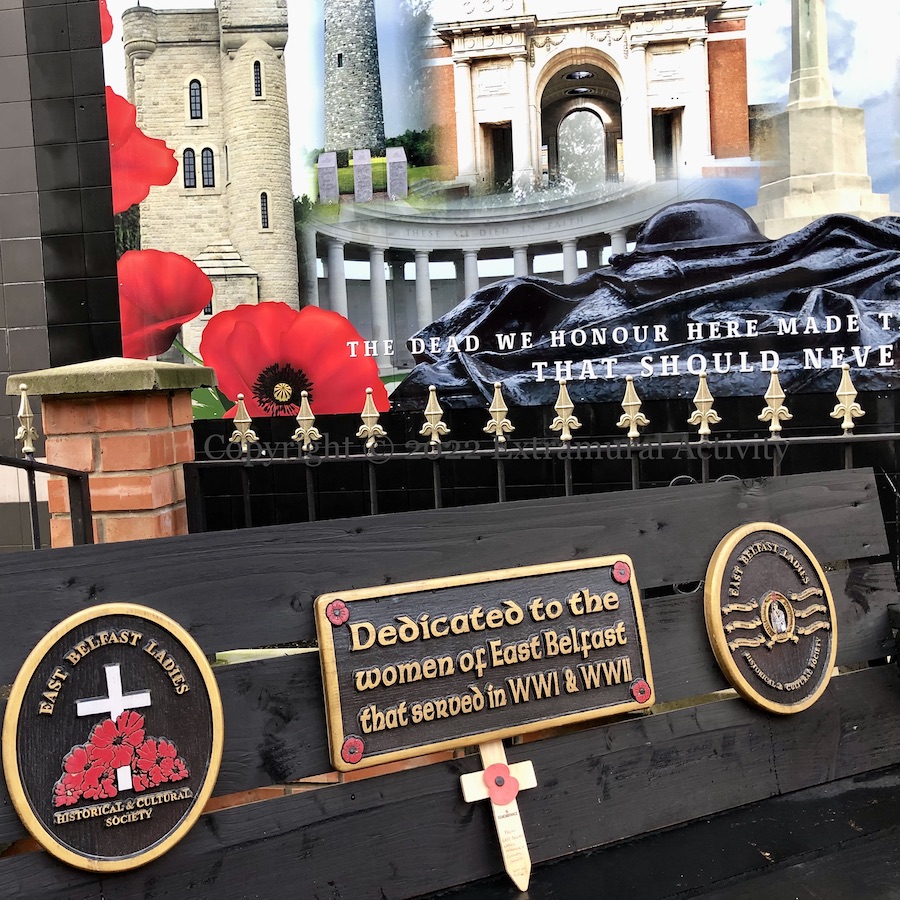
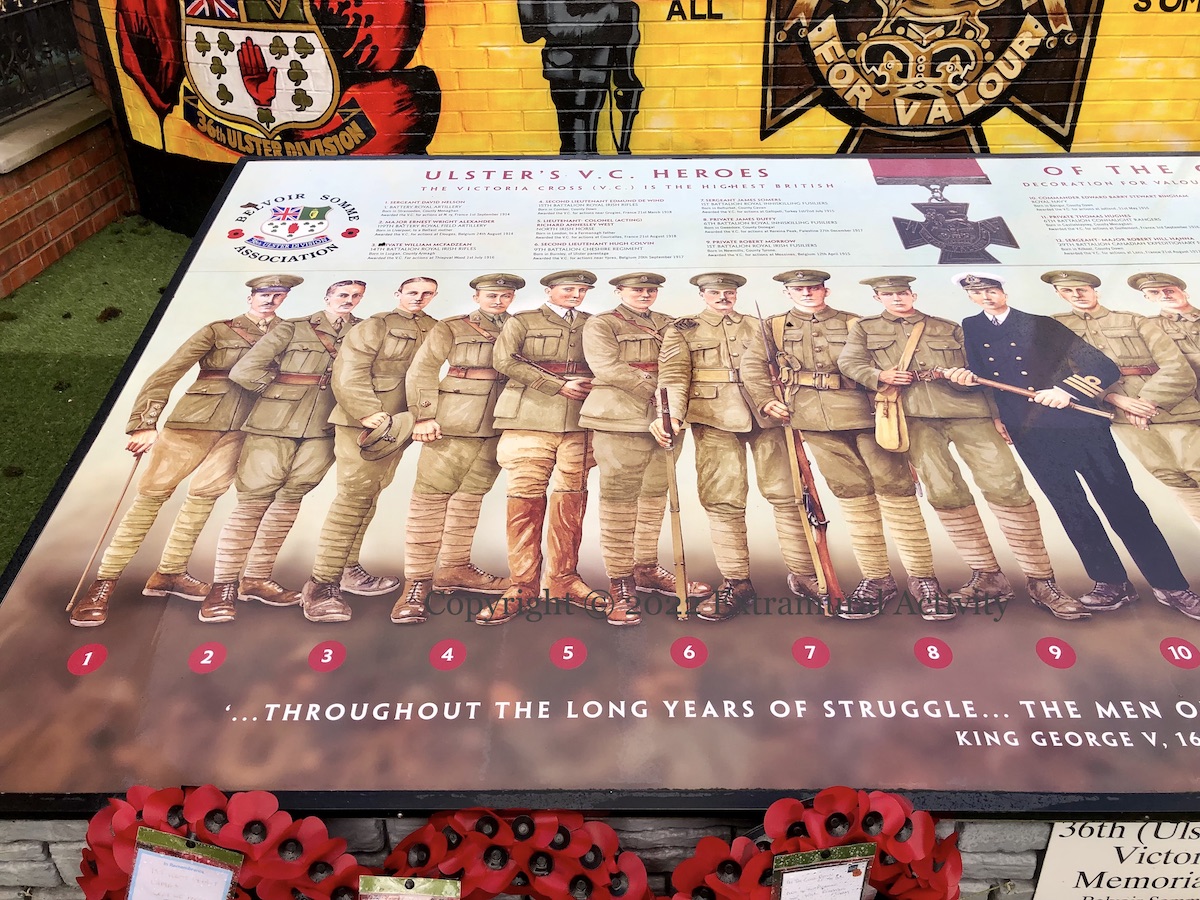
“The dead we honour here made the noble sacrifice for a cause that should never be forgotten.” A new board has been added to the memorial to the Ulster Volunteers on the Newtownards Road at St Leonard’s Crescent (the old Newcastle Street) over the bricked-up windows of the Belvoir Bar (see previously Not For Sale). The annual parade of the Belvoir Somme Association took place at the end of September (youtube)
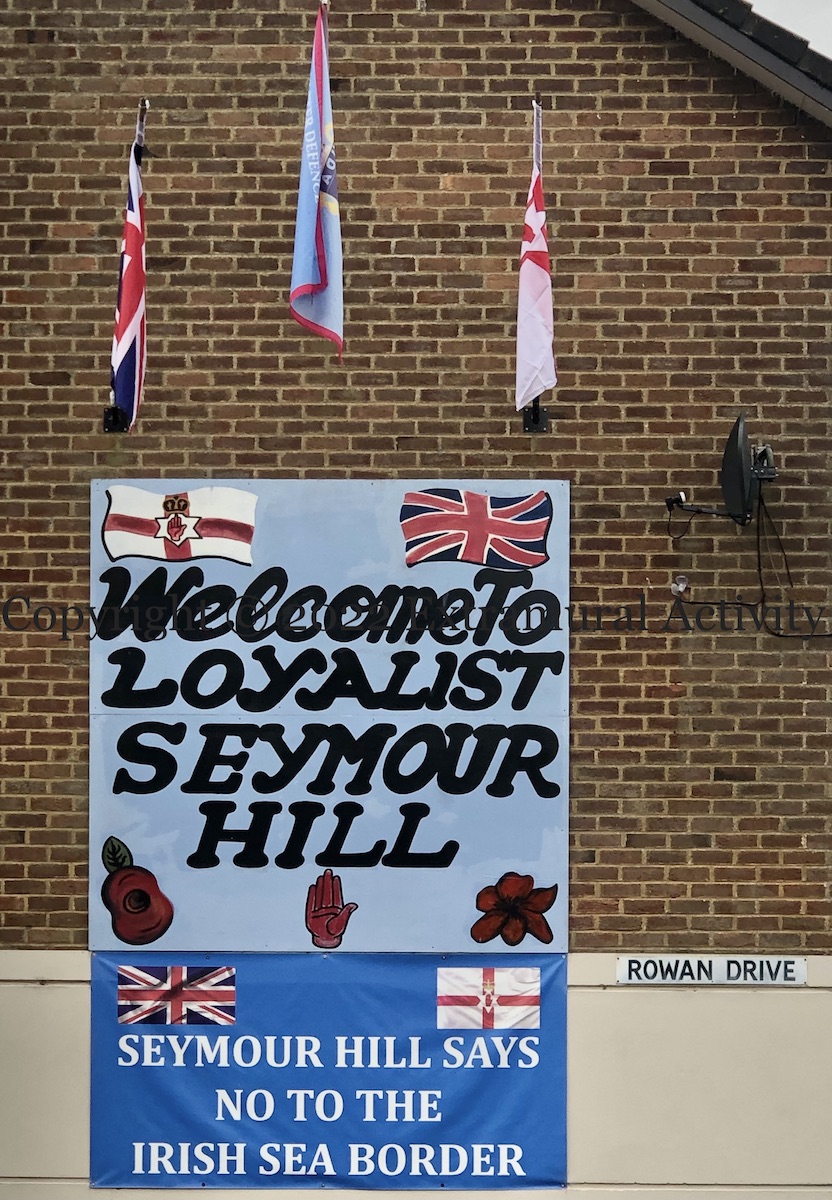
“In remembrance of all those Ulster men and women from the greater Dunmurry area who died during the Great Wars 1914-18 and 1939-45. Also those men and women who died during the recent conflict. Lest we forget.” These are the same words as appeared on a plaque on the previous memorial, which included the Special Constabulary. In the background is a “Welcome to loyalist Seymour Hill” board with flags and poppies, along with a 2021 tarp reading “Seymour Hill says no to the Irish Sea border”.
This is a memorial garden in Westland Street, Derry, in remembrance of children who have died during the Troubles.
They are listed in the following order on the main stone: Bernadette McCool, Carol Ann McCool, Damien Harkin, Gary Gormley, Annette McGavigan, Manus Deery, James O’Hagan, Gerald Doherty, Daniel Hegarty, Tony Diamond, Gordon Gallagher, Kathleen Feeny, Michael Meenan, John McDaid, Paul Whitters, Stephen McConomy, Charles Love.
McGavigan was the first to die at the hands of British forces, in September 1971, though the cross on the right is to nine-year-old Damien Harkin, who was crushed in July 1971 by a British Army lorry accident in the Bogside (MFD). Gary Gormley was also crushed by an armoured car (MFD). McGavigan is depicted in one of the murals in the ‘Bogside Gallery‘ series: The Death Of Innocence.
Other deaths were earlier but did not involve British forces: the McCool sisters died in a premature explosion in Creggan in 1970 and James (Jim) O’Hagan was killed in August 1971 by a fellow IRA member.
Gerry Doherty, Kathleen Feeney, Tony Diamond, Gordon Gallagher, Michael Meenan, John McDaid, and Charles Love also died accidentally by their own or IRA actions (MFD profiles, which lists 20 children, adding David Devine, Joseph Connolly, and Kathryn Eakin). Charles Love was killed by flying masonry from an IRA bomb; he is remembered by a plaque in Fahan Street. There is also a plaque to Stephen McConomy in Fahan Street and long ago he was depicted in a mural in Glenfada Park.
The Manus Deery plaque under the tree to the right was previously on a wall behind the Bogside Inn, before the pub was torn down – see M01919.
The memorial tarps to Ian Ogle were photographed on October 5th and appeared in a November 13th post: For His Family. On about the 18th of November they were subject to an arson attack. Belfast Live has reaction from the family.
“The Woodvale Blitz occurred when German air raids took place during the spring of 1941. The first raid took place on April 7th/8th, the next raid came at Easter on April 15th/16th, the 3rd air raid would come on the May 4th/5th and the final air raid would take place May 5th/6th. These attacks on the city would result in over 1,000 civilians being killed and 1,5000 injured. This was the highest casualty rate of any air raids outside London during the Second World War. It was in these streets that the Woodvale area was indiscriminately attacked resulting in the total devastation of Heather Street, Ohio Street, Palmer Street and Disraeli Street resulting in the loss of many lives injuring 100’s more, most of those lives lost were families who had lived in the area for generations. The effects of the air raids and the devastation caused would last for many years to come.” The names of 79 victims are given on the right (see close-up below).
“The Woodvale Blitz April-May 1941. ‘But for the loyalty of Northern Ireland we should have been confronted with slavery and death and the light which now shines so strongly throughout the world would have been quenched’ – Prime Minister Winston Churchill 1945. We remember those who were killed, those who survived and those lives changed forever.”
There is a fresh coat of paint and all-new lettering on this UDA mural in Rathcoole but the ensignia and hooded gunmen remain the same. Compare to the 2013 image in Rathcoole UFF.
Here are various IRPWA (tw)/Saoradh (web)/Éıstıgí (Fb) statements in Derry’s Creggan and Bogside.
Above, in Iniscarn Road, “Irish republican prisoners still interned within British Gaols in Ireland”. Below that, two from Central Drive, “Support our hunger strikers in Ireland” (explained in Are You On The Side Of The 2020 Hunger Strikers?) and an aging “Disband the rebranded RUC” (seen previously in 2019).
And at the bottom, two from Westland Street, “Irish republican solidarity with Palestine” (described in a north Belfast appearance) and “Salute the men and women of violence” (for which see Her Old Tradition Of Nationhood) and one from the gaggle of boards next to Free Derry Corner: “Support republican prisoner”.