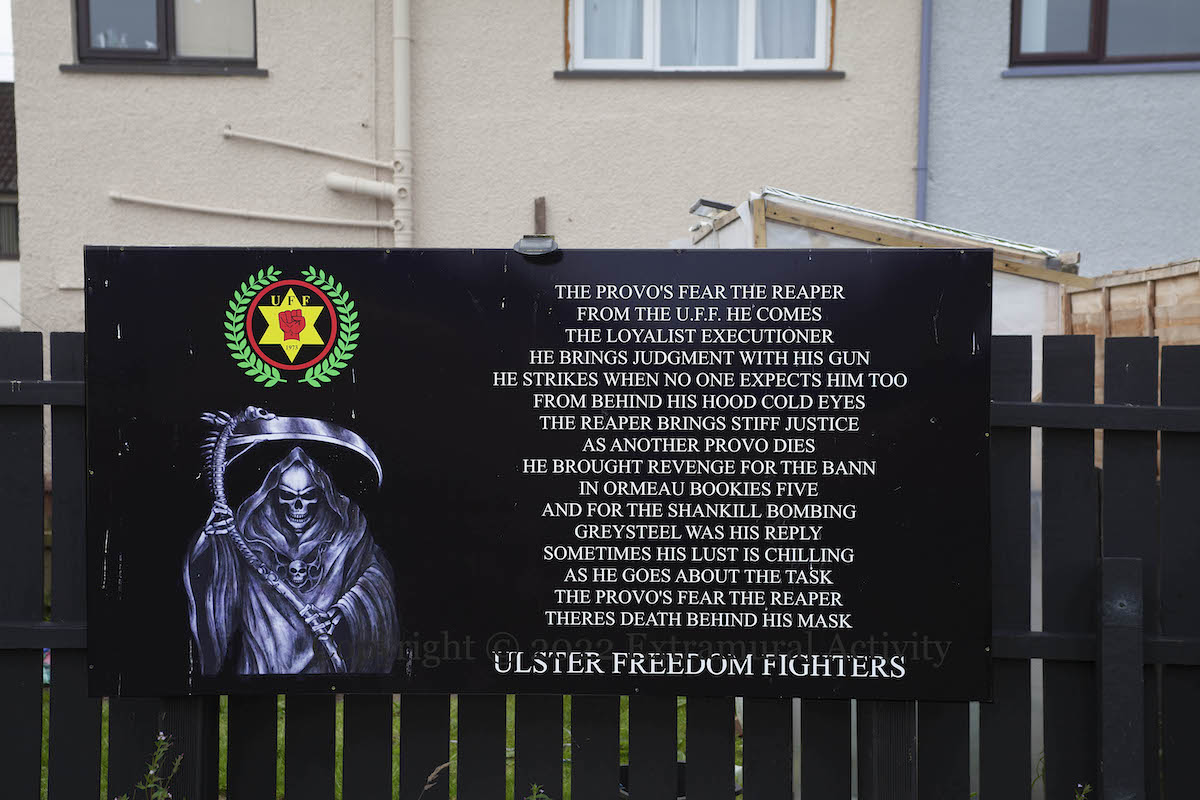
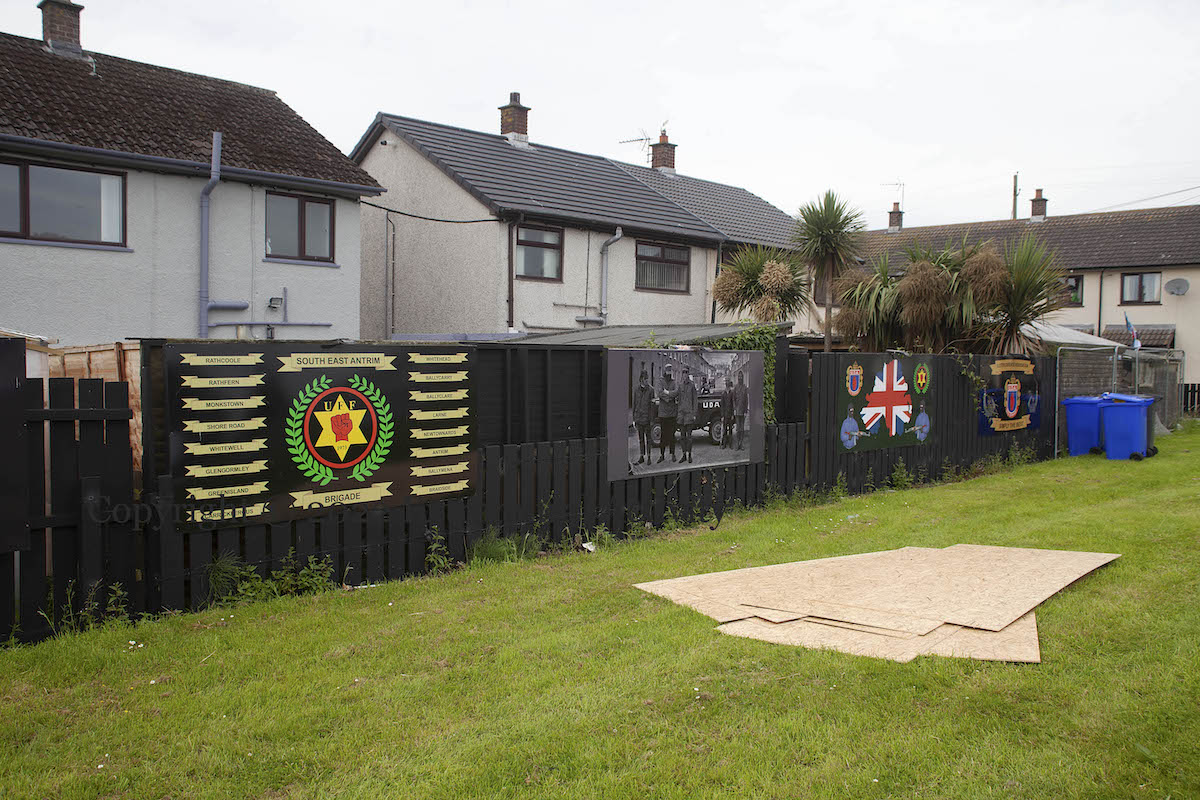
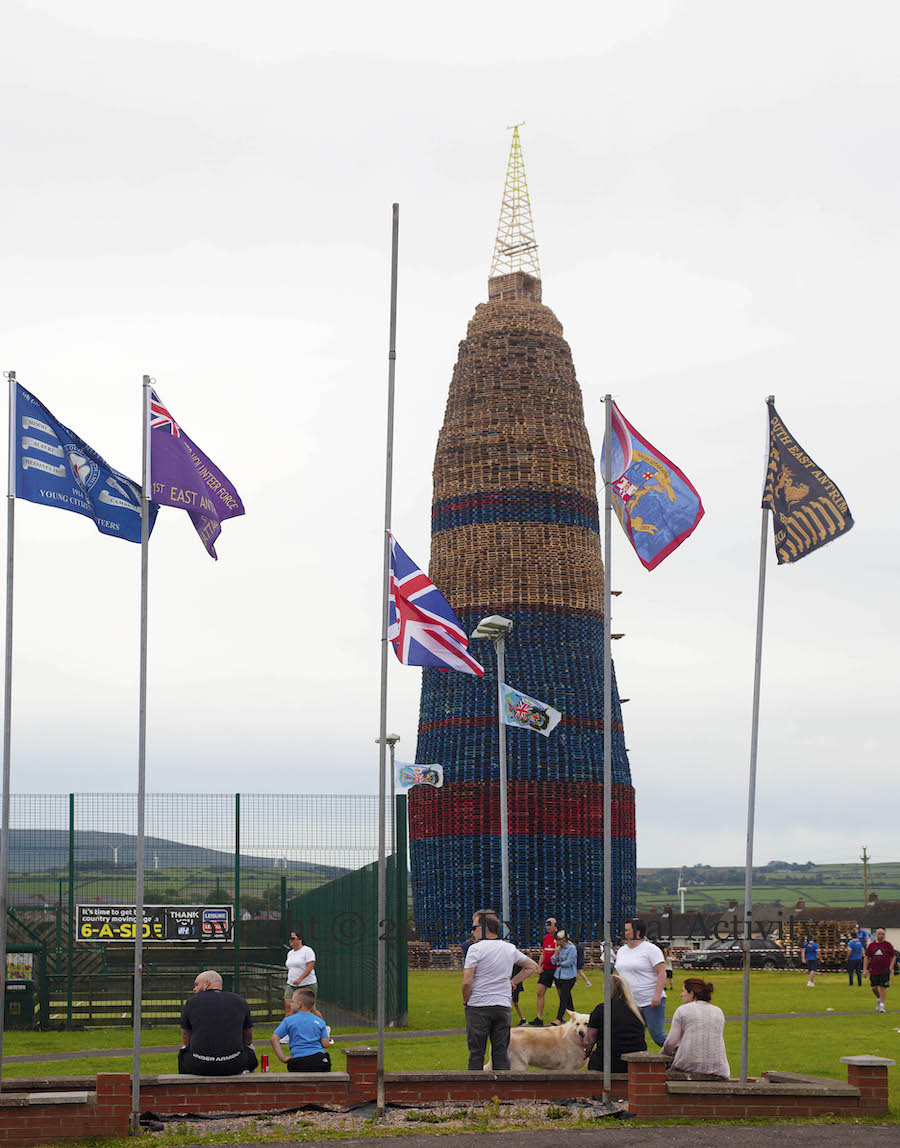
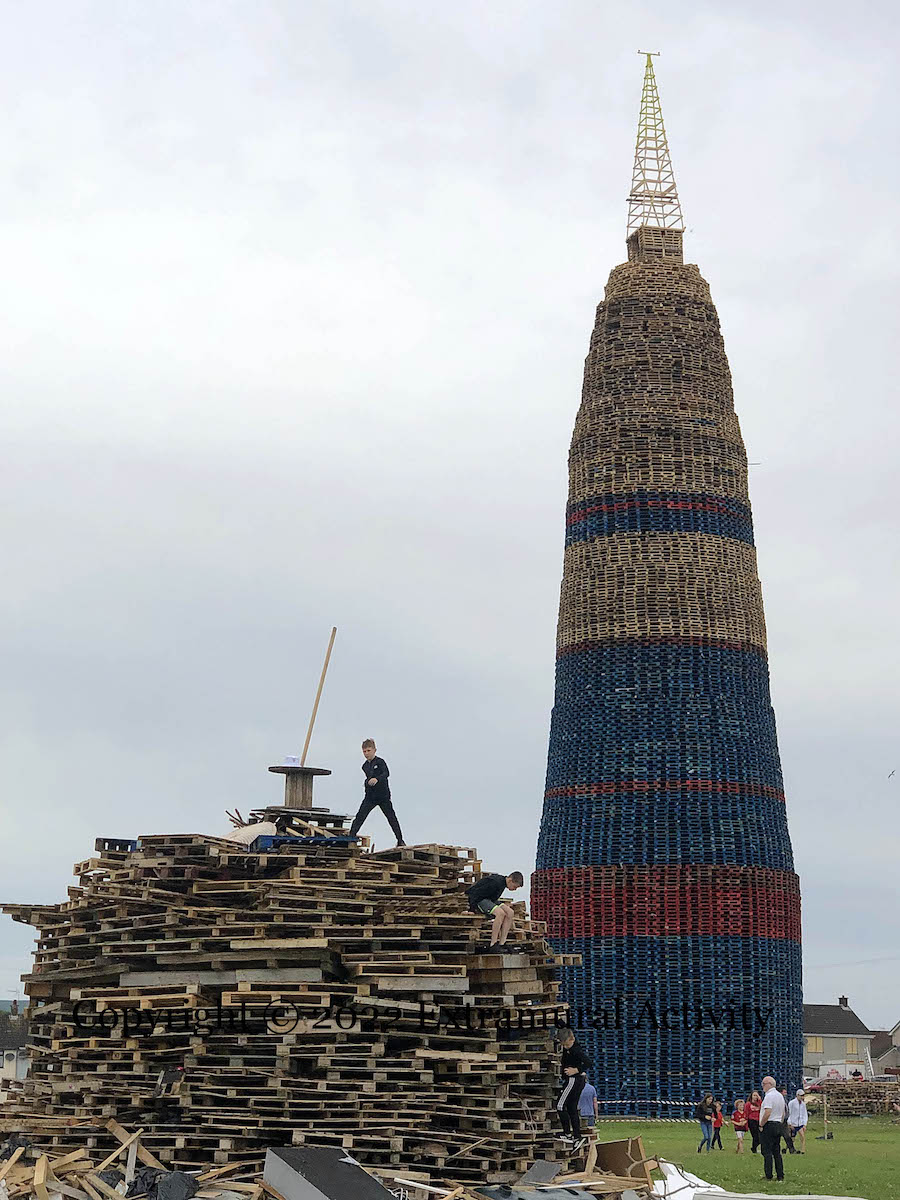
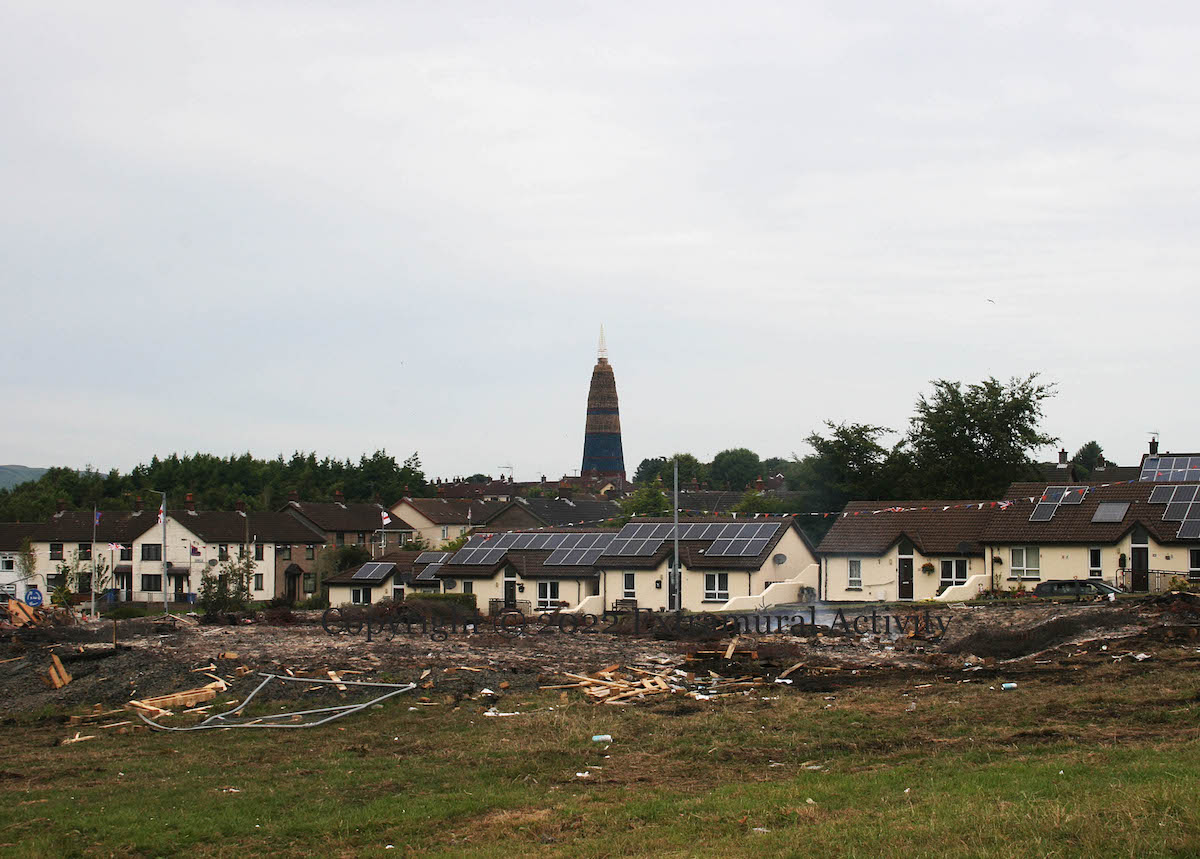
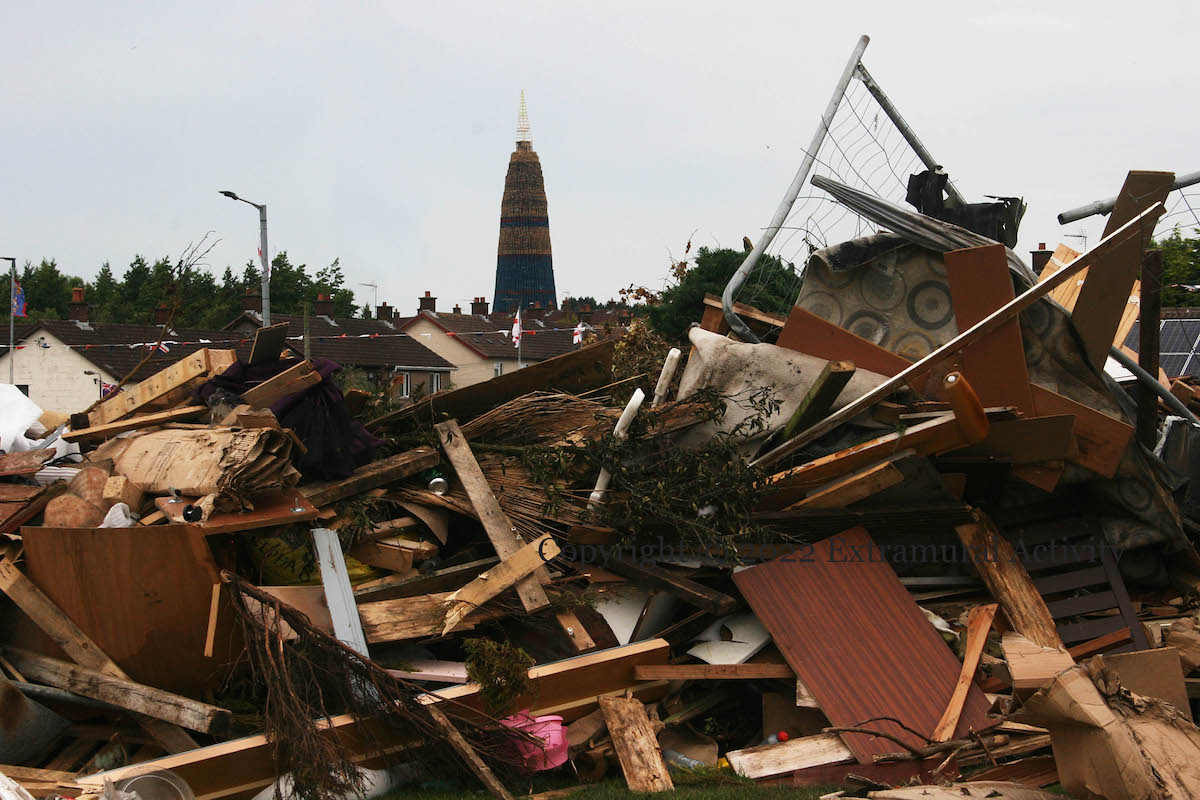
The Craigyhill (Larne) bonfire was officially measured at 202.3 feet in height, exceeding the existing Guinness World Record for tallest bonfire, a 199-ft pyre in Austria in 2019. More than 40,000 pounds was raised for the effort (Belfast Live). In preparation for lighting, houses around the green were boarded up with sheets of plywood (see below).
The red and blue pallets mostly go at the bottom because they are sturdier pallets; they are also longer lasting and more expensive to produce. The red pallets come from La Palette Rouge while the blue come from CHEP (Commonwealth Handling Equipment Pool) (Belfast Media). They can be legally bought or sold only by their respective companies.
In nearby Antiville, a bonfire builder fell to his death. See With Heart And Hand.
The Antiville (Larne) bonfire was toppled and set alight on Sunday night after the death of one its builders, John Steele, who fell from it at about 9:30 p.m. the previous evening (Belfast Live video | BelTel | Belfast Live). The Antiville bonfire was perhaps 50 ft in height; the nearby Craigyhill bonfire, at 202 ft, continued to stand until it was lit at midnight on Monday night.
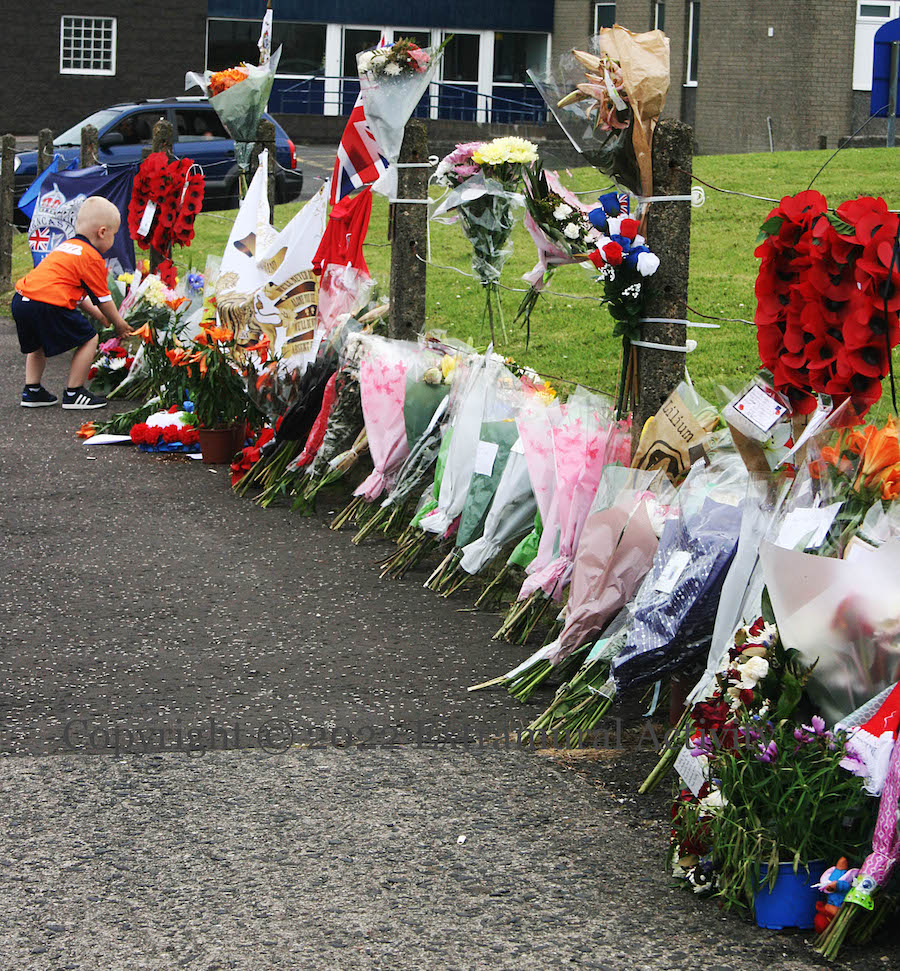
Many floral tributes were left along the fence of the adjacent Presbyterian church, including ones from other bonfire sites (Craigyhill, Old Mossley, Doonbeg), flute bands (Anderson Memorial, Ballycraigy Sons Of Ulster, Ladyhill, Cairncastle, North Down Defenders, Tullycarnet), UVF (Rathcoole RHC), and UDA (Tullycarnet); Steele’s funeral will take place on Thursday (Irish News).
The Ireland Supports The People Of Donetsk graffiti outside the RVH has been modified, perhaps twice. Most prominent is a the writing by MASH (of TMN krew) – highly unusual appearance by a tagger on a central thoroughfare (and in west Belfast, too).
It is possible is that the “Free Ukraine” in the bottom left was an earlier response to the original graffiti. It is not clear why “Free” has been x-ed out.
Support for either Ukraine or Russia in CNR areas is non-existent, perhaps because of anti-imperial attitude applied – in equal but opposite measure – to both NATO and Russia. At the beginning of the conflict, Sinn Féin deleted thousands of comments critical of the EU’s or NATO’s stance towards Russia from its web site (Indo | Irish Times | journal.ie | see also Irish Examiner).
After serving in the IRA in the War Of Independence, Liam Mellows was elected to the First Dáil and as a member of the second Dáil voted against the Treaty in January 1922 (his speech is recorded in Oireachtas.ie under the name “Liam Mellowes”). In the Civil War that followed, he served as IRA quartermaster in the force in the Four Courts that surrendered to Free State forces on June 30th, 1922. He was imprisoned in Mountjoy and executed in December, in reprisal for the killing of Seán Hayes (see Executed). (WP | An Phoblacht) His proposals for government were published posthumously as ‘Mellows Testament’ (NLI) and include state ownership of heavy industry, large estates, the transport system, and the banks. The sticker below quotes from that document: “Ireland, if her industries and banks were controlled by foreign capital, would be at the mercy of every breeze that ruffled the surface of the world’s money-markets.”
“Larne – the original tourist resort” going back to Larnians, Romans, Christians, vikings, the Scots (Edward The Bruce), the English (Sir Moyses Hill) but most particularly after 1842, when the Coast Road was finished, making Larne the “gateway to the Glens” and inspiring Henry McNeill to create the package holiday (see previously Those Magnificent Men In Their Flying Machines). Ships carrying tourists from America would ferry emigrants on the way back – Boyd’s souvenir shop (shown in the first panel, above) sold Irish linen to tourists and one-way tickets to New York. After a double whammy in the 1960s of the Troubles and easier access to Spain, “tourism is flourishing again” thanks to the Gobbins and Game Of Thrones.
Artist Raymond Henshaw produced a series of Markets-related boards in 2008-2009 with support from the Arts Council and despite being printed on laminates they are not indestructible; there is crazing – as well as human-caused damage – on some of them, the worst of which is the ‘Industry’ board in Upper Stanfield Street.
Tillie & Henderson’s shirt factory opened in 1856 at the junction of Abercorn Road and Foyle Road, Derry (next to the ‘Hands Across The Divide’ statue) and survived until 2003 when it was demolished after a fire (BBC); an apartment block is currently planned for the site (Derry Journal | BBC). It was the largest such factory in the world and one of 44 shirt factories in the city in 1900, all of which employed women, many starting in their teens.
Here are a pair of large boards in the Ulster Museum on the theme of Cú Chulainn, one from each sect.
In the left-hand painting – the CNR piece, by Marty Lyons and a Short Strand artist – Francis Hughes of the IRA – in what we think is a unique break with tradition – takes the place of Cú Chulaınn, who became a symbol of the 1916 Easter Rising when Oliver Sheppard’s statue of Cú Chulaınn’s death was placed in the re-built GPO. Hughes has a tourniquet on his right leg, an assault rifle dangling from his wrist, and instead of the raven that signified Cú Chulaınn’s death there is the symbol of republican political prisoner, the lark, which appears in the apex of many other republican murals.
In the second of the pieces – the PUL piece, painted by Dee Craig – the raven sits on the shoulder of a Cú Chulainn who has a red cloak and carries a Northern Ireland shield. “Down through the years, his shadow has cast a new breed of Ulster defender”: a (loyalist) hooded gunman. Thus while Cú Chulaınn is the (surprising) “Ancient defender of Ulster!”, the UVF and UDA are its modern defenders, now that the B Specials and UDR are gone.
The dripping red hand in the top left is the ‘red hand of Ulster’; one version of the origin-story for the red hand is that the man who avenged Cú Chulaınn’s death made a bloody hand-print to indicate his completion of the deed. Most people, however, will think of the legend that in a race to be first to touch the land of Ulster one contestant (perhaps Érımón Uí Néıll) cut off his hand and threw it ahead of the others. (This legend was depicted in a lower Shankill mural and narrated in an east Belfast mural: The Strangest Victory In All History.)
The Black Pig’s Dyke is the collective name for a number of ditches built around 400 BCE, perhaps to prevent cattle-raiding. They share a common mythology: that they were created by huge black boar; they are on the Ulster-Connacht border, rather than the Ulster-Leinster border as shown in the painting, though there are similar earthworks in Down, Armagh (and Cork) (WP).
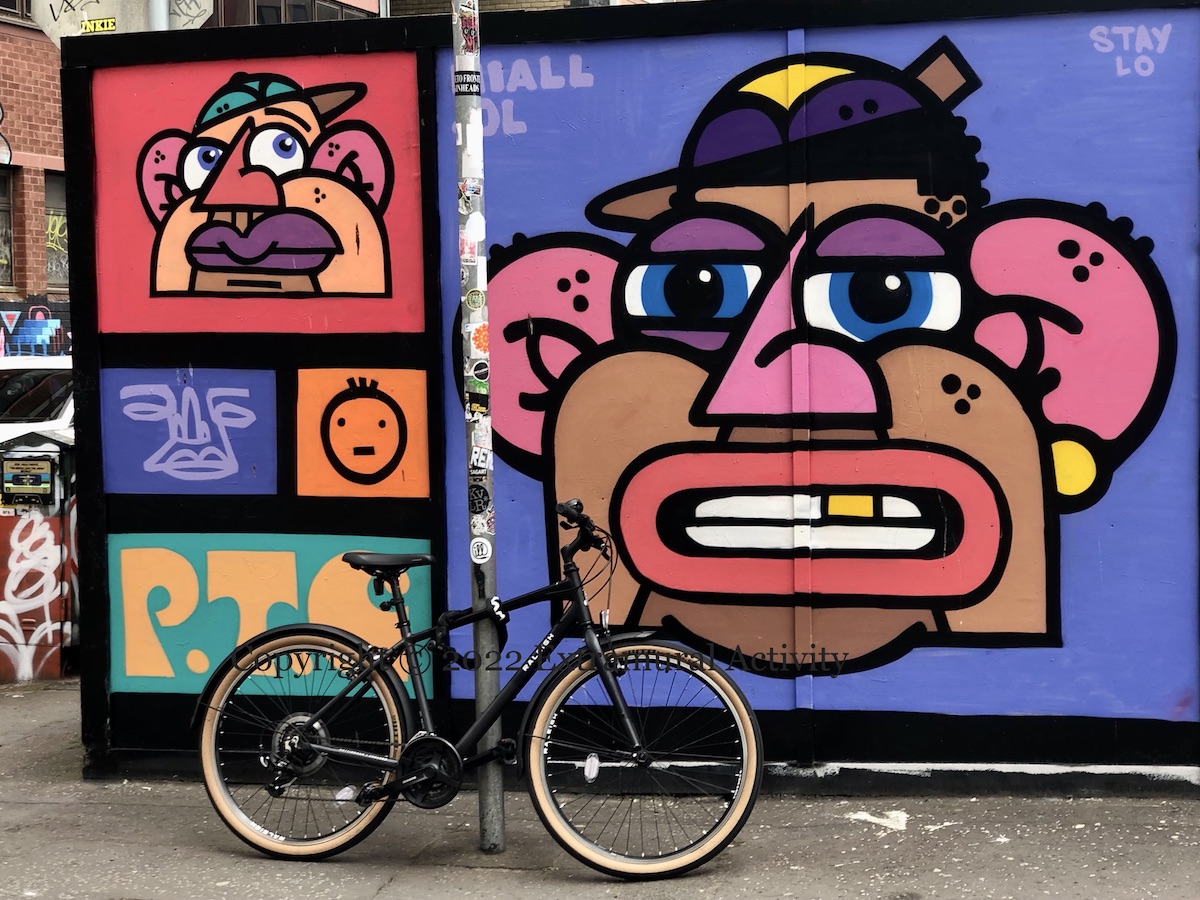
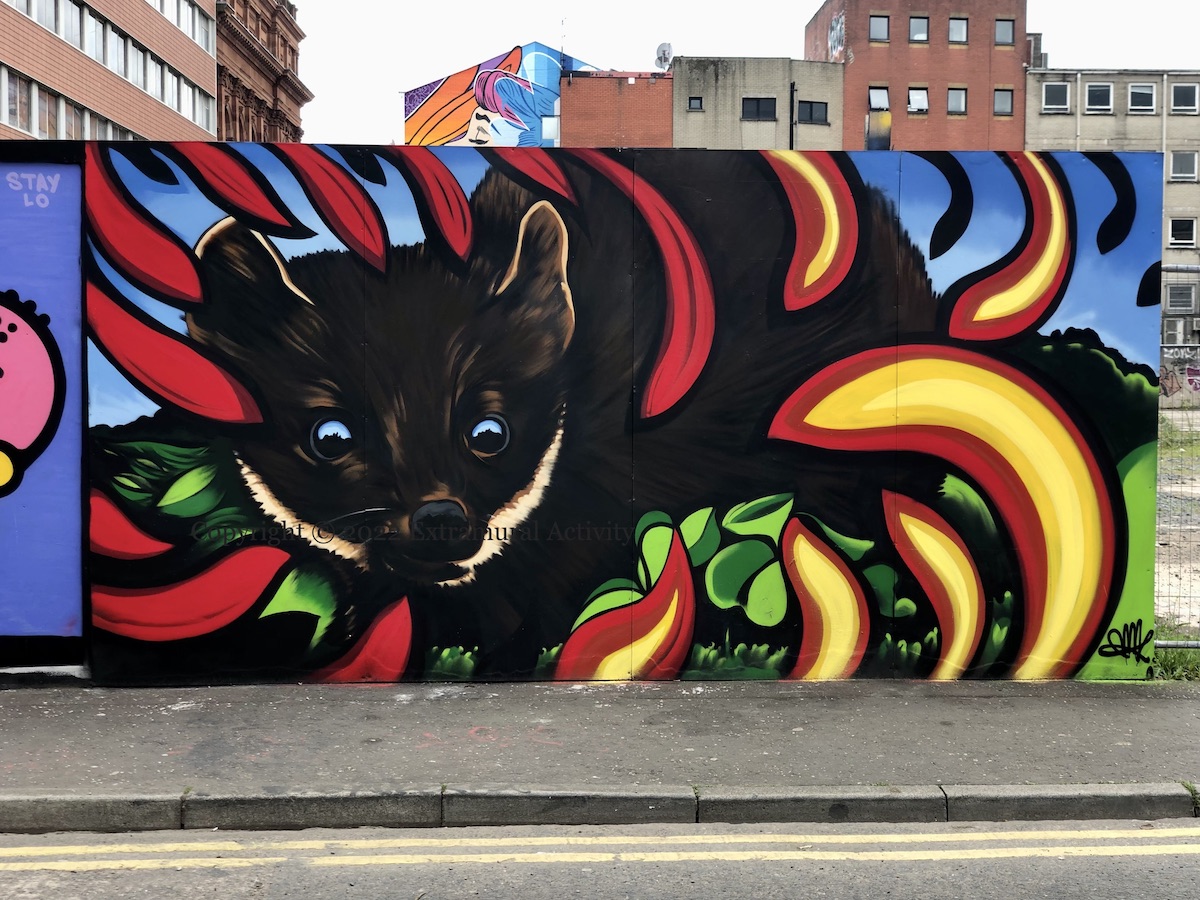
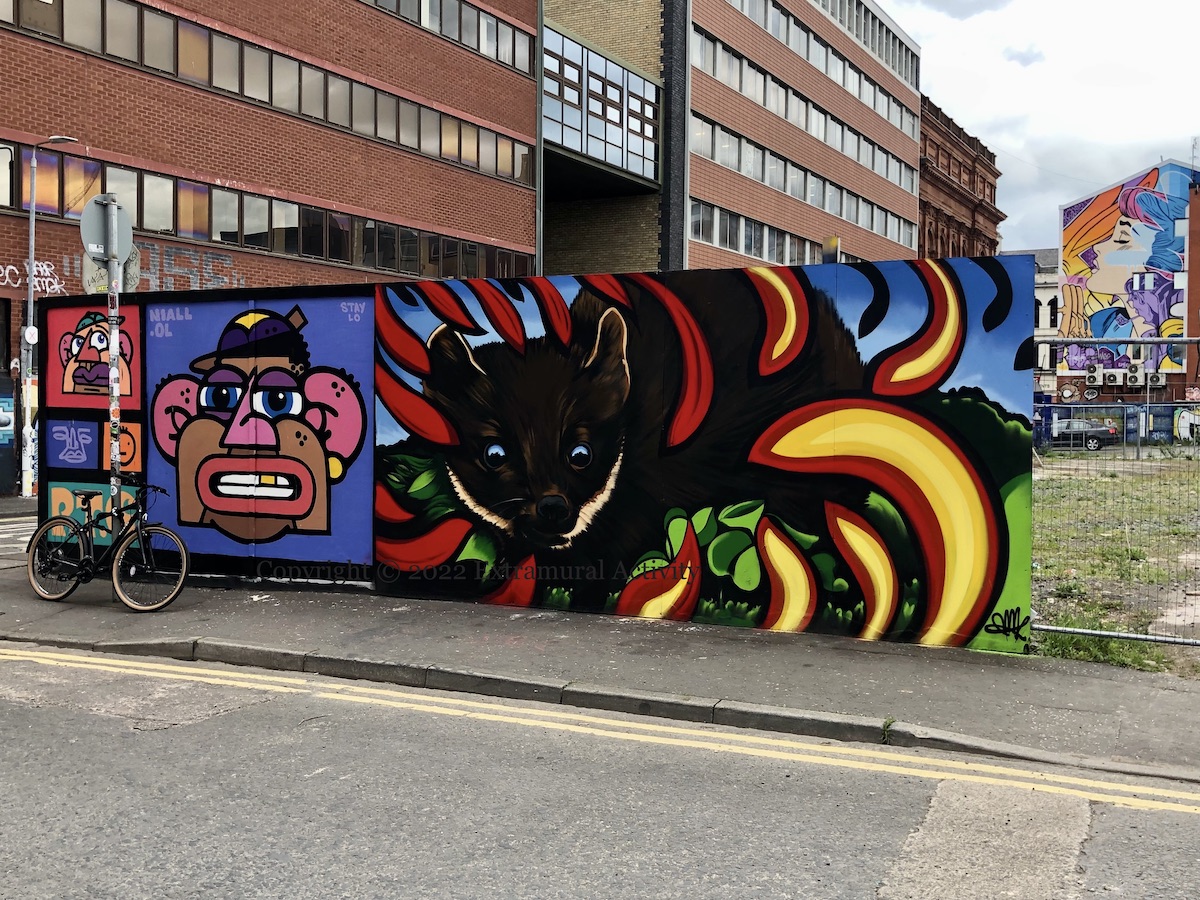
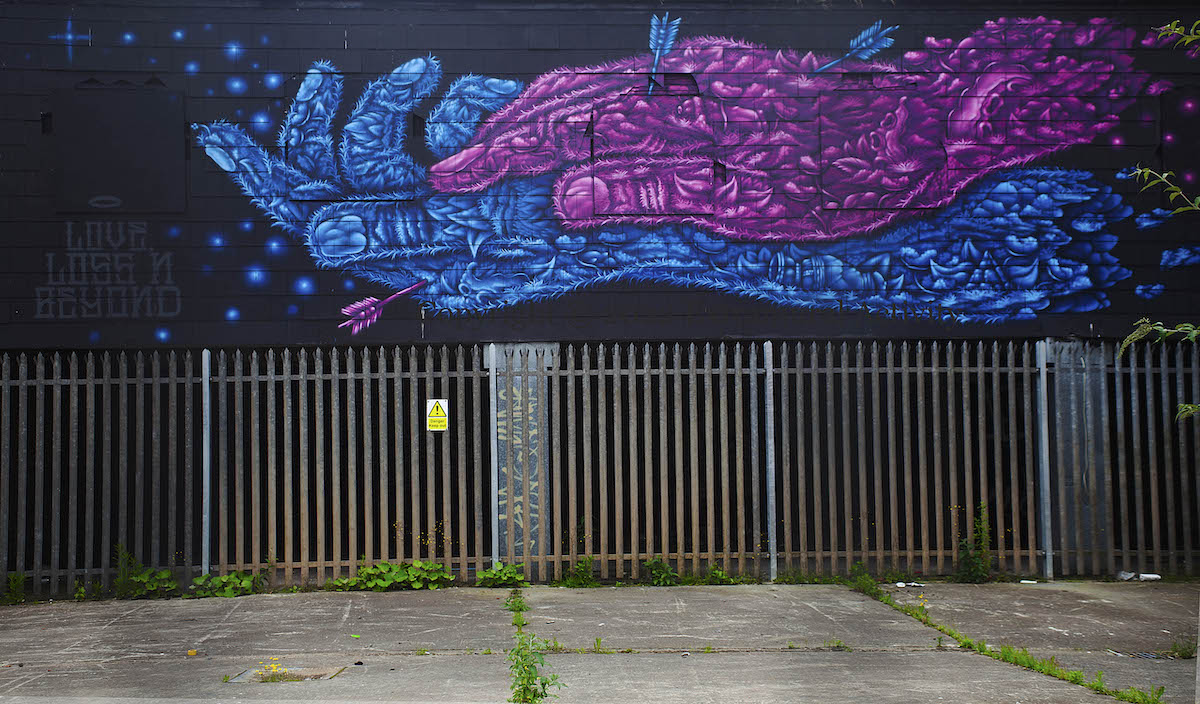
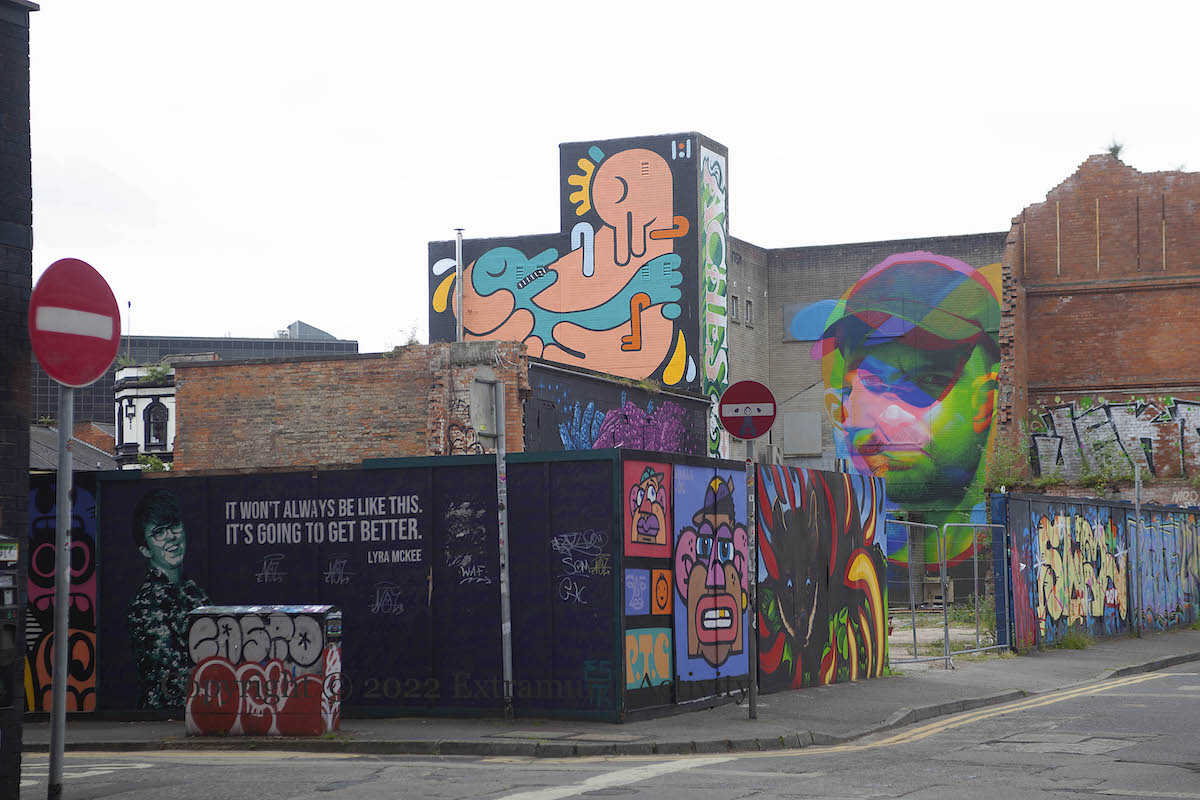
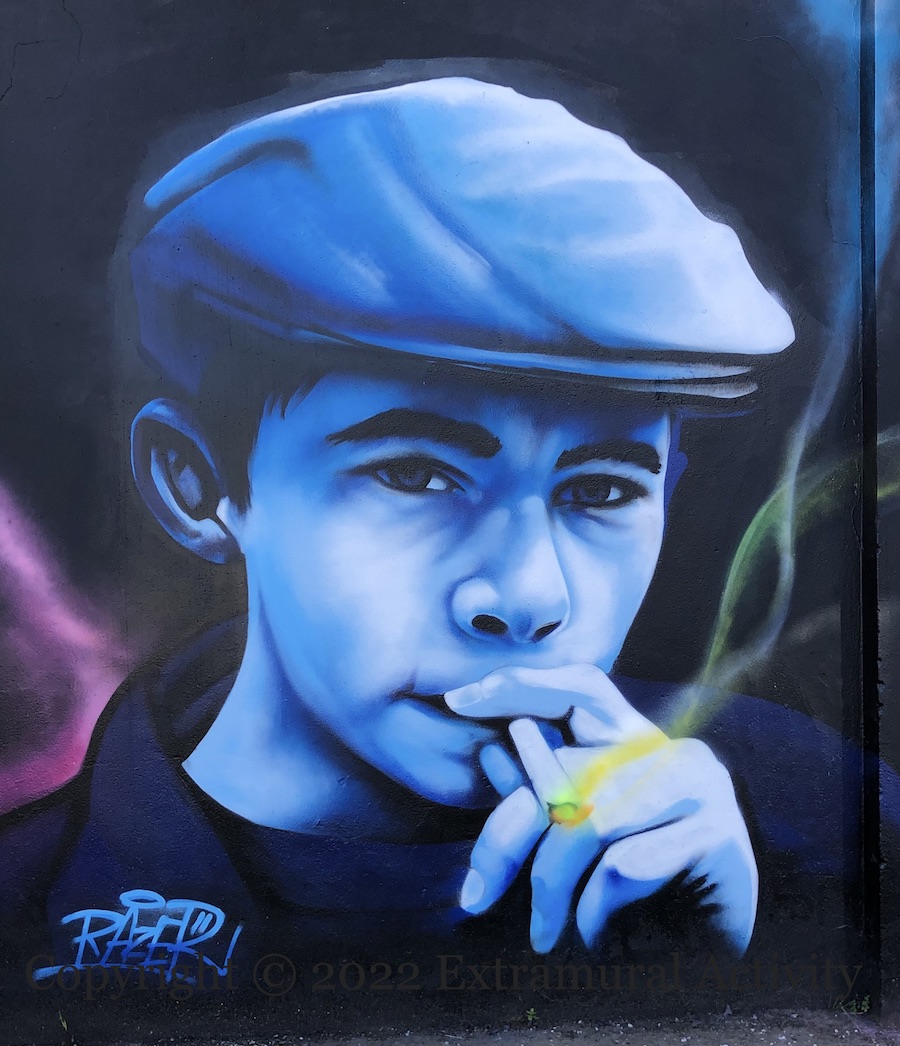
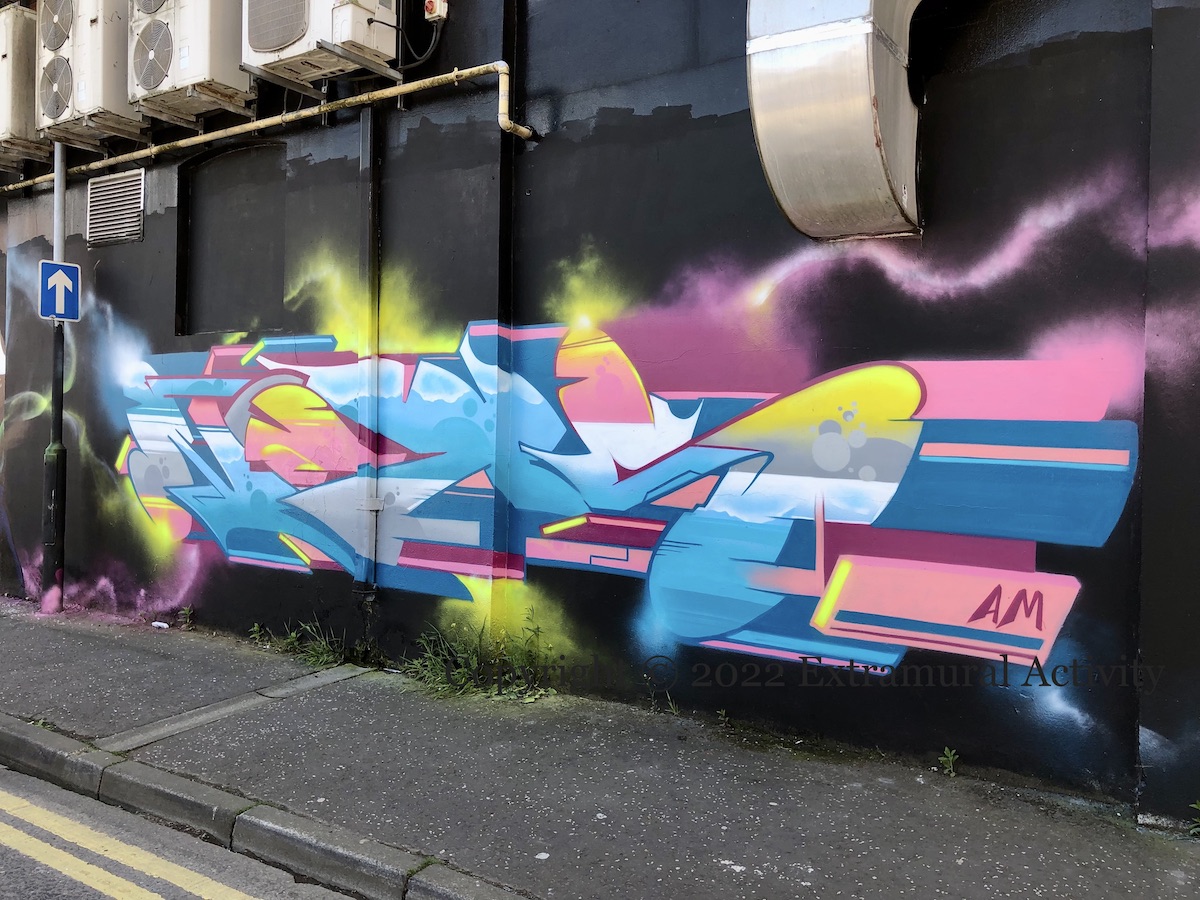
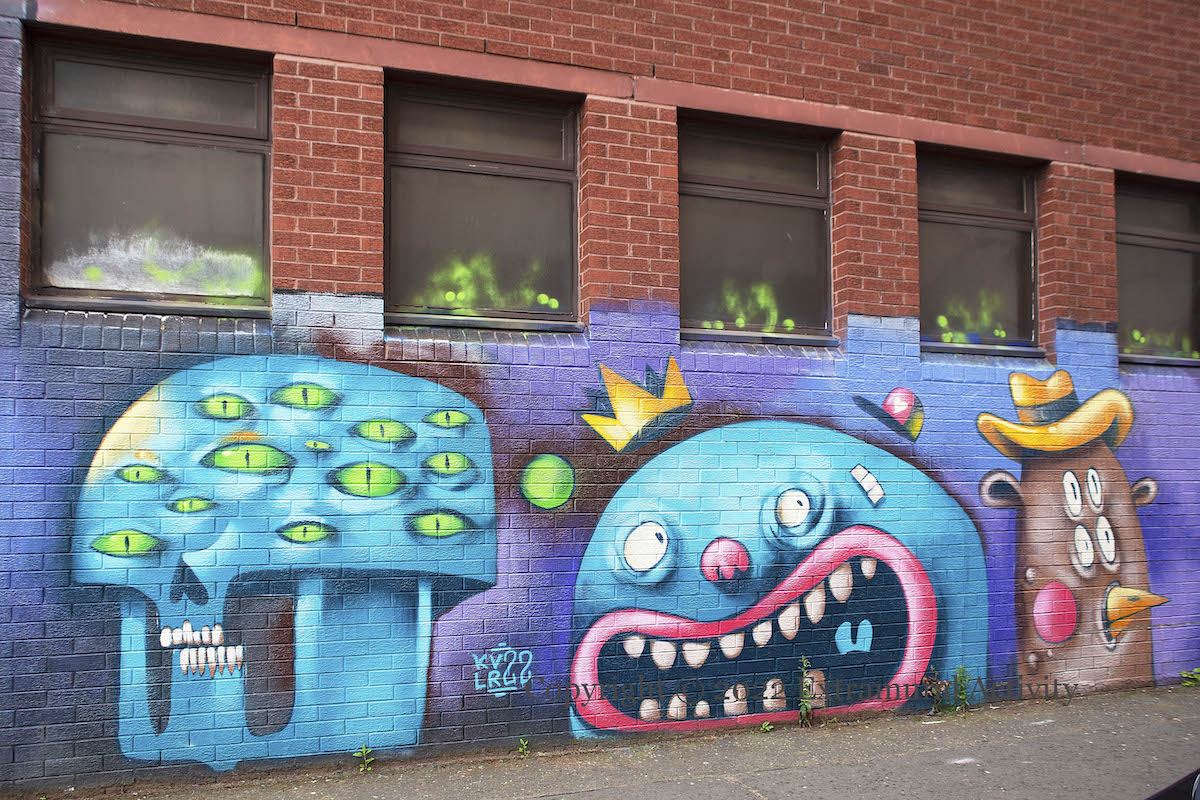
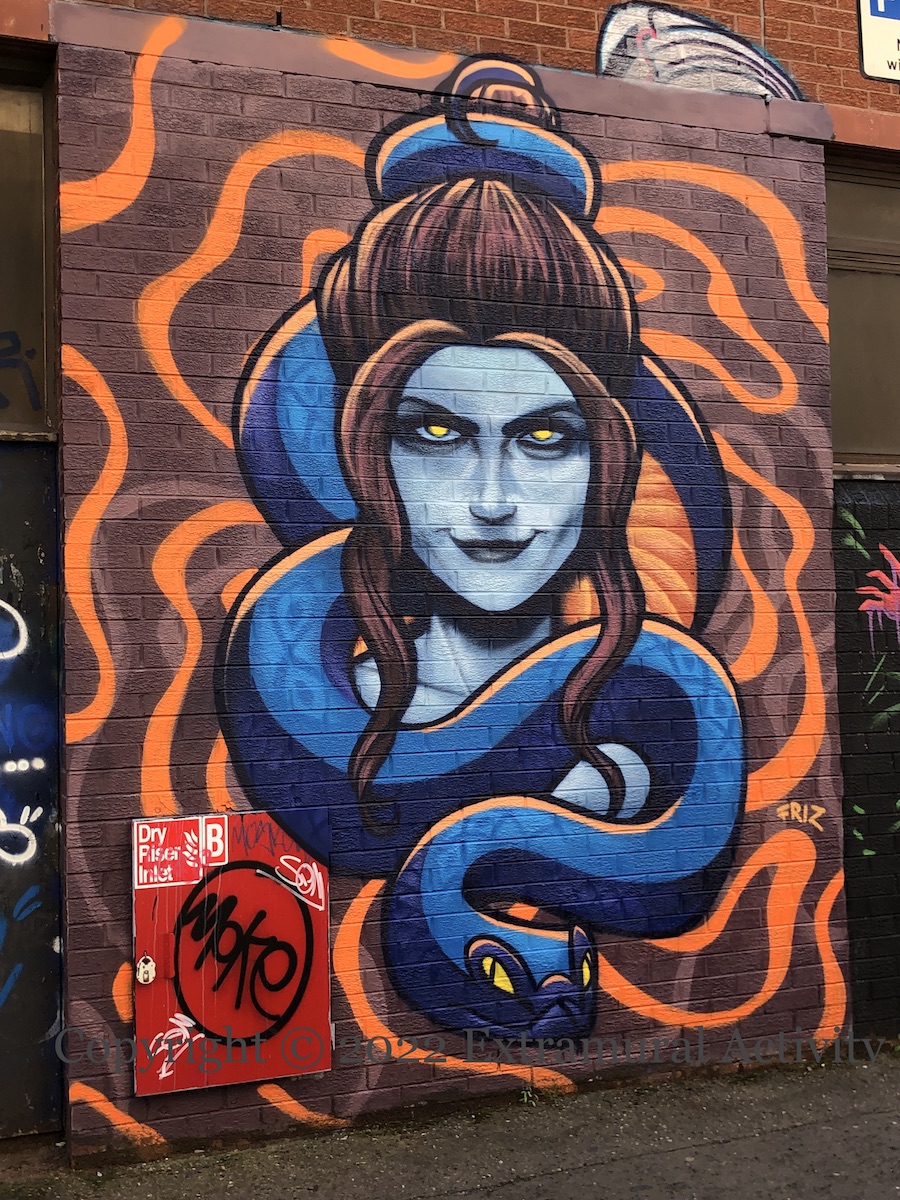
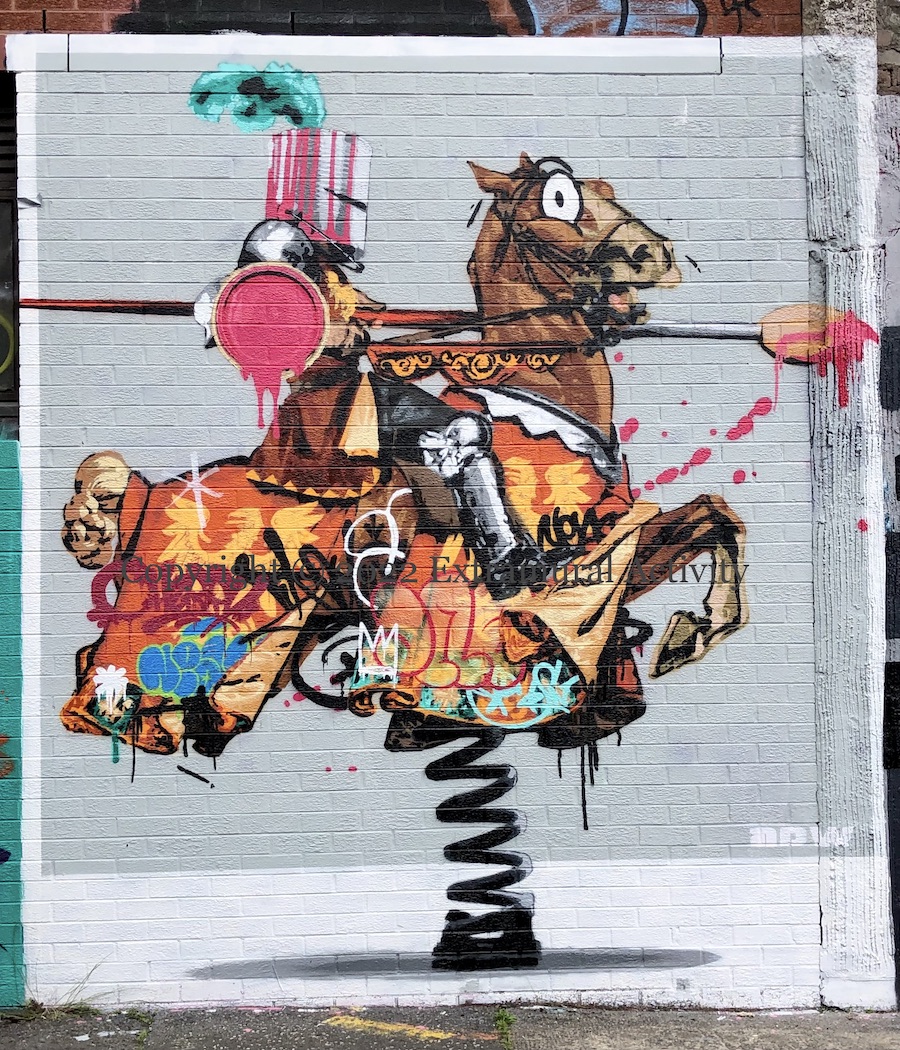
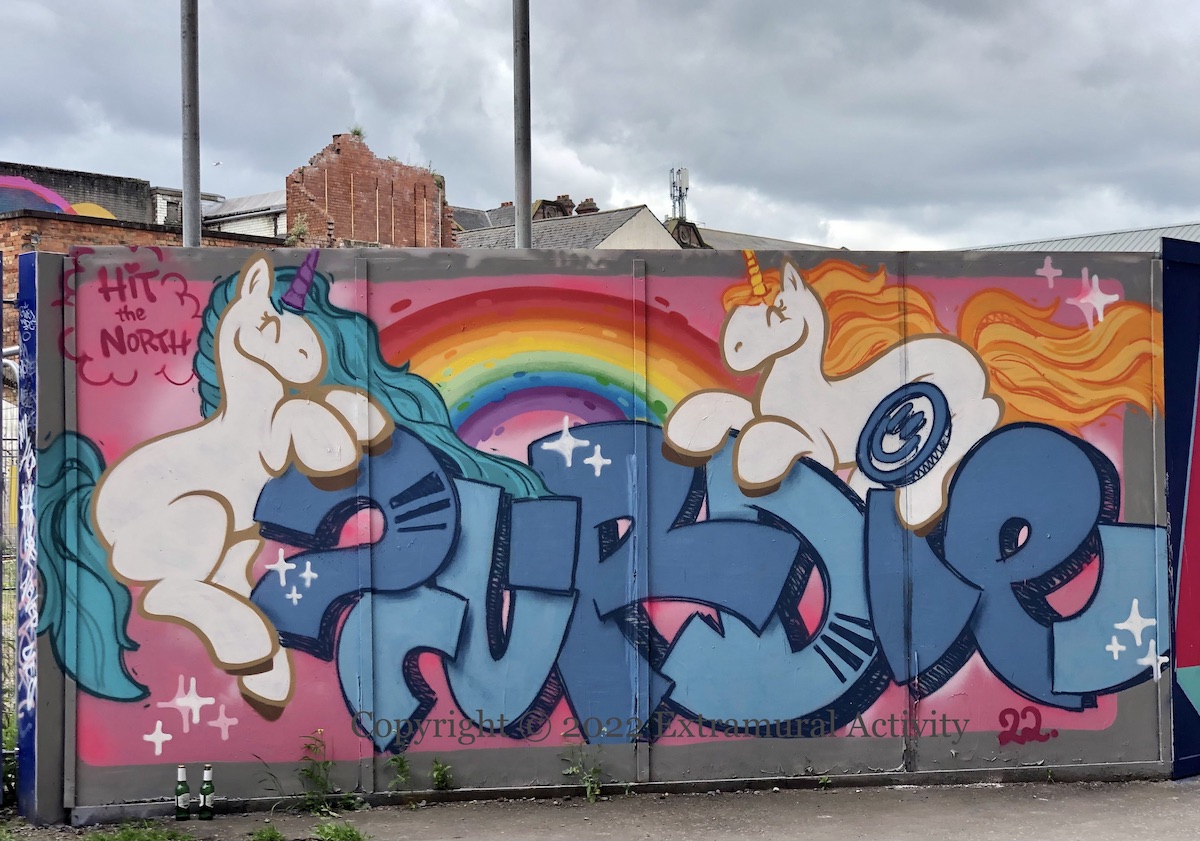
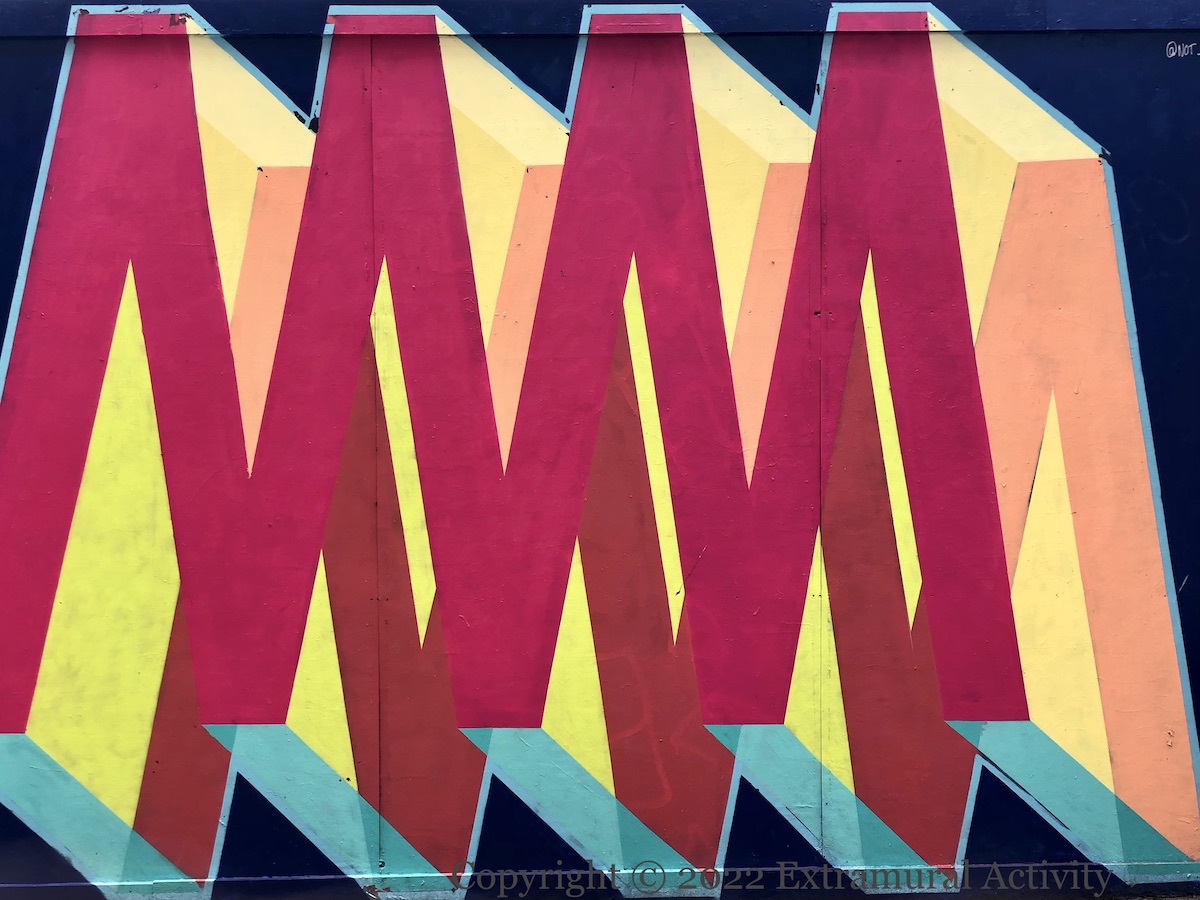
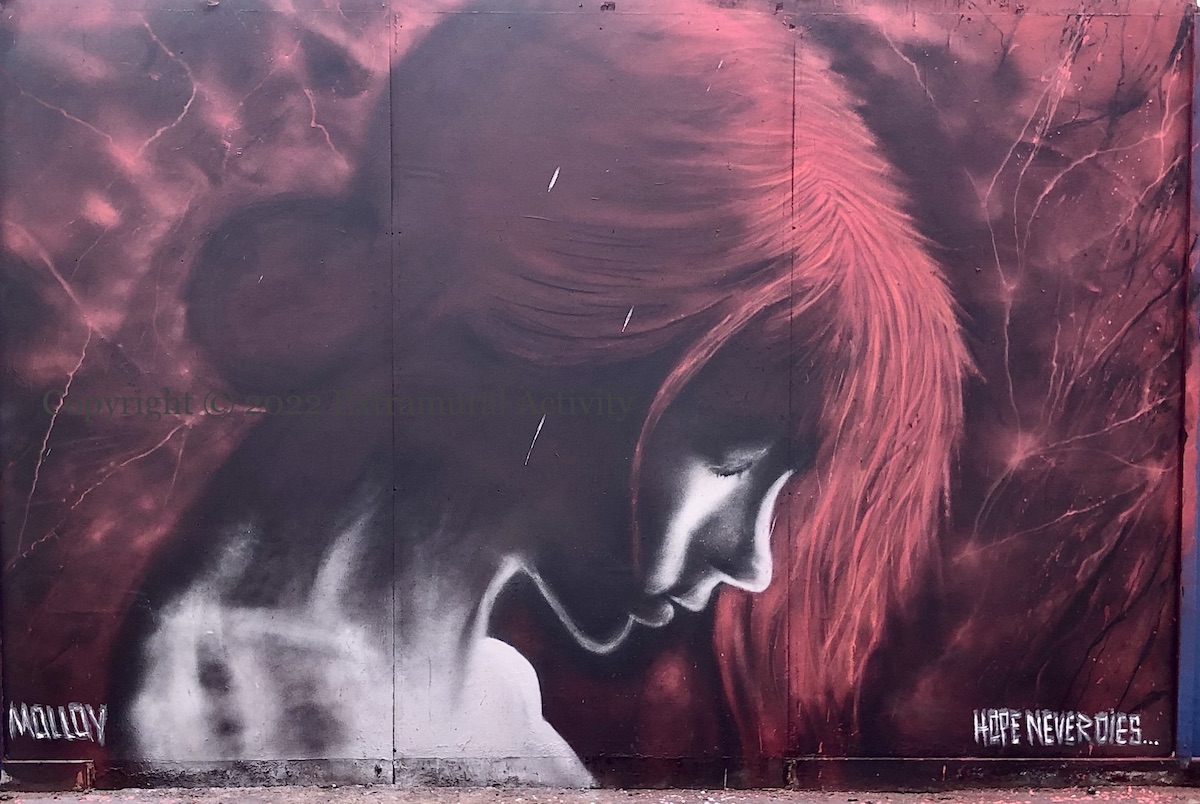
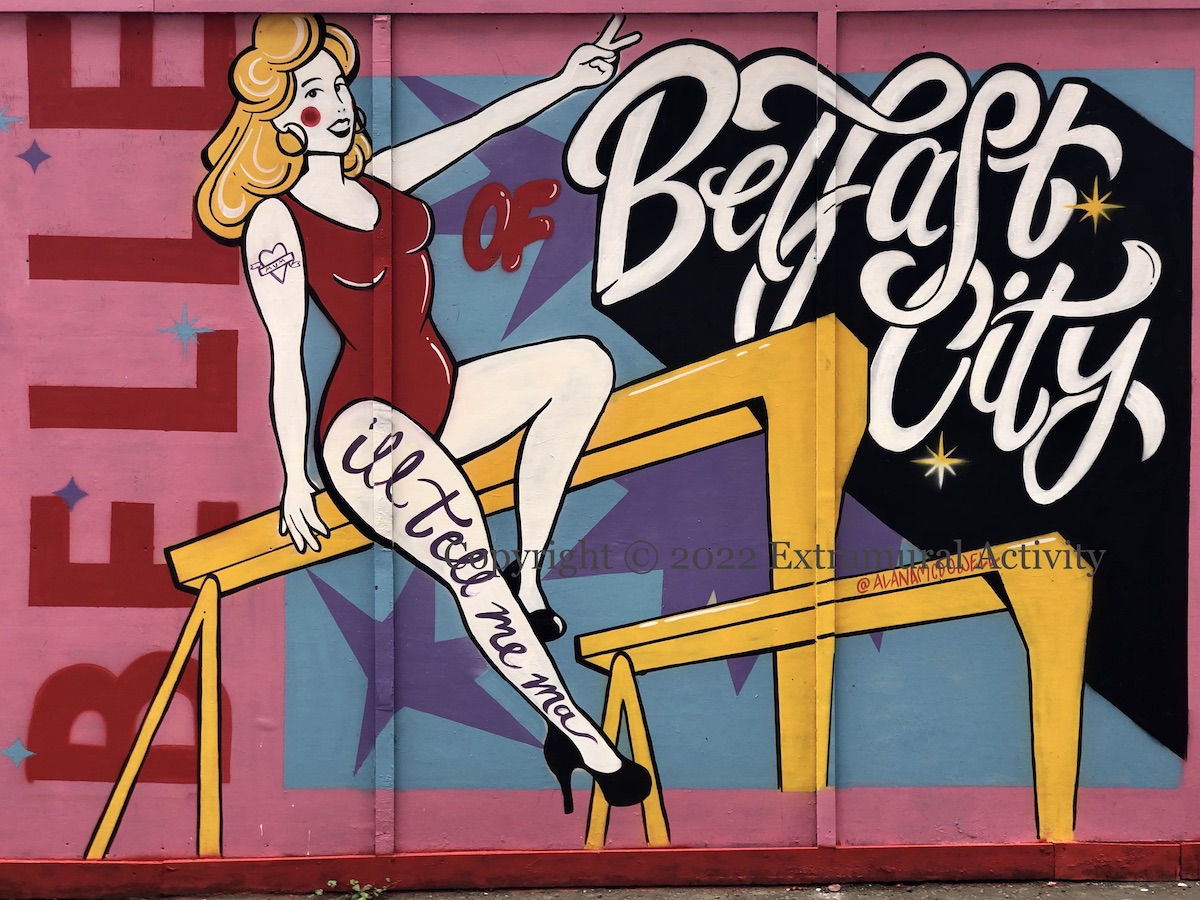
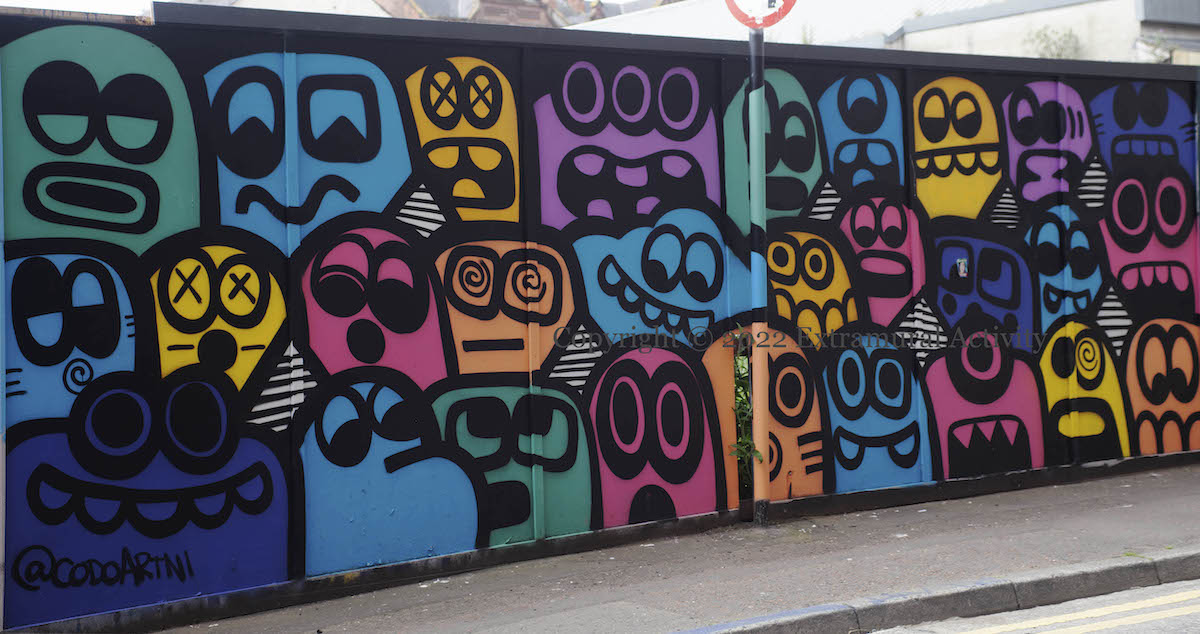
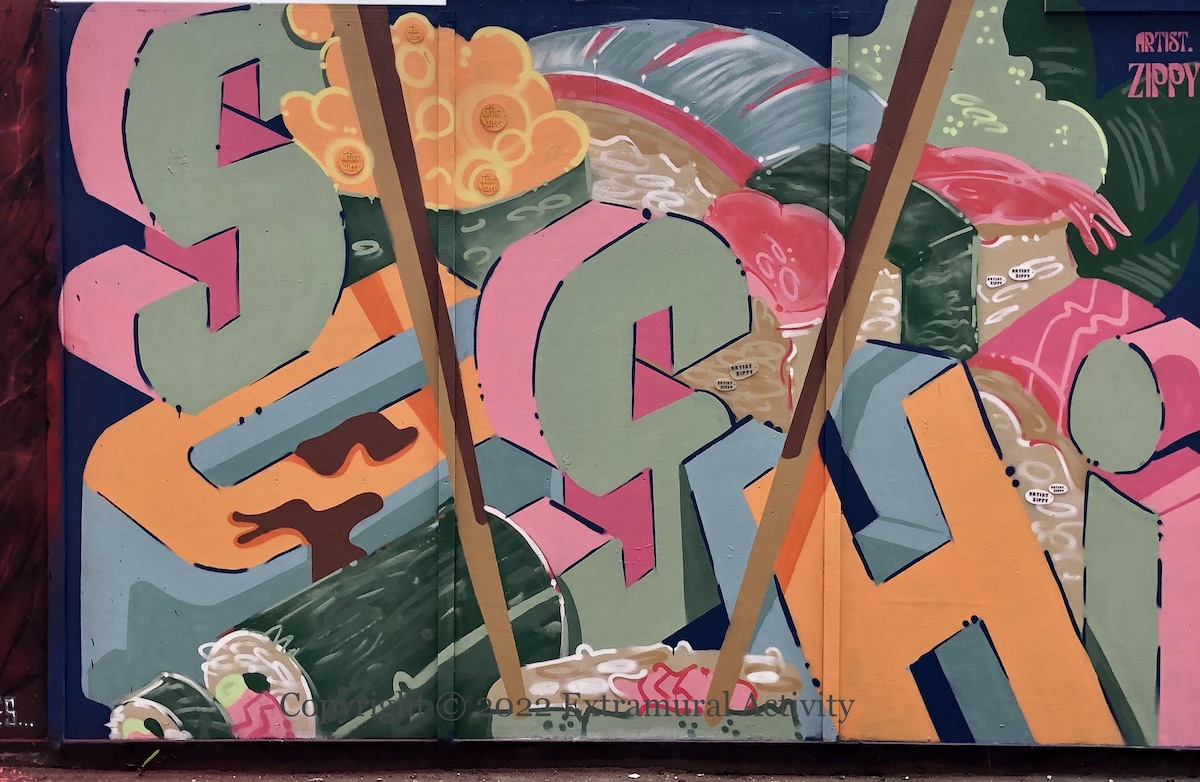
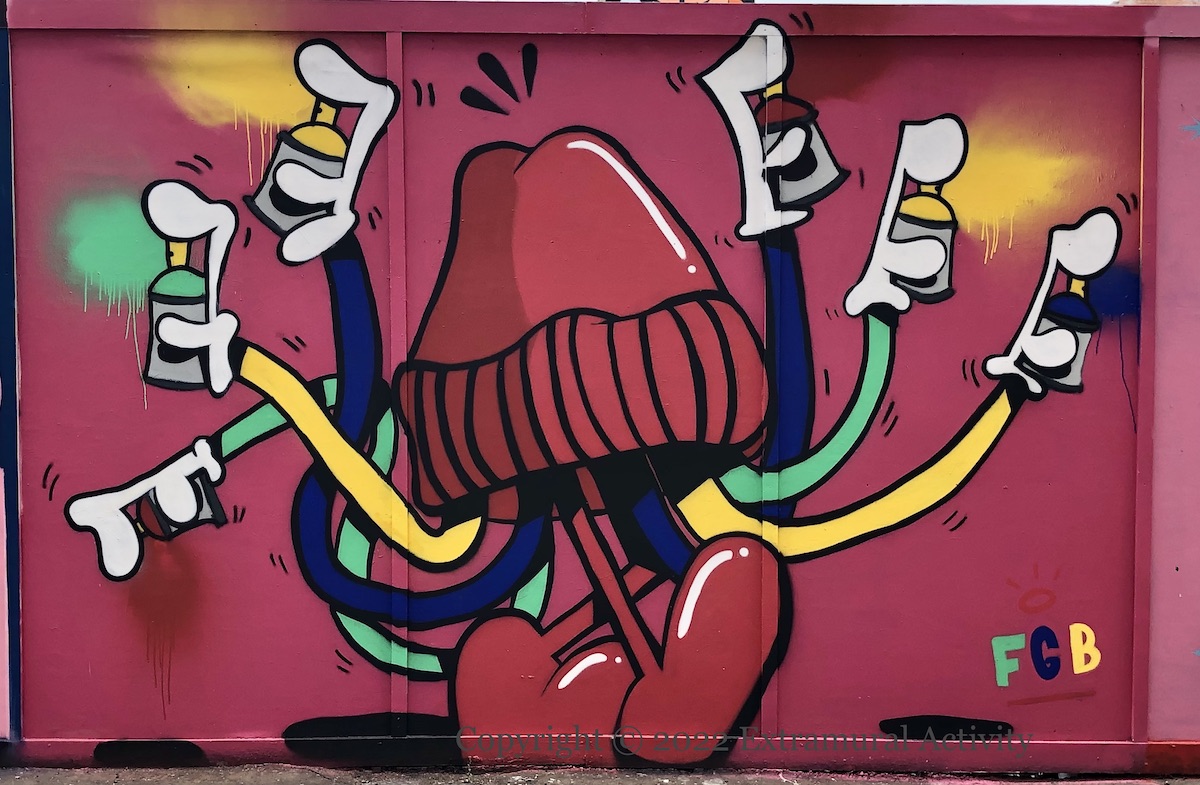
These are the murals from HTN22 in Kent Street above Union Street, by (in order) Hixxy (web), TMN krew, Rob Hilken (web), Curtis Hylton (web), Bad Belfast (ig) – punning on the Irish myth of the Children Of Lear.