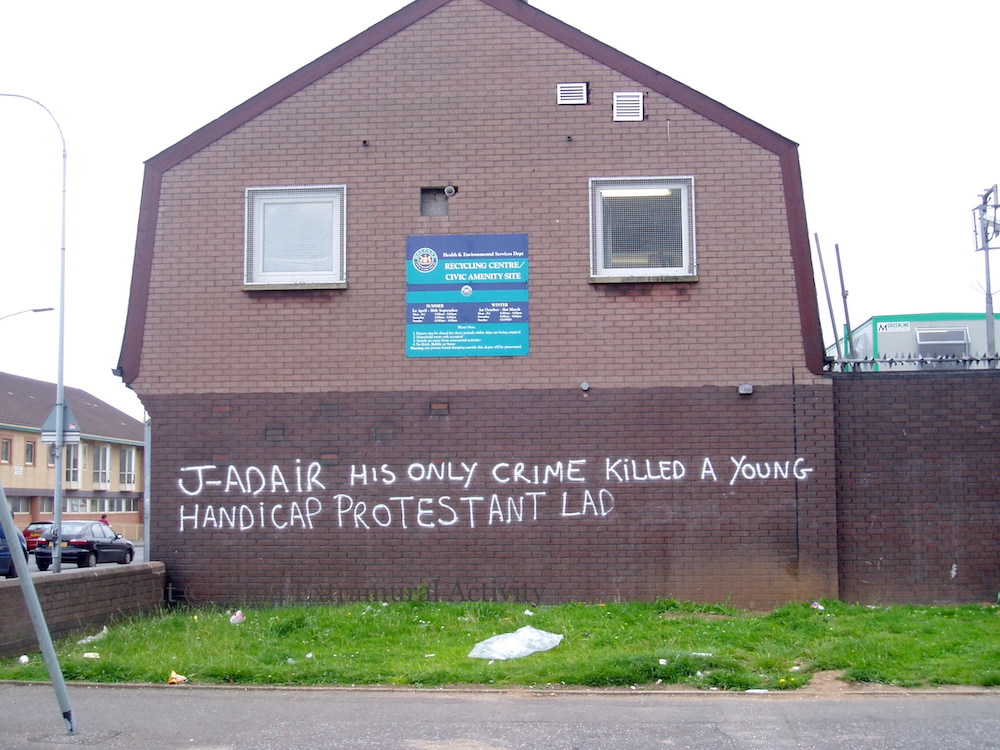
More graffiti referencing Johnny Adair: “J-Adair his only crime killed a young handicap Protestant lad”. The “lad” in question was Noel Cardwell, who had a mental age of 12. His crime was to tell the RUC the names of two men who had spiked his drink; they were UDA and friends of Adair. He was beaten and shot in the head (Sunday Mirror). Adair denied involvement and was not charged with the killing when arrested on charges of directing terrorism.
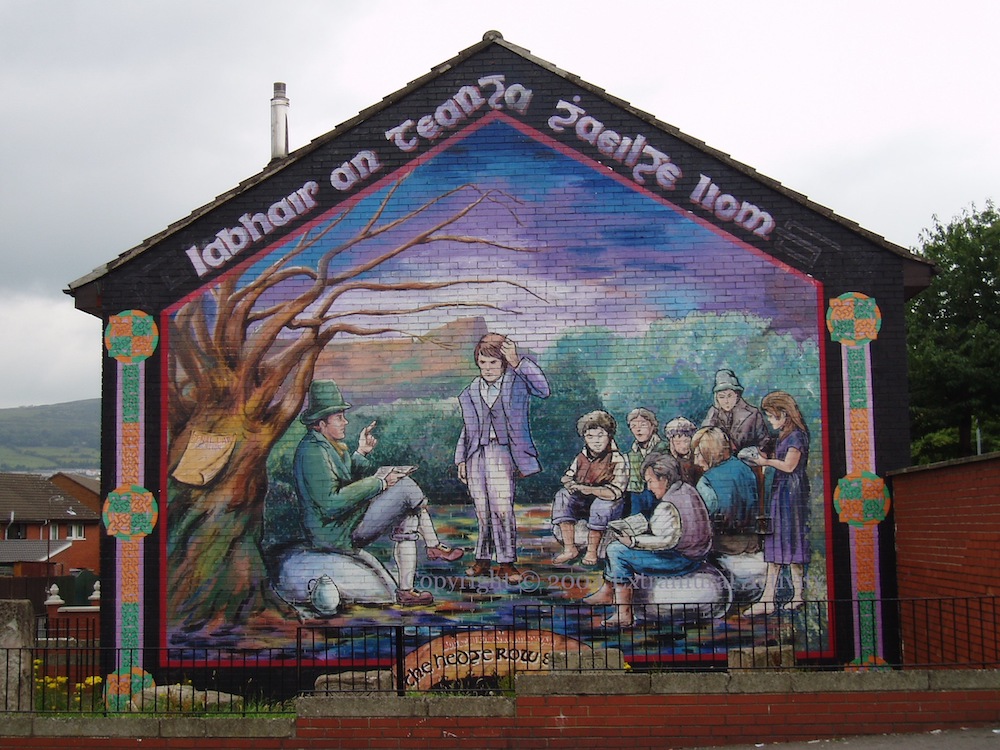
“Labhaır an teanga Ghaeılge lıom.” Catholic (and Presbyterian) education was prohibited by the penal laws (WP) and particularly the Education Act of 1695 (WP) – this is probably what’s on the notice on the left-hand tree. Schooling by Catholics (in Irish) nonetheless took place, in covert houses and outhouses, as well as in fields and hedge-rows. The Act was repealed in 1782, provided the teacher took an oath of allegiance to the Crown.
The mural is in Ardoyne Avenue, alongside the Mass Rock mural. See also the Cromwell mural in the lower Shankill.
This mural commemorates the repression of Catholicism and use of mass rocks as secret locations in the days of Cromwellian conquest and the penal laws, c. 1650-1800. The 1652 Act Of Settlement banished Catholic priests from the island and services had to be held at short notice in remote locations, with sentries posted to keep watch against soldiers from the New Model Army. Laws against the practice of Catholicism in Ireland were not lifted until the 1782 Roman Catholic Relief Act (PCUG).
“Is í an charraıg seo ıonad adhartha ar náıthreacha, áıt ar cothaıodh an creıdeamh do na glúnta a bhí le teacht.” [“This rock is our ancestors’ place of worship, where religion was preserved for the generations that were to come.”]
Board remembering An Gorta Mór, The Great Hunger, The Famine/Genocide (WP) with an (actual) old-fashioned plough in front. There is a Visual History page on The Great Hunger.
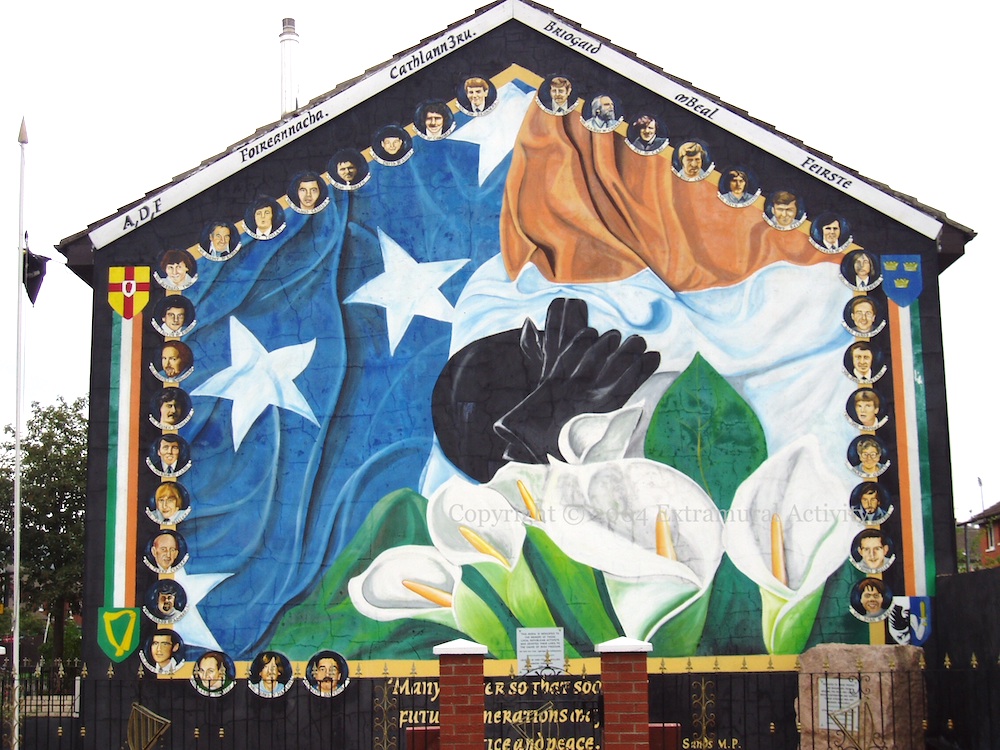
Easter lilies, starry plough (WP), Irish tricolour, black beret and gloves, commemorating dead IRA volunteers from the third battalion of the Belfast brigade.
The plaque on the stone in the corner thanks local residents for their contribution to the struggle. There’s a close-up of the stone in Peter Moloney’s collection (M02420).
“This mural is dedicated to the memory of those local republican activists [34 portraits of volunteers from “A, D, F foıreannacha, cathlann 3rú, Brıogáıd mBéal Feırste”] who devoted their lives to the cause of Irish freedom. Ar son na c[ú]ıse. Óglaıgh na hÉıreann. Unveiled by Sınn Féın councillors Martin Meehan and Margaret McClenaghan.”
“Many suffer so that some day future generations may live in justice and peace – Bobby Sands MP.”
“Dedicated to those friends and neighbours from Ardoyne, the Bone and Ligoniel whose contribution and support to our struggle was and remains invaluable. Aıthníonn muıd a gcrógacht. Óglaıgh na hÉıreann. Meán Fómhaır 2003.”
“Is beo ár cheoıl fós” [our music still lives] The Blind Piper is a painting (original) by Joseph Haverty (WP), here placed in the context of North Belfast’s Cave Hill.
Sponsored by North Belfast Cultural Society (“NBCS” in the apex).
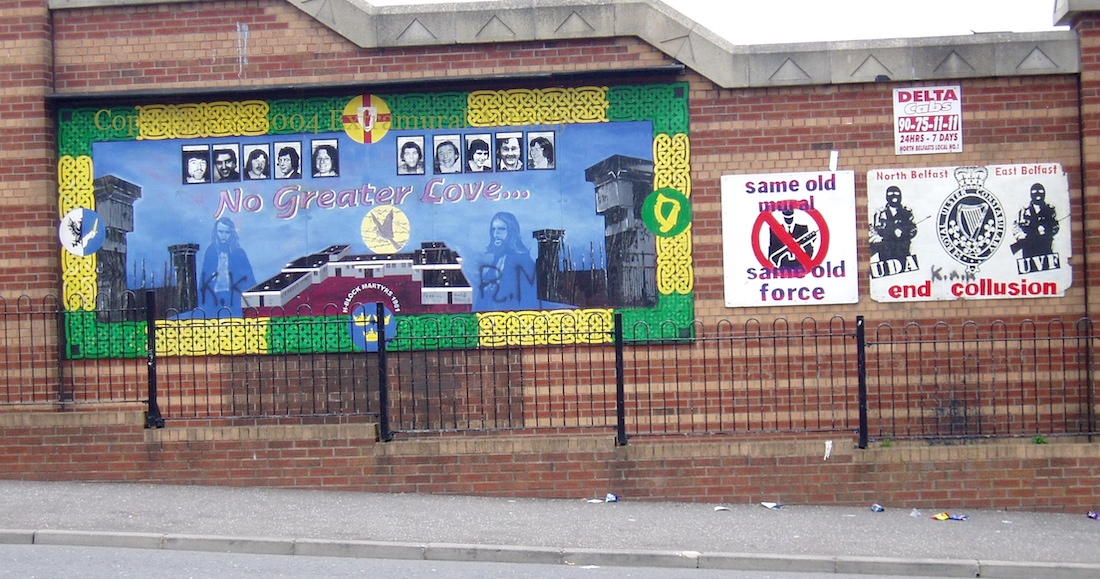
The large board on the left commemorates the 10 dead hunger strikers (WP) and two blanketmen. “No greater love” echoes John 15:13.
There are also two smaller boards on the right: first, “Same old mural, same old force” with the three-in-one figure of RUC, Orange Order, and loyalist paramilitary under a traffic “No” symbol; second, an interesting board alleging collusion between the RUC and the UDA and UVF in north and east Belfast.
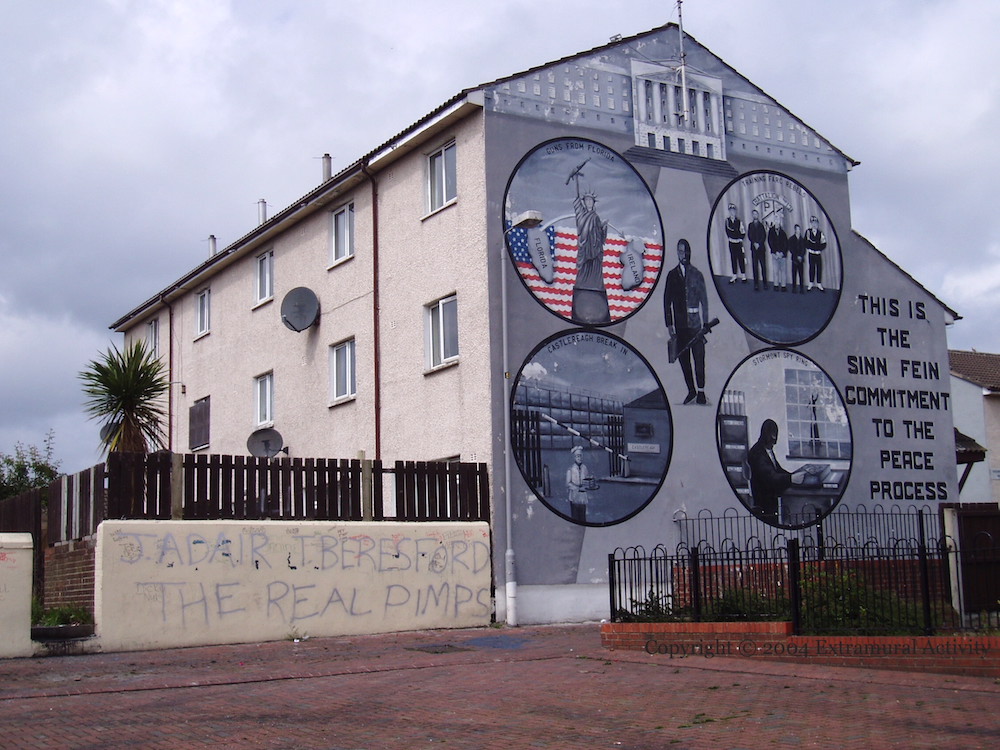
A twofer here, as we get graffiti next to the mural decrying Sinn Féin on Shankill Parade. “J[ohnny] Adair, T[homas] Beresford – the real pimps.” For UDA C Coy pimping, see Free Library, but why Adair and Beresford are the real pimps is unknown. See the Visual History page on the Adair-Era Murals for background on Adair; see this BelTel article for information about the feud.)
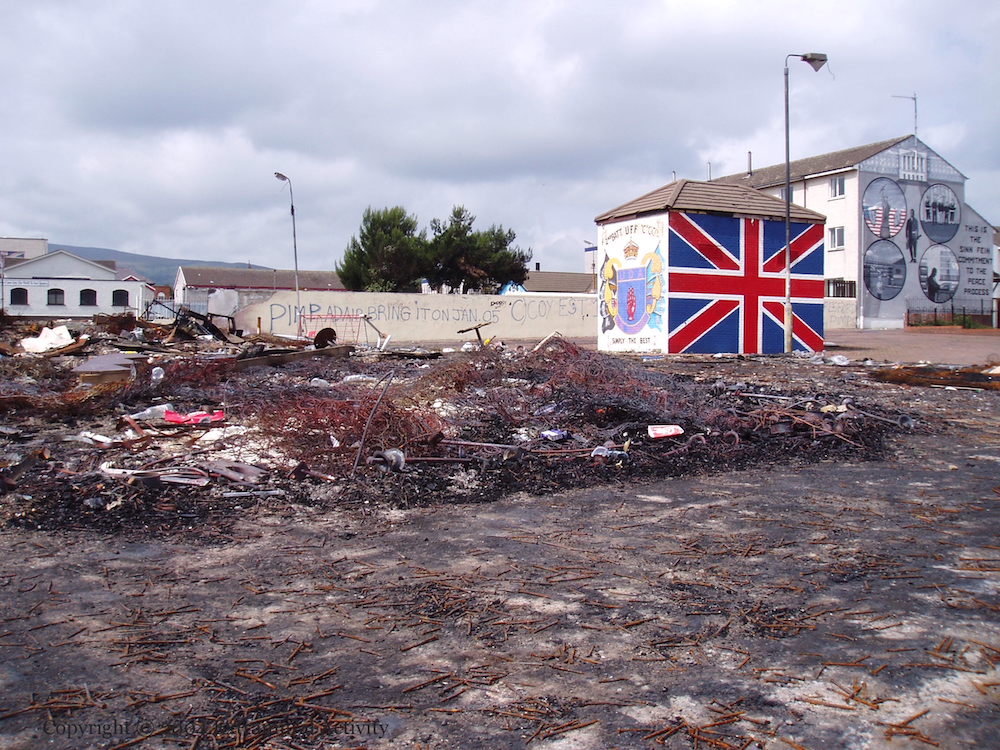
Here’s a shot of the wider scene, from the Boundary Street side, with more graffiti about Johnny Adair: “Pimp Adair, bring it on. Jan 05.” “Jan 05” is a reference to Adair’s forthcoming release from prison.





 Extramural Activity