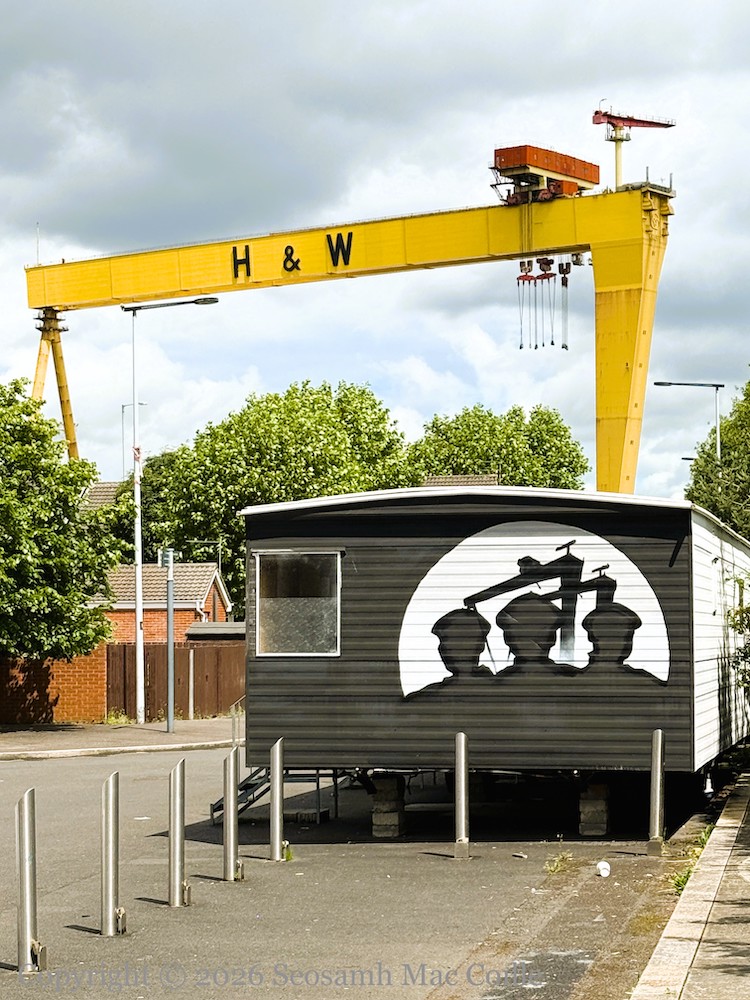
At its peak, the Harland & Wolff shipyard employed 35,000 people (IndustriAll) and the flat-capped worker became a symbol of east Belfast, along – much later – with Samson and Goliath, the two gantry cranes at the shipyard that were raised in 1974 and 1969 (WP) and which have become the symbol of Belfast.
The silhouetted workers and cranes are on a mobile office in Fraser Pass, Newtownards Road, Belfast, at the end of the Pitt Stop next to the Belfast Bikes racks.
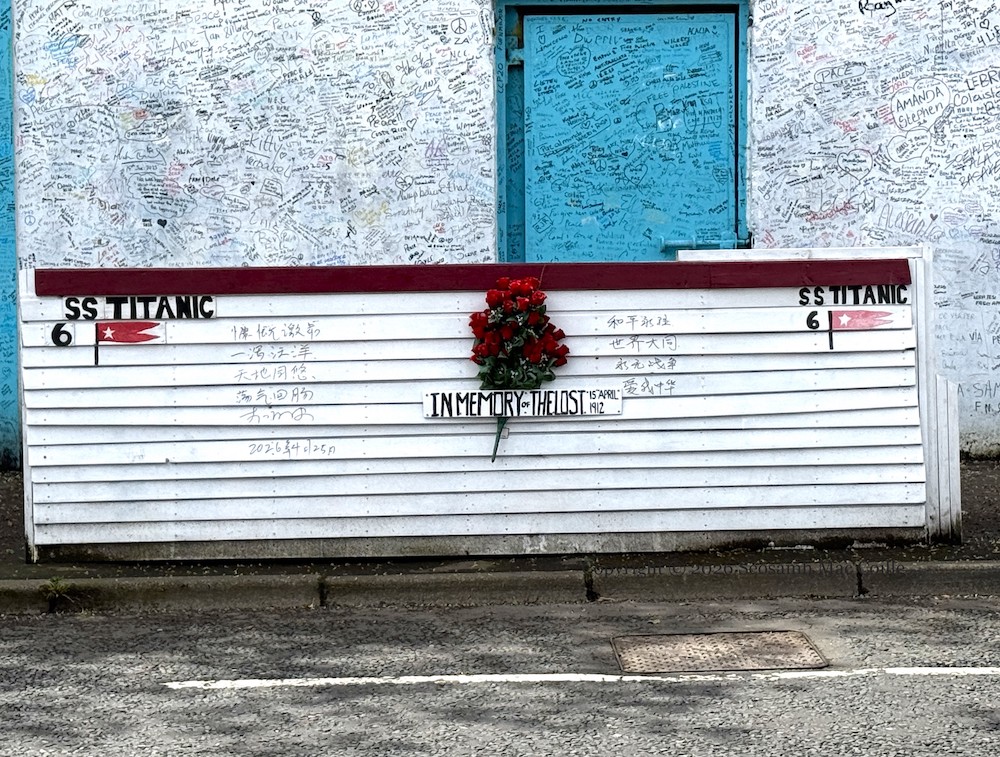
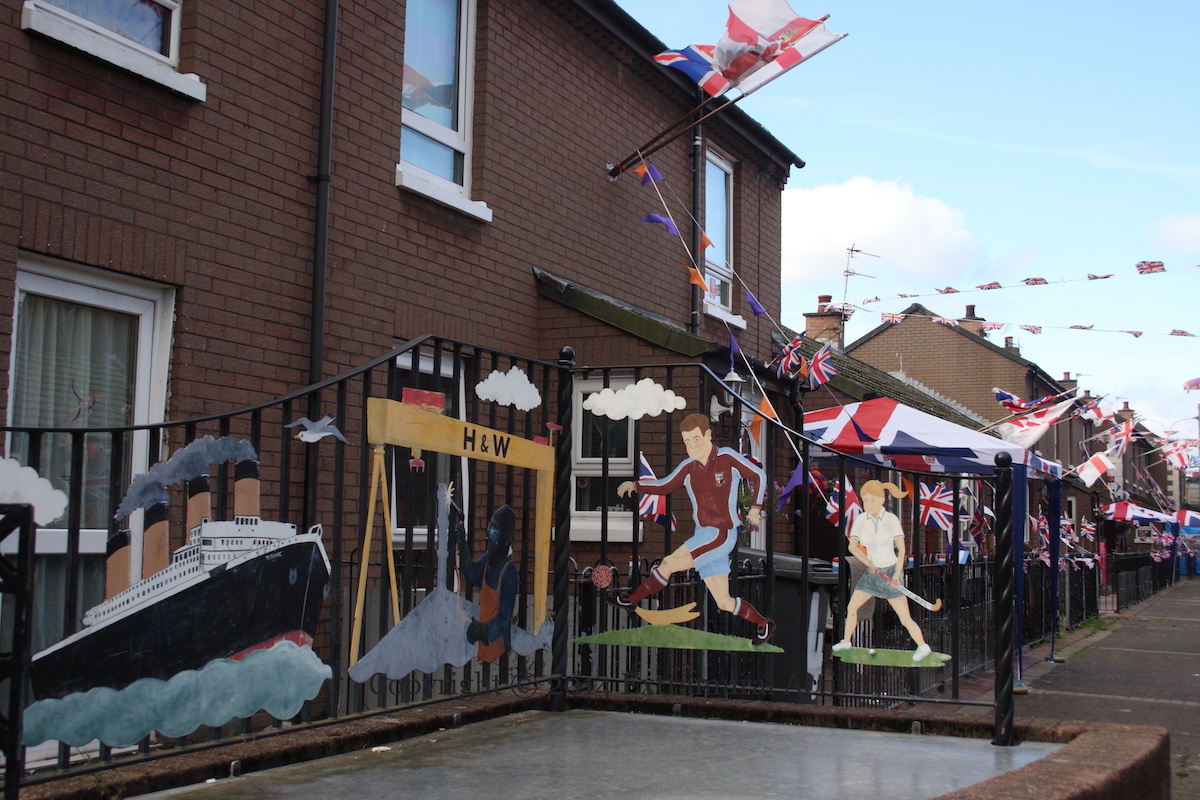
“In memory of the lost, 15 April, 1912.” The majority lifeboats on the RMS (not “SS”) Titanic were made of wood, constructed at Harland & Wolff at the same time that Titanic was built. Of the 2,209 people on board the ship at the time of her collision with an iceberg late in the evening of April 14th, 706 people survived in lifeboats that could have carried 1,178 people. (WP)
This tribute to those who died in on a short section of pedestrian railings on the Cupar Way “peace” line (Visual History). In the background are the specially designated spots for tourists to sign the wall (see Collecting Signatures in the Paddy Duffy Collection).
Tillie & Henderson’s shirt factory opened in 1856 at the junction of Abercorn Road and Foyle Road, Derry (next to the ‘Hands Across The Divide’ statue) and survived until 2003 when it was demolished after a fire (BBC); an apartment block is currently planned for the site (Derry Journal | BBC). It was the largest such factory in the world and one of 44 shirt factories in the city in 1900, all of which employed women, many starting in their teens.
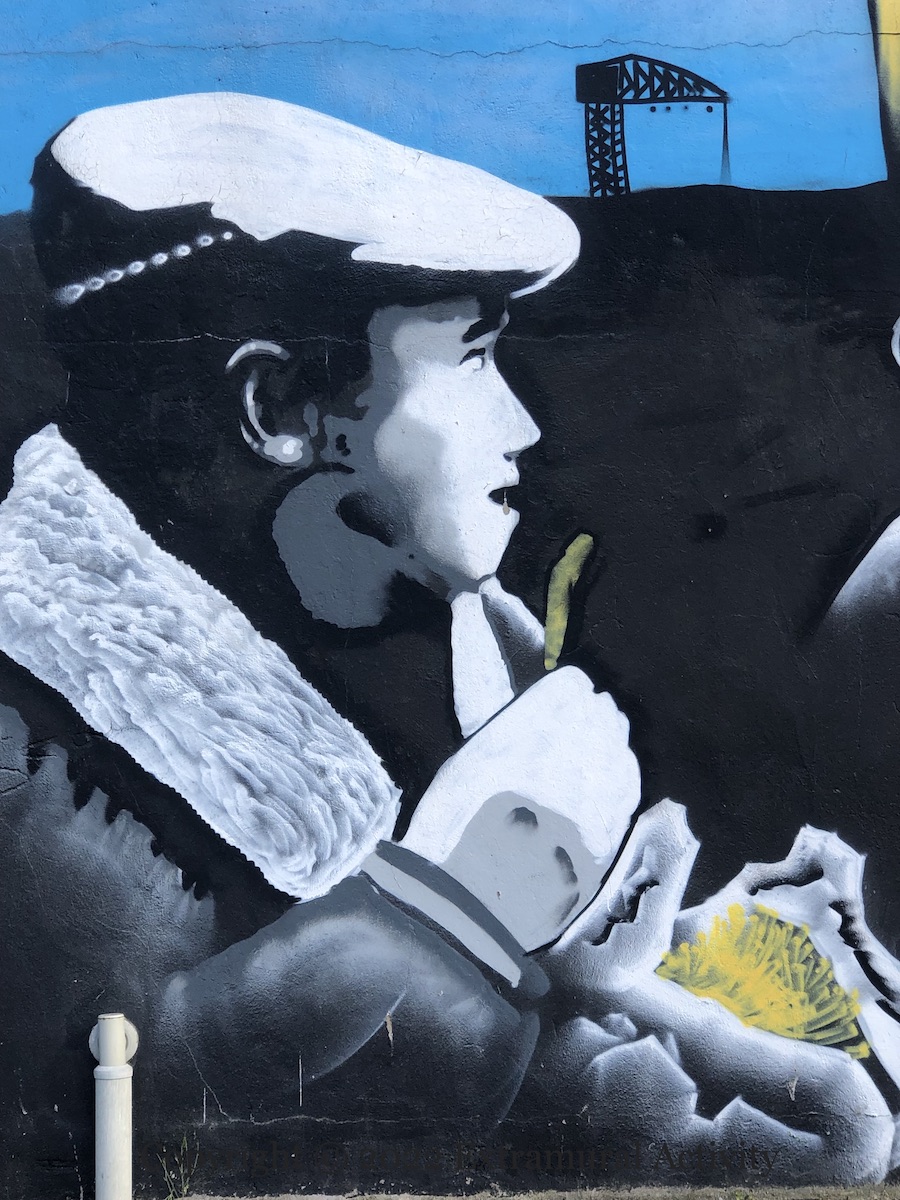
It’s been a long time since workers walked en masse from east Belfast to the shipyard, but fish and chips remain popular, though the number of chippies has fallen from about 35,000 in 1920 to 10,500 today (BBC | Dockside). This mural is on the side of the ‘Chipyard’ in Strandtown.
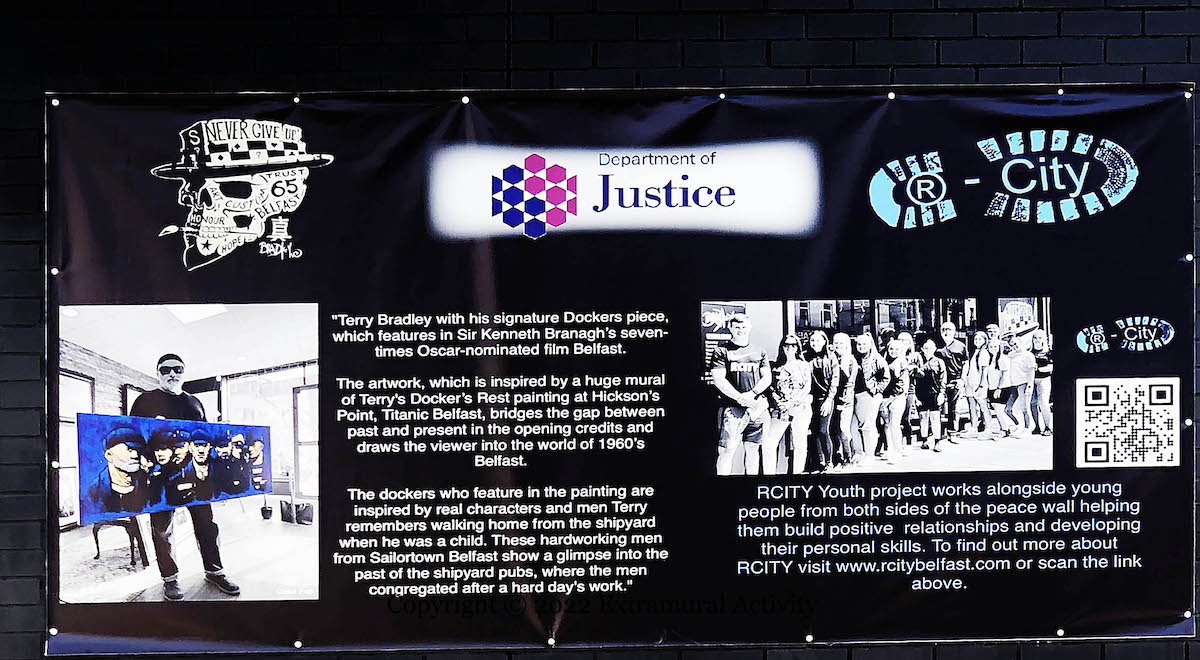
This is a mural of a painting of a mural of a mural. The original is the piece by Terry Bradley (web) and Friz (web) at the Titanic museum’s pub (see Dockers’ Rest), which was then reproduced in a different colour for the opening montage of the Kenneth Branagh film Belfast. The success of the film prompted the Department Of Justice to commission Bradley for a painting that could be turned into a mural and he reproduced the film version (BelTel). The mural that enlarges that painting was painted by DMC on Lanark Way, just above the security gates (Belfast Live).
“The dockers who feature in the painting are inspired by real characters and men Terry remembers walking home from the shipyard when he was a child. These hardworking men from Sailortown, Belfast, show a glimpse into the past of the shipyard pubs, where the men congregated after a hard day’s work.”
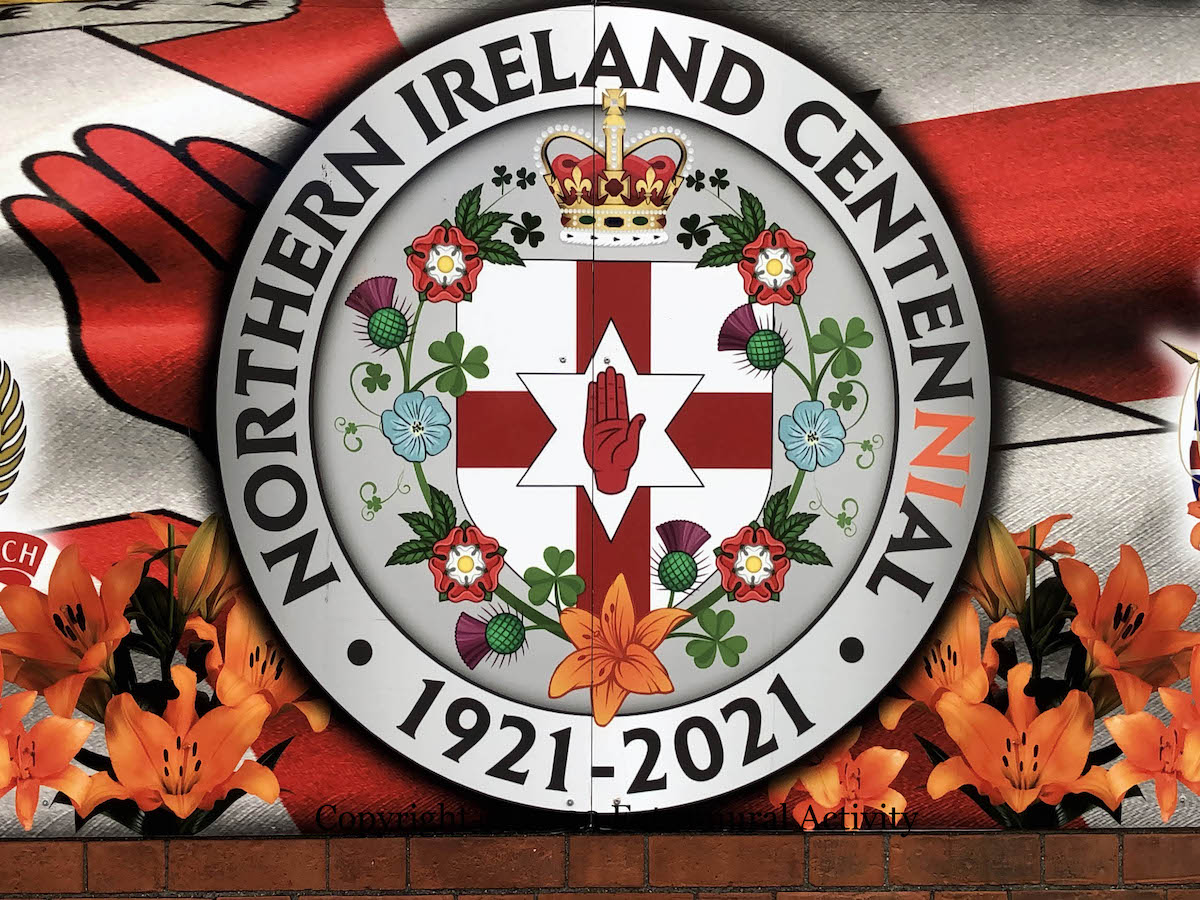
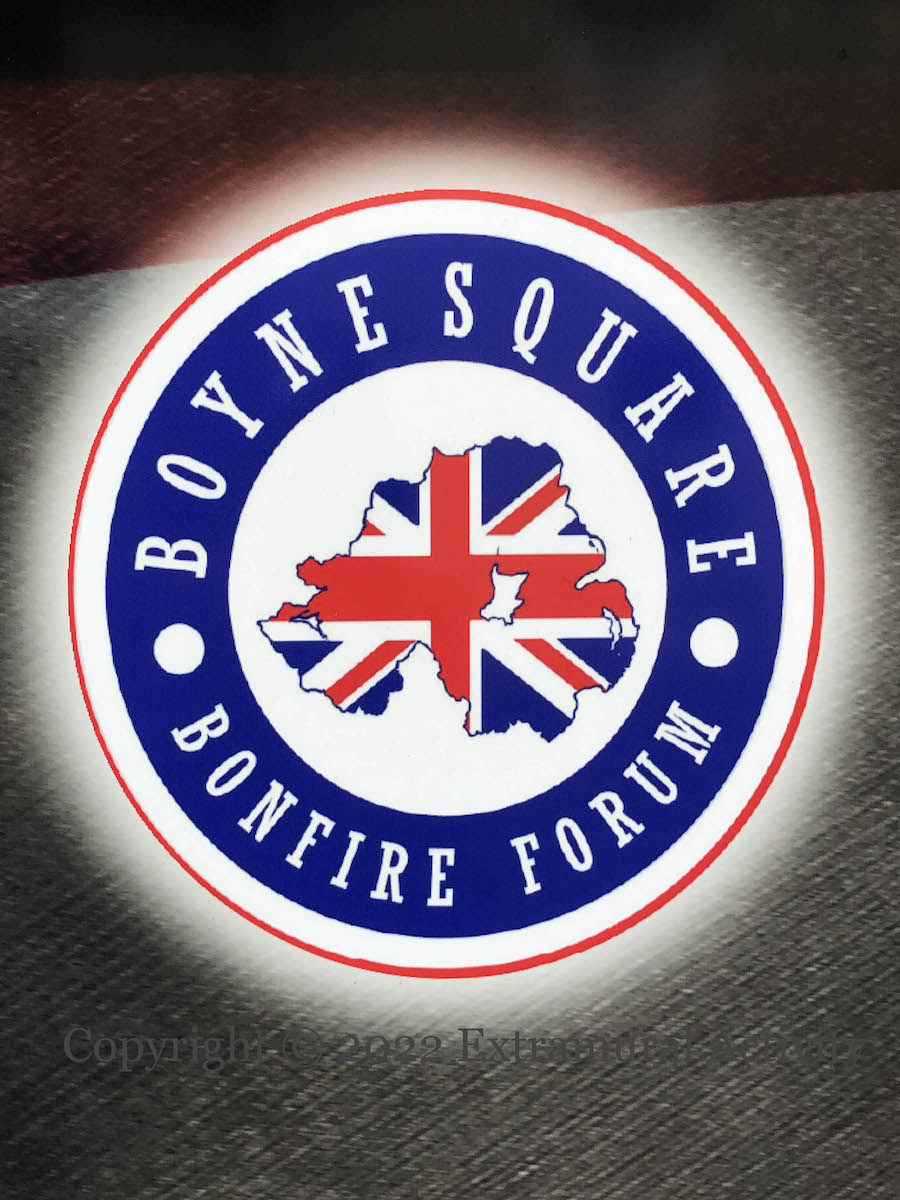
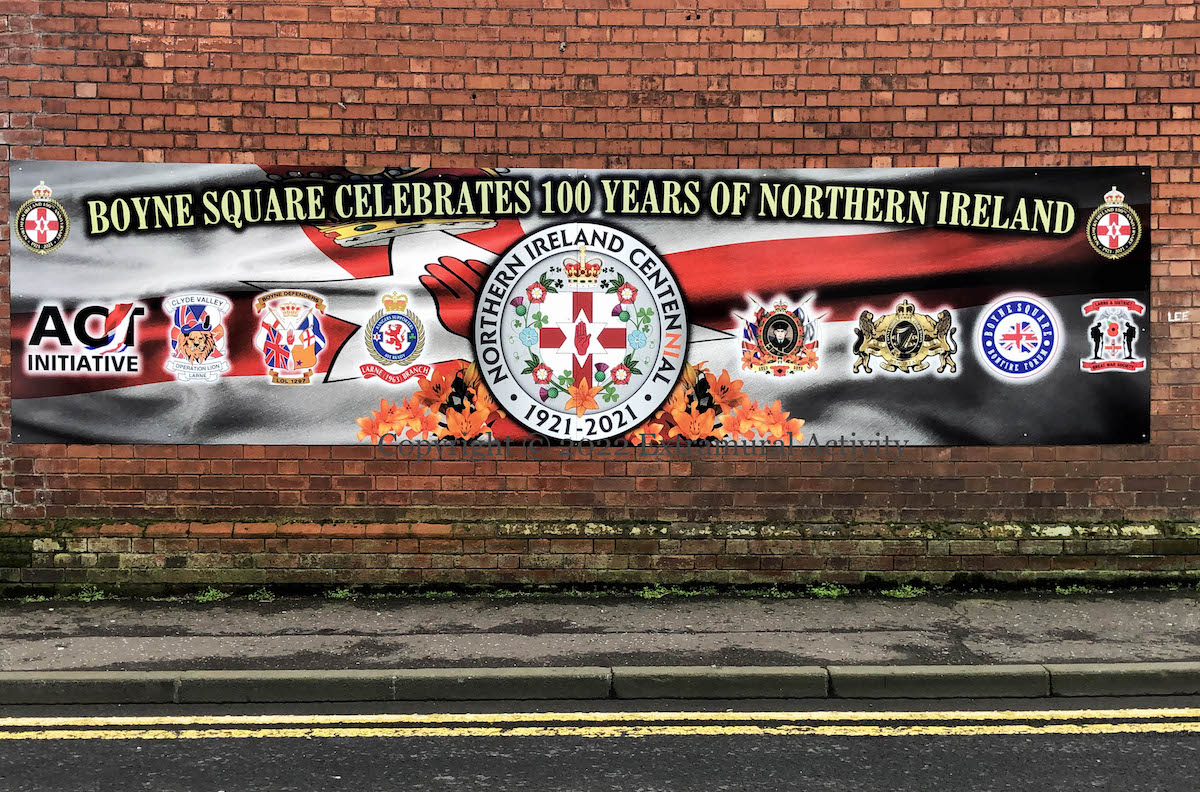
The orange lily and the (pale blue) flax flower take their place around the Ulster Banner alongside the English rose and Scottish thistle, and the Irish shamrock is retained even in the presence of the lily. The flax is perhaps included because we are in the Factory area of Larne, near the site of a (former) linen mill. The Welsh daffodil is excluded. The detail above is part of a wider board “Boyne Square celebrates 100 years of Northern Ireland”; the flanking emblems of the Boyne Defenders (LOL 1297), Rangers Supporters club (Larne Branch) – which also uses the shamrock – Boyne Square Bonfire Forum, and Larne & District Great War Society and included below; the emblems of three flute bands can be seen in Norman Anderson and The Gunrunners.
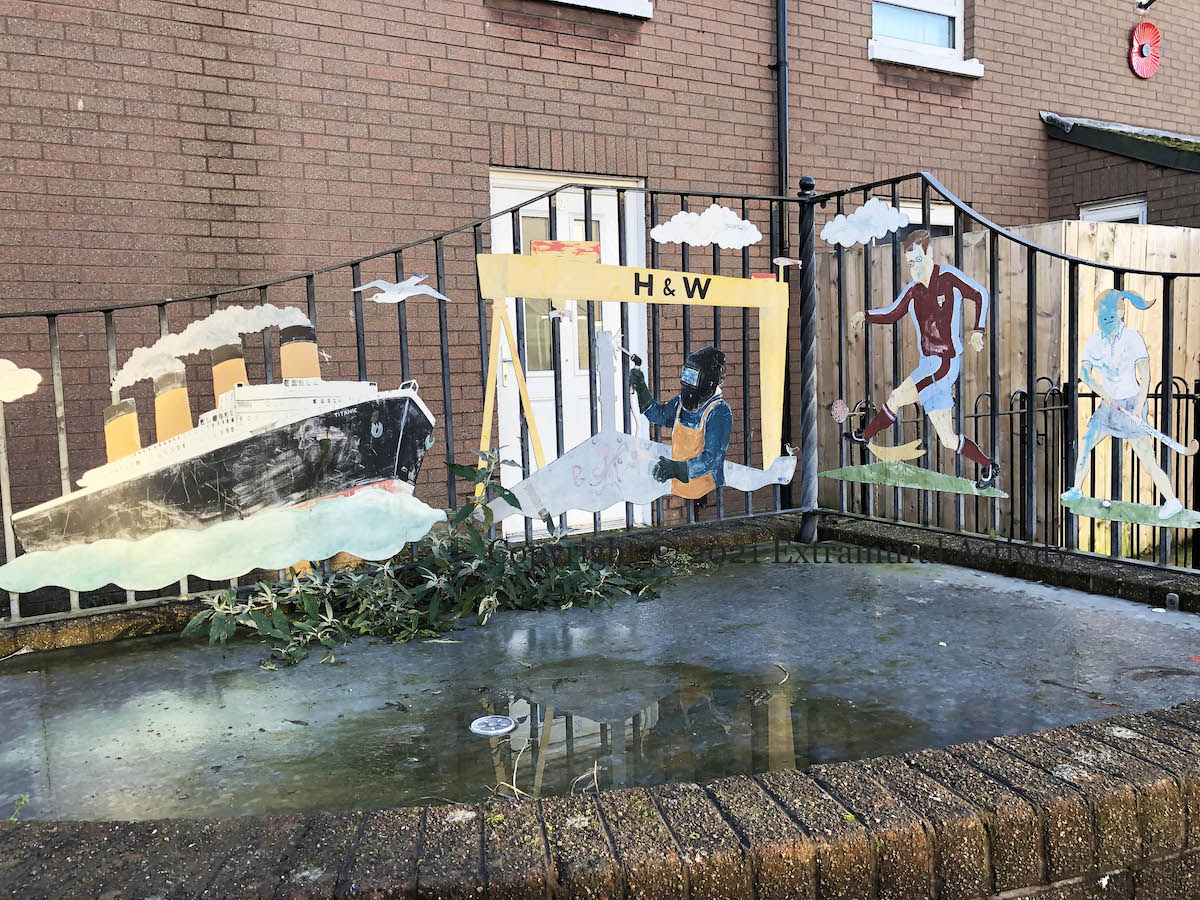
Titanic was built at Harland & Wolff shipyard in east Belfast; it took more than three years to build but was in service for only five days, as it famously hit an iceberg and sank in the North Atlantic ocean. The welders formed their own football club, in 1965. The football and hockey players on the right are perhaps associated with Ledley Hall.
Earl Street and Sussex Street used to be sandwiched between wings of the largest tobacco factory in the world, Gallahers, which took up seven acres between York Street and North Queen Street. The factory was partially demolished in 1990 and became Yorkgate shopping centre and the two streets are roughly now the back and front entrances to the Tesco supermarket. These two plaques (both on North Queen Street) are to former residents. William Campbell, a H&W joiner, might have witnessed the construction of Gallahers (in 1897 – Look Again) before dying on Titanic in 1914. Francis Liggett, an IRA volunteer, was shot and killed by British forces during an attempted robbery of the Royal. (He is also remembered in a mural in St James’s near the site of his death and home – see Liggett & Brady.)
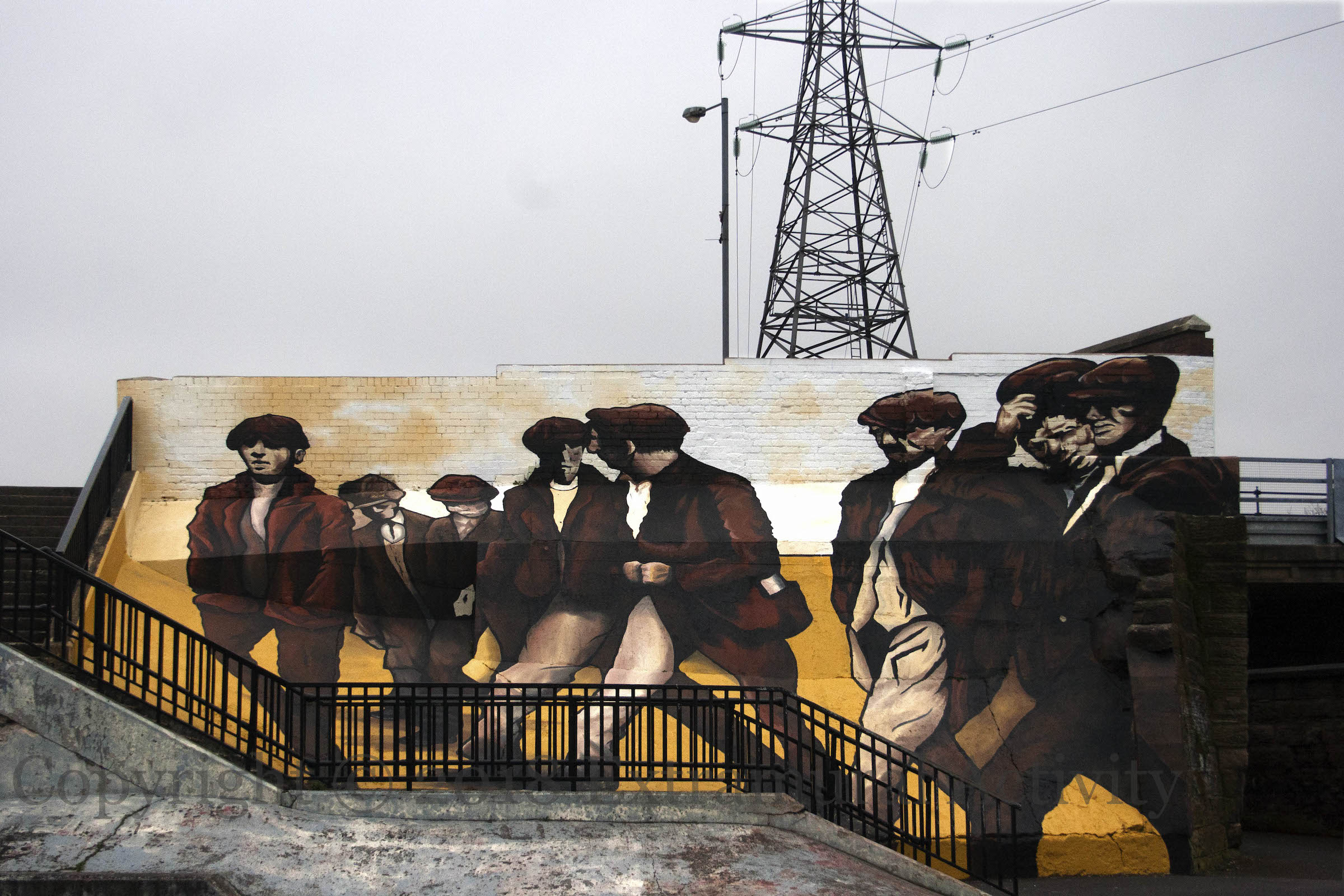
The large mural of H&W shipyard workers at the turn of the century has been restored by Dee Craig (Fb). The mural is on the footbridge linking Dee Street and Queen’s Island. Inspired by paintings of William Conor such as Shipyard Workers Crossing Queen’s Bridge and Over The Bridge. For images of the previous version, see Titanic Workers.
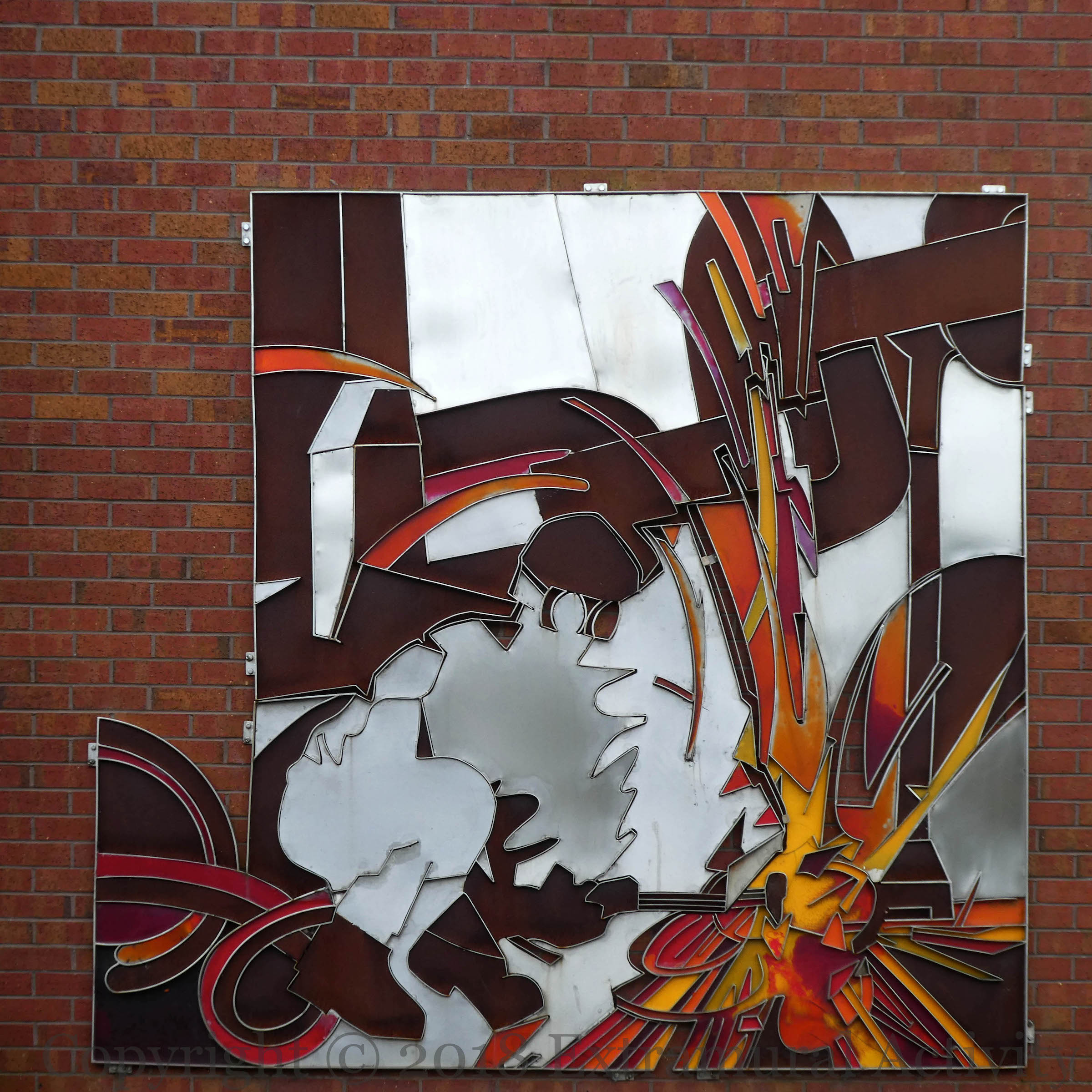
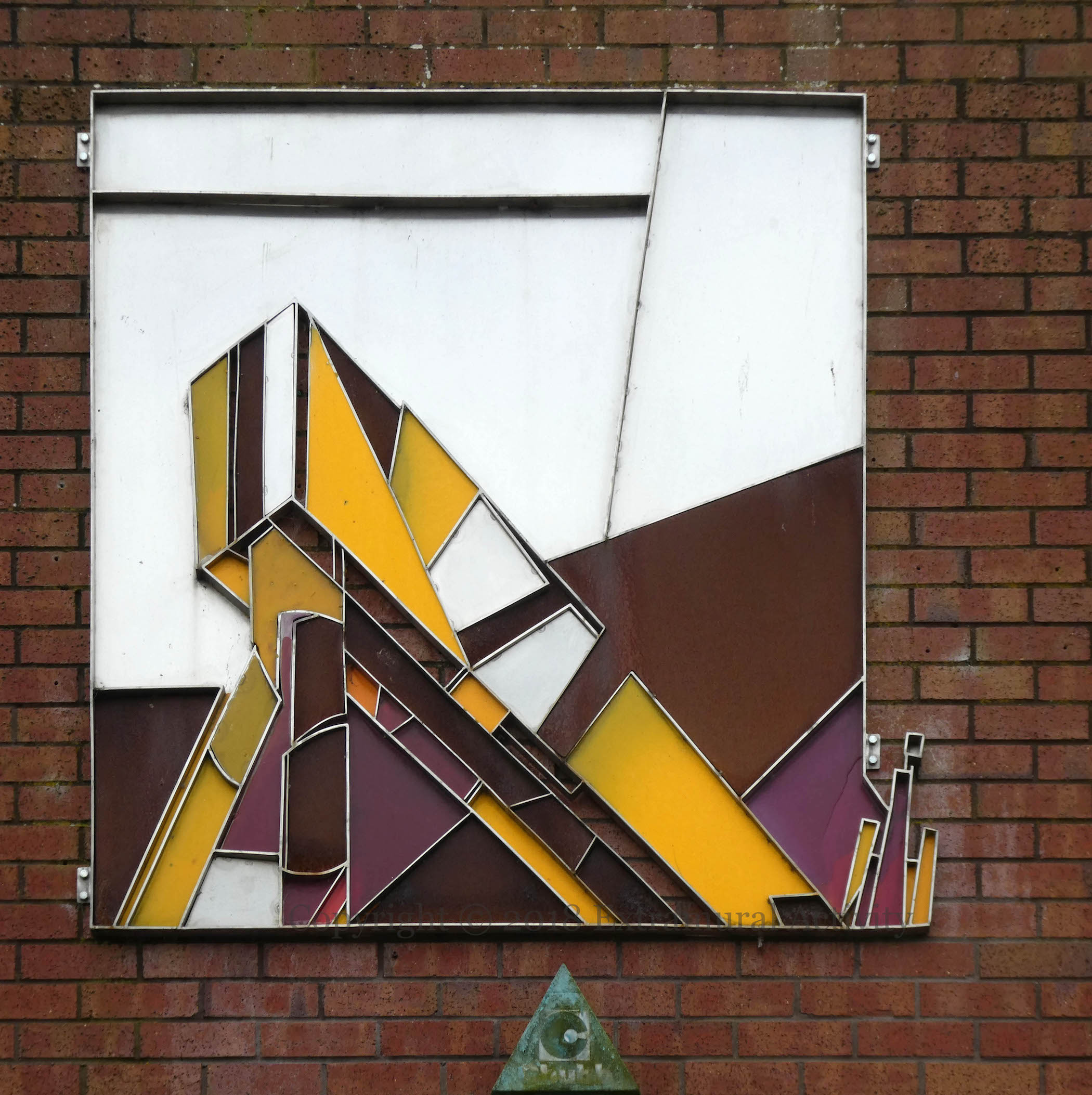
Newcastle artist Alan Burke in 2015 produced four pieces for Eastside Partnership (with funding from the Arts Council) for the area between the Newtownards Road and (what is now) CS Lewis Square (Tele). The piece shown in today’s post is a pair of metalworks depicting the heavy industry of Harland & Wolff. The works themselves are made from sheet metal, stainless steel, and weathering steel which is designed to “form a stable rust-like appearance” after a few years of exposure the elements.










 Extramural Activity