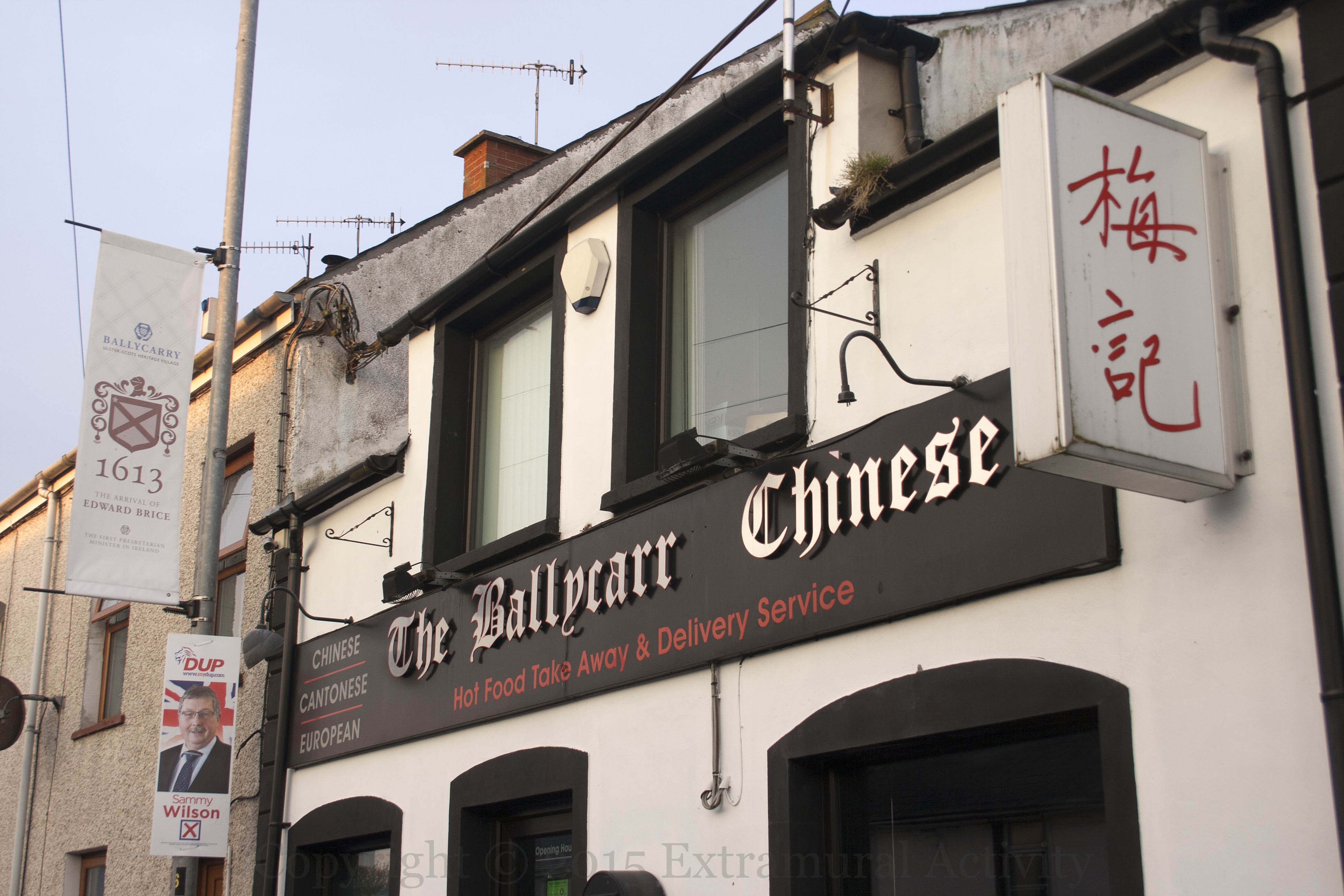
Chinese, Cantonese, European, and Presbyterian. Three signs outside the Chinese take-away in Ballycarry: the Chinese lettering for the restaurant, a DUP poster supporting Sammy Wilson, and an Ulster-Scots heritage banner: “1613 The Arrival of Edward Brice – The first presbyterian minister in Ireland”.
Shepard Fairey used Mannie Garcia’s AP photo of Barack Obama for his ‘Hope’ poster of the 2008 US Presidential election (WP). The three-quarter profile, faraway look and four-tone shading have been repurposed for the board, shown above, in east Belfast: a boy gazes beyond Samson and Goliath, backgrounded by a sunburst: “Dream, Seek, Achieve, Educate, Achieve!”
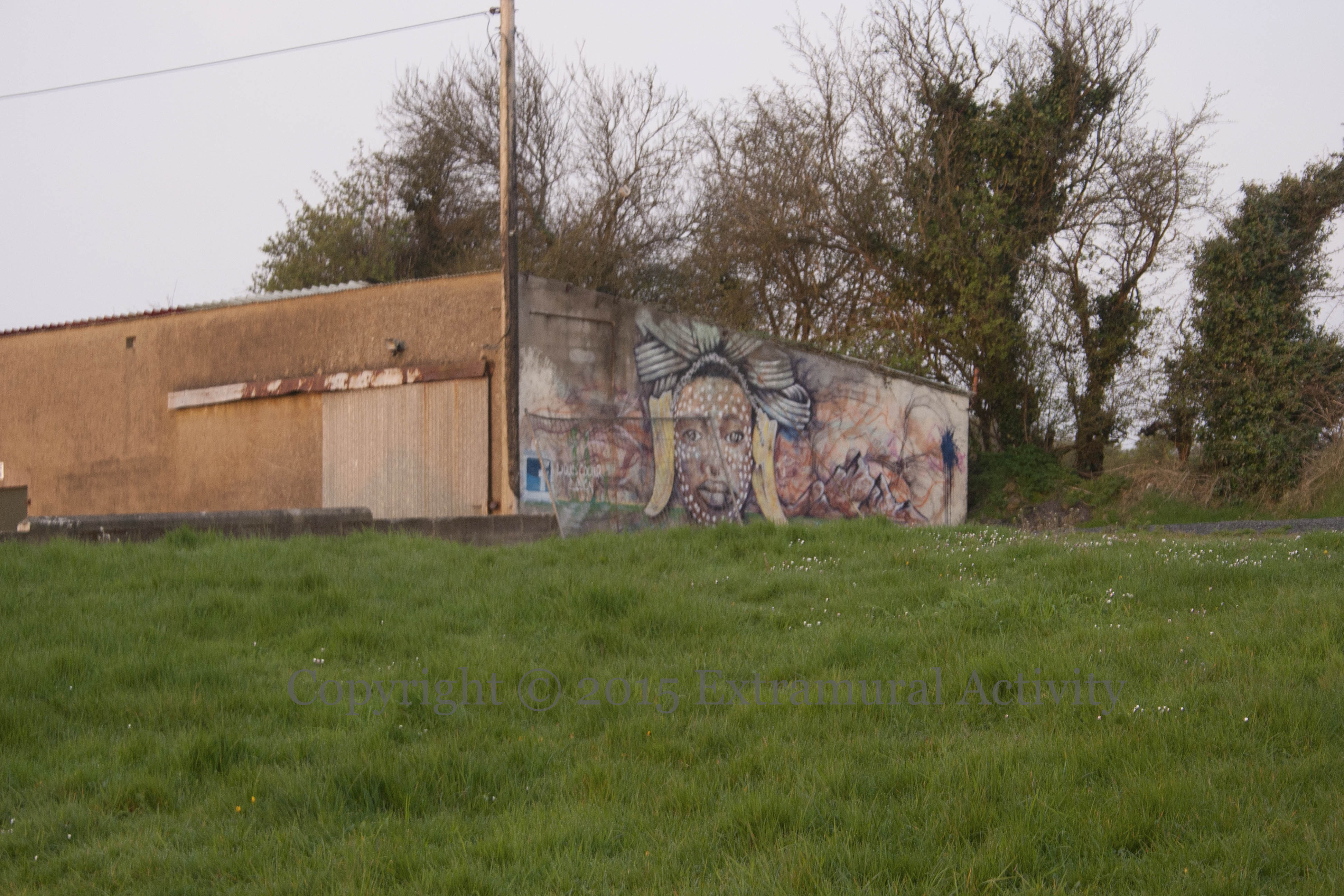
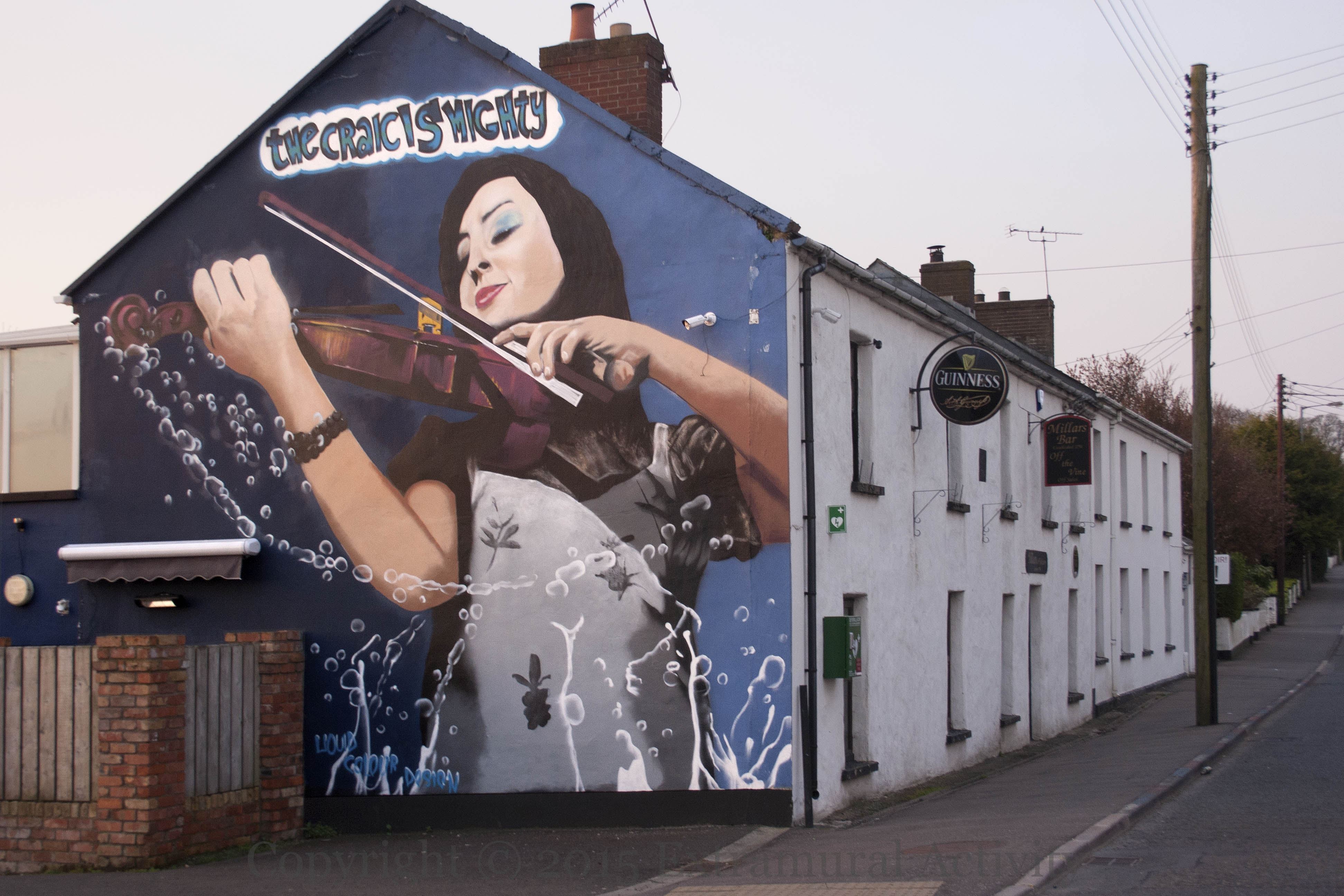
On a barn wall in Ballycarry, County Antrim: a African youth (perhaps Ethiopian Mursi tribe) with painted face and a headdress of warthog tusk and aluminium coils. (By Liquid Colour Design – see also The Craic Is Mighty)
Fiddling in the north of Ireland is common to both Nationalist and Unionist communities and the “old Antrim” style is influenced by Scottish playing (USFO).
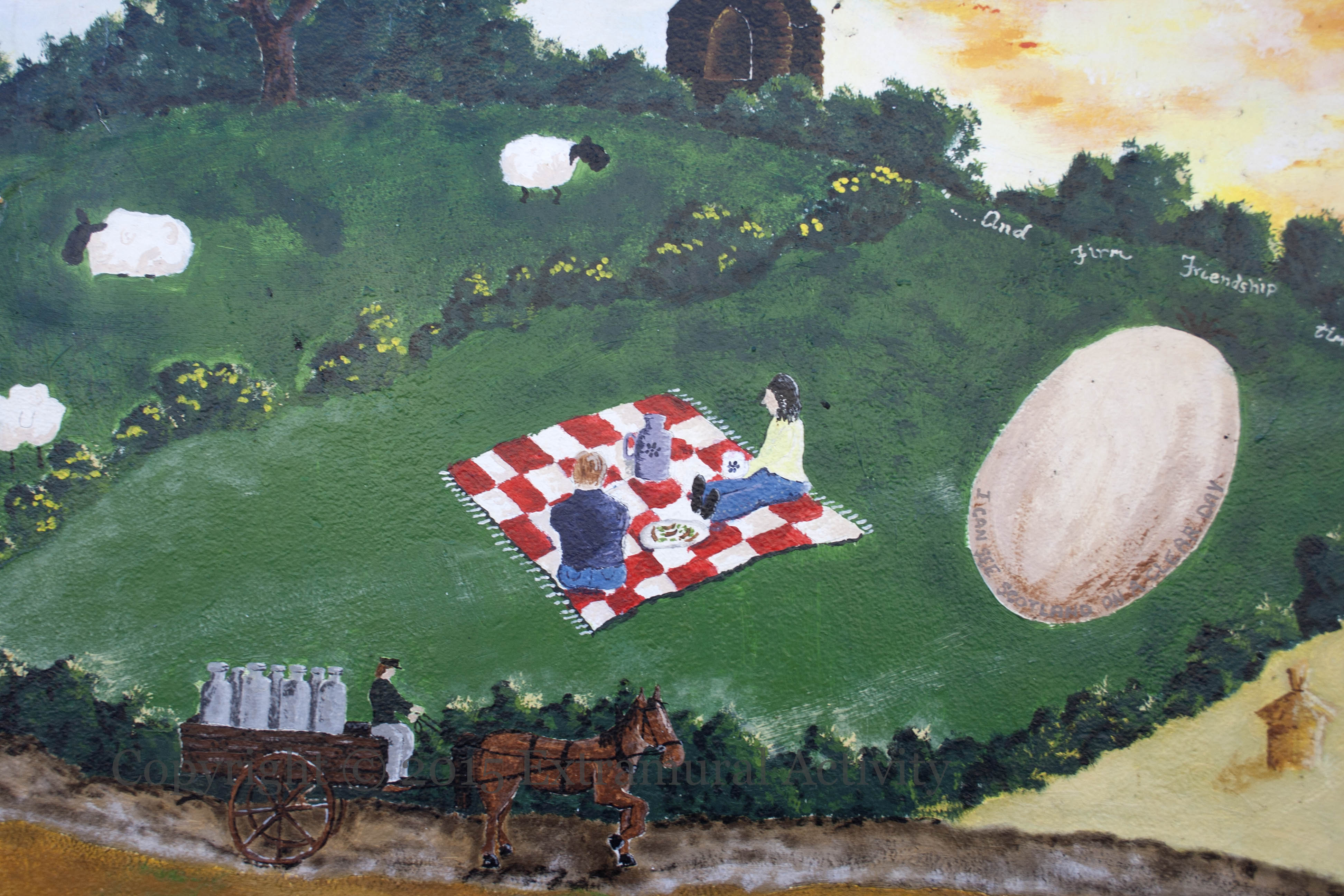
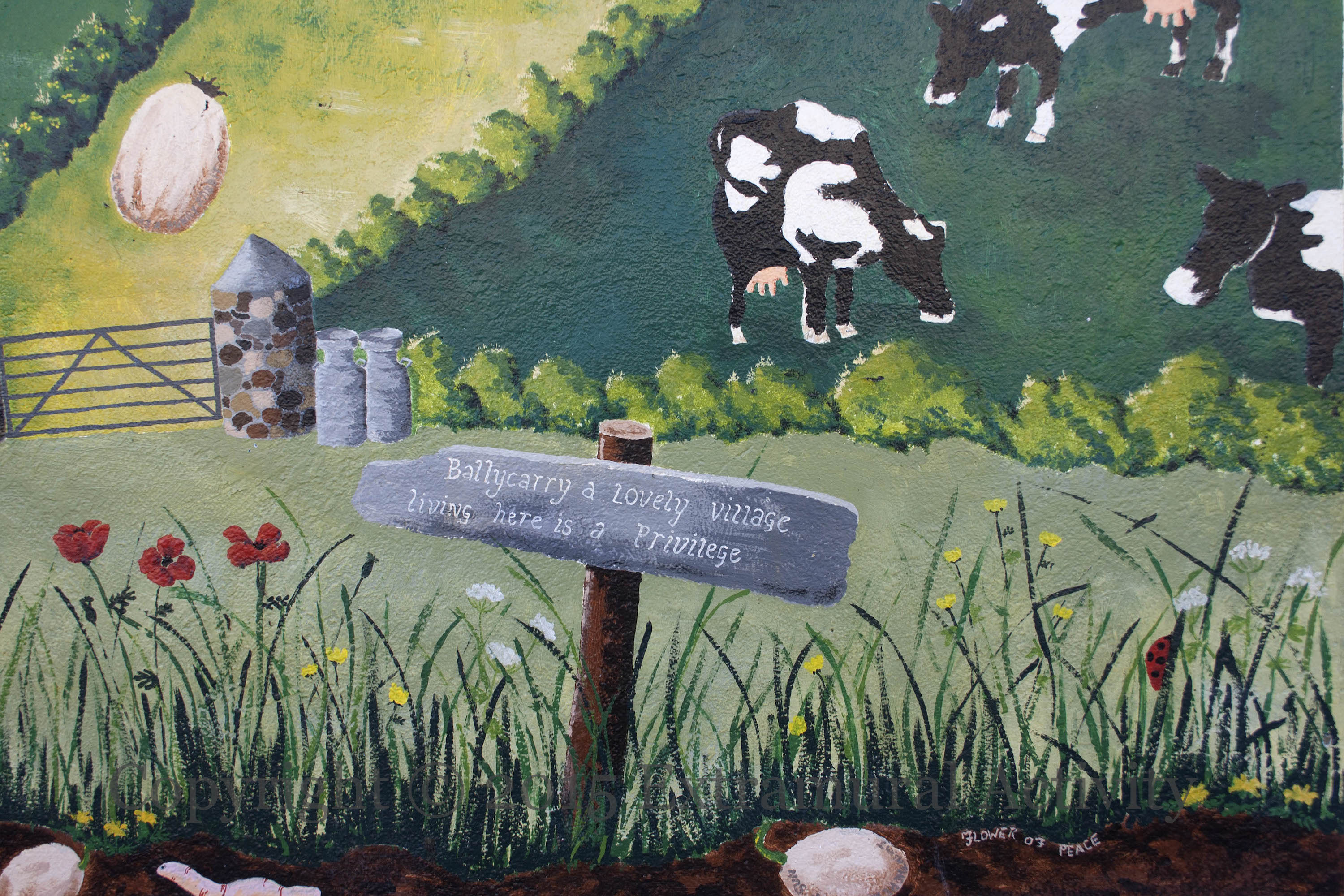
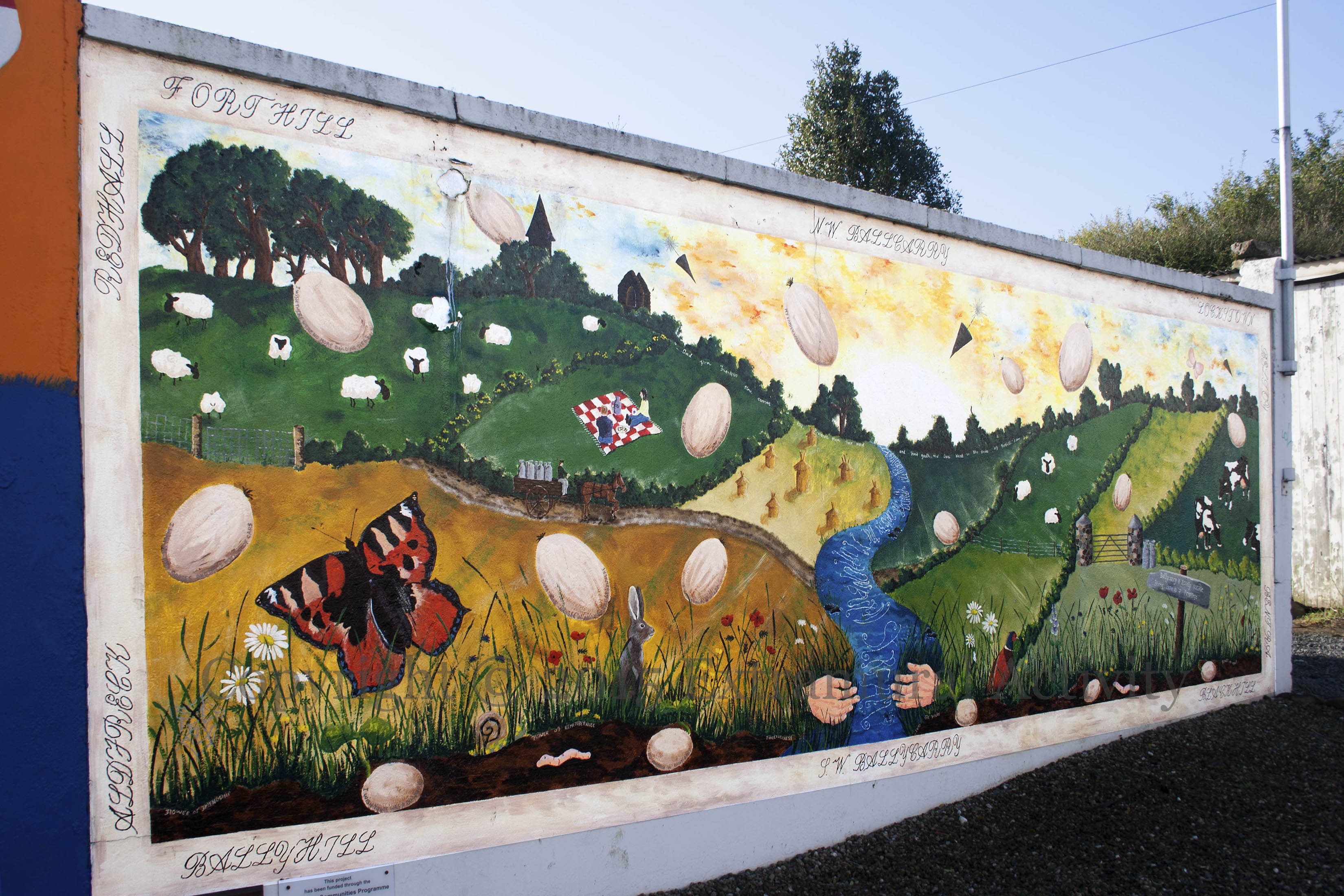
Ballycarry village sits in County Antrim countryside surrounded by the townlands of Ballyhill, Redhall, Forthill, Blackhill, Aldfreck, Lochstown, Beltoy, Bentra. The large pale oval to the right of the picnickers is one of many “seeds” falling from the sky and settling into the earth, which by growing make Ballycarry a pleasant place: “I can see Scotland on a clear day”. The Mutton Burn Stream (lyrics | music from the Ulster-Scots agency) is a song written by Ballycarry resident William Hume (QUB) about the river to the north-west of the village (WP). More about Ballycarry from the BBC’s Ulster-Scots page.
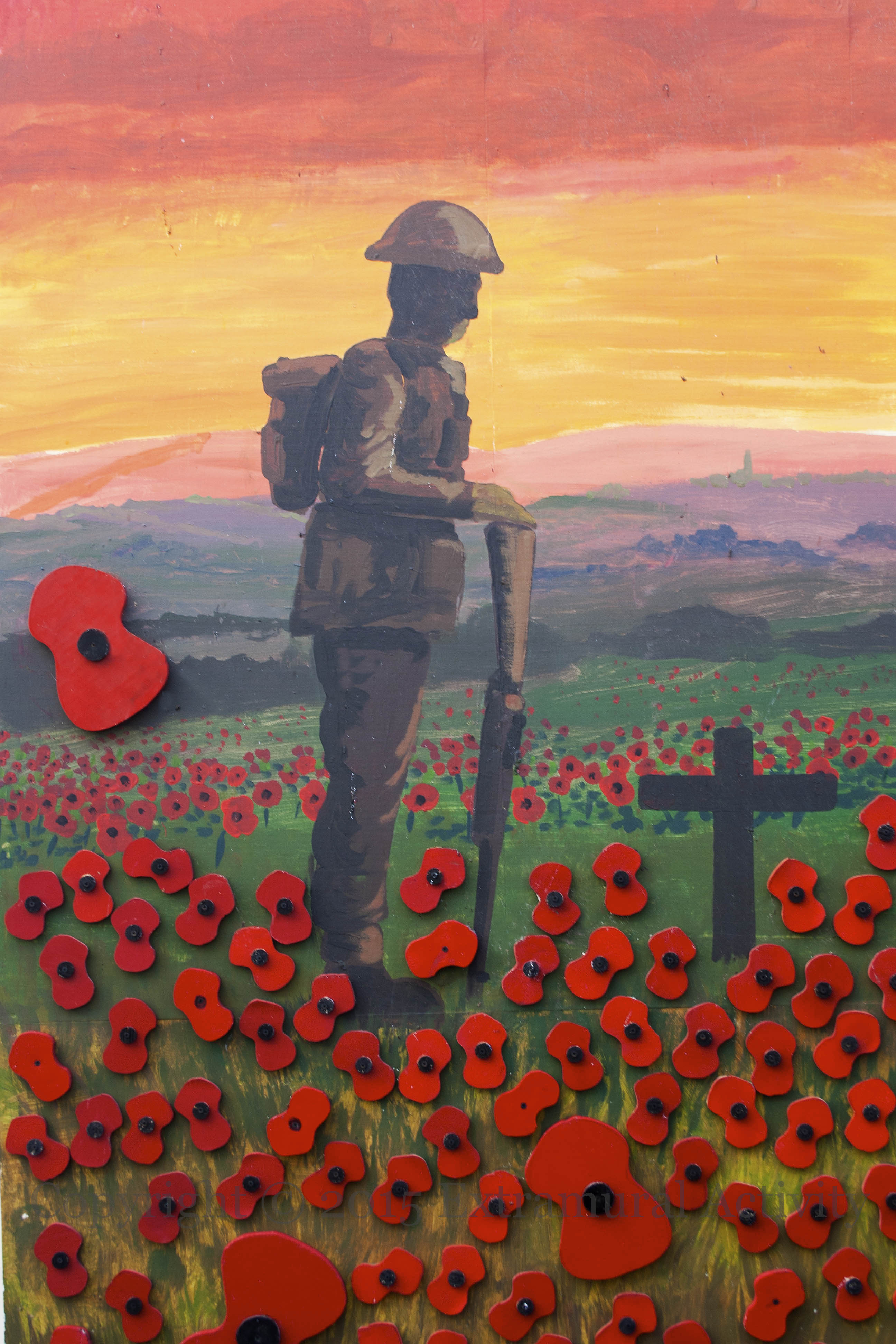
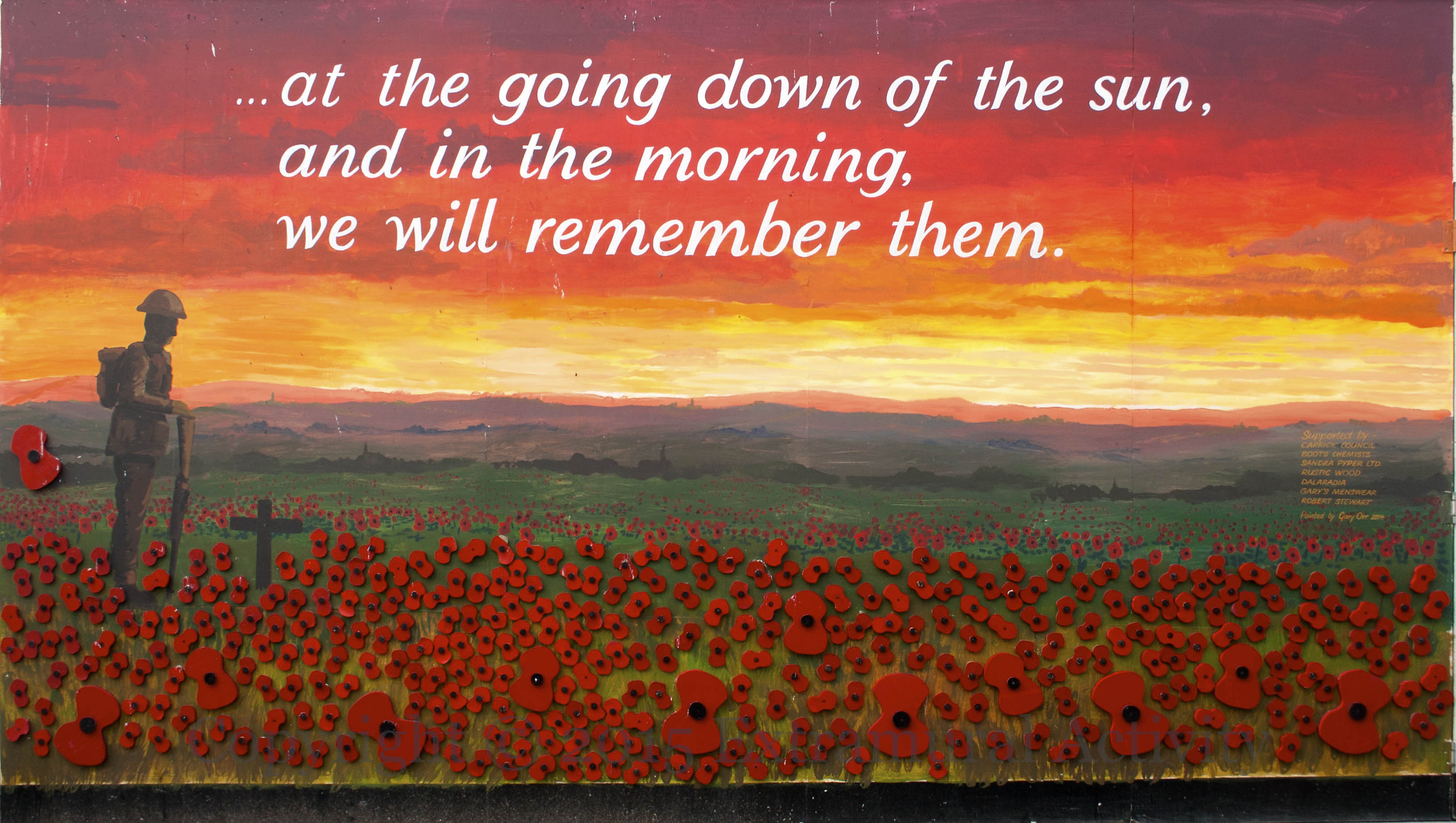
This mural in Carrick has a 3D element: 312 wood poppies were hand-painted and attached to the wall, one for each local man who did not return. By artist Gary Orr. Full shot below.
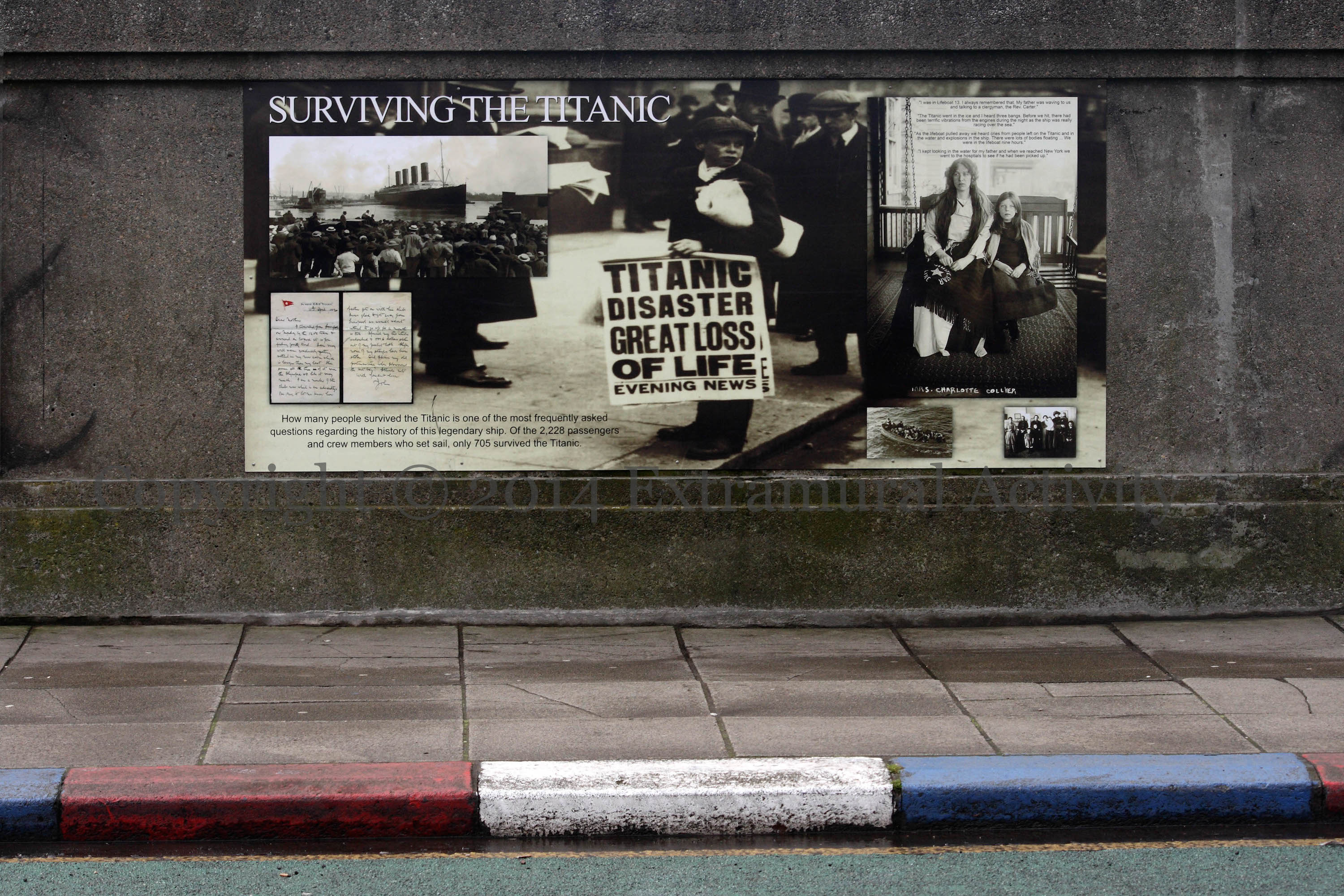
Here are two final images from the south side of the Donegall Road bridge over the Victoria Street line, one about Titanic and the other about locals awarded the MBE.
“I was in Lifeboat 13. I always remember that. My father was waving to us and talking to a clergyman, the Rev. Carter. The Titanic went in the ice and I heard three bangs. Before we hit, there had been terrific vibrations from the engines during the night as the ship was really racing over the sea. As the lifeboat pulled away we heard cries from the people left on the Titanic and in the water and explosions in the ship. There were lots of bodies floating … We were in the lifeboat nine hours. I kept looking in the water for my father and when we reached New York we went to the hospitals to see if he had been picked up.” Mrs. Charlotte Collier
How many people survived the Titanic is one of the most frequently asked questions regarding the history of this legendary ship. Of the 2,228 passengers and crew members who set sail, only 705 survived the Titanic.
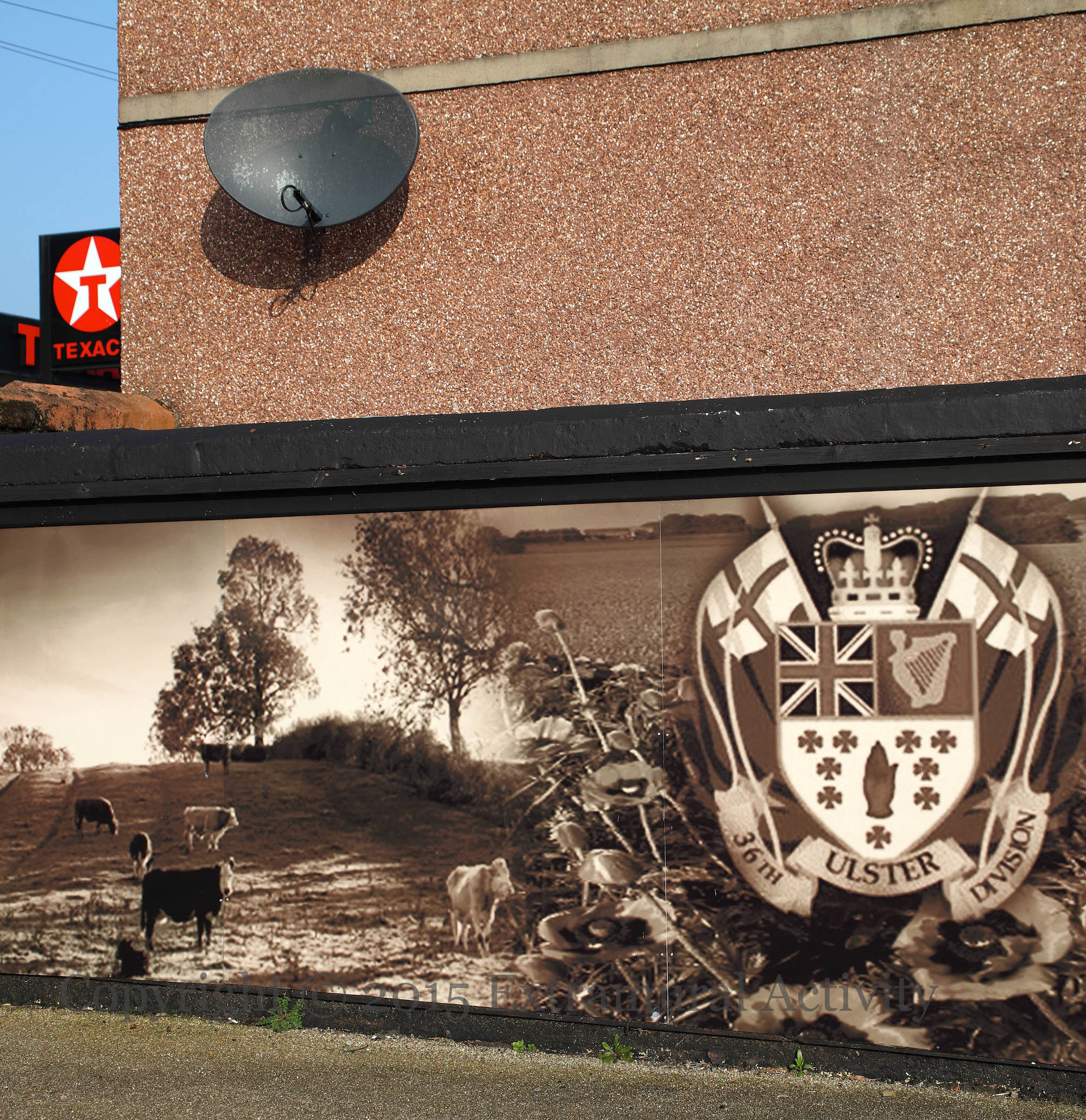
The Tullygarley mural in Larne, originally painted by Caroline Jeffrey, has been replaced with a computer-generated version reproducing most of the images. The bleaching green is gone; the Black Arch has been added, as has part of the mural that was on this site three generations of murals ago: God Save The Queen.
From the info-board for the previous version, included below:
“Tullygarley” means “Hillock of the Grey Calf” – thus the grey calf grazing with the cows.
The 36th Ulster Division – In September 1914 the Ulster Division was formed from the Ulster Volunteer Force which raised thirteen battalions for the three Irish regiments in Ulster.
Bleaching Green – Linen laid out in fields to bleach. The Bleaching Factory interior depicts the Bleaching process. (The building is currently derelict.) Blue Flax Flowers are the national floral emblem of Northern Ireland.
Local Primary School, Inver and Larne, known locally as “the Bridge”, as it looked in the 1930’s with the Inver River running through it. The bridge that the school was named after no longer exists.
Linen Factory of Glyn [Glynn] Road (no longer exists, site of abandoned garage) with inset depicting workers with weaving machines (circa 1924).
The old Tullygarley playground (mural site) with the Fountain in the foreground, and rows of houses on either side (Glynn Road and South Circular Road).
Sun Laundry Van. Sun Laundry showing people working inside (now Rea’s Furnishings, Bank Road).
Larne Lough – it is an area of special interest, a special protection area and a Ramsar site in order to protect the wetland environment.
SS Clyde Valley – launched in July 1886. Was used in 1914 to transport arms from Hamburg to Larne.
Roseate Tern – Larne Lough is the only breeding colony in Northern Ireland for the Roseate Tern, one of the UK’s rarest birds.
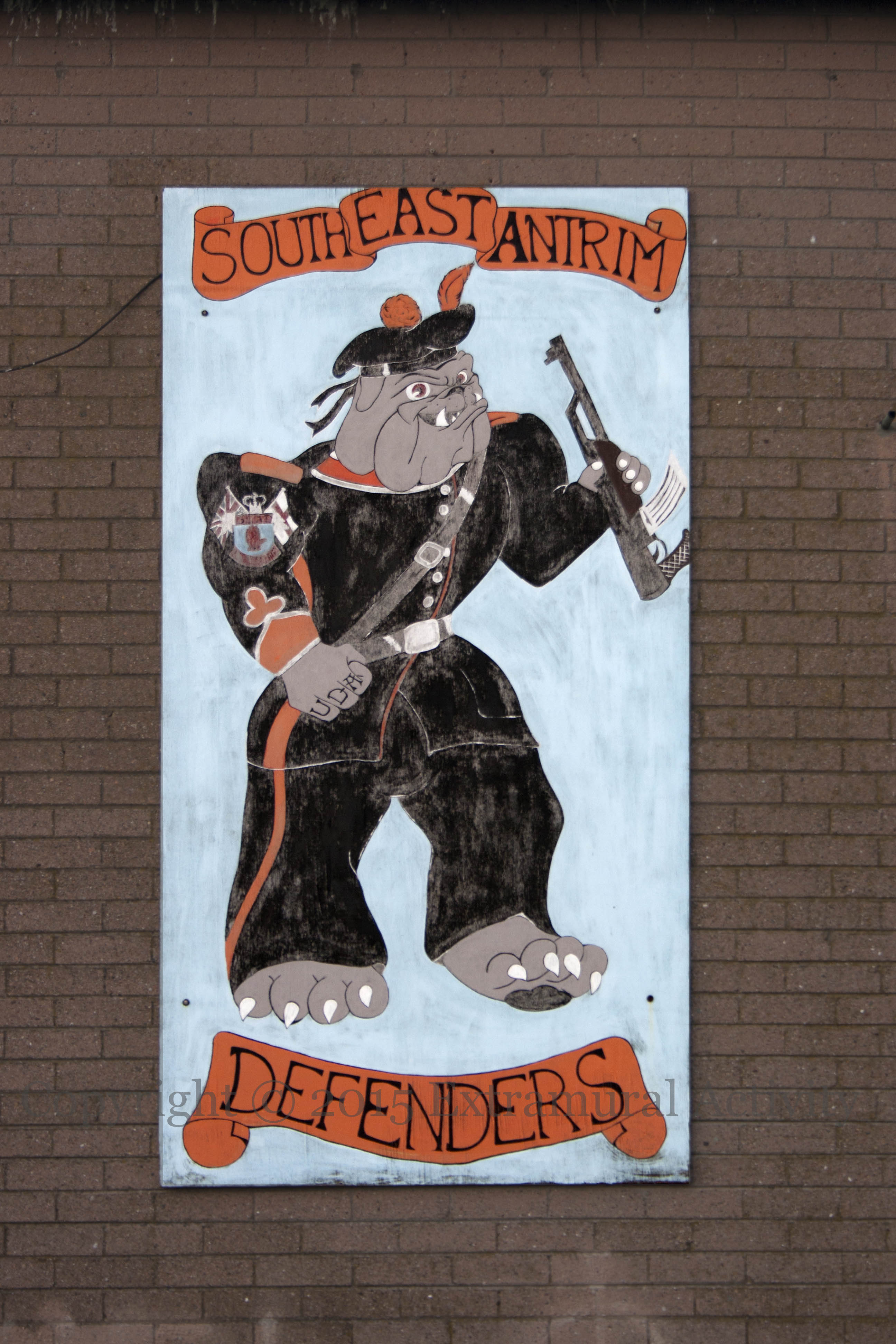
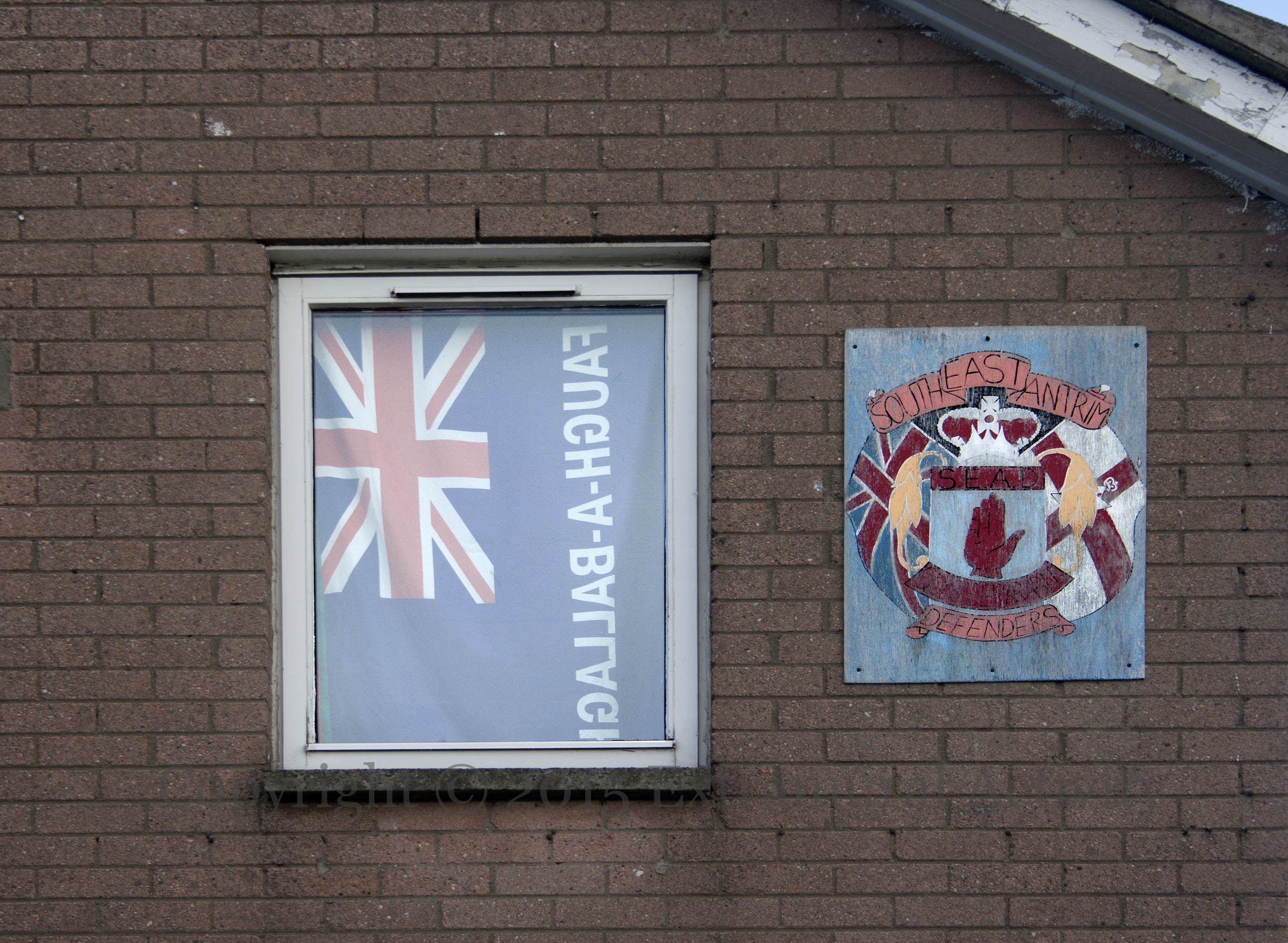
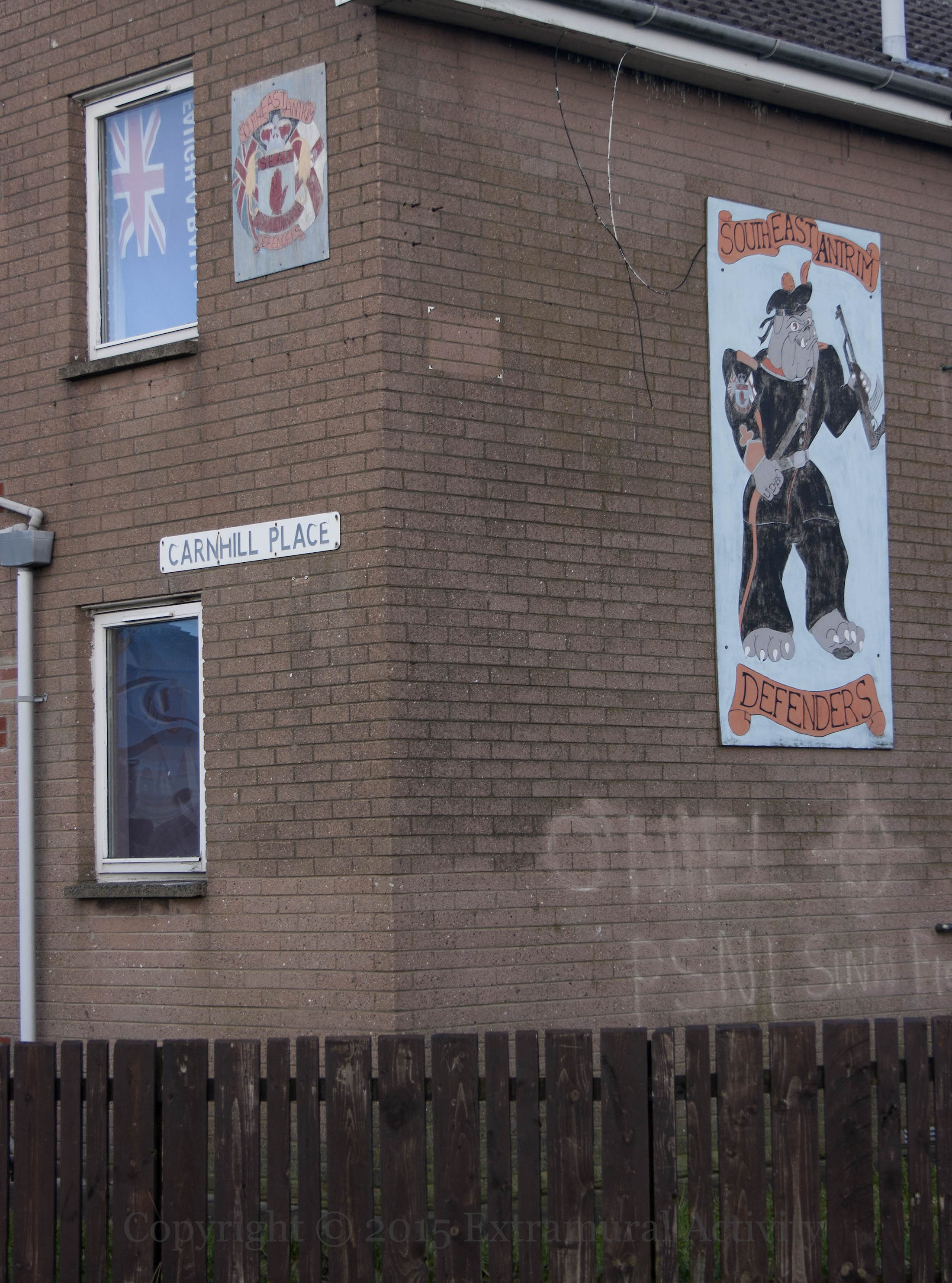
A “Faugh-a-ballagh” flag (the motto of the Royal Irish Regiment) and two South-East Antrim Defenders (a defunct flute band (Fb)) boards – the one above showing a bulldog marching with a rifle, with “UDA” across his knuckles and the UDA insignia on his lapel – adorn this house in the Castlemara estate in Carrickfergus.






 Extramural Activity