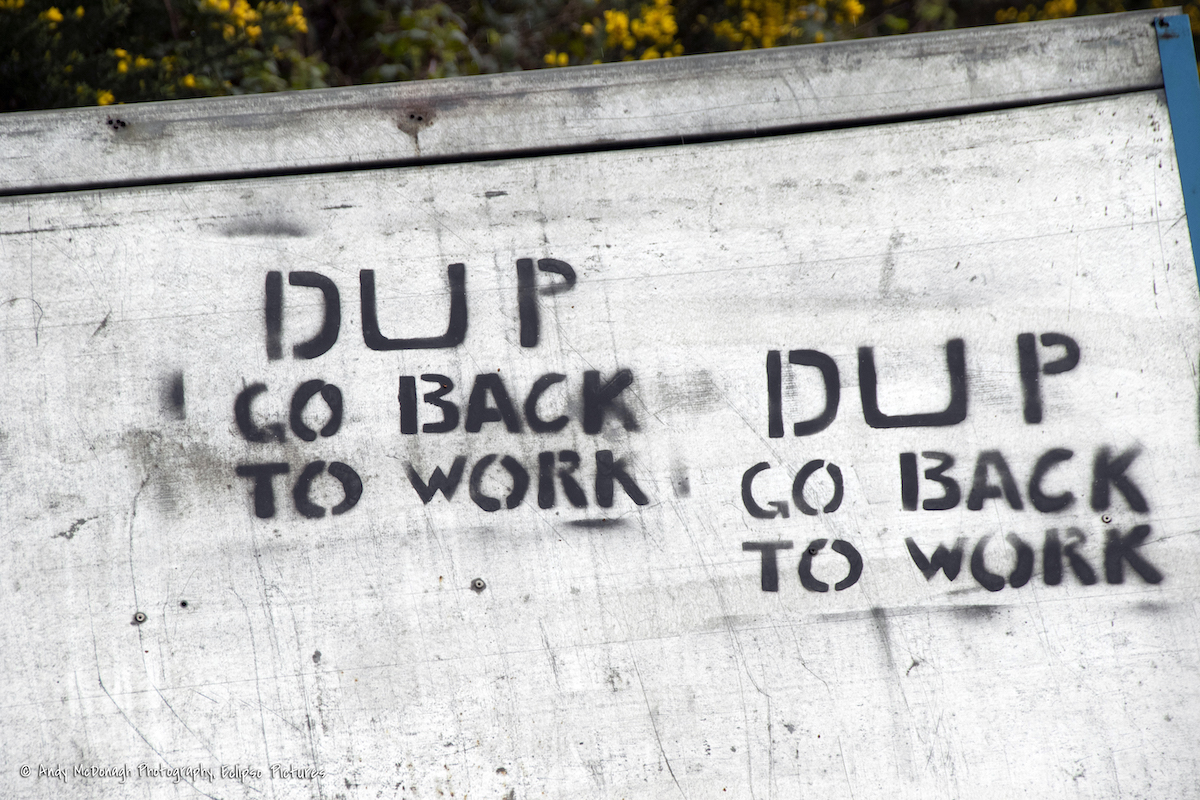
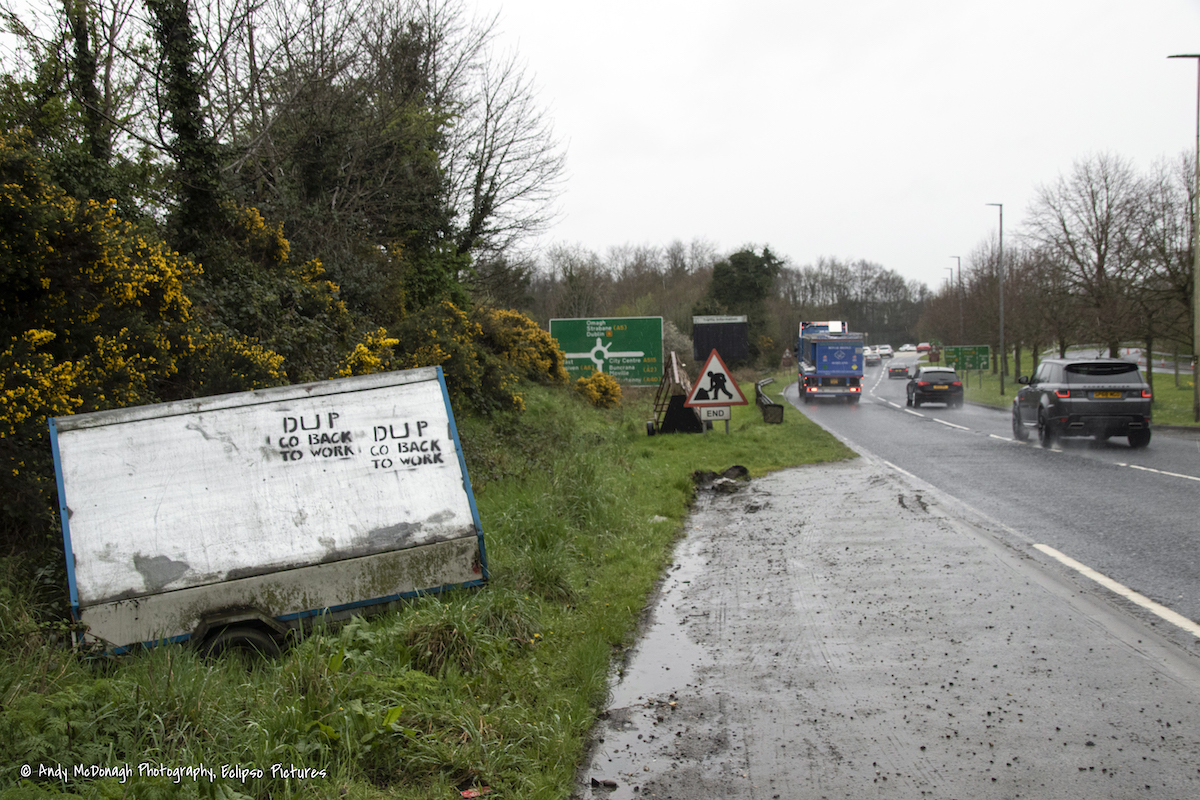
After the May, 2022, elections that resulted in Sınn Féın being the largest party, the Assembly met twice but on both occasions the DUP refused to participate in a vote for speaker after which Stormont could not function. The DUP explained its boycott of the Assembly as a form of protest at the NI Protocol and voted against the “Windsor Framework” intended to resolve those problems (Sky News). Various deadlines have passed, a pay-cut is threatened (Belfast Live), but, as it stands currently, there will not be a new Assembly election under January, 2024 (Guardian | BBC).
A Belfast Live poll three weeks ago found that 75% of respondents thought the rules should be changed to allow Stormont to be restored without DUP co-operation.
“Some believe it is only high walls that can hold fear in check but that is not what I have found. I have found that it is the small, everyday deeds of ordinary folk that keep the darkness at bay, small acts of kindness and love – Gandalf and me [called_to_create_ (ig)].” The quote is from the movie of ‘The Hobbit – An Unexpected Journey’ (youtube) and not any Tolkein book. Whatever the truth of the quotation, residents generally want the so-called “peace” walls to remain: 2023 BelTel (about Derry) | 2019 Irish Times | 2015 BBC.
Here are three new pieces above the security gates on Northumberland Street, coving over the “Deserted! Well, We Can Stand Alone” graffiti in the last remaining spot on the wall without a mural. From left to right:
Arthur Guinness: “Black Protestant Porter” as a description of Guinness stems from Arthur Guinness’s opposition to the 1798 rebellion (Indo). The Union Star (newspaper in Belfast – A Planet Of Light And Heat) called Guinness a spy and advised that “United Irishmen will be cautious of dealing with any publican who sells his drink.” (An Phoblacht).
Gusty Spence, a former commander of the UVF, read out the ceasefire statement of the “Combined Loyalist Military Command” (UVF, RHC, and UDA): “Let us firmly resolve to respect our different views of freedom, culture and aspiration and never again permit our political circumstances to degenerate into bloody warfare – Gusty Spence, loyalist ceasefire [statement in full], 13 October, 1994.”
“Welcome To The Shankill Road – we are proud, resilient, welcoming”: The original ‘three hands’ was on Northumberland Street, just above this spot – see Proud, Defiant, Welcoming – which was then reproduced in reduced form in Gardiner Street – see Welcome To The Shankill Road.
This is the most conciliatory statement ever made by loyalism and the decision to put it on Northumberland Street, especially in the context of the internationally famous and associated-with-Ireland Guinness and the “welcome” mural, suggests that the trio is directed at tourists rather than locals.
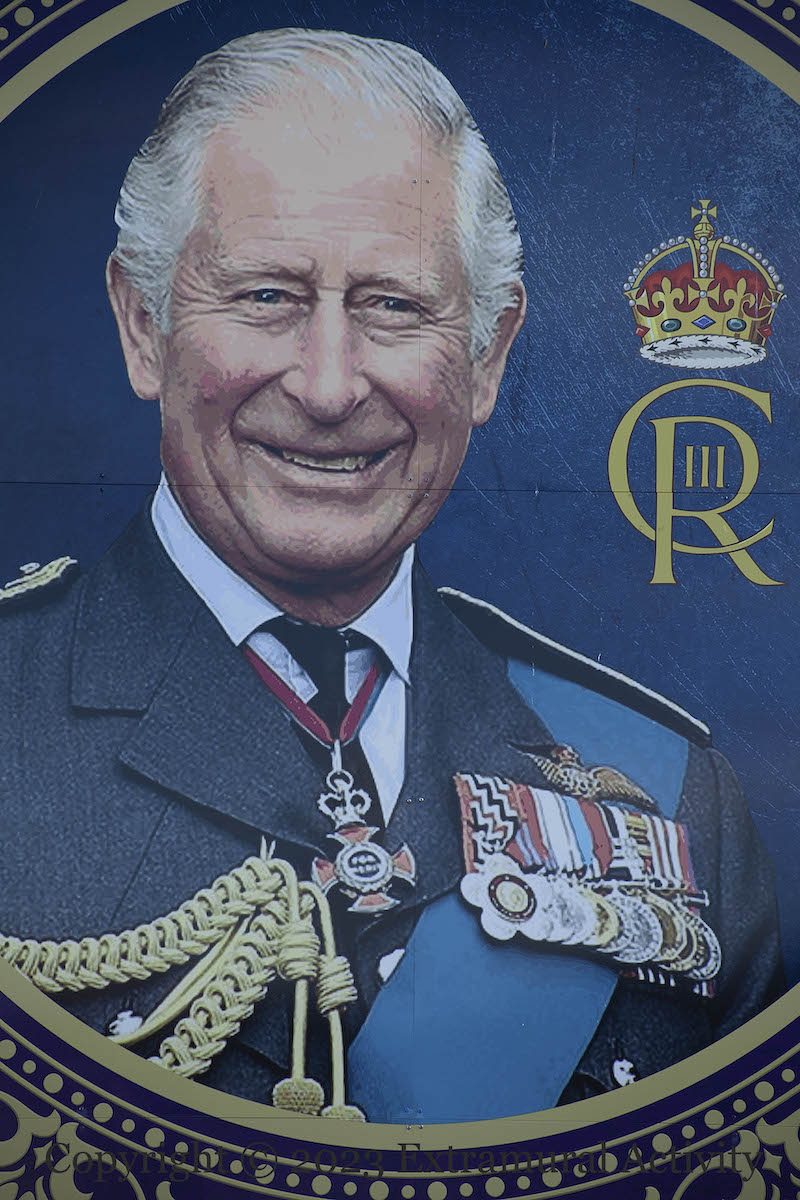
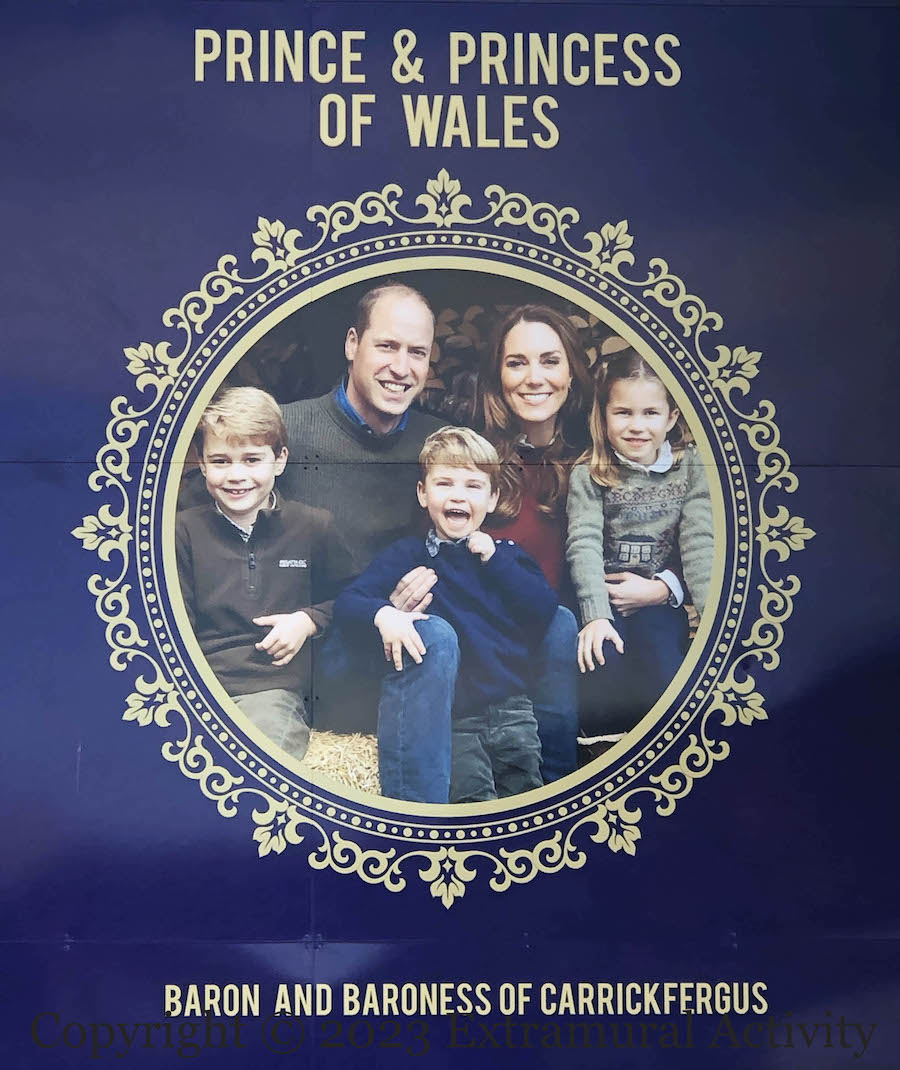
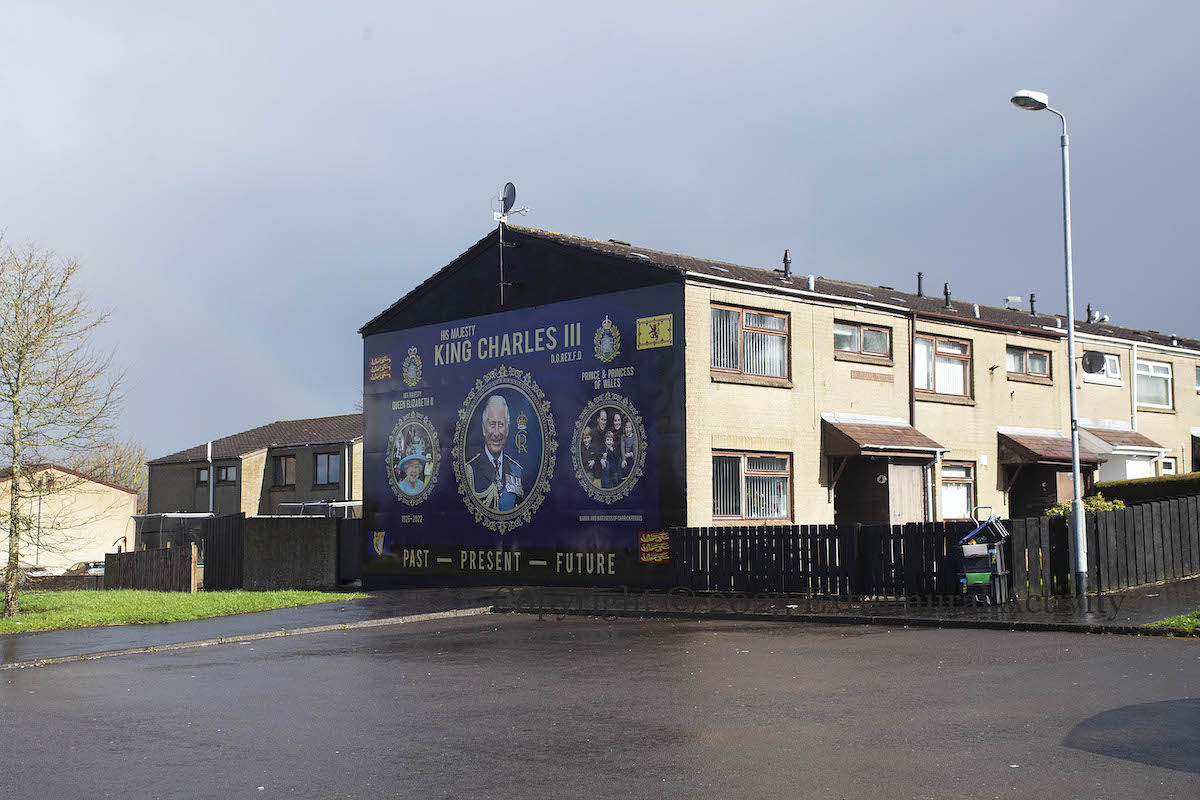
Four generations of UK royalty: the previous Queen Elizabeth II, the current King Charles III, the heir apparent William, baron Carrickfergus – here written as “baron of Carrickfergus” (also the prince of Wales), and his nine-year-old son George. Charles’s coronation will be on May 6th, 2023.
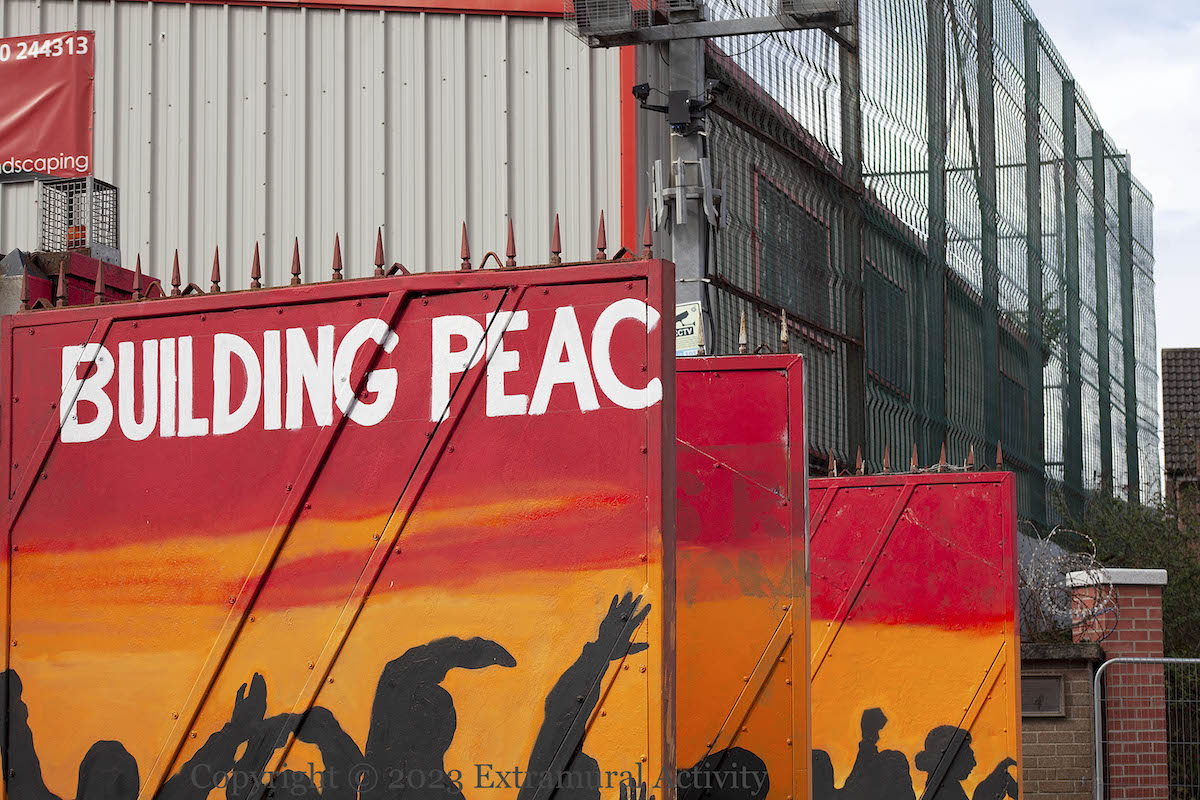
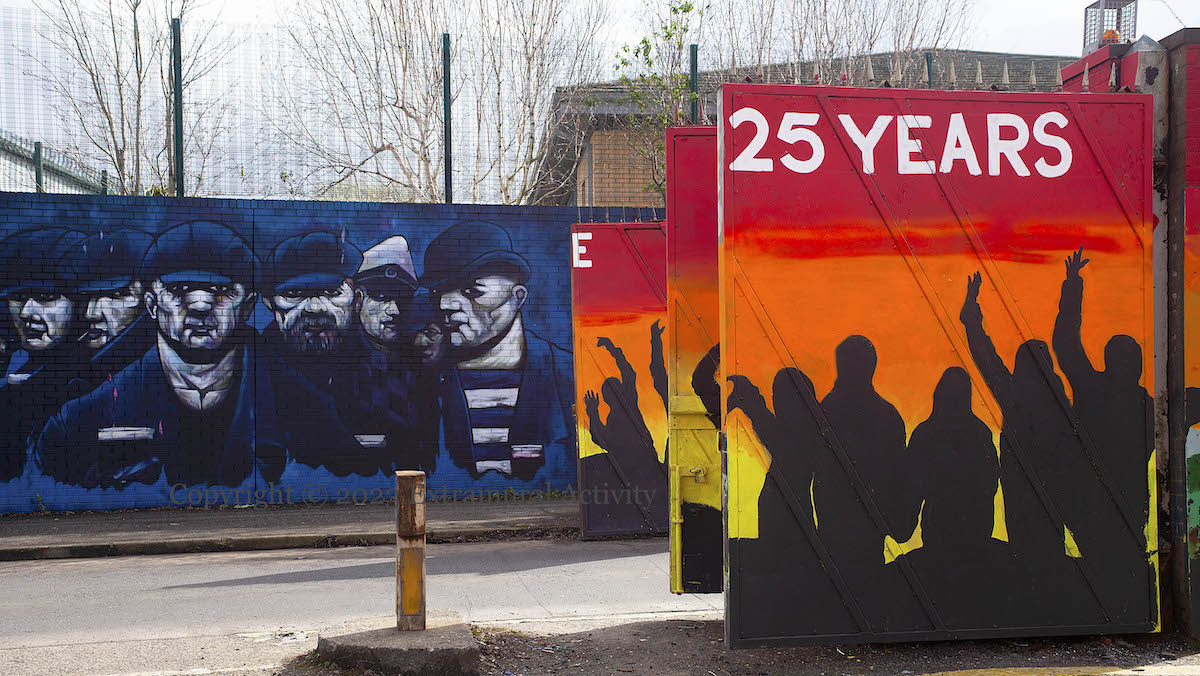
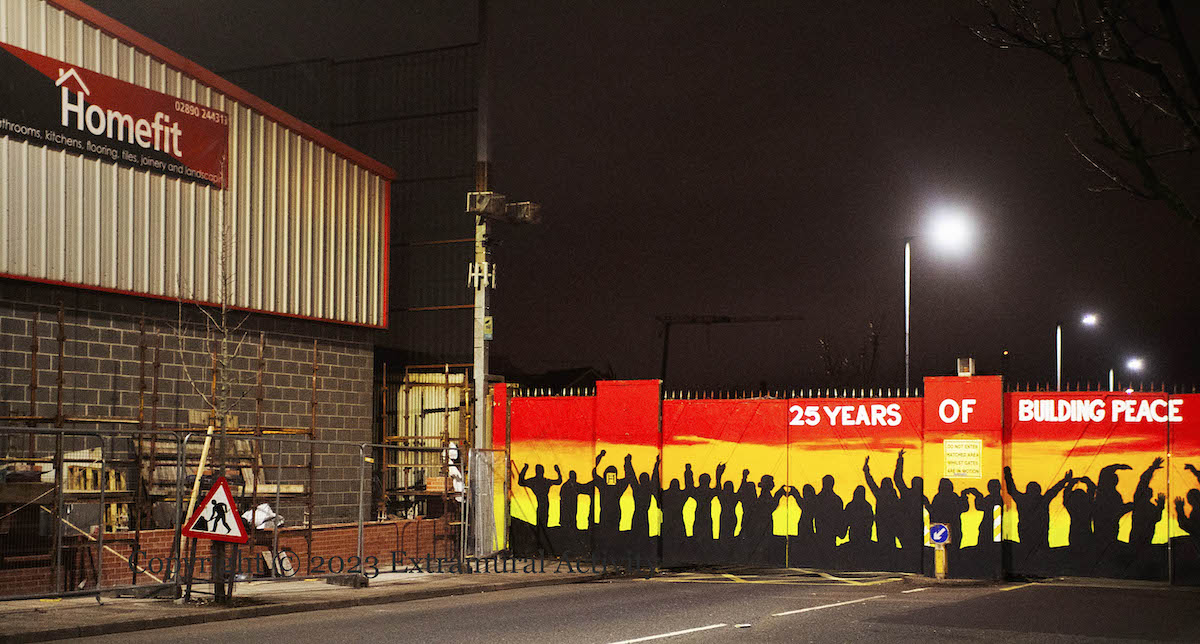
The gates on Lanark Way are part of the west Belfast “peace” wall. On this site we always put the word in scare-quotes to signify that it has a different meaning than it typically does. Without them, “peace wall” might suggest a place where people can go for a few moments of quiet reflection.
Rather, the wall – and the gates and the cages that surround many buildings on either side of the wall (see above) – is a divider meant to keep the peace by separating warring factions. Indeed the reason for the re-painting of the gates is not just the up-coming 25th anniversary of the Belfast or “Good Friday” Agreement (on April 10th) but the fact that they were damaged in the 2021 rioting (BBC). (This Irish News article surveys 150 years of violence at the site.)
The new art on the gates is inspired by the cover of the booklet sent to every household in advance of the May vote to ratify the Agreement (available at CAIN), which was similar in various ways to the television ad shown at the time (Ads On The Frontline). It showed a family of four in silhouette against a red-and-orange sunset; given the rioting associated with Lanark Way, on the gates this sunset could be mistaken for flames, and the rejoicing silhouetted figures for gesticulating and petrol-bomb-throwing rioters. For the previous art on the gates, see the Visual History page on the west Belfast “peace” line. (For the mural in the background, see Sailortown Dockers.)
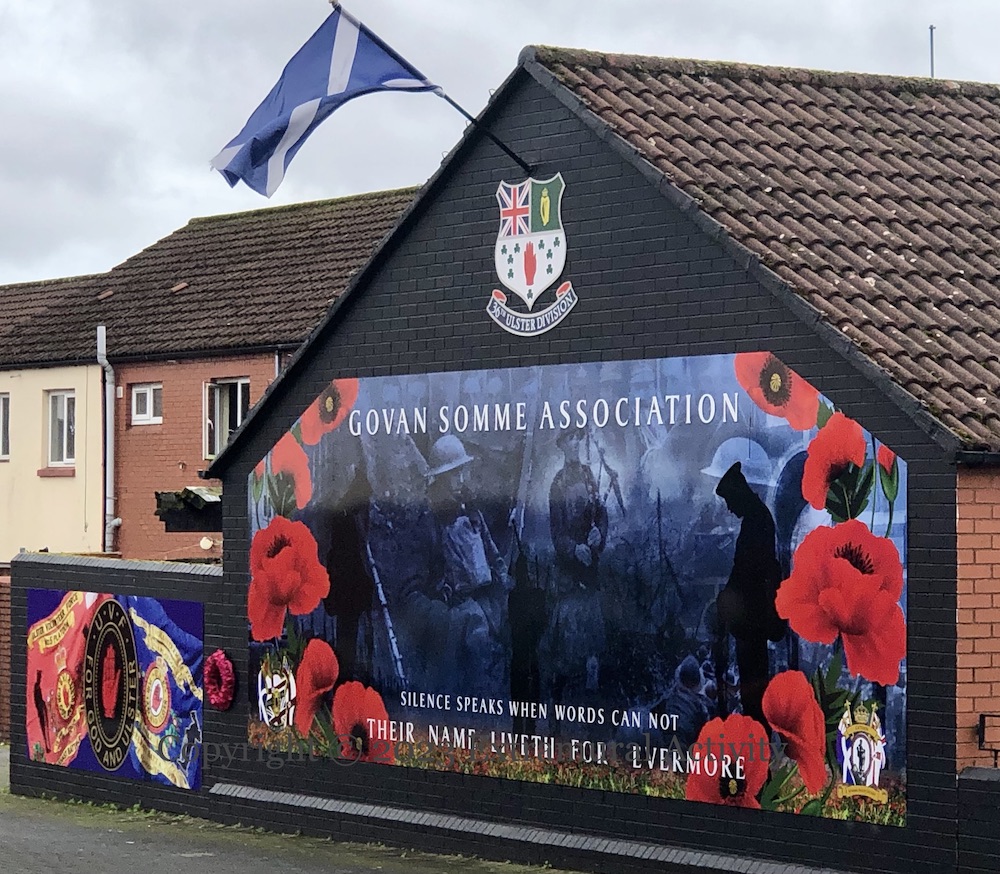
There was previously a (painted) mural on this wall – see Passchendaele Court – but this latest display is a large printed board, with photographs blended together and framed by graveside mourners, poppies, and the emblems of the Pride Of Govan flute band and the Govan Somme Association (Fb), which also supported the previous mural.
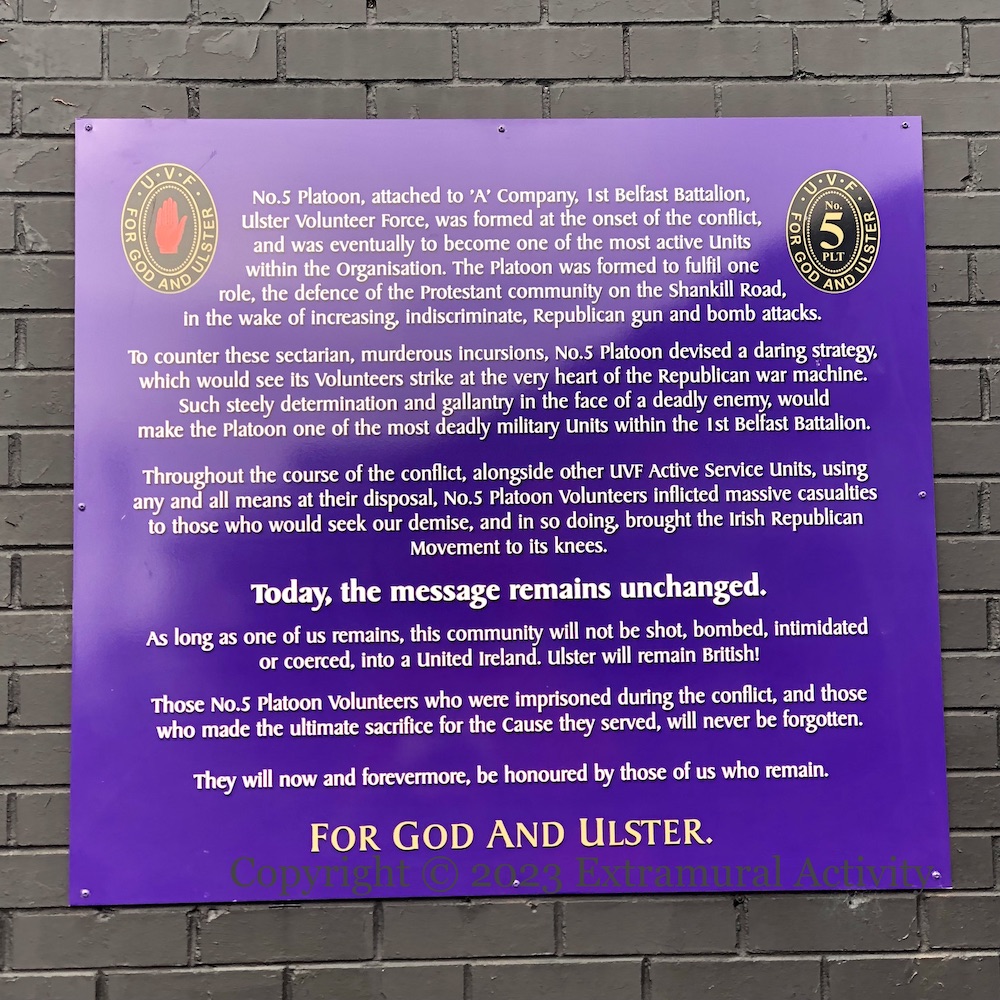
To the left, as seen in the final images, is a smaller UVF (1st Battalion) A Company 5th Platoon board – like the other new board in the street We Will Always Be Ready (and on the other side of Conway Street – see When Needed We Shall Rise Again).
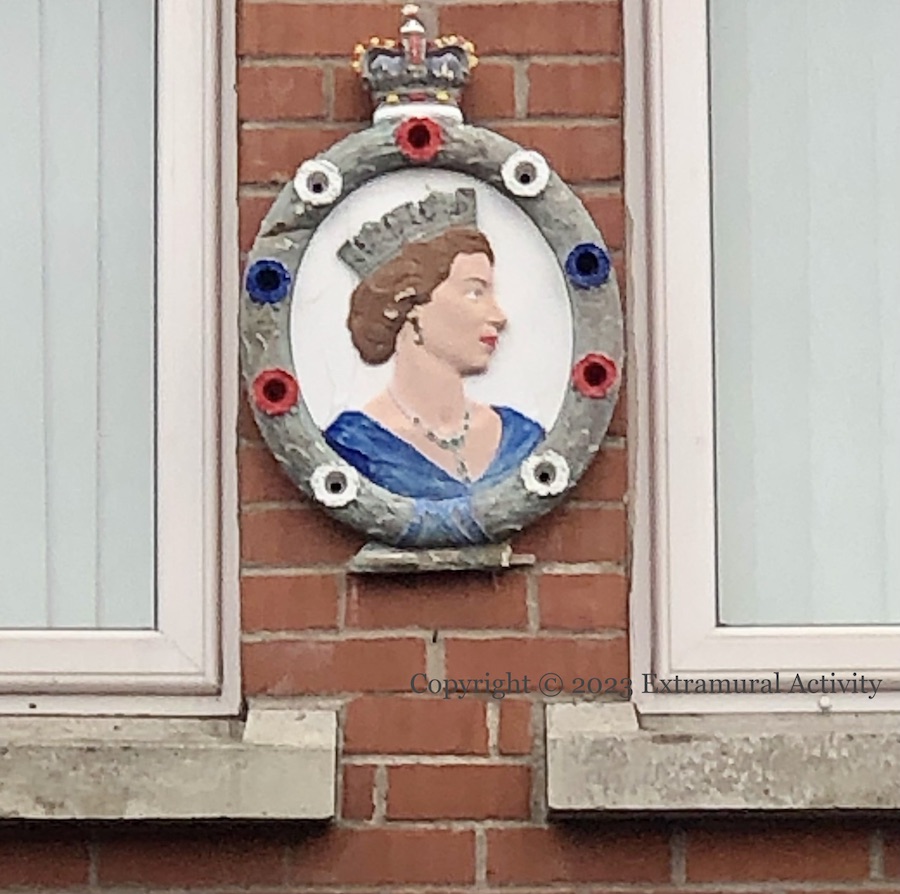
This cast of Queen Elizabeth in profile is mounted on the second storey of a house in Hopewell Crescent, Belfast, prior to her death on September 8th (see e.g. The People’s Queen Is Dead), a few months after her platinum jubilee in June (celebrated with a similar portrait in The Longest Reign).
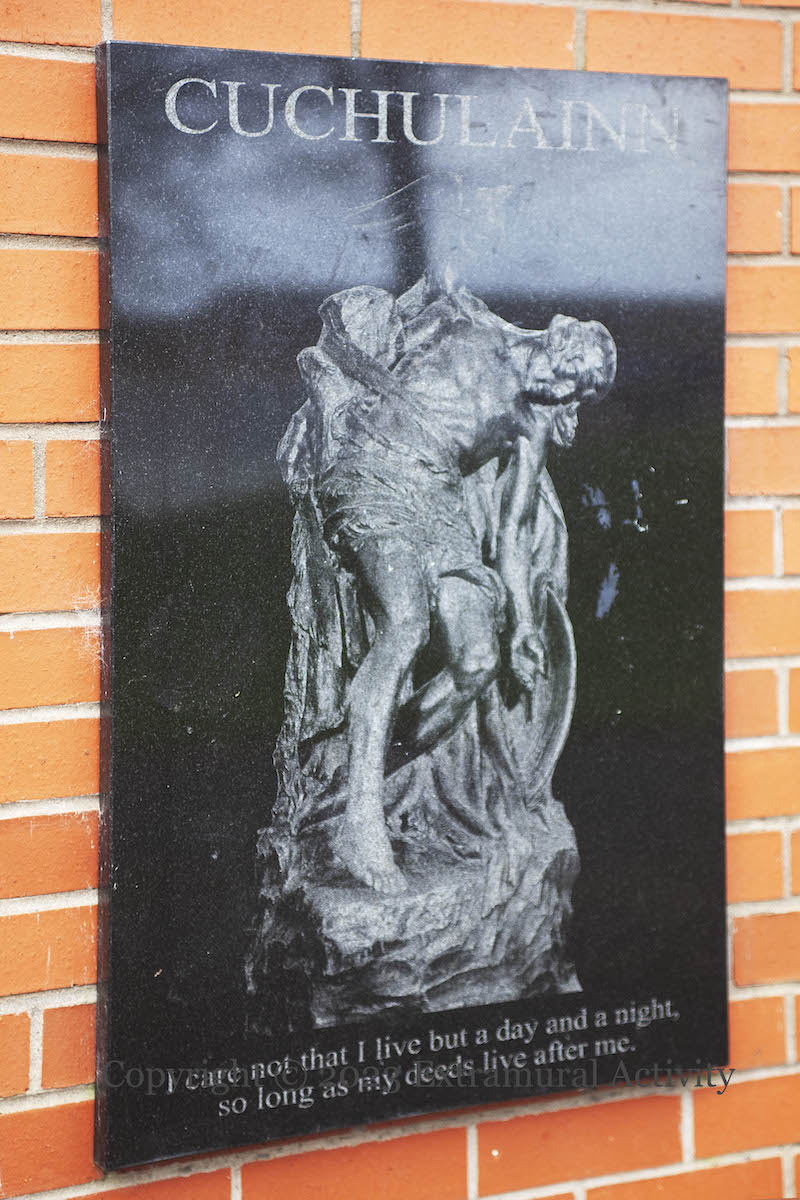
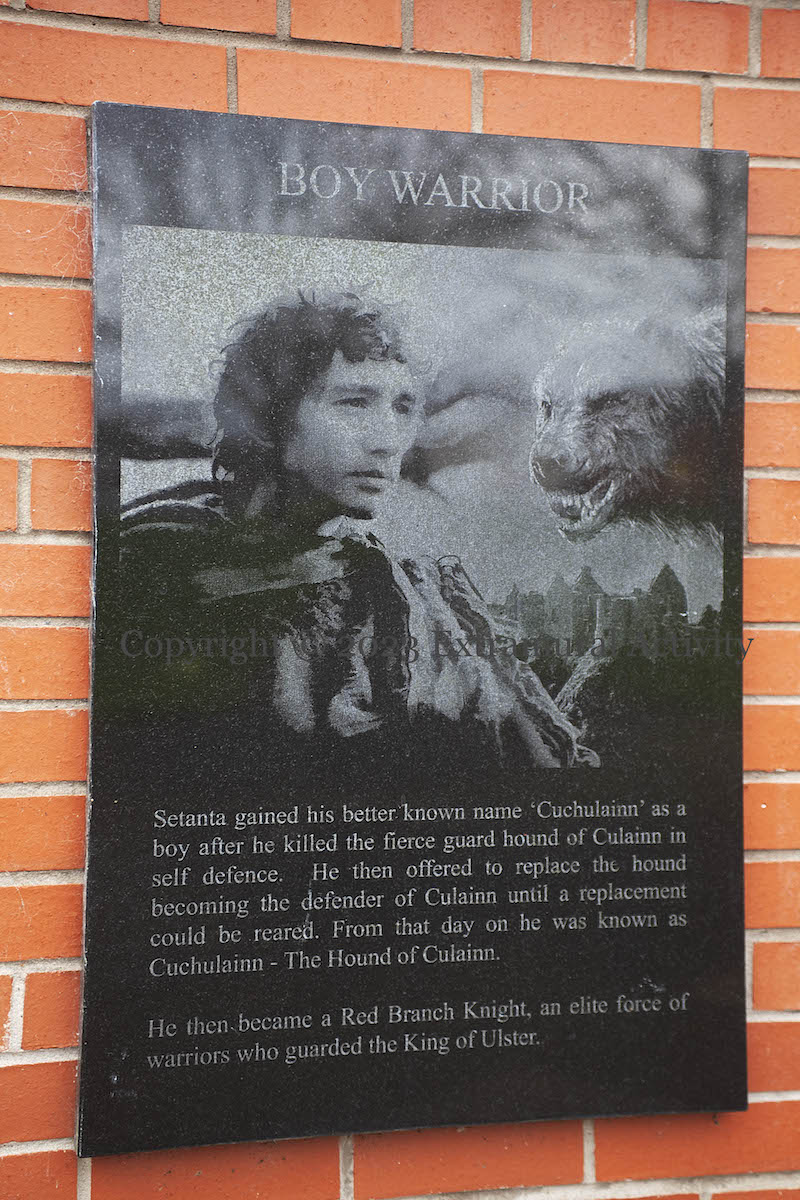
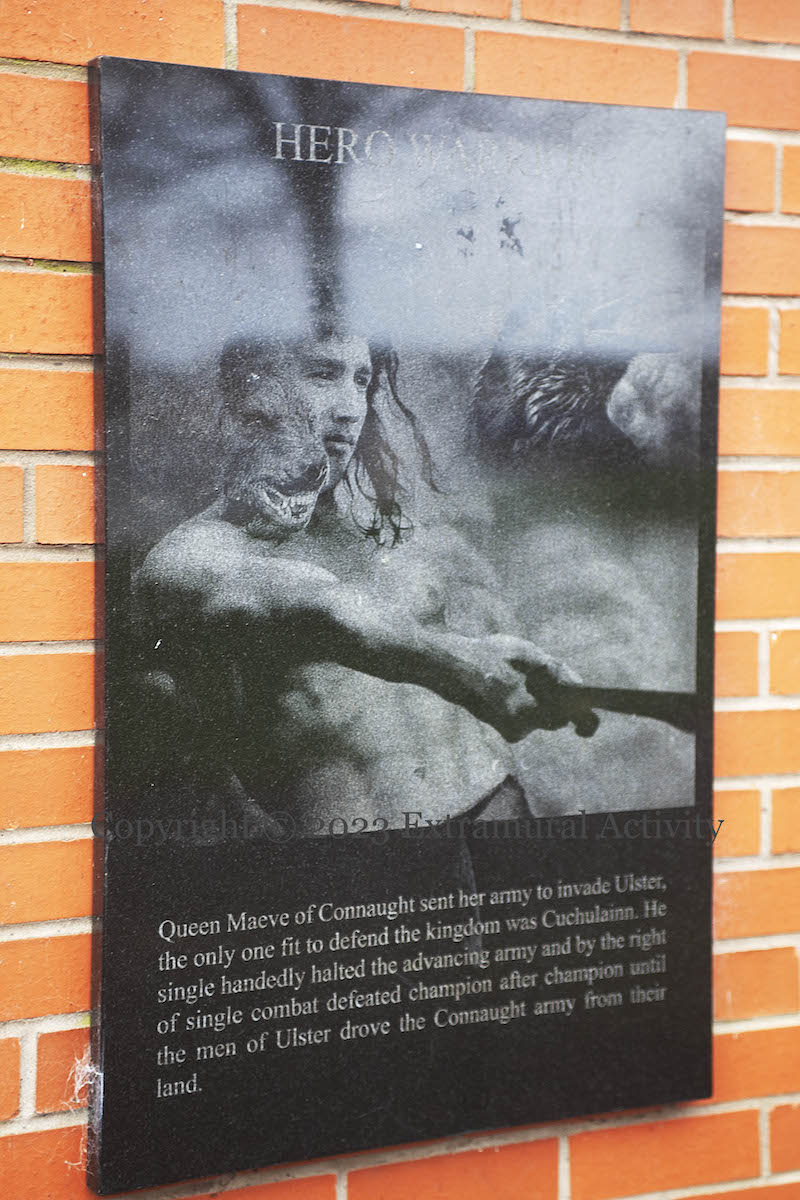
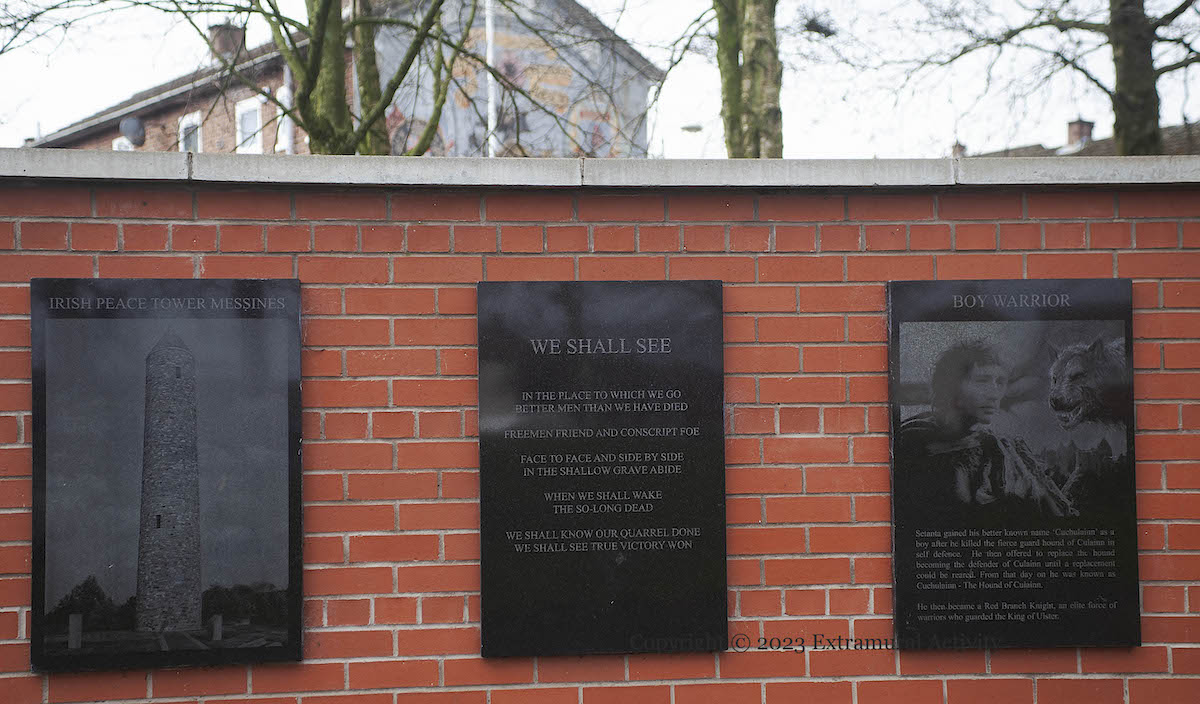
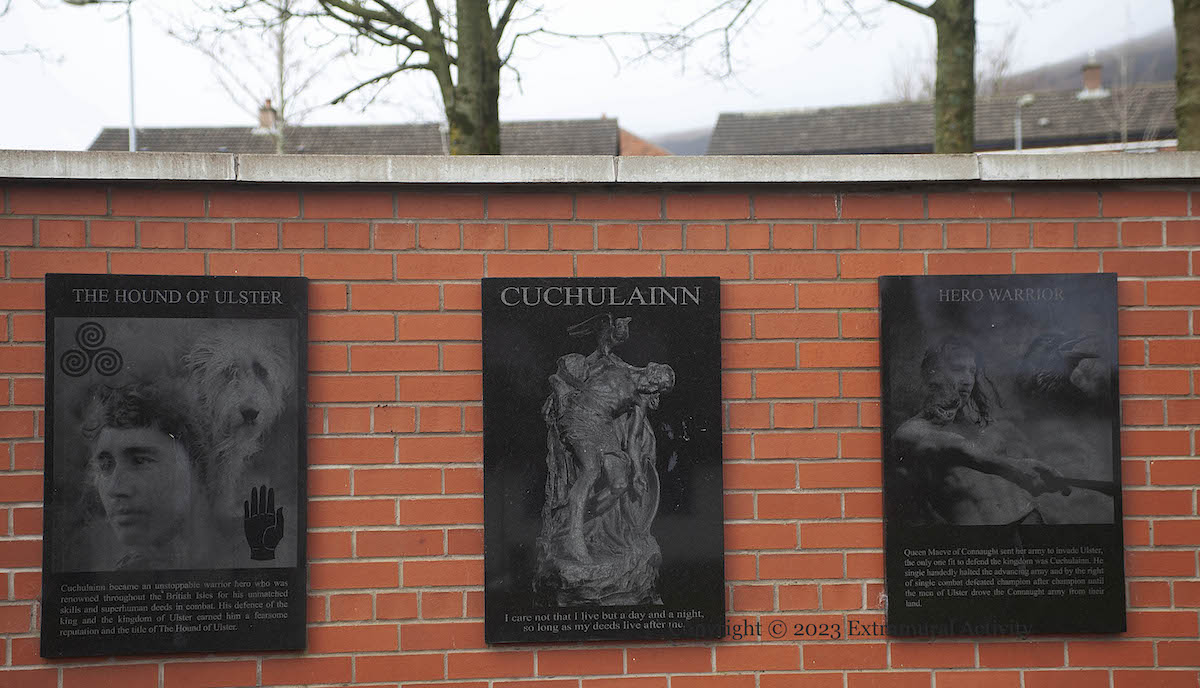
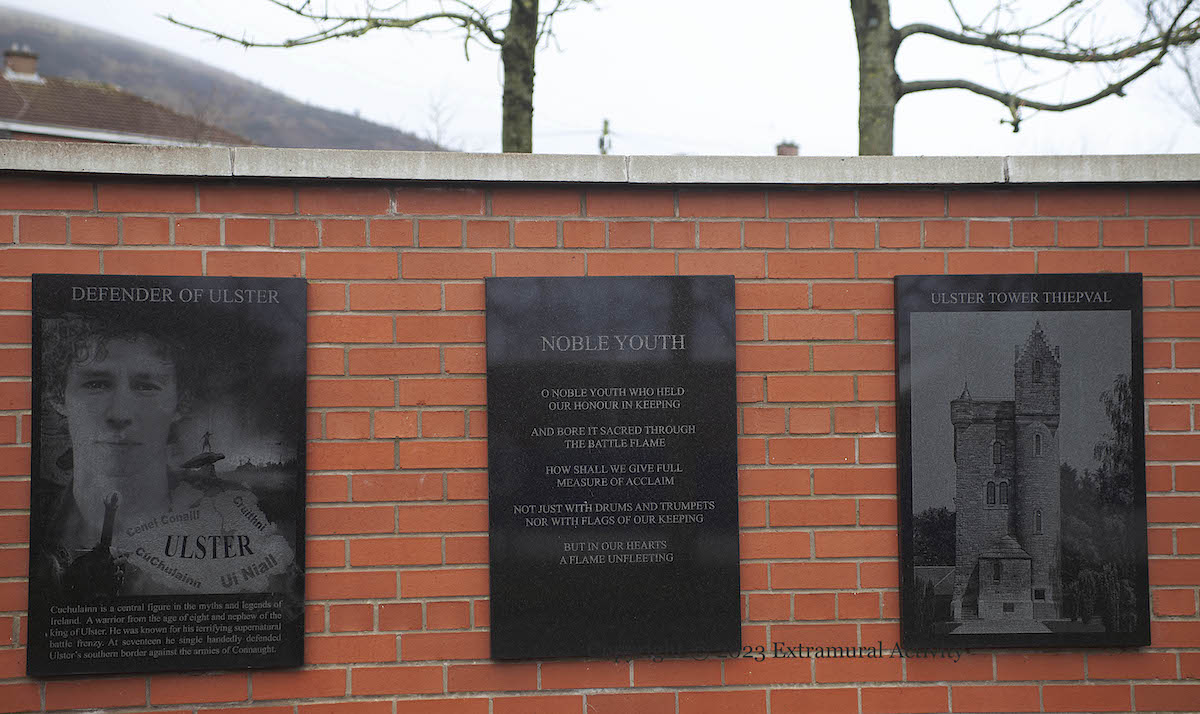
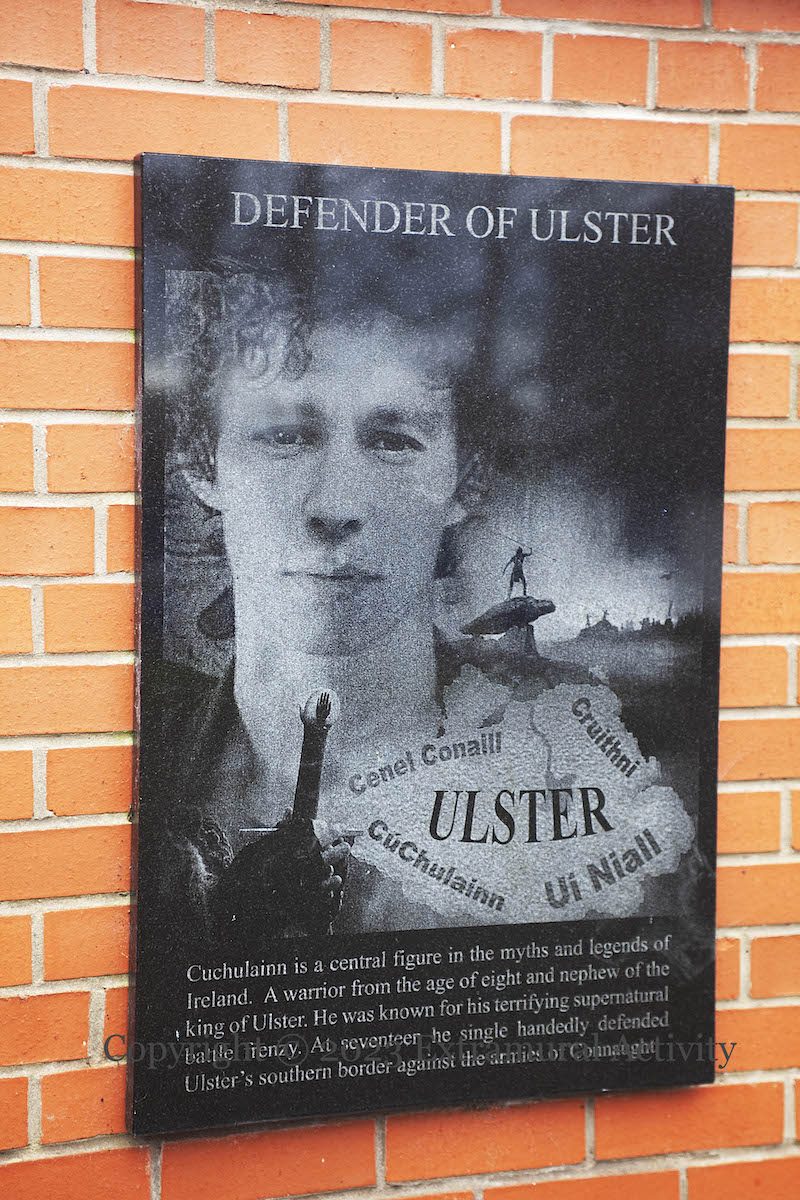
As the Visual History page on the role of Cú Chulaınn makes clear, in PUL muraling and iconography, Cú Chulainn serves as the “ancient defender of Ulster”, and the B Specials, UDR, and loyalist paramilitaries – primarily the UDA but also the UVF – then fit into that tradition. Using Cú Chulaınn as a precursor for service in the Ulster Division of WWI is unique to the panels on Highfield green, five of which are devoted to the hero Cú Chulaınn and four – two on each end – refer to the Great War.
The five Cú Chulaınn panels are (from left to right) Boy Warrior, Hound Of Ulster, Sheppard’s statue, Hero Warrior, and Defender Of Ulster – all shown individually in this post.
On the far left, there are two panels showing Messines tower and a few lines from a Ronald Lewis Carton poem Réveillé (though given a more ‘victorious’ ending) and on the far right, a few lines from Duncan Campbell Scott’s To A Canadian Lad Killed In The War and Thiepval tower. The words to I Vow To Thee My Country (lyrics) are along the bottom (see the wide shot, final image below).
The biographical panels focus on Cú Chulaınn’s age – the sixth panel emphasises that Cú Chulaınn was only 17 when he held off Maeve’s forces – which is perhaps a similarity with those who joined the 36th Division, but how the “defender of Ulster” is connected to the defense of Europe is obscure.
There are three hooded gunmen on the main panel of this new installation along Conway Street, Belfast, and the side panel is a gallery of 14 photographs of hooded gunmen, flanked on either by two more hooded gunmen.
Please note: the photograph above has been photoshopped for colour. The true colour (orange) can be seen in the wide shot, below.
“No. 5 Platoon, attached to ‘A’ Company, 1st Belfast Battalion, Ulster Volunteer Force, was formed at the onset of the conflict, and was eventually to become one of the most active Units with the Organisation. The Platoon was formed to fulfil one role, the defence of the Protestant community on the Shankill Road, in the wake of increasing, indiscriminate, Republican gun and bomb attacks. To counter these sectarian, murderous incursions, No. 5 Platoon devised a daring strategy, which would see its Volunteers strike at the very heart of the Republican war machine. Such steely determination and gallantry in the face of a deadly enemy, would make the Platoon one of the most deadly military Units within the 1st Belfast Battalion. Throughout the course of the conflict, alongside other UVF Active Service Units, using any and all means at their disposal, No. 5 Platoon Volunteers inflicted massive casualties to those who would seek our demise, and in so doing, brought the Irish Republican Movement to its knees. Today the message remains unchanged. As long as one of us remains, this community will not be shot, bombed, intimidated or coerced, into a United Ireland. Ulster will remain British! Those No. 5 Platoon Volunteers who were imprisoned during the conflict, and those who made the ultimate sacrifice for the Cause they served, will never be forgotten. They will now and forevermore, be honoured by those of us who remain. For God and Ulster.”
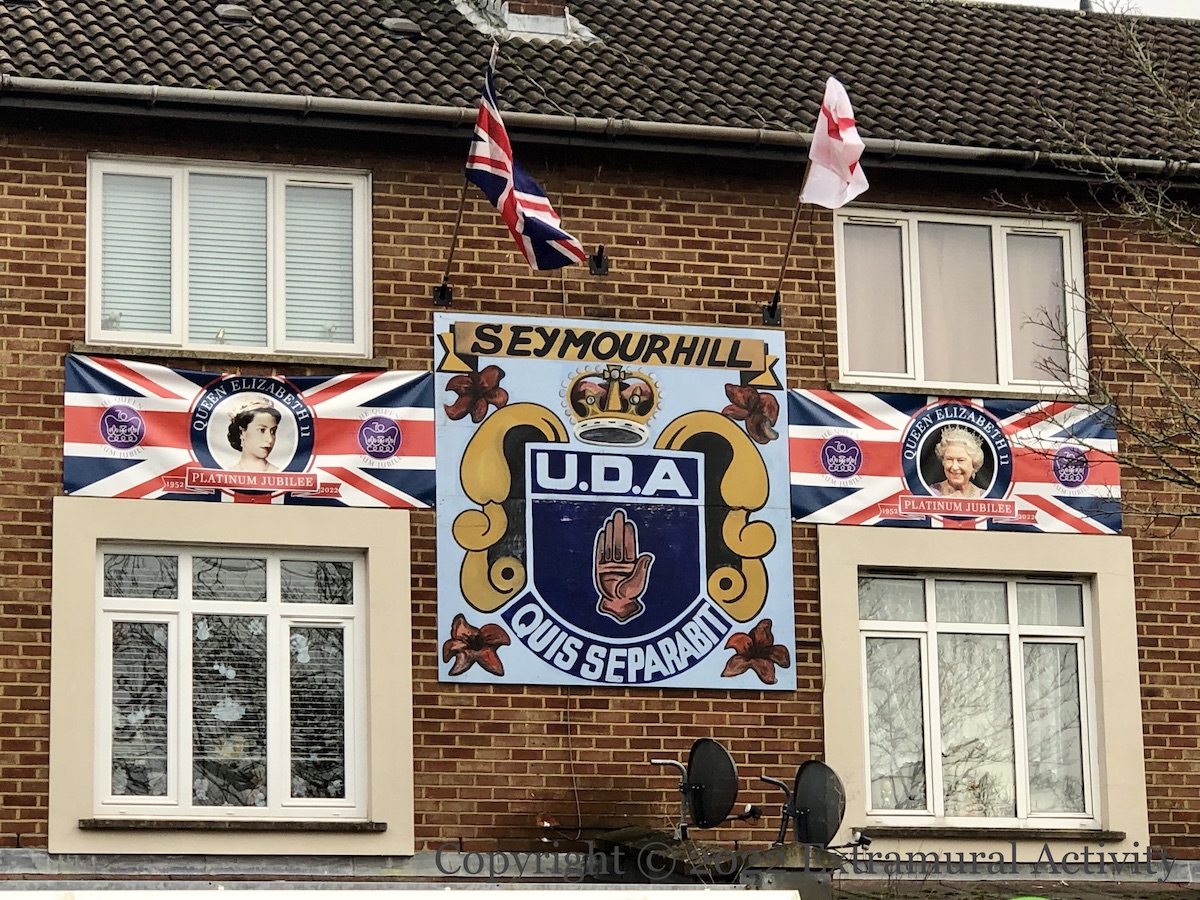
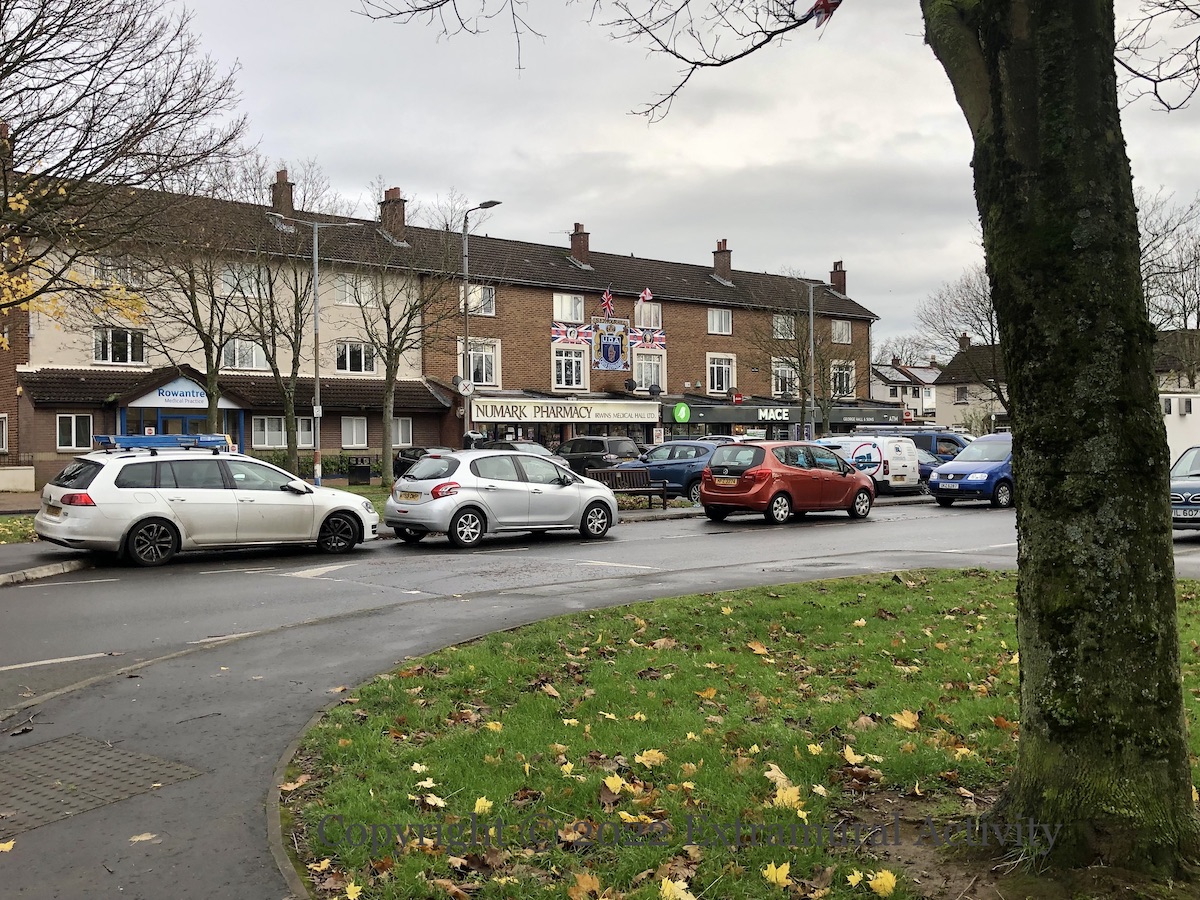
Queen Elizabeth II 70th/platinum Jubilee banners remain on either side of the UDA board above the Seymour Hill shops, even after her death in September (previously there were two NI Centenary banners). There are orange lilies at the four corners of the UDA emblem.













 Extramural Activity