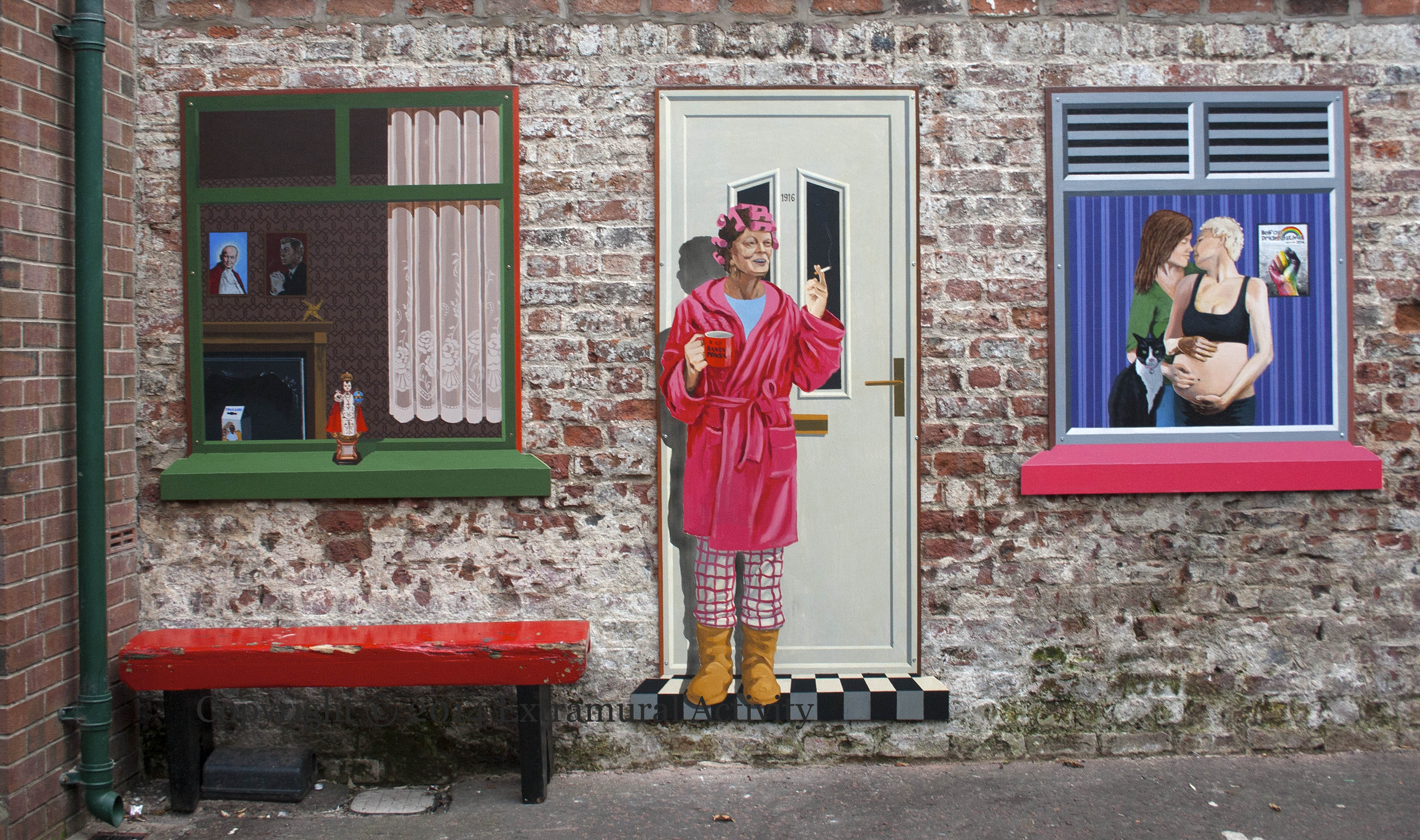
Here is the first of a number of panels from new work by Ciaran Gallagher (web) for CNB14 – Belfast Stripped Bare – in the courtyard of the Dark Horse/Duke of York. The piece humorously depicts a row of houses. In this pair, a woman smokes a cigarette on the front step of a house with portraits of Kennedy and the pope above the mantle, next door to a pregnant lesbian couple with a pride poster and a cat. The brick-work is real.
Pro-Gaza mural/stencil on Northumberland Street decrying continued US support of Israel: the bloody bars of the US flag stain the Star of David (in the place where the stars would be) and run down the wall. Sponsored by the IRSP/INLA. The phrase “These colors don’t run” dates to 1942 or 1943 in Iowa (see page 10).
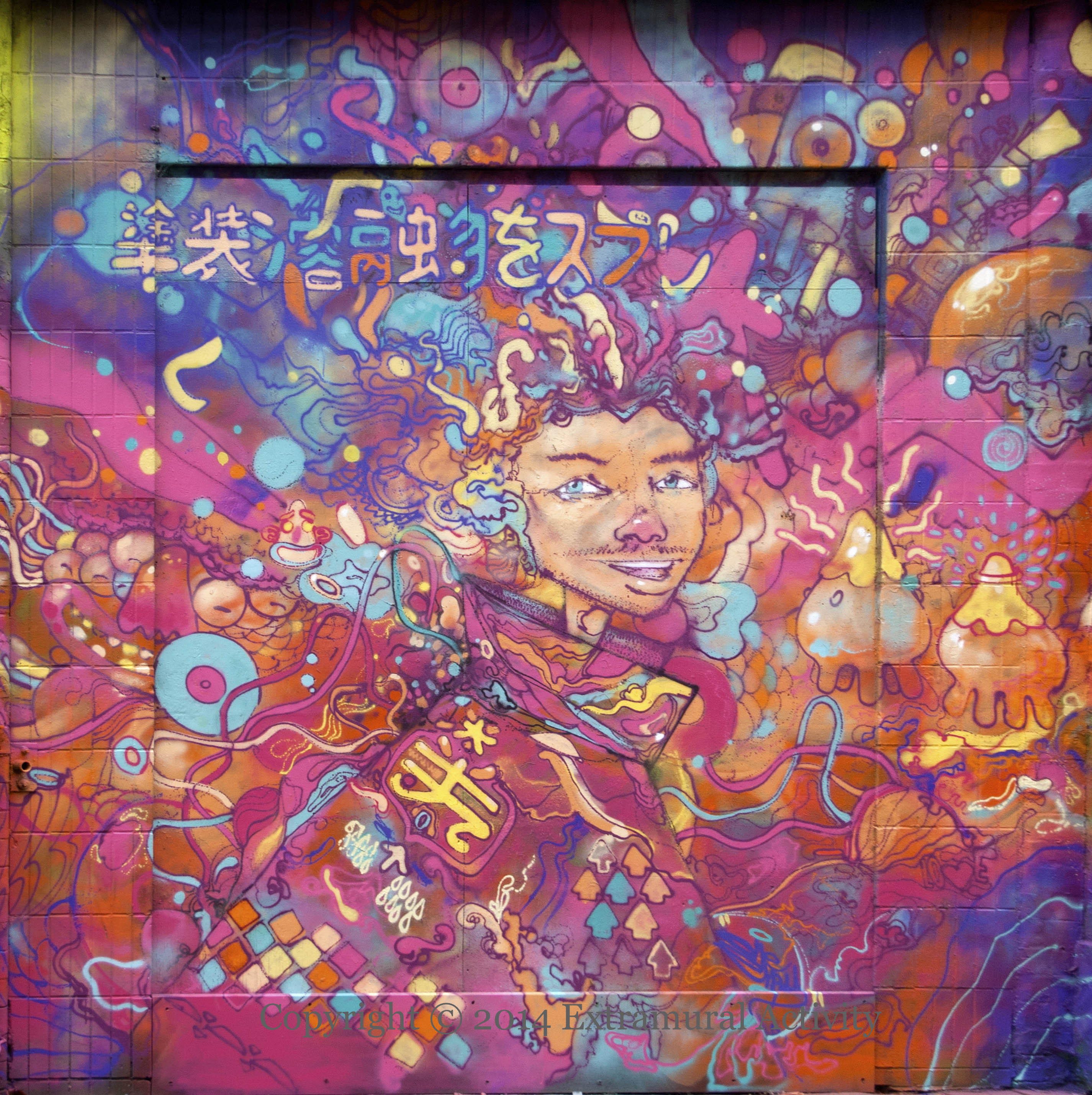
A new piece for CNB14 in Lower Garfield Street, immediately recognizable from Scottish artist Elph’s inimitable style, here using a palette of pinks and blues. On his Fb page you can see a sketch done in preparation for the work.
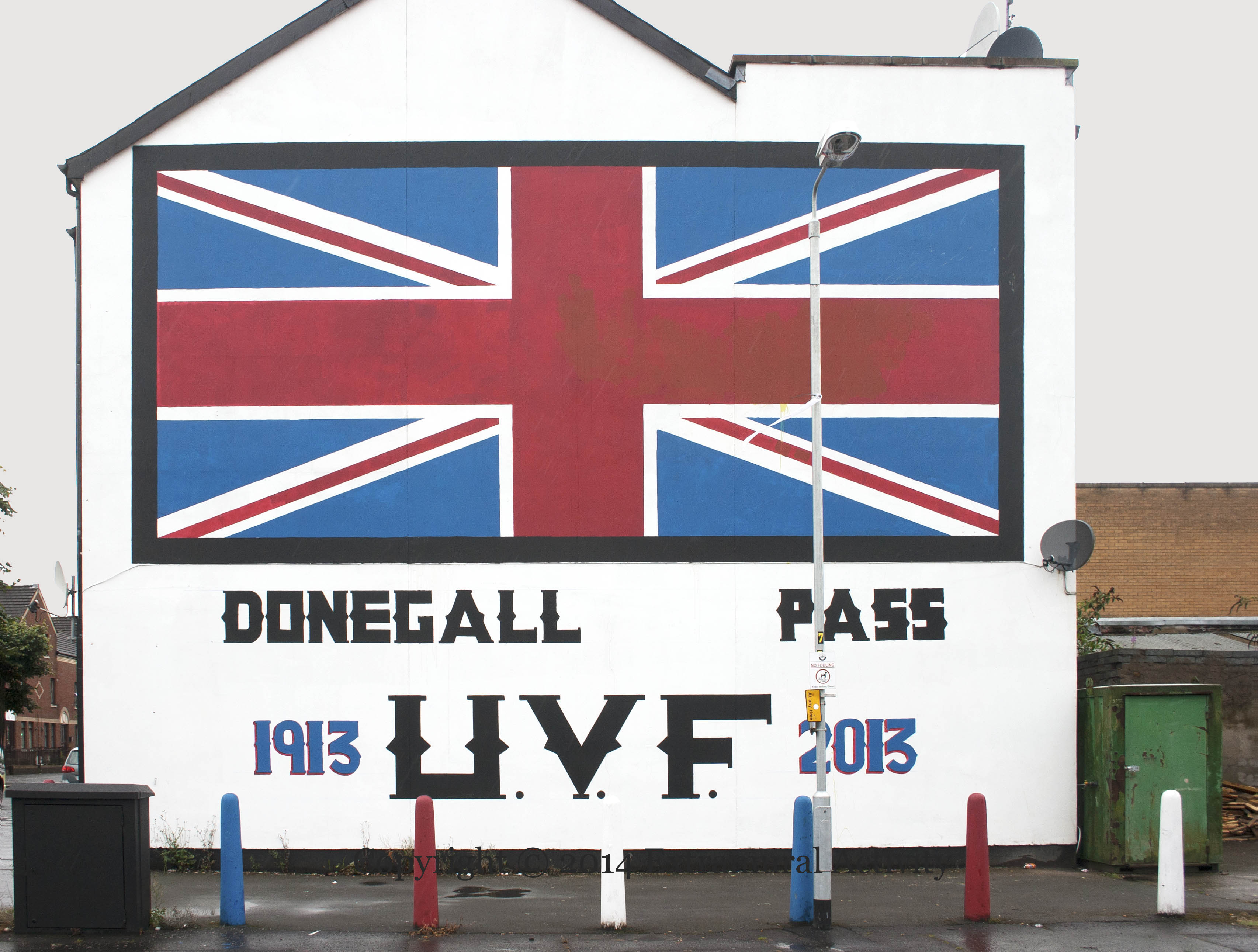
Visible from the Ormeau Road, this large union flag greets visitors to Donegall Pass in the south of the city. It asserts the presence of the UVF and connects the original Ulster Volunteer Force of 1913 to the present-day group one hundred years later: the aim of the original UVF was to resist the impending rule by Catholics under Home Rule.
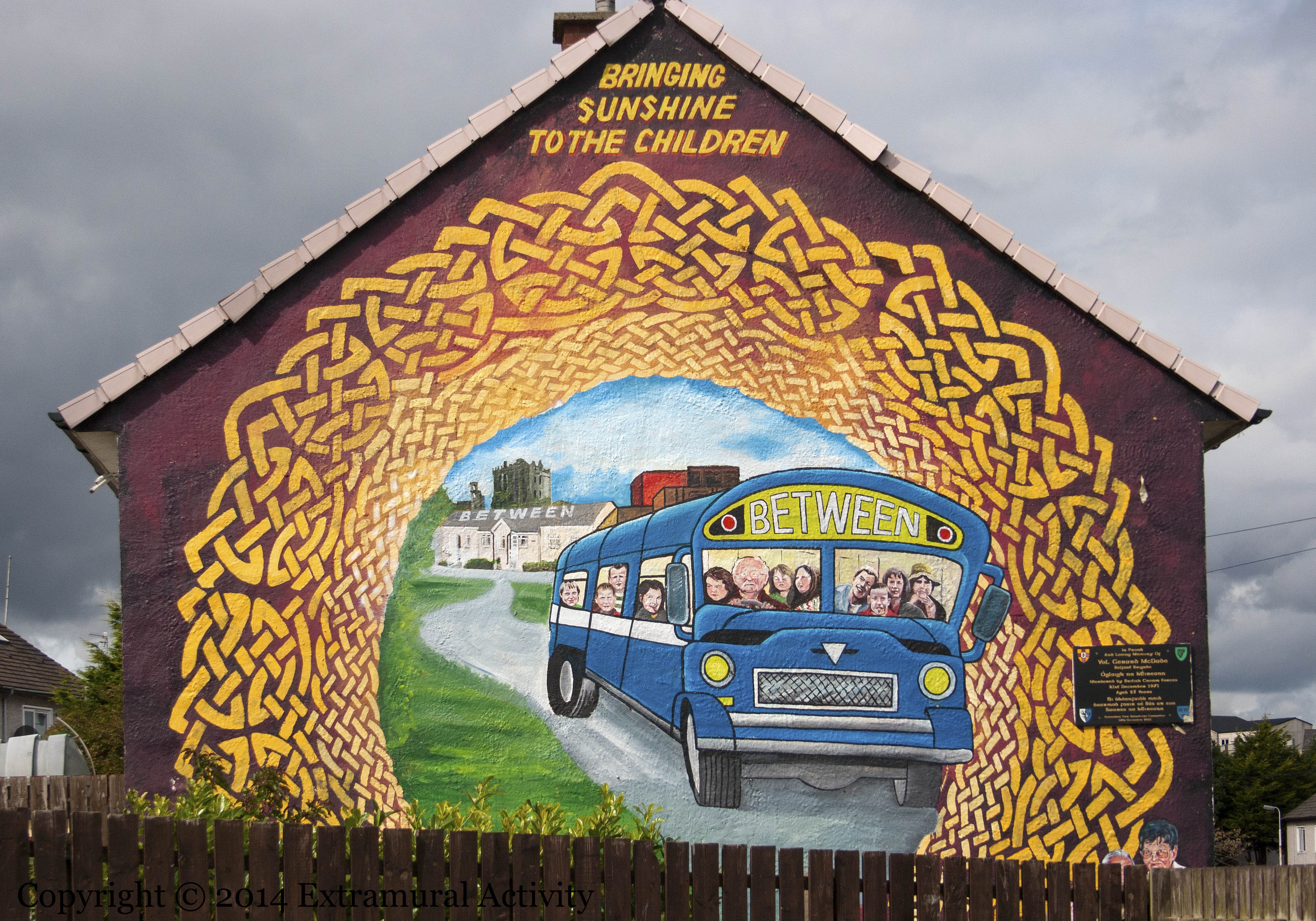
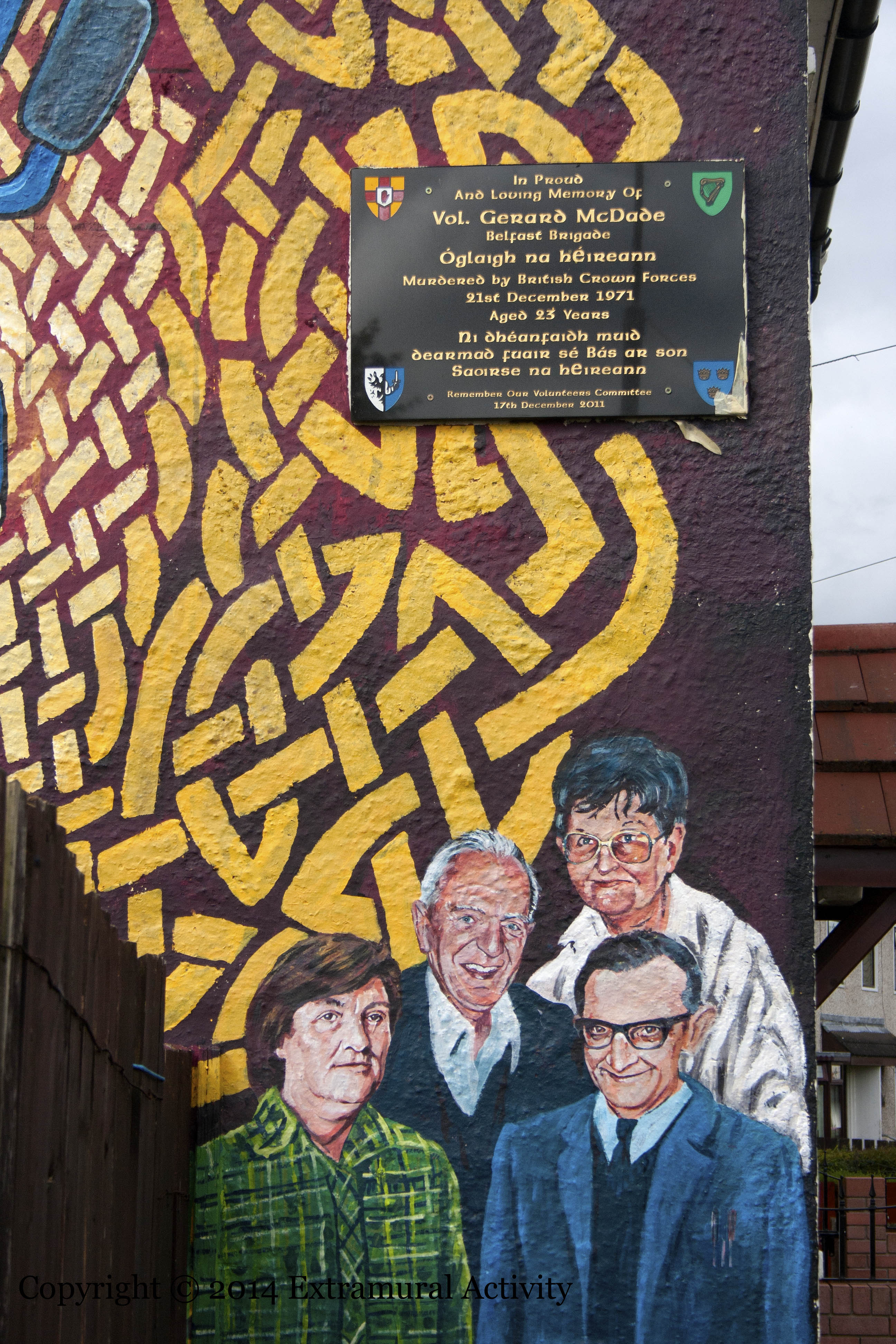
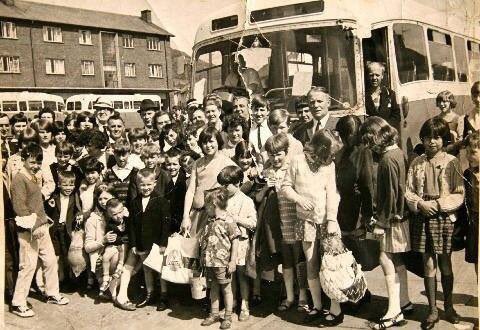
Unlike Ken Kesey’s Further, this bus goes Between, “Bringing sunshine to the children”. ‘Between’ was (and is) a Cork-based group who sponsored trips to Cork (Blarney Castle appears in the background of the mural), Monaghan, Donegal, and elsewhere, for the children of Ballymurphy and the Shankill during the troubles. The figures in the lower-right corner are shown in detail in the image below. The plaque to Gerard McDade remains on the wall. The mural was unveiled on 2014-09-20 – Ciaran Cahill has images from the launch.
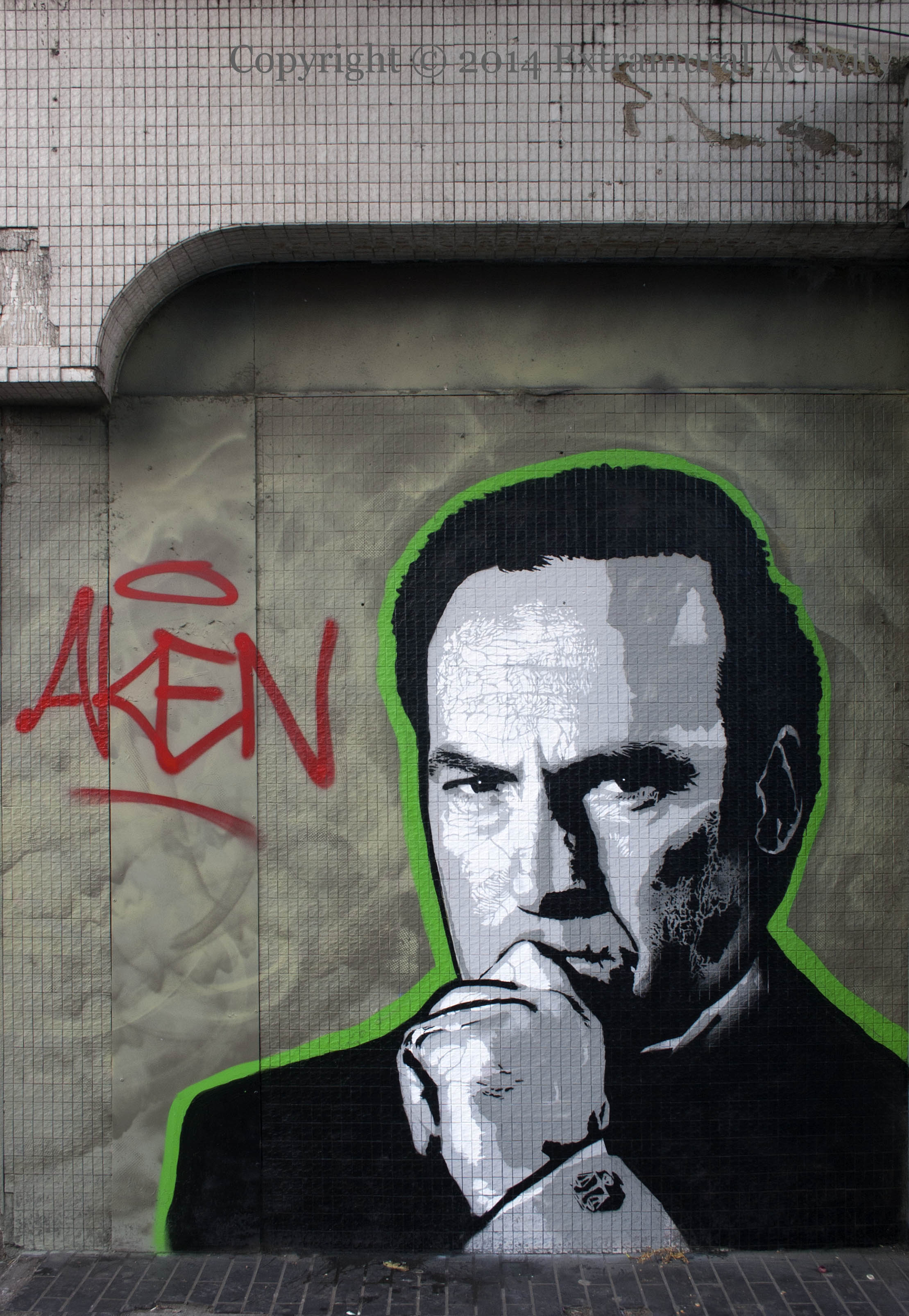
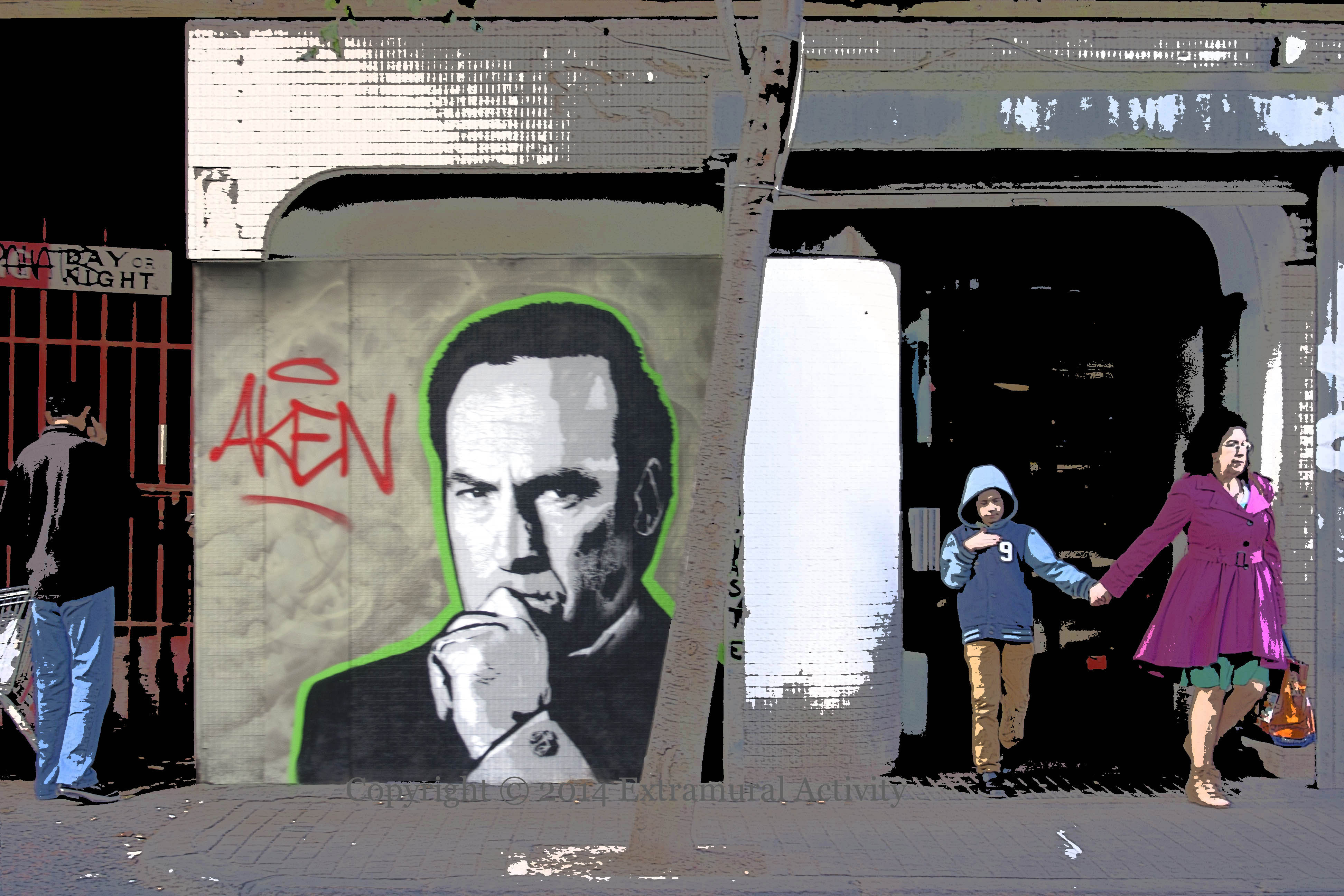
Here are two images of the new Visual Waste piece in North Street, completed as part of Culture Night Belfast, 2014. Bob Odenkirk plays the lead character, Saul Goodman, in the upcoming series Better Call Saul, a spin-off of Breaking Bad, whose lead character (Bryan Cranston as Walter White) was the subject of last year’s Visual Waste CNB piece (see Broken Bad).
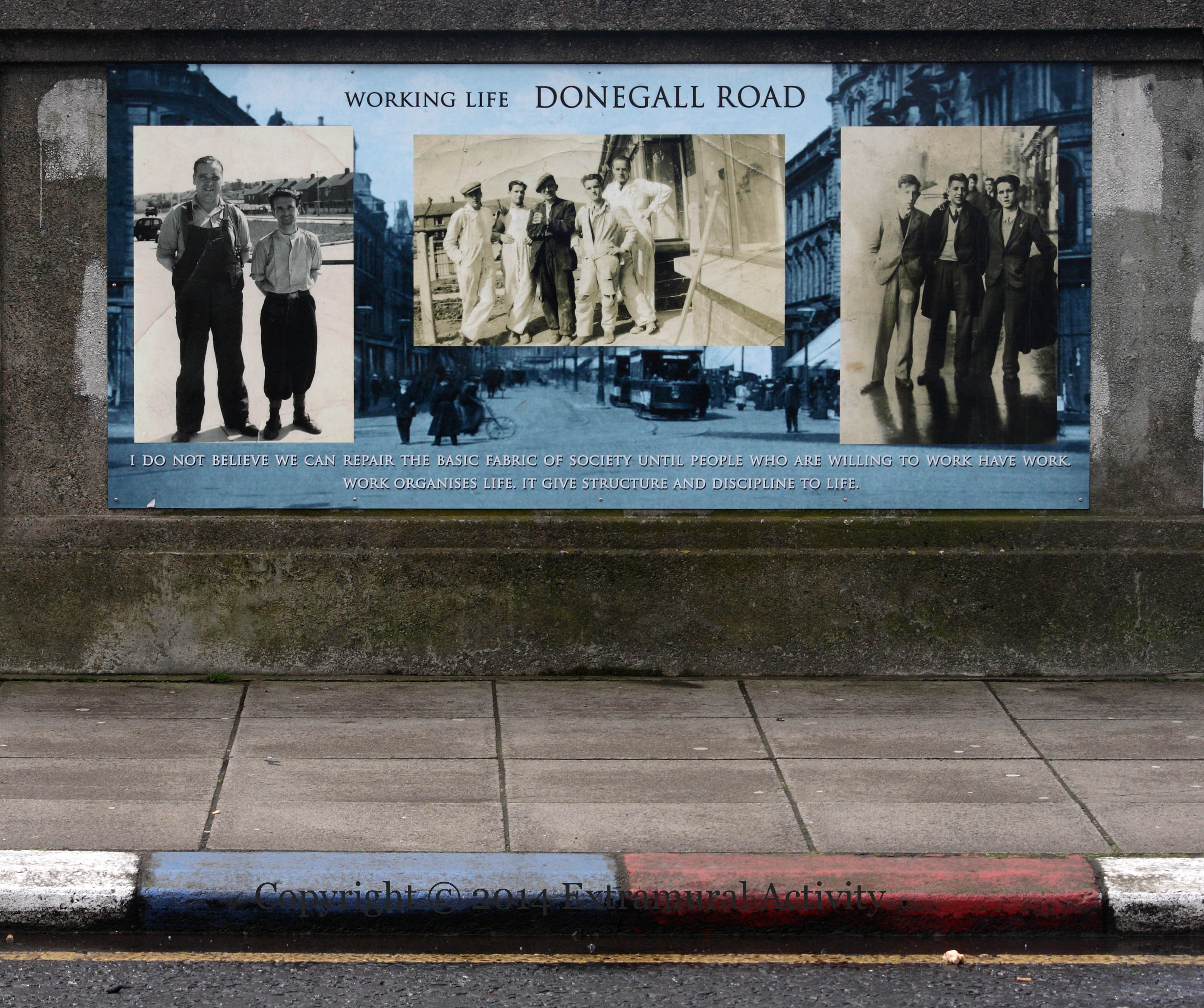
Here are two panels from the Donegall Road bridge at Roden Street both concerned with working life in the area in years gone by. The (uncredited) words at the bottom of the first board come from a Bill Clinton speech. At greater length, it goes “I do not believe we can repair the basic fabric of society until people who are willing to work have work. Work organizes life. It gives structure and discipline to life. It gives meaning and self-esteem to people who are parents. It gives a role model to children …”
The second features two stanzas from a poem called here “The Weaver’s Prayer” but also known as “The Master Weaver”, “The Weaver”, and “Just A Weaver”, and commonly though not unanimously attributed to one Benjamin Malacia Franklin in the 1940s; it is here said to have been penned by a “female Ulster weaver in 1922”: “Not ’til the loom is silent, and the shuttles cease to fly, shall God unroll the canvas, and explain the reasons why. The dark threads are as neatful, in the weaver’s skilful hand, as the thread of the gold and silver, in the pattern he has planned.”
See previously: The Thread Of History which features two reflections on life as a female weaver.
The Australian Manufacturing Workers Union (amwu.org.au) sponsored the mural above in Conway Street, west Belfast.
The painted plaque on the left reads, “Casement Memorial. In proud memory of the 10 Republican prisoners who died on hunger strike in “H” blocks of Long Kesh in 1981. “It is not those who can inflict the most but those who can endure the most who will conquer.” Terence McSwiney. Unveiled by Martin McGuinness, Sınn Féın MP MLA Minister for Education Wednesday 6/12/2000. Donated by AMWU, Craig Johnston State Secretary”. The plaque itself is in Carlton, Australia, named (presumably) for Roger Casement.
Secretary Johnston is on the left in the back. The flag to the right is the flag of the Eureka Stockade.
“Let no man pull you so low as to hate him”. In a sermon on November 4th, 1956 (and repeated on other occasions), Martin Luther King, Jr. imagined a letter from Paul to the Christians of America, expressing concern for spiritual life in a capitalist society and appealing for desegregation of society using non-violent methods: “the weapon of love”, keeping in mind “that you are merely seeking justice for him as well as yourself”.
Click for audio – the remark quoted occurs at the 3 minute mark of section 4 (archive.org) | Text (1958) – see page 7 (= 344)
The image below shows the site in mid-August, without the pro-Palestine boards (for an Irish-language version of which see An Phalaıstín/Palestine; the image above is from the first week of September, 2014.
A young girl wearing an adult’s pushes a pram in the first of a dozen panels from the new ‘Fáılte go dtí Ard Eoın’ mural in Ardyone Avenue. The image is perhaps based on the (unattributed) photo, shown below the images of the mural.
2-3: The woman on the right is a spinner – her job is to ensure that the fibres of threads being wound together to make a strong thread do not break. The occupation of the man on the right is unknown. Please comment or send an e-mail if you recognize his occupation.
5-6: Two panels featuring boxers, possibly Freddie Gilroy and Eamonn Magee — leave a comment or e-mail if you can identify either.
8: Holy Cross church on the Crumlin Road.
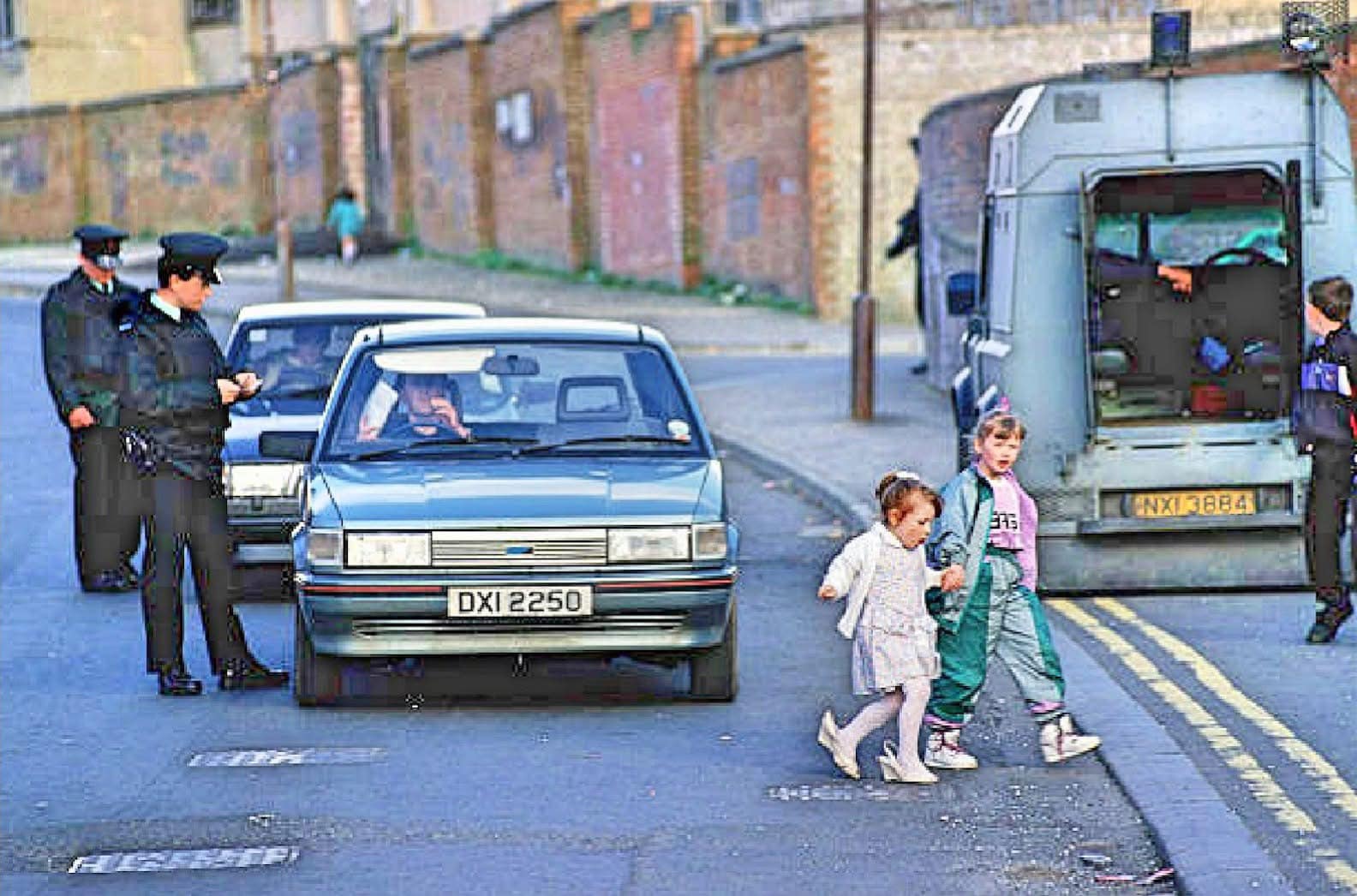
9: A British soldier patrols the streets while a girl walks home from school and a boy plays hurley. This is one of the panels in the long mural at the shops on Ardoyne Avenue.
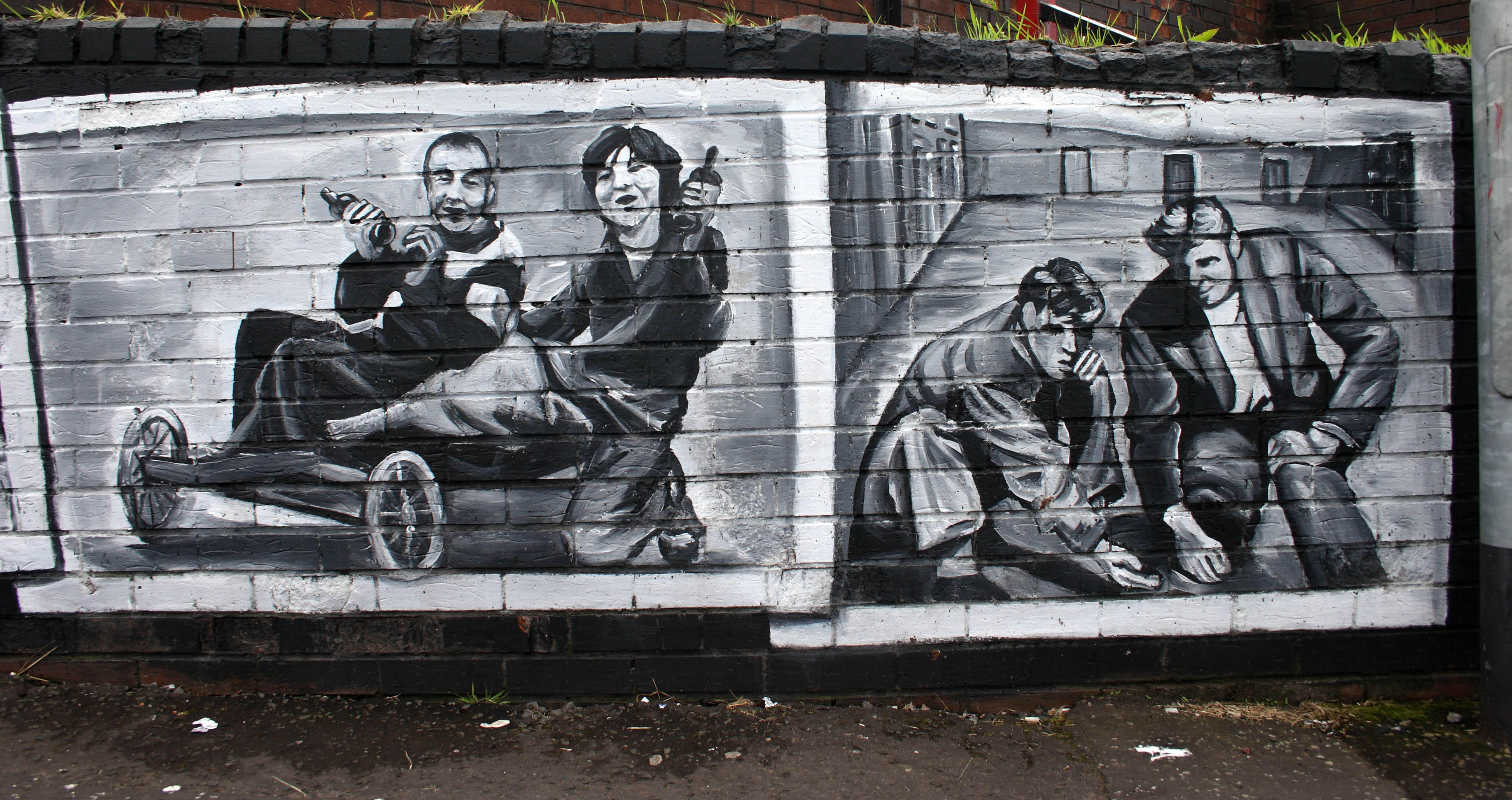
10-11: Two go-karters appear to be brandishing bottles as they ride while, to their left, two (rather stylish?) youths appear to be banging bin-lids.
“Is fearr Gaeılge brıste ná Bearla [Béarla] clıste” means “Broken Irish is better than clever English”.






 Extramural Activity