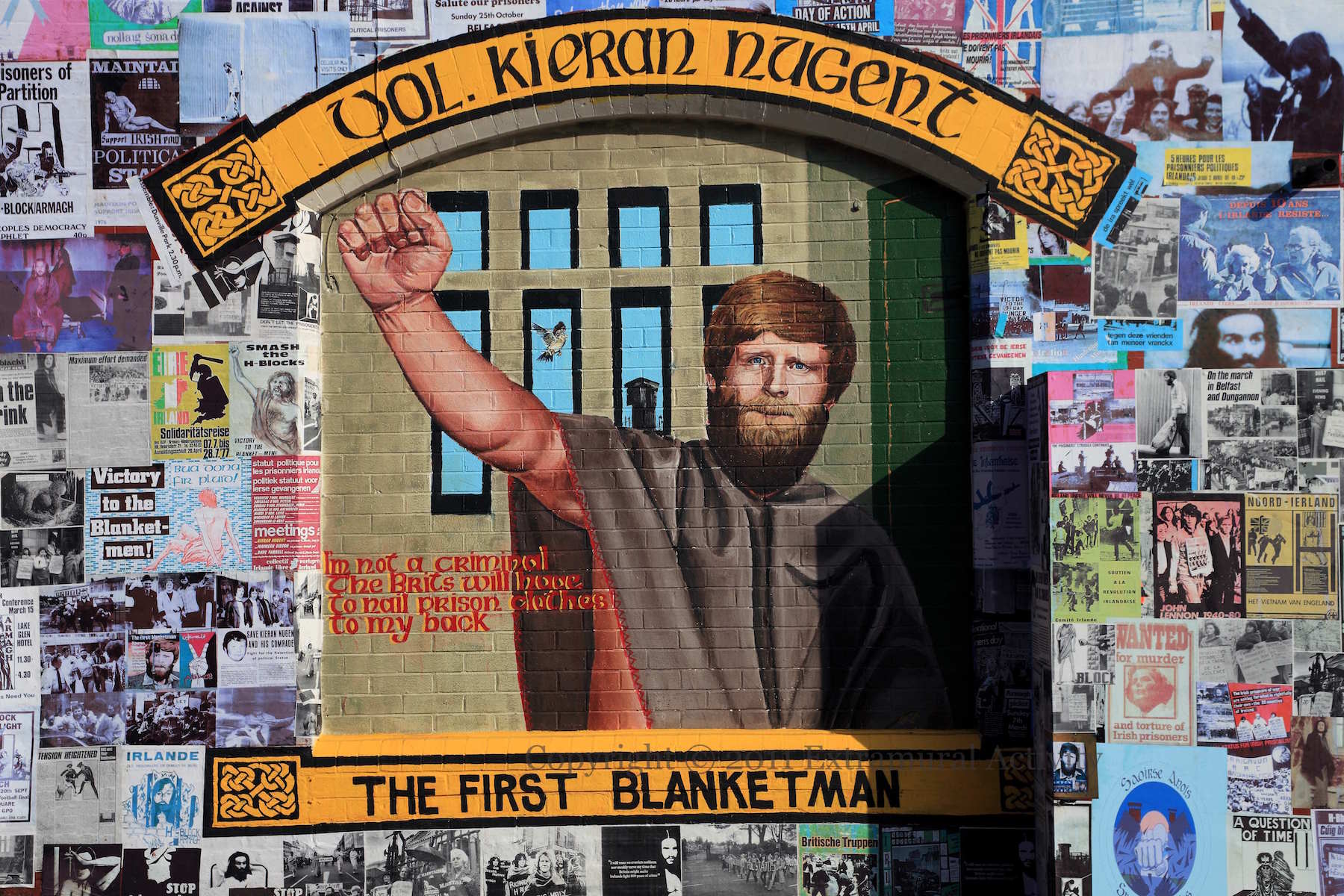
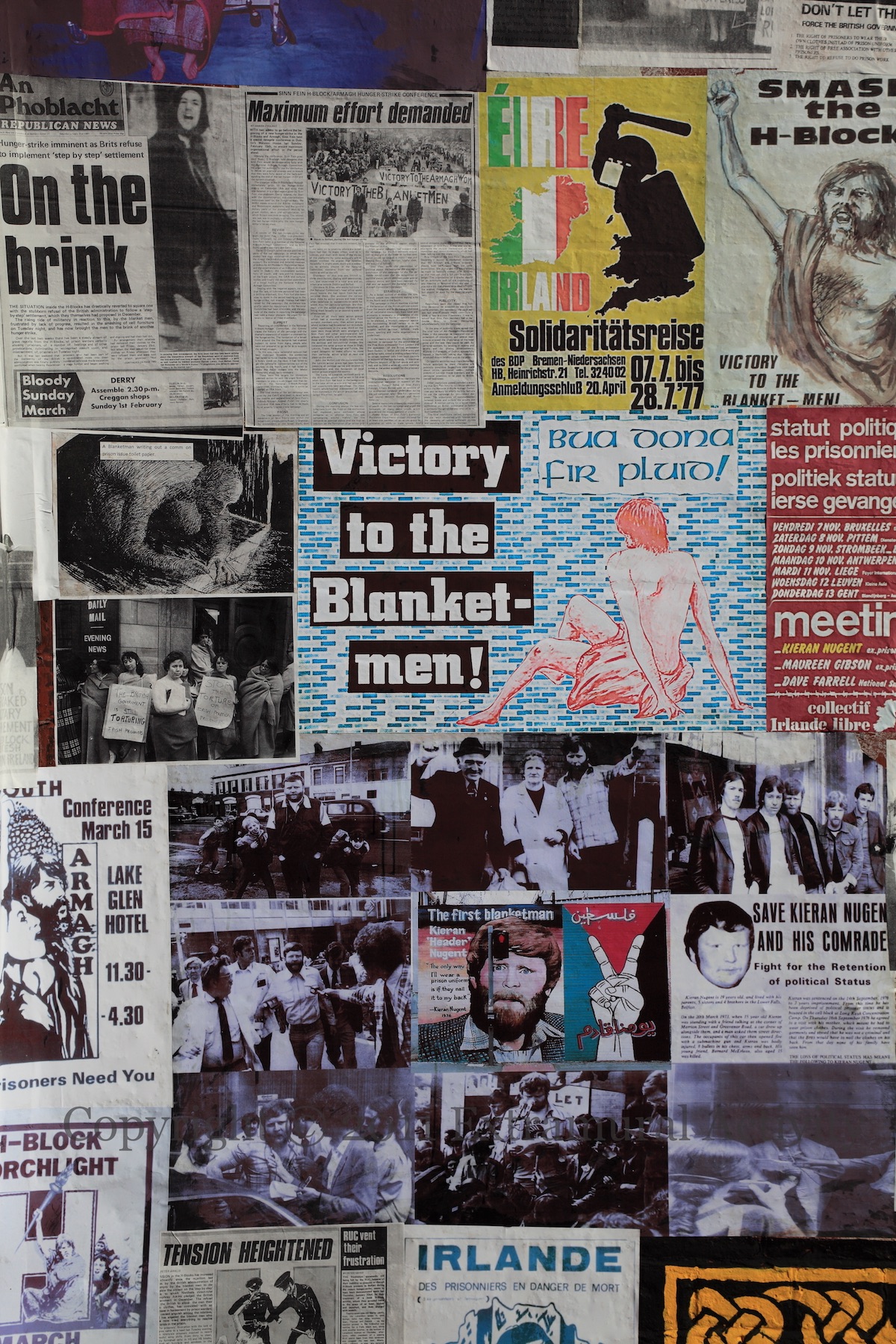
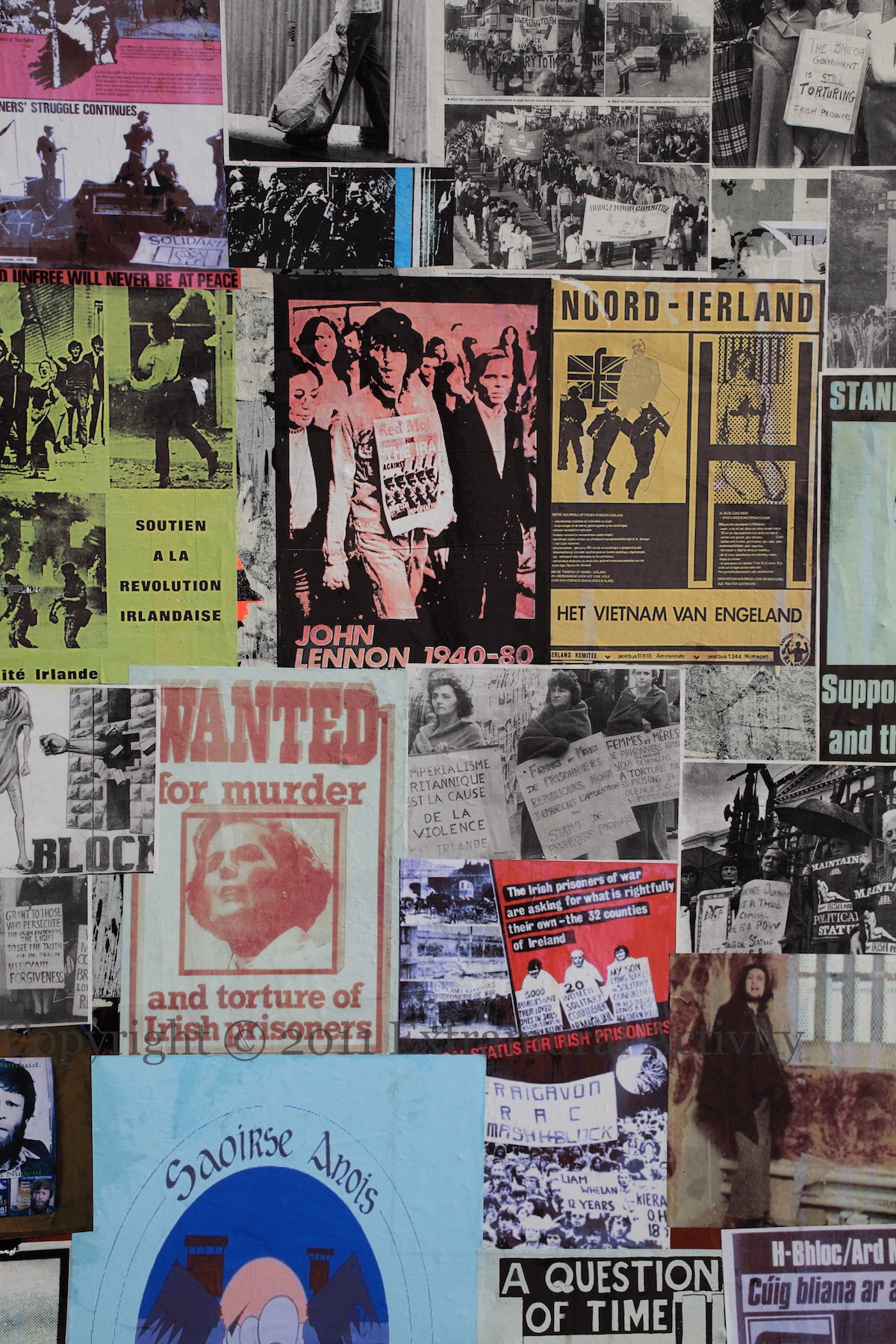
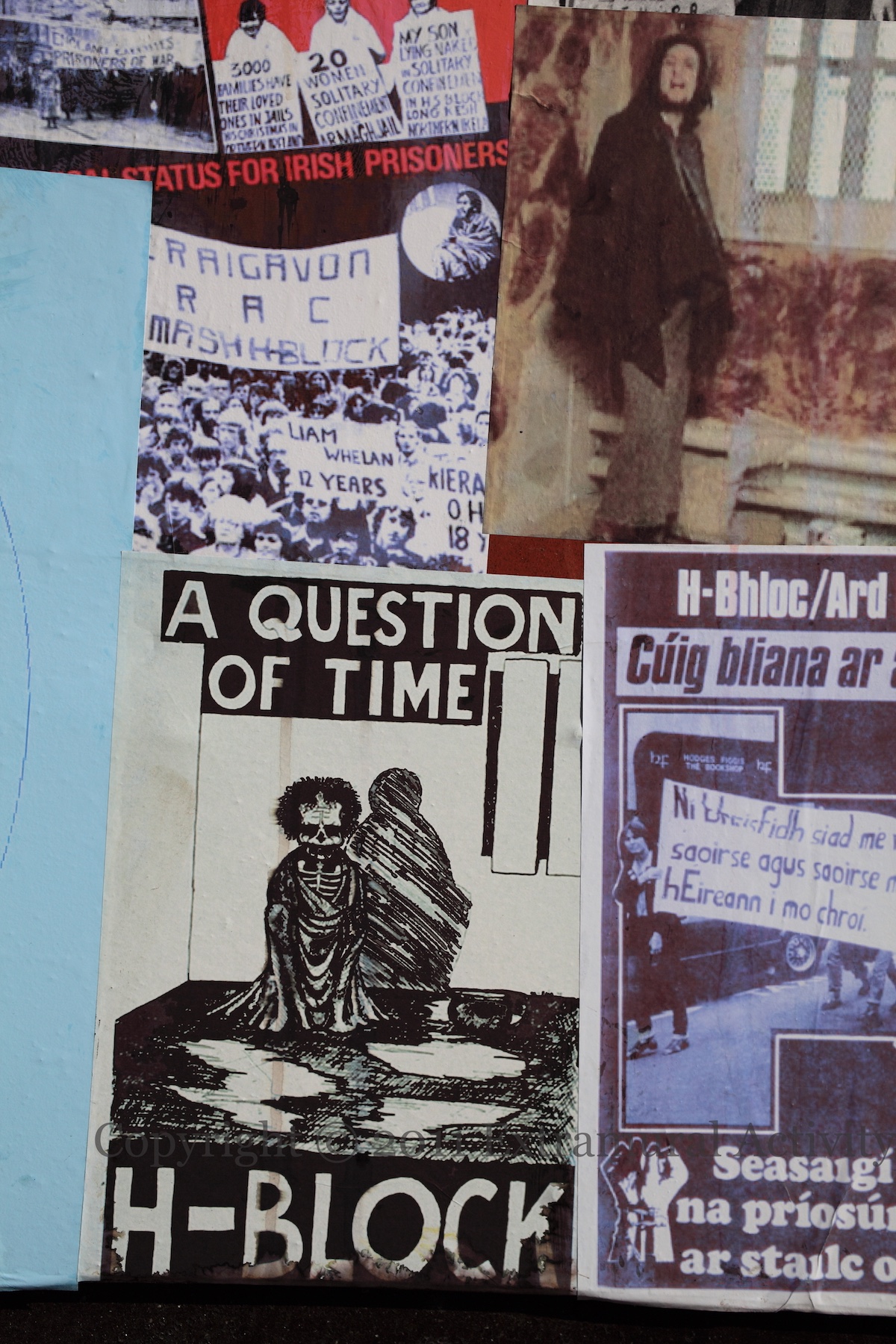
When the mural to “the first blanketman” Kieran Nugent mural (in the Rock streets) was re-done in February 2011, it was initially framed with a terrific selection of posters from the period, many of them from continental Europe, about Kieran, the blanket protest, and hunger striker.
“I’m not a criminal. The Brits will have to nail prison clothes to my back.” For the previous mural, and some background about Nugent going “on the blanket”, see M02550.
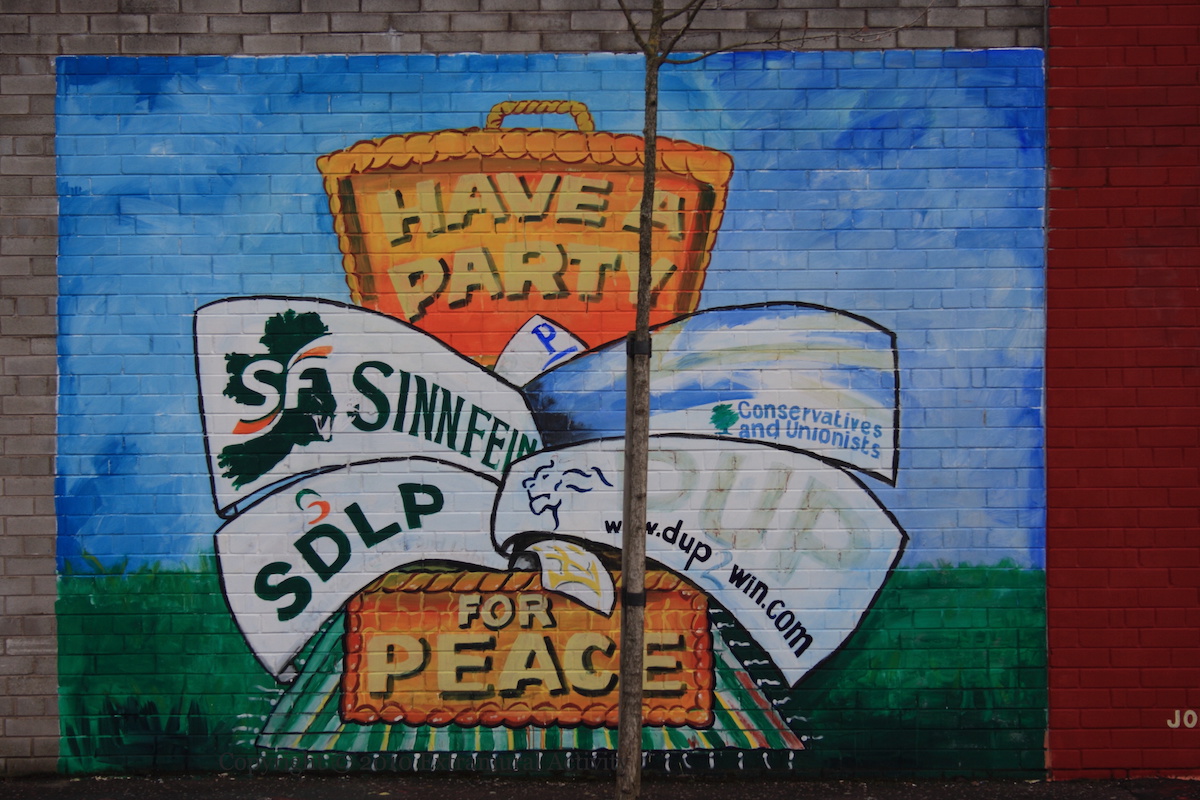
A picnic basket of political parties: PUP, Conservatives and Unionists, DUP, [perhaps Alliance sticking out at the bottom] SDLP, and Sınn Féın. Painted for International Peace Day, 2009.
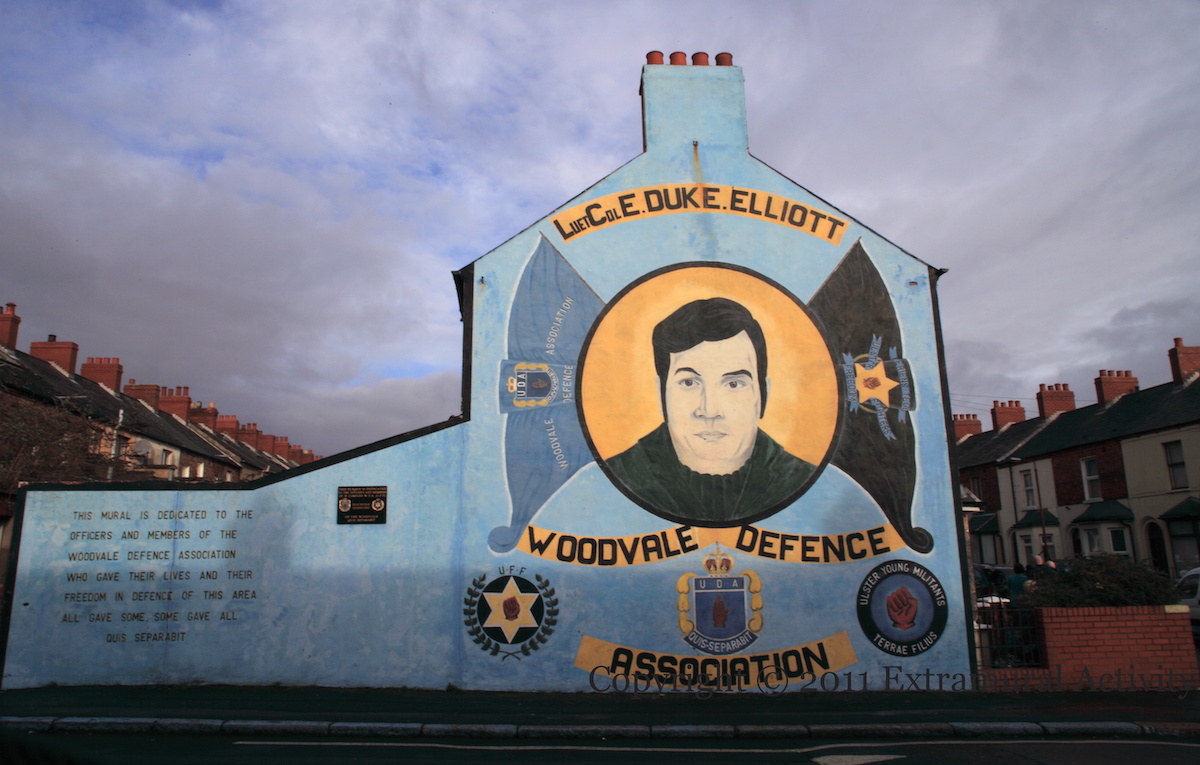
“This mural is dedicated to the officers and members of the Woodvale Defence Association who gave their lives and their freedom in defence of this are. All gave some, some gave all. Quis separabit.” The plaque reads: “This plaque is dedicated to the officers and members of ‘B’ Company WDA (UFF) who gave their lives and their freedom in defence of the Woodvale. Quis separabit.
Ernie “Duke” Elliott came from the Woodvale area and was a founder member of the Woodvale Defence Association in 1971, which was later folded into the UDA. He was also a Marxist. He was killed in a pub brawl in December 1972 in a dispute over weapons (WP | Tele | Watching The Door).
In 1607 – “400 blıaın” after the Anglo-Norman invasion of Ireland – 50 years of newly-asserted English control, most recently at the hands of Charles Blount – who defeated the pair in the Nine Years’ War – and Arthur Chichester – who, as O’Donnell is shown reading, was “appointed Lord Deputy in Ireland” in 1605 – compelled Earls Hugh O’Neill of Tyrone and Rory O’Donnell of Tyrconnell to depart Ireland on a ship bound for Spain in order to petition for Spanish support in reclaiming the lands and status they were losing under English rule. They ended up in Rome instead and never returned, ending the period of Gaelic chiefs’ rule in Ireland and making way for the plantation of Ulster.
The pair of plaques on the left indicate that the mural was painted as part of the Re-Imaging Communities Programme’ (top) and launched by President Mary McAleese on June 19th (bottom). Even though the subject was historical, the state funding for the project required the removal of a sword from O’Neill’s right hand; he is shown instead clutching the collar of his cloak. For more on the re-imaging programme, see Visual History 10.
“Imeacht na nIarlaí. I ndıadh 400 blıaın … that the eternal values of liberty and democracy have prevailed and the sons and daughters of the planter and the Gael have found a way to share the land of their birth and live together in peace.”
“The new artwork and community garden replace the last UDA mural to be removed in North Belfast. The aim is to remove the negative images of the past and replace them with positive representations of history and identity. GroundworkNI, Tyndale Community Residents Association, the appointed artists and children from Ballysillan Primary School developed the vision for the project, which drew on themes from local history and incorporated them with the community’s aspirations for the future. The ‘Tyndale Dragon’ was designed by Daniela Balmaverde through consultation with children from Ballysillan Primary School and Tyndale Residents Association. The body of the dragon represents the flowing water of the rivers that ran through Ballysillan and the fire like letters signifies the volcanic history of Cave Hill, the visible feature in this area. Artist Alan Cargo designed the aluminium sculpture called ‘Reflect’. Children from P1-P7 in Ballysillan Primary School drew pictures which ‘reflected’ the things that they liked about their community as well as what they hoped for in the future. These images have been laser etched onto the reflective metal sculpture, which is shaped to represent the Napoleon’s Nose of the nearby Cave Hill. The ripple design through the middle signifies the Farset River that used to run through the local area. The ‘Garden of Reflection’ aims to provide a quiet space for residents to interact and reflect on the past. It creates an area where local people can appreciate the artwork and enjoy the stunning view of Belfast City. The materials used in the garden are sensitive to local history. The limestone paving links into the local limestone quarry, which used to be a source of industry in the area. The words cast into the pathways were chosen by the wider Tyndale community as an expression of their needs and hopes for the future.”
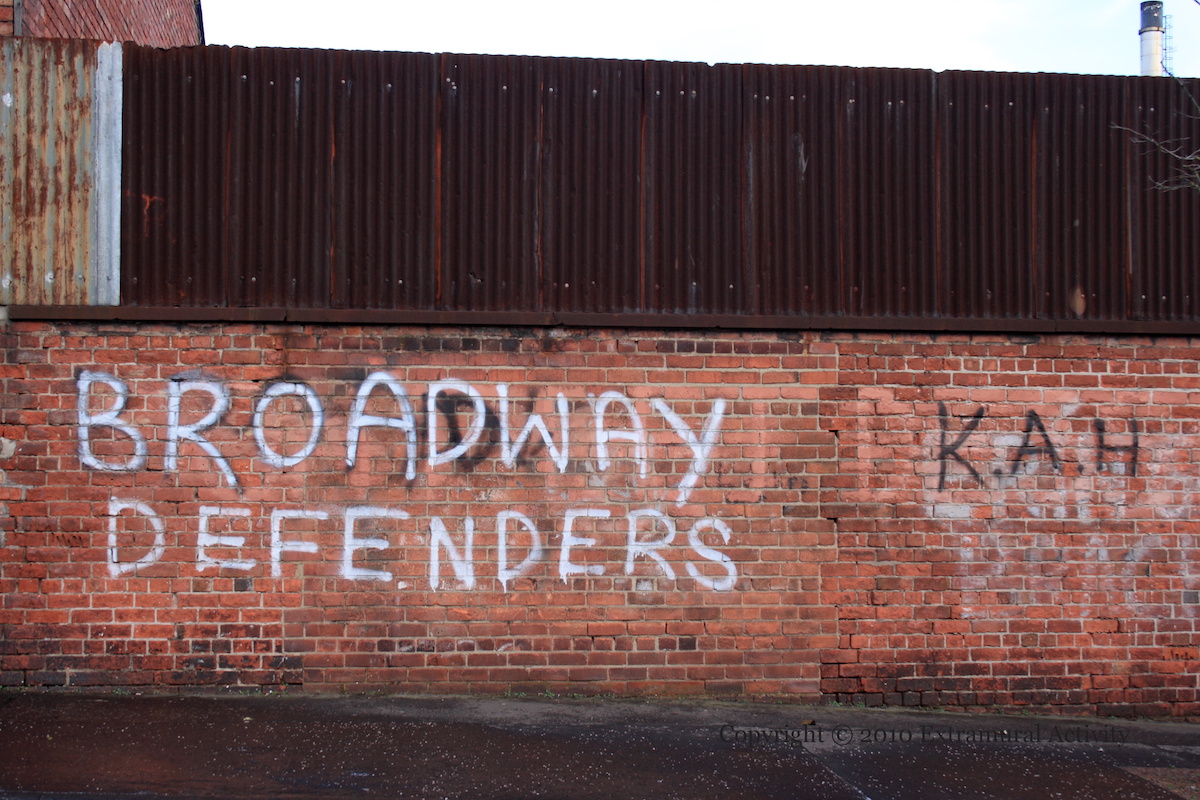
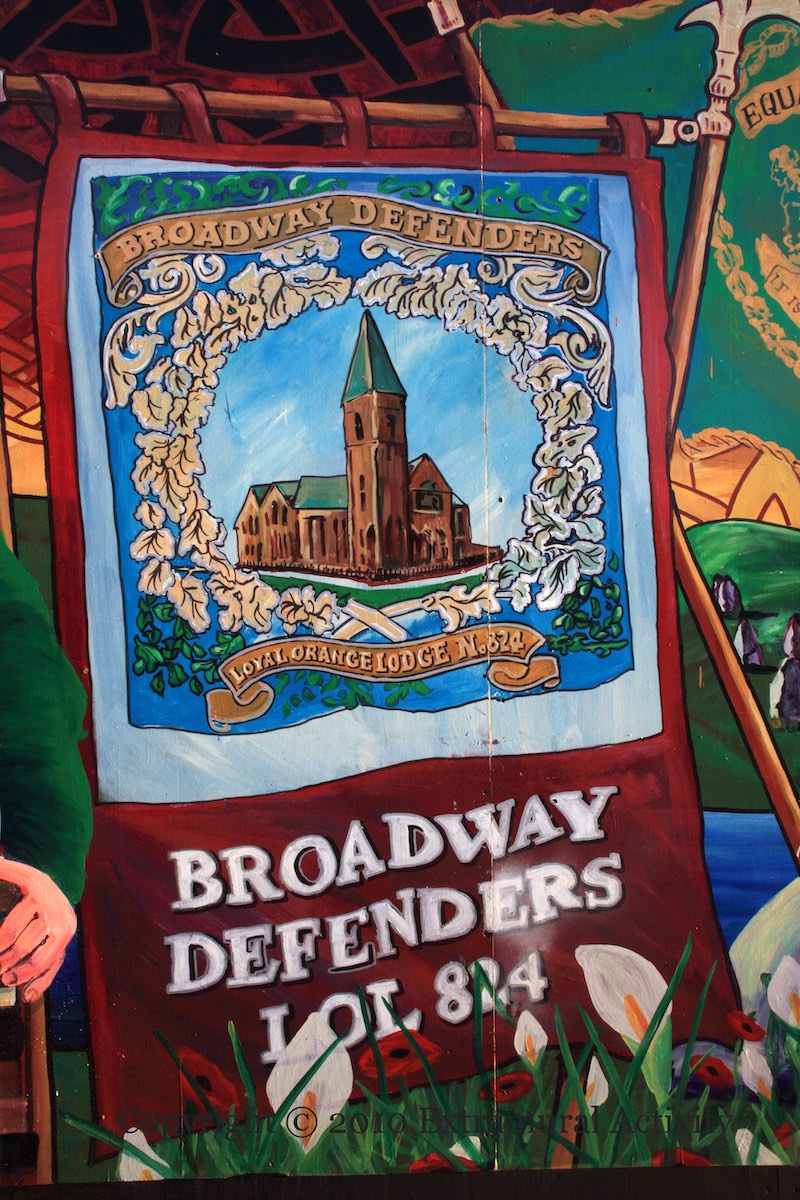
“Broadway Defenders” was originally the name of LOL 824, which was based in what is now An Cultúrlann but was formerly Broadway Presbyterian church. (LOL 824 was included on the mural on the hoarding around Cultúrlann while it was be redeveloped – see the close-up below and for more see M06462.) But the graffiti above is probably from a CNR hand, given its location and the adjacent “KAH” (and previously “Erin Go Brach“) graffiti.
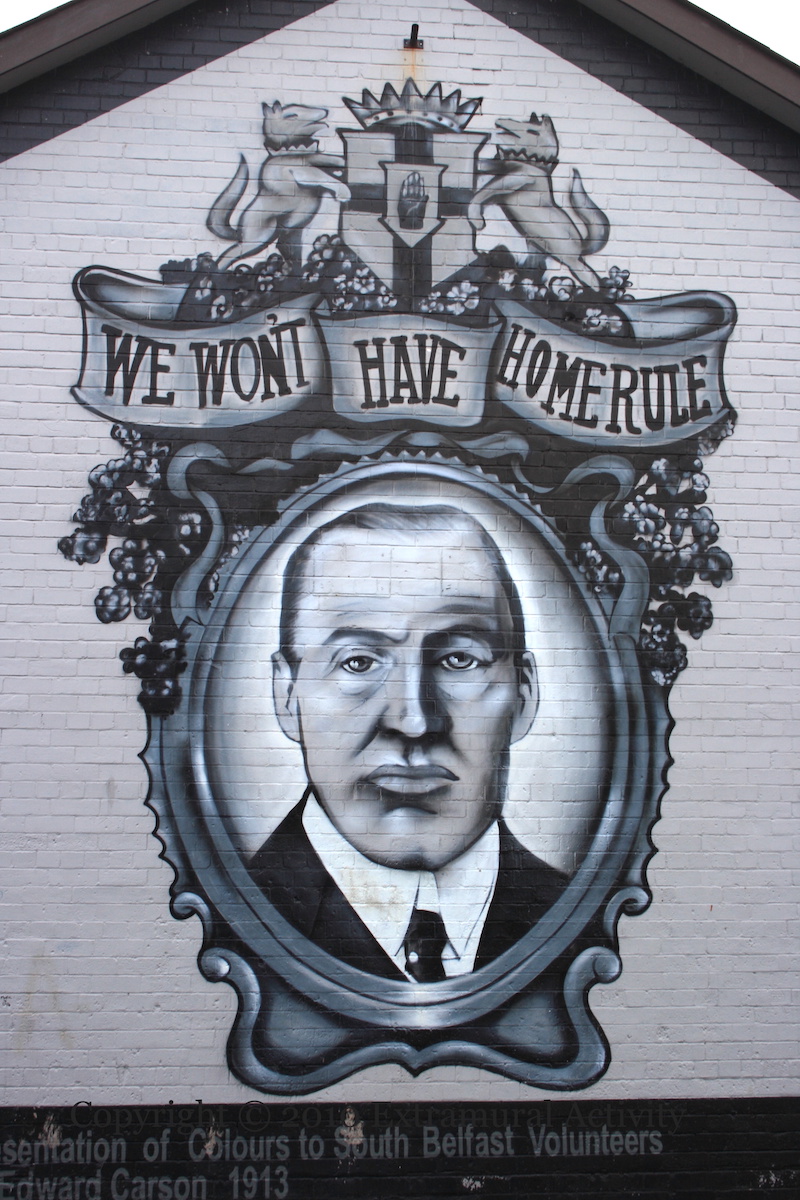
Dublin barrister Sir Edward Carson was the figurehead of Unionism at the time of the Home Rule crisis, overseeing the formation of the Ulster Volunteers and the Covenant in response to the third bill. Carson’s aim was to keep all of Ireland within the UK but advised unionists to accept the six-county Northern Ireland stipulated by the 1920 Bill.
For the side wall out of shot to the left, see M04206.




 Extramural Activity