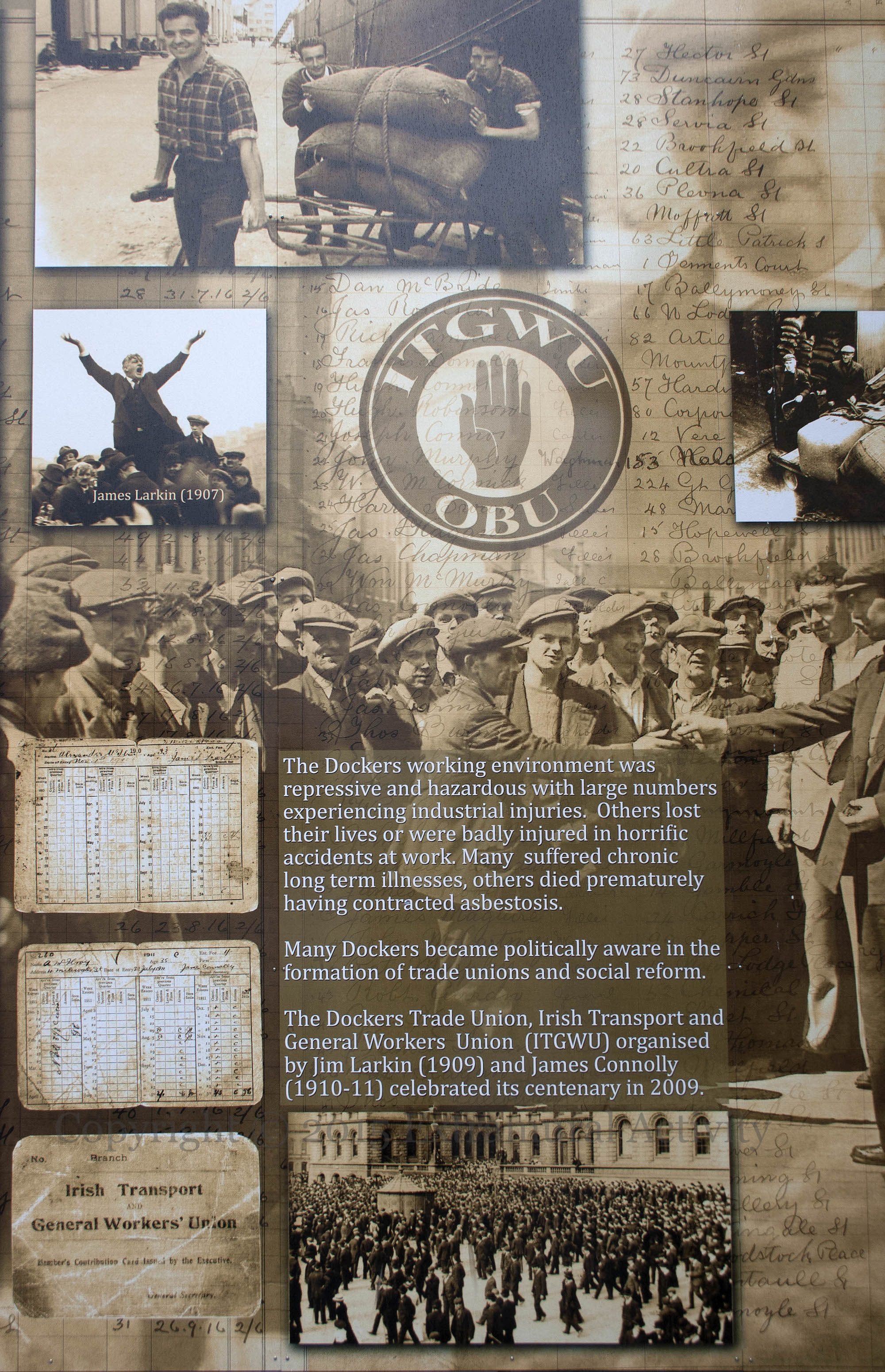
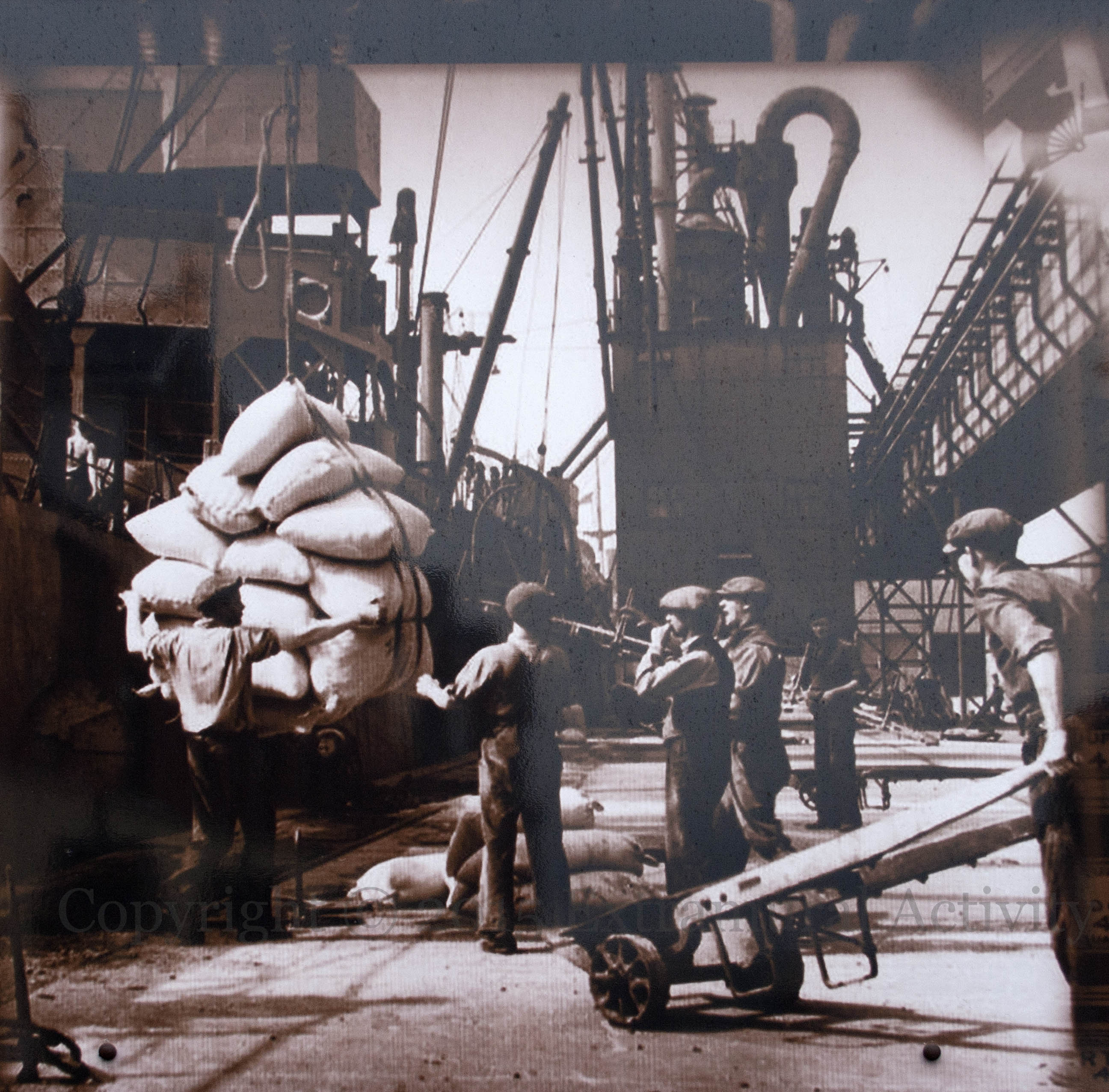
Every day, men would line up in schooling pens on the various docks of the port of Belfast to be hired by foremen. As mentioned on the left-hand side of the board above (recently erected on the New Lodge side of the Duncairn “peace” line) the rise of the shipping container in the 1970s spelled the end of the docker: “from 3000 listed dockers in 1970, the number had fallen to 280 by 1985.” Author and poet John Campbell recalls his first day on the docks in 1952, unloading cement, in this NVTv video.
“This artwork celebrates the unique contribution that generations of dockers have made to the port and City of Belfast.”
“It was a physically demanding job, the hours were long, the conditions were tough and the availability of work was not constant. Without the Dockers, however, the Port of Belfast would not have been able to grow. / Transportation of goods by containers led to a revolution in working practices at Belfast Docks and the number of dockers decreased dramatically. From 3000 listed dockers in 1970, the number had fallen to 280 by 1985. Behind these figures lay the human story of vast social changes in the harbour area as well as the gradual dissappearance [sic] of an entire community who had earned their living from the sea and also through the loading and unloading of ships. These were the Dockers and their families, many of whom lived in Sailortown. / The workforce of dockers spanned both traditions. Red button and Blue button. Dockers had a common allegiance to the Port of Belfast which provided a living for men and families from both communities. / The work was backbreaking, yet the Docks educated us about life, integrity, discipline, about standing up for our rights, about having pride in our identity as working men, as Dockers. / The Dockers[‘] working environment was repressive and hazardous with large numbers experiencing industrial injuries. Others lost their lives or were badly injured in horrific accidents at work. Many suffered chronic long term illnesses, others died prematurely having contracted asbestosis. Many Dockers became politically aware in the formation of trade unions and social reforms. The Dockers Trade Union, Irish Transport and General Workers[‘] Union (ITGWU) organised by Jim Larkin (1909) and James Connolly (1910-11) celebrated its centenary in 2009.” OBU one big union
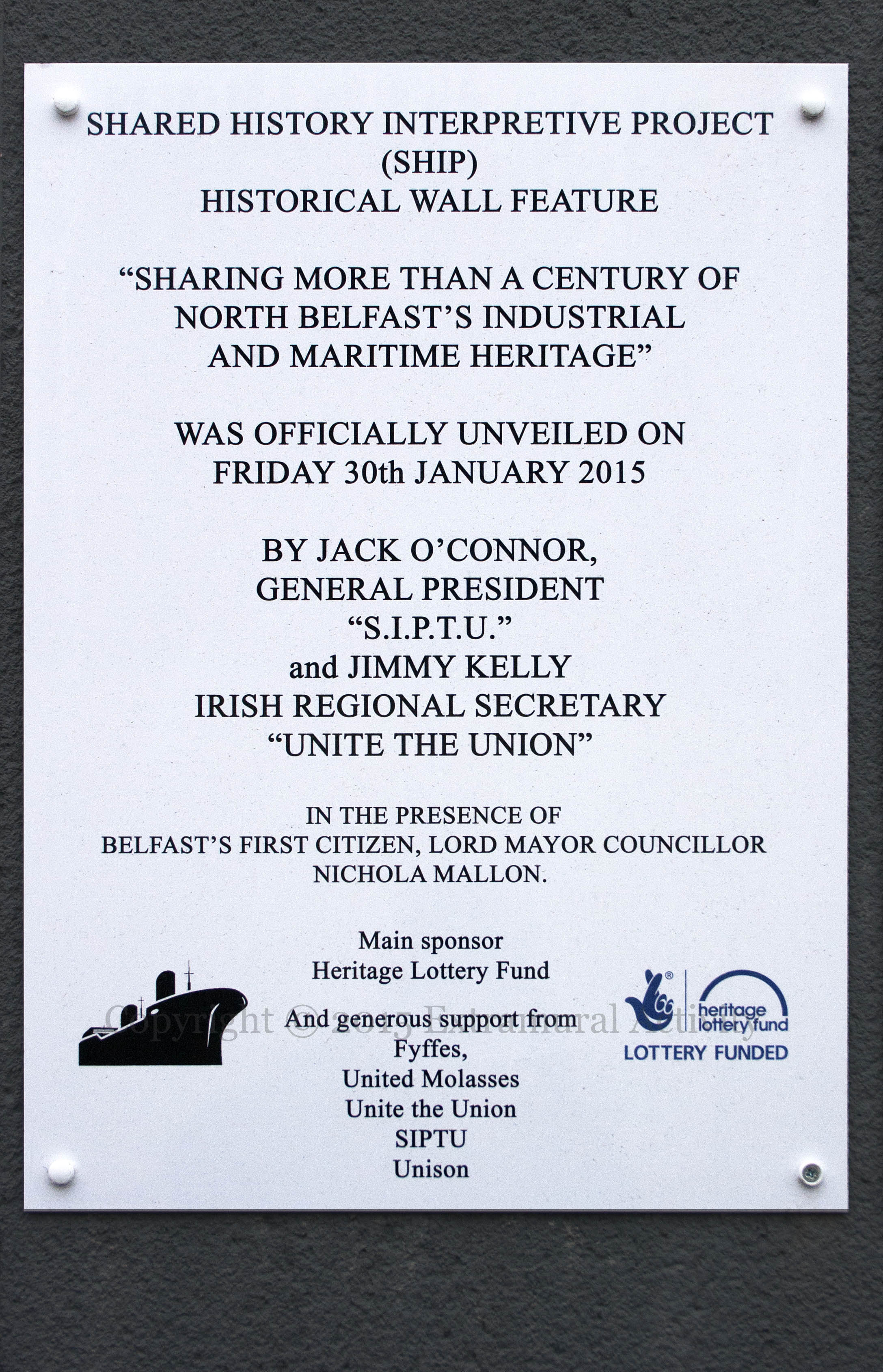
A new “historical wall feature” was unveiled by the Shared History Interpretive Project (SHIP) on the outside of the Dockers Club in Pilot Street in Sailortown. The new piece is a montage of about 60 images of vintage photographs, a census form, and posters of industrial life. In the top-middle (behind the lamppost) there can be seen an image of the board this one replaces, which featured two carters pulling away a heavy load, similar to the carter in the image above. Another addition in the new work is the inclusion of Billy McMullen (1888-1982) and John Quinn (1876-1935) alongside Winifred Carney (1887-1943), James Connolly (1868-1916), and Jim Larkin (1876-1947). Both McMullen and Quinn are Belfast trades unionists. Quinn’s headstone in Milltown Cemetery was featured previously, in Forgotten In Life, Remembered In Death. More information about all five, as well as photographs of dockers and of the unveiling, can be found at the SHIP web site.
James Connolly was concerned not just with the political independence of Ireland but its economic independence: both political and economic liberty were required in order for the human being to live freely. The quote in the image above comes from Connolly’s 1897 essay “Socialism & Nationalism”. The economic context is clear when we read a little more broadly:
“To the tenant farmer, ground between landlordism on the one hand and American competition on the other, as between the upper and the nether millstone; to the wage-workers in the towns, suffering from the exactions of the slave-driving capitalist to the agricultural labourer, toiling away his life for a wage barely sufficient to keep body and soul together; in fact to every one of the toiling millions upon whose misery the outwardly-splendid fabric of our modern civilisation is reared, the Irish Republic might be made a word to conjure with – a rallying point for the disaffected, a haven for the oppressed, a point of departure for the Socialist, enthusiastic in the cause of human freedom.” (marxists.org)
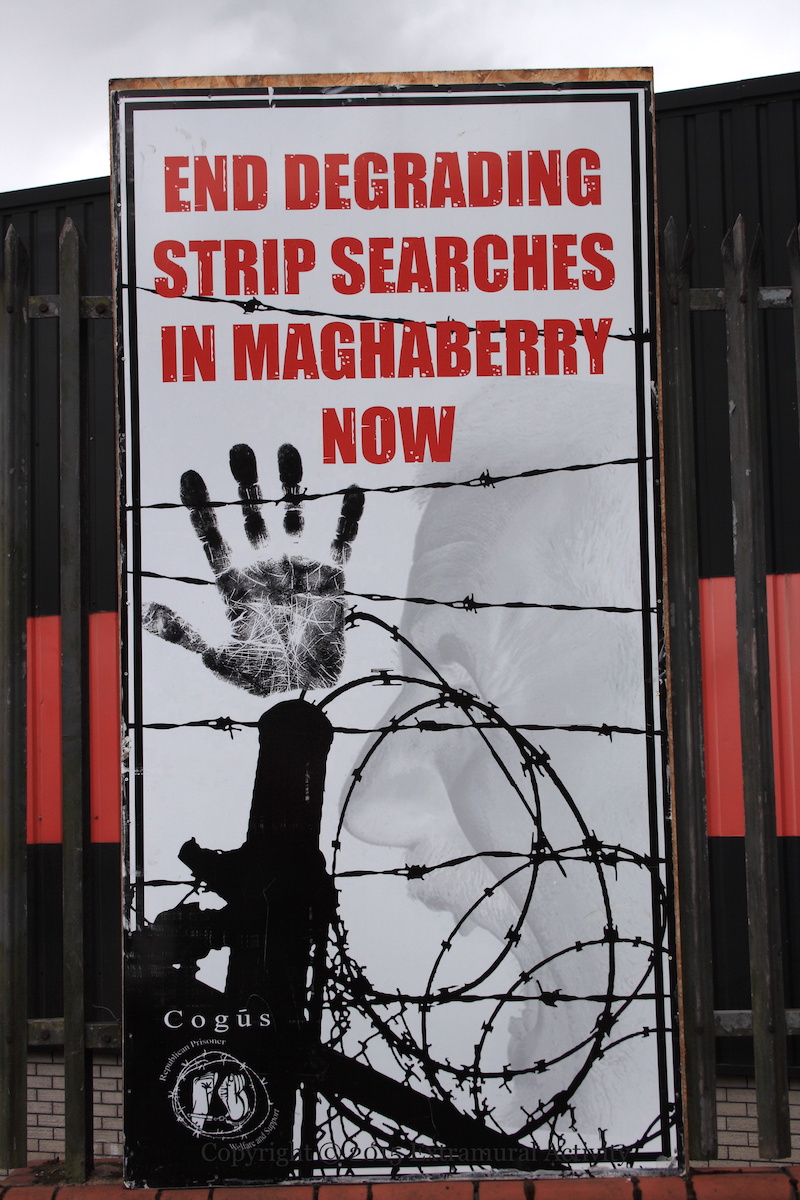
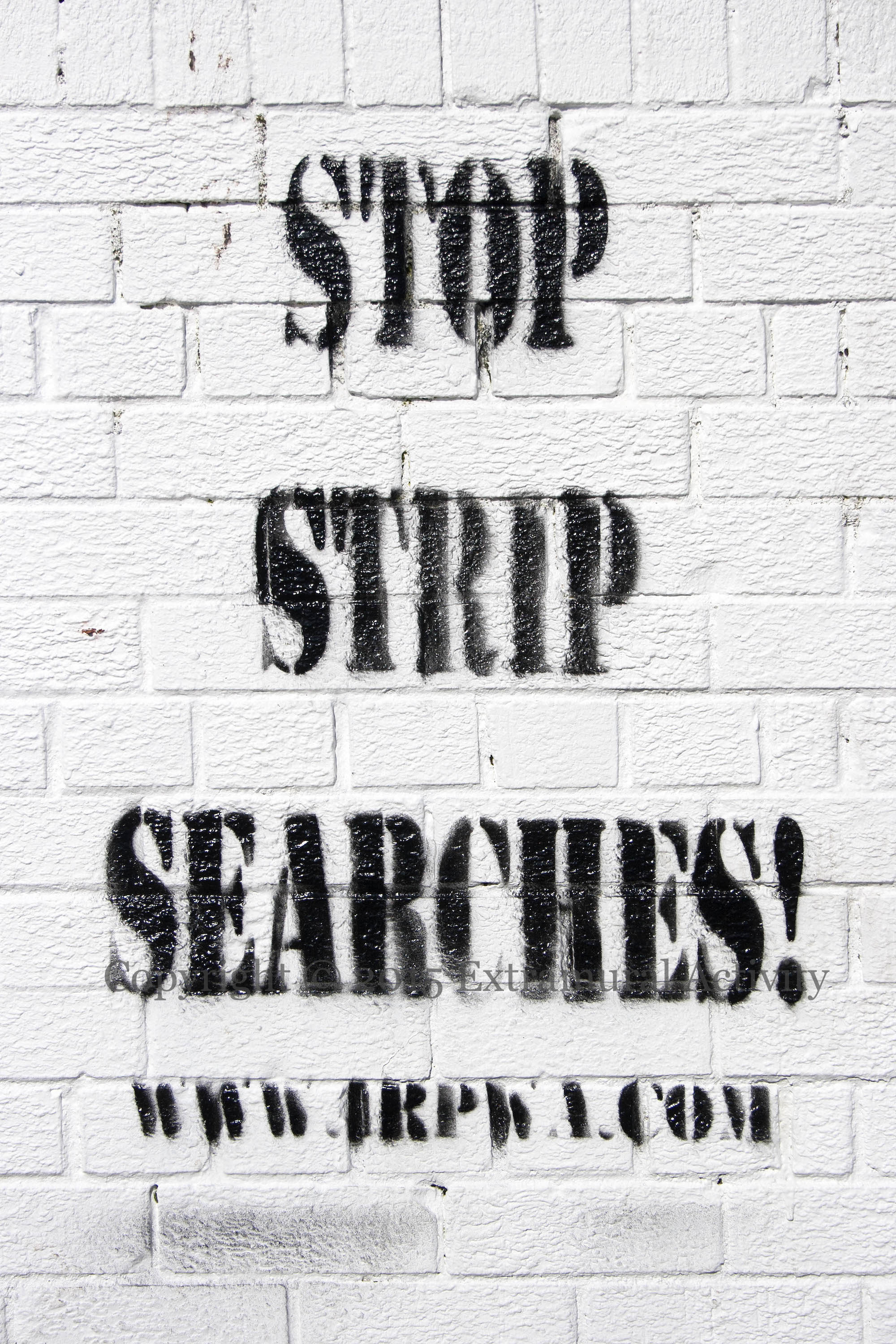
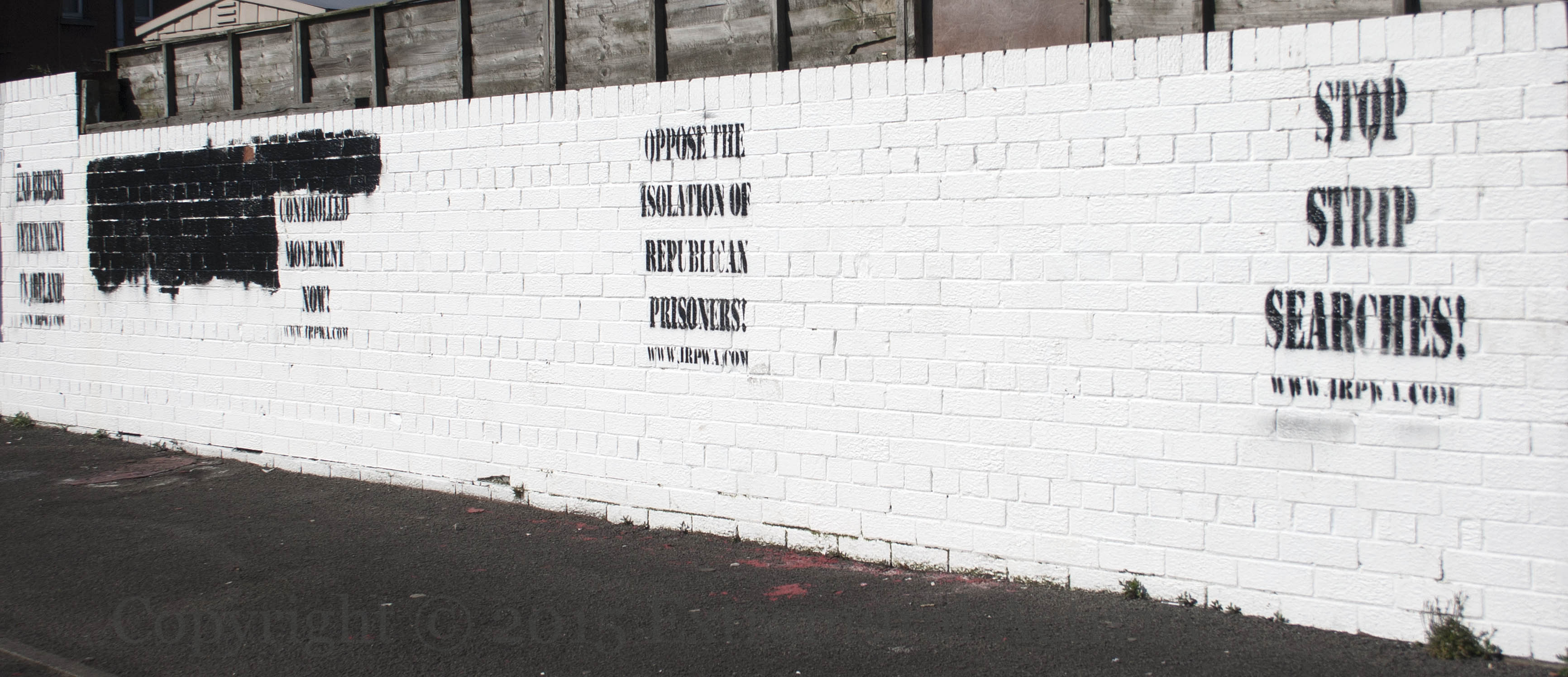
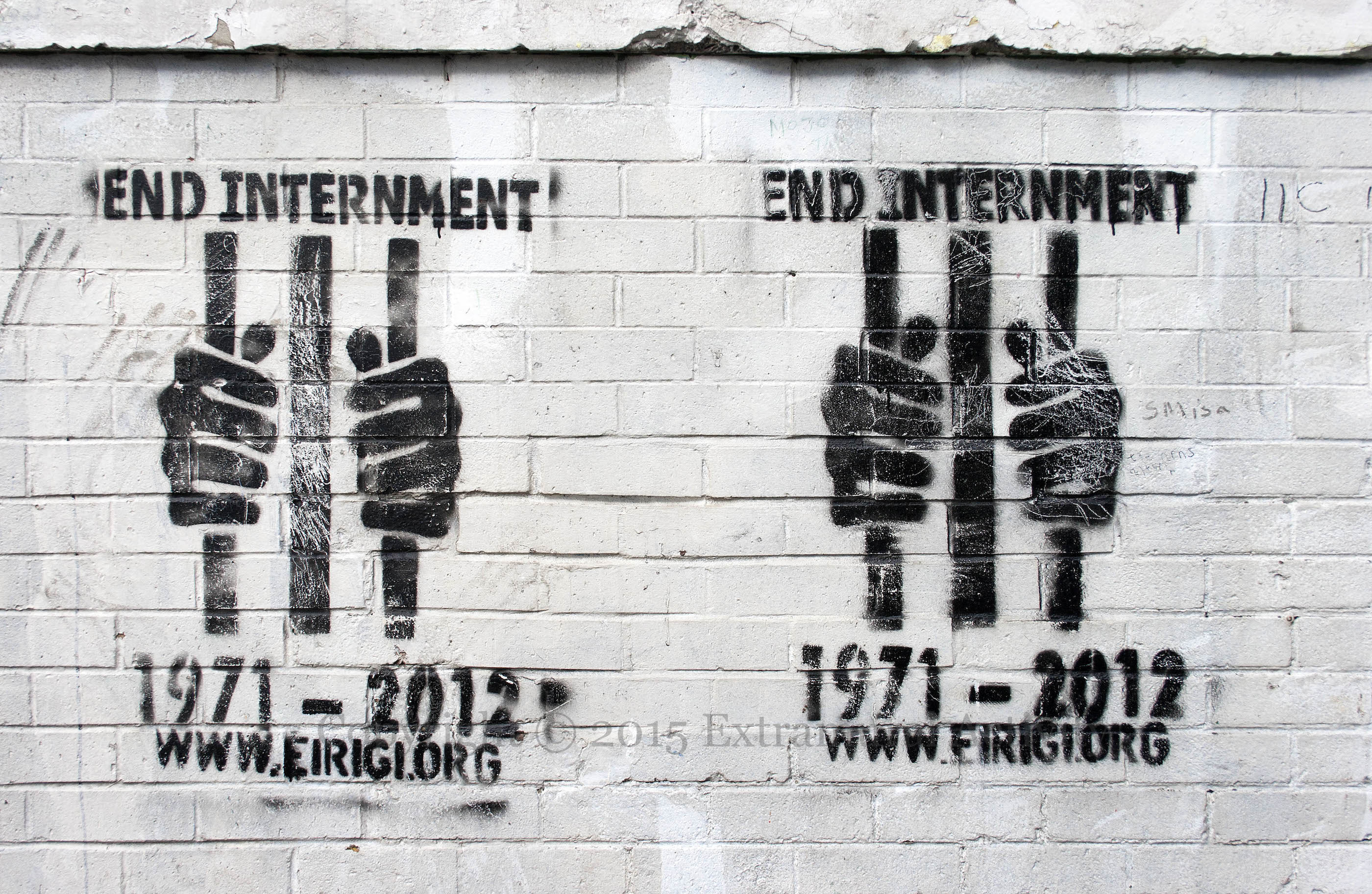
The mural of Padraig Pearse’s famous quote (“The fools, the fools …”) at the east end of Brompton Park has been replaced by the stencils above and below from the Irish Republican Prisoners Welfare Association (irpwa.com): “Oppose the isolation of Republican prisoners!” and “Stop strip searches!”. The final image is an older but similar stencil from the top of the Whiterock Road.
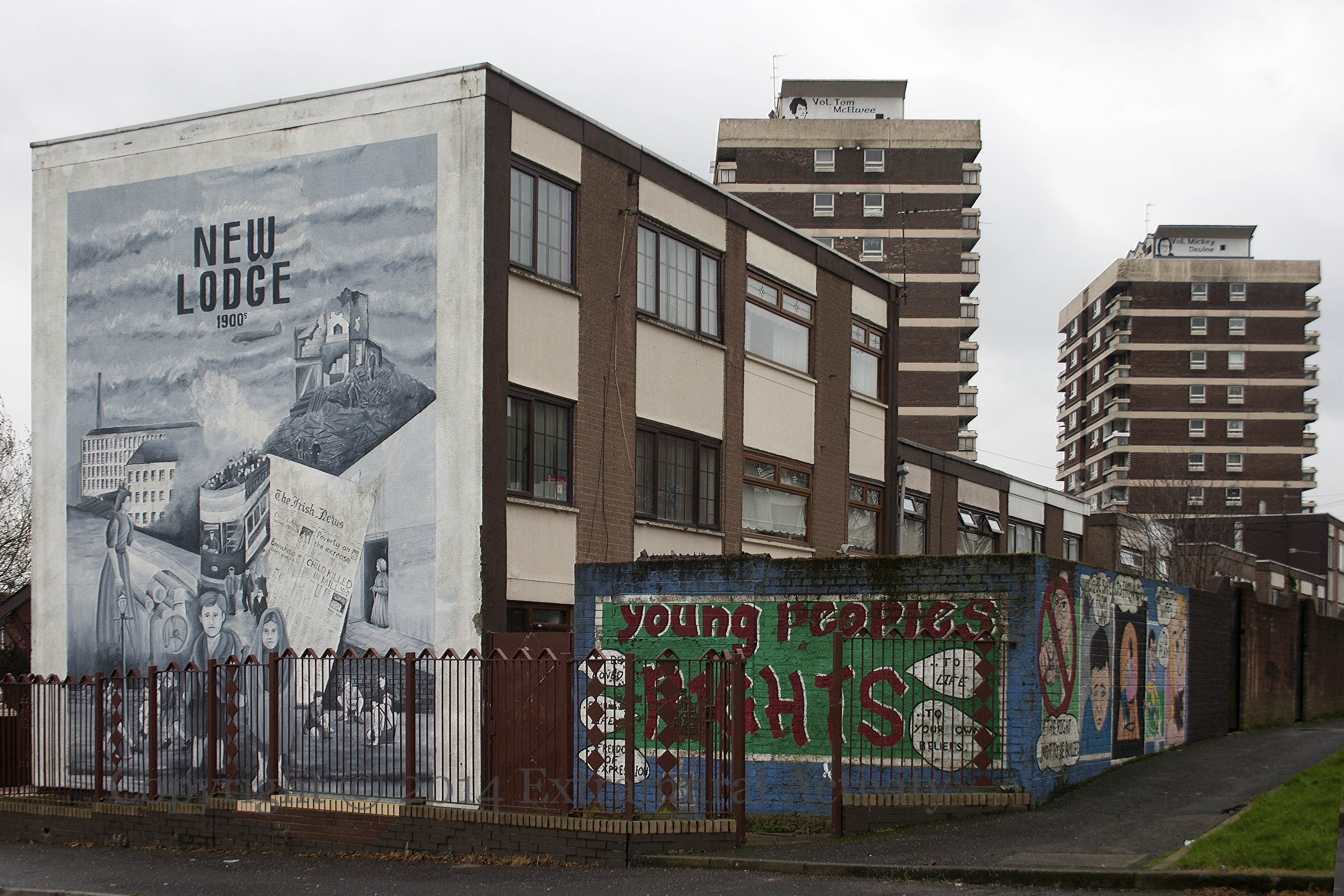
The life of a child in the New Lodge of the 1900s was one of poverty, disease, mill work, and being displaced by German bombers in 1941, with only a lamppost swing and marbles for relief. (It was also in black-and-white.) The struggle for young people’s rights “to be loved, to family life, to freedom of expression, to life, to your own beliefs, not to be bullied, to be safe from war, to privacy, to play, to be happy” continues in the panels on the right-hand side (for a close-up, see Young People’s Rights).
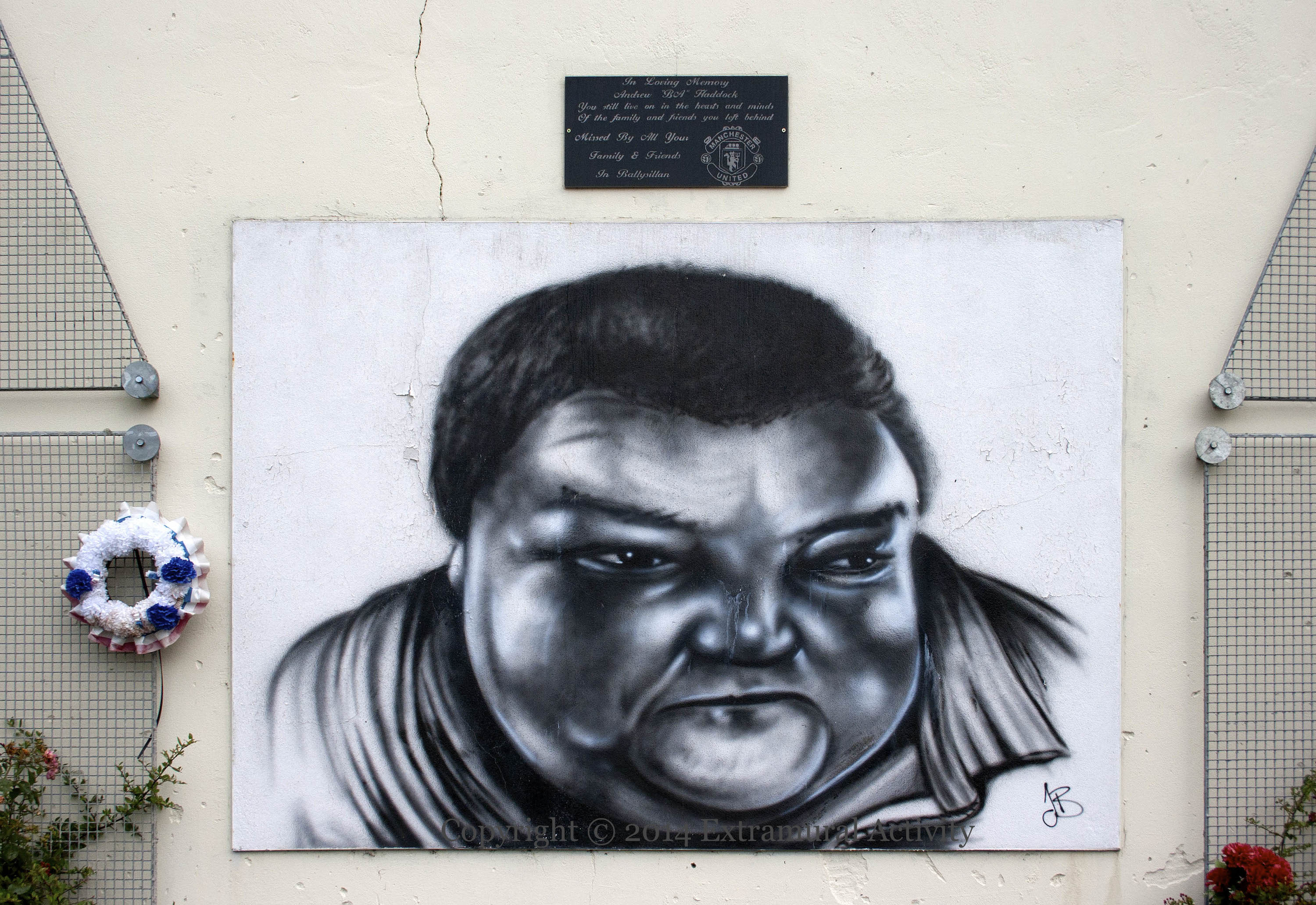
“In loving memory: Andrew “BA” Haddock. You still live on in the hearts and minds of the family and friends you left behind. Missed by all your family and friends in Ballysillan.” The board above to a local lad who died young sits next to rock-wall seating and a sculpture on Tyndale Drive in Ballysillan.
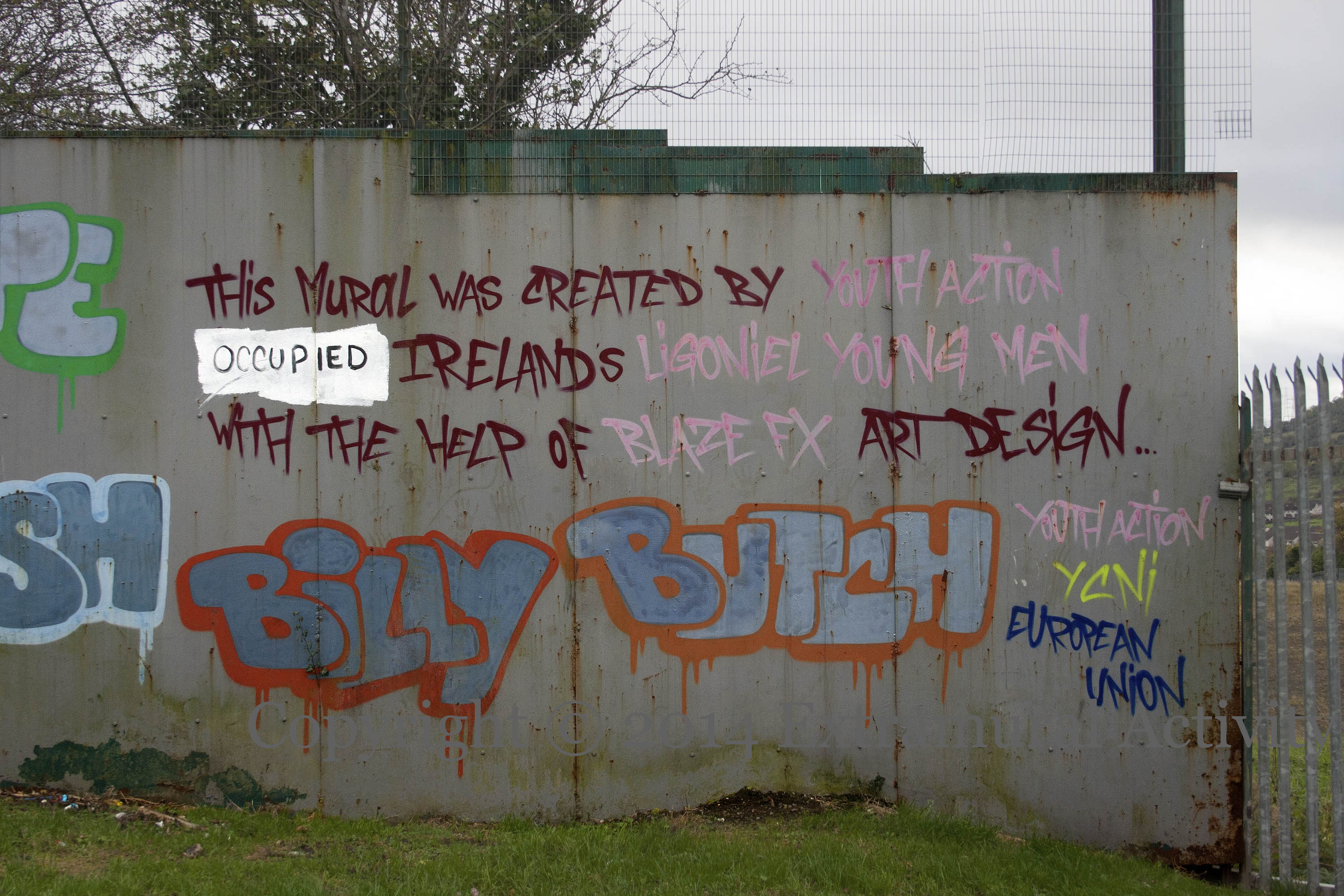
“This mural was created by Youth Action, occupied Ireland’s Ligoniel Young Men with the help of Blaze FX Art Design.” Previously it read “Northern Ireland”. The mural includes one youth gazing down into the city, the bus coming up to Ligonield, two spray-paint artists painting the mural and (just off to the left) two boys fishing.






 Extramural Activity