The Clowney Street phoenix, which dates back to 1981 (see The Oldest Murals), has been repainted, and above, the blanketmen painting (see 1981-2011) has been replaced with a montage of photographs from the period, including prisoners on the blanket and dirty protest, the funeral of Sands and of McDonnell, and three pieces of graffiti: “Thirty thousands can’t be wrong” (Sands’s election to Westminster), “Bobby Sands murdered 1.17 am 5th May 1981”, and “My position is in total contrast to that of an ordinary prisoner. I am a political prisoner.”
“In Memory of the Belfast men who fought against fascism with the international brigade, Spanish civil war 1936 – 1939.” The colours of the international brigade (red, yellow and purple – here a lighter violet colour) serve as a background.
The board shows Belfast socialists walking at Bodenstown, 1934 as part of the annual Wolfe Tone commemoration, held each year in June. Tone, an Anglican and the founder of the United Irishmen, is buried in the Bodenstown graveyard. Sources report, however, that there was an attempt to exclude these marchers, from “Shankill Rd Belfast Branch”, from part of the 1934 commemoration. The reasons given vary: they were carrying a non-standard banner, they had communist leanings, and, they were Protestants. (See Paddy Byrne | WP1 – though a different banner is mentioned | WP2 – see “legacy” section | WP3 – see fn. 1).
The plaque to the right reads: “In memory of all those who fought in Spain against Fascism 1936-1939. This mural was erected by Teach Na Fáılte Republican Ex-Prisoners Support Group and Belfast City Council. It was unveiled on April 20th, 2013 (irsp.ie). Signed “[Fra] Maher 2013”.
Black-and-white and colour versions (see below) of graffiti on Divis Street celebrating the death of Margaret Thatcher. The power of the state lives on, however, in the surveillance camera atop the pole. (Previously: Rot In Hell | Living Like Animals | Thatcher The Real Criminal | Thatcherism)
“Ding-dong! The witch is dead” (from The Wizard Of Oz) (youtube) went to #2 in the singles charts in the aftermath of Thatcher’s death.
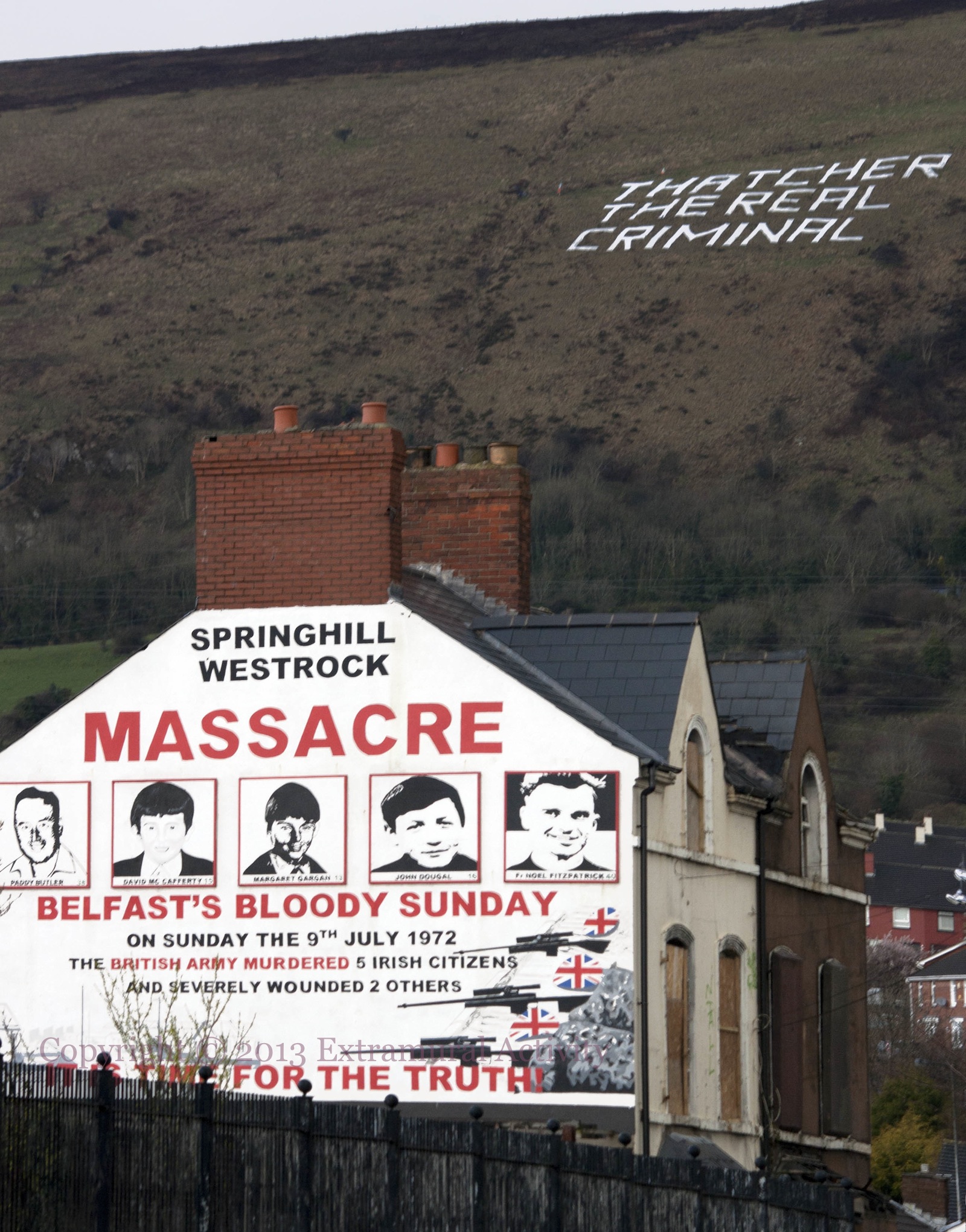
“Thatcher The Real Criminal” on Black Mountain, overlooking the Springfield Road, with a Mo Chara Kelly mural in the foreground, commemorating the deaths of five people shot by British army snipers in 1972.
This picture was taken on April 18th; on April 19th the lettering on the hillside had been removed.
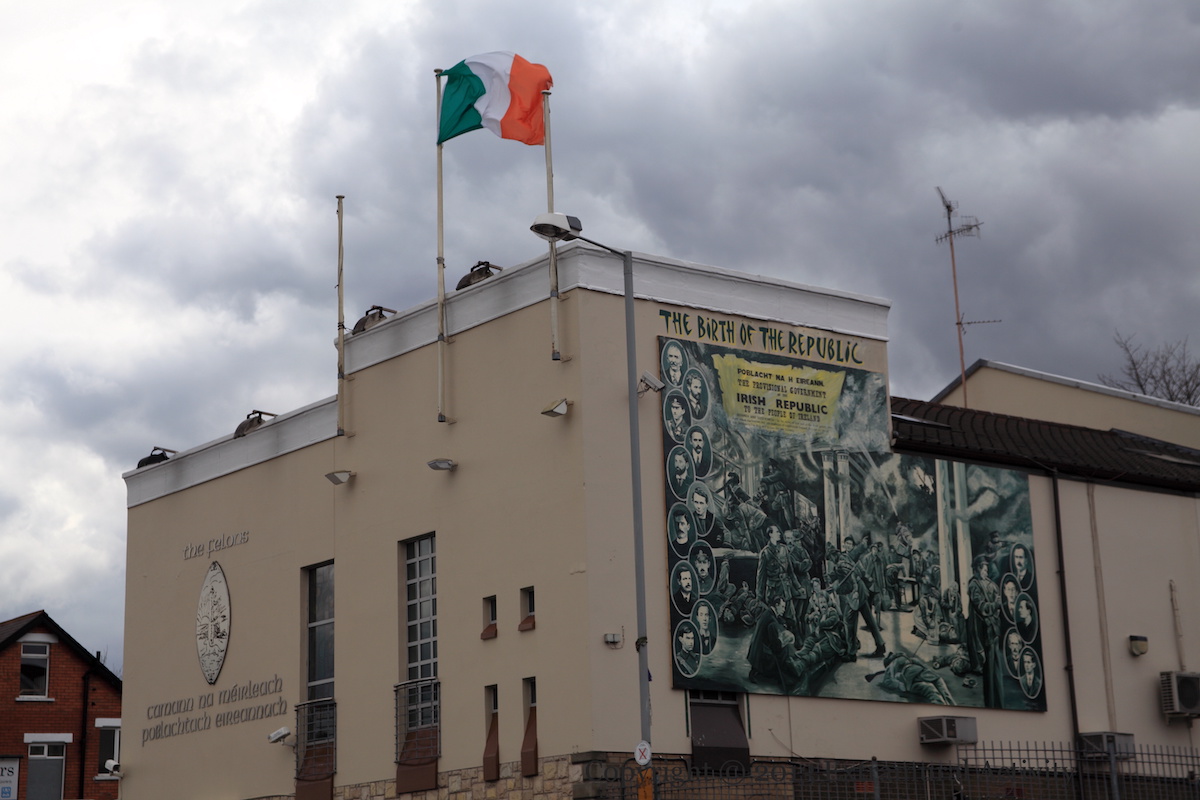
In addition to the seven signatories of the Proclamation of an Irish Republic, 9 other leaders of the Easter Rising were executed in the wake of the rebellion. The portraits of all 16 are part of this new mural (on boards) of Walter Paget’s painting The Birth Of The Irish Republic. (For Paget’s painting, see the painting’s Visual History page.) In order of appearance, the 16 (with links to their WP pages) are …
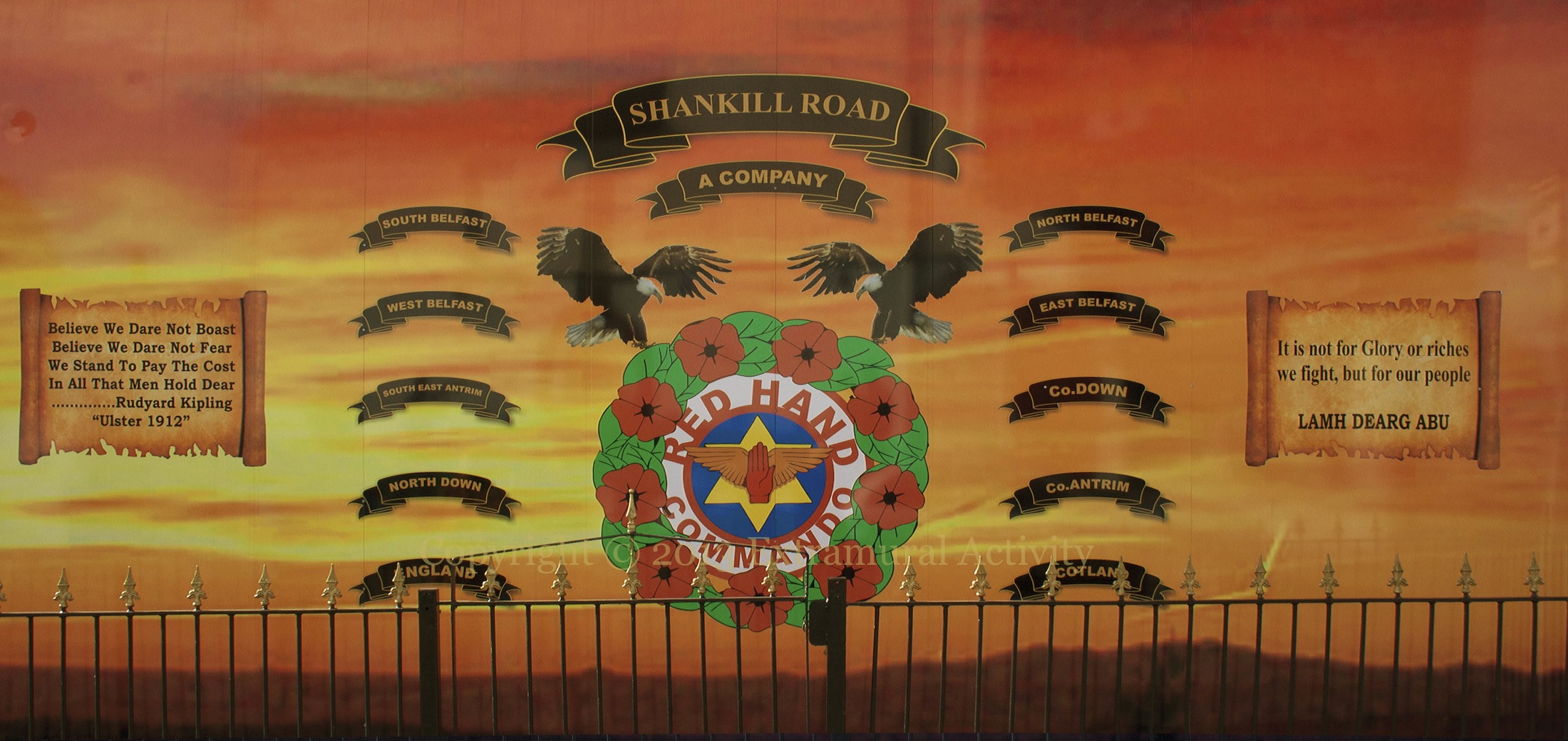
A few words of Irish – “Lamh Dearg Abu” – in a loyalist mural in Glenwood Street, just off the Shankill Road, through strictly it should be “Lámh Dhearg Abú”. “Lámh dhearg” means “red hand”, and this is a Red Hand Commando mural.
The same motto was on the mural that this one replaced, which can be seen at M02433.
The title of the post is the headline of a recent article in the Irish Times, giving an account of Irish language classes in (loyalist) east Belfast. “Tá” is Irish for “yes”.
Here is another piece of graffiti in response to the death of Margaret Thatcher, outside the Royal Victoria hospital on the Falls Road: “Iron Lady? Rust In Peace”, with “Upara” – Up The (I)RA. Thatcher was given the sobriquet by the Soviet army newspaper Red Starin 1976, apparently in imitation of the “Iron Chancellor”, Otto von Bismarck (WP).
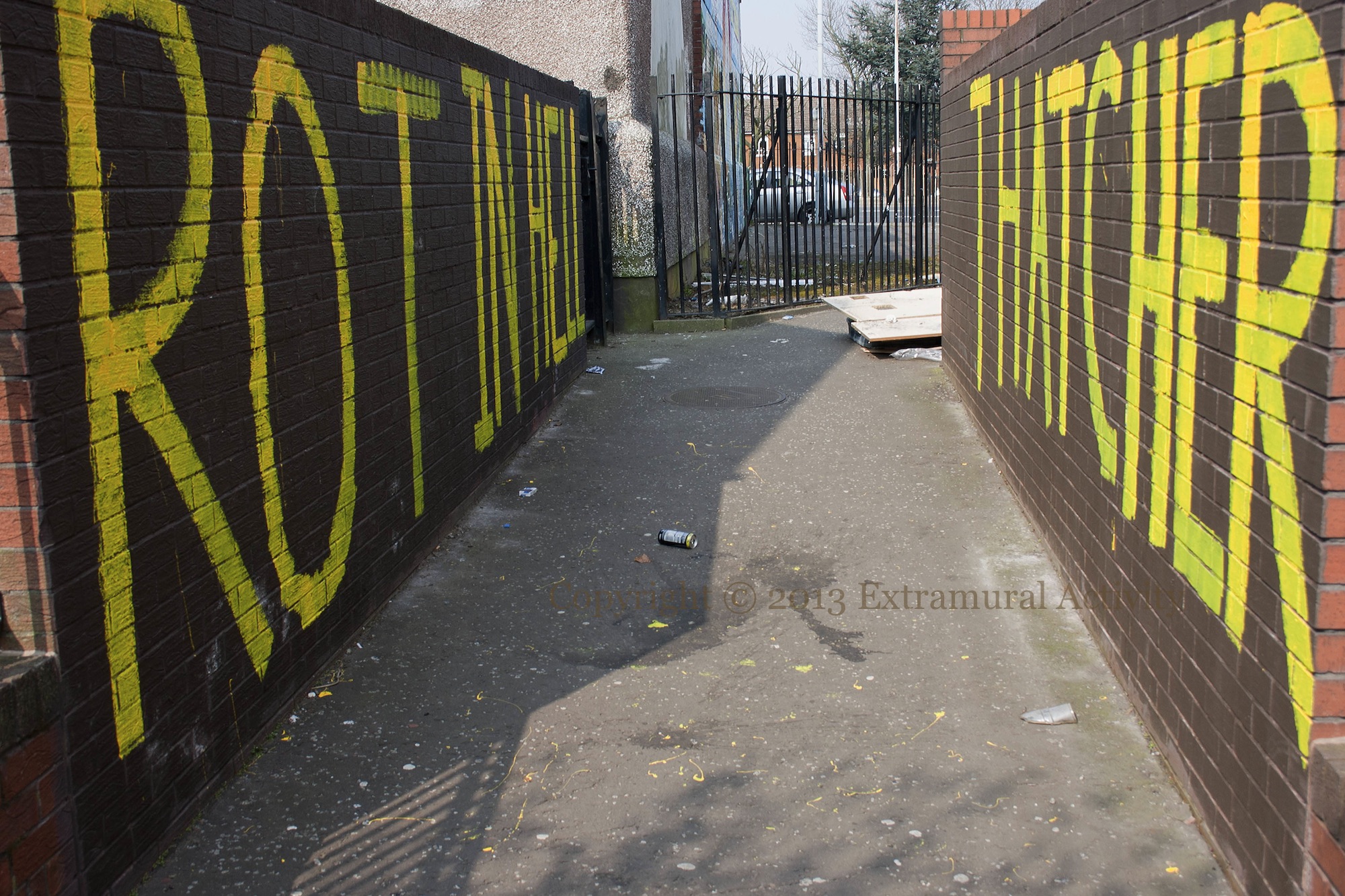
Reaction to the death (on Monday, April 8th) of Margaret Thatcher, U.K. Prime Minister 1979-1990 (WP), in an alley below Divis flats, between Divis Street and Clonfaddan Crescent.
A bilingual board encouraging tourism in CNR west Belfast. The attractions listed are múrphıctúrí [sic], títhe [sic] phobaıl agus reılıgí, ceol agus damhsa, ıarsmalaınn poblachtach, nádúr, ealaín agus cultúr, gaırdíní chuımhneacháın, spóırt Gaelach, ár staır le blıanta beaga [murals, churches and cemeteries, music and dance, republican museums, nature, arts and culture, memorial gardens, Gaelic games, recent history].
By Rısteard Ó Murchú in Nansen Street/Sráıd Nansen, Belfast/Béal Feırste.





 Extramural Activity