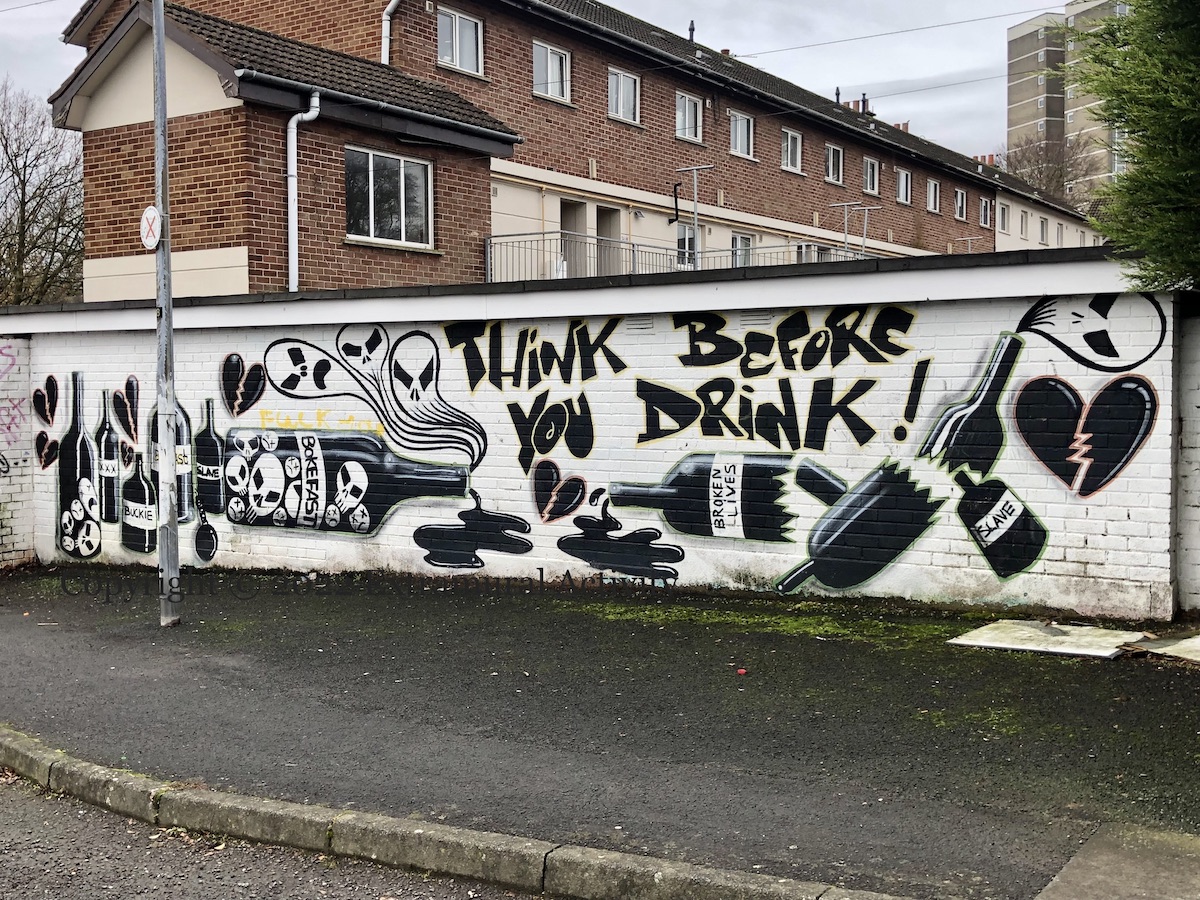
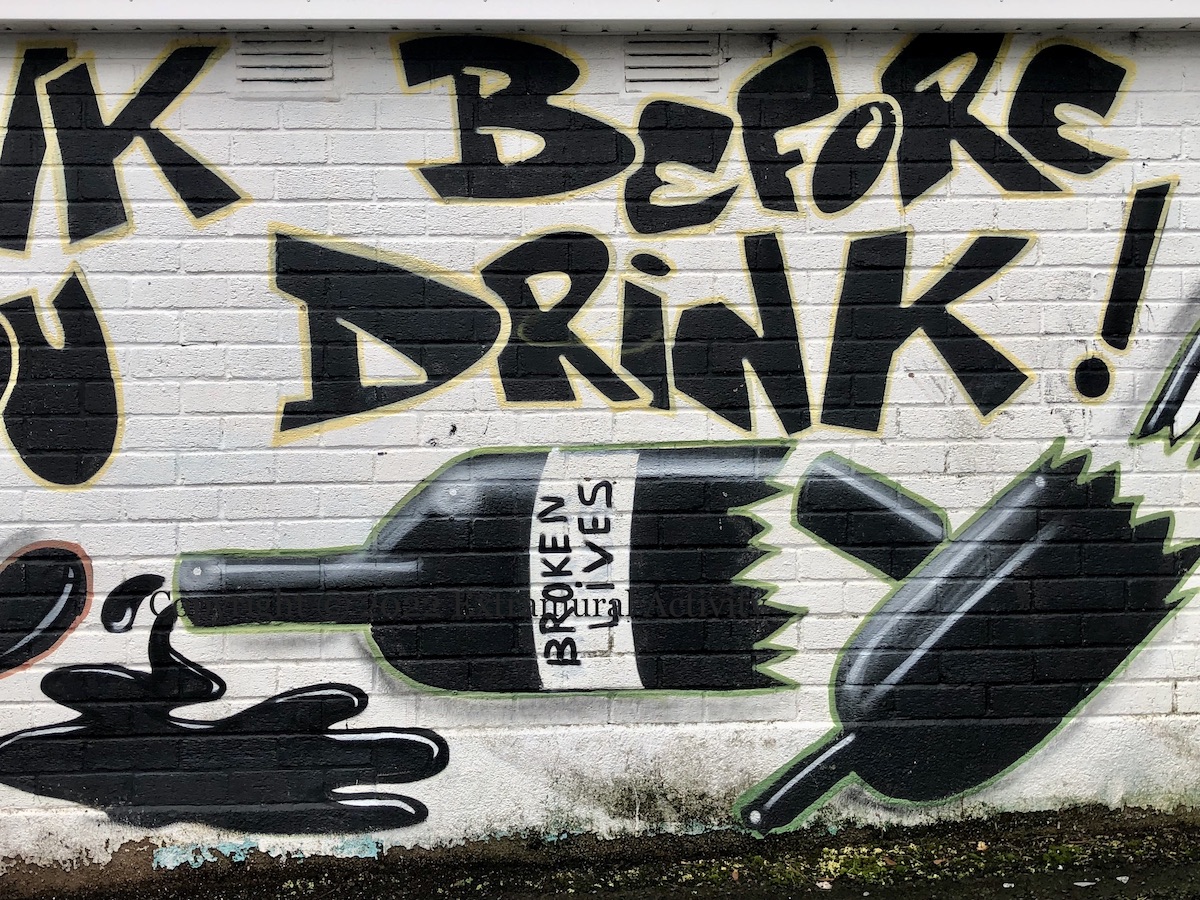
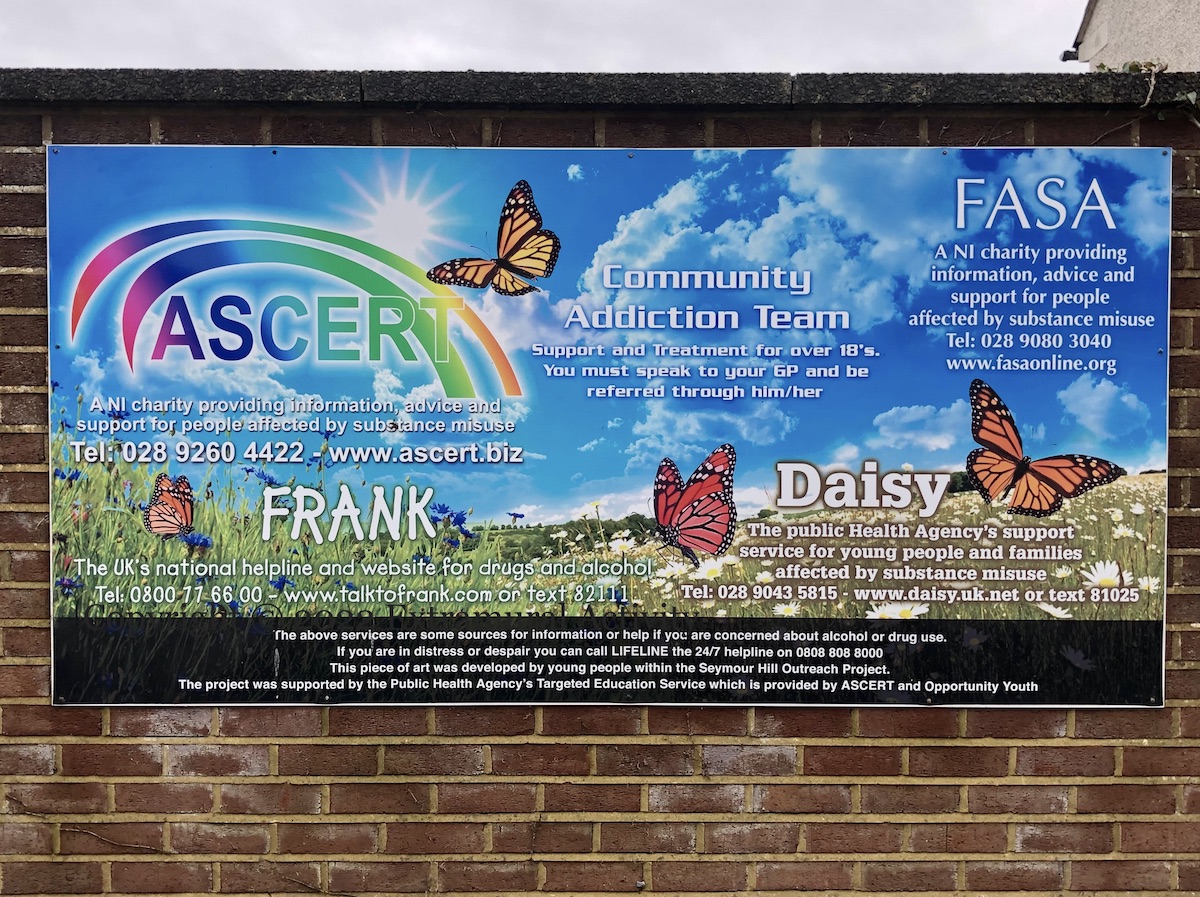
“Think before you drink” – broken bottles, broken loves, and broken lives in Seymour Hill. Help can be sought from the organisations on the adjacent board: FRANK, ASCERT, Community Addiction Team, FASA, and Daisy.
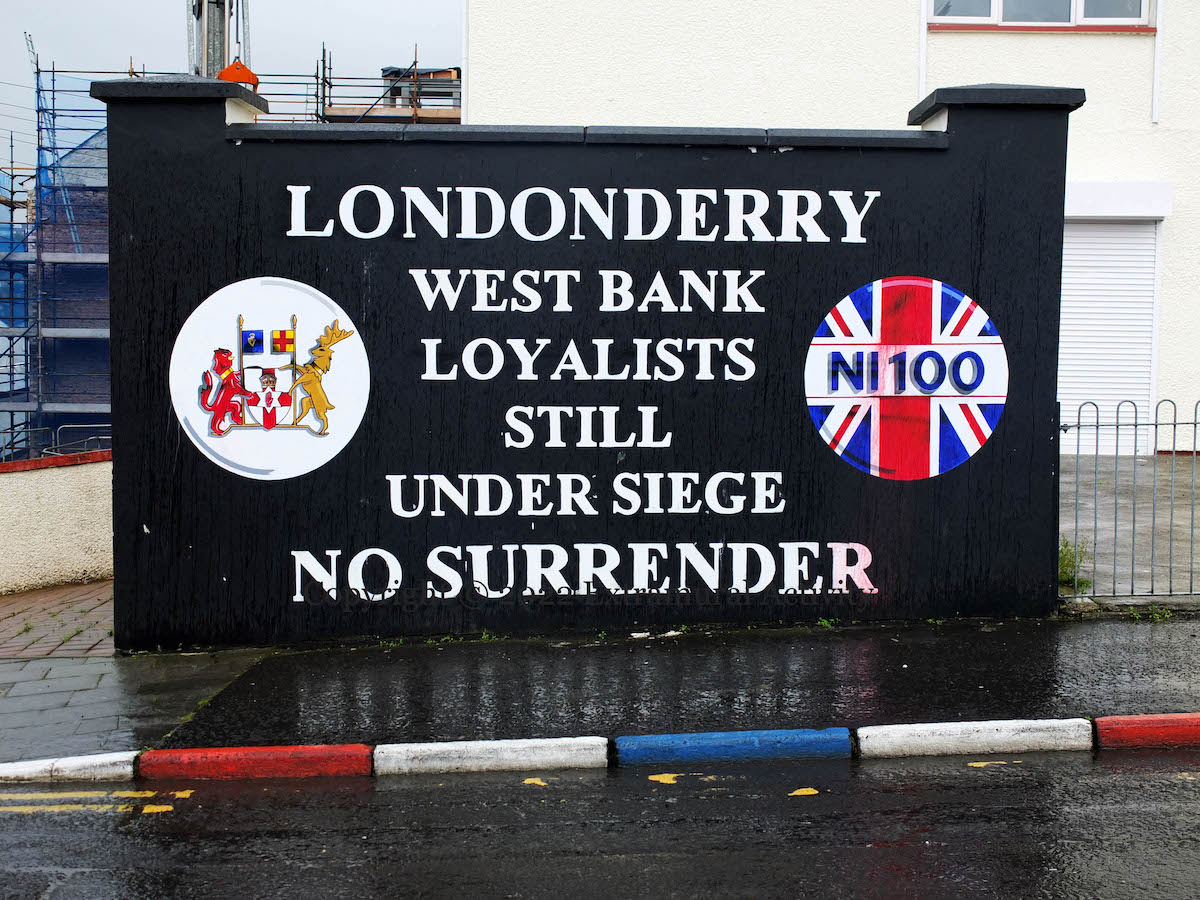
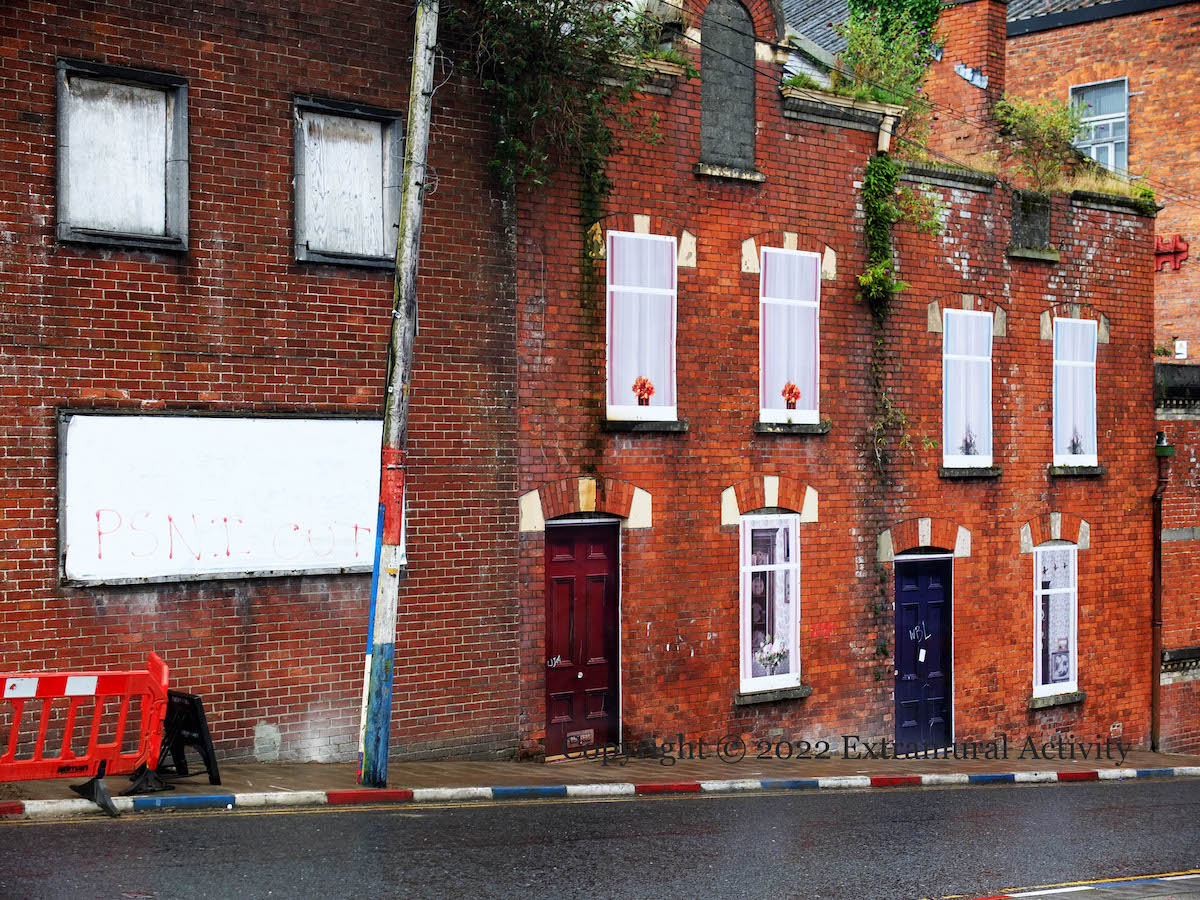
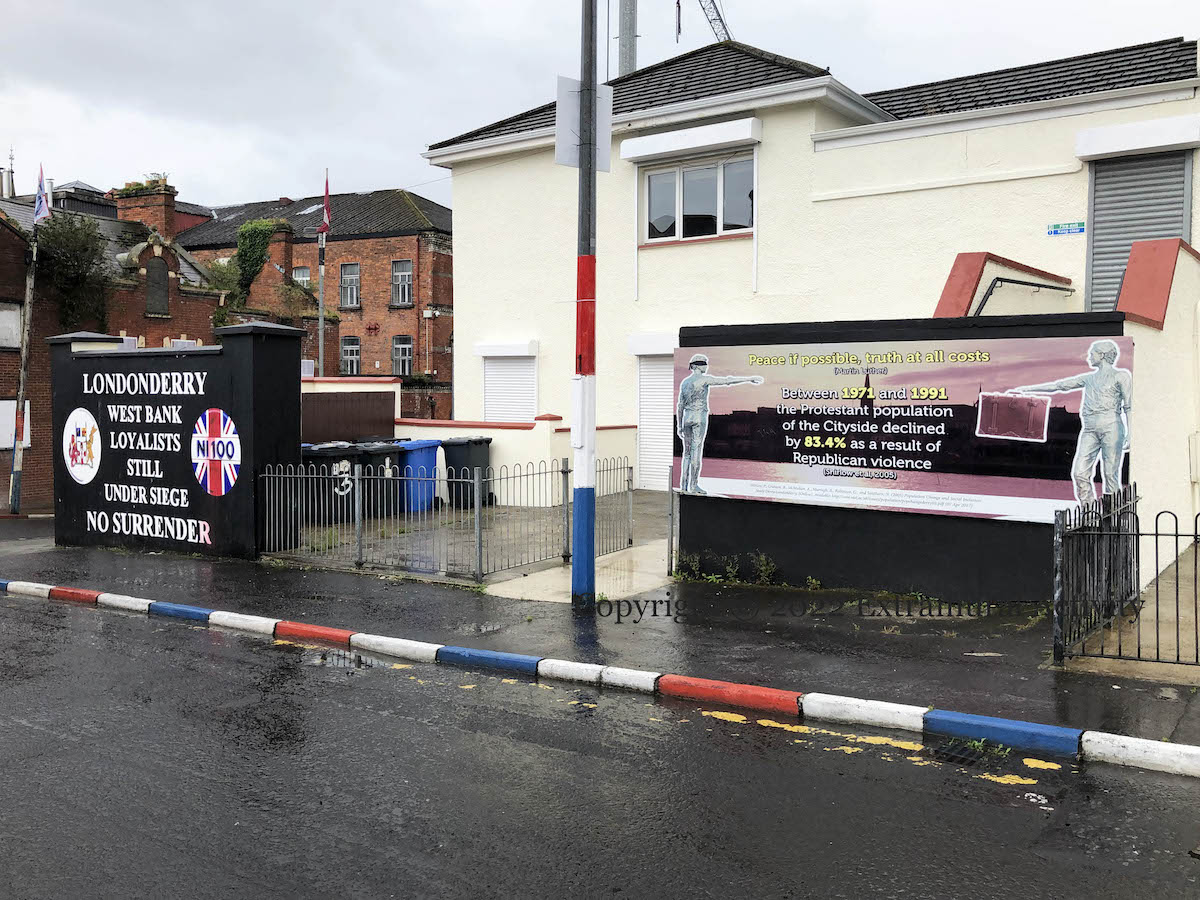
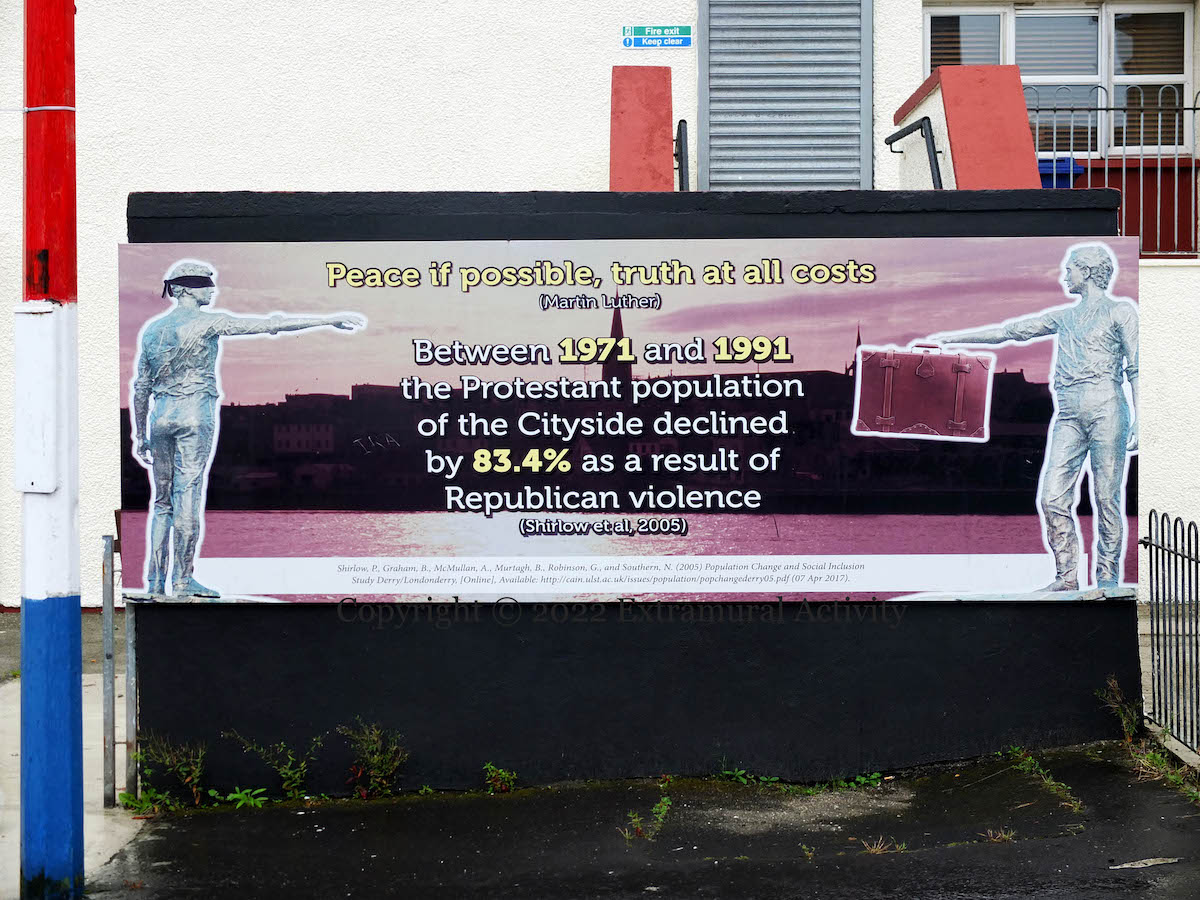
“Londonderry west bank loyalists” are “still under siege”, at first from two decades of “Republican violence” – “Between 1971 and 1991 the Protestant population of the Cityside declined by 83.4% as a result of Republican violence (Shirlow et al. 2005)” – hence the boarded- and dressed-up windows – and now from the “PSNI”.
(The words “as a result of Republican violence” are not included in the Shirlow article).
Fountain Street and Hawkin Street, in the Fountain, Londonderry.
Update: the wall was returned to its plain appearance by 2023-02-14 – see the final image, below
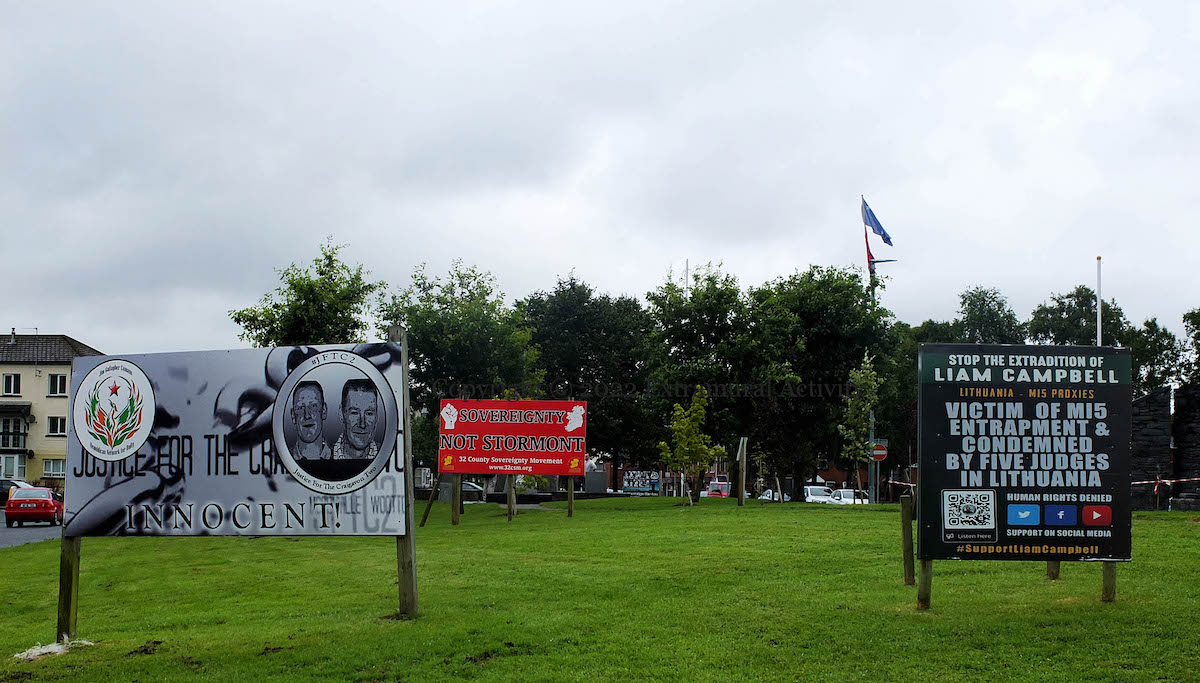
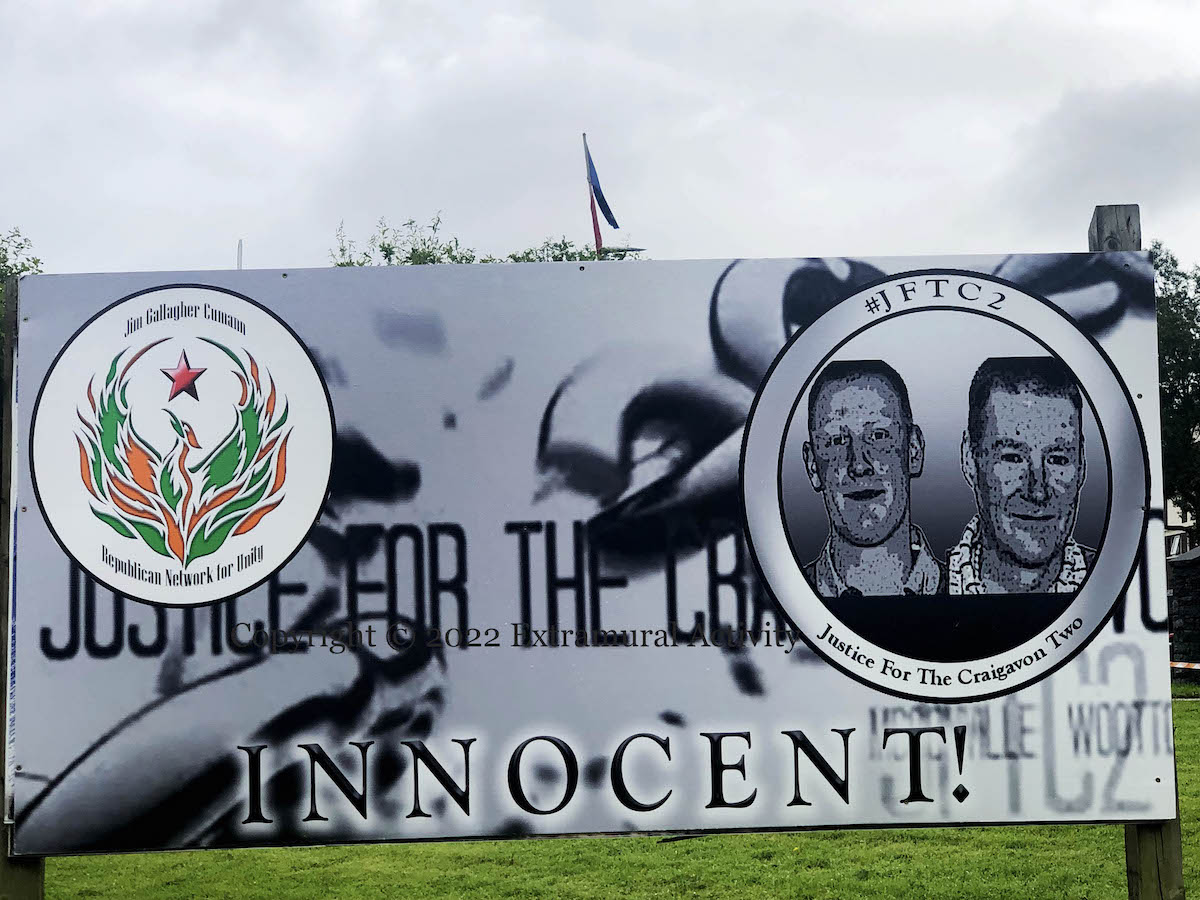
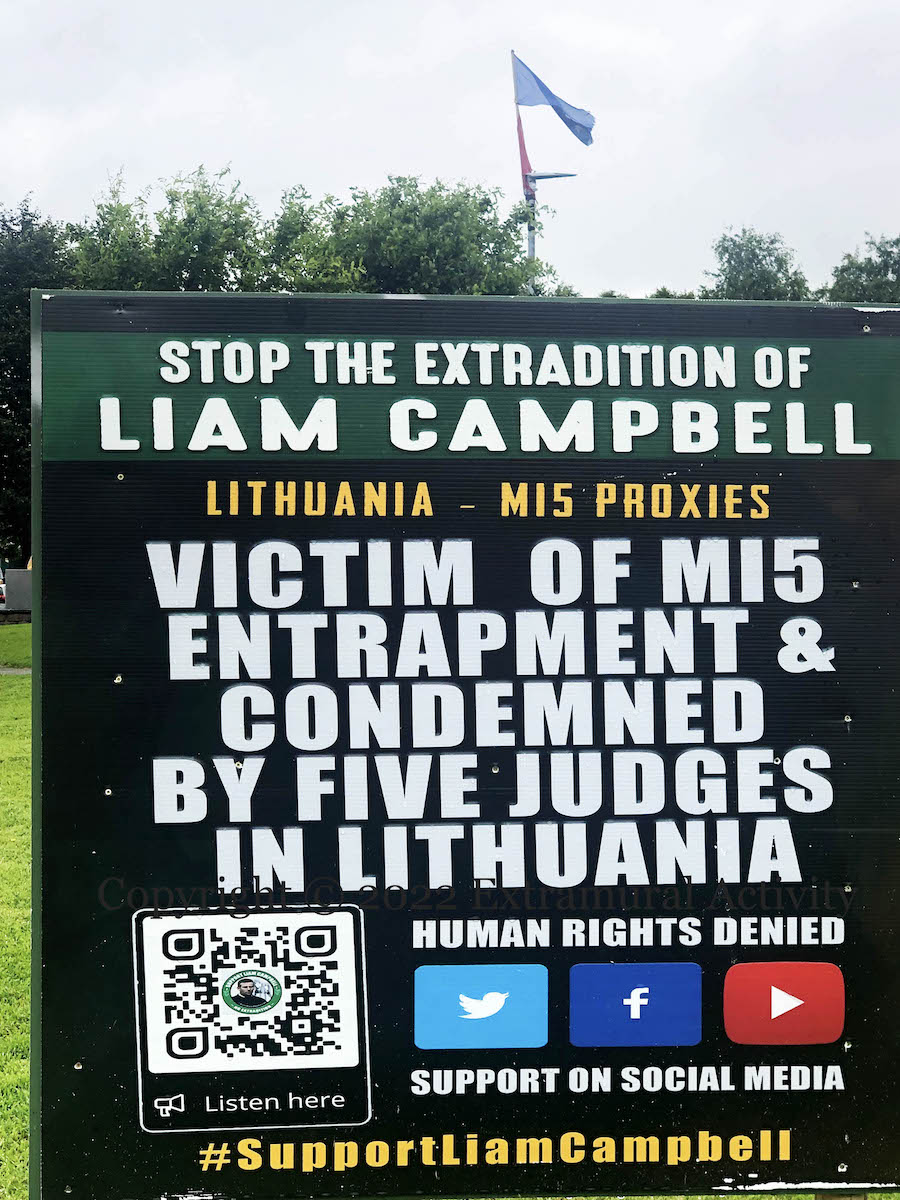
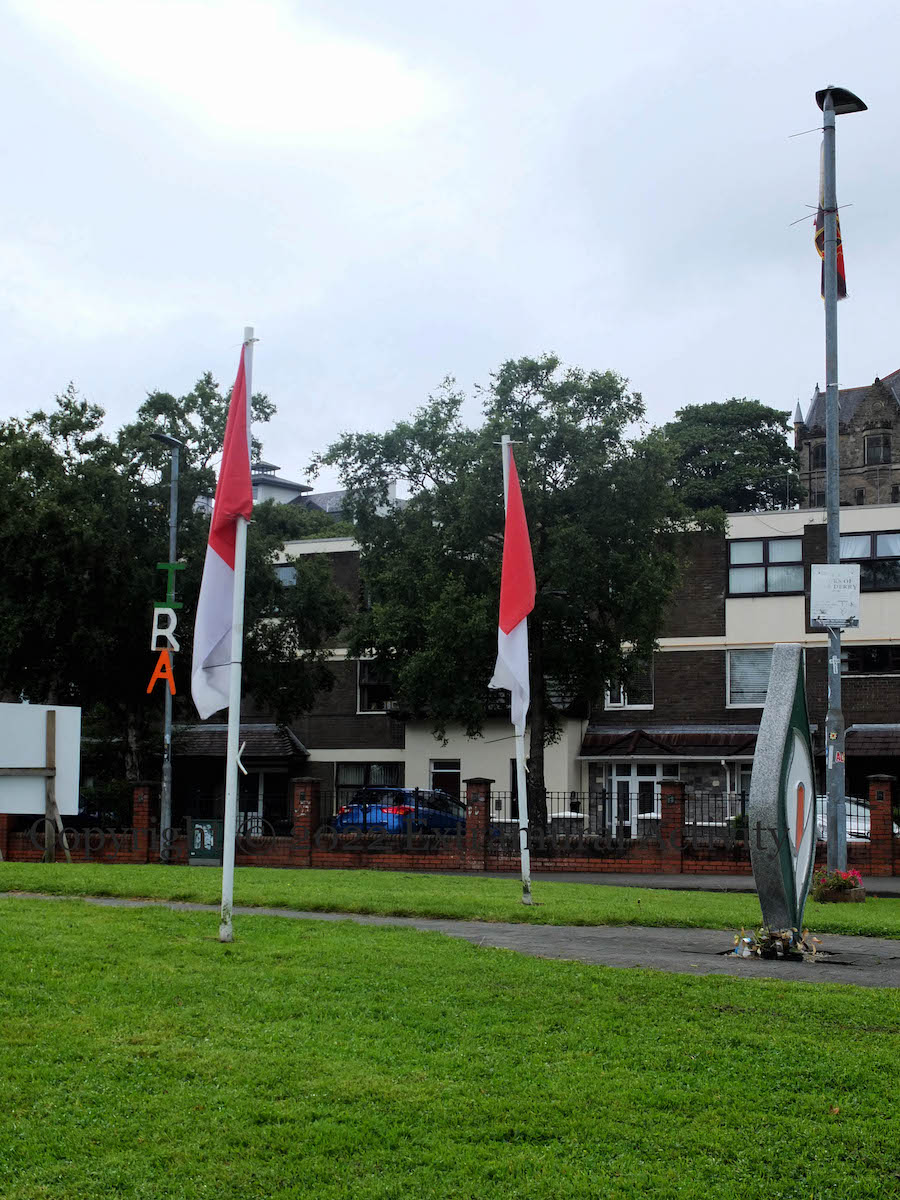
This is the scene on the green-spaces on Lecky Road, Derry. The area is heavily trafficked by tourists visiting around Free Derry Corner (Visual History of the front | rear), the People’s Gallery murals (Visual History), the Hunger Strike Memorial, and the Museum Of Free Derry (web). Anti-Agreement groups thus use the area to get their messages across. In today’s post we see “Sovereignty, not Stormont” from the 32CSM (web); an RNU (Fb) board in support of the “Craigavon 2”; “Stop the extradition of Liam Campbell”, probably from Republican Sin Féin (web) – contrary to the board beneath the one showing, Campbell was extradited to Lithuania but his case was dismissed in October on the grounds that the statute of limitations had passed (Sunday World); an IRA nail-up on a light-pole; a “Remember the ten” 40th anniversary commemoration of the 1918 hunger strike, from IRSP/IRSM (web); and an IRPWA (web) board supporting republican prisoners (previously included in British Gaols In Ireland).
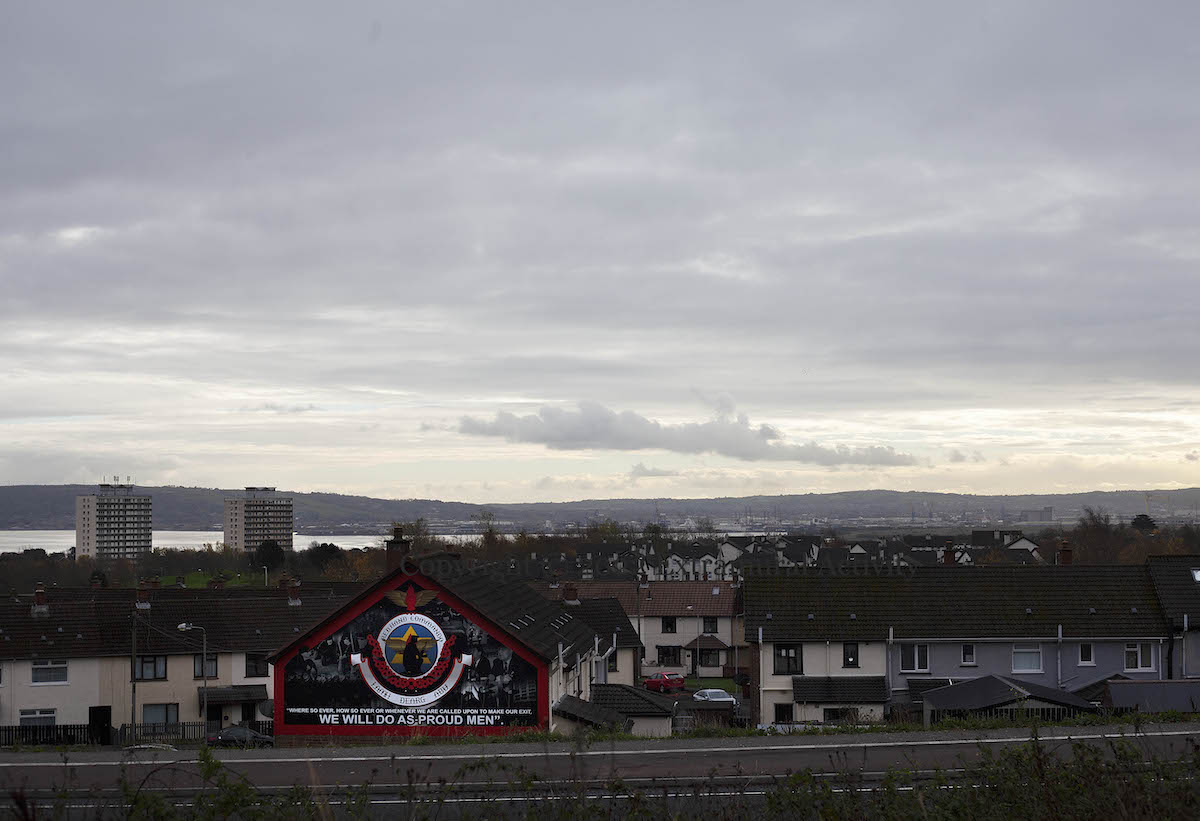
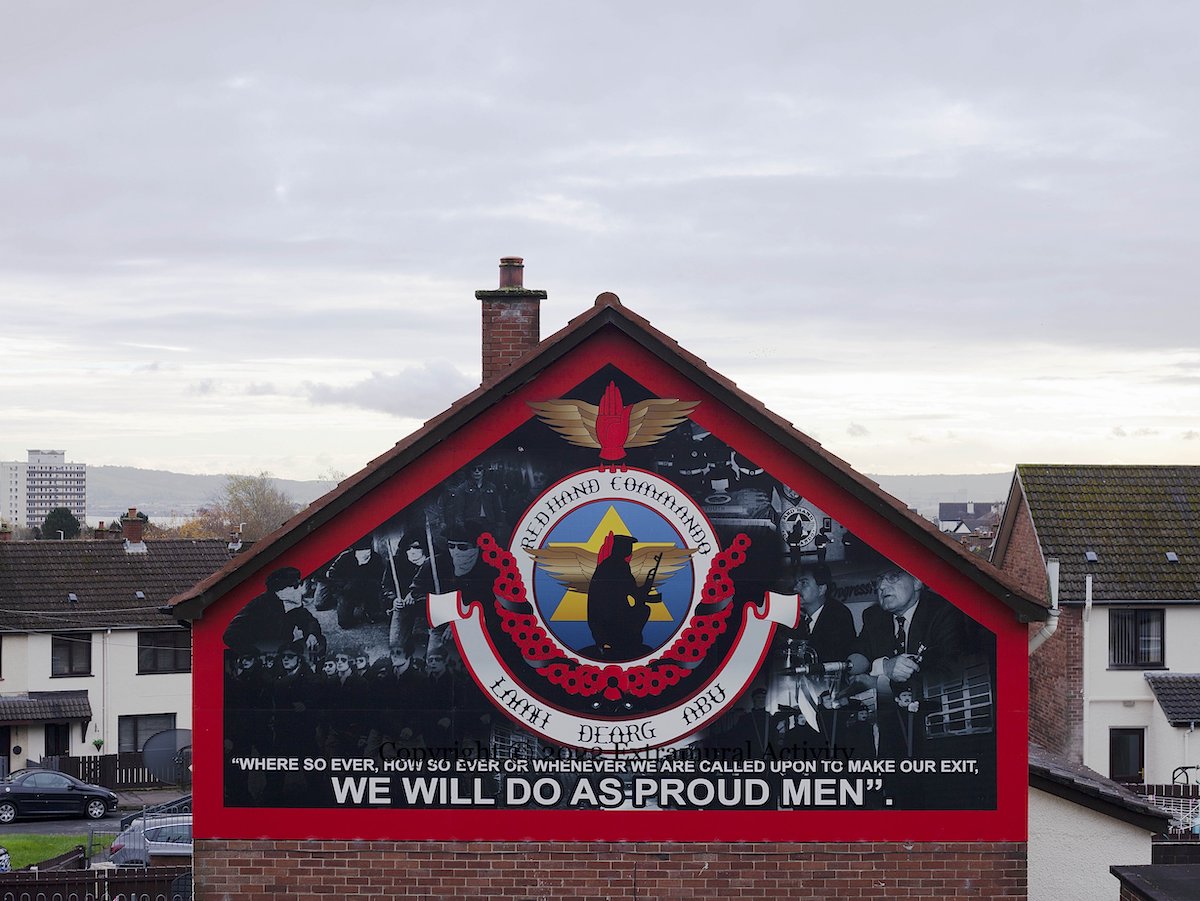
“Where so ever, how so ever or whenever we are called upon to make our exit, we will do as proud men.” This is quite a different message from the one produced within the Rathcoole estate for the 50th anniversary of the Red Hand Commandos, which stated that despite its venerable age, the four Rathcoole companies of the RHC “Await In The Shadows“. (That mural also depicted the kneeling men with sticks (on the left of today’s mural) and the linked post also contains the original photograph.)
It’s not clear who or what within loyalism might call upon the RHC to stand down; loyalist rhetoric at the moment is full of anger at the protocol and warnings/threats about of a return to violence (e.g. BelTel | BBC).
For the use of “Lamh Dear Abu” as the slogan, see Ulster Says “Tá”.
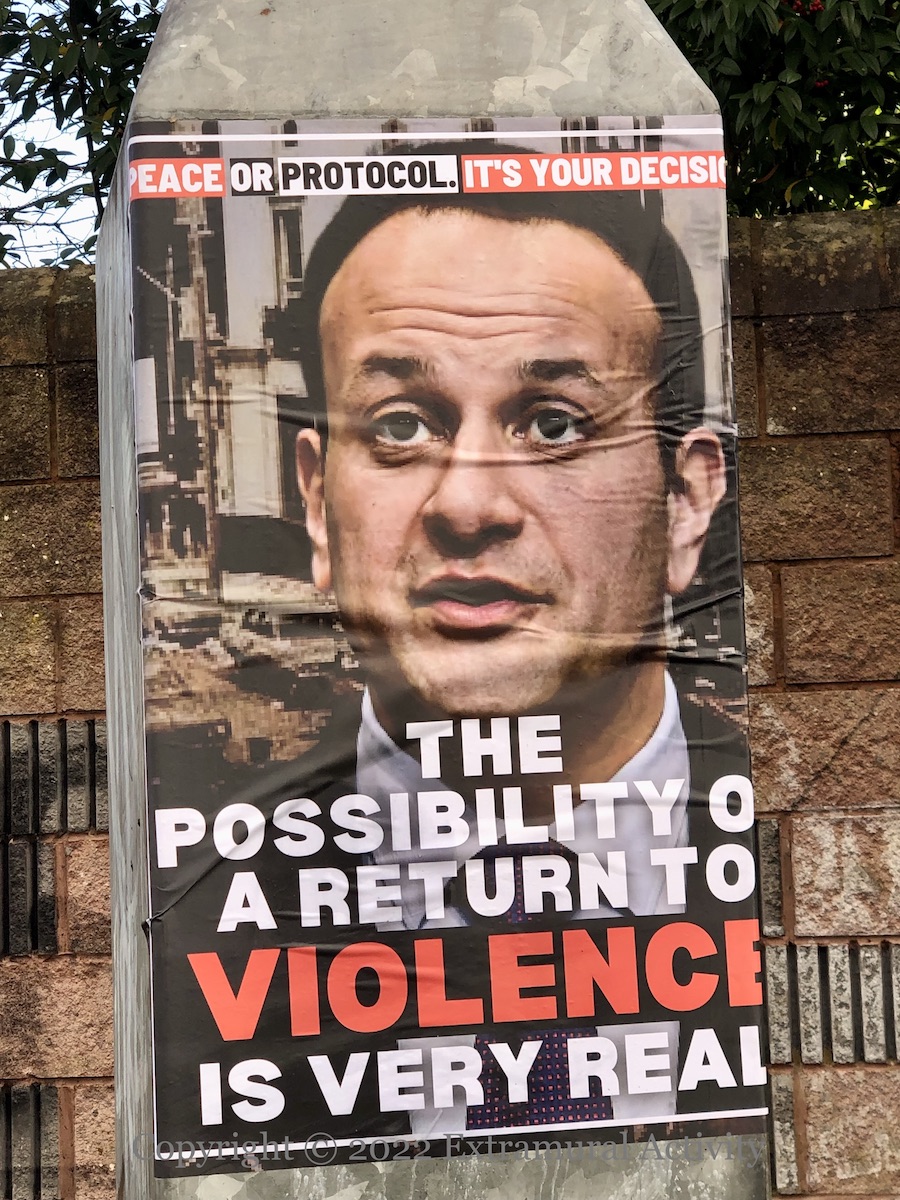
Following yesterday’s east Belfast “Peace or proticol” graffiti, today we have “Peace or protocol – it’s your decision”, aimed at Leo Varadkar on the day that he again became Taoiseach (Irish Times) and repeating his words back to him from a speech in 2018: “The possibility of a return to violence is very real”. At that meeting, Varadkar was anticipating violence by anti-Agreement republicans in response to customs posts on the Ireland-Northern Ireland border, and brought a newspaper describing the death of four customs officials, two lorry drivers, and three IRA volunteers at a Monaghan post in 1972 (BelTel).
The authors of this poster are not known, but the parallel statement (mutatis mutandis) would be that anti-Protocol agents – perhaps the “young loyalists” that the UVF “can no longer contain” (UK Daily; see also RTÉ from November) – might return to acts of violence such as the 1974 “Dublin & Monaghan Bombings” that killed 33 people – in the background of the poster is part of a photograph (Irish News) of bomb damage in Talbot Street – if the Protocol’s “Irish Sea border” is not removed.
The instance of the poster shown in today’s post is on the edge of Tiger’s Bay, on North Queen Street; the posters have also been appearing in east Belfast: Newtownards Rd (at Templemore Ave tw; at Dee St tw) | Beersbridge Rd (reddit).
A group called Let’s Talk Loyalism greeted the new premier with a mock funeral in Dublin for the Good Friday Agreement; the flowers behind the coffin read “GFA is dead” (tw).
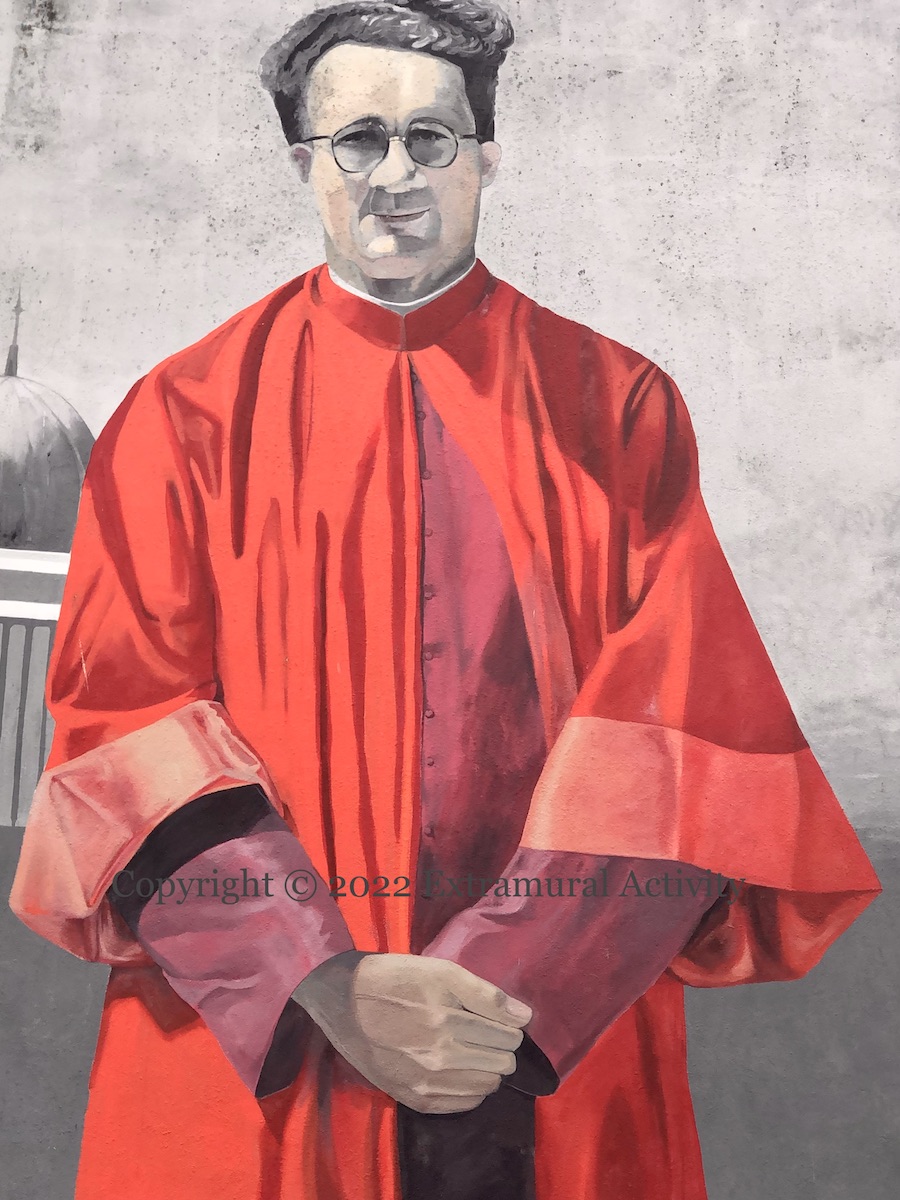
Hugh O’Flaherty – the Scarlet Pimpernel Of The Vatican – is thought to have helped save 6,425 soldiers and Jews who were at large after the fall of Mussolini but prior to the German occupation of Italy and who made it to Rome to see O’Flaherty or the still-functioning Irish embassy at the Holy See. O”Flaherty was raised in Killarney and died in Cahersiveen; he is remembered in Killarney by this mural – painted by Ursula Meehan (ig) in High Street with support from Killarney Art Gallery (web) – and a statue by Alan Ryan Hall (killarney.ie) in Mission Road.
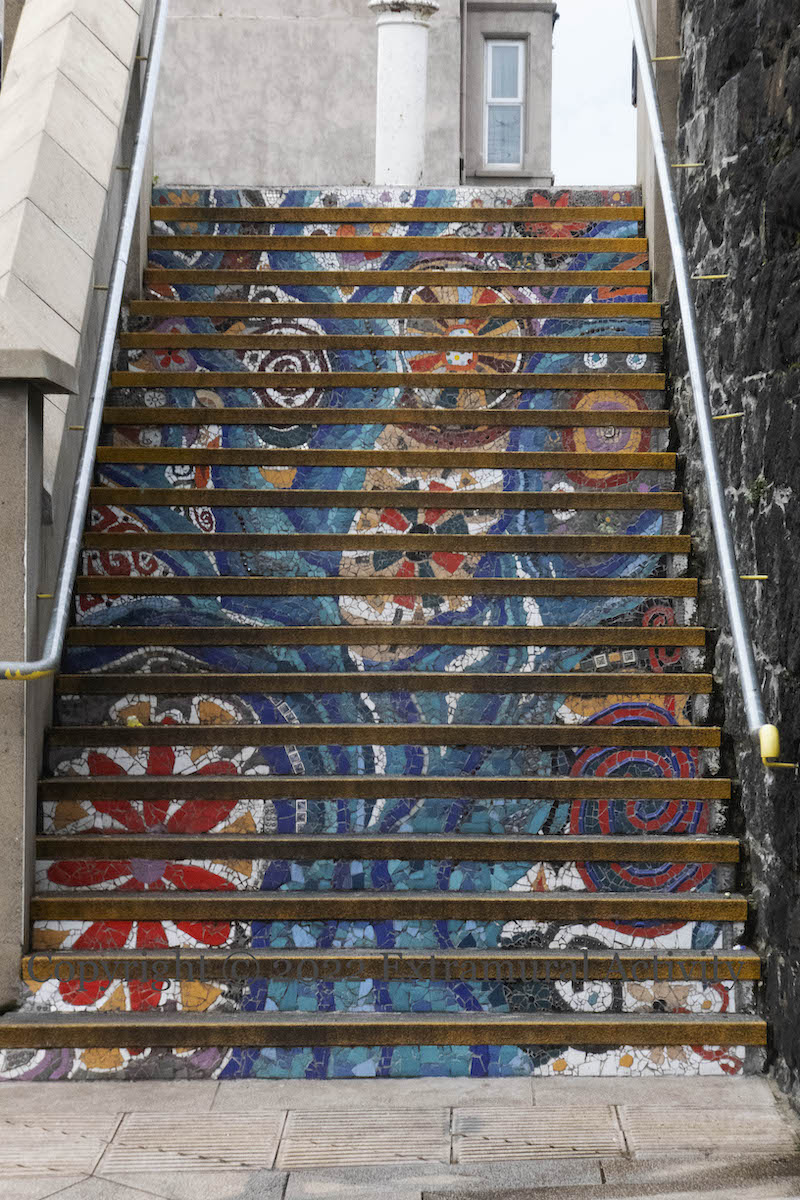
Two Larne trees: above, the tree mosaic at the Town Hall steps created by artist Janet Crymble (see previously Sports We Love), with support from Larne Renovation Regeneration, Larne Trader’s Forum, and Mid & East Antrim Borough Council (NIWorld); below, the “Armada Tree” that is purported to have sprung from a chestnut or chestnut seeds in the pocket of a dead sailor in the Spanish Armada – the tree fell over after 432 years in 2020, a victim of root disease (anglican.org), but is remembered by the board depicting it in Upper Main Street, Larne.
“Local legend has it that when the Spanish Armada was passing these shores in 1588, a sailor was washed up at Ballygally village, no doubt from one of the ships blown off course by gales. Locals were said to have taken the body and buried it in the graveyard of the picturesque St Patrick’s Church at Cairncastle. The ancient tree beside the chuch grew from one of the chestnut seeds that the sailor had in his pocket when he was buried. The tree has been analysed and found to date back to the sixteenth century, adding credence to the story.”
Republican graffiti in Fahan Street, Derry, adjacent to the Che Guevara Lynch mural. Any specific reference is unknown; in 2019 there was controversy over signs threatening informers in relation to the killing of Lyra McKee (e.g. extra).
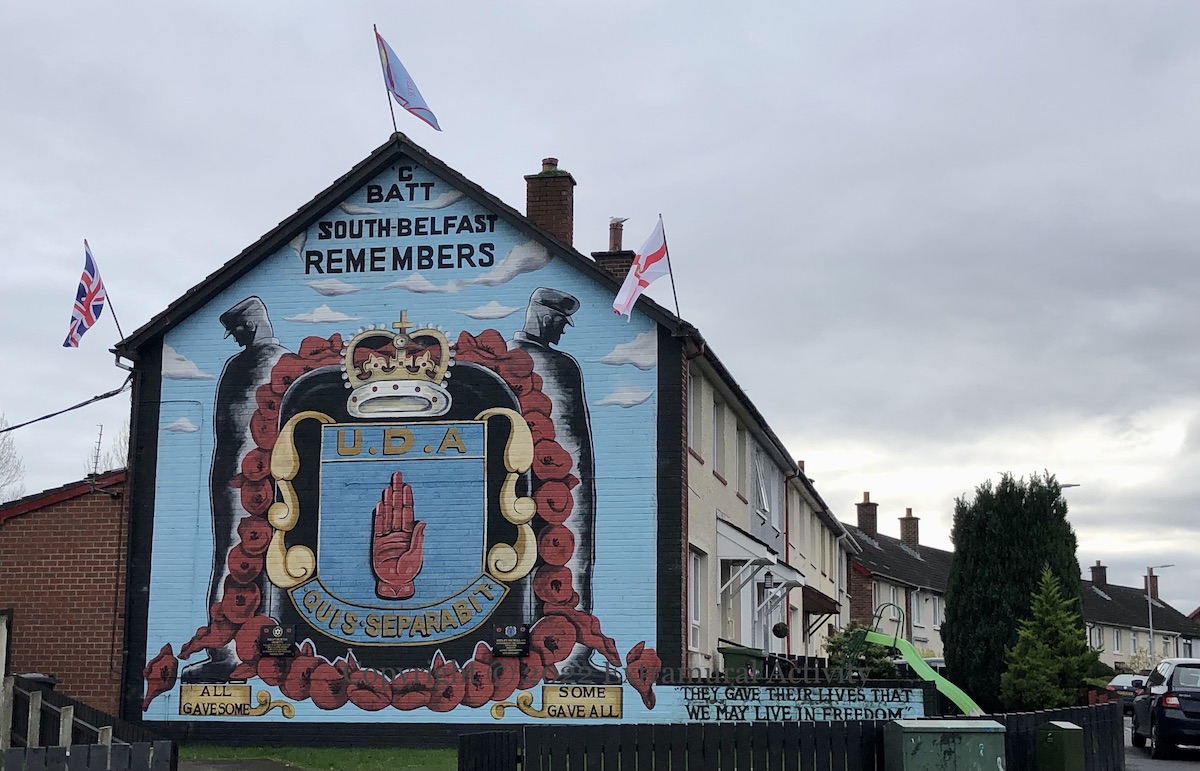
The old C Batt mural further up Hornbeam Road has long been painted over. It used the same line – “They gave their lives that we may live in freedom” – to remember Wesley Nicholl and Brian Morton. A plaque to Morton is now included on top of the new mural. “Brian Morton (Morty) killed in action 07/07/1997, a true Ulster patriot who gave his life in defence of his country. Feriens tego.” As with republican memorials, “active service” means that Morton was killed by a premature bomb exploding.
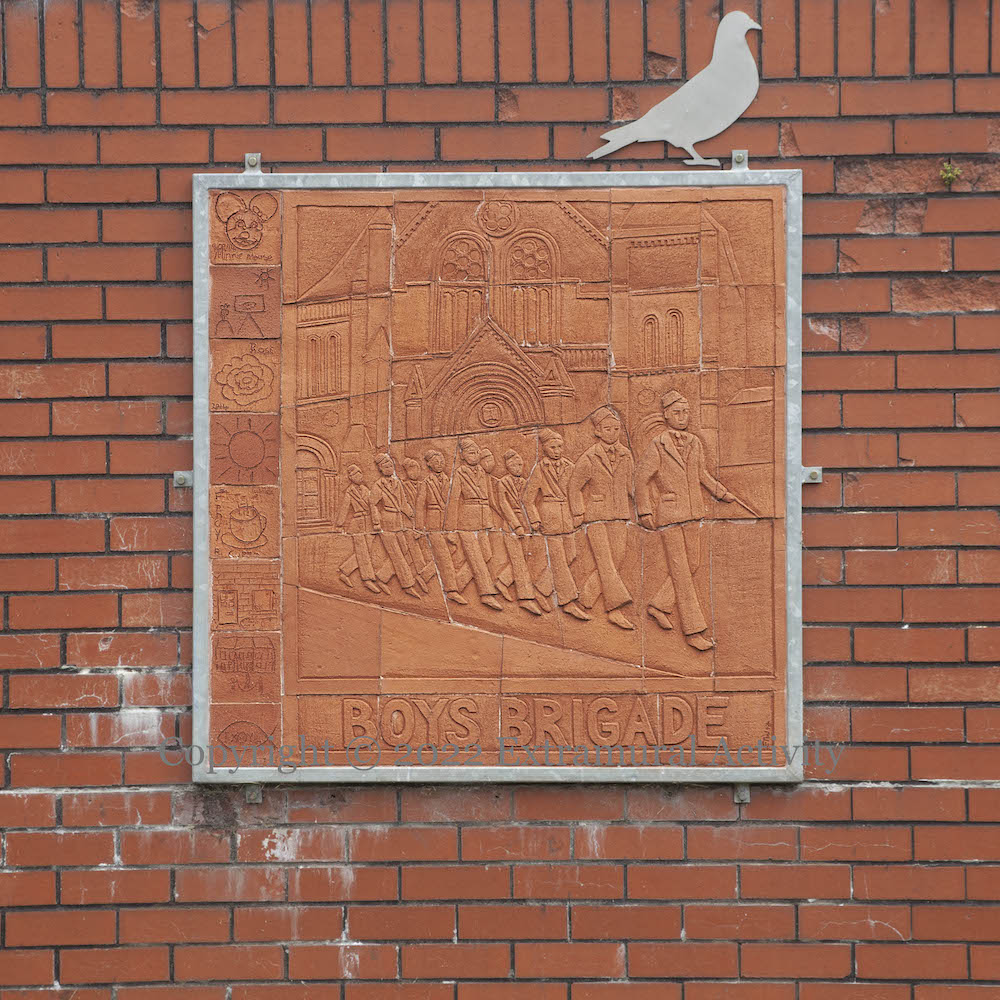
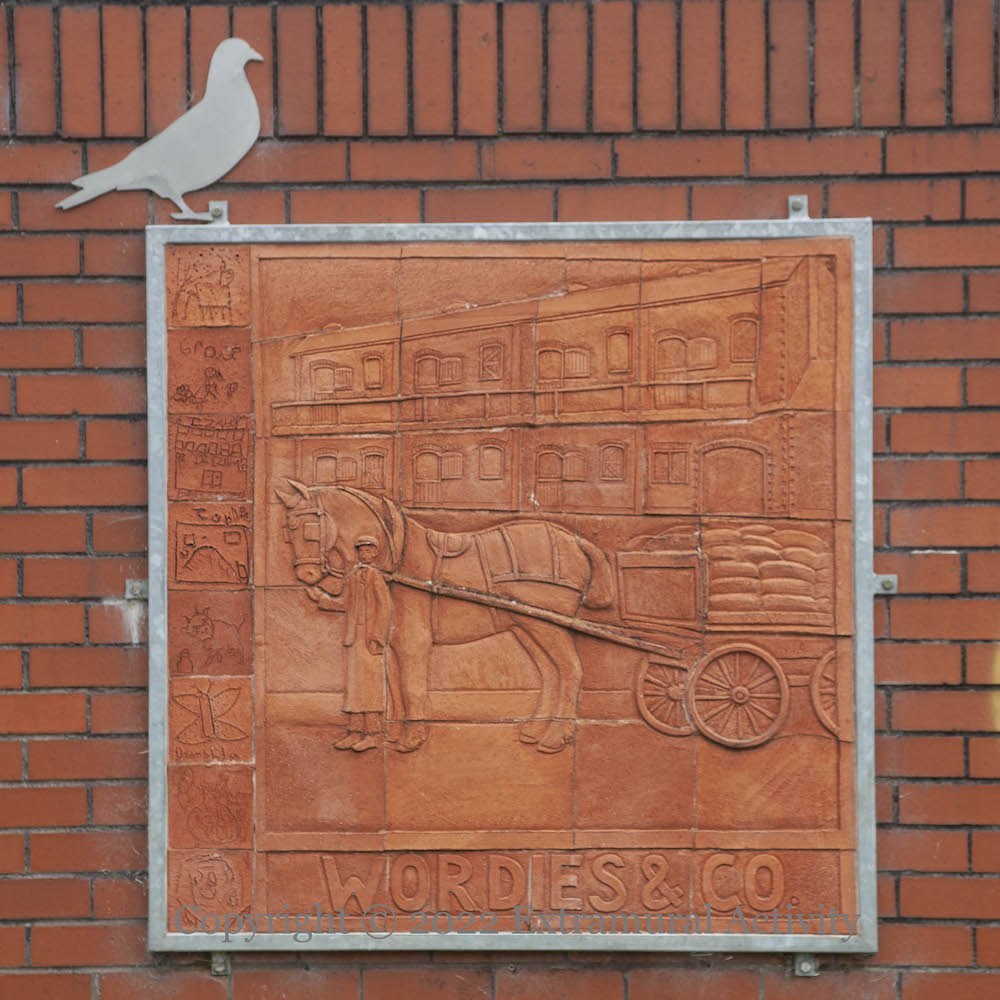
According to a history of Brown’s Square, the area was known as “the oasis” during WWII on account of its 3 dance-halls and 22 pubs (Religion, Riots And Rebels). As with so much publicly-funded art (though we cannot find any provenance for this art) it depicts Belfast in the “good old days” – that is, before the Troubles, which produced the so-called “peace line” dividing west Belfast.
In this case of Brown’s Square, the area was further desolated in anticipation of a planned ring road (formally to be known as the Belfast Urban Motorway). the plan produced only the subterranean “Westlink” that cut Brown’s Square in half. The images in today’s post are in Townsend Street, (these are from below the security gates; there are others above it). Before the construction of the Westlink, which opened in 1981, Townsend Street was considered the western border, and part of Brown’s Square. John Gilbert’s photographs at the Belfast Archive Project show the area in the mid-seventies, when much of it had been abandoned but prior to construction.
The Boys Brigade are shown parading in front of Townsend Presbyterian which held its last service in September and is being handed over to the Ulster Orchestra (Belfast Media) (see previously On The Other Side for stained glass windows inside the church). The Brown’s Square school was at the junction of Brown’s Square (the street) and Melbourne Street.













 Extramural Activity