Derry INLA man Neil McMonagle – who died in February 1983 – is placed among the seven signatories of the proclamation of the provisional government of the Irish Republic.
For more information about his life, see previously McMonagle.
The board was launched on January 31st, 2016, just before the anniversary of McMonagle’s death (Derry Now).
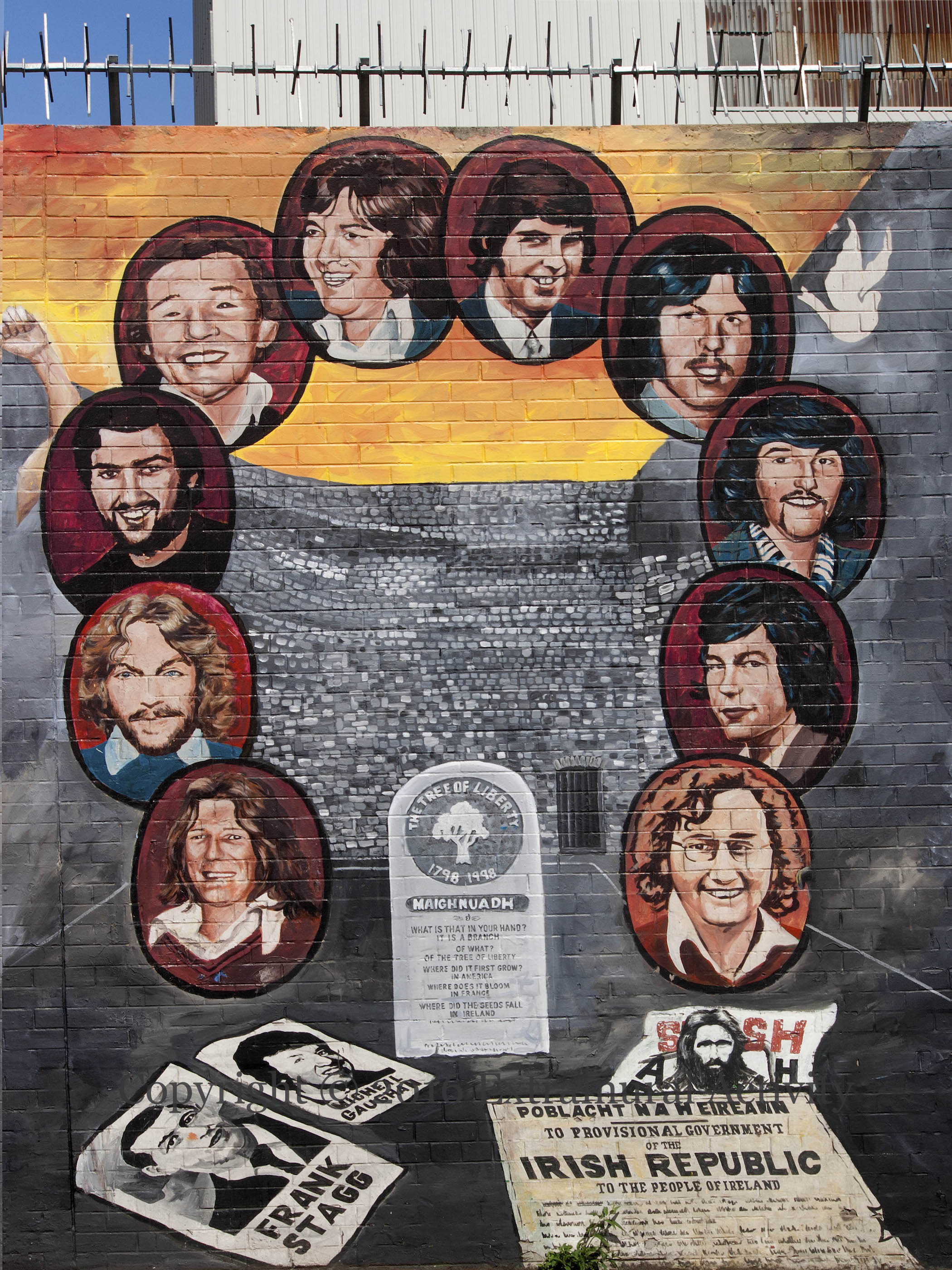
This part of the new mural on the International Wall uses the area of Kilmainham jail where most of the leaders of the Easter Rising were executed in order to tie together the blanket protest – Kieran Nugent and Maıréad Farrell are shown with raised fists – the hunger strikers – including Frank Stagg and Michael Gaughan on the ground – and Roger Casement, walking towards the gallows. Casement was executed not in Kilmainham but in Pentonville Prison, England, convicted of treason for his attempts to secure German rifles and machine-guns for the Rising.
Between Bobby Sands and Mickey Devine in the lower centre of the image is a 200th-anniversary stone in Maynooth/Maıgh Nuad(h) of the 1798 rising. A photograph of the stone is available here. “The Tree Of Liberty: What is that in your hand? It is a branch. Of what? Of the tree of liberty. Where did it first grow? In America. Where does it bloom? In France. Where did the seeds fall? In Ireland.”
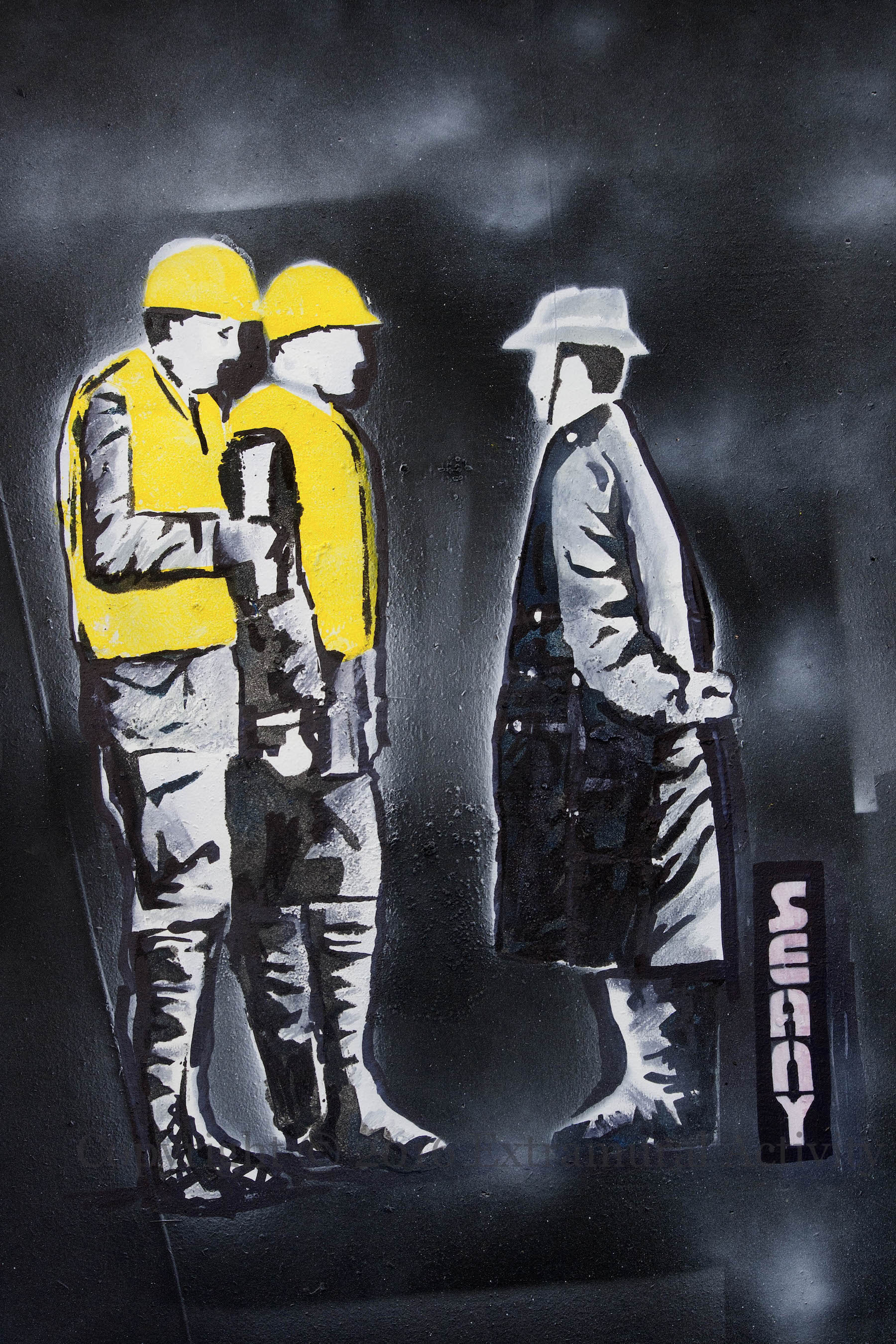
In January (2016) a stencil like the one above appeared in Moore Street, Dublin. Moore Street was the place of the last stand of the Easter Rising after the GPO caught fire and campaigners were thus fighting to save it from redevelopment (Irish Times). (Moore Street’s future is still uncertain at this time, late summer 2016.)
The stencil is based on a photograph of Padraig Pearse and Elizabeth O’Farrell surrendering to the British General Lowe. The piece was ‘signed’ by Banksy, though it was immediately suspected to be not by Banksy, as he had not signed any pieces for some years, and indeed, Banksy denied that it was his (e.g. Irish Times) and Will St Ledger wished that the artist had had the confidence to claim it as their own (RTÉ).
The artist was in fact Short Strand man Séan “Seany” McVeigh, who then died in June. In honour of his life, a fellow Short Strand resident (see second image, below) produced this version of McVeigh’s piece, with the name “Seany” proudly attached. (For his other “Banksy” see a Belfast version of Banksy’s Palestinian “peace” wall stencil.)
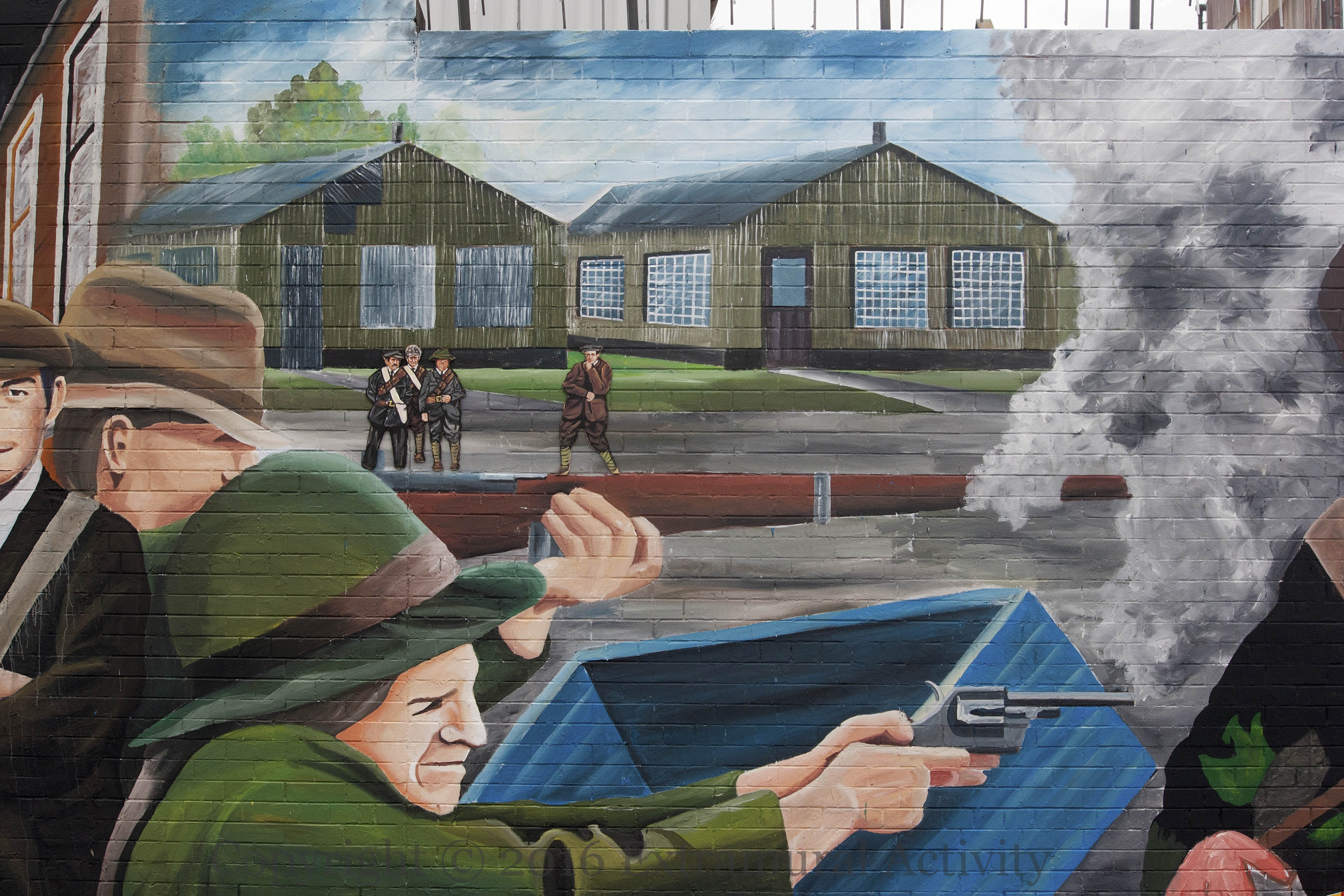
The old military huts at Willow Bank (or: Willowbank; the modern-day La Salle/Iveagh area on the Falls) – which were still in use in 1896 – provided a training ground for Cumann Na mBan and the Irish Volunteers in the run-up to the Easter Rising.
The small figures between the huts and the trainees in the foreground are Charlie Monahan (born in Ballymacarrett, raised in the Markets, who died in a car accident on the way to meet Casement’s arms on board the Aud (findagrave | An Phoblacht)), Manus O’Boyle (BMH witness statement), Jack White (who fought for Britain in the second Boer War and was later captain in the Irish Citizen Army (WP)), and Volunteer Sean O’Neill.
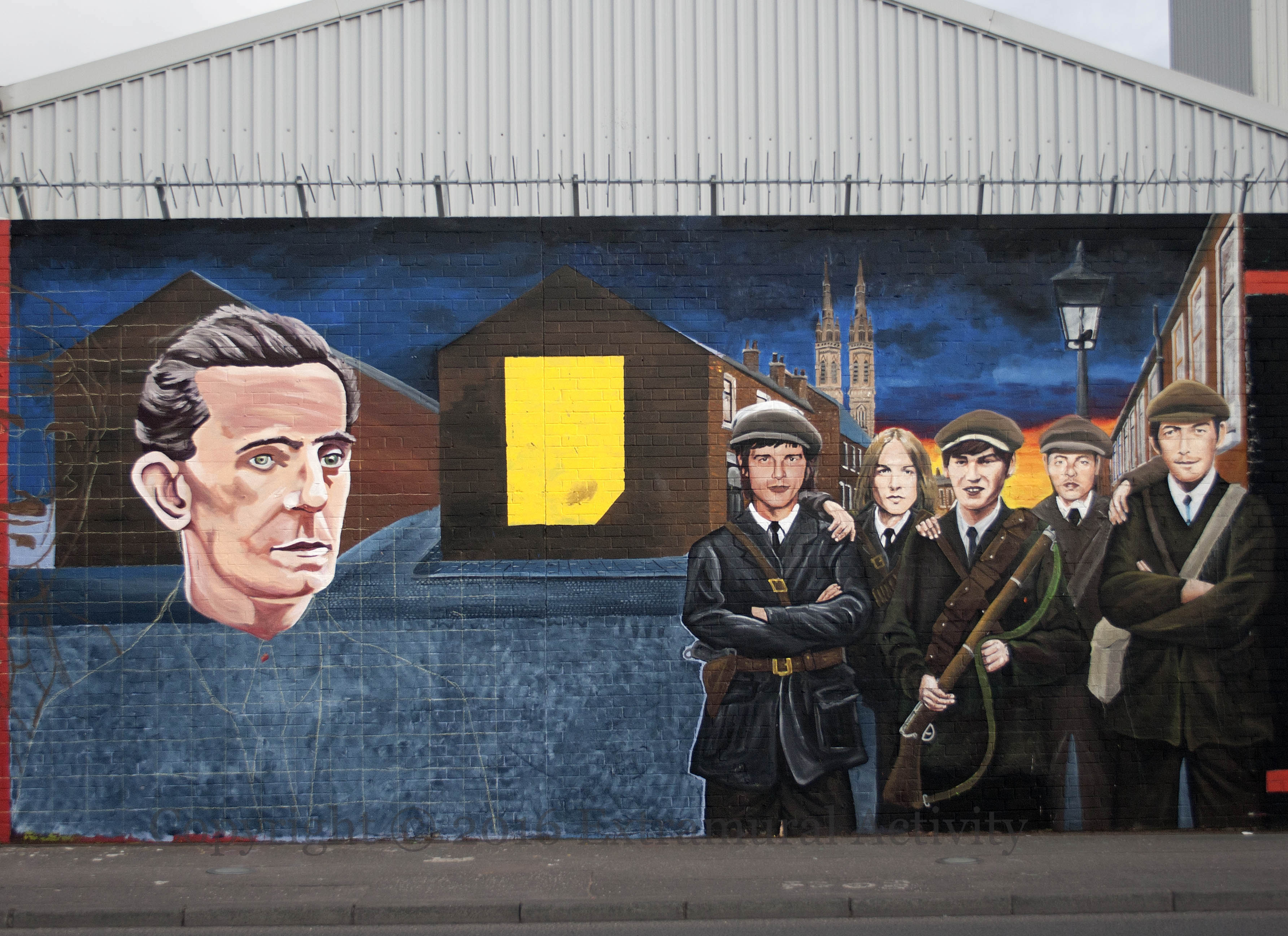
Seán Mac Dıarmada was born in Leitrim but worked on the trams in Belfast in 1905. He also, as member and organiser for many nationalist groups, including Sınn Féın (formed in 1905) and the Irish Republican Brotherhood. He is shown here speaking on Clonard Street in the lower Falls, in 1906, flanked by fellow Brothers Denis McCullough (l) and Bulmer Hobson (r), both from Belfast. (For a brief account of MacDıarmada’s life, see this previous mural on Extramural Activity The Mainspring, which shows MacDıarmada delivering his speech from the back of a coal cart, and also this Saoirse32 post. See also MacDıarmada for a board near where he lived in Ardoyne.
The other part of the picture illustrates the use of magic lanterns to display images on gable walls to spread nationalist history and ideology. On one wall is Eoın MacNeill’s article ‘The North Began’ (which also features earlier on the new wall; see Shared Space and We Won’t Have Carson. On the other wall is an image of An Gorta Mór/The Great Hunger. (Magic lanterns were used by Alice Milligan (NWCI | Field Day | also a kids version from Creative Centenaries) when she gave talks; for her newspaper work, see Shan Van Vocht.)
The image below shows that there were originally (or at least, in April) plans for a two larger faces to be featured.
The old Nissen huts of Long Kesh are rendered in cartoon style of this ‘march against internment’ poster, which has been plastered over a commercial hoarding on Northumberland Street.
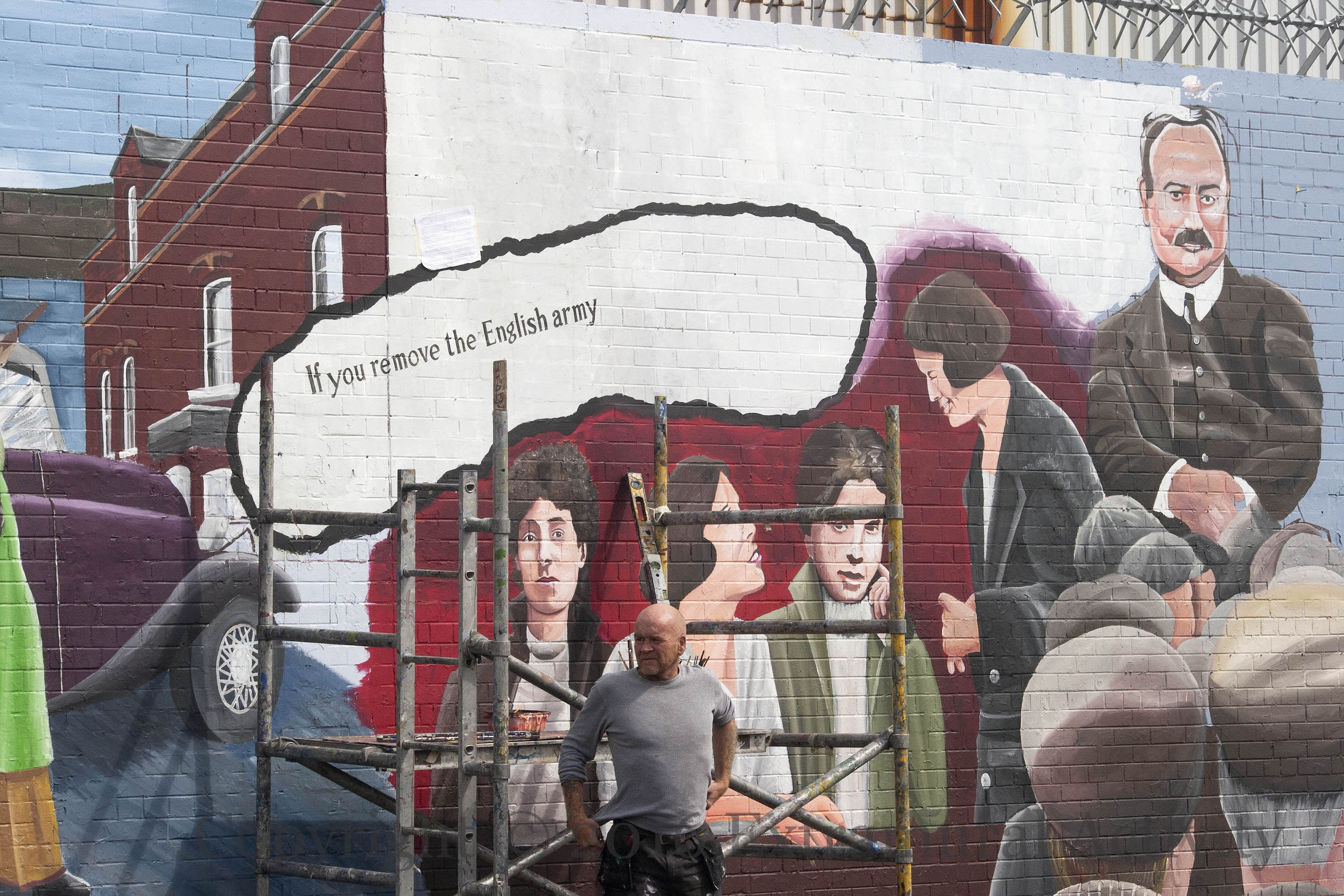
Ethna Carbery (the left-most of the four female figures, who wrote the song Roddy McCorley) and Alice Milligan (with her hand to her face) together founded both The Northern Patriot and The Shan Van Vocht (“the poor, old, woman,” i.e. Ireland), the latter being a monthly socialist newspaper that ran from 1896 until 1899 and included some early writings by James Connolly (pictured on the right of the mural), such as the piece “Socialism And Nationalism” which appeared in The Shan Van Vocht in January, 1897 and from which the quotation on the wall is taken: “If you remove the English army to-morrow and hoist the green flag over Dublin Castle, unless you set about the organisation of the Socialist Republic, your efforts would be in vain.” (For the passage in broader context, see (previously) If You Remove The English Army Tomorrow.)
The other two women shown are Elizabeth (seated second) and Nell Corr (standing), Cumann Na mBan members from the Ormeau Road in Belfast, who were in Dublin on the morning of the Rising but headed north. (For more information and a mural depicting the political complexity of their family, see previously The Corrs.)
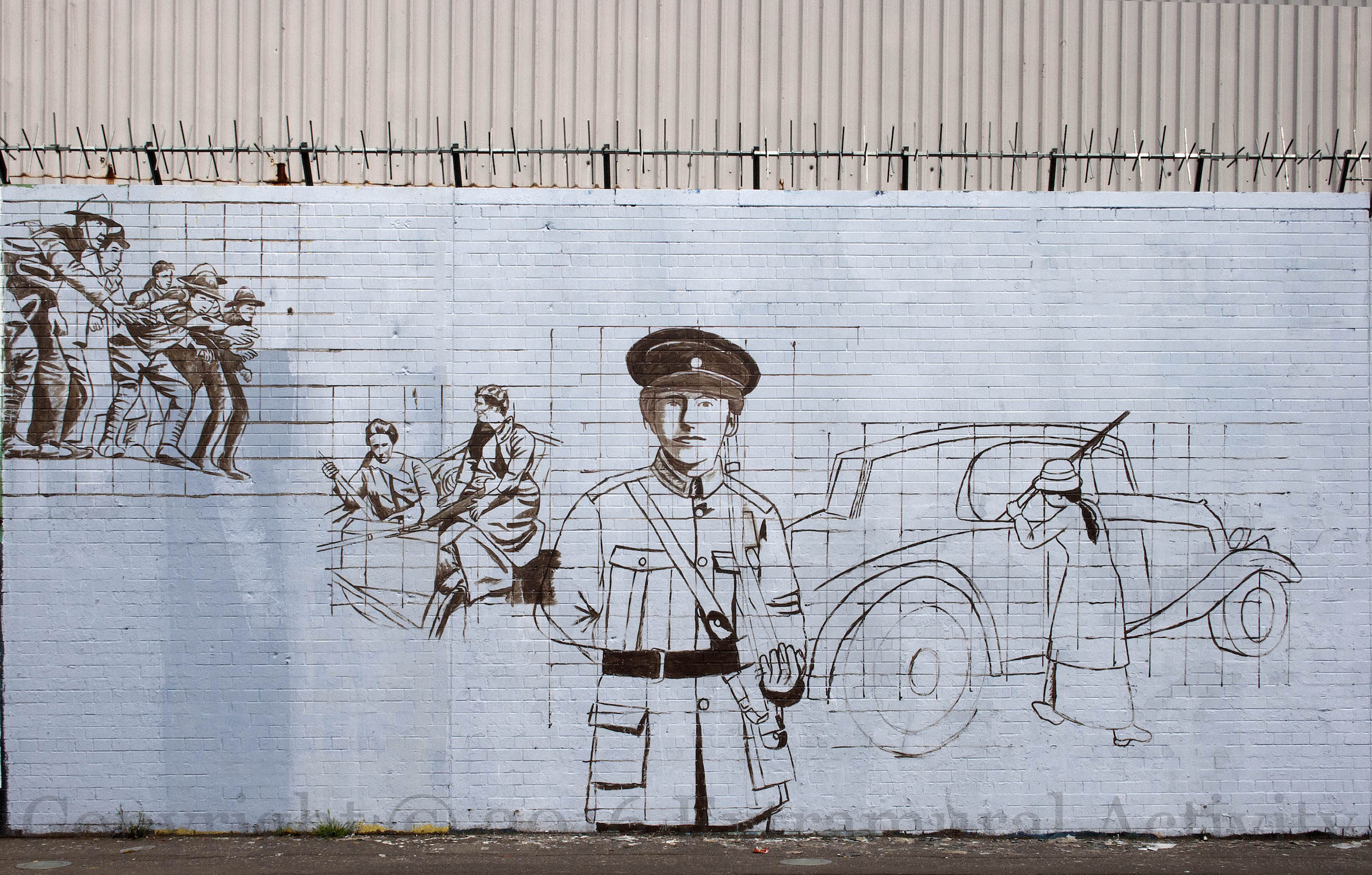
Nora Connolly in her Cumann Na mBan uniform is the centre point of the ‘Howth Gun-Running’ panel in the new mural on the International Wall. Her sister, Ina, is shown to the right, unloading a rifle from a car outside their home in Glenalina Terrace. About 1,500 rifles were smuggled into Ireland on two boats, 900 of them on the yacht, Asgard, shown left-of-centre with Molly Childers and Mary Spring Rice aboard (the latter kept a diary of the trip; extracts are included in this RTÉ History Show video). Asgard docked at Howth on July 26th, 1914. (Here is a tcd.ie collection of images of Asgard’s journey; image #53 is the one reproduced in the mural). The other rifles eventually came ashore two weeks later at Kilcoole. (See this RTÉ article for an account of their tortured journey.)
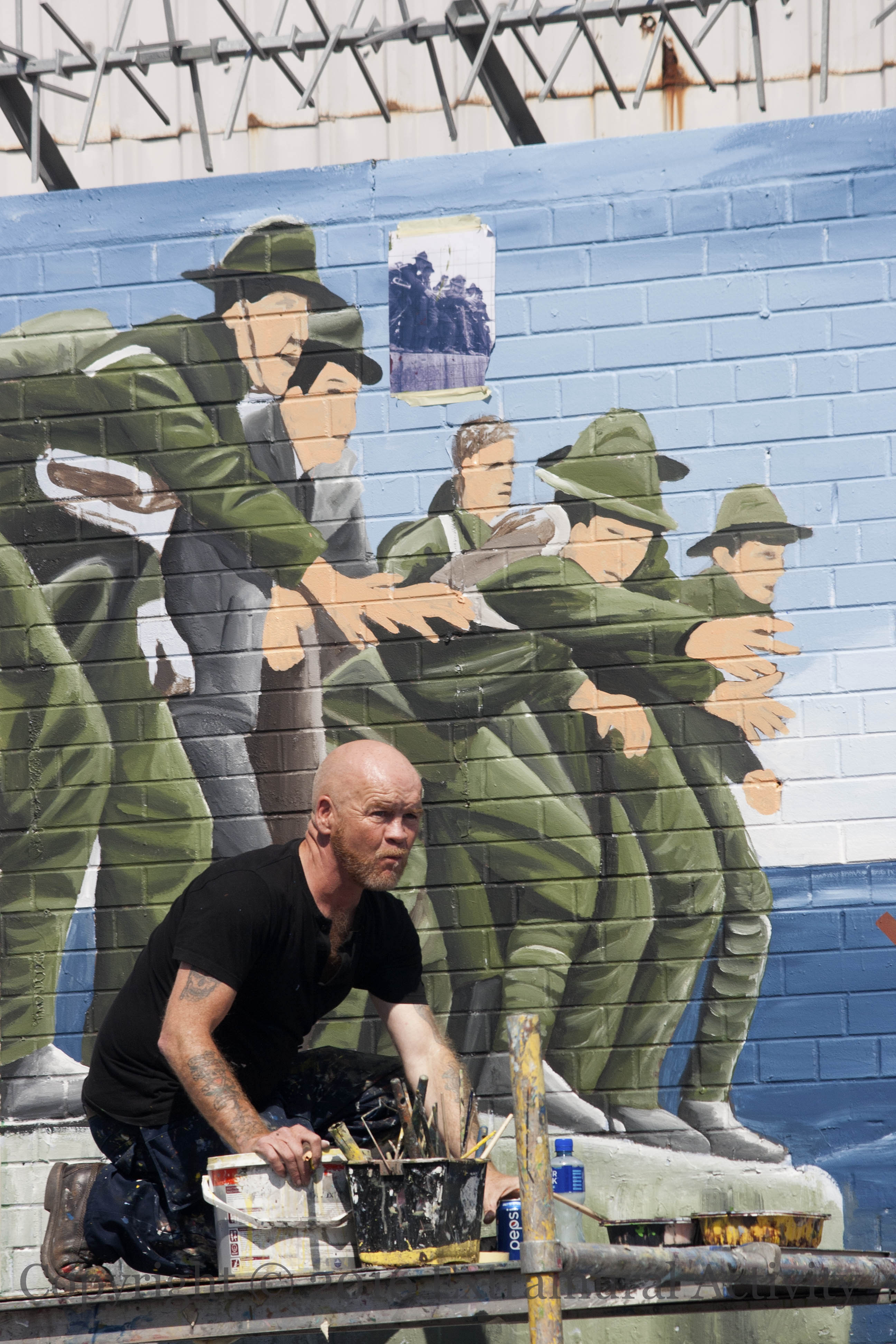
The vintage Mauser rifles were received by members of Óglaıgh Na hÉıreann and Na Fıanna Éıreann (top left of the image above; here is the original photograph). The off-loading took place during the day but when the police and army met the marching volunteers at Clontarf they were able to capture only 19 rifles. As the army regiment involved returned to barracks it was pelted with stones or fruit by a crowd and killed three (with a fourth dying a week later), as recorded on the front page of the Irish Independent in the bottom left.
Below are two in-progress shots, and below those, two shots including the artist, Marty Lyons.
The tarp says féıle is “a year round cultural experience” but the main event is still the Gasyard Féıle in August. This year’s féıle included a screening of the film 66 Days (Derry Now). The festival ends on the 18th. (Final night write-up from Derry Journal.)












 Extramural Activity