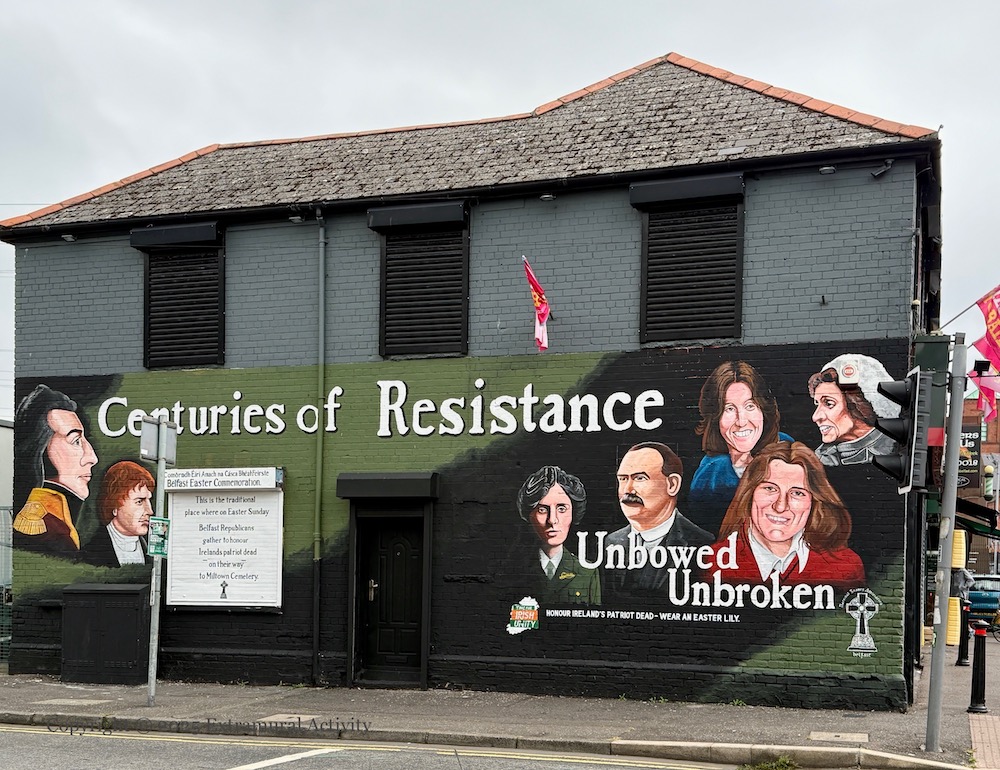
Centuries Of Resistance

The United Kingdom Of Great Britain And Ireland was created in 1801, a reaction to the 1798 Rebellion, led by (amongst others) Wolfe Tone and Henry Joy McCracken, the pair also being founding members of the Society Of United Irishmen in 1791 in Belfast.

In this mural, Tone and McCracken on the left gaze across the “centuries of resistance” from 1798 to 1916 Rising revolutionaries Countess Markievicz and James Connolly, and beyond to Troubles-era figures Maıréad Farrell, Bobby Sands, and Máıre Drumm.

Around the same time as this mural was painted, a Féıle exhibition called ‘Vibrant Colours, Violent Past’ included A Panorama Of Republicanism which contains dozens of figures but again chooses 1798/Tone, 1916/Connolly, and the Troubles/Martin McGuinness as the pivotal moments and figures.

“Comóradh Éırí Amach Na Cásca Bhéal Feırste/Belfast Easter Commemoration. This is the traditional place where on Easter Sunday Belfast republicans gather to honour Ireland’s patriot dead on their way to Milltown Cemetery.” “Honour Ireland’s patriot dead – wear an Easter lily.” “Unbowed, unbroken.”

The Beeechmount-Falls Corner has its own Visual History page, as the most-often painted wall in Belfast.

Click image to enlarge
Copyright © 2025 Seosamh Mac Coılle
X15713 X15712 X15711

Gaırdín Na hÉıreann

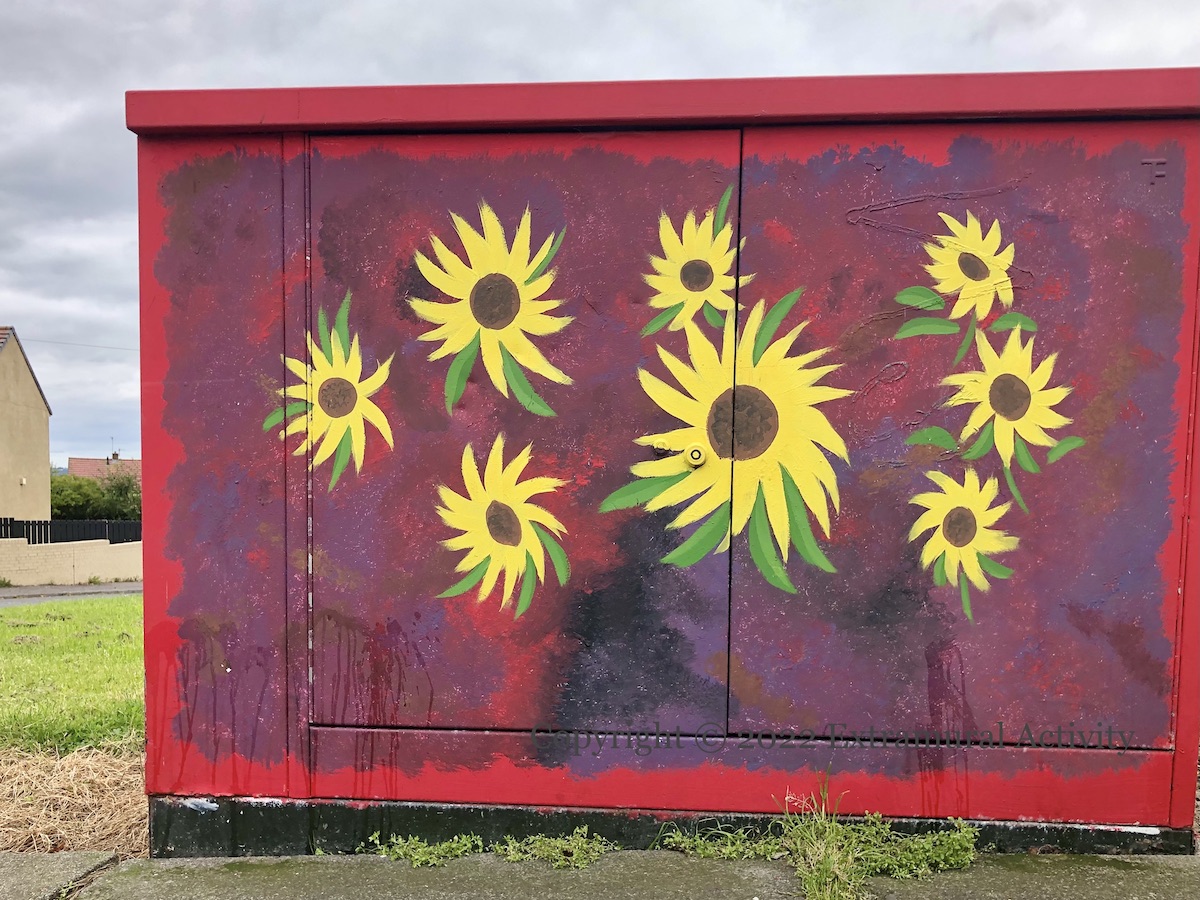
Plants provide symbols of, and metaphors for, rebellion. In America, 1775, Paine wrote of the Liberty Tree which Americans must rise to defend against “Kings, Commons and Lords” and Jefferson would later write (in a 1787 letter) that “The tree of liberty must be refreshed from time to time with the blood of patriots and tyrants.” In Ireland, the tree of liberty was borrowed for the 1798 rebellion (see Where Did The Seeds Fall?“) and although t more familiar symbol of the 1798 Rebellion is the pike, the shamrock is thought to be included as one of the objects in the Wearing Of The Green: Boucicault’s version begins “Oh, Paddy, dear, an’ did you hear the news that’s goin’ round?/The shamrock is forbid by law to grow on Irish ground.” The lily, of course, is a symbol of the 1916 Rising, though it is shown here growing between sunflowers and a rose.

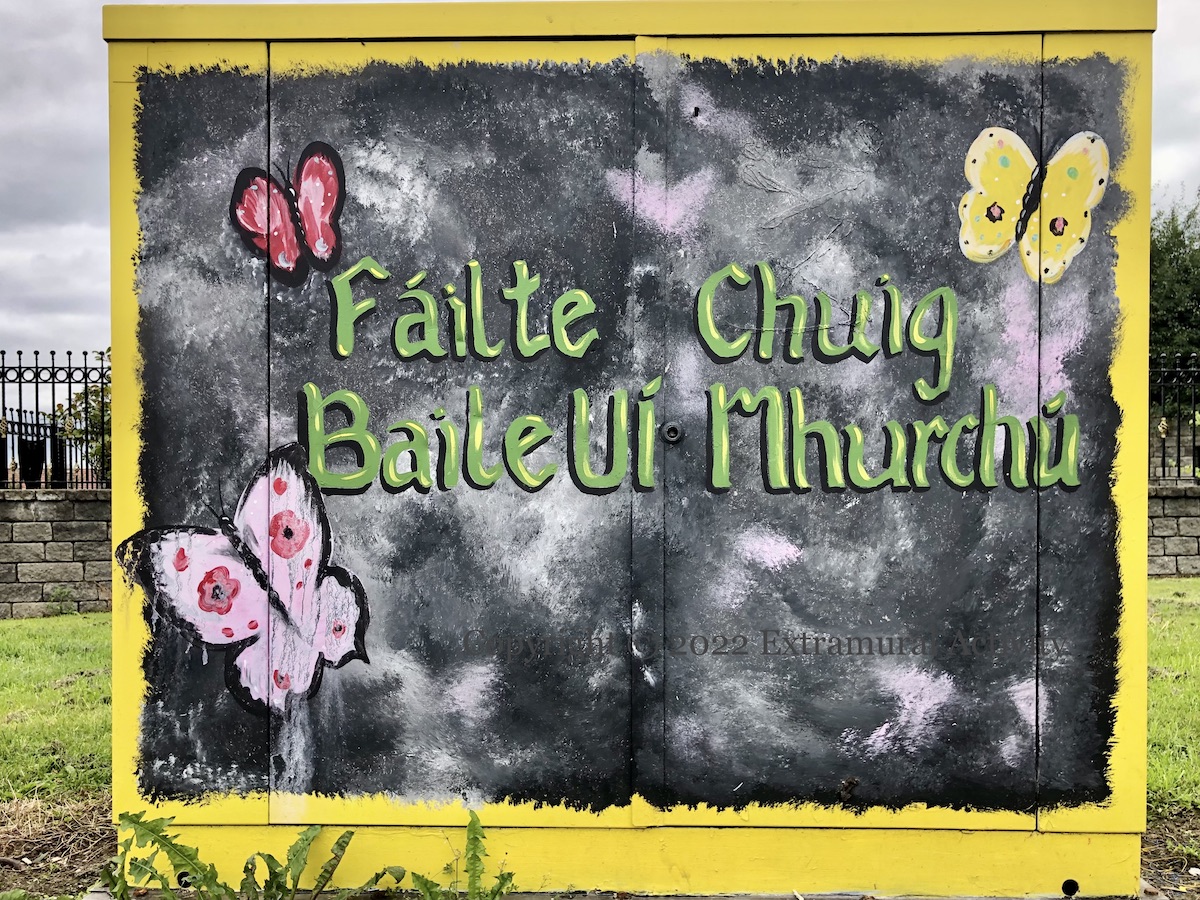
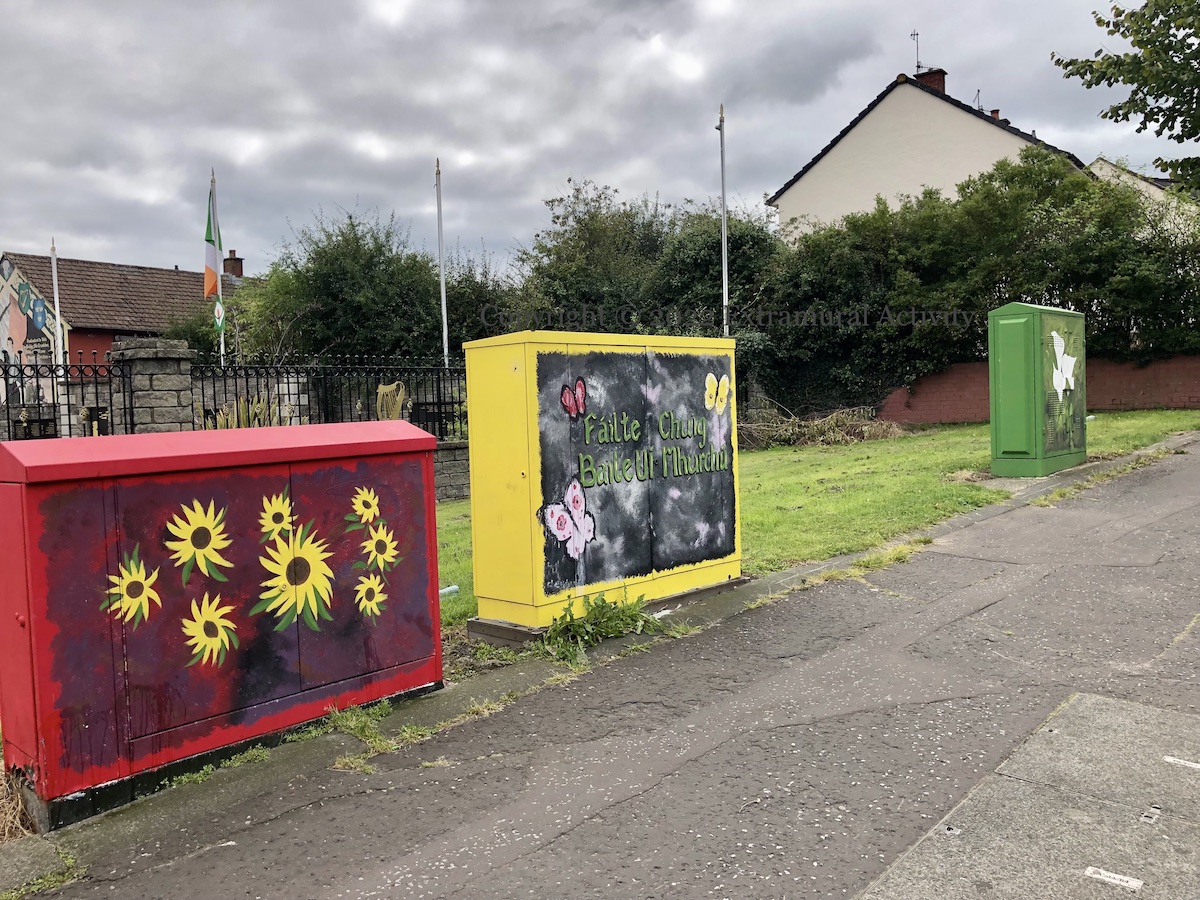
These painted electrical boxes are in Westrock and Ballymurphy (“Fáılte chuıg Baıle Uí Mhurchú”).

Click image to enlarge
Copyright © 2022 Seosamh Mac Coılle
X11514 X11516 X11517 X11518 X11519 X11520 X11521 X11522 X11524 X11515

England, The Never-Failing Source Of All Our Political Evils

“‘To unite Protestant, Catholic and Dissenter under the common name of Irishmen in order to break the connection with England, the never failing source of all our political evils, that was my aim’ (Theobald Wolfe Tone, 1763-1798)”. As the dates suggest, Tone was captured and sentenced to death; his exact cause of death is uncertain – perhaps a self-inflicted knife to the throat, or a bullet to the throat. The other portraits are of Michael Dywer [should be “Dwyer”], Lord Edward Fitzgerald, Anne Devlin, Mary Anne McCracken, Betsy Gray, Fr. John Murphy, William Orr, Robert Emmet, Henry-Joy McCracken, and Jeremiah O’Donovan Rossa.

Ard An Lao/Ardilea, Machaıre Botháın/the Bone, Ard Eoın/Ardoyne

Click image to enlarge
Copyright © 2021 Seosamh Mac Coılle
X08358

Her Old Tradition Of Nationhood

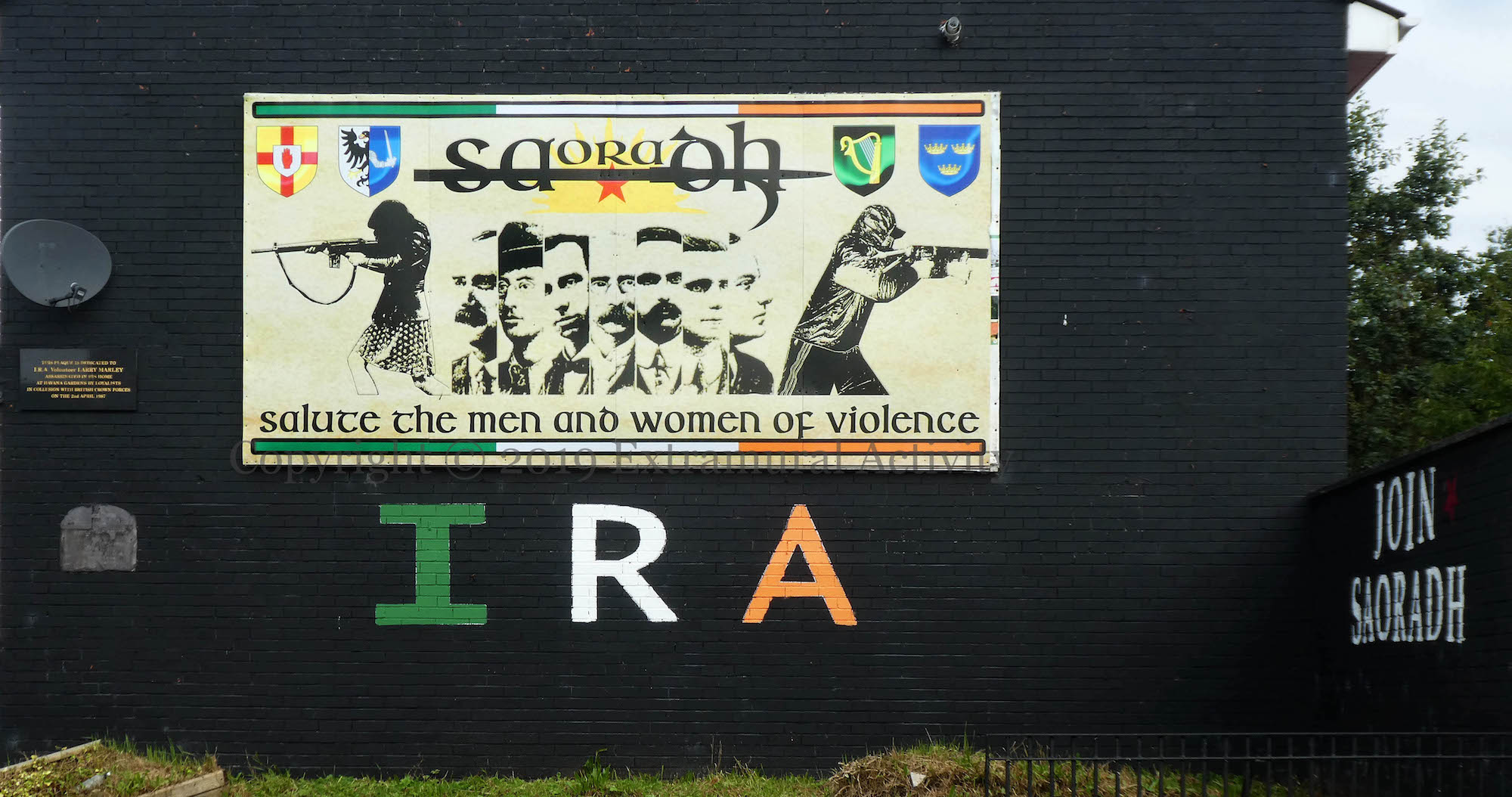
“Saoradh salute the men and women of violence,” namely the signatories to the 1916 Proclamation, the women of the 1970s IRA, and modern “dissidents” with home-made weapons.

The plaque on the left is to the IRA’s Pearse Jordan, next to the centenary celebration of the Proclamation, Ag Fíorú Na Poblachta. The board was been moved to this Falls Road location from Ardoyne; it replaces an anti-RUC/PSNI mural.

Click image to enlarge
Copyright © 2020 Seosamh Mac Coılle
X06993

Death Dealers

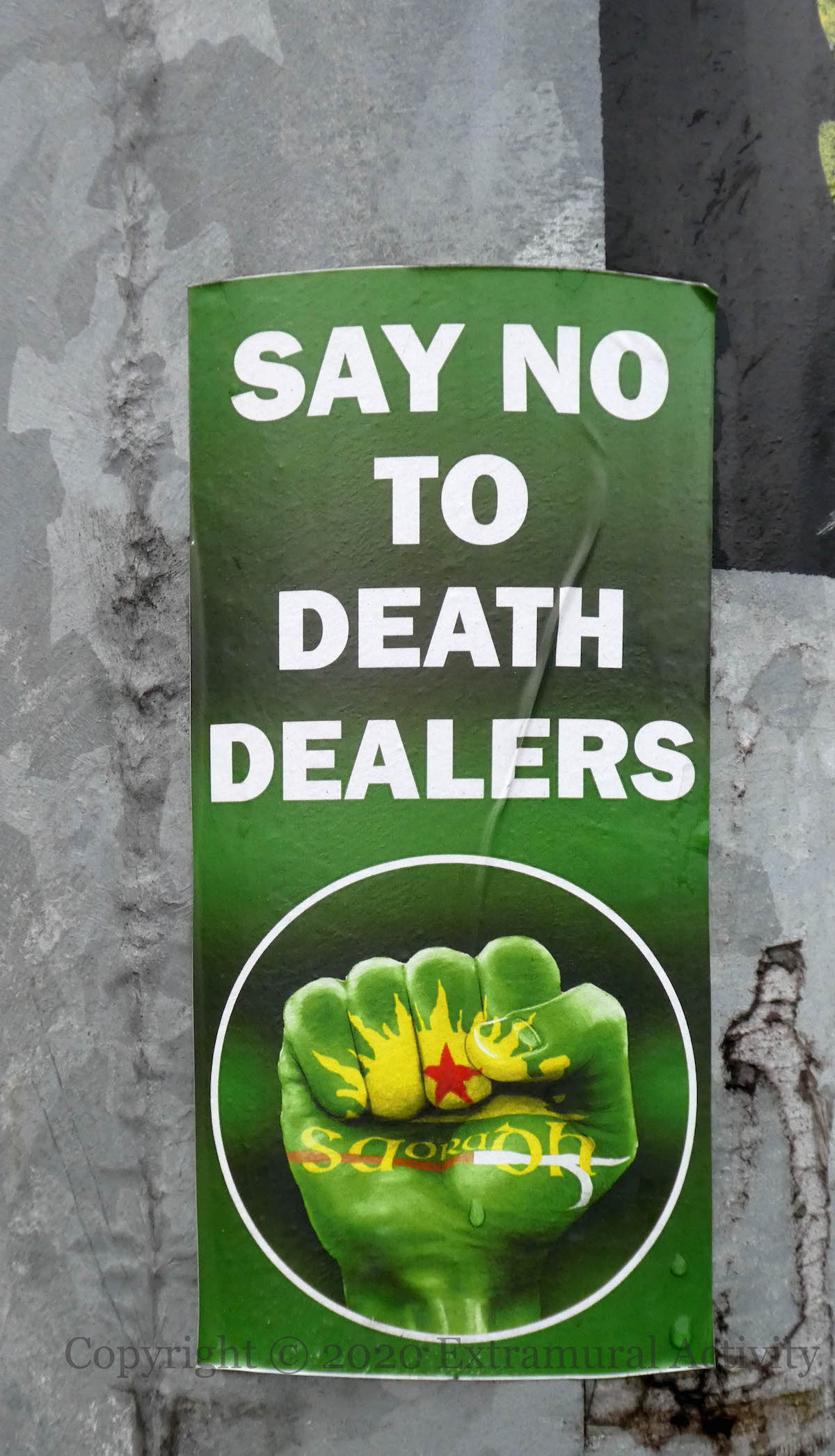
“Say no to death dealers”. Saoradh sticker on Divis Street, west Belfast, against drug dealers.

Click image to enlarge
Copyright © 2020 Seosamh Mac Coılle
X06976

The Men And Women Of Violence

“Saoradh salute the men and women of violence.” Namely the signatories to the 1916 Proclamation, the women of the 1970s IRA, and modern “dissidents” with home-made weapons. Saoradh currently (mid-late 2019, in the wake of the death of Lyra McKee) no longer has a web site or Twitter feed, and the Belfast and Derry section’s Facebook pages are non-existent (other section’s pages are still up, including Tyrone, Dublin, and Munster).

On the same wall as the Larry Marley plaque.

Click image to enlarge
Copyright © 2019 Seosamh Mac Coılle
X06831

Murdered By Those Who Followed In Their Footsteps

The “Provisional” split from the IRA in early 1970 and the feud between the Provos and the “Official” IRA went on intermittently throughout the 70s. This board on Teach Oisín in the New Lodge commemorates three local OIRA members who were (or, were thought) killed in the feud (John) Mario Kelly was killed in Newington near his home in November 1975. Trever [Trevor] McNulty, education officer for the Republican Clubs and OIRA, was shot by the Provisionals in the entrance hall of Alexander House (later Teach Fhinn) in the New Lodge. 11 people, mostly OIRA, died in the feud in the two weeks from the tail end of October into November (CAIN). The third person shown is Patric​k​ McGreevy from Carlisle Square, a youth member aged 15 or 16 (hence the Gal Gréine) who was shot from a passing car outside a café on Clifton St​reet. Originally his killing was thought to be part of the feud (which explains his inclusion here), but it is now generally accepted that he was shot by the UVF (Lost Lives). 

The genealogy of the republican movement goes through the pike-men (silhouettes on the left and right) of 1798 and 1803 to the Easter Rising (the quote from James Connolly: “The cause of labour is the cause of Ireland and the cause of Ireland is the cause of labour”)

Click image to enlarge
Copyright © 2019 Seosamh Mac Coılle
X06640

Make Partition History

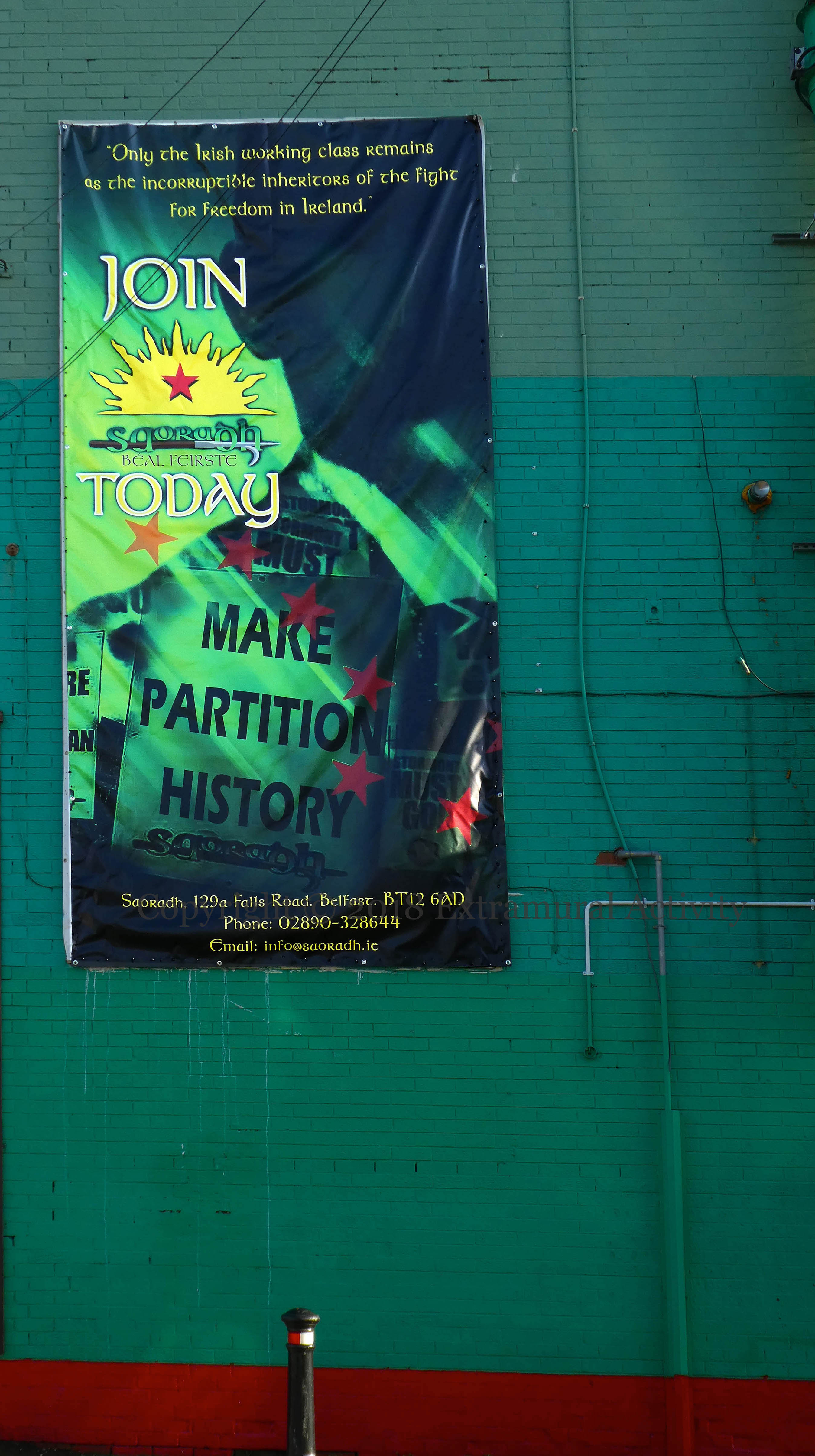
The Thames Street wall of Salvezza’s pizzeria doesn’t allow for full murals because of a giant flue, but Saoradh (web | fb) are making the most of the space with long vertical tarps. The quote on the tarp above (new for 2018) is from James Connolly, from his foreword to Labour In Irish History: “Only the Irish working class remains as the incorruptible inheritors of the fight for freedom in Ireland.”

The tarp that hung for most of 2017 is included below.

Click image to enlarge
Copyright © 2017 Seosamh Mac Coılle
X04768 X04505

Join Today

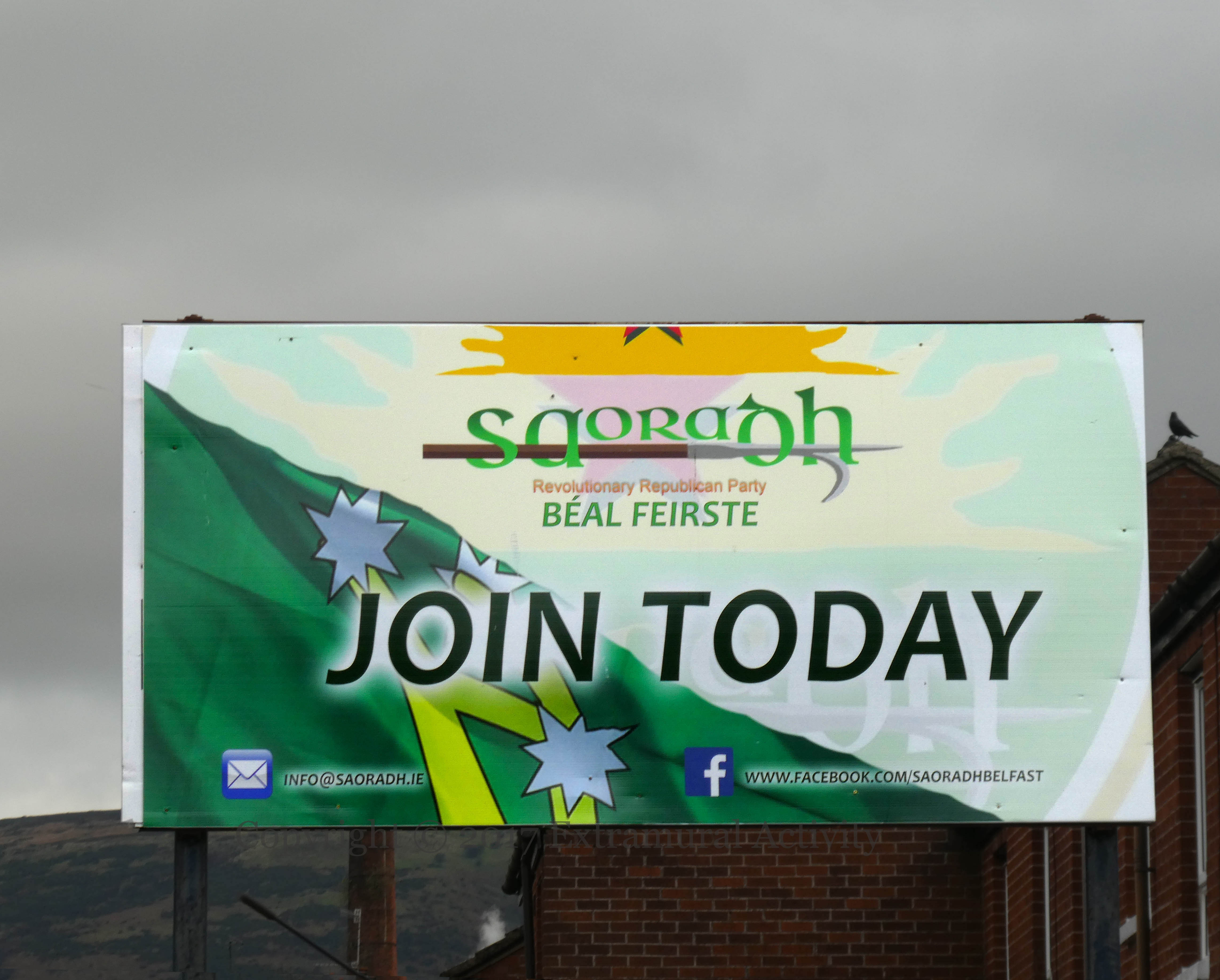
This Ardoyne hoarding for Saoradh the “revolutionary republican party ” (web | fb), uses a pike (for 1798 Rebellion), the Sunburst (traditionally used by Fıanna Éıreann), and the Starry Plough (from the Irish Citizen Army of the Easter Rising). Cut off at the top is a red star of socialism.

Click image to enlarge
Copyright © 2017 Seosamh Mac Coılle
X04664 havana way

The Battle Of Antrim

2014-03-04 BattleAntrimClose+

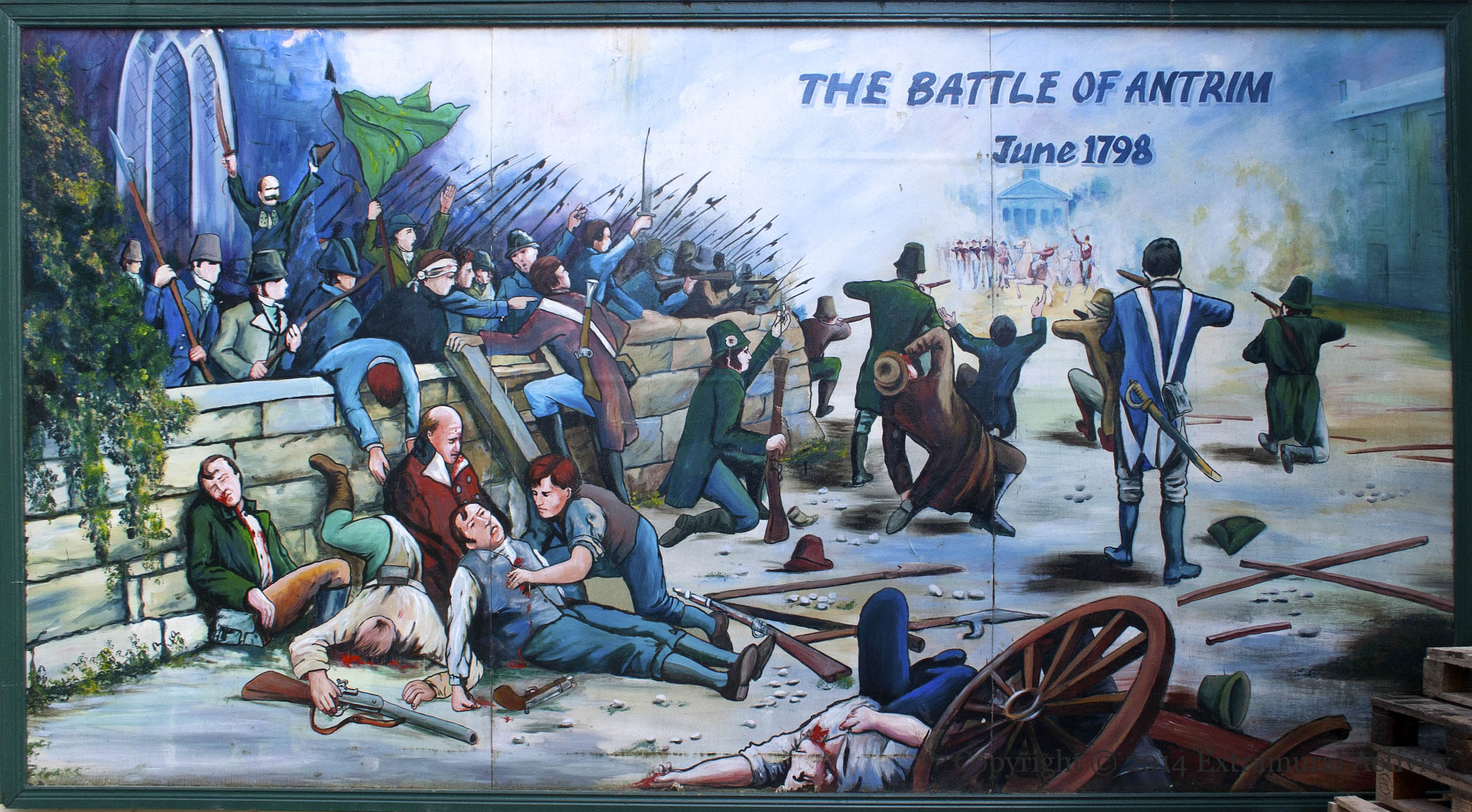
The Battle of Antrim took place on June 7th, 1798, as part of the Irish Rebellion of that summer. Led in the North by the Protestant Henry Joy McCracken, the rebellion met with initial successes in smaller towns, before failing in Antrim. In the full shot, below, the British soldiers can be seen in the distance.

The board above is in the grounds of The Roddy’s, a social club named after Roddy McCorley, another Protestant member of the United Irishmen, most famous for the song written about his hanging at the bridge of Toome in 1800. (Here’s a version by Tommy Makem.)

2014-03-04 BattleAntrimFull+

Click image to enlarge
Copyright © 2014 Seosamh Mac Coılle
X01718 X01719